

Iron ore · Mine profile
Carajás Mine in Brazil: Output, Grade and Expansion
Carajás is Vale’s iron ore complex in Pará, Brazil. Its Northern System produced 170.2 Mt in 2025, just over half of Vale’s 336 Mt, and S11D set a record 86.0 Mt. See output by pit, grade, rail route and expansion plans.
Key takeaways
- Vale’s Northern System, which holds the Carajás pits, produced 170.2 Mt of iron ore in 2025, down 3.1% from 175.7 Mt in 2024 (Vale, January 2026).
- S11D made a record 86.0 Mt in 2025 and now outproduces Serra Norte and Serra Leste combined at 84.1 Mt (Vale, January 2026).
- S11D is designed for more than 90 Mt a year at 66.7% Fe, against a 62% Fe price benchmark of US$90.83 a tonne on 23 October 2026 (Mining Technology; Trading Economics).
- Brazil mined an estimated 420 Mt of usable iron ore in 2025, second to Australia’s 980 Mt (USGS, February 2026).
- Novo Carajás targets 200 Mt a year of regional capacity by 2030 with R$70 billion of spending; Serra Sul +20 Mtpa is due to start in the second half of 2026 (Reuters via InfoMoney, September 2025; Vale, 2Q26).
In this article
- Carajás mine facts: location, owner and output
- Where the Carajás mine is and how the ore formed
- Carajás iron ore production by mine
- S11D: the truckless mine inside Carajás
- From mine to ship: the Carajás railway and port
- Carajás iron ore price and a revenue calculator
- The Novo Carajás expansion plan
- Environment and the Carajás National Forest
- Reading mines like Carajás from space
- Frequently asked questions
Carajás mine facts: location, owner and output
The Carajás mine is a group of open-pit iron ore operations in the state of Pará, northern Brazil, owned and run by Vale S.A. Vale’s Northern System, which holds the Carajás pits, produced 170.2 million tonnes (Mt) of iron ore in 2025, just over half of the company’s 336 Mt total (Vale production report, 4Q25, January 2026). Its newest pit, S11D, set a record at 86.0 Mt. Mining Technology calls Carajás the world’s largest iron ore mine, and the ore is high in iron, with project averages above 65% Fe (iron content, the share of iron by weight).
Chart
Iron ore mine production by country, 2025 (estimate)
Million tonnes of usable ore, selected producers, not a ranking; other producers not shown
This page gives the numbers a buyer, investor or consultant asks for first: how much the complex produces, how the output is split between mines, what the ore grades, how it reaches the sea, what it is worth per tonne, and what Vale plans next. Every figure has a date and a source.
| Item | Fact | Source and date |
|---|---|---|
| Owner and operator | Vale S.A., fully owned | Mining Technology project profile |
| Location | Carajás mountains, Pará state, northern Brazil | Mining Technology project profile |
| Northern System output, 2025 | 170.2 Mt of iron ore (175.7 Mt in 2024) | Vale 4Q25 production report |
| S11D output, 2025 | 86.0 Mt, a record (83.0 Mt in 2024) | Vale 4Q25 production report |
| S11D design capacity and grade | More than 90 Mt a year at 66.7% Fe | Mining Technology project profile |
| Railway and port | Carajás railway to Ponta da Madeira terminal, São Luís (opened 1985) | Railway Gazette |
| Expansion target | 200 Mt a year of capacity in the Carajás region by 2030 | Reuters via InfoMoney, September 2025 |
Where Brazil sits among iron ore producers
Brazil mined an estimated 420 Mt of usable iron ore in 2025, second only to Australia’s 980 Mt, out of a world total of about 2.6 billion tonnes (USGS Mineral Commodity Summaries 2026). That is roughly 16% of world output. USGS puts Brazil’s reserves at 34 billion tonnes of crude ore holding 15 billion tonnes of contained iron. Carajás is the single biggest source of that Brazilian ore, but not the only one: Vale also mines in Minas Gerais, in its Southeastern and Southern Systems, and other companies operate in Brazil too.
Where the Carajás mine is and how the ore formed
The pits sit in the Carajás mountains of Pará. Mining Technology places the ore in Archaean iron formations, rocks more than 2.5 billion years old. These are banded iron formations, thin layers of iron-rich and silica-rich rock laid down in ancient seas. Mining Technology describes weathering that reaches 100 to 150 m deep in the volcanic sequence and oxidation down to about 500 m in the iron formations. The upper 80% of the reserve is soft, crumbly limonite near the surface that passes down into hematite (an iron oxide, Fe2O3) to about 300 m vertical depth.
Chart
Carajás district reserves by range (historical estimate)
Million tonnes of ore, grading 62.8% to 66.3% Fe
That geology explains why the grade is so high. Natural weathering removed much of the silica and left iron behind, so the ore needs little upgrading. Mining Technology quotes known district reserves of about 18 billion tonnes at an average 65.4% Fe (an undated figure; the same page gives 7.2 billion tonnes of proven and probable reserves as of 2009), and gives the production mix as roughly 10% lump and 90% fines. Lump is coarse ore that goes straight to a blast furnace. Fines are fine ore that must be sintered or pelletised first.
Discovery and ownership
Mining Technology reports that the deposit was found by accident in the late 1960s, when a US Steel helicopter landed on a bare hill to refuel and the survey crew noticed the iron content, which later tests put as high as 66%. Brazil would not let a foreign company develop the find alone. In 1970 it set up a joint venture, Amazônia Mineração, owned 51% by Vale and 49% by US Steel, and US Steel sold its share to Vale in 1977 for US$55 million. The Carajás railway opened in 1985 to carry the ore to the coast.
The same page notes that other ores were found in the province later, including manganese, copper, tin, aluminium (bauxite) and gold. If you want to see how copper from this province fits the wider picture, read our guide on where copper is found.
The chart below shows how the district’s quoted reserves split between its ranges. It is a historical third-party estimate, not Vale’s current reserve statement.
Carajás iron ore production by mine
Vale reports the Northern System in two parts. The first is Serra Norte and Serra Leste, the older pits on the northern range. The second is S11D on the southern range, a newer mine built from 2013 to 2016. Vale’s production report for 2025 gives these figures, in million tonnes of iron ore.
Chart
Vale iron ore production by area, 2024 and 2025
Million tonnes of iron ore
| Part of the Northern System | 2024 | 2025 | Change |
|---|---|---|---|
| Serra Norte and Serra Leste | 92.7 | 84.1 | -9.2% |
| S11D | 83.0 | 86.0 | +3.6% |
| Northern System total | 175.7 | 170.2 | -3.1% |
Two things stand out. First, S11D is now larger than the older pits combined. Second, the Northern System fell in 2025 even as Vale’s company total rose, because Vale said run-of-mine availability at Serra Norte was lower. Run-of-mine (ROM) ore is ore as it comes from the pit, before crushing and screening. The pattern held in the first half of 2026: the Northern System made 72.7 Mt against 75.6 Mt a year earlier, with S11D up to 43.3 Mt from 40.3 Mt and Serra Norte and Serra Leste down to 29.5 Mt from 35.3 Mt (Vale production report, 2Q26).
Mid-grade Carajás, a newer product
Vale also sells a blended product it calls Mid-grade Carajás. The company reports sales of 34.6 Mt of it in 2025, up from 14.5 Mt in 2024, and says it is prioritising mid-grade products, blends and concentrates when premiums for high-grade ore are low. The all-in premium in the fourth quarter of 2025 was US$0.9 a tonne, down US$1.2 from the third quarter (US$4.6 a year earlier). That premium is the extra price Vale earns above the 62% Fe benchmark, and it is why grade alone does not set what a tonne is worth.
For a wider look at the ore types and their grades, see our guide to the types of iron ore.
S11D: the truckless mine inside Carajás
S11D, officially the Eliezer Batista Complex, is in Canaã dos Carajás, in the southeast of Pará. Vale opened it in December 2016 after a total investment of US$14.3 billion, of which US$6.4 billion went into the mine and plant and US$7.9 billion into a 101 km rail branch, expansion of the Carajás railway and expansion of the Ponta da Madeira terminal (Mining.com, December 2016). It was named for its place in the S11 orebody, block D. Vale said S11 holds 10 billion tonnes of mineral potential, with blocks C and D holding reserves of 4.24 billion tonnes (Vale figures as reported in 2016).
The design avoids haul trucks. Mobile excavators load mobile crushers, and conveyors, 68 km of them in the mine and plant, carry the ore to the plant. Vale said at the time that this would cut fuel costs by 70% and lower emissions. The plant processes ore at its natural moisture, which Vale said would cut water use by 93% and remove the need for tailings dams. These were the company’s own design claims in 2016; the Mining.com report gives Vale’s targets, not measured results. Vale quoted a target cost of US$7.70 a tonne (C1 cash cost) for ore delivered to the Ponta da Madeira terminal, and said in November 2016 that its company-wide cash cost had fallen to US$12.70 a tonne.
Why the older pits matter less each year
Vale describes the Serra Norte decline as lower, but expected, run-of-mine availability, while S11D keeps rising. Vale’s response is the Serra Sul +20 Mtpa project (Mtpa means million tonnes a year), covered in the expansion section below.
From mine to ship: the Carajás railway and port
Ore does not leave Pará by road. Railway Gazette records that the Carajás railway opened in 1985 to carry iron ore and other minerals from the Serra do Carajás to a deep-water port at Ponta da Madeira near São Luís, in Maranhão state. Vale operates it, and the line was sold to the private sector in 1998. Railway Gazette also lists 113 diesel locomotives and 5,720 freight wagons, with 89.6 billion tonne-km of freight traffic in 2019, and a passenger service of about 0.33 million journeys that year. A tonne-km is one tonne moved one kilometre.
The Carajás mine, the railway and the Ponta da Madeira harbour are grouped by Vale as one system, the Northern Ferrous Minerals System. A cost advantage follows from this setup. Vale’s 2016 target for S11D ore delivered at the terminal was US$7.70 a tonne, which the company said was 41% below its average at that time. Vale also runs a pelletizing plant in São Luís, which was in maintenance in late 2025 while pellet feed was redirected to fines sales.
If you are interested in what the ore ends up in, our guide to the main uses of iron ranks them by steel demand.
▶ What mining adds to an economy: exports, jobs, revenue and the minerals the energy transition needs. · 5:03
Carajás iron ore price and a revenue calculator
Demand comes mostly from steelmaking: world crude steel output was 1,849.4 Mt in 2025, and China made 960.8 Mt of it, about 52% (worldsteel, January 2026). Iron ore trades against a benchmark of 62% Fe fines delivered to China. On 23 October 2026 that benchmark stood at US$90.83 a tonne, down 6.5% over a month and 13.8% over a year (Trading Economics, contract-for-difference series, 23 October 2026). For comparison, Vale’s realised price for iron ore fines averaged US$91.6 a tonne in 2025, against US$95.3 in 2024, and its pellets sold at US$134 a tonne against US$154.6 (Argus Media, 27 January 2026). Realised price is what the company actually received after grade premiums, discounts and freight terms.
Carajás ore averages above the 62% benchmark, so it normally earns a premium per extra point of iron. Contract terms vary, so the calculator below lets you set the premium yourself. It turns tonnes, grade and benchmark price into revenue and margin per year. All prices are examples; enter today’s price from your own source.
Calculator
What is a year of ore worth at your grade and price?
Enter your own tonnes, grade, benchmark price, premium and cost.
- Price per tonne after grade premium (US$): 96.0
- Delivery cost per year (US$ million): $400
- Revenue less delivery cost per year (US$ million): $560
Example values only, not a benchmark. The 62% Fe reference grade is the usual fines benchmark (Trading Economics describes the series as 62% Fe fines, CFR Tianjin). Contract premiums differ; set your own. Prices are inputs: use today’s price.
The Novo Carajás expansion plan
In February 2025 Vale launched a programme called Novo Carajás, with planned spending of R$70 billion (Brazilian reais) to 2030. Its stated aims are to lift iron ore capacity in the Carajás region to 200 Mtpa and to raise copper output by 32%, according to Reuters (InfoMoney, 12 September 2025).
The first big step is Serra Sul +20 Mtpa. On 11 September 2025 Vale said it had received an operating licence from Ibama, Brazil’s federal environmental agency, for the mine activities of the project. The project adds 20 Mtpa to S11D through new mining areas, a new semi-mobile crusher, a second long-distance conveyor and new processing lines. Vale put the total cost at US$2.8 billion and the progress at 57% financial and 77% physical at that date. The company’s mid-2026 report says Serra Sul +20 and the compact crusher are due to start in the second half of 2026 and to add to production from 2027.
Vale’s full-year guidance for 2026 is 335 to 345 Mt of iron ore across the company and 30 to 34 Mt of pellets (Argus Media, January 2026). A reader should treat capacity targets as plans: licensing, weather and market prices all move the schedule.
Environment and the Carajás National Forest
The mine lies inside a protected area. Brazil’s biodiversity agency ICMBio lists the Carajás National Forest (Floresta Nacional de Carajás) as a national forest in Pará, created by Federal Decree 2,486 of 2 February 1998, with an area of about 391,000 hectares (ICMBio unit page). A national forest in Brazil can allow regulated activity such as mining under licence. Whatever the size of the pits, the rule that applies is the operating licence from Ibama, and each expansion, like Serra Sul +20, needs its own.
On climate, Vale reports company-wide figures, not Carajás-only ones. Its target is a 33% cut in absolute Scope 1 and 2 greenhouse gas emissions by 2030 from a 2017 baseline of 10.5 Mt CO2e, and net zero for those scopes by 2050. For 2025 Vale reported Scope 1 and 2 (market-based) emissions of 7.8 Mt CO2e, a 25.3% cut from 2017, which it counts as 76.6% of the way to the 2030 target (Vale climate page). That is below the 26.9% it reported at the end of 2024. Scope 1 covers a company’s own fuel burn, and Scope 2 covers the power it buys.
The truckless design at S11D is the clearest example of fuel savings at Carajás, and Vale’s company-wide targets above are the figures it reports.
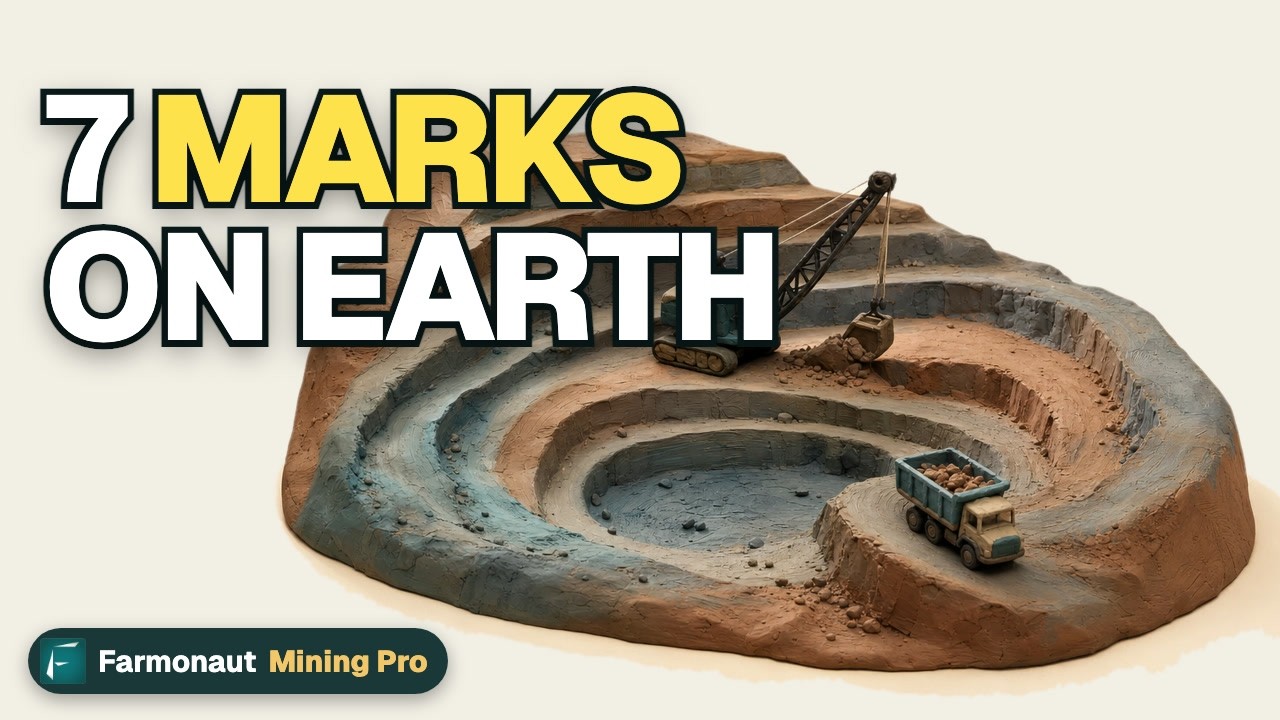
▶ The 7 environmental impacts of mining, explained in claymation with satellite maps. · 2:31
Reading mines like Carajás from space
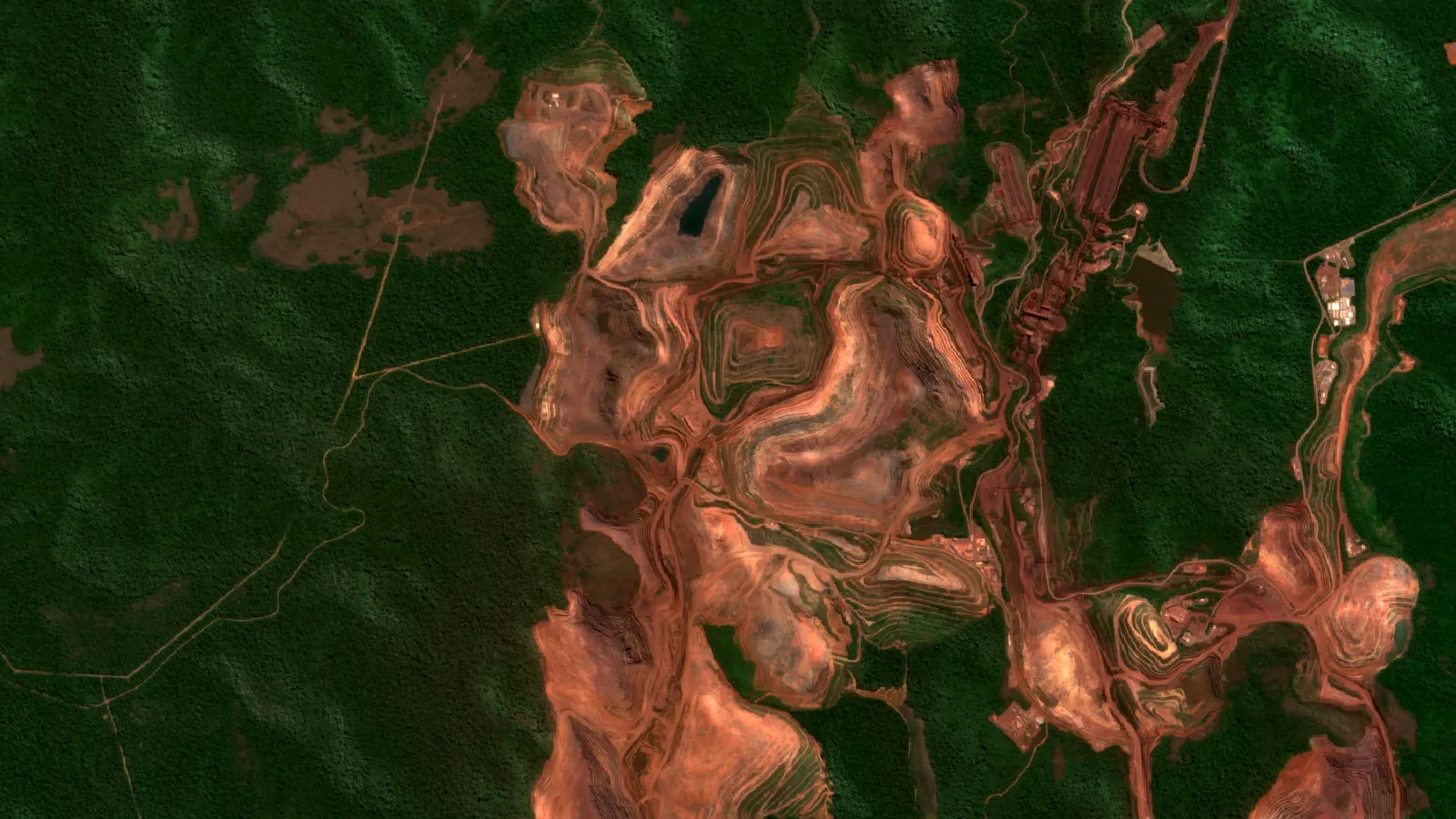
Large open-pit sites change month by month: pit edges advance, waste dumps grow, and cleared ground spreads along new haul roads and conveyors. Public imagery such as Sentinel-2, a European Space Agency satellite pair with 10 m detail and a 5-day revisit, can show those changes. The hero image on this page is a Sentinel-2 view of the Serra Norte area.
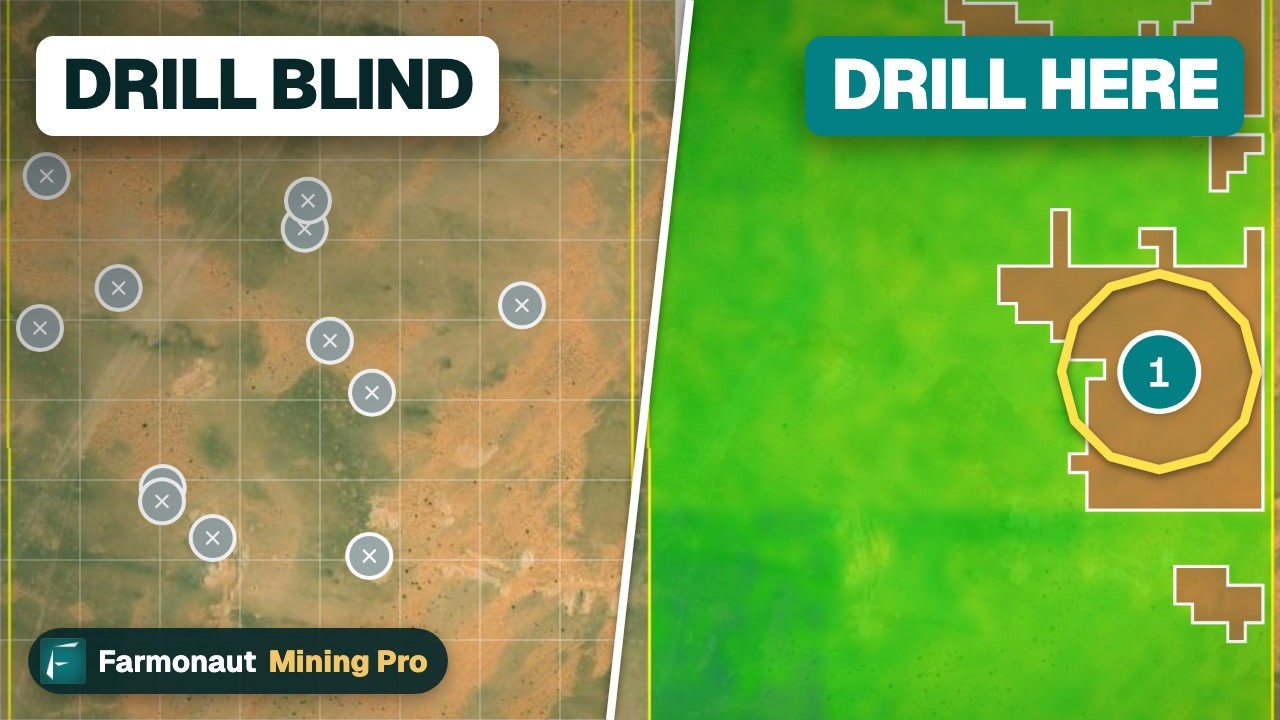
Farmonaut works from the same kind of imagery for exploration clients. A mining consultant can send a licence boundary and receive a screen of target zones, which is a starting point ahead of any drilling or resource estimate. Satellite screens do not replace drilling, and they do not give environmental or social clearance.
Frequently asked questions
Where is the Carajás mine?
It is in the Carajás mountains of Pará state in northern Brazil, with the Serra Norte pits near Parauapebas and S11D in Canaã dos Carajás. The ore goes by railway to Ponta da Madeira port at São Luís in Maranhão.
Who owns the Carajás mine?
Vale S.A. owns and operates it. US Steel held 49% of the original joint venture from 1970 and sold its share to Vale in 1977 (Mining Technology).
How much iron ore does Carajás produce a year?
Vale’s Northern System, which holds the Carajás mines, produced 170.2 Mt in 2025 and 175.7 Mt in 2024. S11D alone produced 86.0 Mt in 2025 (Vale, January 2026).
Is Carajás the largest iron ore mine in the world?
Mining Technology describes it as the world’s largest iron ore mine. Size depends on whether you count one pit or a whole complex. Australia produced 980 Mt of usable ore in 2025 against Brazil’s 420 Mt (USGS), but that Australian output comes from many mines run by several companies.
What grade is the ore at Carajás?
Mining Technology quotes an average of 65.4% Fe for the district and 66.7% Fe for S11D, well above the 62% Fe benchmark. Grade is the iron share of the ore by weight.
How is the ore moved to the coast?
By the Carajás railway, which opened in 1985 and runs to the Ponta da Madeira terminal at São Luís (Railway Gazette). S11D added a 101 km rail branch in 2016.
What is S11D?
It is Vale’s newest and largest Carajás mine, designed at more than 90 Mt a year at 66.7% Fe. It uses mobile crushers and conveyors in place of haul trucks, and processes ore at natural moisture.
When was Carajás discovered?
Mining Technology dates the discovery to the late 1960s. Production followed, and the railway opened in 1985.
Is the Carajás mine inside a national forest?
Yes. ICMBio lists the Carajás National Forest, created in 1998, and mining there needs an operating licence from Ibama.
What is the Novo Carajás plan?
It is Vale’s R$70 billion programme to 2030 to raise iron ore capacity in the region to 200 Mtpa and copper output by 32% (Reuters via InfoMoney, September 2025).
What is Carajás iron ore worth per tonne?
The 62% Fe benchmark was US$90.83 a tonne on 23 October 2026 (Trading Economics). High-grade ore earns a premium that depends on contract terms, and Vale’s realised fines price averaged US$91.6 a tonne in 2025.
This page is for information only. It is not investment advice. Production figures are company-reported and prices move daily; reserve figures from Mining Technology are historical estimates. Check Vale’s latest filings before relying on any number.
Farmonaut mining
Map your own project area from space
Mining consultants can send a licence boundary and get target zones from satellite data, ahead of a resource estimate.

Mining Pro sample view, synthetic data
Keep reading
Sources
- Vale, Production and sales report 4Q25 (January 2026): filemanager-cdn.mziq.com
- Vale, Production and sales report 2Q26: api.mziq.com
- Vale, Production and sales in 4Q25 and 2025: vale.com
- USGS, Mineral Commodity Summaries 2026: Iron Ore (February 2026): pubs.usgs.gov
- Argus Media, Vale’s 2025 iron ore output tops guidance (27 January 2026): argusmedia.com
- Trading Economics, Iron ore price (23 October 2026): tradingeconomics.com
- Reuters via InfoMoney, Vale receives licence to expand Carajás (12 September 2025): infomoney.com.br
- Mining.com, Vale opens largest iron ore mine in its history (December 2016): mining.com
- Mining Technology, Carajás iron ore mine, Pará, Brazil: mining-technology.com
- Railway Gazette, Estrada de Ferro Carajás: railwaygazette.com
- Vale, ESG commitments: targets and results through 2030: vale.com
- ICMBio, Floresta Nacional de Carajás: gov.br
- ESA, Copernicus Sentinel-2 mission: esa.int
- worldsteel, December 2025 and 2025 crude steel production (January 2026): worldsteel.org
- Vale, Climate change and emissions (2025 data): vale.com
Discussion
Questions, corrections or field experience? Share them below. First-time comments are reviewed before they appear, and your email is never published.
No comments yet. Be the first to add a question or your experience.

 GKY Mining
 Alkimy SARL
 Double A Trading
 GemSprout Metals Limited
 Qader Group
 Ileys General Trading
 SG Gold Mining LLC
 VRV Global Pte Ltd
 Omsri International FZE
 G.I.T.T.
 Jaunita Erss Ltd
 Almosi SARL
 SRK Consulting
 Berks Gold Limited
 Mwerezi Minerals Company Limited
 Mining SARL
 SenGold Invest SAS
 Sean Mining Limited
 NTS Group (Pty) Ltd











