

Battery metals · Supply guide
Cobalt Mining for Electric Cars: Who Mines It and Where
The DRC mined 73% of the world’s cobalt in 2025 and Indonesia 14%. Electric cars took 113 kt of the 276 kt demand. Here are the producers, the export quotas, the price drivers and what to check about sourcing.
Key takeaways
- The DRC mined 73% of world cobalt in 2025 and Indonesia 14% (Cobalt Institute, May 2026); the USGS estimates 230,000 of 310,000 tons (USGS, 2026).
- EVs used 113 kt of the 276 kt of cobalt demanded in 2025, a 39% share (Cobalt Institute, May 2026).
- CMOC made 117.5 kt, about 39.5% of world supply; CMOC, Glencore and ERG made over 57% of the world total (Cobalt Institute, May 2026).
- DRC export quotas are 87,000 t for 2026 plus a 9,600 t strategic quota; hydroxide rose 328% in 2025 (Cobalt Institute, May 2026).
- Cobalt traded at US$39,345 per tonne on 14 October 2026 (Trading Economics); LFP batteries use none.
In this article
- Where does the cobalt in electric cars come from
- Which countries mine the most cobalt
- Who mines the cobalt: the largest producers
- How cobalt gets from a Congolese mine to an electric car
- DRC cobalt export quotas explained
- What moved the cobalt price
- Indonesia and the shift beyond the DRC
- Artisanal mining, child labour and traceable cobalt
- Environmental and land impacts of cobalt mining
- Do all electric cars need cobalt: batteries and recycling
- How many tonnes of cobalt does a fleet of electric cars need
- How satellite data helps check a cobalt project area
- What to check before you rely on a cobalt supply claim
- Frequently asked questions
Most cobalt in electric car batteries comes from the Democratic Republic of the Congo (DRC), where it is a by-product of copper mining. The Cobalt Institute’s market report puts the DRC’s share of global mined cobalt at 73% in 2025, ahead of Indonesia at 14%, where it is a by-product of nickel. This guide shows who mines it, how it reaches a battery, what the DRC export quotas changed, and what the price and the sourcing questions look like today.
Cobalt is a hard grey metal. In a lithium-ion battery it sits in the cathode (the positive electrode) and helps the cell hold its structure, store energy and stay stable over many charges. Not every electric car uses it, and that matters for how much cobalt the car industry really needs. We cover both points below.
Where does the cobalt in electric cars come from
Cobalt is rarely mined on its own. The Cobalt Institute report says it is typically a by-product of copper and nickel, with a small amount from platinum-group metal mines. In the DRC the metal sits in sediment-hosted copper-cobalt deposits, and the two largest mines, Tenke Fungurume and Kisanfu, are in Lualaba province. In Indonesia it comes from nickel laterite ore, which is processed with high-pressure acid leaching (HPAL), a method that dissolves metals from the ore in hot acid under pressure.
The USGS says identified world cobalt resources are about 25 million tons, most of them in copper deposits in the DRC and Zambia, nickel laterites in Australia, nearby island countries and Cuba, and nickel-copper sulfide deposits in Australia, Canada, Russia and the United States (USGS Mineral Commodity Summaries 2026). Because cobalt follows copper and nickel, the amount mined depends on those metals as well as on the cobalt price.
Electric cars are now the largest single use. The Cobalt Institute reports that total cobalt demand reached 276 kt (thousand tonnes) in 2025, up 13% on 2024, and that EV batteries took 113 kt of it, a 39% share. Portable electronics were second at 93 kt and superalloys, used in jet engines and gas turbines, third at 20 kt.
Which countries mine the most cobalt
The USGS estimates world mine production at 310,000 tons in 2025, with the DRC at 230,000 tons. Indonesia is second at 44,000 tons, up from 35,000 in 2024. Every other country is below 10,000 tons. The table gives the main producers and the USGS reserve estimates, which are the part of the resource that can be mined economically with today’s methods and prices.
Chart
Cobalt mine production by country, 2025
Thousand tons of contained cobalt (estimates), selected countries
| Country | Mine production 2025 (tons) | Reserves (tons) |
|---|---|---|
| Congo (Kinshasa) | 230,000 | 6,000,000 |
| Indonesia | 44,000 | 760,000 |
| Russia | 7,700 | 800,000 |
| Madagascar | 3,900 | 100,000 |
| Australia | 3,700 | 1,700,000 |
| Canada | 3,500 | 220,000 |
| Papua New Guinea | 2,800 | 84,000 |
| China | 2,000 | 160,000 |
| United States | 300 | 70,000 |
| World total (rounded) | 310,000 | 12,000,000 |
Source: USGS, Mineral Commodity Summaries 2026, cobalt. Production figures are estimates. The DRC holds about half of the world’s cobalt reserves, so its share of supply is unlikely to fall quickly, although the Cobalt Institute expects Indonesia to add more new supply than the DRC over the five years to 2030 (see below).
The United States produced only about 300 tons from the Eagle nickel-copper mine in Michigan and relied on imports for an estimated 79% of its cobalt use in 2025, according to the same USGS summary.
Who mines the cobalt: the largest producers
The list below ranks companies by 2025 cobalt output in the Cobalt Institute report, which uses Benchmark Mineral Intelligence data. It covers the producers that report names with a 2025 tonnage. It is a ranking by tonnes of cobalt, not by quality of practice, and it leaves out companies the report does not give a tonnage for.
Chart
Cobalt output by producer, 2025
Thousand tonnes of cobalt
| Company and assets | 2025 cobalt output | What to know |
|---|---|---|
| CMOC Group: Tenke Fungurume (TFM) and Kisanfu (KFM), DRC | 117.5 kt | About 39.5% of world supply. CMOC holds 80% of TFM and 71.25% of KFM (CMOC website). |
| Glencore: Mutanda and Katanga Copper Cobalt (KCC), DRC | 33.5 kt | Mutanda output rose 34.2%, KCC fell 15.8%. Glencore says it is putting copper ahead of cobalt while exports are limited. |
| ERG: Metalkol RTR, DRC | 19.0 kt | Output unchanged from 2024. ERG is Eurasian Resources Group. |
| PT Huafei Nickel Cobalt, Indonesia | 10.8 kt | Up 35%. The largest cobalt asset in Indonesia. |
| PT Huayue Nickel Cobalt, Indonesia | 7.6 kt | Down 1%. |
| Lygend: PT Obi Nickel Cobalt, Indonesia | 6.5 kt | Ramping up since 2024. Lygend’s other joint venture, PT Halmahera Persada Lygend, made 6.2 kt. |
Source: Cobalt Institute, Cobalt Market Report 2025 (May 2026), with company data from CMOC and Glencore’s 2025 production report. Glencore’s report gives 36.1 kt of own-sourced cobalt for the whole group, which includes assets outside the DRC, so it differs from the 33.5 kt DRC figure above.
CMOC, Glencore and ERG together made over 78% of DRC production and over 57% of world production in 2025, according to the Cobalt Institute. Newer DRC supply includes the Musonoi project, owned 75% by Jinchuan Group and 25% by Gécamines, which started underground mining in September 2025 with capacity of about 7,400 tonnes of cobalt a year (Mining Technology, analyst comment). Mining Technology also estimates DRC output at 237,300 tonnes in 2025, a little above the USGS figure, so estimates differ by source. Smaller DRC miners include China Nonferrous Mining Corp. (CNMC), whose Deziwa, Kambove and Huachin operations changed little in 2025.
Outside the DRC and Indonesia, mined supply was 38 kt in 2025. Producers include Ramu in Papua New Guinea, Goro in New Caledonia and Punta Gorda in Cuba. In Australia the Cobalt Institute names Glencore’s Murrin Murrin and IGO’s Nova (a nickel-copper-cobalt operation in IGO’s annual report) as the only operating cobalt mines after BHP’s Nickel West stopped in December 2024. Murrin Murrin is a nickel-cobalt laterite operation in the Goldfields region of Western Australia.
How cobalt gets from a Congolese mine to an electric car
A Congolese mine does not ship battery-grade metal. The ore is mined, leached and turned into cobalt hydroxide, an intermediate product that the Cobalt Institute says typically holds 20% to 40% cobalt. Almost all of it then goes abroad to be refined. China made 79% of the 240 kt of refined cobalt produced in 2025, and Indonesia has overtaken Canada as the third-largest refined supplier.
Infographic
From mine to electric car in 5 steps
- 1MineCobalt comes out with copper from open pits in Lualaba.
- 2LeachPlants turn the ore into cobalt hydroxide, typically 20% to 40% cobalt.
- 3ExportUnder the quota, miners prepay a 10% royalty and send a control sample.
- 4RefineRefiners, 79% of them in China, make sulphate or metal.
- 5CellCathode and battery makers build the pack for the car.
Refined cobalt is turned into cathode powder, then into battery cells, then into packs. The Cobalt Institute notes that China consumed most of the cobalt needed for cell and cathode manufacturing, even though end-use demand is driven by electric vehicles sold in North America and Europe.
This chain is why one policy decision in Kinshasa reaches car makers within months. If you are tracing a battery back to its mine, this is the route to follow. For related thinking on following goods through a supply chain, see our guide to supply chain strategies for mining and agriculture and the product traceability platform.
DRC cobalt export quotas explained
On 22 February 2025 the DRC banned all cobalt exports, according to the Cobalt Institute report, to lift prices that had fallen to historic lows. Hydroxide delivered to China was as low as $5.60 per pound in mid-February. The ban was extended on 21 June 2025 and replaced in October 2025 by a quota system run by the regulator ARECOMS (Autorité de Régulation et de Contrôle des Marchés des Substances Minérales Stratégiques).
- Quota size: 18,125 tonnes for the last quarter of 2025 (ARECOMS later added it to the 2026 allocation), then 87,000 tonnes for 2026 (7,250 tonnes a month) plus a 9,600-tonne strategic quota. The USGS gives the same pattern of up to 96,600 tons a year in 2026 and 2027, including 9,600 tons for national strategic reserves.
- Who is eligible: companies that exported less than 100 tonnes in 2024, or own a refinery but have not run a cobalt mine in five years, or whose reserves are depleted, get no quota. Allocations follow the average of the previous three years’ production.
- Export rules: miners prepay a 10% royalty on their full quota and send a control sample of each export for testing. In February 2026 ARECOMS briefly stopped exports from Lualaba over assay discrepancies. On 30 June 2026 ARECOMS ordered that unused January to June quotas be forfeited and moved into the strategic quota from 1 July (SMM).
- Artisanal cobalt: the state buyer Entreprise Générale du Cobalt (EGC) has a monthly quota of 470 tonnes, which caps legal artisanal exports.
- Effect on CMOC: Bankable reported on 29 October 2025 that CMOC’s quota was 6,500 tonnes for the last quarter of 2025 and 31,200 tonnes for 2026, against 87,974 tonnes of cobalt produced in the first nine months of 2025.
The Cobalt Institute says the unexportable share of DRC output is large, so cobalt piled up in domestic stockpiles while the rest of the world drew down its own. In April 2026 the DRC also set up a strategic cobalt reserve managed by ARECOMS. Rules like these can change by quarter, so check ARECOMS notices before relying on any quota number.
What moved the cobalt price
The quota story is a price story. The Cobalt Institute reports that Benchmark’s cobalt hydroxide price rose 328% in 2025, from $5.90 per pound at the start of the year to $25.25 at the end, driven almost entirely by supply policy rather than by demand. Sulphate and metal prices rose 266% and 130%.
Chart
Cobalt hydroxide price through 2025
US$ per pound, CIF Asia; five points through 2025
The price has since eased. Trading Economics showed cobalt at US$39,345 per tonne on 14 October 2026, down 4.5% over a month and 7.9% over a year. That is a contract-for-difference quote that tracks the benchmark market, so it is a guide and not a trade price. For comparison, the USGS gives a 2025 average of $21 per pound for US spot cathode and $15 per pound for the London Metal Exchange cash price.
Two things explain the swings. First, cobalt is a by-product, so mines make it whether or not the price is good, and the DRC’s own policy decides how much reaches the market. Second, the Cobalt Institute describes a market that is in surplus on mined supply (+19 kt in 2025, 7% of demand) but short outside the DRC because exports are limited. Prices therefore depend on how many quota tonnes are released.
Indonesia and the shift beyond the DRC
Indonesia is the main change in the supply picture. Its cobalt output grew 29% to 42.5 kt in 2025 as HPAL plants started in 2024 ramped up. Because DRC exports were restricted, the Cobalt Institute calls Indonesia the largest effective supplier to the market in 2025. It forecasts Indonesia adding 109 kt of supply from 2025 to 2030, against 99 kt from the DRC.
Chart
Cobalt supply added by DRC and Indonesia
Thousand tonnes of cobalt added over each five-year period
The cost is a different set of questions. HPAL plants use a lot of sulphur and energy, and the report says 75% of Indonesia’s sulphur comes from the Middle East, so shipping disruption could force output cuts. Cobalt from Indonesia answers the question of where supply comes from, but it does not by itself answer questions about sourcing or the environment.
Artisanal mining, child labour and traceable cobalt
Artisanal and small-scale mining (ASM) means low-mechanisation, labour-intensive digging by individuals or cooperatives. It is the part of the DRC cobalt sector that draws the most attention. The US Department of Labor placed DRC cobalt ore on its List of Goods Produced by Child Labor or Forced Labor in 2009, and its lithium-ion battery supply chain page says child labour persists in cobalt production, often at artisanal sites.
Estimates of how much cobalt comes from ASM vary a lot. The Department of Labor page cites 15% to 30% of local output. Benchmark, in the Cobalt Institute report, put ASM at 1.8% of global supply and 1.3% of DRC supply at the end of 2024, a low point when prices were weak. ASM is very price-sensitive, so the share moves with the market, and informal sales make it hard to measure.
The DRC has tried to formalise the trade. Since 2019 the plan has been to give EGC exclusive purchasing rights for artisanal cobalt, and in 2025 the government restated that and gave EGC a monthly export quota. Formal sourcing checks are growing too. The Cobalt Institute reports that third-party responsible-sourcing assessments covered 78% of mined cobalt output (210,244 tonnes across 180 assets) and 88% of refined output in 2025. About 70% of mined supply goes through refiners that are conformant under the Responsible Minerals Initiative (RMI) assurance process.
Frameworks the report lists include the Initiative for Responsible Mining Assurance (IRMA), RMI, the Copper Mark and Towards Sustainable Mining. For a buyer, the practical test is simple. Ask which mine and which refiner supplied the cobalt, which standard audited each, and when the audit was done.
Environmental and land impacts of cobalt mining
Cobalt mining has the same physical footprint as the copper and nickel mining that it travels with: pits, waste rock, tailings dams, leach pads, and acid and water use. Where acid leaching is used, as in Indonesian HPAL plants, sulphur and energy supply add to the footprint. Where mines are close to farms, towns or forest, land access and water quality become the main local questions.
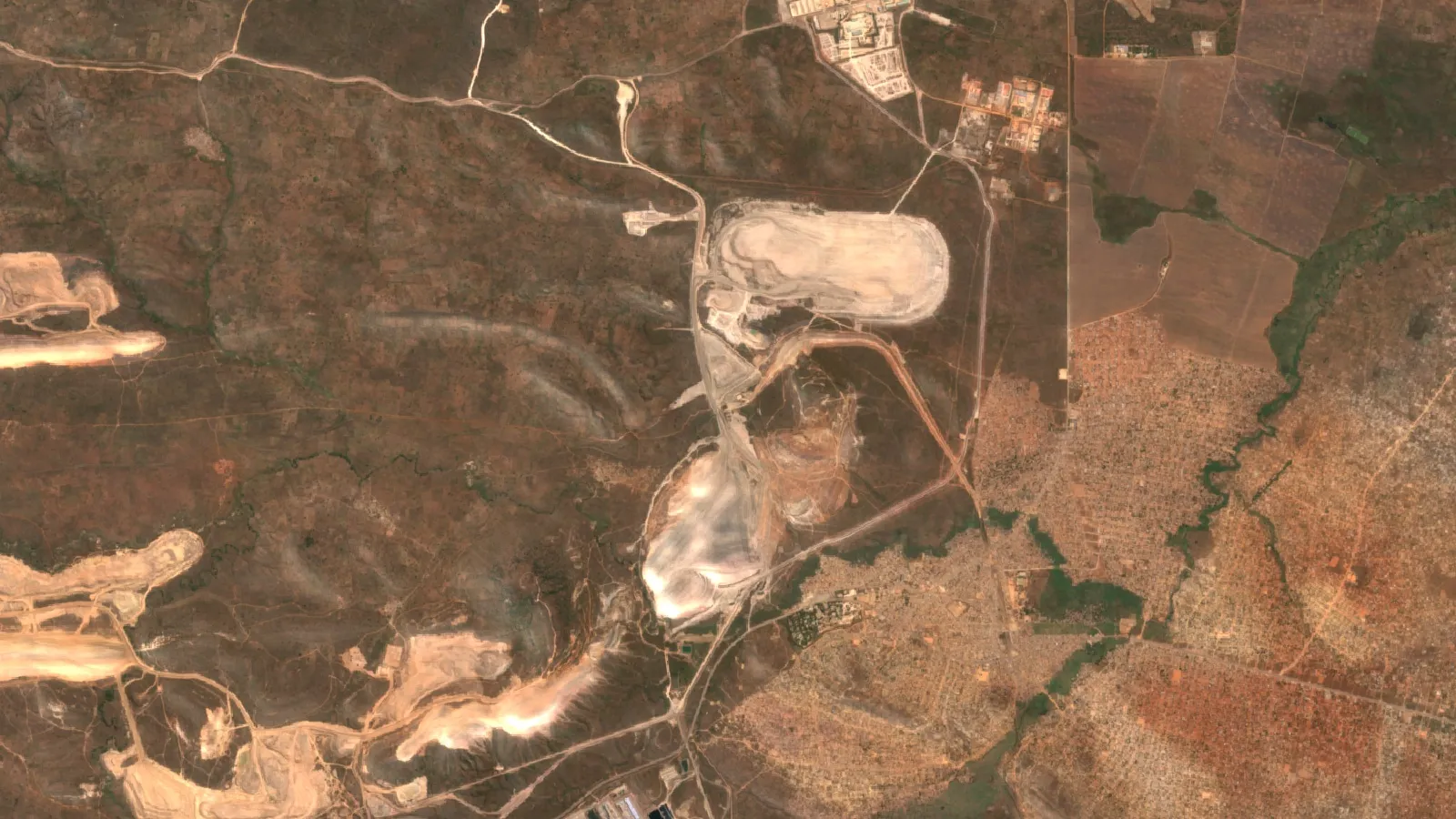
Two points keep this practical. First, impacts depend on the operation, so any claim about a “typical” cobalt mine needs a named site and a named source. Second, the footprint is measurable. Pit growth, tailings area and vegetation change show up in repeated satellite images, so they can be checked without a site visit.
▶ A short claymation explaining seven environmental impacts of mining. · 2:31
Do all electric cars need cobalt: batteries and recycling
No. Lithium iron phosphate (LFP) batteries contain no cobalt, and they dominate Chinese electric cars. The Cobalt Institute says the share of cobalt-bearing ternary chemistries (NCM and NCA) in EV sales fell 8 percentage points to 44% in 2025, while at gigafactory level 48% of EV batteries made had those chemistries. Global EV sales reached 20.8 million cars and light vehicles in 2025, and EV share of new sales ended at 22.9%.
US sales grew only 1% after federal tax credits ended on 30 September 2025, which weakens demand for cobalt-heavy packs in North America. Even so, EV cobalt demand rose 25% in 2025 because high-nickel chemistries kept growing and battery packs got bigger. As a rough average, 113 kt divided by 20.8 million cars is about 5.4 kg of cobalt per vehicle sold. This is a rough average of battery-maker cobalt use divided by cars sold. Battery output and car sales differ in timing and in chemistry mix, and real cars range from none (LFP) to far more.
Recycling is growing but is still small. The Cobalt Institute puts recycled and secondary supply at around 10% of total supply, limited by thin refining capacity outside Asia. Since European and North American recyclers often make black mass (a concentrated powder from shredded batteries) that is still shipped to Asia for refining, recycling today reduces dependence on new mines more slowly than it sounds.
How many tonnes of cobalt does a fleet of electric cars need
Use the calculator below to turn a fleet size into tonnes of cobalt and compare it with the DRC’s monthly export quota. Enter your own kilograms per vehicle: an LFP car is zero and a high-nickel pack is more than the average above.
Calculator
How much cobalt does an EV fleet need?
Enter a fleet size, cobalt per vehicle and a price.
- Value at your price: $21,060,000
- Months of the DRC 2026 quota: 0.07
Example values only, not a benchmark. 5.4 kg per vehicle is our rough average: 113 kt of cobalt used by EV battery makers (Cobalt Institute, 2025) divided by 20.8 million EVs sold, so battery output and sales differ in timing and chemistry mix; an LFP car uses none. The price is an input in US$ per tonne; replace the default with today’s price. The 7,250 t monthly figure is the DRC 2026 export quota (Cobalt Institute, May 2026).
How satellite data helps check a cobalt project area
Satellite imagery cannot tell you the cobalt grade of a deposit, but it can show the ground around it. Multispectral images show rock types, iron staining and alteration zones that often go with copper-cobalt mineralisation, and repeat images over several seasons show how a pit, a waste dump or a tailings area has grown. We use this kind of analysis at Farmonaut to screen licence areas as exploration targets, which comes before a resource estimate and does not replace one. Cobalt is on our list of detectable minerals.
For a worked example, see our case study on satellite copper-cobalt exploration with a drill result, our guide to nickel, cobalt, graphite and vanadium targets, our explainer on copper deposit types and our page on lithium deposits, the other main battery metal.
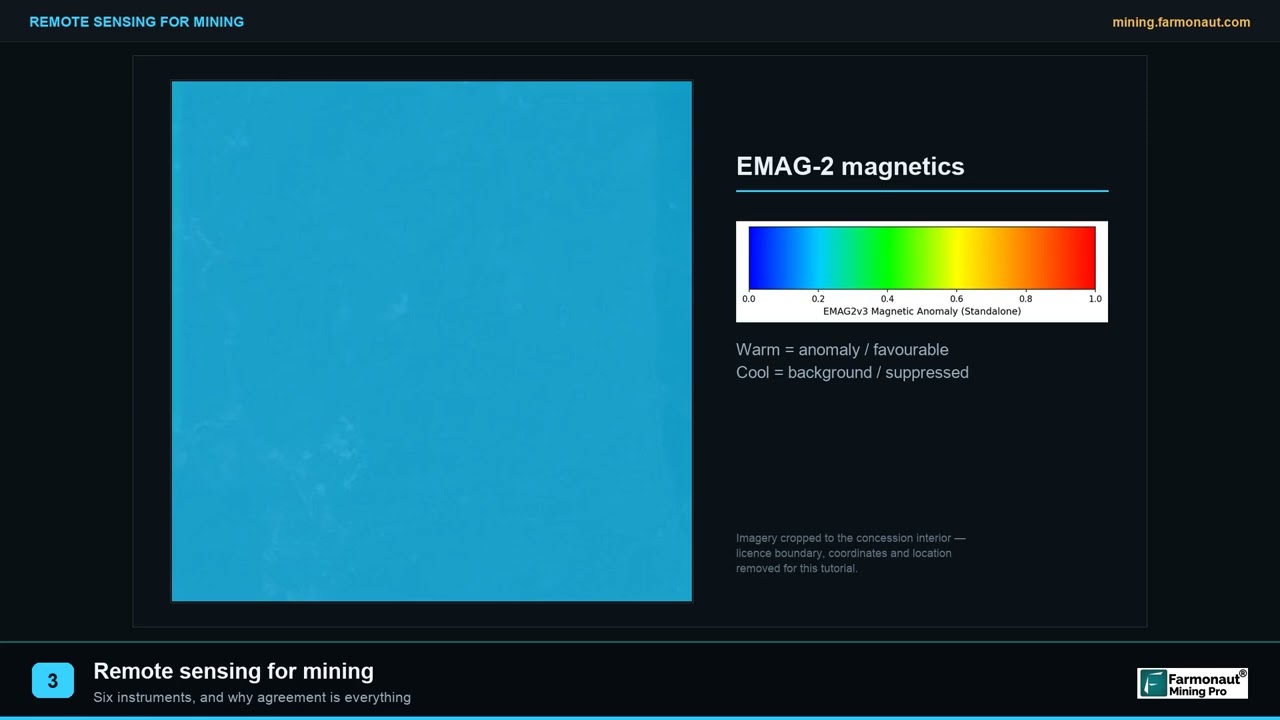
▶ Explains remote sensing for mining: measuring the ground from a distance. · 2:01
What to check before you rely on a cobalt supply claim
- Name the mine and the refiner. “DRC cobalt” or “responsible cobalt” is not a source.
- Check the date. Quotas, prices and export rules in the DRC have changed every few months since February 2025.
- Check the unit. Reports use cobalt contained, hydroxide tonnes (20% to 40% cobalt) and refined metal. They are not interchangeable.
- Check who audited it. Look for IRMA, RMI or Copper Mark status and the audit date.
- Separate mined from exported. Since 2025 the DRC mines far more than it may export.
Related reading on this site: Largest Cobalt Mines in the DRC, Ranked by Output.
Frequently asked questions
Why do electric cars need cobalt?
Cobalt is part of the cathode in nickel-manganese-cobalt (NCM) and nickel-cobalt-aluminium (NCA) batteries. It helps the cathode keep its structure and supports high energy density, which means longer range from a pack of a given size. LFP batteries avoid it.
How much cobalt is in an electric car battery?
It depends on the chemistry. An LFP pack has none. Dividing the Cobalt Institute’s 113 kt of EV cobalt demand in 2025 by 20.8 million cars sold gives about 5.4 kg per vehicle on average. This is a rough average of battery-maker cobalt use divided by cars sold, so battery output and sales differ in timing and chemistry mix. It is not a figure for any one model.
Which country mines the most cobalt?
The DRC. The USGS estimates 230,000 tons of its 310,000-ton world total in 2025. Indonesia is second at 44,000 tons.
Who are the biggest cobalt mining companies?
By 2025 output in the Cobalt Institute report, CMOC (117.5 kt), Glencore (33.5 kt in the DRC) and ERG’s Metalkol (19.0 kt) lead. CMOC alone made about 39.5% of the world’s cobalt.
Is cobalt for electric cars mined by children?
Some is mined by artisanal miners, and the US Department of Labor says child labour persists in DRC cobalt production. Estimates of the artisanal share of output range from about 1.3% of DRC supply (Benchmark, end of 2024) to 15% to 30% (Department of Labor page), so the share is uncertain. Large industrial mines are a separate part of the sector. Audits under standards such as RMI and IRMA are how buyers check.
Why did the cobalt price go up so much?
The DRC banned exports in February 2025 and then set quotas. The Cobalt Institute says hydroxide rose 328% during 2025, mainly because of policy-driven supply limits.
Do all electric cars use cobalt?
No. LFP batteries have none, and the Cobalt Institute reports that cobalt-bearing NCM and NCA chemistries made up 44% of EV sales in 2025, down 8 percentage points.
Is there cobalt mining outside the DRC?
Yes. Indonesia produced about 42.5 kt in 2025. Cobalt is also mined in Australia, Canada, Cuba, Madagascar, Papua New Guinea, Russia and, as a by-product at the Eagle mine in Michigan, the United States.
Can recycling replace cobalt mining?
Not yet. Recycled and secondary material supplied around 10% of total cobalt supply in 2025 according to the Cobalt Institute, and refining capacity outside Asia is limited. It will grow as more electric cars reach end of life.
Can satellites monitor cobalt mining?
They can show land change around a mine, such as pit and tailings growth, and they can screen terrain for alteration linked to copper-cobalt mineralisation. They cannot measure cobalt grade without drilling and assays.
This page is for information only. It is not investment advice. Prices and DRC export rules change often; check the regulator ARECOMS and the sources linked above before relying on any figure.
Farmonaut mining
Map your mining site from space
Consultants can see how satellite data screens a licence area as an exploration target, ahead of a resource estimate.
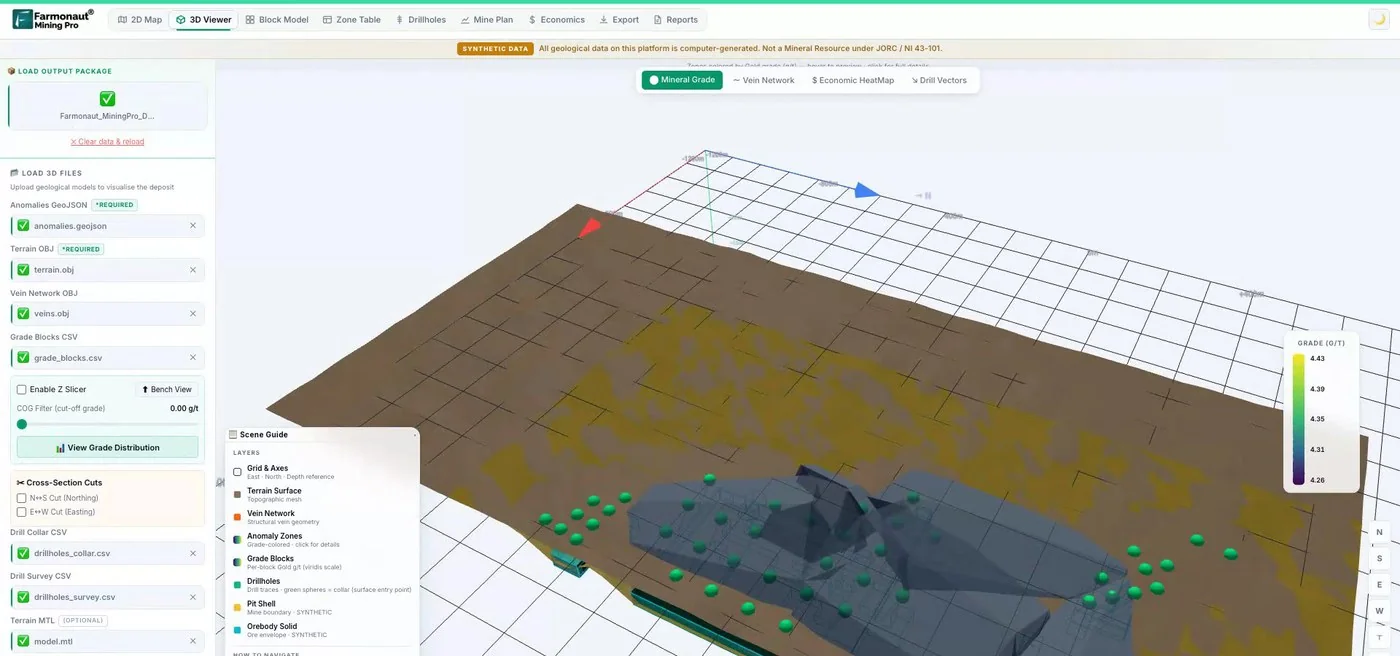
Mining Pro sample view, synthetic data
Keep reading
Sources
- Cobalt Institute, Cobalt Market Report 2025 (May 2026): cobaltinstitute.org
- USGS, Mineral Commodity Summaries 2026: Cobalt: pubs.usgs.gov
- CMOC Group, The DRC: copper and cobalt: en.cmoc.com
- Glencore, Full Year 2025 Production Report: glencore.com
- Glencore Australia, Murrin Murrin operations: glencore.com.au
- Trading Economics, Cobalt price (14 October 2026): tradingeconomics.com
- US Department of Labor, Lithium-ion batteries supply chain page: dol.gov
- Bankable, CMOC nine-month cobalt output and quotas (29 October 2025): bankable.africa
- Mining Technology, Musonoi ramp-up and Mutanda feed to drive DRC cobalt output: mining-technology.com
- IGO Limited, Annual Report 2026: igo.com.au
- SMM (metal.com), Congo withdraws unused cobalt export quotas (30 June 2026): news.metal.com
Discussion
Questions, corrections or field experience? Share them below. First-time comments are reviewed before they appear, and your email is never published.
No comments yet. Be the first to add a question or your experience.

 Geoticgy
 GemSprout Metals Limited
 Qader Group
 Ileys General Trading
 SG Gold Mining LLC
 VRV Global Pte Ltd
 Omsri International FZE
 G.I.T.T.
 Jaunita Erss Ltd
 Almosi SARL
 SRK Consulting
 Berks Gold Limited
 Mwerezi Minerals Company Limited
 Mining SARL
 SenGold Invest SAS
 Sean Mining Limited
 NTS Group (Pty) Ltd
 Mine4Africa
 Lithspo Minerals Limited










