

Chile mine water · Ranked guide
Desalination Plants for Mining in Chile: Capacity Ranked
Escondida has the largest mine desalination plant in Chile at about 3,333 litres per second, ahead of Quebrada Blanca, Collahuasi and Spence. This guide ranks seven plants, shows Cochilco water data and adds a calculator for power cost.
Key takeaways
- Escondida (BHP) leads at 3,333 l/s of treatment capacity, then Quebrada Blanca (about 1,300 l/s) and Collahuasi (1,050 l/s initial design) (CDM Smith, Teck, Acciona).
- Cochilco expects seawater to rise from 40.7% of copper mining’s fresh-water use (recirculated water excluded) in 2024 to 67.6% in 2034, with nearly three-quarters of it desalinated (Reuters, March 2026).
- In 2023, 9.3% of all water entering copper operations was seawater, or 36% of fresh intake; 74.2% was recirculated water (Cochilco, 2023 data).
- At high mines the lift can use more power than treatment: Cochilco’s desalination factor is 3.27 kWh/m3, while a 3,000 m lift needs about 11 kWh/m3 at 75% pump efficiency.
- Permits take more than six years on average, according to Dentons (law firm article).
In this article
- Why Chile's copper mines moved to the sea
- Desalination plants for mining in Chile, ranked by capacity
- What seawater costs a mine to make and lift
- How seawater reaches a mine at 4,000 metres
- Brine, permits and rules to check before you plan a plant
- Water, tailings and land: mapping the corridor
- Frequently asked questions
Chile’s largest mining desalination plant is at Escondida, where BHP reports about 3,333 litres per second (l/s) of seawater treatment capacity, the largest in Latin America according to engineer CDM Smith. Next come Teck’s Quebrada Blanca (about 1,300 l/s at full capacity), Collahuasi’s plant under construction (1,050 l/s initial design, not yet operating), Spence (1,000 l/s), and then plants of around 400 to 500 l/s at Candelaria, Los Bronces and Los Pelambres. Below is the full ranking, what each plant does, what the water costs to make and lift, and a calculator for your own flow and elevation.
One litre per second is 31,536 cubic metres a year. Keep that number in mind: a 1,000 l/s plant running all year delivers about 31.5 million cubic metres, which is why a single plant can replace a river or an aquifer for one mine.
Why Chile’s copper mines moved to the sea
Chile mined an estimated 5.3 million tonnes of copper in 2025 and holds about 180 million tonnes of reserves, according to the US Geological Survey (Mineral Commodity Summaries, 2026). Most of that copper comes from the Atacama and the north, where rain is close to zero. Ore grades are falling, so each tonne of metal needs more rock, and more water, than it did a decade ago.
Chart
Where water entering Chilean copper operations came from, 2023
Per cent of 73.02 m3/s total intake, 51 operations
The state copper commission Cochilco counts the water that mines take in. In its report on 2023 data, covering 51 operations, Cochilco found that mines drew 73.02 cubic metres per second (m³/s) into their processes. Of that, 74.2% was recovered and recirculated water, 16.5% was continental water (rivers and groundwater) and 9.3% was seawater. Looking only at fresh intake of 18.83 m³/s, 64% was continental and 36% was seawater. Cochilco adds that the fall in continental use does not mean better water efficiency; it is a swap to seawater.
Of the 6.81 m³/s of seawater used in 2023, 4.73 m³/s had been desalinated and 2.09 m³/s was used raw. That split matters when you read headlines: seawater use and desalination are not the same number.
The pressure is not only the mines. The World Resources Institute projected in 2015 that Chile would move from medium water stress in 2010 to extremely high water stress by 2040, ranking 24th of the 33 countries in that top category. A projection from 2015 is old, but it explains why regulators and communities push mines off shared aquifers.
Cochilco’s March 2026 outlook, reported by Reuters through Kitco, expects copper mining’s fresh-water use (recirculated water excluded) to rise from 18.5 m³/s in 2024 to 20.6 m³/s in 2034. Seawater is expected to rise from 40.7% to 67.6% of that total, or 13.9 m³/s, and nearly three-quarters of the seawater is expected to be desalinated. Cochilco expects a temporary dip in seawater use between 2028 and 2030.

▶ Why electric vehicles depend on Chilean copper, and where the mines sit. · 6:03
Desalination plants for mining in Chile, ranked by capacity
How we chose: we listed Chilean mine desalination plants whose rated capacity is published by the owner, the builder or an engineering firm, and we ranked them by that figure in litres per second. Rated capacity is not output. A plant may run below its rating, and some figures are initial phases. Chile has many more plants than this list: law firm Dentons, citing an industry presentation from October 2023, counted 24 desalination plants producing more than 8,500 l/s nationwide at that date, with mining operating about 75% of them. The seven below are the ones with a published capacity we could open and read.
Chart
Published capacity of mine desalination plants in Chile
Litres per second; rated or initial design capacity, not output; Los Bronces is a supply cap from a third-party plant
| Rank | Plant and mine | Owner of the mine | Capacity (l/s) | Status | What the source says |
|---|---|---|---|---|---|
| 1 | Escondida, Coloso port (Antofagasta region) | BHP | 3,333 | Operating | Expansion added 833 l/s to reach 3,333 l/s in total (CDM Smith) |
| 2 | Quebrada Blanca (QB2), Patache area (Tarapacá) | Teck | about 1,300 | Operating | Teck states the plant purifies about 1,300 l/s at full capacity |
| 3 | Collahuasi, Patache port (Tarapacá) | Anglo American, Glencore and Japan Collahuasi Resources (44%, 44%, 12%) | 1,050 | Not yet operating; permit annulled 14 May 2026 | Initial design capacity, built by Acciona; not yet operating (permit annulled by environmental court, May 2026); the 194 km seawater pipeline was completed in April 2026 |
| 4 | Spence (Antofagasta region) | BHP | 1,000 | Operating | Cited by Arthur D. Little as a 1,000 l/s plant |
| 5 | Candelaria, Punta Padrones, Caldera (Atacama) | Lundin Mining | 500 | Operating | Running since May 2013; covers 100% of the mine’s water needs |
| 5 | Los Bronces (Santiago region), supply from a third-party plant | Anglo American | up to 500 | First water 8 Oct 2026 (third-party plant) | First phase of a contract with Aguas Pacífico; first desalinated water reached the mine on 8 October 2026; the plant is not owned by the mine |
| 7 | Los Pelambres (Coquimbo region) | Antofagasta plc | 400 | Operating; expansion to 800 l/s under construction | Operating at full capacity through 2025; expansion to 800 l/s under construction |
Two plants tie at rank 5 because both are rated at 500 l/s. The Los Bronces figure is a supply cap in a contract, not the size of the plant behind it.
Escondida (BHP): the largest
Escondida is the world’s largest copper mine and runs on seawater from the Coloso coast. CDM Smith, which supervised construction for BHP, reports that the expansion added 833 l/s of treatment capacity and upgraded four pumping stations, bringing total production to 3,333 l/s. Best for: the benchmark scale if you are sizing a very large concentrator. Trade-off: the scale also means a very large energy bill and a very long lift to the mine.
Quebrada Blanca (Teck): first large plant in Tarapacá
Teck describes its plant, built between Puerto Patillos and Punta Patache, as the first large-scale use of desalinated seawater for mining in Tarapacá. Teck says it purifies about 1,300 l/s at full capacity, pumps the water to the concentrator through five booster stations, and returns the brine to the Pacific through an outfall 750 metres from the coast at 40 metres depth. Best for: seeing how brine dilution is engineered. Trade-off: Teck gives the rating at full capacity, not the operating rate.
Collahuasi: the next large plant
Acciona was awarded design and construction of the Patache plant in 2022, with an initial capacity of 1,050 l/s, plus two years of operation and maintenance extendable by three. In April 2026 Techint reported completing the 194-kilometre, 44-inch seawater pipeline with five pumping stations, which lifts water to the Ujina deposit at more than 4,400 metres above sea level. Best for: understanding the cost of a very high lift. Trade-off: the plant is not yet running. On 14 May 2026 Chile’s Second Environmental Court annulled the environmental permit (RCA) for the desalination plant and the human-environment parts of C20+; on about 22 May it narrowed the ruling to those parts. Construction and testing of the plant have been halted since the ruling, and Collahuasi says the plant is in its final construction and testing phase while it works with the environmental regulator (SEA) to win approval again.
Spence (BHP)
Arthur D. Little principal Ilya Epikhin, speaking to Mining Technology, cites Spence as having a 1,000 l/s plant. Best for: a mid-size plant used as a reference. Mining Technology adds that the plant meets around half of Spence’s current water needs and that BHP plans to expand it. Trade-off: the figure is from an Arthur D. Little interview, not a BHP datasheet.
Candelaria (Lundin Mining): the long runner
The Punta Padrones plant in Caldera was the first desalination plant built in the Atacama region. Chilean outlet Reporte Minero reported in May 2026 that it has operated without interruption since May 2013, can produce 500 litres per second, and covers 100% of the mine’s water needs. Its intake is a passive tower 27 metres deep, followed by dissolved air flotation, ultrafiltration and reverse osmosis. Best for: proof that a 100% desalinated mine can run for more than a decade.
Los Bronces (Anglo American): water bought, not built
Anglo American signed a supply deal with Aguas Pacífico, a private desalination provider. The first phase supplies up to 500 l/s, more than 45% of the mine’s needs. Anglo American reported on 8 October 2026 that the first desalinated water had reached Los Bronces, when Chile’s Minister of Mining opened the pipeline valve at the Quilapilún Station in Colina. The mine will also give 25 l/s to communities in Colina and Tiltil, which are due to receive desalinated water from December 2026. Best for: a mine that wants desalinated water without owning a plant. Trade-off: the mine relies on a third party’s plant and pipeline.
Los Pelambres (Antofagasta plc)
The existing 400 l/s plant has operated since the first half of 2024. Antofagasta’s annual report says it ran at full capacity throughout 2025, and that expansion to 800 l/s, which doubles it, was on schedule and on budget at the end of 2025, with pumps and electrical works still to come. Best for: a recent example of a brownfield expansion.
What seawater costs a mine to make and lift
Treating seawater is only half of the cost. In the Mining Technology interview, Arthur D. Little says desalination typically costs between US$0.50 and US$2 per cubic metre, and that about 70% of pipeline operating cost is energy. The same source notes that desalinated water must be moved to elevations of 2,000 to 4,000 metres.
Chart
Electricity for seawater use in copper mining: 2025 and 2034
Terawatt-hours per year; desalination and pumping split derived from Cochilco growth rates
Cochilco’s electricity projection gives a method you can reuse. It estimates desalination at a factor of 3.27 kilowatt-hours per cubic metre and estimates pumping separately from elevation and distance. On that basis Cochilco’s 2025 to 2034 projection (published 2026) has electricity for seawater desalination and pumping rising 60.0%, from 3.4 terawatt-hours (TWh) in 2025 to 5.4 TWh in 2034, with pumping making up 81.7% of that in 2034. Put simply, for a high mine the lift costs more power than the treatment.
The physics agrees. Lifting one cubic metre by 100 metres needs about 0.27 kilowatt-hours at 100% efficiency (mass times gravity times height). At 75% pump efficiency, a 3,000 metre lift needs about 10.9 kWh per cubic metre, over three times the 3.27 kWh/m³ for desalination. Friction in a 194 km pipeline adds to this.
The calculator below uses those two parts. Enter your own flow, elevation, pump efficiency and power price. The 3.27 kWh/m³ is Cochilco’s desalination factor and is a default you can overwrite; the power price is an example, so use your own contract rate.
Calculator
What does the power for your seawater supply cost?
Enter your own flow, elevation, pump efficiency and power price.
- Water delivered per year: 28.4 million m3
- Energy per cubic metre, treatment plus lift: 14.2 kWh/m3
- Power cost per cubic metre: 1.42 US$/m3
- Share of energy used by the lift: 77 %
Example values only, not a quote. Desalination energy defaults to 3.27 kWh per cubic metre, the factor in Cochilco’s 2025-2034 electricity projection (2026). Lift energy is mass times gravity times height divided by pump efficiency (0.002725 kWh per cubic metre per metre of lift at 100%); pipe friction is not included. Power price is an example, use your own contract rate in US$ per kWh.
How seawater reaches a mine at 4,000 metres
A coastal plant is only the start. A mine at the Collahuasi site needs five pumping stations, a transfer station that holds 49,000 cubic metres and a pipeline of almost 200 kilometres. The steps are the same for most projects:
- Intake: seawater is drawn through a screened or deep passive intake to keep fish and sand out.
- Pre-treatment and reverse osmosis: filters remove solids, then membranes push water through at high pressure and leave a salty brine behind.
- Conditioning: the water is remineralised so it does not corrode pipes or tanks.
- Lift: booster stations pump it to the concentrator, often thousands of metres up.
- Return flow: brine goes back to the sea through a diffuser that mixes it into deep water.
Some mines skip step two for part of their supply. Cochilco reports that in 2023 2.09 m³/s of seawater was used without desalination.
Brine, permits and rules to check before you plan a plant
Brine. Reverse osmosis returns more brine than people expect. Jones and co-authors estimated global brine output at 141.5 million cubic metres a day (Science of the Total Environment, 2019), about 50% above earlier estimates, against about 95 million cubic metres a day of fresh water. Teck’s design diffuses brine 750 metres from the coast at 40 metres depth to dilute it; the exact outfall depends on local currents and the seabed, so it is set by site studies and the environmental permit.
Permits. Dentons (article citing 2023 data) reports that obtaining permits takes more than six years on average from the decision to start a project. Seawater is a public good, so a maritime concession is needed. Desalination plants are not listed on their own for environmental assessment; they are usually assessed as parts of a larger mining or water project. Dentons notes that Chilean rules do not say whether seawater’s status as a national good of public use also covers water after desalination.
Bills. Arthur D. Little points to a proposed Mining Code amendment (Bulletin 9.185-08) that would require desalination for projects taking more than 150 l/s of water. It is a bill, not an enacted rule.
Energy. A 1,000 l/s plant at 3.27 kWh/m³ draws about 103 million kWh a year before pumping. Mines near solar and wind resources can contract renewable power; Mining Technology mentions solar-powered desalination at Codelco and floating solar panels at the Los Bronces tailings ponds, though it gives no output figures.

▶ A plain-language claymation on the seven environmental impacts of mining. · 2:31
Water, tailings and land: mapping the corridor
Pipelines and plants need land: a coastal site, a corridor of hundreds of kilometres and a power line. Before committing, teams check slopes, existing roads, protected or inhabited areas, and where a brine outfall can sit. Satellite imagery can screen those corridors quickly; our satellite-based mineral detection work covers the exploration side, using multispectral and hyperspectral data to mark target zones before drilling. Results are exploration targets, not a resource estimate, and not an environmental clearance.
If you hold a licence in northern Chile and want a satellite screen of your area of interest, request a quote, or contact us with your boundary file.
Frequently asked questions
How many desalination plants serve mines in Chile?
Dentons, citing an industry presentation from October 2023, counted 24 desalination plants in Chile producing more than 8,500 l/s, with the mining industry operating about 75% of them. The count is from 2023, so the number today will differ.
What is the biggest desalination plant for mining in Chile?
Escondida, with 3,333 l/s of treatment capacity after its expansion, according to CDM Smith, the engineer that supervised the work for BHP.
How much of Chile’s copper mining water is seawater?
Cochilco reports 36% of fresh intake in 2023, and expects seawater to reach 67.6% of copper mining’s fresh-water use (recirculated water excluded) in 2034, up from 40.7% in 2024.
Is all seawater used by mines desalinated?
No. In 2023 mines used 6.81 m³/s of seawater, of which 4.73 m³/s was desalinated and 2.09 m³/s was used raw.
How much does desalinated water cost for a mine?
Arthur D. Little puts desalination at roughly US$0.50 to US$2 per cubic metre, before the cost of moving it uphill. Pumping often costs more than treatment at high mines, so use the calculator with your own elevation.
How much electricity does desalination use?
Cochilco uses 3.27 kWh per cubic metre for desalination in its projection. Pumping is added separately and depends on height and distance.
Why do mines in the Atacama not just use groundwater?
Groundwater and river water are shared with towns, farms and ecosystems, and regulators and communities push mines off them. Cochilco notes that the fall in continental use is a replacement by seawater, not a sign of higher efficiency.
What happens to the brine?
It is returned to the sea through an outfall designed to dilute it. Teck’s Quebrada Blanca plant discharges 750 metres offshore at 40 metres depth. Each project must show in its environmental assessment that the discharge is acceptable.
How long does it take to permit a desalination plant in Chile?
Dentons reports more than six years on average from the decision to start a project, because of maritime concessions and environmental review.
Can a smaller mine use desalination?
Smaller operations often share infrastructure or buy water. Arthur D. Little notes that Codelco’s northern operations share desalination infrastructure across three mines, and Los Bronces buys water from a third-party plant.
This page is for information only. It is not investment advice and not legal advice. Capacities are rated or design figures and change as plants expand; confirm the latest figures with each operator and the Chilean regulator.
Farmonaut mining
Map your licence area from space
Send your boundary file and target mineral to get a quote for a satellite exploration screen of your area in Chile.
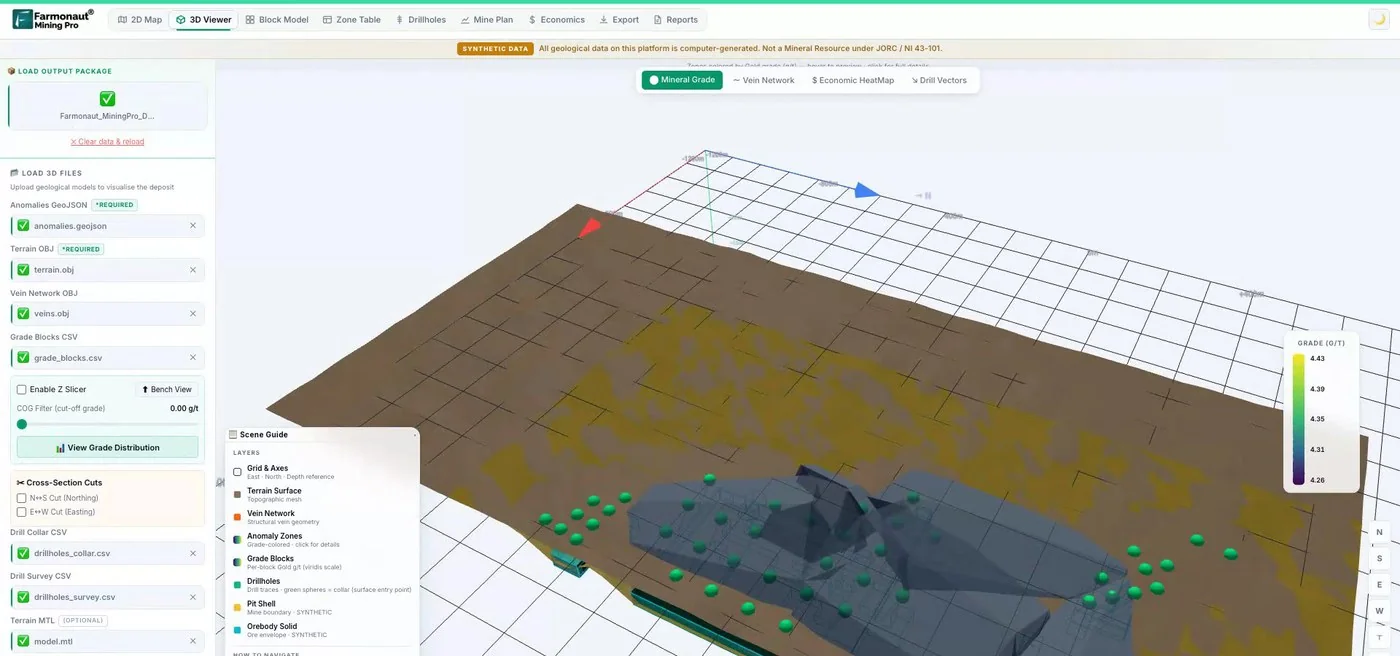
Mining Pro sample view, synthetic data
Keep reading

Sources
- CDM Smith, Desalination for the world’s largest copper mine (Escondida): cdmsmith.com
- USGS, Mineral Commodity Summaries 2026: Copper: pubs.usgs.gov
- Cochilco, Consumo de agua en la mineria del cobre 2023 (2024): cochilco.cl
- WRI, Ranking the World’s Most Water-Stressed Countries in 2040 (2015): wri.org
- Reuters via Kitco, Chilean miners to use more seawater to meet rising demand by 2034 (18 March 2026): kitco.com
- Dentons, Desalination in Chile: dentonsmininglaw.com
- Teck, Building the first large-scale desalination plant for mining in Tarapaca: teck.com
- Acciona, desalination plant for Collahuasi (2 August 2022): acciona.com
- Mining Reporters, Techint completes seawater pumping system for Collahuasi (12 April 2026): miningreporters.com
- Mining Technology, Why Chile’s mines are turning to the sea: mining-technology.com
- Reporte Minero, Lundin Mining Candelaria desalination plant turns 13 (May 2026): reporteminero.cl
- Anglo American, Los Bronces water partnership: angloamerican.com
- Antofagasta plc, Annual Report 2025: antofagasta.co.uk
- MedECC summary of Jones et al., The state of desalination and brine production (2019): medecc.org
- Cochilco, Proyeccion de consumo de energia electrica de la mineria del cobre 2025-2034 (2026): cochilco.cl
Discussion
Questions, corrections or field experience? Share them below. First-time comments are reviewed before they appear, and your email is never published.
No comments yet. Be the first to add a question or your experience.

 VRV Global Pte Ltd
 Omsri International FZE
 G.I.T.T.
 Jaunita Erss Ltd
 Almosi SARL
 SRK Consulting
 Berks Gold Limited
 Mwerezi Minerals Company Limited
 Mining SARL
 SenGold Invest SAS
 Sean Mining Limited
 NTS Group (Pty) Ltd
 Mine4Africa
 Lithspo Minerals Limited
 Tintina Mining Group
 Licence holder · Nigeria · Gold + lithium










