

Hiring guide · 3D mine animation
3D Mining Animation Expert: Costs, Skills, How to Hire
A 3D mining animation expert turns mine data into accurate films for training, planning and investors. General guides list about US$5,000 to US$50,000+ a finished minute (FrameSixty, 2026).
Key takeaways
- General 3D guide rates run about US$5,000 to US$50,000+ per finished minute; industrial projects about US$20,000 to US$100,000+ (FrameSixty, 2026).
- Hire for mining knowledge and a technical review process, not only a good showreel.
- MSHA counted 28 US mining fatalities in fiscal year 2025, including 23 in metal and nonmetal mines.
- A NIOSH study of 49 participants found no significant effect of hazard-specific training on hazard recognition, so do not rely on a film alone.
- Own your scene files and agree review rounds in the contract.
In this article
- What a 3D mining animation expert actually does
- Types of 3D mining animations and who needs them
- How 3D animation supports mining safety, and what the evidence shows
- How much a mining animation costs
- How to hire a 3D mining animation expert
- Good practice for accurate mine animations
- Where satellite data fits in a mining animation
- Frequently asked questions
A 3D mining animation expert turns drillhole data, mine plans and equipment drawings into accurate moving pictures that workers, regulators and investors can follow. General price guides put a delivered minute of 3D at about US$5,000 to US$50,000+ (FrameSixty, 2026). The harder part of hiring is finding someone who understands the mine as well as the software.
This guide is for the mine staff, consultants and project owners who have to brief that person. It covers what the work includes, what it costs, how to test a candidate, and what the safety evidence does and does not show. A calculator below prices your own project.
What a 3D mining animation expert actually does
The job sits between technical data and an audience that cannot read that data. A good specialist reads a mine plan, asks which version is current, and builds a scene that is correct in scale and sequence. Most of the work comes before any rendering starts.
- Takes in data: geological models, drillhole traces, pit shells, stope shapes, ventilation layouts and equipment drawings.
- Checks scale and sequence: truck size against ramp width, the order of drilling, blasting and mucking (removing broken rock), and where people stand at each step.
- Writes the story: what one viewer must understand or do by the end, and in what order.
- Builds and animates: models, textures, camera paths, labels, narration and captions.
- Runs reviews: geologists, engineers and safety staff correct the technical content before final render.
A related role is the mining animation consultant, who advises on what to show and how to brief a studio but may not build the scenes. Some people do both. Ask which one you are paying for.
An animation is not an engineering model. Geological software such as Leapfrog Geo builds the 3D model from drillhole, structural and mesh data, and that model belongs to your technical team. The animator shows the result. If a block or a tunnel moves in the film, the design has not changed, and the animator should not be the person deciding where ore sits.
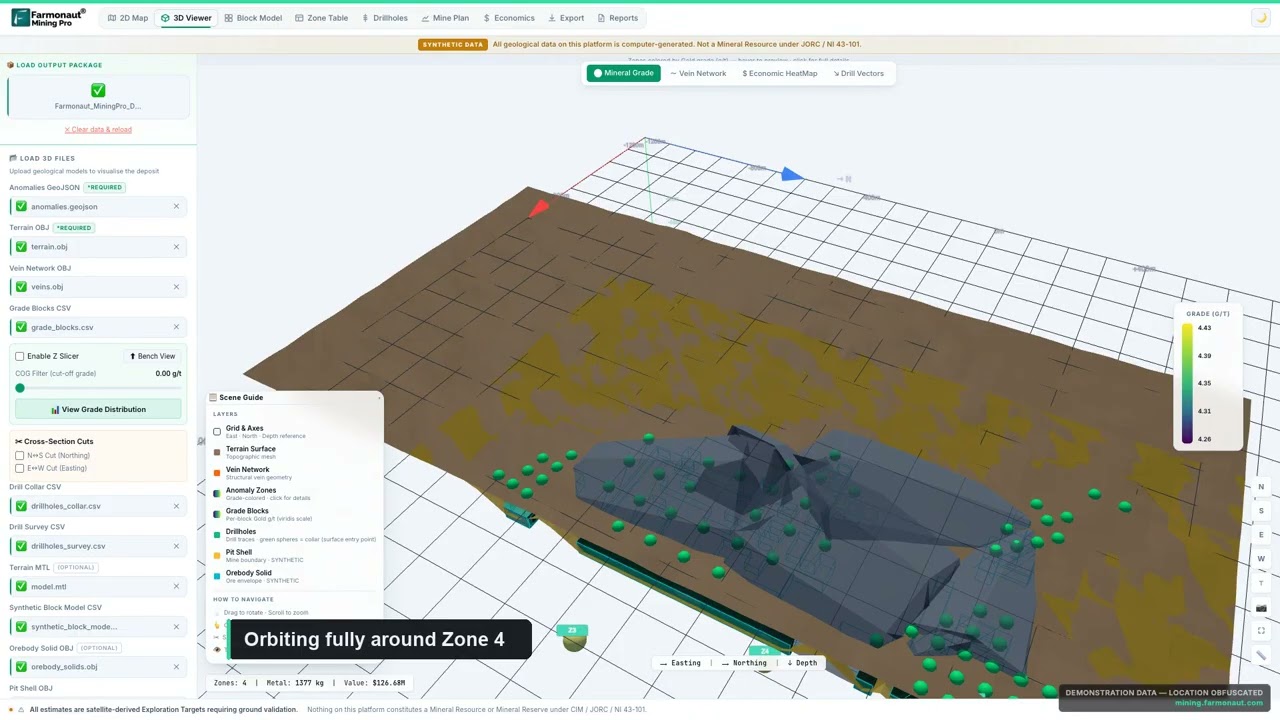
▶ Building a 3D geological scene from elevation data, zone depths and grade layers. · 16:42
Types of 3D mining animations and who needs them
The audience decides the style. A film for a board does not train a loader operator, and one film rarely does both jobs well.
| Animation type | Main viewer | What it shows | What must be right |
|---|---|---|---|
| Animation of mining processes and methods | New staff, students, contractors | Room and pillar, sublevel stoping, open-pit benching, crushing and milling | Order of steps and equipment used |
| Safety and training | Miners and supervisors | Exclusion zones, blind spots, escape routes, lock-out steps | Your site’s actual rules and layout |
| Geological visualisation | Geologists, investors | Orebody shape, faults, drillholes, core results | Model version and stated confidence |
| Mine site development | Boards, lenders, regulators | Construction stages, haul roads, plant, tailings | Dates, footprint and approved design |
| Mine site reclamation | Regulators, local communities | Landform, cover and revegetation in stages | Match to the filed closure plan |
| Equipment and plant | Sales, maintenance staff | Internal parts, flow paths, service steps | Manufacturer drawings |
For an investor or community film, label anything that is conceptual. A polished picture of a future mine can look more certain than the study behind it. Show the status of the plan on screen, and have your qualified person or legal adviser review the script.
For a geology film, the source data matters most. Our guide to core samples explains what drill core can show. Our overview of 3D animation uses in mining gives more examples.
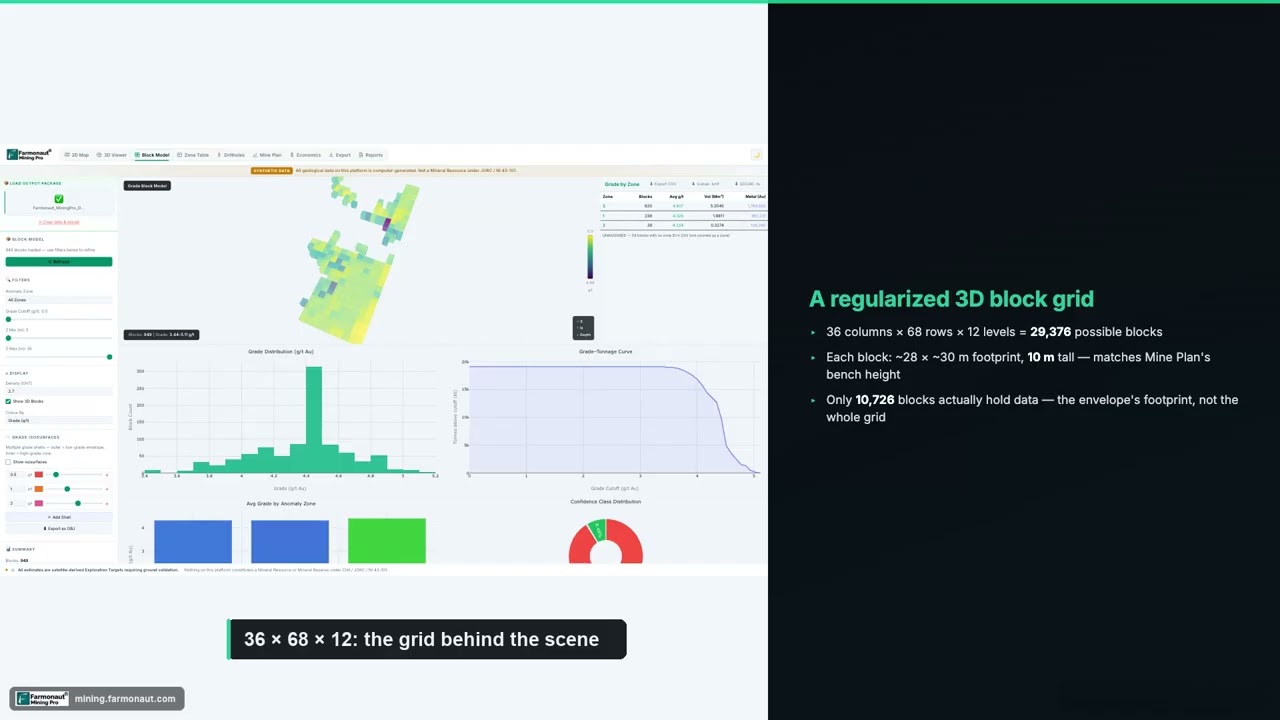
▶ What a block model is, the 3D grid behind a mine plan, using demo data. · 5:23
How 3D animation supports mining safety, and what the evidence shows
The case for animation is simple. Hazards in a mine are often hidden, and a moving picture can show a blind spot or a falling slab with nobody at risk. Direct evidence that animation cuts injuries is thin, so treat it as one tool in a safety programme.
Chart
US mining fatalities by sector
Fiscal years, operators and contractors
Fatalities remain the reason to care. MSHA counted 28 US mining fatalities in fiscal year 2025, 5 in coal and 23 in metal and nonmetal mines, among about 327,000 miners. Early in 2025 powered haulage (moving vehicles and conveyors) was the most common accident class, with four of the first ten deaths.
Three findings are worth knowing before you buy:
- Virtual settings can test hazard spotting. A NIOSH study of 49 participants used panoramic images of a pit, plant, shop and roadway in an immersive lab to measure how well people recognised hazards.
- Training on a hazard did not automatically improve spotting it. In that study, risk attitude and safety-specific work experience affected accuracy, while hazard-specific training did not show a significant effect. The training was self-reported past training, not a film, so this does not test animation directly. It is still a reason to add practice and follow-up around a film.
- This quarry trial was small. A 2025 Italian marble quarry trial with 40 participants tracked completion, errors, scores and retention one week later for interactive VR. That is useful for design, but it measured a training course and not injury rates.
Percentage claims are often repeated online, such as a set fall in incidents after adding animation. Ask any supplier who quotes one for the study, the sample and the site.
Five safety jobs animation does well
- Blind spots around large vehicles. MSHA notes that surface mining vehicles can be several stories tall and can crush smaller vehicles their operators cannot see. A driver’s-eye camera shows this quickly.
- Emergency escape routes. Walk a viewer through the real route, turn by turn, before they go underground.
- Ground failure signs. Show how a rib or highwall fails, then what a worker should report and where to stand.
- Blast clearance. Show the exclusion zone, guard positions and re-entry order for your site.
- Shared understanding across crews. Pictures reduce the wording burden for mixed-language crews, especially with translated narration.
Where animation fits US miner training rules
Animation can support required training, but it does not replace the rules. In the United States, MSHA requires at least 40 hours for new underground miners, in conditions that as closely as practicable duplicate underground conditions, with about 8 hours at the minesite. Refresher training is at least 8 hours a year.
Sand, gravel, surface stone, surface clay and surface limestone mines under Part 46 need at least 24 hours for new miners, including site-specific hazards, and 8 hours of annual refresher, including changes at the mine that affect safety. Check with your training plan holder or MSHA before counting any film toward these hours. Other countries have their own rules, so confirm with the local regulator.
Small sites may have the most to gain from clear training. MSHA’s review found an average fatality rate of 0.0227 per 200,000 hours at mines with 5 or fewer employees for 2011 to 2020, against 0.0167 at mines with 6 to 20. These rates cover surface mines and surface areas of underground mines. A short film for one hazard can be a practical start. See also our guide to mine safety solutions.
Chart
Minimum US miner training hours
Hours set in 30 CFR Parts 46 and 48
How much a mining animation costs
We found no published price list for mining animation, so use general 3D rates as a guide and get quotes. FrameSixty (2026) lists about US$5,000 to US$8,000 a minute for entry motion-graphics 3D, US$8,000 to US$15,000 for mid-tier product work, US$15,000 to US$30,000 for high-end work and US$30,000 to US$50,000+ for cinematic work.
Chart
3D animation guide rates per finished minute
US$ thousand, low to high; general rates, not mining quotes; top tier is open-ended
The same guide puts enterprise animation of industrial systems at US$20,000 to US$100,000+ per project, because of mechanical accuracy, sign-off and multiple approvers. Much mine work has the same needs. Broadcast2World also starts its 3D guide figure at about US$5,000 per minute.
These cost drivers move a quote the most:
- Custom models. A specific shovel, shaft or plant costs more than a generic asset.
- Data clean-up. Mixed coordinates and old design versions take paid hours to sort out.
- Review rounds. Each extra approver adds time. Agree the number of rounds in the contract.
- Languages. Narration and captions need reworking for each language.
- Updates. If the mine plan changes, you will want scene files you can reopen.
- Interactive or VR versions. These are software projects as well as films, so price them separately.
Timelines in the same guide run about 2 to 4 weeks for entry work and 4 to 8 weeks for mid-tier work. Allow extra time for your own technical review, because that is usually outside the supplier’s control.
Calculator
What will your mining animation cost?
Enter your length, a quoted rate and the number of viewers.
- Cost per viewer (US$): $180
- Effective cost per finished minute (US$): $12,000
Example values only, not a benchmark or a quote. Enter the rate from your own supplier. Results exclude your staff time and any VR development.
How to hire a 3D mining animation expert
Three kinds of supplier do this work, and each suits a different job.
Infographic
A mining animation project in 6 steps
- 1Set the goalOne audience and one thing they must do or understand.
- 2Freeze the dataChoose dated design files and a named owner.
- 3Approve the scriptTechnical and safety staff sign off before modelling.
- 4Review a rough cutCheck scale, sequence and protective equipment.
- 5Final renderAdd narration, captions and languages.
- 6Test and updateCheck viewer understanding and set a review date.
| Supplier | Guide rate per minute (US$) | Best for | Watch for |
|---|---|---|---|
| Independent animator | 1,000 to 5,000 | A short film with clean data and a clear brief | Single point of failure; your staff must supply the mining knowledge |
| Studio | 5,000 to 15,000 | Training series, process films, plant walk-throughs | Whether anyone on the team has mining experience |
| Full-service agency | 15,000 to 50,000+ | Investor launches and large multi-language campaigns | Paying for polish when the training need is simple |
The rates above are general animation figures reported by FrameSixty from Vidico (2026), not mining quotes. For wider project help, see our guide to choosing a mine development company or geological consulting firm.
Questions to ask before you sign
- Show me a mining film you built. Who at the client checked it?
- Which data formats can you take directly from our geology and planning software?
- Who on your team has worked at or for a mine?
- How many review rounds are included, and what does another one cost?
- Do we own the final film, the scene files and the models?
- How do you protect confidential drill data and unreleased plans?
- What will an update cost if the mine plan changes in a year?
- Can we get translated versions, captions and short clips for toolbox talks?
What to put in the brief
- One audience and one outcome for each film.
- The current design files, with a named owner who approves any change.
- Your site safety rules, and a safety officer who signs off the script.
- Required personal protective equipment, so that every animated worker wears it correctly.
- A statement of what is conceptual, approved or built.
- Length, languages, formats, deadline and the number of review rounds.
Red flags
- A showreel of attractive machines with no process logic.
- Promised percentage cuts in incidents without a named study.
- No technical review step in the schedule.
- Workers shown without correct protective equipment, or standing inside an exclusion zone.
- A geology film with no mention of the model version or its confidence.
Good practice for accurate mine animations
Most errors come from the process around the animation. These habits prevent the common ones.
- Keep one source of truth. Freeze a dated design version for the film and record it in the credits or the project file.
- Use real units. Build scenes to true scale. A truck that looks small against a ramp misleads people about clearance.
- Match realism to the job. A simple clear model can teach better than a detailed one with distracting effects.
- Show a base case and alternatives. If a board must choose between options, use the same camera and scale for each.
- Test with real viewers. Show a draft to a few new starters and ask them to explain the steps back.
- Add practice. Follow each film with a question, a site walk or a supervised task, given the NIOSH result above.
- Set a review date. Old films that no longer match the site are a safety problem of their own.
Where satellite data fits in a mining animation
Early-stage projects often have little drilling, so surface data can give an animator real terrain and context. Satellite imagery and elevation data help show the ground, access routes and how the site sits in its surroundings. Any target zones shown from such work are exploration targets that sit ahead of a resource estimate, and the film should say so.
Farmonaut offers satellite-based mineral detection reports that include maps and 3D views of a licence area. You can send a project query or contact the team about a specific site.
▶ A walkthrough of 3D prospect analysis in Farmonaut Mining Pro. · 2:17
Frequently asked questions
What does a 3D mining animation expert do?
They turn mine plans, geological models and equipment drawings into accurate animated films or interactive scenes for training, planning and communication. Your technical staff still own the data and approve the content.
How much does a 3D mining animation cost?
General guides list about US$5,000 to US$50,000+ per finished minute, and US$20,000 to US$100,000+ per project for industrial systems (FrameSixty, 2026). Data quality, custom models and review rounds move the price most.
How long does a mining animation take?
General 3D work runs about 2 to 8 weeks for entry and mid-tier films (FrameSixty, 2026). Add time for reviews by your geologists, engineers and safety staff.
What is the difference between a mining animation consultant and an animator?
A consultant advises on content, scope and suppliers. An animator builds the scenes. Some specialists offer both, so confirm this in the proposal.
Does 3D animation reduce mining accidents?
No set reduction is established by the studies cited here. They measure hazard recognition and training performance, not long-term injury rates. Use animation with practice, supervision and engineering controls.
Can animation count toward MSHA training hours?
The rules set minimum hours and subjects, and they do not name animation as a replacement for site-specific instruction. Check with your training plan holder or MSHA before counting a film.
What data does an animator need from a mine?
Usually current design files, geological model exports, equipment models or drawings, photos, safety rules and a technical contact. Send only what the film needs, under a confidentiality agreement.
Can mining methods be shown in an animation?
Yes. Process and method films are a common use. They show the sequence for methods such as room and pillar or sublevel stoping, and they work best with a mining engineer checking each step.
What is mine site reclamation 3D animation used for?
It shows how land is reshaped, covered and revegetated in stages after mining. It helps regulators and communities follow a closure plan, and it must match the plan that was filed.
Should we choose animation or virtual reality for training?
Films are cheaper to share and work on any screen. Interactive VR adds decisions and tracked scores, as in the 2025 quarry trial, but it needs headsets and more development.
This page is for information only. It is not legal advice. Confirm training rules with the regulator. Price ranges are general guides, not quotes.
Farmonaut mining
Start with a map of your site
Get satellite maps and 3D views of your licence area to brief your team and your animator.

Mining Pro sample view, synthetic data
Keep reading
Sources
- MSHA, Mine Safety and Health At a Glance, FY2025: msha.gov
- MSHA, 2025 Fatalities Focus safety alert: msha.gov
- MSHA, Safety Program for Surface Mobile Equipment, Federal Register (2023): federalregister.gov
- eCFR, 30 CFR Part 48, miner training: ecfr.gov
- eCFR, 30 CFR Part 46, miner training: ecfr.gov
- NIOSH authors, risk attitude, experience and training on hazard recognition in mining (PMC): pmc.ncbi.nlm.nih.gov
- Pireddu et al., virtual reality safety training in open-cast mining, IJERPH (2025): pmc.ncbi.nlm.nih.gov
- Seequent, Leapfrog Geo: seequent.com
- FrameSixty, 3D animation cost guide (2026): framesixty.com
- Broadcast2World, animation pricing guide (2026): b2w.tv
Discussion
Questions, corrections or field experience? Share them below. First-time comments are reviewed before they appear, and your email is never published.
No comments yet. Be the first to add a question or your experience.

 Sahara Mining
 Sean Mining Limited
 NTS Group (Pty) Ltd
 Mine4Africa
 Lithspo Minerals Limited
 Tintina Mining Group
 Dalgety Minerals Pty Ltd
 Vortex Minerals Pty Ltd
 Faith At Work (Pty) Ltd
 Geotech Mining Solutions plc
 Vulcan International Limited
 Kidepo Associates
 GKY Mining
 Alkimy SARL
 Double A Trading
 GemSprout Metals Limited
 Qader Group
 Ileys General Trading
 SG Gold Mining LLC
 VRV Global Pte Ltd
 Omsri International FZE
 G.I.T.T.
 Jaunita Erss Ltd
 SRK Consulting
 Berks Gold Limited

 Client · Tanzania · Gold










