
Mine development · Buyer's guide
Mine Development Company: Types, Costs, How to Choose
The term covers owner-developers, engineering (EPCM) firms and mining contractors. Match the role to your gap, check finished projects and the permit record, and plan for years: S&P Global’s sample of 127 mines averaged 15.7 years from discovery to production.
Key takeaways
- Three businesses share the name: owner-developers, EPCM and study engineers, and mining contractors; they are paid and held to account in different ways.
- S&P Global’s 127-mine sample took 15.7 years from discovery to production, 11.9 of them on discovery, exploration and studies (S&P Global, 2024).
- Only a pre-feasibility or feasibility study can support reserves; a PEA cannot (NI 43-101; CIM Definition Standards).
- The Arctic project’s initial capital (100% basis, per Trilogy Metals) rose from US$905.6 million (2020 study) to US$1,176.8 million (2023 update).
- Check the named qualified person, the permit record and two client references before signing.
In this article
- What a mine development company does
- Three kinds of mine development company
- The stages a developer moves through
- How long mine development takes
- What the build itself takes once studies are done
- What development costs and why estimates change
- Check what a study range means for your funding
- Who is hired, and when: a project timeline from public records
- How to choose a mine development company
- What to ask each type before you sign
- Warning signs when comparing companies
- Mine development company examples worth checking first
- What to prepare before you contact a developer
- Frequently asked questions
A mine development company takes a mineral deposit that has been found and drilled and turns it into a permitted, financed and built mine. The name covers three different businesses: owner-developers that hold the deposit, engineering firms that design and manage the build, and contractors that dig the shafts, declines and pits. Most readers searching the term want one of them, so this guide separates the three, shows what each costs and how long the work takes, and gives a checklist for choosing between them.
The timeline is the first number to know. S&P Global Market Intelligence found that 127 mines that started up between 2002 and 2023 took 15.7 years on average from discovery to production, and almost 12 of those years went on discovery, exploration and studies (S&P Global, 2024). A development partner is therefore a long-term relationship, and the choice is made while the project is still a set of drill logs and a licence.
What a mine development company does
A development company owns or controls a deposit that is past discovery but not yet producing, and its job is to remove the doubts that stop a bank or a major mining company from funding construction. In practice that means five tasks, usually run in parallel rather than one after another.
- Prove the resource. Infill drilling raises confidence in the tonnes and grade so that part of the resource can be reported as a reserve. A reserve is the portion that studies show can be mined at a profit. See our guide to mineral exploration stages, methods and costs for the work that comes before this stage.
- Study the economics. Engineers test mining methods, process routes and costs in a sequence of studies, covered below.
- Win the permits. Environmental baseline work, public comment and agency decisions often take longer than the engineering.
- Raise the money. Debt, equity, streams, royalties and government loans are combined into one funding package.
- Build and hand over. Early works, the plant, the pit or the underground workings, and the move to commercial production.
Not every developer builds the mine itself. Many sell the finished project to a larger producer, and the guide on how to sell a mine covers valuation and deal structures for that route.
Three kinds of mine development company
The same phrase is used for three different roles. Mixing them up is the commonest reason a search ends with the wrong list of companies.
1. The owner-developer
This is a company, often a listed junior, that holds the licence or claims and carries the project through studies, permits and financing. It may hire everybody else. Perpetua Resources is an example: it is a Nasdaq and TSX listed developer of the Stibnite Gold Project in Idaho, where it spent eight years in federal permitting before the final federal permit was issued (Perpetua Resources, 2025). Integra Resources, with the DeLamar project in Idaho, is another developer that has taken one deposit through a preliminary economic assessment, a pre-feasibility study and a feasibility study (Integra Resources, 2026).
2. The engineering and EPCM firm
EPCM stands for engineering, procurement and construction management. The firm designs the plant, buys the equipment and manages the builders, while the owner keeps the contracts and the risk. Studies are also written by these firms. Rupert Exploration Finland appointed Ausenco to lead the feasibility study of its Ikkari gold project in Finland, to a stated accuracy of plus or minus 15% on capital and operating costs (International Mining, March 2026). Ioneer signed a non-binding letter of intent with Hyundai Engineering to take part in engineering, procurement and design at its Rhyolite Ridge lithium-boron project in Nevada (International Mining, June 2026).
3. The mining contractor
Contractors supply crews and equipment to open the mine: shaft sinking, declines, pre-stripping, drilling and blasting, and often production mining afterwards. This is the group meant by many buyers who type “mine development company” while they already hold a permitted deposit. Perenti, an ASX-listed mining services group, reported record revenue of A$3.49 billion for its 2025 financial year, which shows the scale of this segment (Perenti, FY25 results). If your need is drilling rather than construction, read the guide to choosing an exploration drilling contractor.
| Type | Owns the deposit? | Typical output | Paid how |
|---|---|---|---|
| Owner-developer | Yes | Studies, permits, financing, a built mine or a sale | Equity, debt, streams, a later sale |
| EPCM or study engineer | No | Study reports, design, procurement, construction management | Fees, often by phase |
| Mining contractor | No | Shafts, declines, pits, haulage, production tonnes | Rates per metre or per tonne |
The stages a developer moves through
Studies are written in a fixed order, and each one has a defined meaning under Canadian rules (NI 43-101) and the CIM Definition Standards. Knowing the terms lets you judge what a company has really finished.
Infographic
From deposit to mine in six steps
- 1Resource drillingRaise confidence in tonnes and grade.
- 2PEAEarly economic look at the resource.
- 3PFSCompare options; reserves can be declared.
- 4Feasibility studyDetailed basis to build or finance.
- 5Permits and fundingAgency approvals and a funding package.
- 6Build and start-upEarly works, plant, first production.
- Preliminary economic assessment (PEA). Under NI 43-101 it is a study, other than a pre-feasibility or feasibility study, that includes an economic analysis of the potential viability of mineral resources (Ontario Securities Commission, NI 43-101 consolidation). It is an early look, sometimes called a scoping study, and it cannot be used to declare reserves.
- Pre-feasibility study (PFS). A comprehensive study of a range of options, at the point where the mining method or pit shape is set and a processing method is chosen. CIM says a PFS is the minimum needed to convert resources to reserves, and that it has lower confidence than a feasibility study (CIM Definition Standards).
- Feasibility study (FS). A detailed study of the chosen option that can serve as the basis for a final decision to build or to finance. CIM says its confidence is equivalent to what a financial institution requires.
- Final investment decision (FID). The board’s decision to commit construction money. Ioneer, for example, said in June 2026 that it was targeting a final investment decision in the second half of 2026, with first commercial production expected in 2029 (International Mining, June 2026, linked above).
Cost estimates tighten as the studies advance. The Ikkari feasibility study above was set to AACE Class 3 standard, which the release says will deliver capital and operating cost estimates with plus or minus 15% accuracy. Earlier studies carry wider ranges, so a headline net present value from a PEA is a different kind of number from one in a bankable feasibility study.
How long mine development takes
Time is the largest hidden cost, because every extra year of waiting adds interest, overheads and price risk. The S&P Global study measured how long mines needed from first discovery to first production and found large differences between countries. The study includes mines not yet producing and, where no startup date exists, assumes 2030 for every country, so some country figures are partly projections. In the report’s larger sample that includes mines not yet producing, gold mines were the fastest to develop at 20.8 years on average worldwide and copper took 24.1 years. In the 127-mine sample, gold also went online fastest, at about 15 years.
Chart
Years from discovery to first production, selected countries
Selected countries (at least two mines each), 268 mines including some not yet producing
The chart below shows the country averages. The 15.7-year figure quoted earlier comes from a separate S&P Global sample of 127 mines, so the two numbers should not be mixed in one comparison.
What the build itself takes once studies are done
Once the studies are finished, the work splits into a decision phase and a build phase. In the S&P Global sample of 127 mines the average time from discovery to production was 15.7 years: 11.9 years for discovery, exploration and studies, 1.5 years in the construction-decision stage, and 2.3 years from the start of construction to startup. In other words, the build itself is a small part of the programme, and most of the schedule risk sits in the work done before a contractor is hired.
Chart
Where the 15.7 years go
Average years by phase, 127 mines started 2002 to 2023
In the United States, federal permitting is a large part of the middle phase. S&P Global notes that for mines on federal land a detailed plan of operations must be submitted, followed by an environmental impact statement process that the government estimates takes about four years. Perpetua’s own record shows how that looks in practice: formal permitting began in 2016, a Final Record of Decision came in January 2025, and the Army Corps Clean Water Act permit followed as the last federal permit (Perpetua Resources, 2025, linked above). By 31 August 2026 the company reported early works and critical-path construction under way at Stibnite (Perpetua Resources, August 2026 construction update).
What development costs and why estimates change
Capital cost is the amount spent before the first sale, and it is rarely fixed at the first study. The best public example of the movement between studies is the Arctic copper-zinc project in Alaska, held 50% by Trilogy Metals (the study figures are on a 100% basis). Its updated feasibility study (February 2023) put initial capital at US$1,176.8 million, against US$905.6 million in the 2020 study, and closure and reclamation at US$428.4 million against US$205.4 million. The company said the update reflected high inflation and supply-chain problems (Trilogy Metals, 2023). Metal price assumptions also changed between the two studies, so the comparison shows how fast inputs move, not a like-for-like cost overrun.
Chart
Arctic project costs between two feasibility studies
US$ million, Trilogy Metals Arctic copper-zinc project
Project size sets the scale of the money. The table shows initial capital from recent studies, all as reported by the owners and all measured on different price and cost bases.
| Project | Stage and source date | Initial capital |
|---|---|---|
| DeLamar gold-silver, Idaho (Integra Resources) | Feasibility study, effective 8 December 2025 | US$389.1 million pre-production capital, including owner’s costs, working capital and the reclamation bond |
| Arctic copper-zinc, Alaska (Trilogy Metals) | Updated feasibility study, 2023 | US$1,176.8 million |
| Stibnite gold-antimony, Idaho (Perpetua Resources) | Investor presentation, September 2026 | US$2,576 million including US$191.9 million contingency, at consensus prices of $3,250/oz gold, $10/lb antimony and $40/oz silver |
Sources for the table: DeLamar feasibility study technical report, the Trilogy release above and Perpetua’s investor presentation. The Perpetua presentation also states that its US EXIM Bank board approval was received on 21 May 2026 for a senior secured loan of up to about US$2.9 billion, which is conditional on definitive documents and other conditions.
Check what a study range means for your funding
An estimate with plus or minus 15% accuracy is a range, not a promise. Use the calculator below with a study’s initial capital, its stated accuracy and your financing plan to see how much equity the high end of the range needs.
Calculator
How much equity does the high end of the estimate need?
Enter your own study capital, accuracy and financing plan.
- Low end of range (US$ million): 340.0
- Debt at the high end (US$ million): 276.0
- Equity needed at the high end (US$ million): 184.0
- Equity still to raise (US$ million): 84.0
Example values only, not a benchmark. Accuracy of plus or minus 15% is the accuracy the Ikkari study release states for its AACE Class 3 estimate; other studies state other ranges (International Mining, March 2026). Capital is a single figure from your own study; no prices are used.
Who is hired, and when: a project timeline from public records
Real projects show the order in which each kind of company appears. Rupert discovered Ikkari in 2020, reached a pre-feasibility study in early 2025, and hired Ausenco to lead the feasibility study in March 2026 (International Mining, linked above). Integra Resources took DeLamar from a maiden PEA to a PFS to a feasibility study written with Forte Dynamics as lead author, with the report filed in February 2026. Ioneer has invested more than US$220 million in Rhyolite Ridge since 2016 and says it has completed more than 70% of advanced engineering work, while naming Korean engineering and infrastructure partners in non-binding letters of intent (International Mining, June 2026). Each of these is a developer that used outside engineers and, later, contractors, so the owner stays the one responsible for the programme.
The ground itself is the starting asset. Owners of licences and claims who are not yet at feasibility stage can add information from satellite data before studies are commissioned; our guide to types of ore deposits shows what grades and sizes different deposit models usually bring to a study.
How to choose a mine development company
Pick by the role you need filled, then test the candidate on evidence. The checklist below applies to all three types, with the extra questions for each type in the next section.
- Define the gap. Do you need a study, a design, a financing partner, a builder or a buyer? A study author and a mining contractor are different hires.
- Ask for finished projects at your stage. A company that has delivered a feasibility study for a heap-leach gold project says little about a deep underground copper mine. Match commodity, mining method, climate and country.
- Check who signs the technical report. Under NI 43-101 a qualified person takes professional responsibility for the report. Ask who that person is and which professional body they belong to. Look up the report on SEDAR+ or SEC EDGAR rather than relying on a brochure.
- Look at the permit record. A developer or engineer should be able to name each permit, the agency, the date and the outcome. In the US, check the project’s page on the Federal Permitting Council dashboard, and for other countries the national cadastre or mining registry (see our page on mining concessions and their terms).
- Test financial strength. Ask how much cash a developer holds against its next 12 months of spending, and how it plans to fund construction. For contractors, read the annual accounts, the equipment fleet, the safety record and the number of live contracts.
- Compare the contract form. Lump sum, cost plus, unit rate and EPCM place risk differently. Lump-sum contracts put more cost risk on the contractor, while EPCM leaves it with the owner, so ask each bidder to state who pays when quantities or prices change.
- Call two references from past clients, and ask what went wrong as well as what went well.
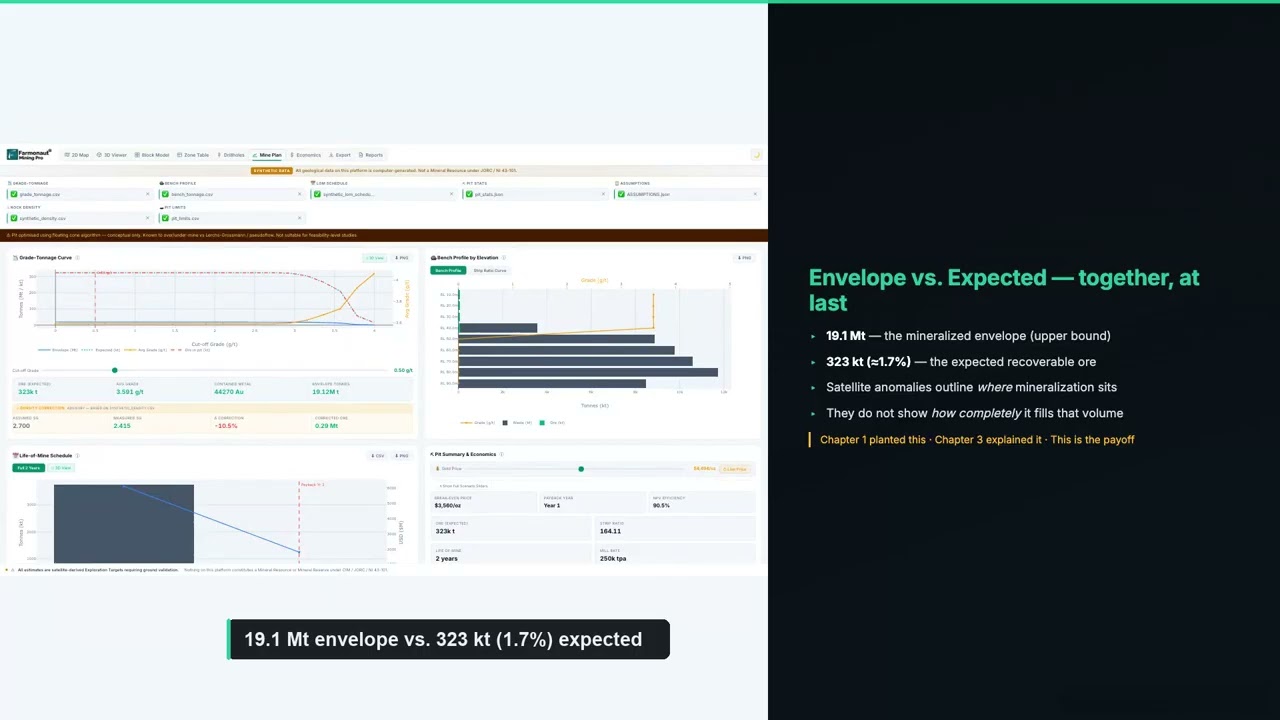
▶ Course chapter on pit shell, grade-tonnage curve and a conceptual production schedule, the kind of work a study team does. · 18:56
What to ask each type before you sign
Owner-developers (if you are selling or partnering)
Ask for the title documents, the latest technical report with its effective date, the permit register and the funding plan. Ask what happens to your interest if the developer cannot raise construction money. Joint ventures and earn-in agreements usually state exactly when the partner gains ownership, and your lawyer should check this clause first.
Engineering and EPCM firms
Ask which team in which office will do the work, whether the lead author on the report will stay on for the whole study, and how they treat contingency. Ask what accuracy class the estimate is built to and what quantities are measured rather than assumed. Ikkari’s AACE Class 3 target of plus or minus 15% is one example of a stated standard.
Mining contractors
Ask for the fleet list and its age, the key supervisors’ names, the rates per metre or per tonne and what they cover, and how the contractor is paid when ground conditions change. The older SME literature on contract mining (OneMine, SME paper) frames the trade-off as owner-operation versus a contractor who brings crews and equipment under a contract.
Warning signs when comparing companies
- A glossy brochure with no named projects, technical reports or references.
- Study results quoted without the study’s date, price assumptions or accuracy range.
- Claims about “reserves” from a company that has completed only a PEA. Reserves need a PFS or FS under the CIM standards.
- No permit history, or permits described as “expected” without agency names.
- Promises of speed with no evidence from comparable projects, given that the S&P Global data shows multi-year timelines even for well-run mines.
- Requests for large upfront payments before any scope or contract is agreed.
▶ Shows how a mineral management system keeps maps, samples and targets in one place. · 3:21
Mine development company examples worth checking first
Use public filings, not advertising, as your first look. The names below are listed only as examples of public records you can read; this is not a ranking and not a recommendation.
- Perpetua Resources (Nasdaq and TSX: PPTA): Stibnite Gold Project, Idaho. Final federal permits in 2025 and construction update in August 2026.
- Integra Resources (TSXV: ITR, NYSE American: ITRG): DeLamar Project, Idaho. Feasibility study filed February 2026.
- Ioneer (ASX: INR): Rhyolite Ridge lithium-boron, Nevada. Final investment decision targeted for the second half of 2026.
- Trilogy Metals (TSX and NYSE American: TMQ): Arctic copper-zinc, Alaska. Updated feasibility study in 2023.
- Ausenco, Perenti: an engineering firm and a mining contractor named in the sources above. Check their own project lists for work in your commodity and region.
Not investment advice. Company status, tickers and project stages change, so confirm each against the latest filing on SEDAR+, EDGAR or the ASX.
What to prepare before you contact a developer
A developer or engineer will ask for the same package, and having it ready shortens the first conversation. Gather the licence or claim documents and the expiry dates, a map in a standard coordinate system, all drilling and assay data with the laboratory certificates, any historical or current resource report, geophysical and geochemical survey results, and existing permits or environmental studies. A short note on access, water and power also helps. See the guide to airborne geophysical survey contractors if a data gap needs a survey.
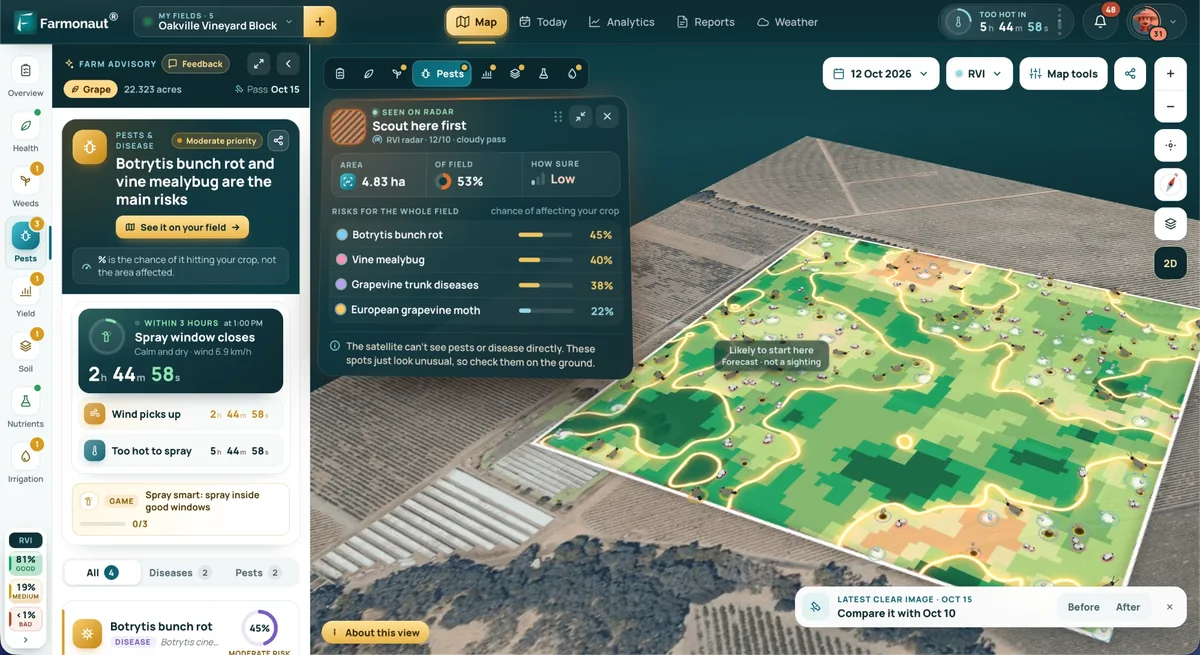
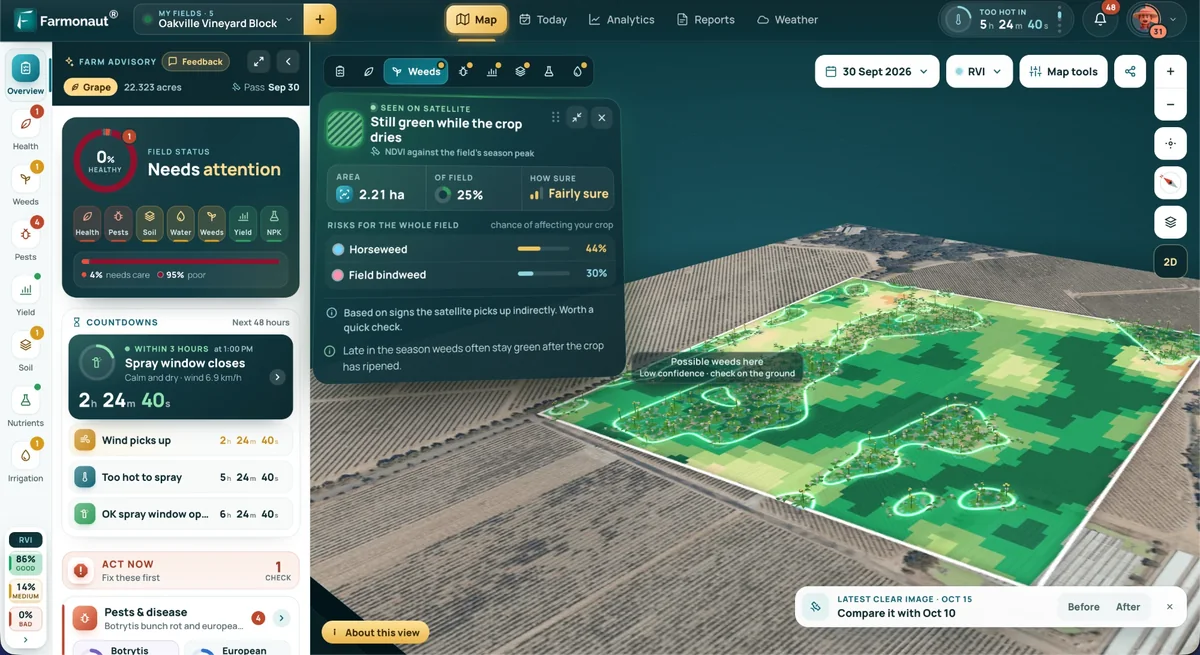
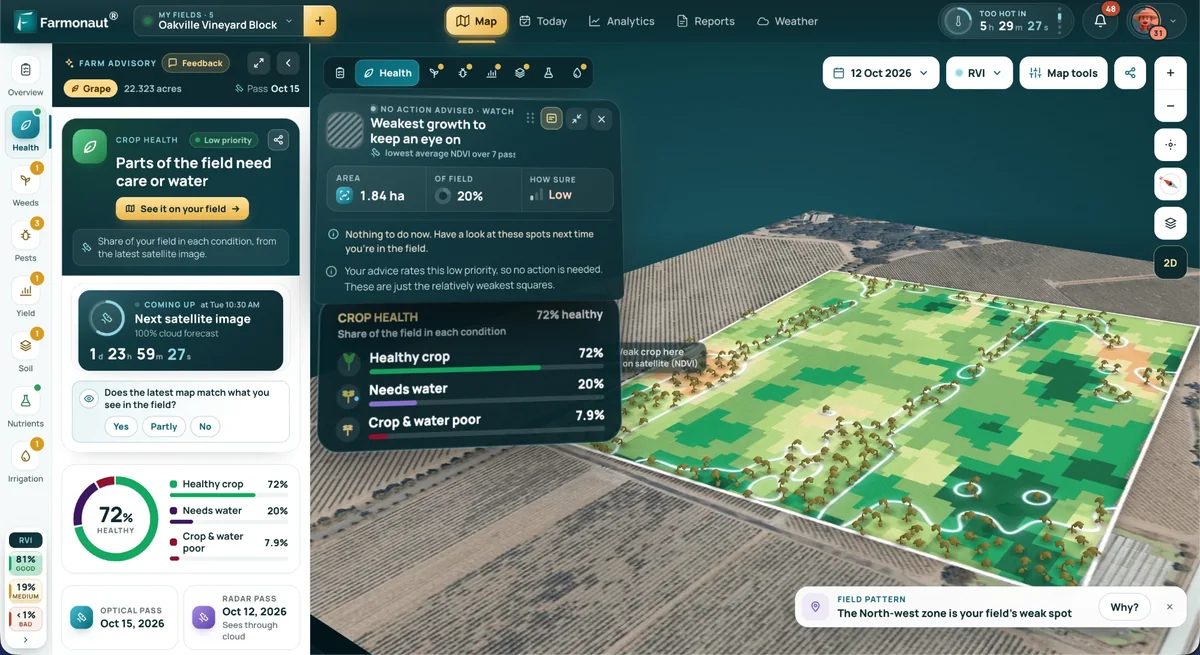
Satellite screening can also support this stage. Farmonaut Mining Pro combines optical, thermal, radar and terrain layers for a licence area so that you can see alteration and structure targets before you commission drilling. It points to places worth testing and does not replace drilling, a resource estimate or a technical report.
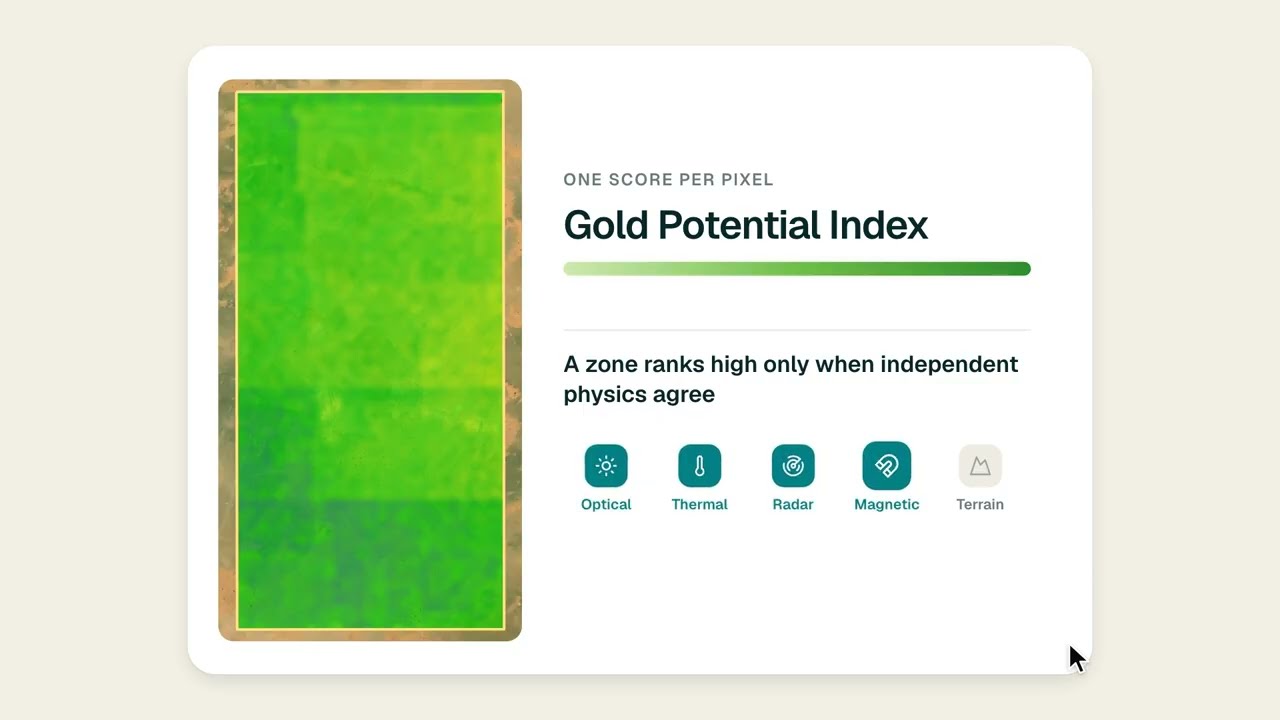
▶ Shows how Farmonaut Mining Pro screens a licence area from satellite data before any drilling. · 1:46
Frequently asked questions
What does a mine development company do?
It advances a discovered deposit through resource drilling, economic studies, permitting, financing and construction until the mine can produce. Some firms do all of this as owners, while others supply only the engineering or the mining crews.
What is the difference between a mine developer and a mining contractor?
A developer owns the project and carries its risk, and a contractor is paid to carry out defined work, such as sinking a shaft or stripping a pit. The S&P Global data on development times applies to the owner’s whole programme, not to the contractor’s part.
How long does it take to develop a mine?
S&P Global’s sample of 127 mines averaged 15.7 years from discovery to production, with 11.9 years of that before a construction decision stage. Country averages in its 2024 study include 20 years for Australia, 27 for Canada, almost 29 for the United States and 34 for Zambia.
How much does it cost to develop a mine?
It depends on the size and metal. Recent studies in this guide show initial capital of US$389.1 million for DeLamar, US$1,176.8 million for Arctic and US$2,576 million for Stibnite, all on different bases and dates.
What is a PEA, a PFS and a feasibility study?
A PEA is an early economic look at resources, a PFS compares options and can support reserves, and a feasibility study is detailed enough to support a decision to build or to finance. Confidence rises at each step (NI 43-101; CIM Definition Standards).
What does EPCM mean?
Engineering, procurement and construction management. The EPCM firm designs the plant, buys equipment and manages the builders, while the owner holds the construction contracts and carries the cost risk.
How do I choose a mine development company?
Decide which role you need, ask for finished projects at the same stage, commodity and country, check the named qualified person and the permit record, compare contract forms, and call references. The checklist above sets out each step.
Can a small licence holder work with a mine development company?
Yes, usually through a sale, an option or an earn-in. The developer pays to advance the project and takes ownership as it spends. Terms differ by deal, so a mining lawyer should review them.
Are mine development companies listed on stock exchanges?
Many owner-developers are listed on exchanges such as the TSX, TSX Venture, ASX, NYSE American or Nasdaq, and file technical reports with regulators. Listing does not mean a project will be built.
What should a licence owner prepare first?
Proof of title, a map, all assay and drilling data, any existing reports and permits, and a note on access, water and power. Developers read these before anything else.
Does a feasibility study guarantee a mine will be built?
No. It shows that extraction is reasonably justified at the study’s assumptions. Prices, costs, permits and financing can all change before and after a construction decision, as the Arctic cost update shows.
This page is for information only. It is not investment advice, legal advice or an engineering study. Company details change; confirm them in current filings and get qualified advisers before signing any contract.
Farmonaut mining
Map your licence area from space
Request a quote to have your licence screened with satellite data before you brief a developer or engineer.
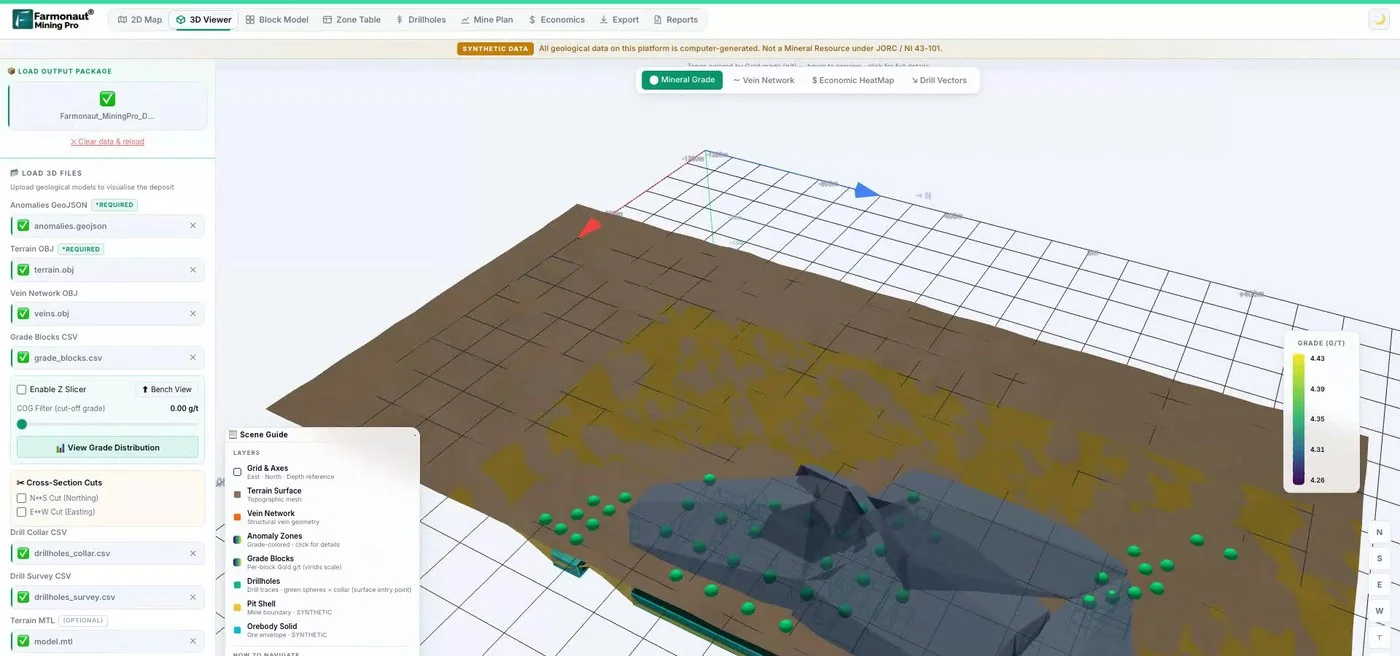
Mining Pro sample view, synthetic data
Sources
- S&P Global Market Intelligence, Mine development times: The US in perspective (2024): cdn.ihsmarkit.com
- Ontario Securities Commission, NI 43-101 unofficial consolidation: osc.ca
- CIM Definition Standards (2014): mrmr.cim.org
- Perpetua Resources, final federal permit release (2025): perpetuaresources.com
- Perpetua Resources, August 2026 construction update: perpetuaresources.com
- Perpetua Resources, investor presentation (September 2026): perpetuaresources.com
- Integra Resources, DeLamar feasibility study filing (February 2026): integraresources.com
- DeLamar feasibility study technical report (effective 8 December 2025): minedocs.com
- Trilogy Metals, updated Arctic feasibility study (2023): trilogymetals.com
- International Mining, Ausenco secures Ikkari feasibility study (March 2026): im-mining.com
- International Mining, Ioneer Rhyolite Ridge letters of intent (June 2026): im-mining.com
- Perenti, FY25 results: perenti.com
- OneMine, Contract mining: an alternative to owner operations (SME): onemine.org
- Federal Permitting Council dashboard: permitting.gov
- SEC EDGAR company search: sec.gov
Discussion
Questions, corrections or field experience? Share them below. First-time comments are reviewed before they appear, and your email is never published.
No comments yet. Be the first to add a question or your experience.

 Sahel Shipping SA
 Sania Corporation
 Sean Mining Limited
 NTS Group (Pty) Ltd
 Mine4Africa
 Lithspo Minerals Limited
 Tintina Mining Group
 Dalgety Minerals Pty Ltd
 Vortex Minerals Pty Ltd
 Faith At Work (Pty) Ltd
 Geotech Mining Solutions plc
 Vulcan International Limited
 Kidepo Associates
 GKY Mining
 Alkimy SARL
 Double A Trading
 GemSprout Metals Limited
 Qader Group
 Ileys General Trading
 SG Gold Mining LLC
 VRV Global Pte Ltd
 Omsri International FZE
 G.I.T.T.
 Jaunita Erss Ltd