

Wyoming gold · Project comparison
Wyoming Gold Projects Compared: Ounces and Status
CK Gold near Cheyenne reports 1,015 koz of gold in reserves, and Rattlesnake Hills has 0.62 Moz indicated at 0.77 g/t. This page compares Wyoming’s gold projects on their filings, charts CK Gold’s price sensitivity and sorts out the lithium facts.
Key takeaways
- CK Gold has 1,015 koz of gold (1,598 koz gold equivalent) in reserves, an after-tax NPV of US$632 million at US$3,250 gold, and no production decision yet (U.S. Gold Corp, 31 March 2026).
- Rattlesnake Hills has 0.62 Moz indicated at 0.77 g/t and 0.42 Moz inferred at 0.69 g/t; the Roxmore sale to SSR Mining announced 13 October 2026 would move it into a spin-out company (Roxmore, October 2026).
- Seabridge Gold agreed on 13 October 2026 to buy the early-stage Slaughterhouse claims for US$300,000 plus up to US$2.55 million in milestones; there is no resource.
- Total Wyoming gold production is unknown; WSGS puts the Carissa mine at 50,000 to 180,000 oz before 1911.
- WSGS found favorable lithium only in small pegmatite occurrences across 26,386 samples; Rock Springs Uplift brines were reported at about 130 to 190 ppm in a 2013 DOE-sponsored project but at 90 to 105 ppm in later WSGS-cited samples, against 200+ ppm in producing brines.
In this article
- Wyoming gold projects at a glance
- How we compared the projects
- CK Gold near Cheyenne: the project with a feasibility study
- Rattlesnake Hills: ounces in a large, low-grade system
- Slaughterhouse: an early-stage claim package, not a deposit
- South Pass and Atlantic City: where Wyoming gold started
- What a gold resource number means
- Estimate contained and recovered gold
- Gold price and Wyoming projects
- Wyoming lithium: what the survey data shows
- Where satellite data helps, and where it does not
- Prospecting safety and permission
- What to check before you rely on a Wyoming gold number
- Frequently asked questions
Three Wyoming gold projects have recent filings or deals. CK Gold, near Cheyenne, reports 1,015 thousand ounces of gold in its mineral reserves but has no production decision yet. Rattlesnake Hills, in the central part of the state, has a published resource of 0.62 million ounces indicated and 0.42 million ounces inferred. Slaughterhouse, in the south, is an early-stage claim package that Seabridge Gold agreed to buy on 13 October 2026. The USGS state profile, which uses 2018-2019 data, lists no gold among the commodities Wyoming produces.
This page puts those projects side by side with the numbers each company filed, shows how sensitive the nearest-to-production one is to the gold price, and adds a short, sourced look at Wyoming lithium. It also has a calculator for turning tonnes and grade into ounces. Ground ownership, claim fees and lease costs are covered on our companion page, Gold Deposits in Wyoming: South Pass, Rattlesnake Hills, so they get only a short mention here. Troy ounces and short tons are used where the filings use them, with metric equivalents where it helps.
Wyoming gold projects at a glance
The table lists the Wyoming gold projects with a filed number or a 2026 deal, plus the historic district that started it all. Ounces are the figures in each company’s own report, so the categories differ. Read the next section before comparing them.
| Project | Where | Stage | Gold on file | Source and date |
|---|---|---|---|---|
| CK Gold | Silver Crown district, Laramie County, about 20 miles west of Cheyenne | Feasibility study done; company says all state permits are in hand; no production decision | 1,015 koz in reserves (74.5 million short tons); 1,209 koz measured and indicated resource, which includes the reserves | U.S. Gold Corp (NASDAQ: USAU), 31 March 2026 |
| Rattlesnake Hills | Natrona County, central Wyoming | Exploration with a technical report; moves into a new company if the Roxmore sale to SSR Mining closes | 0.62 Moz indicated at 0.77 g/t; 0.42 Moz inferred at 0.69 g/t | Roxmore Resources (TSX: RM), 13 October 2026; report effective 5 September 2024 |
| Slaughterhouse | Southern Wyoming | Early-stage exploration; 163 claims; sale to Seabridge agreed, subject to closing | No resource | Seabridge Gold (TSX: SEA, NYSE: SA), 13 October 2026 |
| South Pass and Atlantic City | Fremont County, south end of the Wind River Range | Historic district; most mines inactive | Carissa mine: 50,000 to 180,000 oz before 1911; state total unknown | Wyoming State Geological Survey (WSGS) |
| Bear Lodge Mountains | North-east Wyoming | Listed by WSGS as a gold district; the best-known project there is a rare earth project | No gold figure on file | WSGS; Rare Element Resources |
How we compared the projects
We did not rank these projects, because the filings do not measure the same thing. A mineral reserve is the part of a deposit a study shows can be mined at a profit, after allowing for mining losses. A mineral resource is mineralized rock with reasonable prospects of being mined, and it is split into measured, indicated and inferred by how well drilling has proved it. Inferred is the least certain class. CK Gold reports under S-K 1300, the US Securities and Exchange Commission rule for mining disclosure. Rattlesnake Hills reports under NI 43-101, the Canadian rule. Both force a named qualified person to sign off the numbers, but a reserve in one project and a resource in another are not equal.
Two more differences matter. CK Gold also holds copper and silver, so the company quotes gold equivalent (AuEq) ounces that fold the other metals in at set prices. Rattlesnake Hills is a gold-only system. And CK Gold reports in short tons (2,000 pounds), while Rattlesnake Hills reports in metric tonnes. Every figure below carries its date and source. Nothing here is a Farmonaut estimate.
CK Gold near Cheyenne: the project with a feasibility study
Best for: readers who want to follow the Wyoming project closest to a construction decision.
Chart
CK Gold after-tax value against the gold price
After-tax NPV at a 5% discount rate, US$ million; the US$3,250 point is the study’s base case
CK Gold sits in the historic Silver Crown district. The mineral rights are leased from the Wyoming Office of State Lands and Investments, and the deposit is a gold-copper-silver system that mixes oxide and sulfide rock. The feasibility study released on 31 March 2026 describes an 11-year open-pit mine with a low strip ratio of 0.89 to 1, which means less than one tonne of waste moved for each tonne of ore. Proven and probable reserves are 74.5 million short tons holding 1,015 koz of gold, 260 million pounds of copper and 3,032 koz of silver, which the study converts to 1,598 koz AuEq. Dividing the gold ounces by the tons gives about 0.47 grams per tonne (our calculation), close to the 0.5 g/t that WSGS calls near the minimum for a modern low-grade, large-tonnage gold mine.
The study’s base case uses US$3,250 per ounce gold, US$4.50 per pound copper and US$40 per ounce silver. It reports an initial capital cost of US$394 million, average life-of-mine sales of 85 koz AuEq a year at total cash costs of US$1,748 per AuEq ounce, an after-tax net present value (NPV, the value today of future cash flows at a 5% discount rate) of US$632 million and an after-tax internal rate of return (IRR) of 27%. Gold recovery to the concentrate is 67% in oxide rock, 70% in mixed rock and 73% in sulfide rock. The royalty to the state is 2.1% of concentrate sales.
What the filing does not say is just as useful. The company states that it has not made a production decision, and that one will follow detailed engineering, board approval and financing. Its project page says a construction decision is expected in 2026.
- Strengths: a finished feasibility study, state-only permitting according to the company, an open pit of about 80 acres near Interstates 80 and 25, and published sensitivity to the metal price.
- Limits: the gold-only grade is near the low end, financing still has to be arranged, and about 580 koz AuEq of the 1,598 koz comes from copper and silver (our subtraction).
The sensitivity table in the same filing is the most useful single page for a consultant. It shows how fast the value moves with gold. At US$1,500 gold the after-tax NPV is negative US$147 million. At US$2,000 it turns positive at US$98 million, and at the study’s base case of US$3,250 it is US$632 million. The chart above plots the filed figures from US$2,000 upward; the US$3,250 point is the base case.
Rattlesnake Hills: ounces in a large, low-grade system
Best for: readers tracking a bulk-tonnage exploration project and its change of ownership.
Chart
Gold ounces in published Wyoming estimates
Thousand ounces of gold; reserves, resources and inferred shown as filed (CK = CK Gold, RH = Rattlesnake Hills)
Rattlesnake Hills lies in Natrona County. WSGS lists the hills among Wyoming’s mining districts, and Roxmore’s March 2026 report says the property covers 686 unpatented lode claims and six Wyoming state mining leases, about 5,756 hectares. Roxmore’s 13 October 2026 release says about 101,000 meters of drilling have been done and that the gold is tied to an alkalic intrusion, a type of igneous rock rich in sodium and potassium. The resource comes from a technical report effective 5 September 2024: 24,857 thousand tonnes at 0.77 g/t for 0.62 Moz indicated and 19,626 thousand tonnes at 0.69 g/t for 0.42 Moz inferred. The maiden estimate release added that the pit-constrained resource uses a 0.2 g/t cut-off. A cut-off grade is the lowest grade that still pays to mine and process.
On 13 October 2026 SSR Mining announced a deal to acquire Roxmore for C$6.75 per share in cash. The prize for SSR is the Converse project in Nevada, 6 kilometers from its Marigold mine. Roxmore’s other assets, including Rattlesnake Hills, move into a new company called Roxmore Spinco, funded with US$10 million. Roxmore shareholders receive shares of Roxmore Spinco on top of the cash, as SSR’s release states; former Roxmore holders would own 85.01% of it and SSR 14.99%. Roxmore says the deal is expected to close in December 2026, subject to conditions. Until then the project is still held by Roxmore.
- Strengths: a filed resource of more than one million ounces in total, a large drilled footprint, and several targets Roxmore describes as under-tested.
- Limits: grades below 1 g/t, a resource estimate only, with no mine plan or economic study published, and an ownership change still pending.
The chart at the top of this section shows the gold ounces in each Wyoming estimate on one scale. The bars mix reserves, resources and inferred ounces on purpose, so the caption names each category.
Slaughterhouse: an early-stage claim package, not a deposit
Best for: readers watching new exploration ideas in southern Wyoming.
Seabridge Gold’s 13 October 2026 release says it will buy 100% of the Slaughterhouse project from Orogen Royalties. The package is 163 US mining claims plus geophysical results, geological mapping and sampling. The price is US$300,000 at closing and up to US$2.55 million more on milestones. Orogen keeps a 2.5% net smelter return (NSR) royalty, which is a share of the revenue from metal sales after smelting costs, with a partial buy-down, and a 0.5% to 1% royalty over a wider area. The deal is subject to customary closing conditions.
The idea behind the project is an iron oxide copper-gold (IOCG) deposit, a style where copper and gold sit with abundant hematite, an iron oxide mineral. Seabridge points to Olympic Dam and Prominent Hill in South Australia as examples of the type, and calls the project early stage. There is no resource, no grade and no tonnage. Treat it as a target to follow, not as an asset to value.
South Pass and Atlantic City: where Wyoming gold started
WSGS says travelers on the Oregon Trail reported placer gold on the Sweetwater River around 1842, and that Wyoming’s first gold rush followed the 1867 discovery of the Carissa lode. By 1869 South Pass, Atlantic City and Miners Delight had more than 2,500 people. WSGS puts Carissa output at 50,000 to 180,000 ounces before 1911 and adds that no one kept records for the state as a whole, so Wyoming’s total gold production is unknown.
Chart
Output estimates for South Pass lode mines, in dollars of the time
US$ thousand, 1911 estimates reprinted by the USGS; not adjusted for inflation or gold price
The USGS studied the area in detail. Professional Paper 793 reports that the gold sits mostly in quartz veins in graphitic schist and metadiorite of the Miners Delight Formation, and that all the known gold mines were found between 1867 and 1871. The paper reprints 1911 estimates of output by mine, in the dollars of the time. These are the best surviving numbers, and the chart above shows them for the lode mines. The same paper concluded that most exposed veins are too lean to be of economic interest and that the chance of finding new ones in the mapped ground is remote. Modern exploration has since gone to the other districts and to new ideas.
For the geology, the greenstone belt and the ground held today, see our companion page on gold deposits in Wyoming. For the national picture, see gold deposits in the United States by state.
What a gold resource number means
Every figure above is built the same way. Grade is the amount of gold per tonne of rock, in grams per tonne (g/t). One troy ounce is 31.1035 grams. So a million tonnes at 1 g/t holds about 32,150 ounces. Rattlesnake Hills checks out: 24.857 million tonnes at 0.77 g/t is about 615,000 ounces, which matches the 612,000 reported. That check is worth doing on any filing.
The ounces in the ground are never the ounces in the pocket. Recovery is the share of gold the plant captures, and CK Gold’s 67% to 73% means 27% to 33% of the gold does not reach the concentrate. Smelters then pay for most, not all, of the metal in a concentrate. CK Gold’s study applies a payable factor of 98% to gold. Add the mining cost per tonne, the royalty and the price, and you have the logic of every study on this page.
For a plain-language walk through the full chain, from drilling to refined bars, the short video below follows one nugget through the steps.
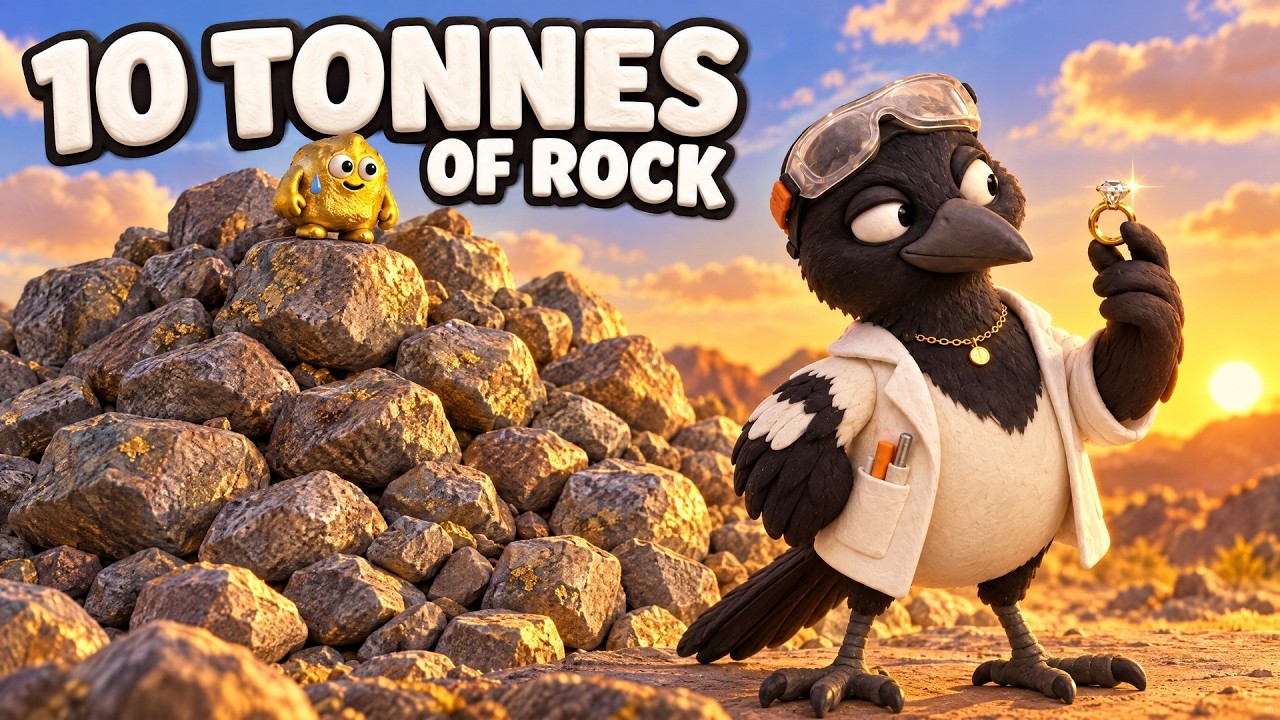
▶ Follows one gold nugget from rock to ring, showing the steps between ounces in the ground and ounces sold. · 5:27
Estimate contained and recovered gold
Use the calculator to test any resource line in a filing. Enter the tonnes, the grade, a recovery and a price of your own. The result is contained ounces, recovered ounces and gross value before any costs, royalty, tax or payable deduction.
Calculator
How many ounces are in a resource line?
Enter your own tonnes, grade, recovery and price from a filing.
- Recovered gold: 422 koz
- Gross value of recovered gold (US$ million): 1,688 US$ m
- Gross value per tonne of ore (US$): 67.5 US$/t
Example values only, not any project’s figures or a forecast. Enter metric tonnes; for short tons (as CK Gold reports), multiply by 0.9072 first. Ounces = tonnes x grade / 31.1035 grams per troy ounce. Gross value is before mining and processing costs, royalty, payable deductions and tax. Price is an input: example, use today’s price (US$ per troy ounce).
Gold price and Wyoming projects
The USGS puts the average US gold price at US$3,300 per troy ounce in 2025 (estimate), up from US$1,801 in 2021. On 15 October 2026 CNBC quoted spot gold at US$4,150.26 an ounce at 9:00 a.m. ET. Both sit above the US$3,250 that CK Gold’s study uses as its base case, and the company’s release also shows results at US$4,500. Higher prices raise the value of a filed number quickly, but studies take years, and cost inflation can eat part of the gain. A project’s value depends on the price used in its own study, so always note it.
Chart
Average US gold price, 2021 to 2025
US dollars per troy ounce; 2025 is a USGS estimate
For scale, the same USGS summary says Nevada made about 64% of US gold in 2025 and Alaska about 22%.
Wyoming lithium: what the survey data shows
Many pages describe Wyoming as a coming lithium state. The state survey’s data does not support that. WSGS says Wyoming hosts only minor occurrences of lithium. A review of 26,386 samples of rock, soil and water found favorable concentrations only in isolated, small pegmatite occurrences. A pegmatite is a coarse-grained igneous rock that can carry lithium minerals. The one small spodumene deposit, a lithium-bearing mineral, is in the Rattlesnake Hills of Natrona County, and small amounts were mined there during World War II. Lepidolite, a lithium mica, occurs in pegmatite at Copper Mountain in the Owl Creek Mountains.
The brine story is different and often misquoted. In 2013 University of Wyoming researchers studying carbon dioxide storage found lithium in the deep salty water of the Rock Springs Uplift in the south-west. A DOE-sponsored project reported about 190 parts per million (ppm) in the Weber/Tensleep Sandstone and 130 ppm in the Madison Limestone. A later WSGS report, as described by Cowboy State Daily in December 2022, put the water at 90 to 105 ppm, based on six samples from the Rock Springs Uplift. WSGS says producing brine operations typically exceed 200 ppm. That gap is the reason the early excitement faded.
For scale, USGS says commercial lithium production in the United States came from a continental brine operation in Nevada. Direct lithium extraction (DLE) is a family of methods that pull lithium out of brine without evaporation ponds. Any Wyoming brine project would still need a concentration and cost case first, and the survey data above is where that case would start. For where lithium is found worldwide, see where is lithium found in the world.
Where satellite data helps, and where it does not
A satellite cannot see gold. It can map what hot fluids leave behind: iron-oxide staining, clay and mica minerals, silica, and the straight cracks that guide fluids. In a belt like South Pass or the Rattlesnake Hills, those maps help a geologist decide where to put a sampling line or a drill pad. They do not give grade or tonnes, so they sit ahead of a resource estimate and never replace drilling.
Farmonaut builds satellite mineral reports from a KML, KMZ or polygon of a license area in 5 to 20 business days. Our page on satellite-based mineral detection explains what the reports contain, and satellite gold exploration in the United States shows the US approach. To discuss a Wyoming area, contact us or send a mining query.
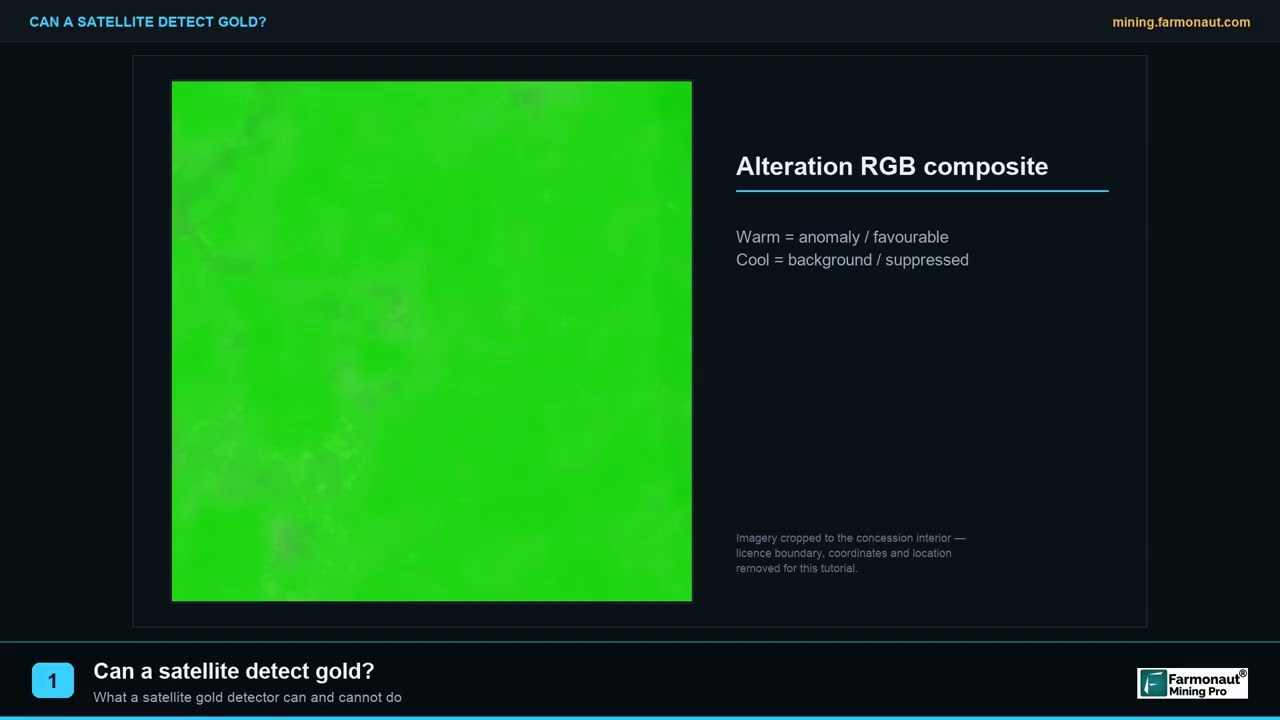
▶ Explains why no satellite sees gold itself, and how the alteration around a gold system is mapped instead. · 2:00
Prospecting safety and permission
Gold lies on mapped ground that someone holds. Before you dig or pan anywhere, get the landowner’s permission, check whether a claim, a state lease or a private title covers the spot, and follow the rules of the agency that manages the land. Never use mercury to catch gold. It is toxic to you and to the water downstream. Wyoming’s Department of Environmental Quality says its Land Quality Division does not regulate recreational exploration with minor, infrequent surface disturbance, but it does regulate exploration by dozing or trenching with motorized equipment and suction dredges with an intake wider than 3 inches or a motor above 10 horsepower. The Bureau of Land Management (BLM) tells prospectors in its mining claim packet not to prospect or pan on another person’s claim without the claimant’s permission. Rules change, so confirm them with the agency first.
What to check before you rely on a Wyoming gold number
- Find the category: reserve, measured, indicated or inferred. Do not add them without saying so.
- Find the date of the technical report, not just the date of the news release.
- Check the cut-off grade and the price used. Both move the ounces and the value.
- Check the units: short tons or tonnes, troy ounces or grams, gold or gold equivalent.
- Check who holds the ground and under what title: federal claim, state lease or private land.
- Check whether a deal is signed or closed. Several items above are announced, not completed.
If this topic matters to you, read Gold Mine Case Studies: 5 Real Projects Compared next.
Related reading on this site: Gold Mines in Newfoundland: 5 Projects Compared.
Frequently asked questions
Is there an operating gold mine in Wyoming?
The USGS Wyoming profile, built on 2018-2019 data, does not list gold among the commodities produced in the state. CK Gold is the project closest to production, and its owner said on 31 March 2026 that no production decision had been made.
Where was gold first found in Wyoming?
WSGS says placer gold was reported along the Sweetwater River around 1842, and the first lode rush followed the Carissa discovery in 1867 near South Pass.
How much gold has Wyoming produced?
Nobody knows. WSGS states that total production is unknown because records were not kept, and it puts the Carissa mine alone at 50,000 to 180,000 ounces before 1911.
How much gold is at Rattlesnake Hills?
The 2024 technical report, quoted in Roxmore’s October 2026 release, shows 0.62 million ounces indicated at 0.77 g/t and 0.42 million ounces inferred at 0.69 g/t. Those are resources, not reserves, and the project is still at the resource-estimate stage.
Is CK Gold permitted and funded?
The company says all permits needed to start construction are in hand under Wyoming state jurisdiction and that a US$5 million reclamation bond is in place. The same filing says construction will follow only after engineering, board approval and financing, and the initial capital cost is estimated at US$394 million.
What gold price does CK Gold need to be worthwhile?
According to the company’s sensitivity table, the after-tax NPV is negative at US$1,500 per ounce, about US$98 million at US$2,000, US$632 million at the US$3,250 base case and US$1,155 million at US$4,500 with copper and silver held at the base case. The company’s headline spot case, which also raises copper to US$5.50 a pound and silver to US$70 an ounce, shows US$1.30 billion. Gold alone does not tell the full story.
Does Wyoming have a lithium mine?
WSGS describes only minor lithium occurrences in the state, and USGS names a Nevada brine operation as the source of US commercial lithium production, so no Wyoming mine appears in either.
What happened to the Rock Springs Uplift lithium find?
Researchers found lithium in deep brine in 2013, and early estimates were large. Later reporting on the state survey’s work put the concentration at 90 to 105 ppm, below the 200 ppm or more that WSGS says producing brines typically carry, and the hype faded.
Can I pan for gold in Wyoming?
The state’s Land Quality Division says it does not regulate recreational exploration with minor, infrequent surface disturbance, but its guidance lets only hand panning take place in Class 1 streams such as the Sweetwater River near South Pass. You still need the landowner’s permission, you must stay off other people’s claims, and you should never use mercury. Motorized digging, trenching and larger suction dredges fall under the Land Quality Division’s exploration rules.
What does g/t mean in a gold report?
It means grams of gold per tonne of rock. One troy ounce is 31.1035 grams, so 1 g/t in a million tonnes of rock is about 32,150 ounces.
Can satellites find gold in Wyoming?
No satellite sees gold itself. Satellites map the iron staining, clay minerals and fault patterns around gold systems, which helps choose where to sample. Grade and tonnes still come from drilling.
This page is for information only. It is not investment advice, and it gives no price targets. It is not legal advice either: confirm claim, lease and exploration rules with the Bureau of Land Management, the Wyoming Office of State Lands and Investments and the Wyoming Department of Environmental Quality. Before prospecting, get the landowner’s permission, check for claims, and never use mercury.
Farmonaut mining
Map your mining site from space
Send a license boundary to get satellite alteration and structure maps that help plan sampling lines and drill targets, ahead of any resource estimate.

Mining Pro sample view, synthetic data
Keep reading
Sources
- U.S. Gold Corp, CK Gold feasibility study release, Form 8-K Exhibit 99.1 (31 March 2026): sec.gov
- U.S. Gold Corp, CK Gold Project overview: usgoldcorp.com
- Roxmore Resources, sale to SSR Mining and spin-out of exploration assets (13 October 2026): theglobeandmail.com
- SSR Mining, acquisition of Roxmore Resources (13 October 2026): s22.q4cdn.com
- Roxmore Resources, management’s discussion and analysis (March 2026): newsfile.moomoo.com
- Axcap Ventures, maiden Rattlesnake Hills resource release (15 October 2024): europeanbusinessmagazine.com
- Seabridge Gold, Slaughterhouse project release, Form 6-K Exhibit 99.1 (13 October 2026): sec.gov
- Wyoming State Geological Survey, Gold in Wyoming: main.wsgs.wyo.gov
- Wyoming State Geological Survey, Mining Districts: main.wsgs.wyo.gov
- Wyoming State Geological Survey, Lithium: main.wsgs.wyo.gov
- USGS Professional Paper 793, Geology of the South Pass Area, Fremont County, Wyoming (1973): pubs.usgs.gov
- USGS, The Mineral Industry of Wyoming: usgs.gov
- USGS, Mineral Commodity Summaries 2026: Gold: pubs.usgs.gov
- USGS, Mineral Commodity Summaries 2026: Lithium: pubs.usgs.gov
- CNBC, The price of gold today, 15 October 2026: cnbc.com
- U.S. Department of Energy, DOE-sponsored project shows potential for carbon storage in Wyoming: energy.gov
- Cowboy State Daily, What happened to Wyoming’s anticipated lithium boom (7 December 2022): cowboystatedaily.com
- Wyoming DEQ Land Quality Division, Exploration and Prospecting: deq.wyoming.gov
- Bureau of Land Management, Mining Claim Packet (12 March 2026): blm.gov
- Rare Element Resources, Bear Lodge Project: rareelementresources.com
Discussion
Questions, corrections or field experience? Share them below. First-time comments are reviewed before they appear, and your email is never published.
No comments yet. Be the first to add a question or your experience.

 Omsri International FZE
 G.I.T.T.
 Jaunita Erss Ltd
 Almosi SARL
 SRK Consulting
 Berks Gold Limited
 Mwerezi Minerals Company Limited
 Mining SARL
 SenGold Invest SAS
 Sean Mining Limited
 NTS Group (Pty) Ltd
 Mine4Africa
 Lithspo Minerals Limited
 Tintina Mining Group
 Dalgety Minerals Pty Ltd

 Licence holder · Nigeria · Gold + lithium










