

Australian gold · Ranked list
Largest Gold Mines in Australia: 11 Mines and Owners
Newmont’s Boddington mine was Australia’s largest gold producer in 2025 at 565,000 oz. Tropicana and the Kalgoorlie Super Pit follow, each near 470,000 oz in FY26.
Key takeaways
- Boddington (Newmont) produced 565,000 oz of gold in calendar 2025, the most of any Australian mine (Newmont, 2026).
- KCGM, which runs the Super Pit, sold 468,000 oz in FY26; Northern Star guides 550,000-650,000 oz for FY27 as its expanded mill ramps up.
- Tropicana produced about 477,000 oz in FY26 on a 100% basis, implied from Regis Resources’ 30% share of 143,100 oz.
- Cadia fell from 464,000 oz in 2024 to 385,000 oz in 2025 and also produced 82,000 t of copper (Newmont, 2026).
- Australia mined about 303 t of gold in calendar 2025 (Surbiton Associates); nine of the eleven mines listed here are in Western Australia.
In this article
- Top 10 biggest gold mines in Australia at a glance
- How we chose and ranked these mines
- Which is the biggest gold mine in Australia?
- Boddington: Australia's largest gold producer
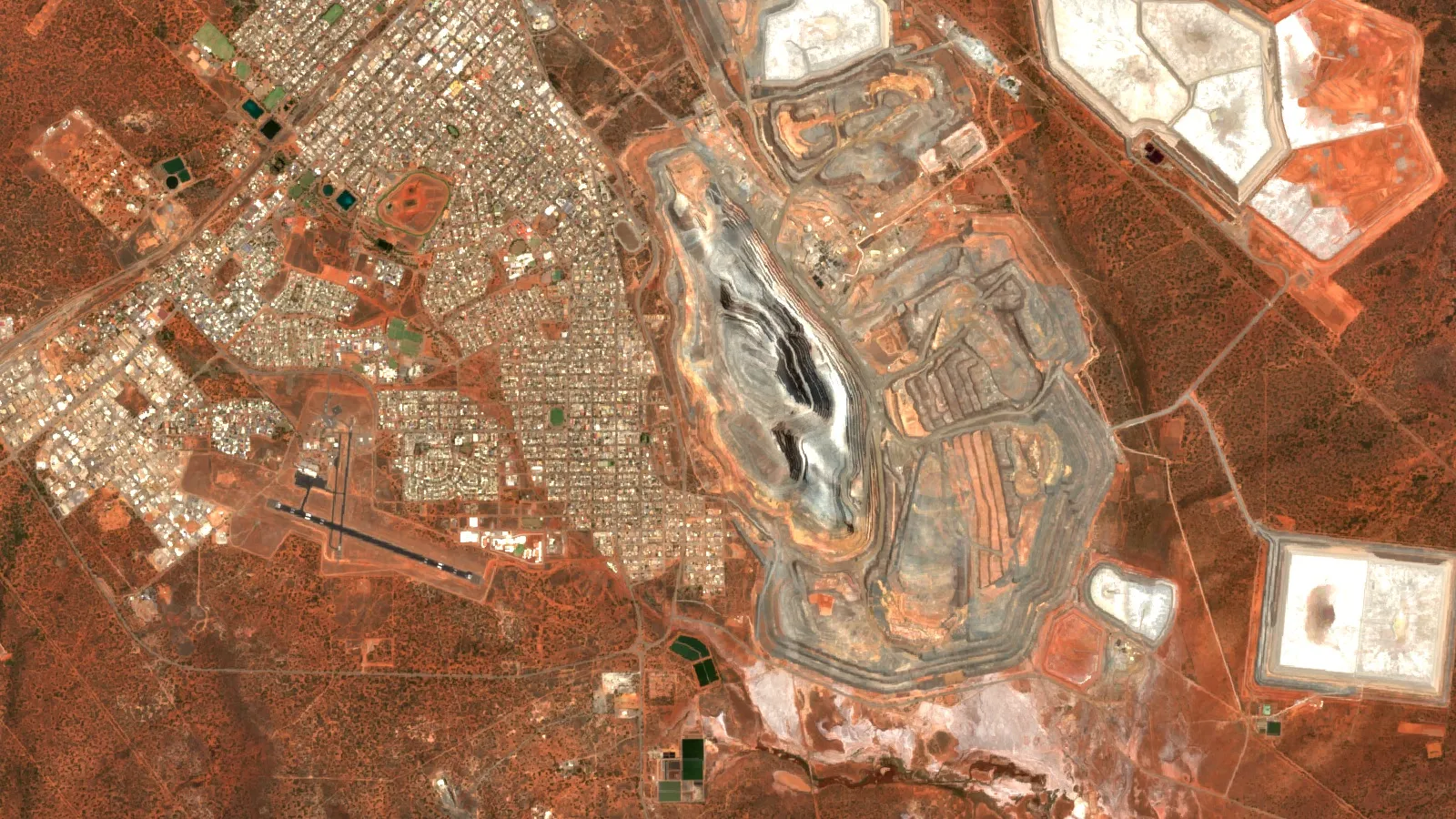
- The Super Pit and KCGM, Kalgoorlie
- Tropicana, Tanami, Telfer and the remote giants
- Gold mines in New South Wales and Queensland
- Mining companies in Australia behind the biggest mines
- How much gold does Australia produce?
- Production trends: costs, prices and new mills
- Technology and exploration at Australian gold mines
- Sustainability and closure obligations
- What to check before working with a large gold mine
- Estimate a gold mine's annual revenue
The largest gold mine in Australia by output is Newmont’s Boddington mine in Western Australia, which produced 565,000 ounces of gold in calendar 2025, according to Newmont’s 2025 operating statistics. The Kalgoorlie Super Pit, often called the biggest, is the largest open pit by size, and its owner Northern Star Resources expects it to overtake Boddington as its new mill ramps up.
This page lists the eleven biggest gold mines in Australia with a recent company-reported figure, who owns each one, which ASX or overseas exchange the owner trades on, and how output has moved. It is written for mining consultants, contractors and business owners who need to know where the ounces, the budgets and the buyers sit. A calculator at the end turns any mine’s ounces into revenue at a gold price you enter.
Top 10 biggest gold mines in Australia at a glance
The table ranks mines by their latest full-year output as reported by the owner. Owners report on different years: Newmont uses the calendar year, while Australian-listed miners use the financial year to 30 June (FY26 means July 2025 to June 2026). Gold Fields’ three Western Australian mines have only a half-year figure for 2026 in the sources used here, so they are listed after the full-year mines.
Chart
Australia’s largest gold mines by latest full-year output
Thousand troy ounces; mines with a full-year company figure (calendar 2025 or FY26)
| Rank | Mine (state) | Owner (exchange: ticker) | Latest output | Period |
|---|---|---|---|---|
| 1 | Boddington (WA) | Newmont (NYSE: NEM) | 565,000 oz | Calendar 2025 |
| 2 | Tropicana (WA) | AngloGold Ashanti 70% (NYSE: AU), Regis Resources 30% (ASX: RRL) | About 477,000 oz (100% basis) | FY26 |
| 3 | KCGM Super Pit, Kalgoorlie (WA) | Northern Star Resources (ASX: NST) | 468,000 oz sold | FY26 |
| 4 | Tanami (NT) | Newmont (NYSE: NEM) | 391,000 oz | Calendar 2025 |
| 5 | Cadia (NSW) | Newmont (NYSE: NEM) | 385,000 oz | Calendar 2025 |
| 6 | Telfer (WA) | Greatland Resources (ASX: GGP) | 328,986 oz (group) | FY26 |
| 7 | Cowal (NSW) | Evolution Mining (ASX: EVN) | 297,000 oz | FY26 |
| 8 | Duketon (WA) | Regis Resources (ASX: RRL) | About 236,000 oz | FY26 |
| 9 | St Ives (WA) | Gold Fields (NYSE: GFI) | 170,000 oz gold-equivalent | First half 2026 |
| 10 | Gruyere (WA) | Gold Fields (NYSE: GFI) | 120,000 oz attributable | First half 2026 |
| 11 | Agnew (WA) | Gold Fields (NYSE: GFI) | 103,000 oz | First half 2026 |
The Tropicana figure is worked out from Regis Resources’ reported 30% share. Telfer’s number is Greatland’s group total for FY26; Telfer is its only producing mine, with the Havieron project next door still in development. Northern Star’s Yandal centre (Jundee and Thunderbox) sold 434,000 ounces in FY26, but the company reports it as one production centre rather than by mine.
How we chose and ranked these mines
We used one metric: gold produced or sold at the mine in its owner’s latest full reporting year, taken from the owner’s own results. We did not rank by reserves, pit size or revenue, because those give different winners. A mine had to be a single operation (or a reported mine complex such as KCGM) in Australia with a published figure for 2025 or FY26.
- Calendar 2025: Newmont’s Boddington, Tanami and Cadia, from Newmont’s fourth-quarter 2025 operating statistics.
- Year to June 2026 (FY26): KCGM from Northern Star’s 2 July 2026 production update, Cowal from Evolution’s June 2026 quarterly report, Tropicana and Duketon from Regis Resources, and Telfer from Greatland.
- Half-year only: St Ives, Gruyere and Agnew from Gold Fields’ first-half 2026 results. Doubling a half-year would be a guess, so we show them as reported.
Two smaller notes. “Sold” and “produced” can differ by a few thousand ounces in a year because of gold still in the processing circuit. And “gold-equivalent” adds the value of any copper or silver to the gold figure, which slightly flatters copper-gold mines.
Which is the biggest gold mine in Australia?
It depends on the measure. By ounces, Boddington led in 2025. By physical size, the Super Pit is the giant: the Fimiston Open Pit is about 3.5 kilometres long, 1.6 kilometres wide and more than 675 metres deep, according to its reference entry. By milling capacity, KCGM is about to jump ahead: Northern Star’s FY26 results guide KCGM to 550,000-650,000 ounces in FY27 as the expanded 27-million-tonne-a-year plant ramps up.
Chart
Newmont’s Australian mines, 2024 vs 2025
Attributable gold produced, thousand troy ounces
Cadia, in New South Wales, used to top the list. Its output has been falling, from 464,000 ounces in 2024 to 385,000 ounces in 2025 (Newmont, 2026). Cadia also produced 82,000 tonnes of copper in 2025, so it is as much a copper mine as a gold mine.
Boddington: Australia’s largest gold producer
Boddington sits south-east of Perth in Western Australia’s South West region. It is a large, low-grade open pit that also produces copper: 24,000 tonnes in 2025 alongside its 565,000 ounces of gold, down from 590,000 ounces in 2024, according to Newmont’s 2025 operating statistics. Newmont reported all-in sustaining costs (AISC, the full cost of keeping a mine running, per ounce) of US$1,514 an ounce at Boddington for 2025.
For contractors, Boddington is notable for autonomy: Newmont has invested in an autonomous haul fleet at the mine, as reported by the Canadian Mining Journal. For consultants, it is a reminder that a low grade (often below one gram per tonne) can still support a top-ranked mine when the ore body is very large and the plant is efficient. Grade, measured in grams of gold per tonne of rock (g/t), is the single number most buyers ask about first.
▶ How gold is mined and refined, from rock to ring · 5:27
The Super Pit and KCGM, Kalgoorlie
The Super Pit was created in 1989 by Kalgoorlie Consolidated Gold Mines (KCGM), a joint venture that merged many old underground leases on the Golden Mile into one open pit. Ownership changed hands several times; Saracen Mineral Holdings bought Barrick’s 50% in 2019, and Northern Star Resources now owns the whole operation after merging with Saracen. You can follow the year-by-year numbers in our Kalgoorlie Super Pit gold production data.
In FY26, KCGM sold 468,000 ounces, part of 844,000 ounces from Northern Star’s whole Kalgoorlie production centre. Its mines moved ore at record rates in the June quarter: 88 million tonnes a year from the open pit and 3.2 million tonnes a year underground, according to Northern Star’s June 2026 quarterly report. The mill expansion to 27 million tonnes a year began commissioning in mid-2026, which is why the company expects output to climb over the next few years.
Tropicana, Tanami, Telfer and the remote giants
Several of the biggest mines in Australia are far from any town and run on fly-in fly-out rosters.
Tropicana (Western Australia)
Tropicana lies on the western edge of the Great Victoria Desert, north-east of Kalgoorlie. AngloGold Ashanti operates it with 70%, and Regis Resources holds 30%. Regis reported 143,100 ounces as its share for FY26, which implies roughly 477,000 ounces for the whole mine. Regis expects its Tropicana share to fall to 120,000-130,000 ounces in FY27 because of a different mix of ore sources (Regis Resources, July 2026).
Tanami (Northern Territory)
Newmont’s Tanami mine sits in the Tanami Desert of the Northern Territory, far from any large town. It produced 391,000 ounces in 2025, down from 408,000 ounces in 2024. Newmont is building the Tanami Expansion 2 project, a deep shaft designed to extend the mine’s life. More detail is in our Tanami gold mine guide.
Telfer (Western Australia)
Telfer, in the Paterson Province of the East Pilbara, was formerly a Newmont mine and is now 100% owned by Greatland. Greatland reported FY26 group output of 328,986 ounces and plans to combine Telfer with the nearby Havieron gold-copper deposit into a long-life operation, according to Proactive’s report of its FY26 production.
Gold mines in New South Wales and Queensland
Outside Western Australia, the big gold mines are mostly copper-gold operations in New South Wales and Queensland.
- Cadia (NSW): Newmont’s block-cave mine near Orange; 385,000 ounces of gold and 82,000 tonnes of copper in 2025.
- Cowal (NSW): Evolution Mining’s largest mine, near West Wyalong; 297,000 ounces in FY26, with the open pit continuation (the E46 pit) under way, according to Evolution’s June 2026 quarterly report.
- Northparkes (NSW): an Evolution copper-gold mine (80% owned) where the E22 block cave ramps up from FY27.
- Ernest Henry (Queensland): Evolution’s copper-gold mine near Cloncurry; 55,000 ounces of gold in FY26 after a weather event cut production in two quarters.
For a map of these districts and more mines in the state, see our guide to gold in New South Wales.
Mining companies in Australia behind the biggest mines
Five companies own most of the gold mines listed above. Their size in Australia differs from their size worldwide.
| Company | Main Australian gold mines | Listing | Note |
|---|---|---|---|
| Northern Star Resources | KCGM, Kalgoorlie operations, Carosue Dam, Jundee, Thunderbox | ASX: NST | 1,543,000 oz sold group-wide in FY26, including Pogo in Alaska |
| Newmont | Boddington, Tanami, Cadia | NYSE: NEM, also on ASX and TSX | 1,341,000 oz from these three mines in 2025 |
| Gold Fields | St Ives, Agnew, Granny Smith, Gruyere | JSE and NYSE: GFI | Took full ownership of Gruyere after buying Gold Road Resources in 2025 |
| Evolution Mining | Cowal, Ernest Henry, Northparkes, Mungari | ASX: EVN | 715,000 oz group-wide in FY26, including Red Lake in Canada |
| Regis Resources | Duketon, 30% of Tropicana | ASX: RRL | 379,000 oz in FY26 |
AngloGold Ashanti (Tropicana 70% and Sunrise Dam) and Greatland (Telfer) complete the list of owners of Australia’s biggest gold mines. If you need the full company ranking, including mid-tier producers such as Westgold, Vault Minerals, Genesis Minerals and Ramelius, see our list of Australian gold mining companies ranked by output and our wider top 20 gold mining companies in Australia.
Company facts here come from company reports and are not a recommendation to buy or sell any share.
How much gold does Australia produce?
Australia produced 303 tonnes of gold in calendar 2025, up 2% on 2024, according to Melbourne consultants Surbiton Associates as reported by The Northern Miner. That is close to 9.7 million troy ounces (one tonne is about 32,150 troy ounces). The eight mines in our full-year list produced about 3.1 million ounces between them, roughly a third of the national total.
Chart
Gold mine production by country, 2025
Metric tons, estimated; top six producers
On the US Geological Survey’s estimates, Australia was the third-largest gold producer in 2025, after China and Russia, and it holds an estimated 13,000 tonnes of gold reserves, according to the USGS Mineral Commodity Summaries 2026. Reserves are the part of a known deposit that can be mined at a profit under current conditions; they are not the same as the total gold in the ground.
Most of the output comes from one state. Western Australia produced 209 tonnes (6.7 million ounces) of gold in 2024-25, a record A$29 billion of sales, according to the state’s 2024-25 statistics digest, and nine of the eleven mines in our table are there. Our Australia mining map shows where the main gold, copper and iron ore districts sit.
Production trends: costs, prices and new mills
Three things shape the list for the next few years.
- Prices are high, but so are costs. Regis Resources received an average of A$6,241 an ounce in the June 2026 quarter, while Northern Star’s group AISC was A$2,698 an ounce for FY26. High prices let owners mine lower-grade ore and fund expansions, which can lower ounces per tonne even as revenue rises.
- Grade is falling at some older mines. Boddington, Tanami and Cadia all produced less in 2025 than in 2024, according to Newmont’s 2025 operating statistics.
- New capacity is arriving. The KCGM mill expansion, the Cowal open pit continuation and the Northparkes E22 cave are all due to add ounces from FY27.
For anyone selling services to these mines, the expansions are where the contracts are: earthworks, tailings dams, power stations, camps and mine development. Northern Star alone guided A$2,550-2,935 million of group capital investment for FY27.
Technology and exploration at Australian gold mines
The largest Australian operations now run autonomous haul trucks, remote operations centres and high-volume drilling programs. Exploration around existing mines (called brownfields exploration) is the cheapest way to add ounces, because the mill, road and camp already exist. Before drilling, many teams screen the ground with satellite data to map rock types, iron oxides and clay alteration, which helps rank targets. Farmonaut offers satellite-based mineral detection reports for licence areas of this kind; the results are exploration targets, not a resource estimate.

▶ How satellites help find gold: remote sensing explained · 4:25
Sustainability and closure obligations
Large gold mines in Australia operate under state environmental approvals that cover water use, tailings storage, dust, noise and rehabilitation. Each owner reports emissions and rehabilitation work in its annual sustainability report, and the state regulators hold bonds or levies to cover closure. The KCGM project is a good example of what comes with growth: Northern Star’s capital plan includes new tailings dams and a new thermal power station for the expanded plant (Northern Star, 2026). If you advise on approvals, the expansions listed above are where new environmental work is happening.
What to check before working with a large gold mine
- Who decides: the operator, not a minor partner, usually runs contracts. At Tropicana that is AngloGold Ashanti.
- Which year: confirm whether a quoted figure is calendar or financial year, and gold sold or gold produced.
- Where the money goes: read the latest quarterly report for capital guidance and project timing.
- Who owns it now: Australian gold assets change hands often (Telfer, Gruyere and Saracen’s KCGM stake all moved since 2019). Check the ASX announcements page before you rely on an older list.
If you have a project or licence question for our team, use the mining query form or contact us.
▶ The environmental impacts of mining, explained · 2:31
Estimate a gold mine’s annual revenue
Use the calculator below to turn a mine’s ounces into revenue and margin at your own gold price and cost. Enter figures from the mine’s latest report.
Calculator
What is a gold mine’s output worth a year?
Enter a mine’s annual ounces, a gold price and its AISC.
- Margin over AISC (A$): $1,000,000,000
- Margin as share of revenue: 50.0%
- Output in tonnes of gold: 12.4
Example values only, not a forecast or benchmark. Gold price is an input: example, use today’s price. All money in A$. Margin is before tax, growth capital and exploration. Ounces and AISC come from the mine’s own report.
Frequently asked questions
What is the biggest gold mine in Australia?
By ounces produced, Newmont’s Boddington mine in Western Australia, with 565,000 ounces in 2025. By size, the Kalgoorlie Super Pit (Fimiston Open Pit) is the largest open pit.
What are the top 10 gold mines in Australia?
On the latest reported figures: Boddington, Tropicana, KCGM (Super Pit), Tanami, Cadia, Telfer, Cowal, Duketon, St Ives and Gruyere, with Agnew close behind. The table above gives each mine’s output and period.
Who owns the Kalgoorlie Super Pit?
Northern Star Resources (ASX: NST) owns 100% of KCGM, the operation that runs the Super Pit.
Is the Super Pit still the largest gold mine in Australia?
It is the largest open pit, but in FY26 it sold 468,000 ounces, behind Boddington’s 565,000 ounces for 2025. Northern Star guides 550,000-650,000 ounces for FY27 as the new mill ramps up.
What are the biggest mining companies in Australia for gold?
By ounces from Australian mines, Newmont and Northern Star Resources lead, followed by Gold Fields, Evolution Mining and Regis Resources.
Which mining companies operate in Western Australia’s goldfields?
Northern Star, Newmont, Gold Fields, AngloGold Ashanti, Regis Resources and Greatland run the largest gold mines in the state, alongside mid-tier miners such as Westgold, Vault Minerals, Genesis Minerals and Ramelius.
How much gold does Australia produce a year?
About 303 tonnes in calendar 2025, or close to 9.7 million ounces, according to Surbiton Associates.
Where is the biggest mine in Australia?
For gold, Boddington, south-east of Perth in Western Australia. The biggest mines of any kind are mostly iron ore operations in the Pilbara region.
Does Cadia still produce a lot of gold?
Yes, but less than before: 385,000 ounces in 2025, down from 464,000 ounces in 2024, plus 82,000 tonnes of copper (Newmont).
How long will Australia’s big gold mines keep producing?
It varies by mine. Owners publish reserves and mine-life plans; for example, Northern Star’s Fimiston South cutback is extending KCGM’s open pit, and Newmont’s Tanami Expansion 2 is designed to extend Tanami’s life.
This page is for information only and is not investment advice. Mine figures are as reported by their owners for the periods shown and may be revised; check the latest company announcements before relying on them.
Farmonaut mining
Map your mining site from space
Consultants can screen a client's licence area with satellite data and rank exploration targets before drilling.

Mining Pro sample view, synthetic data
Keep reading
Sources
- Newmont, Q4 2025 operating statistics (2026): s24.q4cdn.com
- Northern Star, FY26 production update (2 July 2026): announcements.asx.com.au
- Northern Star, June 2026 quarterly activities report: nsrltd.com
- Northern Star, FY26 results and FY27 guidance (August 2026): announcements.asx.com.au
- Regis Resources, June 2026 quarterly report: announcements.asx.com.au
- Motley Fool Australia, Regis Resources FY26 production (July 2026): fool.com.au
- Evolution Mining, June 2026 quarterly report: yourir.info
- Gold Fields, Q2 2026 results booklet: goldfields.com
- Proactive Investors, Greatland FY26 production (2026): proactiveinvestors.com.au
- USGS, Mineral Commodity Summaries 2026: Gold: pubs.usgs.gov
- WA Department of Mines, Petroleum and Exploration, 2024-25 Statistics Digest: wa.gov.au
- The Northern Miner, Aussie gold output rises 2% (Surbiton Associates, 2026): northernminer.com
- Fimiston Open Pit, reference entry: en.wikipedia.org
- Canadian Mining Journal, Newmont autonomous fleet at Boddington: canadianminingjournal.com
- Australian Mining Review, Northern Star FY26 gold sales (29 July 2026): australianminingreview.com.au
Discussion
Questions, corrections or field experience? Share them below. First-time comments are reviewed before they appear, and your email is never published.
No comments yet. Be the first to add a question or your experience.

 Comfix & Engineering Limited
 Congo Mining Solutions
 Mining SARL
 SenGold Invest SAS
 Sania Corporation
 Sean Mining Limited
 NTS Group (Pty) Ltd
 Mine4Africa
 Lithspo Minerals Limited
 Tintina Mining Group
 Dalgety Minerals Pty Ltd
 Vortex Minerals Pty Ltd
 Faith At Work (Pty) Ltd
 Geotech Mining Solutions plc
 Vulcan International Limited
 Kidepo Associates
 GKY Mining
 Alkimy SARL
 Double A Trading
 GemSprout Metals Limited
 Qader Group

 Client · Somalia · Gold
 Client & affiliate partner · Ghana · Gold










