

Australian lithium · Mine comparison
Lithium Mining in Australia: 9 Main Mines Compared
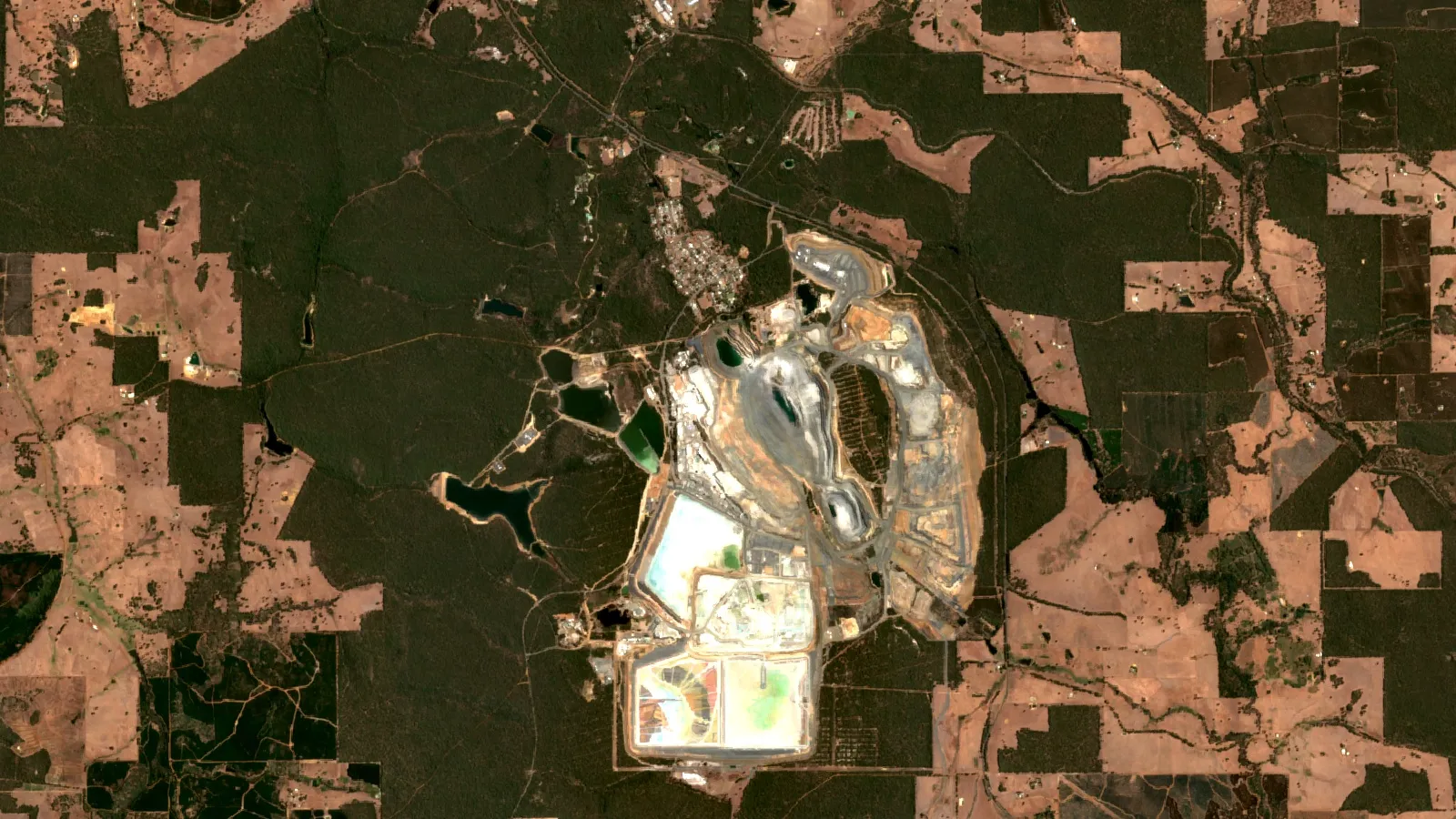
Australia mined an estimated 92,000 tonnes of lithium in 2025, the most of any country (USGS). This page compares the nine main mines, shows who owns them and what they produced in the year to June 2026, and prices a tonne of concentrate.
Key takeaways
- Australia mined an estimated 92,000 t of lithium in 2025, ahead of China (62,000 t) and Chile (56,000 t); that is about 32% of world output (USGS, 2026).
- Greenbushes made 1.41 Mt of concentrate and Pilgangoora 879,543 t in the year to 30 June 2026; Kathleen Valley made 392,000 t (company annual reports).
- Greenbushes supplied 41% of Western Australia’s concentrate in 2025, Pilgangoora 19%, Mt Marion 13%, Wodgina 12% and Kathleen Valley 9% (WA Government, August 2026).
- Bald Hill and Finniss restarted in 2026 after the price slump, while Mt Cattlin was placed on care and maintenance in 2025 (Mineral Resources; INN; ABC).
- Western Australia charges a 5% royalty on concentrate value; spodumene averaged US$2,133 a tonne in August 2026 and ended September at US$1,780 (WA profile; Benchmark via INN).
In this article
- How much lithium does Australia mine
- Spodumene, SC6 and other terms in one place
- Australian lithium mines compared
- Which Australian lithium mines produce the most
- The nine mines one by one
- Restarts and expansions after the price recovery
- What spodumene and lithium carbonate cost
- What a tonne of concentrate earns after royalty
- Processing: why most concentrate still leaves Australia
- Competition from Zimbabwe and Africa
- Jobs, land and community agreements
- Where satellite screening fits
- Frequently asked questions
How much lithium does Australia mine
Australia mines more lithium than any other country. The US Geological Survey estimates 92,000 tonnes of lithium content for 2025, ahead of China at 62,000 tonnes and Chile at 56,000 tonnes (USGS Mineral Commodity Summaries 2026). That is about 32% of the estimated world total of 290,000 tonnes, down from about 37% in 2024 (82,700 of 222,000 tonnes; shares calculated from the USGS table). A share above one half does not match the USGS figures, because China, Zimbabwe, Argentina and Mali have all raised output.
Chart
World lithium mine production, top producers
Thousand tonnes of lithium content
This page compares the nine main hard-rock mines, shows which ones produce the most, and gives a calculator for what a tonne of concentrate earns after the Western Australian royalty. It is written for consultants, licence owners and analysts who need current, sourced numbers. For the geology of the deposits themselves, see our guide to spodumene deposits and exploration in Australia; for pegmatite, brine and clay deposit types worldwide, see lithium deposit types.
Two production figures circulate, and they do not match because they are built differently. USGS publishes its own estimate of 92,000 tonnes of lithium content for 2025. Geoscience Australia’s preliminary 2026 tables give 118,000 tonnes for the same year, converted from spodumene concentrate output reported by the Office of the Chief Economist, assuming 6% lithium oxide in concentrate. Geoscience Australia counts 7 operating lithium mines in 2025 and 4.6 million tonnes of lithium in ore reserves at those mines, equal to 39 years of 2025 output.
Australia is second, not first, for reserves. USGS lists Chile at 9.2 million tonnes of reserves and Australia at 8.4 million tonnes. For resources, USGS lists 10 million tonnes for Australia, against 28 million tonnes for Argentina and 23 million tonnes for Bolivia. Australia leads on production because its resources are hard rock that can be mined and shipped as concentrate within a few years, not because it holds the most lithium.
Spodumene, SC6 and other terms in one place
Spodumene is the lithium-bearing mineral mined in Australia. It occurs in pegmatites, coarse-grained igneous rock bodies, and is crushed and floated into a concentrate that is sold to chemical plants. The largest hard-rock mine in the world is Greenbushes in Western Australia, according to Investing News Network (INN).
Concentrate is priced by its lithium oxide (Li2O) grade. SC6 means concentrate at about 6% Li2O, and PLS reports its price as SC5.2 because its product averages 5.2 to 5.3%. dmt means dry metric tonnes. Lithium chemicals are measured as lithium carbonate equivalent (LCE). As a guide from the Western Australian Government, lithium carbonate is about 19% lithium by weight, so a volume in LCE is around 5.3 times the lithium-content volume (WA Battery and Critical Minerals Profile, August 2026). Company reports mix these units, so check the unit before comparing two mines.
Australian lithium mines compared
How we chose. The table covers the nine hard-rock spodumene operations that produced concentrate, restarted or were idled in 2025 and 2026, using each owner’s own reports for the year to 30 June 2026 where they exist. The first five are in order of their share of Western Australian concentrate production in 2025 (LCE basis), which is the only published ranking on one basis. The last four are ordered by status. Figures for joint ventures are shown as the operator reports them, so a “100% basis” figure is the whole mine, not the owner’s share.
| Mine | Where | Operator and owners | Latest output | Status in October 2026 |
|---|---|---|---|---|
| Greenbushes | South-west Western Australia | Talison Lithium; Tianqi Lithium Energy Australia 51%, Albemarle 49% | 1.41 Mt concentrate, year to June 2026 (100% basis) | Operating; new chemical grade plant 3 ramping up |
| Pilgangoora | Pilbara, Western Australia | PLS (100%) | 879,543 dmt, year to June 2026 | Operating; Ngungaju plant restarting |
| Mt Marion | Western Australia | Mineral Resources and Ganfeng, 50/50 | 242,000 dmt SC6 sold, year to June 2026 | Operating; underground and flotation plant approved |
| Wodgina | Pilbara, Western Australia | MARBL: Mineral Resources and Albemarle, 50/50 | 317,000 dmt SC6 sold, year to June 2026 | Operating; third processing train in use |
| Kathleen Valley | Northern Goldfields, Western Australia | Liontown Resources | 392,000 t concentrate, year to June 2026 | Operating; shifting to underground ore |
| Mt Holland | Western Australia | Covalent Lithium: Wesfarmers and SQM, 50/50 | Nameplate about 380,000 t a year (100% basis) | Operating; expansion approved July 2026 |
| Bald Hill | Western Australia | Mineral Resources | First concentrate June 2026 | Restarted May 2026 |
| Finniss | Northern Territory | Core Lithium | First concentrate produced September 2026 | Restarted: Grants open-pit mining began in the June 2026 quarter; first concentrate made September 2026; first shipment of new product targeted for the December 2026 quarter |
| Mt Cattlin | Near Ravensthorpe, Western Australia | Rio Tinto | None | Care and maintenance since 2025 |
Sources for the table are in each mine’s entry below. Output figures are not directly comparable: Greenbushes, Pilgangoora and Kathleen Valley report concentrate produced, while Mineral Resources reports SC6 sold from its two joint ventures.
Which Australian lithium mines produce the most
The Western Australian Government ranks the state’s mines on one basis, LCE, for 2025. Greenbushes supplied 41% of the state’s spodumene concentrate production, followed by Pilgangoora at 19%, Mt Marion at 13%, Wodgina at 12% and Kathleen Valley at 9% (WA Battery and Critical Minerals Profile, August 2026). Together the five supplied 94%. Western Australia was the world’s largest lithium supplier in 2024 at 42% of world supply, ahead of Chile at 20% and China at 17%, according to the same profile.
Chart
Share of Western Australian spodumene concentrate production
Per cent, lithium carbonate equivalent basis, 2025
Two points follow for anyone screening the sector. First, one mine, Greenbushes, outweighs the next two combined, so an outage there moves national output. Second, the five leaders are all in one state, so state rules such as the royalty (covered below) shape the whole industry.
The nine mines one by one
Greenbushes
Greenbushes is run by Talison Lithium. Talison is 51% owned by Tianqi Lithium Energy Australia, a joint venture between Tianqi Lithium and IGO, and 49% by Albemarle (INN). IGO reports an effective interest of 24.99% in the mine. In the year to 30 June 2026 the mine produced 1.41 million tonnes of spodumene concentrate on a 100% basis, 5% less than a year earlier, at a cash cost of A$415 a tonne. A new plant, Chemical Grade Plant 3, was commissioned in the year and contributed 104,000 tonnes before a fire in June took it offline for about seven weeks, with production restarting in early August (IGO Annual Report 2026).
Chart
Spodumene concentrate produced, year to 30 June 2026
Thousand tonnes, as reported by each operator (Greenbushes on a 100% basis)
At the end of 2025 the mine’s ore reserve was 176 million tonnes at 1.9% Li2O and its mineral resource was 457 million tonnes at 1.6% Li2O (100% basis, same report). A reserve is the part of a resource that can be mined at a profit with current costs and prices; a resource has a lower level of economic proof.
Pilgangoora
PLS, formerly Pilbara Minerals, owns Pilgangoora outright. It produced a record 879,543 dmt of concentrate in the year to 30 June 2026, 17% more than the year before, at an average grade of 5.3% Li2O. Unit operating costs were A$569 a dmt (FOB Port Hedland, meaning at the port before freight and royalties), and the average realised price was A$2,164 a tonne of SC5.2, up 109% from A$1,034 in the previous year (PLS Annual Report 2026). The board approved a restart of the Ngungaju plant in February 2026; the restart began after 30 June 2026, and the report expects target capacity within the first four months of the 2026-27 financial year. INN adds that PLS is studying a larger expansion with results due in the December quarter of 2026.
Mt Marion
Mineral Resources and Ganfeng each hold half of Mt Marion. In the year to June 2026 the mine sold 242,000 dmt of SC6, above the company’s upgraded guidance of 210,000 to 230,000 dmt, at an FOB cost of A$847 a dmt. In May 2026 the owners took a final investment decision on a flotation plant and underground mining for A$490 million (100% basis) over two years (Mineral Resources, June 2026 quarterly report).
Wodgina
Wodgina is owned half by Mineral Resources and half by Albemarle through the MARBL joint venture. It sold 317,000 dmt of SC6 in the year to June 2026, above guidance of 270,000 to 290,000 dmt, at an FOB cost of A$738 a dmt. Quarterly production was 94,000 dmt, and recovery fell to 68% as the plant moved fully onto Stage 3 ore. All three processing trains operate from the start of the 2026-27 financial year (same Mineral Resources report).
Kathleen Valley
Liontown Resources produced 392,000 tonnes of spodumene concentrate and shipped 382,000 tonnes in the year to June 2026, at an average grade above 5% Li2O. It is moving from stockpiled ore to underground ore, which the company says gives cleaner plant feed. On 30 September 2026 the board approved a A$389 million expansion (final investment decision), lifting plant capacity from about 2.8 to 4.2 million tonnes a year (Liontown FY26 Annual Report). The site’s hybrid power station reached 80% renewable penetration in the year, and Liontown works with two businesses owned by the Tjiwarl traditional owners.
Mt Holland
Covalent Lithium, owned equally by Wesfarmers and SQM, runs the Mt Holland mine and concentrator and a hydroxide refinery at Kwinana. In July 2026 the owners approved an expansion that lifts nameplate concentrate output from about 380,000 tonnes a year to 760,000 tonnes a year (100% basis), with a new ore-sorting plant. The second concentrator is expected to start construction in the second half of 2027, with first expansion volumes in the first half of 2030 (International Mining, 22 July 2026).
Bald Hill
Mineral Resources placed Bald Hill on care and maintenance in November 2024 and announced a restart in May 2026 as prices recovered (INN). First concentrate was produced in June 2026, a first shipment followed in July, and the company targets full capacity of 140,000 dmt of SC6 a year in the December quarter of 2026. It is also studying a plant expansion.
Finniss
Core Lithium’s Finniss mine in the Northern Territory is the only lithium mine on this list outside Western Australia. Core approved the restart on 18 March 2026, began mining at the Grants open pit in the June quarter and produced first spodumene concentrate in September 2026. It targets the first shipment of newly produced concentrate in the December quarter of 2026 (Core Lithium Annual Report 2026).
Mt Cattlin
Mt Cattlin, near Ravensthorpe, came to Rio Tinto with its 2025 purchase of Arcadium Lithium and was placed on care and maintenance in 2025. The ABC reported that the town was without a working mine for the first time in almost a decade (ABC News, July 2025).
Restarts and expansions after the price recovery
The 2024 and 2025 price slump pushed several mines into care and maintenance; the 2026 rebound is bringing them back. Mineral Resources restarted Bald Hill after roughly 18 months idle, Core Lithium restarted Finniss and made first concentrate in September, and PLS began restarting its Ngungaju plant after 30 June 2026. Two expansions were approved in 2026: Mt Marion’s underground and flotation project and the doubling of Mt Holland. Liontown approved a A$389 million Kathleen Valley expansion on 30 September 2026.
The restarts are the quickest way supply returns, because the plant and pit already exist. New mines take years, and the Mt Holland expansion does not deliver until 2030. That gap is why lithium prices respond to a single mine going on or off line, as the next section shows.
What spodumene and lithium carbonate cost
Lithium prices have swung widely. USGS reports the annual average real price of battery-grade lithium carbonate at US$11,700 a tonne in 2021, US$63,700 in 2022, US$11,800 in 2024 and an estimated US$9,000 in 2025. Prices then rose sharply in early 2026, which the Western Australian profile attributes to energy storage demand, buying ahead of the end of Chinese export tax rebates on batteries, and Zimbabwe’s limits on lithium concentrate exports.
Chart
Battery-grade lithium carbonate, annual average real price
US dollars per tonne
In August 2026 the monthly average spodumene price was US$2,133 a tonne, 127% higher than a year earlier, and the Office of the Chief Economist forecasts an annual average of US$2,236 for 2026 and US$1,575 for 2027 (WA profile, August 2026). Since then prices have fallen: Benchmark Mineral Intelligence put spodumene concentrate (FOB Australia) at US$1,780 a tonne at the end of September 2026, down 23.5% in the quarter. On 12 October 2026 the most active lithium carbonate contract on the Guangzhou Futures Exchange fell 11.8% to about US$15,650 (INN, 14 October 2026). The two spodumene figures come from different assessors and dates, so do not treat the gap as one move.
Costs matter as much as price. The WA profile puts the average total cash cost of Western Australian lithium at US$4,701 per tonne of LCE in 2024, 36% below the world average of US$7,293. Company cost figures cannot be lined up directly because definitions differ: Greenbushes reports A$415 a tonne as cash cost, PLS reports A$569 a dmt before freight and royalties, and Mineral Resources reports A$738 and A$847 a dmt FOB for Wodgina and Mt Marion.
What a tonne of concentrate earns after royalty
Western Australia charges a 5% royalty on the value of lithium concentrate feedstock. Lithium royalty receipts fell 41% to A$221 million in 2025, and lithium was 2.2% of the state’s royalty receipts (WA profile, August 2026). The state’s lithium sales were worth A$4.5 billion in 2025, down 11%, on 4.0 million tonnes sold, up 4%, with the average unit price down 15%.
The calculator below applies that rate to your own tonnes, price, exchange rate and cost. It treats the royalty as 5% of gross sales, which overstates it slightly, because the royalty value allows deductions. It is a screening tool, not a project valuation.
Calculator
What does a year of concentrate sales leave after royalty?
Enter your own tonnes, price, exchange rate, cost and royalty rate.
- Royalty at your rate (A$ million): 69.2
- Sales per tonne (A$): 2,769.2
- Margin after cost and royalty (A$ million): 915.4
Example values only, not any mine’s figures and not a benchmark. Prices are inputs: example, use today’s price. The 5% rate is the Western Australian rate on concentrate value (WA Government, August 2026); the royalty is applied here to gross sales, which slightly overstates it. Results are before tax, freight and capital costs.
Processing: why most concentrate still leaves Australia
Almost all Australian lithium is sold as concentrate and converted to hydroxide or carbonate overseas. Australian refining has had a hard run. The Kwinana plant, which processes Greenbushes concentrate, produced 8,839 tonnes of lithium hydroxide in the year to June 2026, up from 6,782 tonnes but below the guided 9,000 to 11,000 tonnes, and the owners ceased work on the second train (IGO Annual Report 2026). Albemarle placed the last hydroxide train at its Kemerton plant on care and maintenance in February 2026 (INN). Covalent Lithium produced its first battery-grade hydroxide at its own Kwinana refinery in July 2025 and targets 50,000 tonnes a year by the end of 2026 (INN).
The owners of these plants say high costs and ramp-up problems were the reasons. For the business side of refining, including the cost drivers, see our note on running a lithium refining business.
Competition from Zimbabwe and Africa
Australia’s share of world supply has slipped as other hard-rock producers expand. USGS estimates Zimbabwe’s output rose from 20,000 tonnes of lithium in 2024 to 28,000 tonnes in 2025, and Mali’s from 770 tonnes to 9,400 tonnes after two new operations started in 2024. Zimbabwe’s limits on concentrate exports are one reason the Western Australian profile gives for the 2026 price rise. Nigeria is a newer lithium frontier, and the video below shows how satellite data were used in a Nigerian lithium study. For one of the long-running African mines, see our profile of the Bikita lithium mine in Zimbabwe.

▶ Shows how satellite data were used in a Nigerian lithium exploration study. · 10:49
Jobs, land and community agreements
The slump cost jobs. Direct full-time equivalent employment in Western Australian lithium projects fell 30.4% to 7,954 in 2025 (WA profile, August 2026). The Mt Cattlin closure left Ravensthorpe without a working mine, and the community spent a year consulting with the owners on the transition (ABC News, July 2025).
Agreements with traditional owners are part of project delivery. Liontown reports a Native Title Agreement and engagement with the Tjiwarl people at Kathleen Valley, including two Tjiwarl-owned service businesses and cultural awareness training for more than 300 staff (Liontown FY26 Annual Report). Power is the other site issue: Liontown’s 80% renewable share at its hybrid power station is a company-reported figure for one site, not an industry average. Before applying for ground, read the state rules; our guide to Western Australian mining tenements explains the tenement types and where to apply.
Where satellite screening fits
Satellites cannot see lithium in the ground. They can map the rock and surface minerals that pegmatite exploration depends on. A 2020 study of lithium pegmatites in a rugged part of north-west China reports that ASTER, Sentinel-2, Landsat-5 and Landsat-8 data are commonly used to find altered zones and lithium-bearing pegmatites, that spodumene-bearing pegmatite shows strong absorption near 2,200 nanometres and weaker absorption near 2,350 nanometres, and that pegmatite veins at least 1 metre wide were visible on WorldView-3 images (Frontiers in Earth Science, 2020).
For a consultant, the practical use is screening. A satellite review of a tenement can rank ground for pegmatite-like surface signs and structure before a field team is booked, which is where the cost and time saving comes from. We at Farmonaut offer satellite-based mineral detection on this basis: you supply a boundary as a KML, KMZ or polygon, name the mineral, and receive a report in 5 to 20 business days. The result is an exploration target to test on the ground, not a resource estimate. Soil, cover and vegetation can hide the rock, so field mapping, sampling and drilling still make the decision. To discuss a project, use the mining query form.
▶ A short explainer of remote sensing for mining and why agreement between instruments matters. · 2:01
Frequently asked questions
Which country mines the most lithium?
Australia, with an estimated 92,000 tonnes of lithium content in 2025, ahead of China at 62,000 tonnes and Chile at 56,000 tonnes (USGS Mineral Commodity Summaries 2026).
What is the biggest lithium mine in Australia?
Greenbushes in Western Australia. It produced 1.41 million tonnes of spodumene concentrate in the year to 30 June 2026 and supplied 41% of the state’s concentrate in 2025.
How many lithium mines are there in Australia?
Geoscience Australia counted 7 operating lithium mines in 2025. This page covers nine because Bald Hill and Finniss restarted in 2026 and Mt Cattlin is idle.
Where are Australia’s lithium mines?
Almost all are in Western Australia, in the south-west (Greenbushes), the Pilbara (Pilgangoora and Wodgina) and the Goldfields region (Mt Marion and Kathleen Valley). Finniss is in the Northern Territory.
Who owns Greenbushes?
Talison Lithium operates it. Tianqi Lithium Energy Australia holds 51% and Albemarle holds 49%. IGO owns 49% of Tianqi Lithium Energy Australia, which gives it 24.99% of the mine.
How long will Australia’s lithium reserves last?
Geoscience Australia’s preliminary 2026 table gives a reserve life of 39 years, which is reserves at operating mines divided by 2025 output. It is an arithmetic ratio, not a forecast, because output and reserves both change.
What is the lithium royalty in Western Australia?
5% of the value of lithium concentrate feedstock (WA Battery and Critical Minerals Profile, August 2026). Confirm the current rate and the royalty value rules with the state regulator.
Does Australia refine its own lithium?
Only a small part. Most concentrate is shipped abroad. Kwinana made 8,839 tonnes of hydroxide in the year to June 2026, and Covalent Lithium’s Kwinana refinery produced its first battery-grade hydroxide in July 2025.
Why did Australian lithium mines close and?
Prices fell sharply. USGS reports the annual average lithium carbonate price falling from US$63,700 a tonne in 2022 to US$11,800 in 2024. Mineral Resources placed Bald Hill on care and maintenance in November 2024, and Mt Cattlin followed in 2025.
What is spodumene?
A lithium-bearing mineral found in pegmatites. It is the main ore of Australian lithium and is sold as a concentrate graded by its Li2O content, such as SC6 at about 6%.
Can satellites find lithium?
They can help screen ground. Satellite data map altered rock and surface minerals, and published studies use it to find lithium-bearing pegmatites, but the result is a target to check in the field, not a measured deposit.
This page is for information only. It is not investment advice or legal advice. Company figures are from their own reports on the dates shown. Confirm royalty and licence rules with the state regulator.
Farmonaut mining
Map your mining site from space
Consultants can screen a tenement for pegmatite-style targets before field work starts.

Mining Pro sample view, synthetic data
Keep reading
Sources
- USGS, Mineral Commodity Summaries 2026: Lithium: pubs.usgs.gov
- Geoscience Australia, Australia’s Identified Mineral Resources 2026 preliminary tables: ga.gov.au
- WA Government, Battery and Critical Minerals Profile (August 2026): watc.wa.gov.au
- IGO, Annual Report 2026 (Greenbushes): igo.com.au
- PLS, Annual Report 2026 (Pilgangoora): pls.com
- Mineral Resources, Q4 FY26 quarterly activity report (Mt Marion, Wodgina, Bald Hill): mineralresources.com.au
- Liontown Resources, FY26 Annual Report (Kathleen Valley): liontown.com
- International Mining, Covalent Lithium to double spodumene output from Mt Holland (22 July 2026): im-mining.com
- Investing News Network, 7 Biggest Lithium-mining Companies: investingnews.com
- Investing News Network, Lithium Market Trends: Q3 2026 Review and Forecast (14 October 2026): investingnews.com
- ABC News, Lithium mine closure shines light on Ravensthorpe community’s resilience (July 2025): abc.net.au
- Frontiers in Earth Science, Dahongliutan lithium pegmatites and remote sensing (2020): frontiersin.org
- Core Lithium, Annual Report 2026 (Finniss; ASX, 24 September 2026): announcements.asx.com.au
Discussion
Questions, corrections or field experience? Share them below. First-time comments are reviewed before they appear, and your email is never published.
No comments yet. Be the first to add a question or your experience.

 SenGold Invest SAS
 Sania Corporation
 Sean Mining Limited
 NTS Group (Pty) Ltd
 Mine4Africa
 Lithspo Minerals Limited
 Tintina Mining Group
 Dalgety Minerals Pty Ltd
 Vortex Minerals Pty Ltd
 Faith At Work (Pty) Ltd
 Geotech Mining Solutions plc
 Vulcan International Limited
 Kidepo Associates
 GKY Mining
 Alkimy SARL
 Double A Trading
 GemSprout Metals Limited
 Qader Group
 Ileys General Trading
 SG Gold Mining LLC
 VRV Global Pte Ltd
 Omsri International FZE
 G.I.T.T.
 Jaunita Erss Ltd











