

Reviewed August 2026 against USDA ERS/ARMS, Farmdoc Daily (University of Illinois), and Ergeon/Fixr fencing cost data.
Try it: Run your own numbers →
Agricultural Implements: Types, Costs, and 10 Tools Worth Budgeting For
Agricultural implements fall into six functional groups — soil preparation, planting, cultivation, irrigation, harvesting, and post-harvest handling — and within those groups, US farms are shifting fast toward GPS- and sensor-guided versions. Machinery-related costs on US farms averaged $171 per acre in 2024, up from $136 per acre in 2021, per Farmdoc Daily analysis of University of Illinois farm records. Below: what each implement type costs, which ones US farms actually use, and real fencing price ranges you can budget against today.



Table of Contents
- Types of Agricultural Implements, by Farming Stage
- Types of Agricultural Fencing & What They Cost
- Types of Agricultural Farming These Tools Serve
- 10 Modern Agricultural Implements Worth Knowing
- Comparison Table: Implement, Function, Price Range
- Fencing Cost Calculator
- How Many US Farms Actually Use This Equipment
- Where Satellite Data Fits Alongside These Tools
- FAQ
- Choosing Implements for Your Operation
- Try it: Run your own numbers

Types of Agricultural Implements, by Farming Stage
Every agricultural implement fits somewhere in the farming cycle. Grouping them this way is more useful than grouping by brand or size, because it tells you what job you actually need solved before you look at a price tag.
- Soil Preparation — ploughs, disc harrows, rotavators, land levelers.
- Planting & Sowing — seed drills, precision planters, transplanters.
- Cultivation — row cultivators, weeders, aerators.
- Irrigation — drip lines, center-pivot and sprinkler systems, pumps.
- Harvesting — combine harvesters, headers, balers.
- Post-Harvest & Boundary Infrastructure — dryers, hermetic storage, and the fencing that defines the field itself.
US farm machinery-related costs rose from $136/acre in 2021 to $171/acre in 2024 — a 26% jump in three years, according to Farmdoc Daily’s review of Illinois farm business records. That trend is the backdrop for every price range below: budget against current, not historical, figures.

Types of Agricultural Fencing & What They Cost
Fencing is boundary infrastructure, not an implement, but it’s priced and budgeted the same way — per linear foot, installed. Three grades dominate US agricultural use, and the gap between them is wide enough to change a fencing plan for a whole property line.
- Chicken wire on T-posts — the lightest option, suited to poultry runs and garden perimeters: $3–$5 per linear foot installed in 2026, per Ergeon.
- Hog/woven wire fencing — mid-weight, standard for hogs, sheep, and general livestock containment: $5–$9 per linear foot installed in 2026, per Ergeon.
- Heavy welded-wire mesh with treated posts — the highest-durability option, used for cattle and long perimeter runs: $10–$15 per linear foot installed in 2026, per Ergeon.
- Barbed wire — the traditional low-cost cattle boundary: $1–$3 per linear foot, per Fixr.
For citable detail on labor, post spacing, and material specs behind these figures, see Ergeon’s wire fence cost breakdown and Fixr’s wire fencing cost guide. Both track material and regional labor separately, so use them to sanity-check any quote against current lumber, wire, and labor rates rather than the numbers printed here a year from now.
Types of Agricultural Farming These Tools Serve
Implement choice follows farming type more than farm size. The four broad categories US operations fall into:
- Row-crop/arable farming — corn, soybeans, wheat; heaviest users of GPS autosteering, seed drills, and combine harvesters.
- Livestock/ranching — cattle, sheep, hogs; fencing, water systems, and feed handling dominate the equipment list here.
- Specialty/horticultural farming — orchards, vegetables, vineyards; transplanters and precision drip irrigation are the primary capital tools.
- Mixed/diversified farming — combines row crops and livestock, and typically carries the broadest implement inventory per acre.
The USDA NASS Census of Agriculture is the authoritative source for how many US farms fall into each category and what equipment they report owning; it’s published on a roughly five-year cycle, so check the current release for the latest county- and state-level counts rather than relying on any single year cited elsewhere.

10 Modern Agricultural Implements Worth Knowing
1. Ploughs
Ploughs remain the primary tool for tilling and loosening soil. Reversible and zero-till versions reduce erosion and preserve organic matter, and GPS-guided models let large operations cover more acreage per pass without overlap.
Zero-till practices tie directly into carbon footprint tracking for operations reporting soil-carbon gains.
2. Harrows
Disc, chain, and spike-tooth harrows break up clods left by ploughing and level the seedbed. Choice depends on soil texture: heavier disc harrows suit clay-heavy ground; spike-tooth harrows suit lighter, sandy soils needing a fine finish before planting.
3. Rotavators
Powered tillers that mix soil and residue in a single pass, common on medium and large operations that need faster turnaround between cropping cycles than a plough-and-harrow sequence allows.
Over-relying on deep rotavator tillage can cause soil compaction below the tilled layer. Pair it with periodic soil structure checks.
4. Seed Drills
Precision seed drills place seed at a consistent depth and spacing, which is where most of their yield benefit comes from — inconsistent depth is a leading cause of uneven germination. GPS-guided drills also cut seed overlap on pass turns, a direct input-cost saving.
- Uniform seeding depth for consistent germination.
- Row-spacing control tuned to crop and soil type.
- Reduced seed overlap and waste on pass turns.
5. Transplanters
Mechanical transplanters automate seedling placement for crops like tomatoes, peppers, and other vegetable transplants common on US specialty farms, cutting labor hours versus hand transplanting at scale.

6. Cultivators
Manual or tractor-mounted cultivators control weeds and aerate soil around growing crops without disturbing the root zone. Multi-tool models now combine several attachments — sweeps, shanks, rolling baskets — on one toolbar to cut pass count.
7. Weeders
Weeders range from hand tools to tractor-mounted mechanical weeders; camera-guided models that distinguish crop rows from weeds are increasingly used on specialty vegetable operations to cut herbicide passes.
- Camera or sensor-guided row detection.
- Fewer herbicide passes needed per season.
- Suited to organic and reduced-chemical programs.
8. Irrigation Systems
Drip and sprinkler systems deliver water at the root zone rather than broadcasting it, and sensor-controlled versions adjust flow to soil-moisture readings. On US row-crop and specialty operations, this is where automation investment tends to pay back fastest because water is a direct, meterable input cost.
See how satellite-based field monitoring complements irrigation scheduling via the Farmonaut Agro-Admin Platform.

9. Combine Harvesters
Combines reap, thresh, and winnow in one pass. Yield-mapping combines — which log yield variation across the field as they cut — are now common on large US operations; see the adoption figures in the next section for exactly how common.
Yield-map data from a combine is only useful if you can overlay it against soil and weather context from the same season — that’s the pairing to check before investing in a yield-mapping upgrade.
10. Post-Harvest Tools: Dryers & Storage
Grain dryers reduce moisture content to safe storage levels, and hermetic (sealed) storage limits pest and mold pressure without added chemical treatment — both protect crop value between harvest and sale.

Comparison Table: Implement, Function, and What Drives Its Cost
| Implement | Category | Primary Function | Cost Driver / Range |
|---|---|---|---|
| Zero-Till Plough | Soil Preparation | Tilling with reduced erosion | Scales with working width and GPS package |
| Disc Harrow | Soil Preparation | Clod-breaking, seedbed leveling | Priced per disc gang and frame width |
| Rotavator | Soil Preparation | Single-pass soil/residue mixing | Priced by PTO horsepower requirement |
| Precision Seed Drill | Planting | Depth- and spacing-controlled sowing | GPS/sensor package adds significantly to base cost |
| Mechanical Transplanter | Planting | Seedling placement | Row-count and automation level drive price |
| Row Cultivator | Cultivation | Weeding, aeration | Multi-tool toolbars cost more per attachment |
| Camera-Guided Weeder | Cultivation | Precision weed removal | Sensor/vision system is the main cost premium |
| Drip/Sprinkler Irrigation | Irrigation | Root-zone water delivery | Priced per acre covered, not per unit |
| Yield-Mapping Combine | Harvesting | Reap/thresh/winnow + yield logging | Highest single capital outlay on this list |
| Grain Dryer / Hermetic Storage | Post-Harvest | Moisture control, pest prevention | Scales with storage capacity (bushels/tonnes) |
Exact retail prices move with steel, diesel, and interest-rate cycles, so a fixed dollar figure printed here would be stale within a season. Farmdoc Daily’s machinery cost series and USDA NASS’s Census of Agriculture are the two places to check current per-acre and per-unit figures before buying.
Fencing Cost Calculator
Enter your perimeter length and pick a fence grade to estimate an installed-cost range using the 2026 per-linear-foot figures cited above.
Run your own numbers
Assumes installed pricing (materials + labor) from Ergeon and Fixr’s 2026 US cost data. Excludes gates, corner bracing, permits, and site-specific labor rates, which can push actual cost outside this range.
How Many US Farms Actually Use This Equipment
Adoption of precision and automated implements is uneven by farm size, and the gap is the most useful number in this whole article for deciding whether an upgrade fits your operation. Per the 2023 USDA ARMS survey via USDA ERS:
- 27% of all US farms and ranches reported using precision agriculture practices in 2023.
- 52% of midsize US crop farms used guidance/autosteering systems on tractors or harvesters in 2023.
- 70% of large-scale US crop farms used guidance/autosteering systems in 2023 — 18 points above the midsize rate.
- 68% of large-scale US crop farms used yield monitors, yield maps, and soil maps together in 2023.
Full detail is in the USDA ERS report on precision agriculture adoption by farm size and the related USDA ERS Chart of Note on ARMS adoption data. ARMS is fielded annually, so check the current chart of note for the latest adoption rate rather than treating 2023 as a permanent figure — this is exactly the kind of number that moves year to year and is worth re-checking before a purchase decision.
The market backing this adoption curve is sizeable: US precision agriculture technology was valued at $2.1 billion in 2024 and is projected to reach $4.3 billion by 2032, a 9.3% compound annual growth rate for 2024–2032, according to PS Market Research. That's a forecast, not a certainty — treat it as the market's current trajectory, and check the source below for any updated projection.
See the full projection methodology in the PS Market Research US precision agriculture market report.
Where Satellite Data Fits Alongside These Tools
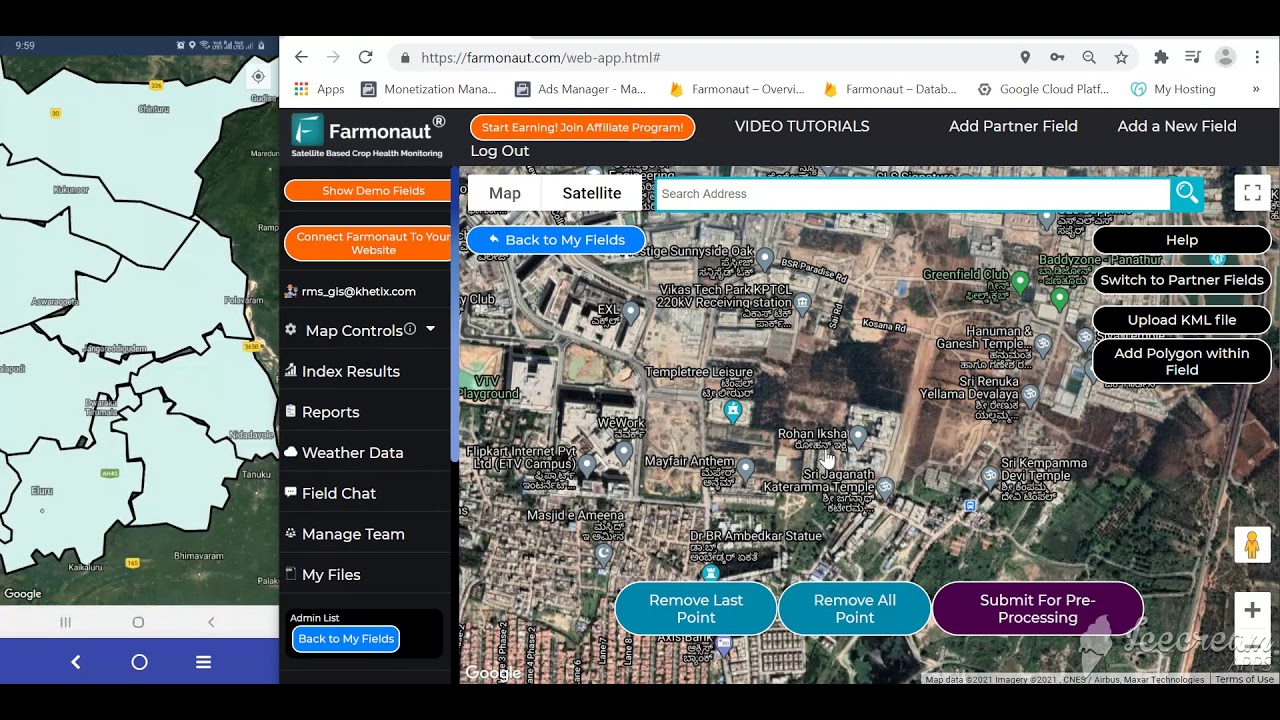
Implements do the physical work; satellite monitoring tells you where and when to deploy them. Farmonaut layers multispectral imagery, AI analytics, and blockchain-based traceability on top of the equipment described above, so the same field data that justifies a seed drill's variable-rate settings can also back a loan or insurance claim.
- Monitor Crop Health & Soil: Farmonaut's app provides NDVI, soil moisture, and biomass maps.
- Blockchain Traceability: Trace every stage of the crop journey for supply-chain transparency.
- Fleet Management: Track and optimize equipment usage to reduce fuel and operating cost — directly relevant given the machinery cost trend cited above.
- Crop Loan & Insurance Verification: Satellite-based field verification for loan and insurance processes.
- API Access: Build custom analytics on the Farmonaut Satellite API, documented at the API developer docs.
FAQ
What are the main types of agricultural implements?
Six functional categories: soil preparation (ploughs, harrows, rotavators), planting (seed drills, transplanters), cultivation (cultivators, weeders), irrigation (drip/sprinkler systems, pumps), harvesting (combines, balers), and post-harvest handling (dryers, storage). Fencing is separate boundary infrastructure, priced per linear foot rather than per unit.
What are the different types of agricultural fencing?
Four grades dominate US use: barbed wire ($1–$3/linear foot per Fixr), chicken wire on T-posts ($3–$5/linear foot per Ergeon), hog/woven wire ($5–$9/linear foot per Ergeon), and heavy welded-wire mesh with treated posts ($10–$15/linear foot per Ergeon) — all 2026 installed-cost figures.
What are the types of agricultural farming?
Row-crop/arable farming, livestock/ranching, specialty/horticultural farming, and mixed/diversified farming. Each draws on a different slice of the implement categories above — row-crop farms lean on seed drills and combines, ranching leans on fencing and water systems, and specialty farms lean on transplanters and precision irrigation.
What are the best smart farming tools right now?
By documented US adoption, guidance/autosteering systems lead — used on 52% of midsize and 70% of large-scale US crop farms in 2023 per USDA ARMS — followed by yield monitors and yield/soil mapping (68% of large-scale farms). Precision agriculture overall sits at 27% adoption across all US farms and ranches.
Are mechanized and smart implements suitable for small farms?
The adoption data above shows real scale sensitivity: precision practices sit at 27% across all farms but climb to 68-70% on large-scale operations, meaning cost and scale still gate adoption. Compact and semi-automated versions exist for smaller acreages, but the ARMS data doesn't break out a small-farm adoption rate separately — check the current USDA ERS chart of note for any newer breakdown.
How can Farmonaut help farmers use these tools efficiently?
Satellite-based monitoring tells you where soil moisture, biomass, or crop stress varies across a field, which is the input a variable-rate seed drill or a scheduled irrigation system needs to actually save money rather than apply a flat rate everywhere. API integration lets that data feed directly into farm management software.
Treating adoption-rate figures as static. USDA ARMS is fielded on a rotating basis by topic, so re-check USDA ERS Charts of Note for the current release before citing a specific percentage in a grant application, loan request, or board presentation.
Further reading:
Choosing Implements for Your Operation
Start from the category, not the brand: identify which stage of the farming cycle is actually your bottleneck — soil prep, planting precision, irrigation efficiency, or harvest speed — then compare implements within that category against your acreage and the machinery-cost trend above ($136/acre in 2021 to $171/acre in 2024). For fencing, run your own perimeter through the calculator above rather than budgeting off a national average that may not match your fence grade.
The durable check, regardless of what changes next: before any equipment purchase, cross-reference USDA NASS Census of Agriculture data for your county, the current USDA ERS ARMS adoption chart for your farm-size bracket, and Farmdoc Daily's latest per-acre cost series. Those three sources update independently of this article and will still be the right ones to check years from now.
Explore Farmonaut's satellite-based platform for field-level data that informs when and how to deploy the implements above.
Explore Farmonaut's satellite-powered apps & APIs for field monitoring, fleet tracking, and carbon reporting.
Launch Farmonaut App or View API Capabilities

 Juligerm
 Inclusive Growth Chain
 AdBio
AdBio MISE Maroc
 Drift-Sense
 NWNS
NWNS Red August Group
 Farm Inc
 WeMe Global
 Agrotoken
 Blue BearX
 Insignito
 Croptimum
 DnCubed
 Field Capacity
 Indosistim Teknologi
 Liquify Digital
 CU Foods
