

Maine tourmaline · Access and price guide
Maine Tourmaline Mines: Where to Dig, What It Sells For
Few Maine tourmaline mines are open to the public: Mount Apatite Park in Auburn is the clearest case, while Mount Mica and the Dunton Quarry are private. A 2020 magazine guide quotes about US$700 a carat for top-grade stones.
Key takeaways
- Tourmaline is Maine’s state mineral; the gem species is elbaite and the common one is black schorl (Maine Geological Survey).
- Mount Apatite Park in Auburn is city-run and lets amateurs search the old mine tailings under special rules (City of Auburn).
- The 1972 Big Find at the Dunton Mine in Newry produced over a ton of gem tourmaline by 1974 (Maine Mineral & Gem Museum, via National Jeweler, 2022).
- No public index prices Maine tourmaline; a 2020 Portland Magazine guide gives about US$700 per carat for top-grade, plain, one-carat New England stones.
- Maine ranks sixth of the leading states for natural gemstone output, within a US total of about US$9.4 million in 2025 (USGS, 2026).
In this article
- Which Maine tourmaline mines can you visit?
- Where does Maine tourmaline come from?
- From Mount Mica to the Big Find: a short history
- How big is the Maine gem trade?
- How much is Maine tourmaline worth per carat?
- How to value a parcel of rough before you cut it
- Rules before you dig: permission, license and safety
- Plan a legal tourmaline trip in five steps
- Could Maine's gem pegmatites matter to lithium investors?
- Where satellite data helps, and where it does not
- Water, dumps and reclamation near quarries
- Frequently asked questions
Only a few Maine tourmaline mines can be visited by the public. The easiest is Mount Apatite Park in Auburn, which the city owns and where, according to the City of Auburn, amateurs may still search the old mine tailings for apatite, tourmaline and quartz under special park rules. Most of the famous quarries, including Mount Mica in Paris and the Dunton Quarry in Newry, are private, and access depends on the owner. A 2020 magazine guide quotes about US$700 a carat for top-grade one-carat New England stones, and color is the main driver of price.
This guide lists the sites by access, explains where the gems come from, shows how stones are priced and what no public source can tell you, and sets out the permission and safety rules. It also covers why the same rock belt matters to lithium investors, and includes a calculator for the value of a parcel of rough. Spelling follows US usage, and prices are in US dollars.
Which Maine tourmaline mines can you visit?
Maine has no system of claim staking on private land. Most pegmatite quarries are owned by individuals or companies, and the sites that welcome visitors change from year to year. Treat the table below as a starting list, and phone the owner or operator before you drive out.
| Site | Town and county | Land status | What visitors can do | Source |
|---|---|---|---|---|
| Mount Apatite Park | Auburn, Androscoggin | City park | Search mine tailings for tourmaline, apatite and quartz; special rules apply | City of Auburn |
| Mount Mica | Paris, Oxford | Private quarry | Gem tourmaline produced on and off since 1820; closed to visitors except by arrangement with authorized agents such as Dig Maine Gems (Sunday trips, US$65 adult, US$35 youth; checked 16 October 2026) | Maine Geological Survey; Dig Maine Gems |
| Dunton Quarry, Plumbago Mountain | Newry, Oxford | Private | Site of the 1972 Big Find; private; ask the owner about access | Maine Atlas |
| Black Mountain | Rumford, Oxford | Not stated | Named by the Survey as a tourmaline locality; ask about access | Maine Geological Survey |
| Maine Mineral & Gem Museum | Bethel, Oxford | Museum | View Maine tourmaline, including Big Find stones | Museum; National Jeweler |
| Maine State Museum | Augusta, Kennebec | State museum | Exhibit of Maine tourmalines and other gems | Maine Geological Survey |
The Survey’s own page says that pieces of pink, green, blue or watermelon tourmaline can be found at the Dunton Mine, Mt. Mica or Black Mountain. That page cites 1990s references, so use it for geology, not for access. For Mount Mica, the authorized agent Dig Maine Gems runs Sunday field trips at US$65 per adult and US$35 per youth aged 8 to 16, and its sifting dig site sells buckets of Mount Mica material from US$25 (Dig Maine Gems, checked 16 October 2026).
If you want to see great stones without digging, the Maine Mineral & Gem Museum is at 99 Main Street, Bethel. Its collection includes a 100-carat tourmaline and a necklace made only of Dunton Mine stones, the largest weighing 40.82 carats, according to National Jeweler.
Where does Maine tourmaline come from?
Tourmaline is a group of boron-bearing minerals. The most common kind in Maine is schorl, the black, iron-rich species. The colored gem species is elbaite, and the Survey says the best examples occur in pegmatite. A pegmatite is a very coarse-grained granite that cooled slowly, so its crystals grew large. Gem crystals grew best where open cavities, called pockets, formed inside the rock. Crystals in Maine range from microscopic to over a foot long, and the watermelon variety has a green outer layer around a pink core.
Pegmatite veins are abundant in parts of Oxford, Androscoggin and Sagadahoc Counties, and the Survey notes that most were worked commercially for mica or feldspar, leaving waste dumps where collectors search. Colored crystals occur mainly in Oxford County and the Auburn and Poland area, and the best gem localities lie roughly on a line running south-east through that part of the state. Black tourmaline is much more widespread, but it is not gem material.
The spodumene-bearing pegmatites of the Rumford district around Plumbago Mountain are a related group. U-Pb dating of cassiterite from them gives ages of 333 to 327 million years, and the study ties them to melting of crust during the collapse of the Acadian mountain belt. Do not assume that every gem pegmatite in the state has the same age or origin.
From Mount Mica to the Big Find: a short history
The first major tourmaline discovery in Maine came in 1820 at Mount Mica, near Paris Hill, when two boys exploring the hillside found green crystals, according to the Maine Atlas. The Survey adds that the quarry opened there has produced gem tourmaline off and on to the present, and that the Hamlin Necklace, set with Mount Mica stones, is held by the Harvard Mineralogical Museum. A 2020 Portland Magazine feature says Maine can claim the first commercial gemstone mine in the United States, found near Paris in 1820.
Chart
Sizes of notable Maine tourmalines
Carats; stones tied to the Dunton Mine 1972 find and the state necklace
The largest find came much later. In October 1972, four men broke into rich pockets at the Dunton Mine on Plumbago Mountain in Newry. The Maine Mineral & Gem Museum says the discovery produced more than a ton of gem tourmaline between 1972 and 1974 and revived gem mining in the state. The Survey records that hundreds of pounds of red and green crystals came out, including the 10-inch “Jolly Green Giant” now in the Smithsonian’s National Museum of Natural History. Stones from the find went into the ceremonial state necklace made in the 1970s, which carries a 24.58-carat pink tourmaline drop.
Older gems came from other hills too. The Peary Necklace, commissioned in 1912, is made entirely of tourmaline from Mount Apatite, according to the Maine Atlas. That is one reason the Auburn park is more than a rockhound spot: it is part of the same gem history.
How big is the Maine gem trade?
Small. The US Geological Survey (USGS) estimates the US natural gemstone output for 2025 at about US$9.4 million, and ranks Arizona, Oregon, California, Nevada, Montana and Maine as the leading states by value, in that order, together holding 68% of the total (USGS Mineral Commodity Summaries, 2026). The list covers all gem materials, from agate to topaz to tourmaline, and no value is given for tourmaline alone or for Maine alone.
Chart
US natural gemstone production
Value in US$ million, 2021 to 2025 (2025 estimated)
The same USGS report says the US price of gemstones is “variable, depending on size, type, and quality”, and that US gemstone imports were valued at about US$11 billion in 2025, with diamonds averaging 79% of import value. Domestic colored-stone mining is a niche trade of small crews. A 2020 interview in Portland Magazine describes Maine gem miners as operations of one or two people, with Mount Mica the largest gem quarry, small enough to be hard to pick out in satellite photos.
How much is Maine tourmaline worth per carat?
There is no public price index for Maine tourmaline, and the USGS does not publish one. Stones are sold one by one, so price depends on the stone. The Gemological Institute of America (GIA) treats color as the main value factor, followed by clarity, cut and size. Its tourmaline quality guide notes that dark-toned stones sell for much less than bright, clean ones, that green stones are expected to be clear of visible inclusions while pink and red stones are often forgiven some, and that price per carat generally climbs once fashioned stones pass five carats.
Chart
A price ladder, from amethyst to Paraíba
US$ per carat; highest-grade stones; sources and years differ
For a figure to start from, a 2020 Portland Magazine guide gives an average of about US$700 per carat for New England tourmaline, for the highest grade, plain one-carat, cut and faceted stones, against about US$70 for New England amethyst. The guide gives it as an average price for the highest-grade stones, not for typical stones, and it is several years old. Most stones sold are not the highest grade. The International Gem Society (IGS) says small tourmalines under five carats are fairly easy to obtain at modest cost, with prices rising above a few hundred dollars a carat mainly for large sizes or rare colors.
At the top end sits copper-bearing Paraíba tourmaline, which is not a Maine stone. GIA reports that top-quality Paraíba stones of three to five carats climbed to over US$10,000 per carat, a level no other tourmaline had reached. The chart puts the ladder in one place, but the bars come from different sources and years, so read them as orders of magnitude, not a price list. For other markets, see our notes on chrome tourmaline prices and on the Cruzeiro mine in Brazil.
Rough, specimens and cut stones are different markets
A crystal sold as a mineral specimen is priced by shape, color, size and the matrix it sits on, not by the carat. A rough piece sold for cutting is priced by how much clean material it can yield. Most of a crystal is lost in cutting, and the yield depends on cracks, inclusions and color zoning, so a bag of rough may produce very few finished stones. The calculator below lets you test your own yield, price and cutting cost.
Treatment and paperwork
Heating and irradiation are common on tourmaline: the IGS lists heating, which lightens blue and green stones, and irradiation, which produces red, deep pink, yellow and orange colors and can be undetectable. A buyer paying a high price will want a laboratory report, such as one from GIA, that states origin and treatment. Keep your own notes on where and when a stone was found, because a documented find is easier to sell than an unlabelled one.
How to value a parcel of rough before you cut it
Gem rough is bought by weight but sold as finished stones, so the cutter’s yield decides most of the result. One gram is five carats. Multiply the weight of clean, gem-grade rough by the share that survives cutting, and you have the finished carats. Multiply by a per-carat price for stones of that color, clarity and size, and you have a retail figure. A dealer will pay only part of retail, and the cutting bill and your trip costs come off the top. The calculator below does this sum with the numbers you type in, so you can see how sensitive the result is to yield and price.
Calculator
What is your parcel of rough worth after cutting?
Enter your own weight, yield, price and costs. Results update as you type.
- Finished carats: 15.0
- Retail value of finished stones: $4,500
- Dealer buy value: $2,250
- Cutting bill: $225
Example values only, not benchmarks or quotes. The price is an input: use today’s price for stones of your color, clarity and size (a 2020 Portland Magazine guide quoted about US$700 per carat for top-grade one-carat stones only). One gram is 5 carats. Yield is the share of rough weight that ends up as finished stones. All money in US$.
Rules before you dig: permission, license and safety
Maine ties mineral ownership to the land. The Survey explains that a landowner owns from the surface down unless the mineral rights have been separated by legal agreement, and that a discovery belongs to you only on your own property or under rights the owner has given you. The land-access and trespass rules apply to collectors like anyone else. See our guide to how mineral rights are valued per acre for the wider picture.
- Private land: get the owner’s permission before you enter a collecting site. Many localities close from time to time while they are being mined for specimens.
- State parks: taking samples is prohibited without special permission, and mining is strictly prohibited in all Maine State Parks.
- Other state land: exploring for minerals requires an exploration permit from the Maine Geological Survey.
- White Mountain National Forest: collecting is allowed if it is non-commercial, limited to hand tools and does not greatly disturb the area.
- Staking claims: Maine does not offer claim staking on private land. The state issues exploration permits, exploration claims and mining leases only for land it owns or holds in trust.
- Larger programs: anyone whose exploration spending on private land in Maine goes above US$25,000 in a calendar year must register with the Survey’s director.
Prospecting safety: get written permission from the landowner, check whether any license or permit applies to your activity, and never use mercury. Quarries have sheer walls and loose dumps, so wear gloves and safety glasses, as the Survey advises, and never work under an overhang. This page is general information, not legal advice.
▶ Walks through the seven environmental impacts of mining in plain words, useful context before you dig on any quarry land. · 2:31
Plan a legal tourmaline trip in five steps
The flow below sets out the order in which to do things. Start with the owner, not the shovel.
Infographic
Before you dig in Maine
- 1Pick a siteChoose a public site such as Mount Apatite Park, or a private quarry whose owner you can contact.
- 2Ask the ownerGet permission, the day fee, the dates and any waiver in writing.
- 3Check the rulesState parks, national forest and city parks each have their own limits.
- 4Pack for safetyHand tools, gloves and safety glasses; stay clear of quarry walls. No mercury.
- 5Record the findNote the date, spot and photos; a documented stone is easier to sell.
Could Maine’s gem pegmatites matter to lithium investors?
The same belt of pegmatites that produced the tourmaline also holds lithium. The USGS-authored study of the Rumford pegmatite district calls the Plumbago North pegmatite a world-class spodumene resource. Spodumene is the main lithium-bearing pegmatite mineral, and a resource is an estimate of material that may one day be mined, which is not the same as a reserve that is economic today. For how pegmatite lithium deposits form and are explored, read our guide to pegmatite, brine and clay lithium deposits.
Whether any of it is ever mined is a separate question. The Survey notes that metallic mineral mining in Maine is governed by the Maine Metallic Mineral Mining Act of 2012, with the Department of Environmental Protection responsible for permitting, and that local ordinances may be stricter. Gem digging, by contrast, is small and seasonal. This page makes no forecast about lithium prices or company value.
Where satellite data helps, and where it does not
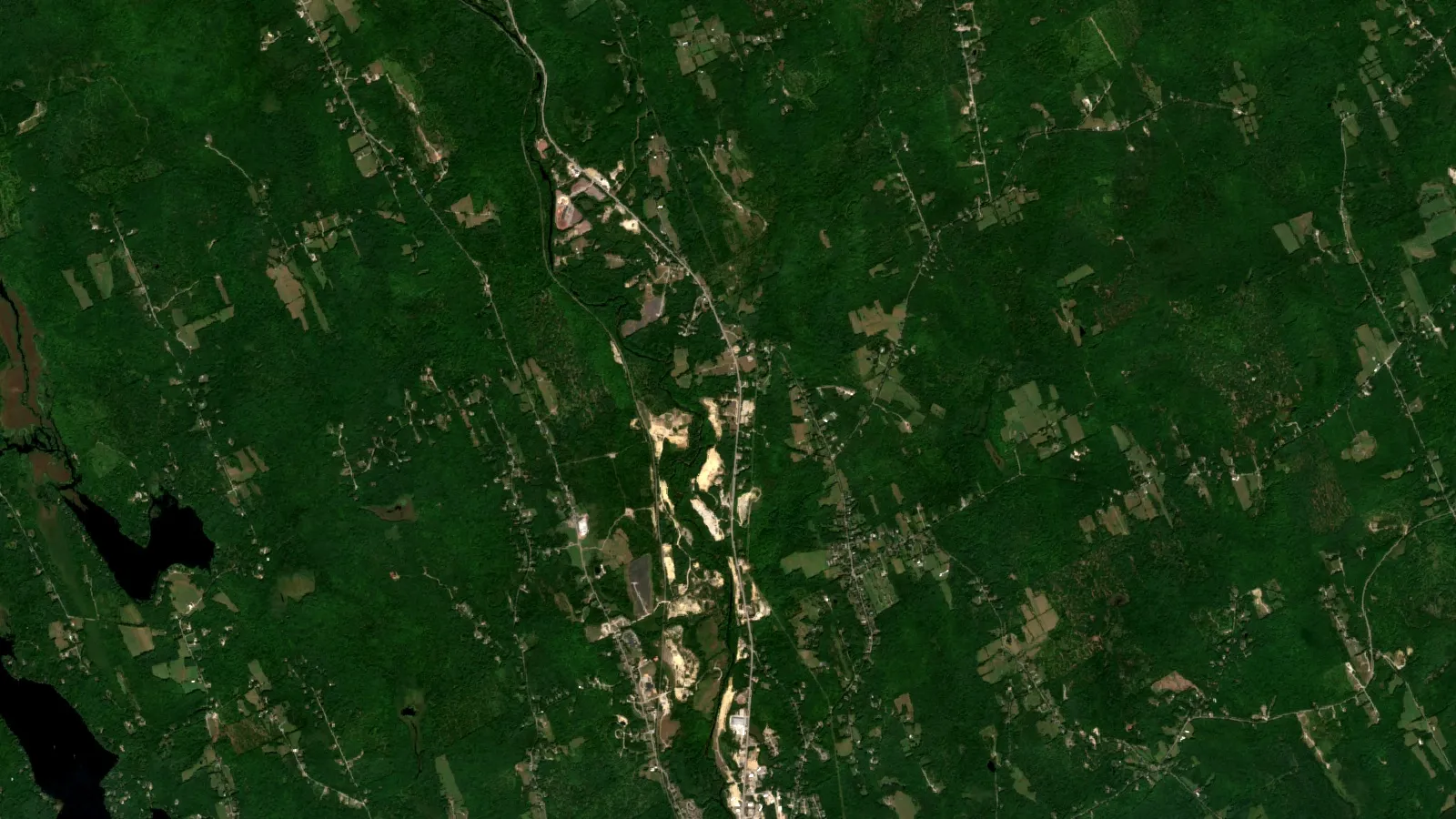
A satellite cannot see a gem pocket. Pockets are small and sit underground, and they are found by digging, mapping and the records of earlier miners. What satellite images can do is screen a large area for clues such as faults, rock types and alteration, so that field time goes to the most promising ground first. Farmonaut’s satellite-based mineral detection covers minerals including lithium and beryllium, which occur in pegmatites, but tourmaline gems are not on its list of detectable materials. Results are exploration targets that need field checks, not a resource estimate.
Landowners and explorers who want a first look at a pegmatite belt can send a KML, KMZ or polygon and receive a report in 5 to 20 business days. The satellite mineral detection page explains the process, and you can send an area on the mining query form or through contact us. Our guide to 3D geologic map sources shows where to find the bedrock maps that go with such work, and our page on diamond exploration covers another gem search method.

▶ Explains how satellites map the rock around a deposit, such as iron stains, clay minerals and faults, instead of seeing the mineral itself. · 4:25
Water, dumps and reclamation near quarries
Environmental permitting is the responsibility of the Department of Environmental Protection in organized towns and cities, according to the Survey, and the Land Use Planning Commission also has a role in the unorganized territory. A town may add its own rules. For a hobby dig the practical points are simple: stay out of wetlands and streams, keep dump piles stable, fill holes, and carry out what you carry in. Mount Apatite Park adds its own limits, so read the city’s posted rules before you start.
Related reading on this site: Silicon Mining Companies: Who Mines, Smelts and Sells.
Frequently asked questions
Where can I search for tourmaline in Maine without a private fee dig?
Mount Apatite Park in Auburn is city-owned, and the city says amateurs may search the mine tailings for tourmaline, apatite and quartz under special rules. White Mountain National Forest also allows non-commercial hand-tool collecting. Read the posted rules first.
Are Maine tourmaline mines open to the public?
Most are not. The big quarries are on private land, and the Survey says many localities close from time to time while they are mined. A few owners offer fee-dig days in some seasons, so contact them before you travel.
Is Mount Mica open to visitors?
Mount Mica is a private quarry that has produced gem tourmaline on and off since 1820. The mine is closed to visitors except by special arrangement with authorized agents. One such agent, Dig Maine Gems in West Paris, runs Sunday field trips to the mine during the mining season at US$65 per adult and US$35 per youth aged 8 to 16 (its page, checked 16 October 2026). Do not contact the mine directly.
Do I need permission to look for tourmaline?
Yes, on private land. The Survey says the usual access and trespass rules apply to collectors, and that on state land an exploration permit is needed. State parks prohibit mining and sampling without special permission.
How much is Maine tourmaline worth per carat?
No public index exists. A 2020 Portland Magazine guide quotes about US$700 per carat for top-grade, plain, one-carat New England stones. Many stones sell for far less, and rare colors and large sizes sell for more.
What is Maine’s state mineral?
Tourmaline is Maine’s state mineral, as the Maine Geological Survey describes it. The most common species in the state is black schorl, while the gem species is elbaite.
What was the Big Find?
In October 1972, four men found rich tourmaline pockets at the Dunton Mine on Plumbago Mountain in Newry. The Maine Mineral & Gem Museum says more than a ton of gem tourmaline was recovered by 1974.
Can I stake a mining claim in Maine?
Not in the western sense. Mineral rights belong to each land parcel, and the state issues exploration permits, claims and leases only for land it owns or holds in trust. On private land you need an agreement with the owner.
Is black tourmaline valuable?
Black schorl is the most common tourmaline in Maine and is rarely gem material. Collectors may want fine crystals as mineral specimens, but cut-gem prices apply to the transparent colored stones.
Can satellites find tourmaline?
Not the gems themselves. Satellite images can help screen ground for faults, rock types and alteration that suggest where to look, but gem pockets are found in the field.
Is the Plumbago Mountain pegmatite a lithium mine?
No. USGS-authored research describes Plumbago North as a world-class spodumene resource, but a resource is not a mine, and Maine’s mining rules would apply to any project.
This page is for information only. It is not investment advice or legal advice. Confirm access, fees and permits with the landowner and the regulator before you visit. Prospecting safety: get the landowner’s permission, check any license or permit that applies, and never use mercury.
Farmonaut mining
Screen a pegmatite belt from satellite images
Send a KML, KMZ or polygon and Farmonaut maps alteration and structure from satellite images before field crews go in.
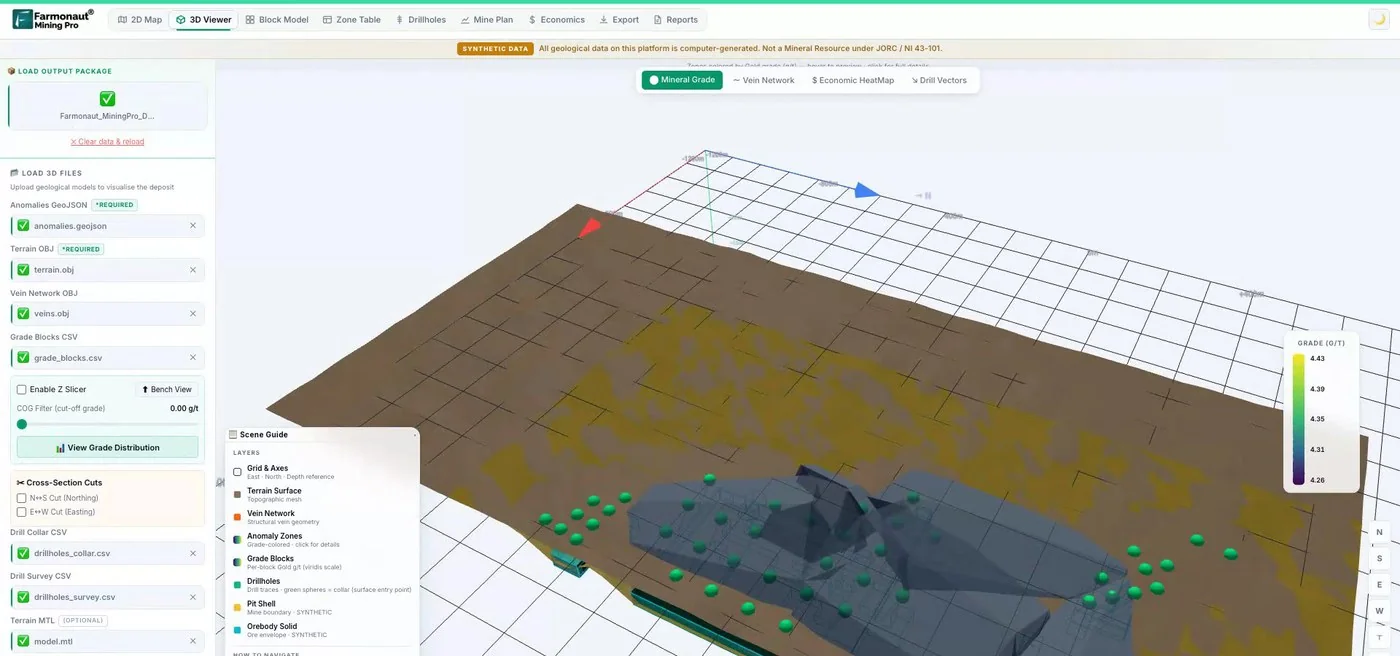
Mining Pro sample view, synthetic data
Keep reading
Sources
- Maine Geological Survey, Tourmaline: Maine’s State Mineral: maine.gov
- Maine Geological Survey, An Introduction to Mineral Collecting in Maine (updated pages): maine.gov
- Maine Geological Survey, Mining and Quarrying in Maine: FAQ (updated March 2023): maine.gov
- Maine Atlas Project, Maine Tourmaline: maine.gov
- City of Auburn, Mount Apatite Park: auburnmaine.gov
- USGS, Mineral Commodity Summaries 2026: Gemstones (February 2026): pubs.usgs.gov
- USGS, Felch et al., Anatectic origin of Mississippian spodumene-bearing pegmatites in western Maine (Economic Geology, 2025): pubs.usgs.gov
- GIA, Tourmaline Quality Factors: gia.edu
- International Gem Society, Tourmaline Gem, Price, and Jewelry Information (updated 10 July 2025): gemsociety.org
- Portland Magazine, Tourmalines Are Forever (Winter guide 2020): portlandmonthly.com
- National Jeweler, Tourmaline by the Ton: Maine Museum Celebrates ‘The Big Find’ (23 February 2022): nationaljeweler.com
- Maine Mineral & Gem Museum, Getting Here: mainemineralmuseum.org
- Dig Maine Gems, Mount Mica field trips and dig site (checked 16 October 2026): digmainegems.com
Discussion
Questions, corrections or field experience? Share them below. First-time comments are reviewed before they appear, and your email is never published.
No comments yet. Be the first to add a question or your experience.

 Vortex Minerals Pty Ltd
 Faith At Work (Pty) Ltd
 Geotech Mining Solutions plc
 Vulcan International Limited
 Kidepo Associates
 GKY Mining
 Alkimy SARL
 Double A Trading
 GemSprout Metals Limited
 Qader Group
 Ileys General Trading
 SG Gold Mining LLC
 VRV Global Pte Ltd
 Omsri International FZE
 G.I.T.T.
 Jaunita Erss Ltd
 Almosi SARL
 SRK Consulting
 Berks Gold Limited
 Mwerezi Minerals Company Limited
 Mining SARL
 SenGold Invest SAS
 Exploration consultancy · South Africa · Gold










