

Mineral properties · Identification guide
Malachite Specific Gravity vs Gold, Pyrite and Quartz
Malachite has a specific gravity of about 3.6 to 4.05 (Handbook of Mineralogy: 4.05 measured). Pure gold is 19.3. This page compares them with pyrite and quartz, shows how to measure SG, and corrects the idea that gold ore itself has an SG near 19.
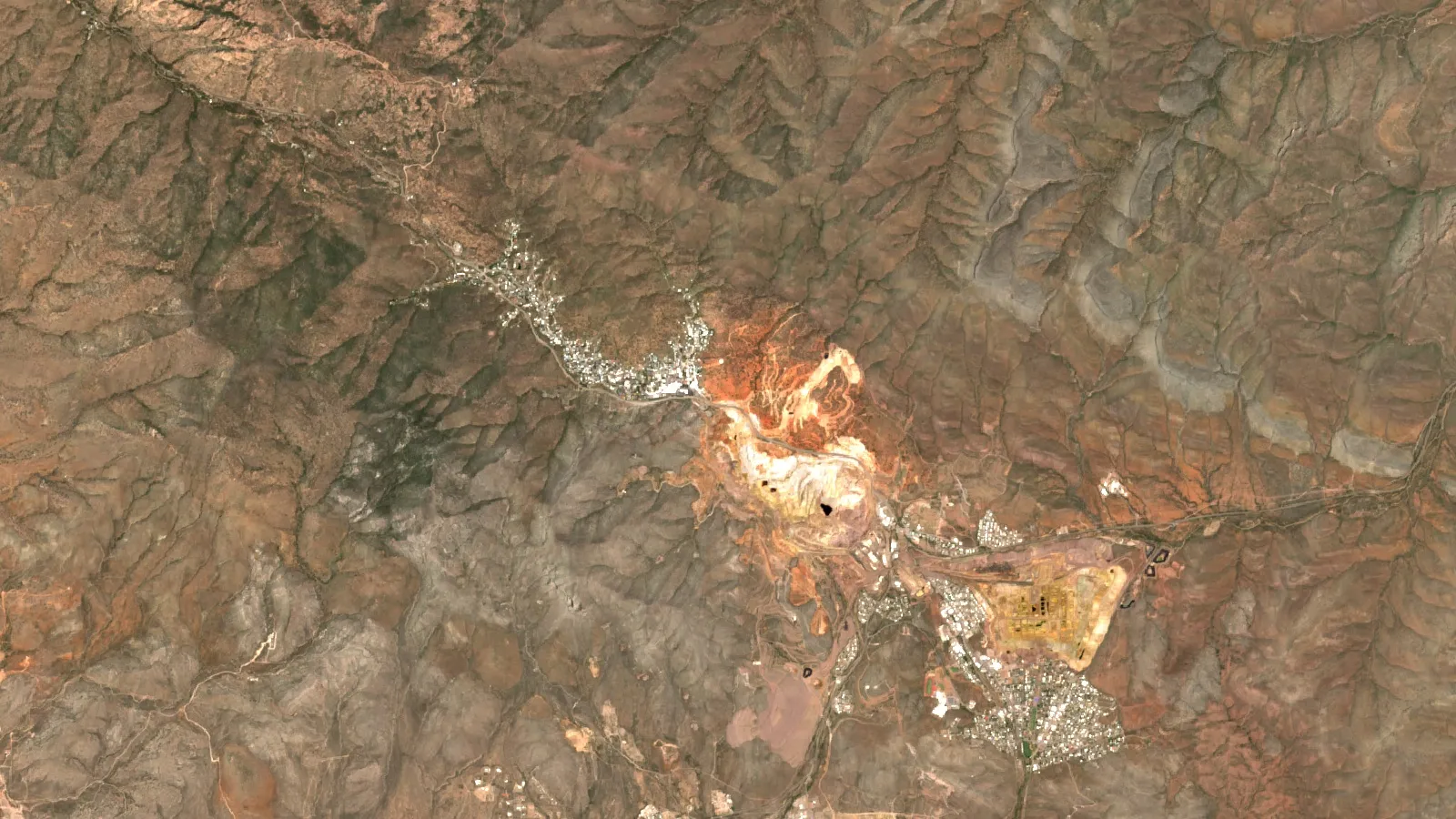
Key takeaways
- Malachite SG is 4.05 measured and 3.98 calculated for pure material; typical specimens read 3.6 to 4.0 (Handbook of Mineralogy; Geology.com).
- Pure gold is 19.3, about 3.8 times heavier than pyrite (5.02) for the same volume, so SG separates real gold from fool’s gold (Handbook of Mineralogy).
- Gold ore is not 19.3: at 5 g/t the bulk SG stays near the host rock’s 2.7, because gold is a few parts per million of the rock (our calculation).
- Against quartz in water, gold scores about 11 on the concentration criterion and malachite about 1.8; the usual threshold for easy gravity separation is 2.5 (PMC gravity review; our calculation).
- Measure SG with two weighings: weight in air divided by the weight lost in water. Use the calculator on this page.
In this article
- Malachite specific gravity: the value and why sources differ
- Malachite against gold, pyrite and other minerals
- How to measure specific gravity with a scale and a cup of water
- What gold ore SG really is, and why it is not 19.3
- How specific gravity helps identify gold and its look-alikes
- Why malachite is not separated by gravity the way gold is
- Gravity separation for gold: what SG buys you
- Malachite as a clue when you are looking for gold
- What satellites can and cannot tell you about SG
- Safety and permission when you test samples
- Frequently asked questions
Malachite has a specific gravity (SG) of about 3.6 to 4.05, which means a piece of it weighs roughly four times as much as the same volume of water. The Handbook of Mineralogy lists a measured value of 4.05 and a calculated value of 3.98 for pure malachite (Handbook of Mineralogy, malachite). Gold is far heavier at 19.3 when pure, and that gap is why SG is one of the quickest ways to separate real gold from yellow look-alikes.
This page gives the numbers side by side, shows how to measure SG with a scale and a cup of water, and explains what SG can and cannot tell you about a gold ore. One common claim needs fixing at the start: the SG of 19.3 belongs to the gold metal, not to gold ore. Ore is mostly ordinary rock, and its bulk SG is close to 2.7.
For a closer look at a related question, see our guide: Gold vs Pyrite: 7 Tests and Where Gold Hides.
If this topic matters to you, read Gravity Separation of Copper Ore: Methods, Limits, Steps next.
Malachite specific gravity: the value and why sources differ
Specific gravity is the density of a mineral divided by the density of water, so it has no unit. A mineral with an SG of 4 has a density of 4 grams per cubic centimetre (4 g/cm³). Geologists use SG because it is a property of the mineral itself, not of its colour or shape.
Published values for malachite (Cu₂CO₃(OH)₂, a copper carbonate hydroxide) are close but not identical:
| Source | Reported SG | What it is |
|---|---|---|
| Handbook of Mineralogy | 4.05 measured, 3.98 calculated | Reference data for pure crystals |
| Geology.com | 3.6 to 4.0 | Range for typical specimens |
| Minerals.net | 3.9 to 4.0 | Narrower range for good specimens |
The spread has a physical cause. The Handbook describes malachite as typically stalactitic, botryoidal (grape-like) and fibrous inside. These forms trap tiny voids, and a sample with voids weighs less per unit volume than solid crystal. Mixing with softer, lighter material such as clay or silica pulls the number down further. A reading near 3.6 on a banded lump is normal. A reading well above 4.1 points to a different mineral, such as chalcopyrite (4.1 to 4.3).
Malachite is also a soft mineral, with a Mohs hardness of 3.5 to 4, and it fizzes in cold dilute hydrochloric acid, which few green minerals do (Geology.com). Together, bright green colour, a light green streak, a hardness near 4 and an SG near 4 identify malachite with little doubt.
Malachite against gold, pyrite and other minerals
The table below uses Handbook of Mineralogy values for every row except where noted, so the numbers are comparable. Hardness is the Mohs scale; where the Handbook gives a range, both ends are shown.
Chart
Specific gravity of malachite and common companions
SG (no unit) from reference data; gold is pure gold
| Mineral | SG | Mohs hardness | Why it matters here |
|---|---|---|---|
| Gold (pure) | 19.3 | 2.5 to 3 | Heaviest common mineral; very malleable |
| Galena | 7.58 | 2.5 to 2.75 | Lead ore; heavy but grey, not yellow |
| Cuprite | 6.14 | 3.5 to 4 | Red copper oxide often found with malachite |
| Pyrite | 5.02 | 6 to 6.5 | The usual “fool’s gold” |
| Chalcopyrite | 4.1 to 4.3 | 3.5 to 4 | Brass-yellow copper sulfide; second fool’s gold |
| Malachite | 3.98 to 4.05 | 3.5 to 4 | Green copper carbonate |
| Azurite | 3.77 | 3.5 to 4 | Blue partner of malachite |
| Calcite | 2.71 | 3 | Common vein and host-rock mineral |
| Quartz | 2.65 | 7 | The usual vein and gangue mineral |
Two things stand out. First, malachite and azurite are close in SG (3.98 to 4.05 against 3.77), so SG alone will not tell them apart; colour does that. Second, malachite sits right beside chalcopyrite (4.1 to 4.3). A brass-coloured grain with an SG of 4.2 is chalcopyrite, not malachite and not gold, and the Handbook gives a hardness for it that overlaps malachite’s. Colour and streak settle those cases.
How to measure specific gravity with a scale and a cup of water
You do not need a lab. The method rests on Archimedes’ principle: an object in water is pushed up by a force equal to the weight of the water it displaces. The Gemmological Association of Great Britain describes SG as the weight in air divided by the weight of an equal volume of water, found as weight in air divided by (weight in air minus weight in water) (Gem-A).
- Pick a clean, solid piece. Avoid pieces with cracks, loose crust or air pockets. Porous samples soak up water and give a false low reading.
- Weigh it dry. Use a scale that reads to 0.01 g or better for small samples. Write down the weight in air.
- Weigh it in water. Hang the sample from a thin thread so it is fully under water, not touching the sides or the bottom of the cup. Brush off any air bubbles. Write down the weight in water.
- Divide. SG = weight in air ÷ (weight in air − weight in water).
Use the same units for both weights. For the best accuracy use distilled water at a steady temperature, as Gem-A advises, and keep the scale on a stable surface. Samples under about 5 g give noisy results on a kitchen scale, so use a piece the size of a thumb joint or larger.
A worked example: a green lump weighs 40.0 g in air and 30.0 g in water. It loses 10.0 g, so SG = 40 ÷ 10 = 4.0. That fits malachite. If the same lump gave 2.6, you would be holding quartz stained with copper or a green silicate, not massive malachite. The calculator below does the sum and also shows how easy a gravity separation would be.
Calculator
What is the SG of my sample, and could gravity separate it?
Enter the two weights from your scale, in the same unit.
- Volume of the sample (cm3): 10.0
- Concentration criterion against your gangue (2.5 or more is easy): 1.82
Example values only, not a benchmark: 40 g in air and 30 g in water give an SG of 4.0. The quartz default of 2.65 and the water value of 1 come from the Handbook of Mineralogy and the PMC gravity review. The 2.5 threshold comes from the PMC gravity review.
What gold ore SG really is, and why it is not 19.3
Gold ore is rock that contains gold. In most mines the gold is a few grams per tonne (g/t), which is a few parts per million of the rock. A gold grade of 5 g/t means 5 grams of gold in a million grams of rock. The rest is quartz, feldspar, carbonate, clay and sulfide minerals.
That has a simple consequence for SG. Take a tonne of rock with an SG of 2.7 and swap 5 g of it for 5 g of gold. Using gold at 19.3, the bulk SG moves from 2.7000 to about 2.70001 (our calculation from the two SG values). Even a very rich 100 g/t ore moves it only to about 2.7002. No scale can see that. So the bulk SG of gold ore tells you about the host rock, not about the gold.
What does move bulk SG is the heavy sulfide content. If 10% of a rock’s weight is pyrite (SG 5.02) and the rest is a host with SG 2.7, the bulk SG rises to about 2.83 (our calculation). That is a real, measurable change, and in some deposits gold travels with sulfides, so a heavier-than-normal core sample can point to sulfide-rich zones worth assaying. The SG tells you about sulfide, and only the assay tells you about gold.
The figure of 19.3 applies to pure gold. Geology.com notes that SG falls as gold alloys naturally with silver, copper and other metals (Geology.com, gold). Natural gold is therefore often a little under 19.3. It is still far heavier than any common gangue mineral, and that gap is what gravity concentration uses.
How specific gravity helps identify gold and its look-alikes
SG is one of several diagnostic properties the same source lists for gold: colour, hardness, streak, SG, ductility and malleability (Geology.com). Used together they are decisive.
Chart
SG and hardness together identify a mineral
Specific gravity (x) against Mohs hardness midpoint (y)
- Gold against pyrite. Gold at 19.3 is about 3.8 times heavier than pyrite at 5.02 for the same volume (our calculation). Pyrite is also hard (6 to 6.5) and brittle, while gold is soft (2.5 to 3) and the Handbook describes it as very malleable and ductile. Press a pin into the grain: gold dents or flattens, pyrite shatters or skids.
- Gold against chalcopyrite. Chalcopyrite is 4.1 to 4.3, close to malachite, and gold is about 4.6 times as heavy (19.3 ÷ 4.2). Chalcopyrite has a greenish-black streak, while gold streaks golden yellow.
- Gold against malachite. They are never confused by colour, but green copper staining can sit near gold in a copper-gold system, as the later sections explain.
A simple field order works well: look at the colour, test the streak and hardness, then confirm with SG. If a yellow grain passes the first three tests and weighs close to 19, it is gold. If it fails any one test, assume it is not. Our guide to finding gold deposits covers the wider prospecting steps.
Why malachite is not separated by gravity the way gold is
Malachite is sometimes described as ideal for gravity separation. The numbers say otherwise. Mineral processing uses a rule of thumb called the concentration criterion: (SG of heavy mineral − SG of fluid) ÷ (SG of light mineral − SG of fluid). A value above 2.5 means the separation is feasible by jigs and shaking tables, and the value falls as the density gap narrows (review of gravity concentration, PMC). In water the fluid SG is 1.
Chart
Concentration criterion against quartz gangue in water
(SG heavy minus 1) divided by (2.65 minus 1); above 2.5 suggests easy gravity separation
Against quartz gangue (SG 2.65) in water, the criterion works out to about 11 for gold, 4 for galena, 2.4 for pyrite, 1.9 for chalcopyrite and 1.8 for malachite (our calculation from Handbook SG values). Gold clears the 2.5 threshold by a wide margin. Malachite does not.
That matches how copper oxide ores are treated in practice. The University of Arizona Superfund programme explains that oxide copper ore is usually processed by hydrometallurgy: heap leaching, solvent extraction and electrowinning (University of Arizona). Flotation, the common route for copper sulfides, works poorly on oxides unless they are first treated with sulfide ions, because the usual xanthate collectors do not attach to oxide minerals (study of oxide-sulfide copper ores, PMC). In that study a low-grade mixed ore (0.5% Cu, with chalcopyrite and malachite) was upgraded with gravity and flotation to a concentrate with 27.1% Cu at about 70% recovery. Sulfidation flotation alone gave 22.5% Cu at 94.25% recovery, so adding gravity raised the grade but cut recovery.
For a reader with a copper licence, the point is practical. Malachite SG helps you recognise the mineral and estimate tonnage from volume, but the plant route is decided by leach tests on the actual ore, not by density.
Gravity separation for gold: what SG buys you
Gold is the opposite case. With an SG of 19.3 against 2.65 for quartz, a particle of gold settles much faster than a quartz grain of the same size. Panning, sluices, spirals, jigs, shaking tables and centrifugal concentrators all exploit this gap. The PMC review lists these methods as the main gravity circuits for heavy minerals (PMC review).
The US Environmental Protection Agency points small-scale miners to gravity methods, such as panning, as a way to concentrate gold without mercury (US EPA). Mercury forms an amalgam with gold that is heated to drive off the mercury, which is dangerous and restricted in some places. Do not use it.
SG has limits as a plant tool. Gravity works best on gold that has been liberated, meaning released from the rock by crushing. Gold locked inside sulfide grains is not freed by SG and needs other steps. Very fine gold, flattened flakes and fine clay also settle slowly and can be lost. Treat the figure of 19.3 as a reason to expect gravity to work on coarse liberated gold, then confirm with a test on your own ore.
▶ Follows a gold nugget from rock to ring, including the crushing and concentration steps behind recovered gold. · 5:27
Malachite as a clue when you are looking for gold
Malachite is a surface sign of copper. When copper sulfides weather in air and water, they leave green and blue stains of malachite and azurite near the surface. The USGS chapter on supergene ore and gangue (the weathered and enriched parts of deposits) lists malachite and azurite among the minerals of oxidised zones, and native gold among the minerals of some gossans, the rusty iron-rich caps left by weathering (USGS Scientific Investigations Report 2010-5070, chapter 12). The same chapter reports a sixfold gold enrichment in the gossan above the Flambeau deposit in Wisconsin, compared with the sulfide rock beneath.
This is a clue, not a rule. Malachite shows that copper was present. It does not show that gold is. Gold may be absent, or it may sit in a different part of the system. Treat green staining as a prompt to sample, then check copper and gold together in assays.
If you find heavy green-stained rock, a quick SG check separates it from lookalikes. Massive malachite should read near 4. Green-stained quartz will read near 2.65. Chrysocolla, another green copper mineral, is much lighter, with a Handbook SG of 1.93 to 2.4 (Handbook of Mineralogy, chrysocolla). A reading of 2 on a blue-green mass is chrysocolla, not malachite.
For more on how copper deposits form and where they occur, see our guide to copper carbonate minerals and our overview of copper exploration.
What satellites can and cannot tell you about SG
Satellites cannot weigh rock. SG is measured on a sample, in your hand or in a lab. What satellite data can do is map the spectral signatures of iron-oxide staining, clay alteration, carbonate and silica across a licence, and show faults and structures. Those maps point you to places worth sampling. Once you have samples, SG, assays and geology take over.
Farmonaut’s satellite mineral detection service screens an area of interest from a KML, KMZ or polygon and delivers target zones as exploration targets that sit ahead of any resource estimate, in 5 to 20 business days. Learn more on the satellite-based mineral detection page, or ask for a quote through the mining query form. If you have a site-specific question, you can also contact us.
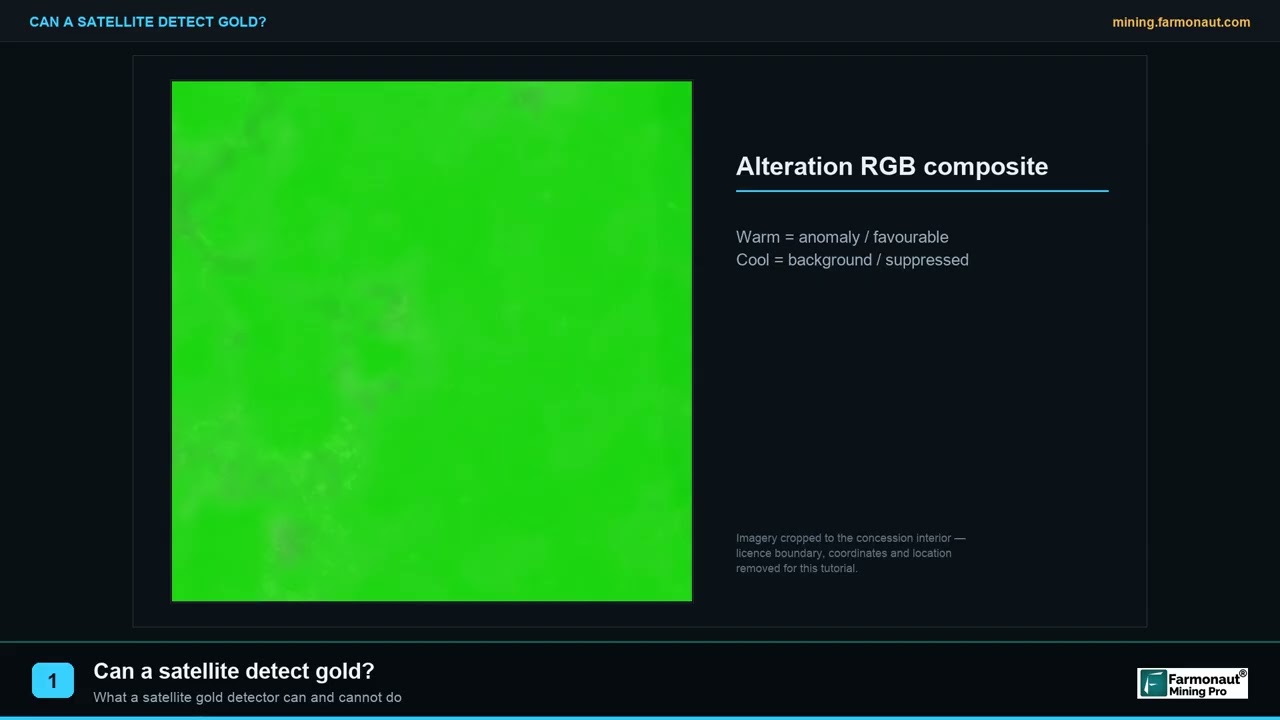
▶ Explains that no satellite sees gold itself, but that it can map the alteration halo a gold system leaves behind. · 2:00
Safety and permission when you test samples
- Get permission first. Collect rock and gravel only where you have the landowner’s consent and, where required, a claim, permit or licence from the regulator.
- Do not use mercury. Gravity methods such as panning concentrate gold without it (US EPA, linked above), and our page on mercury risks and safer gold extraction explains why.
- Handle copper minerals with care. Wash your hands after handling malachite and do not breathe dust from grinding it. Do not put it in your mouth.
- Wear eye protection when you break rock to get a fresh surface for testing.
Frequently asked questions
What is the specific gravity of malachite?
About 3.6 to 4.05. The Handbook of Mineralogy gives 4.05 measured and 3.98 calculated for pure material, and Geology.com gives 3.6 to 4.0 for typical specimens.
What is the density of malachite in g/cm³?
The same number. SG is density divided by the density of water, and water is 1 g/cm³, so a malachite SG of 4.0 equals a density of about 4.0 g/cm³.
Is malachite heavier than gold?
No. Pure gold has an SG of 19.3 (Handbook of Mineralogy), almost five times malachite’s 4.05. For the same volume, gold weighs about 4.8 times as much (our calculation).
What is the specific gravity of gold ore?
Close to that of the host rock, usually near 2.7 for quartz and carbonate rock. Quartz is 2.65 and calcite 2.71 (Handbook of Mineralogy). The 19.3 value is for gold metal. Even a rich ore of 100 g/t shifts bulk SG by only about 0.0002 (our calculation).
How does specific gravity help identify gold?
Gold is about 3.8 times denser than pyrite and about 4.6 times denser than chalcopyrite. A yellow grain that weighs close to 19 and is soft and malleable is gold. A grain near 5 and brittle is pyrite.
How do I tell malachite from other green minerals?
Check four things: bright green colour with banding, a light green streak, hardness near 4 and an SG near 4. Malachite also fizzes in cold dilute hydrochloric acid (Geology.com). Chrysocolla is much lighter, at 1.93 to 2.4.
Why do different sources give different SG values for malachite?
Natural malachite contains voids and impurities and is often a banded, fibrous mass. These lower the measured value. Reference tables give the value for pure crystal, and field samples read lower.
Can I measure specific gravity at home?
Yes. Weigh the sample in air, then suspended in water, and divide the dry weight by the weight lost in water. Use a solid piece of at least 5 g and a scale that reads to 0.01 g.
Can you separate malachite from gangue by gravity?
Poorly in most cases. Against quartz in water, the concentration criterion is only about 1.8, below the 2.5 level that suggests easy gravity separation (our calculation using the PMC review). Oxide copper ore is usually leached and processed by solvent extraction and electrowinning.
Does malachite in a rock mean there is gold?
Not by itself. Malachite shows copper in the weathered zone. Some gossans above copper-bearing deposits also carry gold (USGS), so staining is a reason to sample and assay, not proof of gold.
Can a satellite measure specific gravity?
No. SG is measured on a rock sample. Satellite data maps alteration minerals and structures, which helps you choose where to collect samples.
This page is for information only. It is not investment advice. Collect samples only with permission and any licence the regulator requires, do not use mercury, and wear eye protection when breaking rock.
Farmonaut mining
Map your mining site from space before you sample
Mining consultants can use satellite data to screen a licence for alteration and structure, then choose where to take samples for SG and assay.
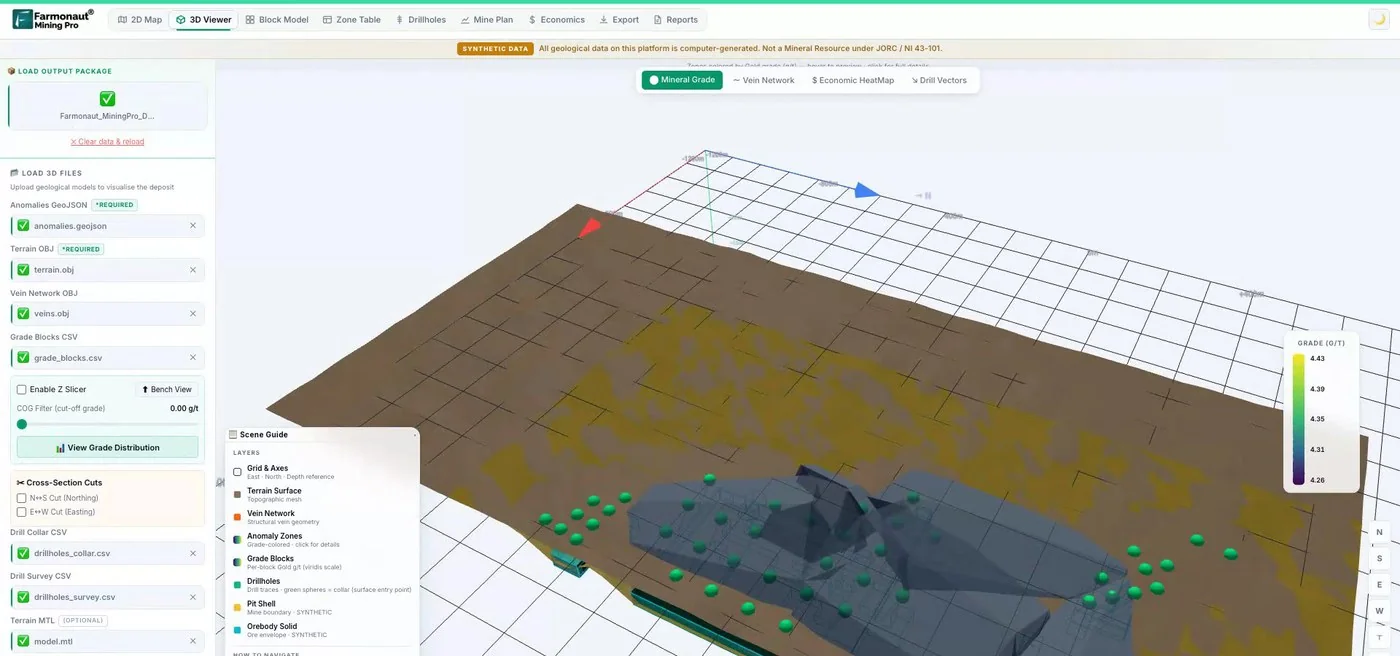
Mining Pro sample view, synthetic data
Keep reading
Sources
- Handbook of Mineralogy: malachite: handbookofmineralogy.org
- Handbook of Mineralogy: gold: handbookofmineralogy.org
- Handbook of Mineralogy: pyrite: handbookofmineralogy.org
- Handbook of Mineralogy: chalcopyrite: handbookofmineralogy.org
- Handbook of Mineralogy: quartz: handbookofmineralogy.org
- Handbook of Mineralogy: azurite: handbookofmineralogy.org
- Handbook of Mineralogy: galena: handbookofmineralogy.org
- Handbook of Mineralogy: chrysocolla: handbookofmineralogy.org
- Handbook of Mineralogy: calcite: handbookofmineralogy.org
- Handbook of Mineralogy: cuprite: handbookofmineralogy.org
- Geology.com: Malachite: geology.com
- Geology.com: Gold: geology.com
- Minerals.net: Malachite: minerals.net
- Gem-A: Understanding specific gravity: gem-a.com
- PMC (2023): Physical beneficiation of heavy minerals, Part 1, gravity concentration: pmc.ncbi.nlm.nih.gov
- PMC: Copper recovery from oxide-sulfide ores through gravity separation and flotation: pmc.ncbi.nlm.nih.gov
- University of Arizona Superfund: Processing copper ores: superfund.arizona.edu
- USGS SIR 2010-5070, chapter 12: Supergene ore and gangue characteristics: pubs.usgs.gov
- US EPA: Artisanal and small-scale gold mining without mercury: epa.gov
Discussion
Questions, corrections or field experience? Share them below. First-time comments are reviewed before they appear, and your email is never published.
No comments yet. Be the first to add a question or your experience.

 Jaunita Erss Ltd
 Almosi SARL
 SRK Consulting
 Berks Gold Limited
 Mwerezi Minerals Company Limited
 Mining SARL
 SenGold Invest SAS
 Sean Mining Limited
 NTS Group (Pty) Ltd
 Mine4Africa
 Lithspo Minerals Limited
 Tintina Mining Group
 Dalgety Minerals Pty Ltd
 Vortex Minerals Pty Ltd
 Faith At Work (Pty) Ltd
 Licence holder · Nigeria · Gold + lithium










