

Gold vs pyrite · Identification and processing guide
Gold vs Pyrite: 7 Tests and Where Gold Hides
Gold is soft (hardness 2.5 to 3) and about 19.3 times denser than water. Pyrite is hard (6 to 6.5) and about 5.0 times denser. Use seven tests, a density calculator and a recovery calculator, and learn how gold hides in pyrite ore.
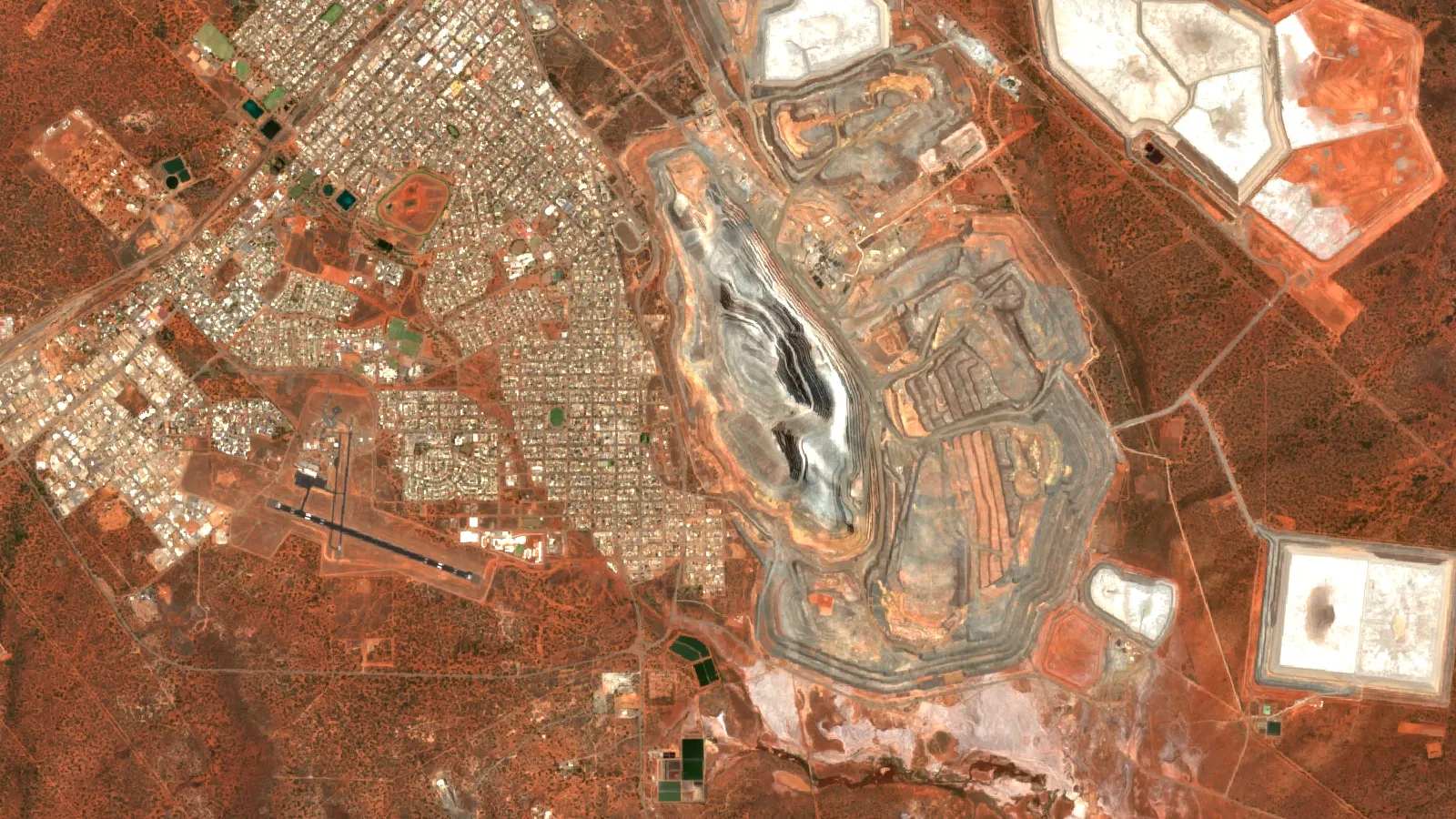
Key takeaways
- Gold has a hardness of 2.5 to 3 and a density of 19.3 g/cm3; pyrite has a hardness of 6 to 6.5 and a density of about 5.0 (Handbook of Mineralogy).
- Pyrite leaves a greenish-black to brownish-black streak (Handbook of Mineralogy) and crushes to a black powder when hammered; gold flattens into thin sheets and bends without breaking (Washington DNR).
- Gold can sit inside pyrite as invisible gold: Reich and co-authors (2005) found a limit of about 0.02 gold per arsenic atom for gold held in solid solution in arsenian pyrite.
- In one 2025 lab test, direct cyanide leaching recovered around 50% of the gold from a pyritic concentrate and acid pressure oxidation lifted it to 98.4% (REM journal).
- Pyrite oxidises to sulfuric acid: the standard acid-base factor is 31.25 kg of calcium carbonate per tonne for each 1% of pyritic sulfur, and a USGS paper argues for 62.5.
In this article
- Gold vs pyrite compared side by side
- Seven tests to tell gold from pyrite
- Density calculator: is your grain gold or pyrite?
- Other yellow minerals that fool people
- Where gold hides inside the rock and the crystal
- Why gold in pyrite ore is hard to recover
- Gold in pyrite concentrate: what recovery is worth
- Pyrite and acid mine drainage: the risk next to the gold
- Pyrite with galena: what changes in ore and in the plant
- How pyrite helps explorers find gold from space
- Frequently asked questions
Gold is soft, very heavy and malleable, and it smears or slices under a knife point. Pyrite (iron sulfide, FeS2), known as “fool’s gold”, is hard, brittle and about a quarter as dense. Per the Handbook of Mineralogy entry for gold, gold has a hardness of 2.5 to 3 and a density of 19.3 g/cm3. The entry for pyrite gives a hardness of 6 to 6.5 and a density of about 5.0 g/cm3. Those two numbers settle most arguments at the pan or on the bench.
There is a second reason to read on. Real gold often sits inside pyrite, sometimes as grains you can see and often as particles far too small to see. That is why a pyrite-rich rock can be worth assaying even when it shows no visible gold, and why such ore can be expensive to process. This page covers seven simple tests, a side-by-side table, a density calculator, how gold hides in pyrite, what that does to recovery, the acid risk from pyrite, and a short section on pyrite that occurs with galena (lead sulfide).
Gold vs pyrite compared side by side
The table lists gold, the two minerals most often mistaken for it (pyrite and chalcopyrite), and two other sulfides that occur with it in ore. Every value comes from the Mineral Data Publishing Handbook of Mineralogy unless noted. The Handbook entry for gold lists no streak, so the gold streak is standard field knowledge. Hardness is on the Mohs scale, where a higher number resists scratching. Density is in g/cm3 (specific gravity, which is the density relative to water). A streak is the colour of the powder a mineral leaves when rubbed on unglazed porcelain.
Chart
Hardness against density for gold and four sulfide minerals
Mohs hardness (midpoint of range) on the x axis; density in g/cm3 on the y axis
| Mineral | Colour and lustre | Hardness | Density | Streak | How it breaks |
|---|---|---|---|---|---|
| Gold (Au) | Gold-yellow, metallic | 2.5 to 3 | 19.3 | Yellow, metallic mark | Jagged (hackly) break, very malleable and ductile |
| Pyrite (FeS2) | Pale brass-yellow, may tarnish | 6 to 6.5 | 5.0 | Greenish black to brownish black | Brittle, curved shell-like (conchoidal) to uneven break |
| Chalcopyrite (CuFeS2) | Brass-yellow, often tarnished or iridescent | 3.5 to 4 | 4.1 to 4.3 | Greenish black | Brittle |
| Arsenopyrite (FeAsS) | Silver-white to steel-gray | 5.5 to 6 | 6.1 | – | Brittle, uneven |
| Galena (PbS) | Lead-gray, bright metallic | 2.5 to 2.75 | 7.6 | Lead-gray | Brittle, perfect cube cleavage |
Two things stand out. Gold is the only one of these that is both soft and extremely dense. Pyrite and gold have almost the same colour in poor light but sit at opposite ends of the hardness scale. Washington’s geological survey makes the same point in its Gold in Washington bulletin: the yellow minerals most often mistaken for gold are pyrite, chalcopyrite and golden mica flakes, and pyrite is “heavy, but not as heavy as gold”.
Seven tests to tell gold from pyrite
Run the tests in this order. The first five need nothing but a pin, a hammer and a magnifier. Always test a spare grain or a broken edge, not your best specimen.
- Heft and pan test. Gold is so dense that it drops to the bottom of a pan and stays there. Pyrite is lighter and travels further along the pan with the other heavy sand. Golden mica flakes wash out of the pan altogether, according to the Washington survey.
- Cut or scratch test. Press a pin or knife point into the grain. Gold is soft enough to dent or slice, and it takes a curl. Pyrite (hardness 6 to 6.5) is much harder than gold, so the point skids, or the grain crumbles.
- Streak test. Drag the grain across unglazed porcelain. Pyrite leaves a greenish-black to brownish-black powder. Gold leaves a yellow metallic smear, not a powder.
- Hammer test. Gold flattens into thin, flexible sheets that you can bend many times. Pyrite is brittle and, in the Washington survey’s words, crushes to a black powder when hammered.
- Shape test under a 10x lens. Pyrite often forms cubes and related shapes, and its faces are commonly striated. Gold is usually irregular, rounded or flaky, and when it does form crystals they grow in intergrown masses.
- Density test. Weigh the sample in air and then hanging in water. The calculator below turns the two readings into density. A pure gold grain gives about 19.3. A pyrite grain gives about 5.0. A grain of gold in quartz can read lower than pyrite, because quartz is only about 2.65 g/cm3. Treat a pure grain near 5 as pyrite, anything above 10 as worth a lab check, and a low reading on a mixed grain as inconclusive.
- Lab check. If the grain matters, send it for an assay or have a lab look at a polished section under a microscope. A fire assay measures the gold content of the grain or rock. It does not tell you the form the gold is in.
Two old tests are best left out. The Washington bulletin notes that pyrite dissolves in concentrated nitric acid while gold does not, and that heated pyrite gives off sharp sulfur dioxide fumes while gold does not smell. Both tests use hazardous chemicals or fumes. Use the safer tests above instead, and never use mercury to recover gold.
▶ A short story about a pyrite cube that insists it is gold, set in an 1880s Arkansas gold boom town. · 6:31
Density calculator: is your grain gold or pyrite?
The calculator below works out density from two weighings (Archimedes’ method). Enter the grain’s weight in air and its weight while hanging in water on a thread. The result is more reliable for grains of a few grams or more, because a tiny grain gives a very small reading on a kitchen scale.
Calculator
Is your grain closer to gold or to pyrite?
Enter your own two weighings. Results update as you type.
- Difference from pyrite density: -0.02
- Difference from pure gold density: 14.30
- Position between pyrite and gold density (0 = pyrite or lighter, 100 = gold): 0
Example values only. Density = weight in air divided by (weight in air minus weight in water). Reference densities are from the Handbook of Mineralogy (gold 19.3, pyrite 5.02). A grain of gold in quartz can read well below pyrite, because quartz is only about 2.65 g/cm3, so a low reading does not rule gold out.
Other yellow minerals that fool people
Pyrite is the usual suspect, but not the only one. Chalcopyrite, a copper iron sulfide, is also brass-yellow. It is softer than pyrite (3.5 to 4), so it scratches with a pin more easily, but it is still brittle, and its powder is greenish black. Mica flakes in streams glitter like gold, but they split into layers, spring back when bent and float away in the pan. Weathered pyrite turns into rusty iron oxides (limonite and hematite). Those rust-red stains are not gold, though they are often a sign that sulfides once sat there.
Gold telluride minerals are a special case: they are comparatively rare and not easily recognised, according to the Washington survey. If your ore comes from a district known for tellurides, rely on assays, not on colour.
Where gold hides inside the rock and the crystal
Yes. The Handbook of Mineralogy notes that gold in epithermal veins typically sits in quartz with pyrite and other sulfides, and the Washington survey says that in sulfide deposits gold is usually associated with pyrite, and less commonly with arsenopyrite. Gold turns up in three forms in pyrite ore:
- Visible native gold in quartz next to pyrite. You can see it, pan it and recover it by gravity.
- Tiny grains on pyrite edges and in fractures. At the Colosseum mine in California, the US EPA’s technical resource document records gold of submicroscopic size that occurs with pyrite: in contact with it, in its fractures, along grain edges and enclosed in the crystals (US EPA, 1994).
- Gold locked inside the crystal, often called “invisible gold”. You cannot see it even under an ordinary microscope. A study by Reich and co-authors (2005) looked at pyrite that contains arsenic, from Carlin-type and other deposits. They found that the gold the crystal can hold depends on how much arsenic it has: about one gold atom for every 50 arsenic atoms (a ratio of about 0.02). Pyrite with more gold than that carries it as tiny metal particles instead.
The practical lesson is that grade can differ a lot from one deposit, and even one pit, to the next. The Colosseum breccia pipes, for instance, averaged 0.04 and 0.067 troy ounce of gold per short ton in two pits (US EPA, 1994). A grade is the amount of gold per unit of rock, here given in troy ounces per short ton and elsewhere in grams per tonne (g/t). One troy ounce per short ton is about 34.3 g/t.
Why gold in pyrite ore is hard to recover
An ore is called refractory when cyanide leaching cannot reach much of the gold, usually because the gold is enclosed in sulfide minerals such as pyrite or arsenopyrite. A 2025 study in the journal REM – International Engineering Journal describes gold encapsulated in the crystal matrix of pyrite, pyrrhotite and arsenopyrite as significantly reducing the efficiency of cyanide leaching. On a flotation concentrate from the Pitangui greenstone belt in Brazil (12 to 20% sulfur), direct cyanide leaching recovered around 50% of the gold. After acid pressure oxidation (220 degrees C, 500 kPa of oxygen, three hours) on a 12% sulfur concentrate, recovery in the test rose to 98.4%. That is a laboratory result for one ore, not a rule for every mine, but it shows the size of the gap.
The three standard pre-treatments are roasting, pressure oxidation and bacterial oxidation. A paper on their relative economics (OneMine, 1990) compares the capital and operating cost of each as a function of the ore’s sulfide grade. Roasting also releases arsenic-bearing gases when the ore carries arsenic, which is why pressure oxidation is often preferred for such ores (REM study, above).
For anyone holding a licence over pyritic ground, the lesson is to ask for a gold deportment study, which is a mineralogical report on where the gold sits, before you price a project. A fire assay shows how much gold is present. It does not show how much you will get out. The calculator below puts two recovery rates side by side.
▶ Follows gold from rock to ring: finding, drilling, crushing, dissolving, catching on carbon, melting and refining. · 5:27
Gold in pyrite concentrate: what recovery is worth
Use this calculator to see how much the recovery rate changes the gold you can sell from a concentrate. Enter your own tonnes, grade and price.
Calculator
What is recovery worth on a pyritic concentrate?
Enter your own tonnes, grade, recoveries and price.
- Gold recovered by direct leaching (oz): 322
- Value, direct leaching: $1,286,029
- Value, after pre-treatment: $2,443,455
- Extra value from pre-treatment: $1,157,426
Example values only, not benchmarks. The 50% and 95% recoveries echo a 2025 lab study (about 50% by direct cyanidation, 98.4% after acid pressure oxidation) but your ore will differ. The gold price is an input: use today’s price. Money in US$; 31.1035 g per troy ounce.
Pyrite and acid mine drainage: the risk next to the gold
Pyrite is the most abundant and widespread sulfide mineral, per the Handbook of Mineralogy, so most gold mines handle it somewhere. When pyrite meets air and water it oxidises and makes sulfuric acid. The US EPA gold document notes that sulfur-bearing minerals such as pyrite and pyrrhotite can oxidise to sulfuric acid, and that acid generation depends on rainfall, the design of the waste unit, and the balance between the rock’s acid-generating and acid-neutralising potential. The US EPA describes the result, acid mine drainage, as highly acidic water rich in heavy metals.
Chart
Maximum potential acidity of rock by pyritic sulfur content
kg of calcium carbonate needed per tonne of rock, if all the sulfur is pyritic
Labs estimate the risk with acid-base accounting. They measure the rock’s sulfur and multiply by a factor to get its maximum potential acidity (MPA) in kilograms of calcium carbonate per tonne. The accepted factor is 31.25 for each 1% of pyritic sulfur. A 1990 conference paper on coal-mine spoil by US Geological Survey hydrologist Charles Cravotta and co-authors argued that the factor should be 62.5 if the carbon dioxide from neutralisation stays in solution. The chart shows both. Which one applies depends on the water chemistry at the site, so ask your geochemist.
The sulfur content of pyrite is high: 53.45% by weight in pure FeS2 (Handbook of Mineralogy). So a rock that tests at 1% pyritic sulfur contains roughly 1.9% pyrite. A rock with a few per cent pyrite can need tens of tonnes of limestone for each thousand tonnes of waste. In wet climates, close to farms, forests and streams, that is why acid-base testing comes before the mine plan.
Some districts carry less risk. The EPA document notes that the carbonate in the Cripple Creek area of Colorado gives a relatively low potential for acid generation, even though fine-grained pyrite is present.
Pyrite with galena: what changes in ore and in the plant
Pyrite and galena often grow together in hydrothermal veins and lead-zinc deposits. The Handbook of Mineralogy lists galena as the most important ore mineral of lead and lists pyrite among its associated minerals. You can tell them apart with the table above: galena is gray, soft (2.5 to 2.75), very dense (7.6) and breaks into cubes along perfect cleavage planes. Pyrite is brassy, hard and brittle.
Chart
Sulfur share by weight in four sulfide minerals
Percent sulfur in the ideal formula
In the mill, pyrite is usually waste. A general metallurgy reference on flotation depressants says lime is widely used to keep pyrite out of other sulfide concentrates, and that in lead-zinc separation the first stage often uses sodium cyanide to hold down sphalerite and pyrite while ethyl xanthate floats the galena. Each mine tunes its own reagents, so treat this as a general description, not a recipe.
The bigger issue is lead. Galena is 86.6% lead by weight in the pure mineral (Handbook of Mineralogy), and lead dust or runoff near homes is a health matter. In January 2024 the US EPA lowered its residential soil screening level for lead from 400 to 200 parts per million, and to 100 ppm where there are several sources of exposure. These are screening levels, not cleanup standards (US EPA). For more on this pairing, see our page on pyrite and galena in quartz veins.
How pyrite helps explorers find gold from space
Pyrite-bearing zones weather at the surface into iron oxides. The EPA document describes this at the Rain pit in Nevada, where near-surface rock has its pyrite converted to hematite and limonite while unweathered rock below keeps abundant carbon and pyrite. Those rusty iron-oxide zones and nearby clay alteration can be mapped from multispectral satellite images. Satellites do not see gold. They map the rock and the alteration around a gold system, which gives a shortlist of places to sample.
That is the step where a licence owner or consultant can save money: screening a licence for iron-oxide and clay zones before sending a field crew. Farmonaut’s satellite-based mineral detection service does this for an area of interest you supply as a polygon or KML/KMZ file, and returns exploration targets. These are targets to sample and drill, not a resource estimate. To discuss a licence area, use the mining query form or contact us.
▶ Explains how satellites map the rock around a gold system, such as iron stains and clay, since they cannot see gold itself. · 4:25
We cover a connected topic in Malachite Specific Gravity vs Gold, Pyrite and Quartz.
Frequently asked questions
What is the easiest way to tell gold from pyrite?
Try to cut or dent the grain with a pin. Gold is soft and malleable, so it dents, slices or smears. Pyrite is hard and brittle, so it skids or crumbles. The Handbook of Mineralogy gives hardness 2.5 to 3 for gold and 6 to 6.5 for pyrite.
Does pyrite contain gold?
It can. Gold occurs with pyrite in many veins and sulfide deposits, as visible grains, as tiny grains on the pyrite or inside it, and as “invisible” gold within the crystal lattice. Only an assay can tell you how much a given rock carries.
Is pyrite worth anything?
Pyrite alone is mostly a waste mineral or a source of sulfur. Its value comes from the gold, copper or other metals it carries. It is also used as an exploration clue, because it often lies close to gold.
What colour streak does gold leave compared with pyrite?
Pyrite leaves a greenish-black to brownish-black powder (Handbook of Mineralogy). Gold leaves a yellow metallic mark, not a powder.
Is gold heavier than pyrite?
Yes, about four times. Pure gold has a density of 19.3 g/cm3 and pyrite 5.0 g/cm3. That gap is why gold stays in the pan and why a density test is so useful.
How can you tell gold from fool’s gold with a magnet?
A magnet is not a good test. Neither gold nor ordinary pyrite is strongly magnetic, and the Handbook of Mineralogy lists pyrite as only paramagnetic, which means very weakly drawn to a magnet. Use hardness, streak, malleability and density instead.
What is refractory gold?
It is gold that cyanide leaching cannot reach well because the gold is enclosed in minerals such as pyrite or arsenopyrite. It needs a pre-treatment such as roasting, pressure oxidation or bacterial oxidation before leaching.
Can gold be extracted from pyrite at home?
Not safely. Loose native gold can be panned, but gold locked in pyrite needs industrial oxidation and leaching, with strong chemicals and toxic gases. Do not use mercury or acids to recover gold.
Why does pyrite cause acid mine drainage?
Pyrite oxidises when exposed to air and water, and the reaction makes sulfuric acid. Without enough neutralising rock such as limestone, the water turns acidic and carries heavy metals out of the waste (US EPA).
How can you tell pyrite from galena?
Galena is lead-gray, soft (2.5 to 2.75), much denser than pyrite (7.6 against 5.0) and splits into cubes along perfect cleavage. Pyrite is brass-yellow, hard (6 to 6.5) and brittle.
Can satellites find pyrite or gold?
Satellites do not detect gold itself. They map iron-oxide staining, clay alteration and structures that often accompany gold systems, which helps target field sampling.
This page is for information only. It is not investment or legal advice. Get permission from the landowner and check the claim rules before you prospect or sample, and never use mercury or strong acids to test or recover gold.
Farmonaut mining
Map your mining site from space
Send a KML, KMZ or polygon and get iron-oxide and clay targets screened from satellite images before ground crews go in.
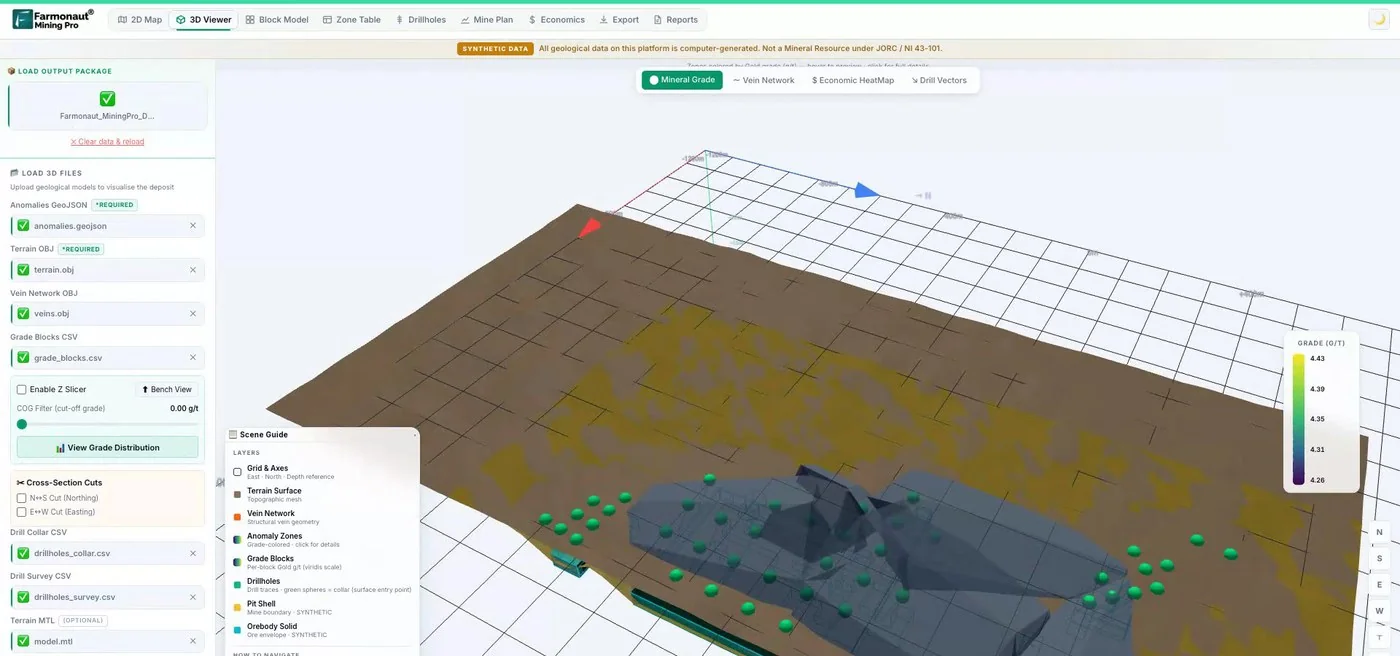
Mining Pro sample view, synthetic data
Keep reading
Sources
- Handbook of Mineralogy: Gold: handbookofmineralogy.org
- Handbook of Mineralogy: Pyrite: handbookofmineralogy.org
- Handbook of Mineralogy: Galena: handbookofmineralogy.org
- Handbook of Mineralogy: Chalcopyrite: handbookofmineralogy.org
- Handbook of Mineralogy: Arsenopyrite: handbookofmineralogy.org
- Washington Division of Mines and Geology, Bulletin 42: Gold in Washington: dnr.wa.gov
- US EPA, Extraction and Beneficiation of Ores and Minerals, Volume 2: Gold (EPA 530-R-94-013, 1994): archive.epa.gov
- US EPA, Abandoned Mine Drainage: epa.gov
- Cravotta et al., Effectiveness of the addition of alkaline materials at surface coal mines, Part 1 (1990): wvmdtaskforce.com
- Reich et al., Solubility of gold in arsenian pyrite (2005): repositorio.uchile.cl
- Lemos et al., Recovery of gold from refractory ore employing pressure oxidation, REM International Engineering Journal (2025): scielo.br
- OneMine, Refractory Gold Treatment Options: Economics Rule the Way: onemine.org
- 911 Metallurgist, Flotation Depressants: 911metallurgist.com
- US EPA, Region 7 news release on residential soil lead screening levels (January 2024): epa.gov
Discussion
Questions, corrections or field experience? Share them below. First-time comments are reviewed before they appear, and your email is never published.
No comments yet. Be the first to add a question or your experience.

 Timestream Mining
 Lithspo Minerals Limited
 Tintina Mining Group
 Dalgety Minerals Pty Ltd
 Vortex Minerals Pty Ltd
 Faith At Work (Pty) Ltd
 Geotech Mining Solutions plc
 Vulcan International Limited
 Kidepo Associates
 GKY Mining
 Alkimy SARL
 Double A Trading
 GemSprout Metals Limited
 Qader Group
 Ileys General Trading
 SG Gold Mining LLC
 VRV Global Pte Ltd
 Omsri International FZE
 G.I.T.T.
 Jaunita Erss Ltd
 Almosi SARL
 SRK Consulting
 Berks Gold Limited
 Mwerezi Minerals Company Limited
 Exploration consultancy · South Africa · Gold










