

Montana · Mineral rights guide
Montana Mineral Rights: Who Owns, Value, Buy, Sell
Whoever holds the mineral estate owns Montana mineral rights, and that can differ from the surface owner. Search the county Clerk and Recorder, Montana Cadastral and the BLM’s MLRS, then value, buy or sell with a title opinion.
Key takeaways
- A fee simple deed with no reservation keeps surface and minerals together; earlier sales or state and federal reservations can split them (DNRC split-estate guide).
- Private minerals are traced at the county Clerk and Recorder, state minerals through DNRC, federal minerals through the BLM’s MLRS.
- The State of Montana keeps coal, oil, gas, phosphate, sodium and other minerals in land it sold (section 77-2-304, MCA).
- DNRC’s 1 September 2026 oil and gas sale averaged $314.57 per acre, yet one tract made up about 99% of the revenue and the rest drew $1.50 to $10.
- A new federal lode claim costs $274 in the first year and $200 a year after that (BLM fee sheet, February 2026).
In this article
- Who owns the minerals under a Montana parcel
- How mineral rights get severed in Montana
- How to find who owns mineral rights in Montana
- State, federal and private minerals: what changes
- Hard-rock minerals versus oil and gas
- Hard-rock claims, leases and permits in Montana
- Why a gold claim is not the same as owning the land
- What Montana mineral rights are worth
- How to buy or get mineral rights in Montana
- How to sell mineral rights in Montana
- Surface owners, access and damage payments
- Taxes on Montana mineral rights in general terms
- Check the ground before you buy: using satellite imagery
- Frequently asked questions
Montana mineral rights belong to whoever holds the mineral estate, and that is not always the person who owns the land. A deed that conveys the property in fee simple with no reservation keeps the surface and the minerals together, but a past sale, a homestead patent or a state land sale may have split them. Start at the county Clerk and Recorder, check the parcel on Montana Cadastral, and look up federal minerals in the BLM’s MLRS database. The Montana Department of Natural Resources and Conservation (DNRC) explains the same first step in its guide to split estates, written for oil and gas but true of every mineral.
This guide puts hard-rock (metal) minerals first: gold, silver, copper, platinum-group metals and similar ores, with the claim, lease and permit steps that apply to them. Petroleum is covered too, because it is the only Montana mineral with public per-acre lease price data and because the two follow different rules. Everything here is general information. Real decisions need a title search and a Montana attorney.
Who owns the minerals under a Montana parcel
Land in Montana can have three layers of ownership: the surface, the minerals, and sometimes a second owner of part of the minerals. The DNRC guide says the federal Bureau of Land Management (BLM) and the State of Montana are large land and mineral owners, but many minerals are privately owned. Any mix of federal, state and private ownership of the surface and the minerals is possible. Even under one parcel, one party can own the coal while another owns the oil and gas.
| Who owns the minerals | Who administers them | Where to look |
|---|---|---|
| Private owner (individual, family, company, trust) | The owner leases or sells directly | Deeds, mineral deeds and leases at the county Clerk and Recorder |
| State of Montana | DNRC Minerals Management Bureau | DNRC lease records and sale lists |
| United States | Bureau of Land Management | BLM Mineral and Land Records System (MLRS) |
The DNRC guide lists these same three paths: the county Clerk and Recorder for private minerals and mineral leases, the DNRC bureau for state-owned minerals, and the BLM for federal minerals.
How mineral rights get severed in Montana
A severed estate (also called a split estate) exists when the right to develop minerals is separated from the surface. The DNRC guide explains that governments reserved mineral rights when they gave away or sold land, and that the federal government reserved coal and other minerals under the homestead acts as Montana was settled. A private seller can also sell the surface and keep the minerals, or sell the minerals and keep the surface.
State land follows a written rule. Under section 77-2-304 of the Montana Code, coal, oil, gas, phosphate, sodium and other mineral deposits in state land are reserved to the state, with sand, gravel, building stone and brick clay excepted, and a purchaser of state land acquires no right to those deposits. The state and its lessees may enter the land to prospect and mine, and the lessee must pay the surface purchaser for damage. A buyer of former state land should therefore expect the state, not the surface owner, to hold the minerals.
Many tracts therefore have several mineral owners, each holding a fraction. A fraction is not a problem by itself, but it makes the title search longer and changes who has to sign a lease.
Different minerals can also be separated. A deed may reserve “oil, gas and other minerals”, only “coal”, or “all minerals”. The wording decides whether hard-rock metals went with the surface or stayed with the seller. Read the reservation clause word by word.
How to find who owns mineral rights in Montana
Use the steps below in order. The first two are quick and tell you whether a deeper search is needed.
Infographic
Ownership check in 5 steps
- 1Get the legal descriptionTownship, range and section identify the land.
- 2Read the deedLook for reserving or excepting wording.
- 3Search the countyTrace the chain of title at the Clerk and Recorder.
- 4Check state and federal filesUse DNRC records and BLM MLRS.
- 5Get a title opinionA Montana attorney confirms the result.
- Get the legal description. Township, range and section (or the lot and block of a subdivision) identify the land in deeds. The DNRC guide says the legal description helps in finding mineral deeds, grants and reservations.
- Read your own deed. If it says fee simple or fee simple absolute, the surface and minerals are intact unless the chain of title says otherwise. If you have no copy, the Clerk and Recorder of the county where the land sits is most likely to have it on file.
- Check the parcel on Montana Cadastral. The state’s Cadastral map at cadastral.mt.gov lets you search by owner, geocode or subdivision and open a property record. The state library’s Cadastral FAQ says the Department of Revenue maintains the property data and that new tax years usually appear each January. The Cadastral disclaimer says the data are for information only and come from tax records, so they are not a title search. Use Cadastral to get the parcel number, the taxpayer name and the legal description, not to prove who owns the minerals.
- Trace the chain of title at the county. Work backward through the recorded deeds from the current owner. Look for words such as “reserving”, “excepting” or “less and except”, and for separate mineral deeds. The DNRC guide says a legal description helps in finding mineral deeds, grants and reservations, and that title companies or landmen can help for a fee if the first searches fail.
- Check federal records. The BLM’s Mineral and Land Records System replaced several older systems (LR2000 among them) and holds records for federal land and mineral actions, including leases and mining claims. Its research map, which needs an MLRS account, finds locations by name or legal land description, and public MLRS reports are at reports.blm.gov/reports/mlrs. Federal minerals can sit under private surface, so check even when the surface is privately owned.
- Check state records. State-owned minerals are leased by the DNRC Minerals Management Bureau. The bureau can tell you whether the state holds minerals under a tract and whether a lease exists.
- Look for leases and recorded claims. Mineral leases are usually on file with the county Clerk and Recorder. Hard-rock claims on federal land are also recorded there (see the claims section below).
- Hire help when the chain is long. Title companies and landmen (professionals who research mineral ownership and negotiate leases) do this for a fee, and the DNRC guide recommends making sure the title search covers both surface and mineral ownership.
If a search finds a mineral interest owned by a person who cannot be found, or an unclear fraction, ask a Montana attorney about options such as a quiet title action. Do not assume that an old interest has lapsed.
State, federal and private minerals: what changes
The route to a lease, a purchase or a sale depends on who holds the minerals.
Chart
Federal mineral revenue paid to counties
US$ million, fiscal 2025, six largest counties
State minerals. The DNRC manages about 6.2 million acres of mineral estate on state trust land, according to its fiscal 2022 Minerals Management Bureau report. That is more than the roughly 5.2 million acres of state trust surface land, because the state kept the minerals when it sold land (DNRC, Understanding Trust Lands). Petroleum leases covered a little over 508,000 of those acres in fiscal 2022, while hard-rock leasing was small: the report counts 9 metalliferous and non-metalliferous leases covering 3,514 acres, and only one of them is a metalliferous lease (92 acres) with no production that year.
Federal minerals. The BLM issues petroleum leases, and hard-rock minerals on open federal land are taken up by locating mining claims. Under the Mineral Leasing Act, the Legislative Fiscal Division reports that 50% of sales, bonuses, royalties and rentals from federal lands in Montana is paid to the state. Of that, 75% goes to the state general fund and 25% to counties in proportion to where the revenue arose. In fiscal 2025 the counties received a total of about $7.1 million, and the chart below shows the six largest.
Private minerals. The owner can lease, sell or hold. Terms are negotiated, and anything recorded with the county binds later buyers.
Hard-rock minerals versus oil and gas
Hard-rock minerals are metals and ores that are mined, such as gold, silver, copper, platinum and palladium, antimony and molybdenum. Oil and natural gas are fluid minerals produced from wells. The rules differ in three ways that matter to an owner.
- Where the value is. Oil and gas royalties arrive as soon as a well produces. A metal deposit needs exploration, a permit and often years of work before any royalty appears.
- Who regulates. Wells fall to the Board of Oil and Gas Conservation. Metal exploration and mining fall to the Department of Environmental Quality (DEQ) under the Metal Mine Reclamation Act.
- How the federal government treats them. Federal petroleum is leased. Hard-rock minerals on open federal land are located as claims under the 1872 Mining Law, with annual maintenance fees instead of royalties.
Montana is a real hard-rock state. The USGS 2026 platinum-group metals summary says one company in Montana mined and processed platinum-group metals worth an estimated $290 million in 2025, down 31% from $420 million in 2024, and that one operation stayed on care and maintenance. USGS also reports that copper was mined in Montana in 2025, that molybdenum came from a Montana byproduct operation, that a domestic company began mining antimony in Montana in 2025, and that most United States chromium resources lie in the Stillwater Complex in Montana. A mineral owner in these areas holds something quite different from an owner in a county with only petroleum potential.
Hard-rock claims, leases and permits in Montana
If you want hard-rock rights rather than royalties, there are four routes, each with different paperwork.
1. Unpatented claims on federal land. A lode or placer claim gives the right to explore and mine on open federal land, but it does not give ownership of the land. Montana’s claim statute (82-2-102, MCA) requires the locator to record a certificate of location with the county clerk within 60 days after posting the notice of location, and the certificate must name the claim, the locator, the date and the section, township and range. Federal filings go to the BLM as well, within 90 days of the date of location.
The BLM’s fee sheet (updated 9 February 2026) lists a new lode claim at $274 in total: a $200 maintenance fee, a $49 location fee and a $25 processing fee. A new placer claim pays the same $49 location fee and $25 processing fee per claim, plus a $200 maintenance fee for each 20 acres or part of 20 acres. Each year the holder pays $200 per lode claim, or per 20 acres of placer, or files a small-miner waiver and an affidavit of assessment work with a $15 per claim filing fee. The BLM’s notice for the 2027 assessment year put the payment deadline at 1 September 2026 and the affidavit deadline at 30 December 2026, with no extensions. Fees can change, so check the BLM fee sheet before paying. For a state-by-state view of claim buying see our guide to Montana gold mining claims for sale.
2. A state metal lease. The DNRC’s sample metal lease has a primary term of ten years, which continues while minerals are produced in paying quantities. Rent is $1.00 per acre for the first three years, $2.50 per acre for the next two and $3.00 per acre after that, on top of any bonus. The royalty is a percentage of the returns, and it may not fall below 5% of the fair market value of what is recovered. Treat this as the form’s text, not a quote: the royalty and bonus for a real tract are set at the time of the lease.
3. A private mineral lease or option. The owner and the explorer negotiate the bonus, rent, work commitments and royalty. The lease or a memorandum of it is recorded with the county.
4. Buying the minerals. The owner sells a mineral deed. See the buying section below.
Drilling and trenching need a state license, whichever route you use. The DEQ’s exploration licensing guide says every exploration activity that disturbs the surface falls under the Metal Mine Reclamation Act and Montana Environmental Policy Act review, with an application fee of $1,000 to $2,000 depending on the activity, a reclamation bond calculated by DEQ, and environmental review completed within 90 days of a complete application (longer where federal land is involved). An exploration license is not a mining permit: production mining needs an operating permit. Surface work also needs the permission of the surface owner or land manager, and prospecting should never use mercury.
Calculator
What royalty would a metal lease pay?
Enter your own tonnes, grade and royalty rate for a gold ore lease.
- Value of gold recovered (US$): $17,361,390
- Annual royalty to the owner (US$): $868,070
Example values only, not a forecast. Use today’s gold price. This calculator applies the rate to the gross value of gold recovered. The DNRC sample metal lease (form revised 2005) applies its royalty to net returns after transport and smelting, and sets a minimum of 5% of fair market value, so a real lease will pay less than this gross figure.
Why a gold claim is not the same as owning the land
A claim holder owns a right to the minerals, not to the ground. People often mix this up when they buy “mining claims for sale”, and the reverse also happens: a buyer of ranch land assumes the minerals came along. The video explains the claim side in plain language.
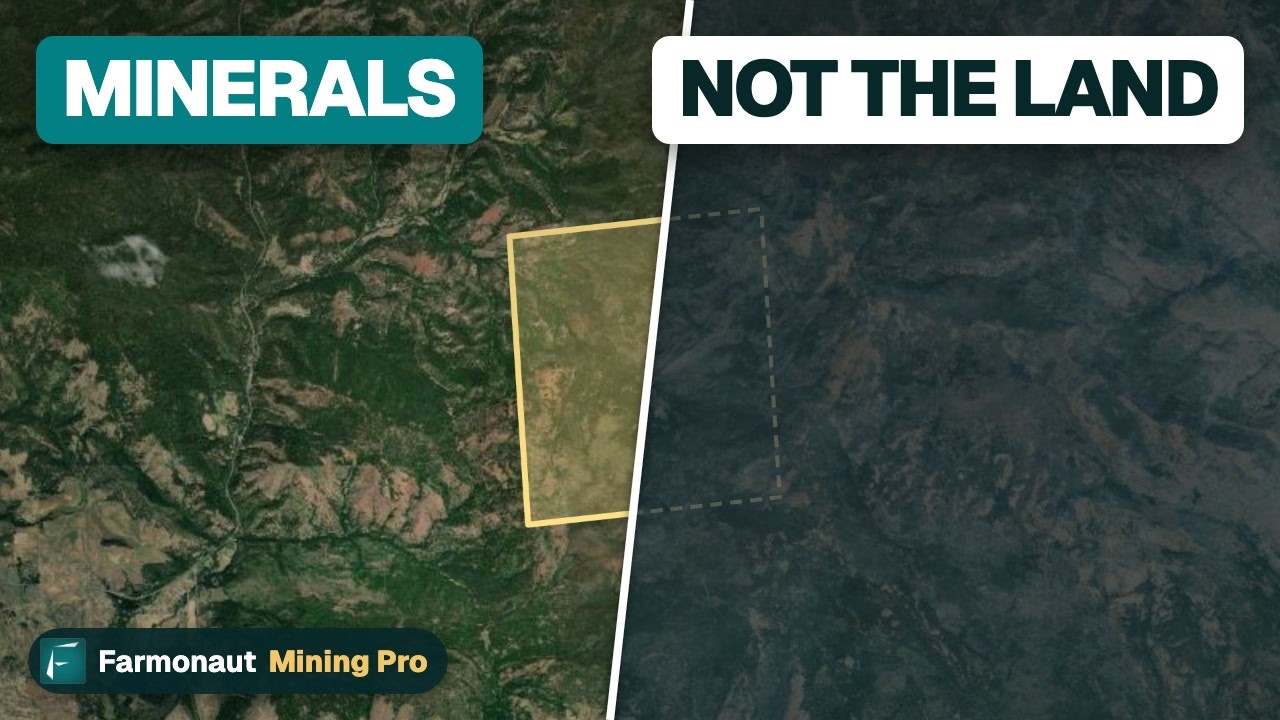
▶ Why owning a gold claim is not owning the land, and how to check the ground first · 3:19
What Montana mineral rights are worth
Value depends on what is under the ground, how well it is proven, and who can develop it. A tract with a producing well nearby is priced from the income it earns. A tract with only a geological idea is priced on what a lessee will pay for the option to look.
Chart
Winning bids per acre, DNRC oil and gas sale
US$ per acre, 1 September 2026, five of 12 tracts
Start with hard-rock ground, because that is where the main uncertainty lies. A metal deposit has no price per acre until drilling has shown grade and tonnes, and the DNRC’s own records show how thin the market is: in fiscal 2022 the state held one metalliferous lease on 92 acres out of 6.2 million mineral acres. What a hard-rock owner can actually be paid is an option or lease: a bonus on signing, rent per acre (the DNRC sample form runs from $1.00 to $3.00 per acre a year) and a production royalty. The calculator in the claims section shows how a royalty changes with grade, recovery and price.
The only public per-acre price series in Montana is petroleum. DNRC’s quarterly oil and gas auctions publish every winning bid. These are bonus bids for a lease, not sale prices of mineral rights. At the 1 September 2026 sale, 12 tracts totaling 6,866.52 acres raised $2,160,024.40, an average bid of $314.57 per acre. One 866.52-acre Sheridan County tract went for $2,470 per acre ($2,140,304.40), about 99% of the revenue. The other eleven tracts drew between $1.50 and $10 per acre. The 3 September 2025 sale looked the same: nine tracts, 5,440 acres, an average of $265.50, with one Roosevelt County tract at $2,150 per acre and seven at $1.50. A single average per acre therefore says little about any one parcel.
This is the main reason searches for “average price per acre for mineral rights in Montana” get unsatisfying answers. A fair price depends on location relative to existing production, on whether the minerals are leased, and on the royalty fraction. Our guides to mineral rights worth per acre and to US ranges by state and basin cover national methods.
Three common ways to value minerals that do produce:
- Income method. Take the royalty income of the last 12 months (net of taxes the payer withholds) and apply a multiple that a buyer accepts for the expected decline of the wells.
- Comparable sales. Use recent sales of similar interests in the same area. Public records at the county show the deed but often not the price, so a broker or landman is useful.
- Lease bonus benchmark. Recent lease bonuses (for example, the state sale results above) show what operators pay for the right to drill, which sets a floor for unleased acreage near the same activity.
For hard-rock minerals, a value requires drilling results, grade and tonnes, metal prices and a development cost. Without those, the realistic value is the option payment an explorer will offer.
How to buy or get mineral rights in Montana
You cannot simply claim another person’s private minerals. There are four lawful ways to get mineral rights, and the questions “how to claim”, “how to get” and “how to obtain” all lead to one of them.
- Buy a mineral deed. The owner conveys the minerals, or a fraction of them, in a recorded deed. Ask for the full chain of title first.
- Buy land that includes the minerals. Listings for land with mineral rights vary: some include all minerals, some reserve everything, some convey half. Request a title commitment and read every reservation. Do not rely on the listing text. Land with minerals is advertised by Montana land brokers and auction platforms, and mineral-only interests mostly change hands through landmen and direct deals, so ask the broker which minerals convey before you make an offer.
- Lease from the owner, the state or the BLM. You get the right to explore or produce for a term, not ownership.
- Locate a federal mining claim. This applies to open federal land only, and the claim confers mineral rights, not title to the land.
Before you buy, check the following.
- Confirm the seller’s chain of title back to the original grant or patent.
- Find out whether the minerals are leased, and the lease terms. A lease can pass to the buyer with the minerals.
- Read the surface use rights, and ask whether a surface use agreement exists.
- Look for outstanding liens, mortgages or unpaid taxes.
- For hard-rock ground, look at past mining and exploration work, environmental liabilities and the access route.
- Pay for a title opinion from a Montana attorney who handles mineral title.
How to sell mineral rights in Montana
Owners usually have one of three goals: sell everything, sell part of the income, or lease. The choice of buyer follows.
- Confirm what you own. Do the title work above. An unclear fraction or a missing deed slows a sale and reduces the price.
- Collect the records. Gather lease copies, division orders (the payer’s record of who gets which share of royalties), 12 months of royalty statements and any geological data you hold.
- Value the interest. Use the methods above and obtain more than one offer.
- Choose the buyer. Options include mineral aggregators, neighbouring operators, local landmen and, for hard-rock ground, exploration companies. A company that wants only the royalty income is a different buyer from one that wants to drill.
- Negotiate and sign the deed or assignment. A partial sale can sell a perpetual share or a share limited in time. Have a Montana attorney draft or review it.
- Record the conveyance with the county Clerk and Recorder. Recording puts later buyers on notice.
If you want to sell only the income stream, our guide on how to sell mineral royalties covers valuation and the six steps in detail.
Surface owners, access and damage payments
Montana’s split-estate rules were written mainly for petroleum. The DNRC guide states that courts have held that an oil or gas right has no value unless the oil or gas can be removed, so mineral owners have the right to reasonable use of the surface, with or without the surface owner’s permission. State and federal rules then define the relationship.
Under Montana’s Surface Owner Damage and Disruption law, an oil and gas developer must give the surface owner notice at least 20 days, but not more than 180 days, before any entry that disturbs the surface. The developer must also disclose the work plan. The guide lists compensable damages: loss of agricultural production and income, lost land value and lost value of improvements. On federal minerals, the developer must make a good-faith effort to get a surface use agreement, a waiver of access and agreed damages, and if that fails must post a bond of at least $1,000.
These notice and payment rules are in the petroleum chapters of the guide (Title 82, chapter 10, part 5, MCA). Hard-rock exploration is subject to DEQ licensing, as noted above, and hard-rock lessees on state land must pay the surface purchaser for damage under section 77-2-304. If you own the surface above someone else’s hard-rock minerals, ask an attorney which regime applies before you sign anything.
The video shows why access, not just rock quality, decides whether ground can ever be mined.
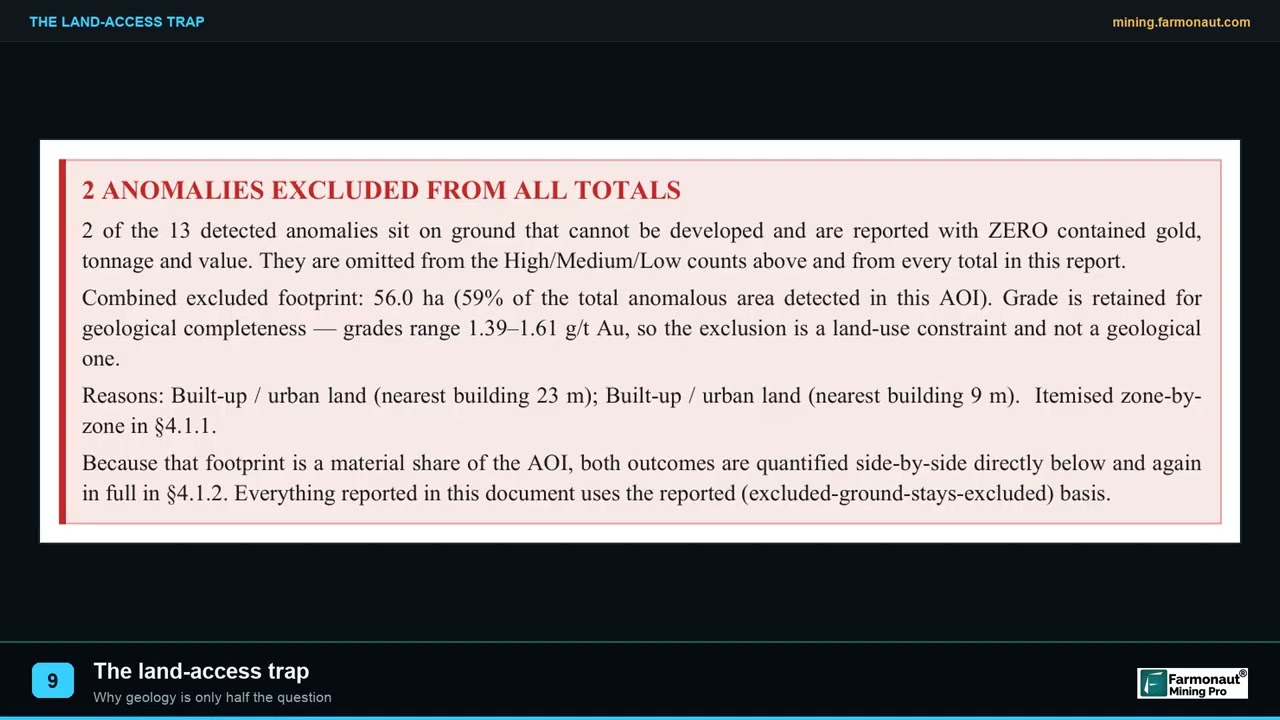
▶ A survey where most anomalous ground sat under a town: good rock blocked by land access · 2:05
Taxes on Montana mineral rights in general terms
Several taxes apply, depending on whether the minerals are oil and gas, metals or a sale. These are the main ones. A tax adviser must confirm how they apply to you.
Chart
Montana oil production tax rates
Percent of gross value, total rate including 0.3% add-on
Chart
Montana metal mine tax collections
US$ million by fiscal year
Metal mine taxes. Metal mines pay a gross proceeds tax: the taxable value is 3% of merchantable value, which is gross sales of metal less allowed deductions, and local and state mills are applied to that value. Metalliferous mines also pay a license tax on the gross value of the product, with the first $250,000 of gross value exempt. Concentrate shipped to a smelter or mill is taxed at 1.81% of gross value, and gold, silver or platinum-group metal shipped to a refinery as dore, bullion or matte at 1.6% (Department of Revenue, July 2022 to June 2024 report). Both taxes fall on the operator, not on the owner of the minerals, but they shape what a mine can afford to pay in royalty.
Production tax on petroleum. The Department of Revenue’s biennial natural resources report (July 2022 to June 2024) says taxable royalty owners of oil and gas are taxed at 15.1% of the gross value of production, and that government royalties are exempt. Working-interest rates are lower for newer wells: 9.3% for regular post-1999 oil production and 0.8% in the first 18 months of a horizontally completed well.
Federal income tax. The IRS treats royalties from minerals as income and allows a depletion deduction in some cases. Publication 535 has a chapter on depletion, and Publication 544 covers sales of assets. A sale of a mineral interest can be taxed differently from royalty income, and selling part of future production can be treated differently again. This is the area where a tax adviser pays for themselves before you sign.
Keep records of what you paid for the minerals, of any leases and bonus payments, and of every royalty statement.
Check the ground before you buy: using satellite imagery
For hard-rock ground, a buyer can screen the area before paying for fieldwork. Satellite images show rock and soil colour, alteration patterns, old workings and access roads, and they help narrow a block of ground to the parts worth sampling. Farmonaut produces satellite mineral-detection reports from a polygon of your tract. A report is an exploration target map, not a resource estimate, and it does not replace title, permits or sampling.
Frequently asked questions
How do I find out who owns the mineral rights to my land in Montana?
Read your deed for a reservation clause, then ask the county Clerk and Recorder for the chain of title. Use Montana Cadastral for the parcel and legal description, the BLM’s MLRS for federal minerals, and the DNRC for state minerals.
Are mineral rights included when I buy land in Montana?
Not automatically. A fee simple deed with no reservation keeps the surface and minerals together, but earlier owners or the government may have reserved them. Check the title commitment for reservations.
Who owns the minerals under state land that was sold?
The State of Montana does. Section 77-2-304 of the Montana Code reserves coal, oil, gas, phosphate, sodium and other minerals to the state, and a purchaser of state land acquires no right to them.
What is the average price per acre for mineral rights in Montana?
There is no single figure. Hard-rock minerals have no public per-acre price, because value depends on drilling results. For oil and gas, DNRC’s 1 September 2026 lease sale averaged $314.57 per acre in bonus bids, but one Sheridan County tract at $2,470 per acre made up about 99% of the revenue and the other eleven drew $1.50 to $10. Bonus bids are lease payments, not the price of owning the minerals.
Can I sell my mineral rights without selling the land?
Yes, if you own the minerals separately or you reserve them in the sale. You can sell the minerals, a fraction of them, or only the royalty income. Record the deed or assignment with the county.
Can someone drill or mine on my land if they own the minerals?
The mineral owner has a right to reasonable use of the surface. In Montana, an oil and gas developer must give notice before entering and must compensate you for damage. Ask an attorney how the rules apply to your case.
How do I claim mineral rights in Montana?
You cannot claim private minerals. You can locate a mining claim on open federal land, which means recording the certificate of location with the county and filing with the BLM, then paying the annual fee. Other routes are leasing or buying.
What does a BLM mining claim cost?
For a new lode claim, the BLM’s fee sheet shows $274 in total ($200 maintenance fee, $49 location fee and $25 processing fee), then $200 per year. Placer claims pay $200 per 20 acres or part. Check the sheet for changes.
Is there a Williams County in Montana?
No. Williams County is in North Dakota. Montana counties with recent state oil and gas lease activity in the DNRC’s September 2025 results include Roosevelt, Sheridan, Toole and Musselshell.
Do I have to pay tax on mineral royalties?
Yes, in general. Montana taxes royalty owners on oil and gas production, and the IRS treats royalties as income. A sale of the interest is taxed under different rules. Ask a tax adviser.
Is hard-rock mineral ownership different from oil and gas ownership?
The ownership records are the same, but leasing and permitting differ. Hard-rock exploration needs a DEQ license, and federal hard-rock minerals are staked as claims rather than leased.
This page is for information only. It is not legal, tax or investment advice. Confirm ownership, claim rules and taxes with a Montana attorney, a tax adviser and the regulator. Get permission from the landowner before any fieldwork, follow safety rules and never use mercury.
Farmonaut mining
Screen your mineral ground from space
Request a quote for a satellite mineral-detection report on your tract.

Mining Pro sample view, synthetic data
Keep reading
Sources
- Montana DNRC and Environmental Quality Council, A Guide to Split Estates in Oil and Gas Development: dnrc.mt.gov
- Montana State Library, Montana Cadastral FAQ (December 2025): docs.msl.mt.gov
- Bureau of Land Management, Mineral and Land Records System: blm.gov
- Montana Code Annotated, 77-2-304 Mineral reservations in state land: mca.legmt.gov
- Montana Code Annotated, 82-2-102 Record of certificate of location (MCA 2025): mca.legmt.gov
- Montana DNRC, Minerals Management Bureau FY2022 Annual Report: dnrc.mt.gov
- Montana DNRC, Oil and Gas Lease Sale Results, 3 September 2025: prod-dnrc.mt.gov
- Montana DNRC, sample metal lease (DS-477): dnrc.mt.gov
- Montana Department of Revenue, Biennial Report 2022-2024, Natural Resources: revenue.mt.gov
- Montana Legislative Fiscal Division, U.S. Mineral Royalties brochure (December 2025): archive.legmt.gov
- BLM, mining claim fees (updated 9 February 2026): blm.gov
- Montana DEQ, Mineral Exploration Licensing in Montana: deq.mt.gov
- USGS, Mineral Commodity Summaries 2026, platinum-group metals: pubs.usgs.gov
- IRS, Publication 535 Business Expenses: irs.gov
- IRS, Publication 544 Sales and Other Dispositions of Assets: irs.gov
- Montana DNRC, Oil and Gas Lease Sale Results, 1 September 2026: dnrc.mt.gov
- USGS, Mineral Commodity Summaries 2026, copper: pubs.usgs.gov
- USGS, Mineral Commodity Summaries 2026, molybdenum: pubs.usgs.gov
- USGS, Mineral Commodity Summaries 2026, antimony: pubs.usgs.gov
- USGS, Mineral Commodity Summaries 2026, chromium: pubs.usgs.gov
Discussion
Questions, corrections or field experience? Share them below. First-time comments are reviewed before they appear, and your email is never published.
No comments yet. Be the first to add a question or your experience.

 WSP Investment Company
 Dalgety Minerals Pty Ltd
 Vortex Minerals Pty Ltd
 Faith At Work (Pty) Ltd
 Geotech Mining Solutions plc
 Vulcan International Limited
 Kidepo Associates
 GKY Mining
 Alkimy SARL
 Double A Trading
 GemSprout Metals Limited
 Qader Group
 Ileys General Trading
 SG Gold Mining LLC
 VRV Global Pte Ltd
 Omsri International FZE
 G.I.T.T.
 Jaunita Erss Ltd
 Almosi SARL
 SRK Consulting
 Berks Gold Limited
 Mwerezi Minerals Company Limited
 Mining SARL

 Exploration consultancy · South Africa · Gold










