

Copper · Mine profile
Nchanga Copper Mine, Zambia: Owner, Output and Pits
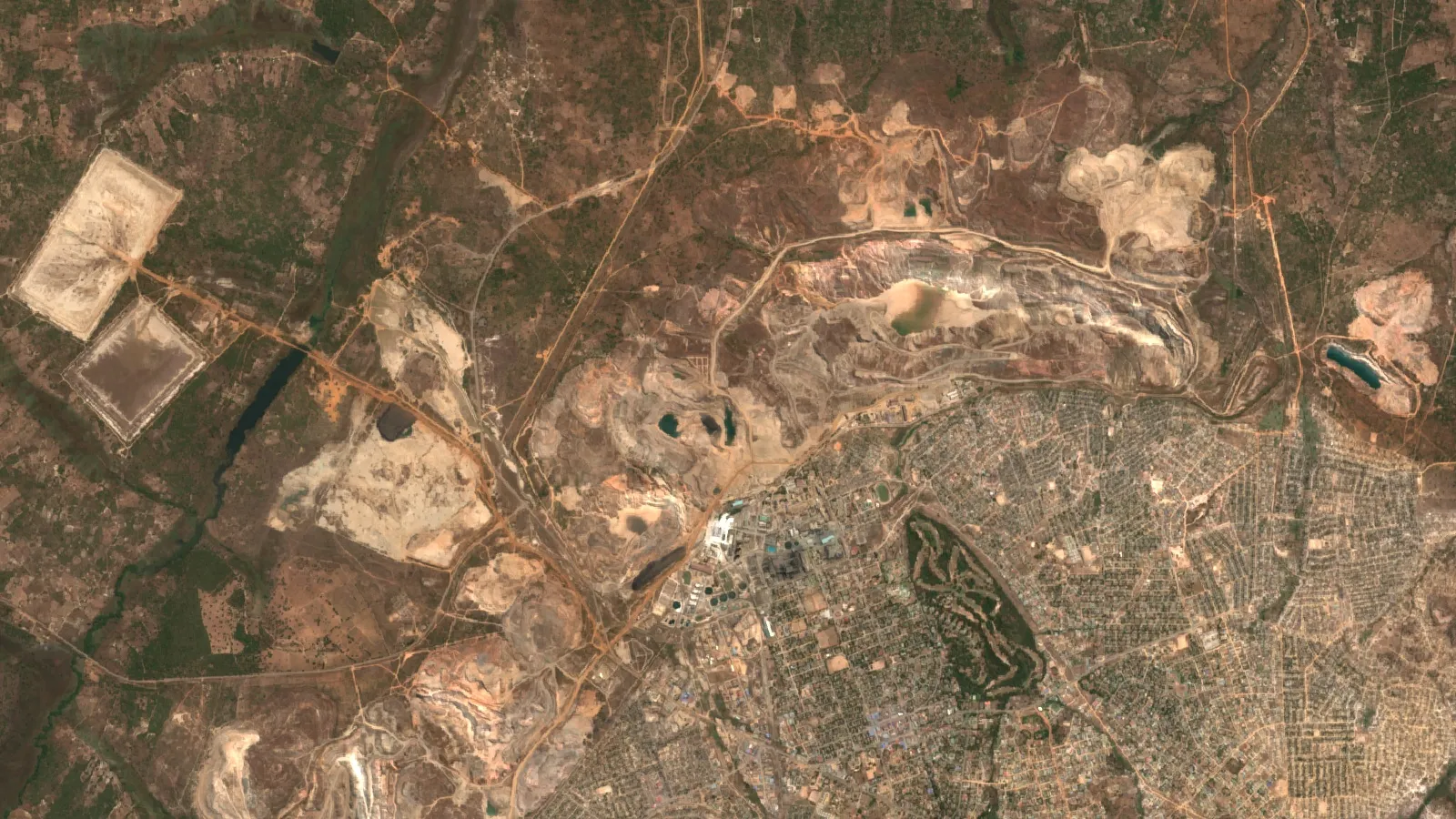
Nchanga is an open pit and underground copper-cobalt mine at Chingola, Zambia, run by Konkola Copper Mines (79.4% main shareholder, 20.6% ZCCM-IH). Chingola B restarted in May 2026 after an 18-year stop.
Key takeaways
- Nchanga combines an open pit with underground orebodies; KCM does not publish a split of output (Mining Indaba, 2026).
- KCM is 79.4% held by its main shareholder and 20.6% by ZCCM-IH; Chingola B restarted on 21 May 2026 (Reuters).
- KCM made about 80,000 t of copper in 2025 and targets 300,000 t a year by 2031 (Mining Technology, September 2026).
- Zambia mined 890,346 t in 2025; the DR Congo side of the Katanga copperbelt mined an estimated 3.2 Mt (Reuters; USGS 2026).
- Copper leaves landlocked Zambia through Dar es Salaam, Walvis Bay, Beira and Durban (Freight News, August 2026).
In this article
- Nchanga copper mine in brief
- Where Nchanga is and how its ore formed
- Open pit and underground mining at Nchanga
- From ore tonnes to copper tonnes: a worked example
- Who owns Nchanga
- Nchanga history from the 1920s to the Chingola B restart
- How much copper Nchanga and KCM produce
- What stands between Zambia and 3 million tonnes
- Large copper mines in Zambia compared
- The Katanga copperbelt and the Zambian Copperbelt
- Copper mine logistics in Zambia
- Tailings, water and the environment at Nchanga
- How to read published figures on Nchanga
- Checking Copperbelt ground with satellite imagery
Nchanga copper mine in brief
Nchanga is a copper and cobalt mine at Chingola in Zambia’s Copperbelt Province, run by Konkola Copper Mines (KCM). The complex includes a large open pit and underground orebodies. KCM is 79.4% held by its main shareholder and 20.6% by the state investor ZCCM-IH. In May 2026 KCM restarted mining at Chingola B, an orebody of the Nchanga complex, after an 18-year stop (Reuters via Kitco, 21 May 2026).
This page covers where Nchanga is, how its ore formed, how the pit and the underground mine work, who owns it, how the story runs from the 1920s to today, and how copper leaves the Copperbelt for the sea. It also puts Nchanga next to the other large copper mines in Zambia and next to the Katanga copperbelt across the border in the DR Congo. Published figures for single mines are thin, so every number below carries its source and date.
| Item | What the sources show |
|---|---|
| Location | Chingola, Copperbelt Province, Zambia, at about 12.5 degrees south, 27.85 degrees east |
| Operator | Konkola Copper Mines (KCM): 79.4% main shareholder, 20.6% ZCCM-IH (Reuters, May 2026) |
| Mining methods | Open pit and underground, within the wider Nchanga complex (KCM; Mining Indaba) |
| Restart | Chingola B restarted in May 2026; steady state above 200,000 tonnes of ore a month (Reuters, May 2026) |
| Company output | KCM made about 80,000 t of copper in 2025 and targets 300,000 t a year by 2031 (Mining Technology, September 2026) |
Where Nchanga is and how its ore formed
Chingola sits near the northern end of the Zambian Copperbelt, close to the border with the Democratic Republic of the Congo. The town grew to serve the Nchanga mine. The Copperbelt is a belt of old sedimentary rocks, the Katangan Supergroup, that hosts sediment-hosted stratiform copper. The U.S. Geological Survey counts the Central African Copperbelt in Zambia and the DR Congo as one of two districts, with the Kupferschiefer of Germany and Poland, that hold most of the known copper in this deposit type (USGS Scientific Investigations Report 2010-5070-M).
At Nchanga the ore sits against the edge of old basement granite. The USGS notes that the distribution of ore is controlled by where the Mindola Clastics Formation pinches out against the basement. The same report says a considerable part of the mineralisation at Nchanga is of supergene origin. Supergene means that groundwater and weathering moved copper downward and concentrated it, which produced oxide and copper-silicate minerals such as chrysocolla near the surface. Deeper down the ore is sulphide, mainly copper sulphides in dolomitic and arenitic host rocks.
This split matters for how a mine is run. Oxide ore from the upper part of a deposit is usually treated by leaching, while sulphide ore is crushed, ground and floated to a concentrate. Nchanga has both circuits, so cobalt, which tends to sit in the same belt, can be recovered as well. Grade is the share of metal in the rock; the earlier operating years of Chingola B averaged about 2.5% copper at roughly 60,000 tonnes of ore a month (Mining Indaba, September 2026).
Open pit and underground mining at Nchanga
An open pit removes waste rock and ore in steps called benches. It suits ore that lies near the surface in a broad body. Nchanga has a large open pit, and KCM does not publish current pit dimensions, so any depth or length quoted online should be treated as a rough description of scale.
The underground mine takes over where a pit becomes too deep to dig profitably. Underground ore is milled separately from pit ore. The restart of Chingola B, part of the Nchanga complex, adds a new source of ore. KCM says it is working with business partners and newer methods meant to improve safety and efficiency, and about 80 people had joined that workforce at the start, with around 100 more expected (Mining Indaba).
The group chief executive, quoted in the same report, described the plan as growth at both Konkola and Nchanga. Ore tonnes are not copper tonnes: 200,000 tonnes of ore a month becomes a much smaller tonnage of metal after grade and recovery are applied, which is why the calculator below asks for both.
From ore tonnes to copper tonnes: a worked example
Headlines about a restart often quote ore, and ore is not metal. To turn ore into copper, multiply the ore tonnes by the head grade, which is the average copper content going into the mill, and by recovery, which is the share of that copper the plant captures. Take a plain example that is not a KCM result: 200,000 tonnes of ore a month at 2.0% copper and 85% recovery gives 3,400 tonnes of copper a month, or about 40,800 tonnes a year. At the 2.5% grade quoted for Chingola B’s earlier years the same tonnage gives 4,250 tonnes a month, about 51,000 a year.
The value follows from the price. The LME cash price was 653.85 US cents a pound on 23 October 2026 (Reporte Minero, citing Cochilco), about US$14,400 a tonne after multiplying by 2,204.62 pounds per tonne. At that price 40,800 tonnes would be worth about US$588 million before smelting charges, royalties, tax and costs. The gap between that figure and profit is why operators report cost per pound alongside tonnage. The calculator on this page lets you change the ore rate, grade, recovery and price.
Calculator
How much copper does a monthly ore rate give?
Enter an ore rate, grade, recovery and price to see copper tonnes and gross value.
- Copper recovered per month (t): 3,400
- Gross value per year at your price (US$): $587,520,000
Example values only, not a KCM or Nchanga result. Prices are inputs: use today’s price. The LME cash price was 653.85 US cents per pound on 23 October 2026 (Reporte Minero, citing Cochilco); one tonne is 2,204.62 pounds. Gross value ignores smelting charges, royalties, tax and costs.
Who owns Nchanga
Nchanga is run by KCM, a company created when the Zambian state sold off the old state mining group. The 79.4% / 20.6% split between KCM’s main shareholder and ZCCM Investments Holdings (ZCCM-IH) is reported by Reuters and by Mining Indaba.
Control has changed hands more than once. The Zambian government forced KCM into liquidation in May 2019, and the dispute ran for more than four years. On 6 November 2023 ZCCM-IH signed an agreement that restored the majority shareholder’s ownership, re-appointed the board and ended the legal challenges, including the provisional liquidator, after the shareholder pledged about US$1.2 billion of investment (Reuters via Mining.com, 6 November 2023).
Nchanga history from the 1920s to the Chingola B restart
Zambian copper mining on the Copperbelt grew out of concessions granted in the 1920s. In 1923 the Anglo-American Corporation received prospecting rights over the Rhokana concession, and its group later became Nchanga Consolidated Copper Mines, which ran Nchanga, Nkana and Konkola (ZCCM-IH, company history). After the Mulungushi reforms of 1968 and a proclamation in 1969, the government took 51% of the mining companies on 26 June 1970. The two state-held groups merged into Zambia Consolidated Copper Mines (ZCCM) on 25 March 1982. When ZCCM was broken up, KCM took over the Nchanga and Konkola divisions.
| Date | Event | Source |
|---|---|---|
| 1923 | Anglo-American Corporation receives prospecting concessions on the Copperbelt | ZCCM-IH |
| 26 June 1970 | Government takes 51% of the Anglo-American group companies | ZCCM-IH |
| 25 March 1982 | ZCCM formed from the two state-held groups | ZCCM-IH |
| May 2019 | KCM forced into liquidation by the state | Reuters |
| 6 November 2023 | Agreement restores ownership and the KCM board | Reuters |
| 21 May 2026 | Chingola B restarts after an 18-year stop | Reuters |
| September 2026 | US$498 million contract for a Chingola tailings copper plant | Mining Technology |
▶ Why an electric car starts as a copper mine, and how much copper one vehicle needs. · 6:03
How much copper Nchanga and KCM produce
KCM does not publish a separate figure for Nchanga. At company level, KCM made about 80,000 tonnes of copper in 2025 and aims to reach 300,000 tonnes a year by 2031, with much of the increase expected from the Konkola Deep underground project and new tailings treatment (Mining Technology, 18 September 2026). Nchanga’s role in that plan is clear: its chief executive said the Chingola B restart adds another 200,000 tonnes of ore a month.
Chart
Zambia’s copper output against its targets
Thousand tonnes of copper per year
The same Mining Technology report says KCM has awarded a US$498 million contract to China’s NERIN Engineering to build a plant at Chingola that reprocesses old mine tailings. The plant could add about 70,000 tonnes of copper a year. The contract is not yet effective: it depends on conditions that include an advance payment, so no commissioning date is public.
For scale, Zambia as a whole produced 890,346 tonnes of copper in 2025, up 8% from 825,513 tonnes in 2024 and short of a 1 million tonne target. The country wants 3 million tonnes a year by 2031 (Reuters via Mining.com, 27 January 2026). KCM’s 2025 output was therefore roughly one-ninth of the national total.
What stands between Zambia and 3 million tonnes
Zambia’s target of 3 million tonnes by 2031 would more than triple the 2025 figure, and a few projects carry much of the weight. Zambia’s Presidential Delivery Unit points to the US$1.25 billion Kansanshi S3 expansion, which raises milling capacity and recovery, and to the US$600 million Kitumba project in Mumbwa, due to start copper production in 2026 with a 50-megawatt solar plant (Presidential Delivery Unit Zambia, February 2026). KCM’s growth at Nchanga and Konkola is the Copperbelt’s share of that plan.
Analysts quoted by the Zambian Economist argue that the limit is power rather than price, and that the gap to the 2031 goal depends on electricity supply (The Zambian Economist, 6 August 2026). For a licence holder or investor, the lesson is to look at power, water, rail and port capacity alongside the grade of the ore.
Large copper mines in Zambia compared
Zambia’s copper comes from the old Copperbelt around Chingola, Kitwe and Mufulira and from the newer North-Western Province. The table lists the large mines for which a source gives current output or a mining method.
| Mine | Operator | Region | Latest output or method |
|---|---|---|---|
| Nchanga | KCM | Copperbelt, Chingola | Open pit and underground; company output about 80,000 t in 2025 |
| Lumwana | Barrick | North-Western, west of Solwezi | Open-cut mine; average about 122,000 t of copper a year (Mining Technology) |
| Kansanshi | First Quantum | North-Western, Solwezi | 43,997 t of copper in the second quarter of 2026 |
| Sentinel | First Quantum | North-Western, Kalumbila | 50,335 t of copper in the second quarter of 2026 |
The Lumwana description comes from Mining Technology’s Lumwana profile, which places the mine 220 km west of the Copperbelt and 65 km west of Solwezi. The quarterly figures come from First Quantum’s second-quarter 2026 results. For other copper producers see our ranking of the largest copper mining companies.
The Katanga copperbelt and the Zambian Copperbelt
The Katanga copperbelt is the Congolese half of the same geological belt. Katanga was a single province of the DR Congo until it was split, and its copper and cobalt mines in Haut-Katanga and Lualaba lie along the same Katangan Supergroup rocks that host Nchanga. The border is a political line, not a geological one: the USGS treats the Central African Copperbelt as one district across Zambia and the DR Congo.
Chart
Copper reserves by country
Million tonnes of contained copper, USGS 2026
The scale difference is large. USGS data show the DR Congo mined an estimated 3.2 million tonnes of copper in 2025 against 940,000 tonnes for Zambia, and the DR Congo produced an estimated 230,000 tonnes of cobalt, the largest national output by a wide margin (USGS Mineral Commodity Summaries 2026, copper; cobalt). USGS puts DR Congo copper reserves at 80 million tonnes and Zambia’s at 21 million tonnes. Reserves are the part of a resource that can be mined profitably under current conditions.
For a reader comparing the two sides, the practical differences are who owns the ground, how the rules differ and how the metal reaches a port. Both countries ship copper from landlocked mines, so the logistics section below applies to both. For a wider view of where copper is found, see where copper is found on Earth and our guide to copper deposit types.
Copper mine logistics in Zambia
Zambia and the DR Congo are both landlocked, so copper has to cross at least one border to reach a ship. Freight News reported in August 2026 that copper traffic, once concentrated on Durban in South Africa, is now spread across Dar es Salaam, Walvis Bay, Beira and Durban, with smaller volumes through Nacala and Lobito (Freight News, 21 August 2026). Zambia is using corridors that run both east and west.
Chart
Truck round trip from Kolwezi, DR Congo
Days, reported range
The same report puts a truck round trip from Kolwezi in the DR Congo to Durban at 35 to 40 days or longer, against about 14 to 16 days to Lobito in Angola, and notes that the western route has one border crossing instead of several. Rail on the Lobito and Tazara lines to Dar es Salaam could move bulk cargo off the roads, although capacity and reliability decide how much. Power shortages hit both economies and affect mines and smelters as much as transport.
For Nchanga the cost chain runs from the mill to a smelter or refinery, then to the border, port and buyer. Concentrate leaves the country for treatment elsewhere unless a local smelter takes it, while copper cathode, a finished metal product, can go straight to the port. A change of route moves days of transit and the cost of money tied up in metal on the road.
Tailings, water and the environment at Nchanga
Tailings are the finely ground waste left after copper is recovered. Nchanga’s tailings are a resource of their own, and the planned NERIN plant would reprocess old tailings at Chingola, turning a legacy store into a source of metal.
The record includes legal claims over pollution: more than 2,500 Zambian villagers brought a claim in London over pollution allegations near Chingola (Leigh Day). Anyone assessing a Copperbelt project should read the environmental and community conditions attached to its licence alongside the geology.
How to read published figures on Nchanga
Three problems come up again and again when people research this mine. First, sources mix units: some quote ore tonnes a month, some quote copper tonnes a year, and some quote the whole company. A figure for KCM is not a figure for Nchanga, and 200,000 tonnes of ore is not 200,000 tonnes of copper. Second, history is thin and dated. The pit and plant descriptions above come from a reference work, and KCM does not publish a current pit survey, so treat them as descriptions of scale rather than mine-plan data. Third, plans are not results: the 300,000 tonne target and the tailings plant are intentions, and the NERIN contract was not yet effective when it was reported.
- Check the date and the unit before comparing two numbers.
- Prefer company filings, regulator statements and wire reports to blogs.
- Separate what a mine has produced from what its owner plans to produce.
- Ask whether a figure covers open pit, underground, tailings or all three.
The same checks apply to any Copperbelt asset, on either side of the border, and to the neighbouring mines KCM runs at Konkola, Chililabombwe, Kitwe and Nampundwe (Reuters, May 2026). Satellite imagery adds an independent view of pit and dump growth that can be compared with company claims.
Checking Copperbelt ground with satellite imagery
Satellite imagery gives mining consultants and licence owners a first look at ground before they commit to field work. In sediment-hosted belts such as the Copperbelt, multispectral images can show iron-oxide staining, clay and carbonate alteration, bare rock, tailings areas and pit growth, and repeat passes show how a pit, dump or tailings pile changes. Farmonaut turns a licence boundary into mapped exploration targets and site-change maps; results are exploration targets, not a resource estimate.
Mining rights in Zambia are granted under the Mines and Minerals Act, so check licence status with the regulator before any purchase. A common use is screening a block before buying it or joining a venture on it. Compare the satellite signs with published geology maps, then plan soil sampling or drilling on the targets that agree.
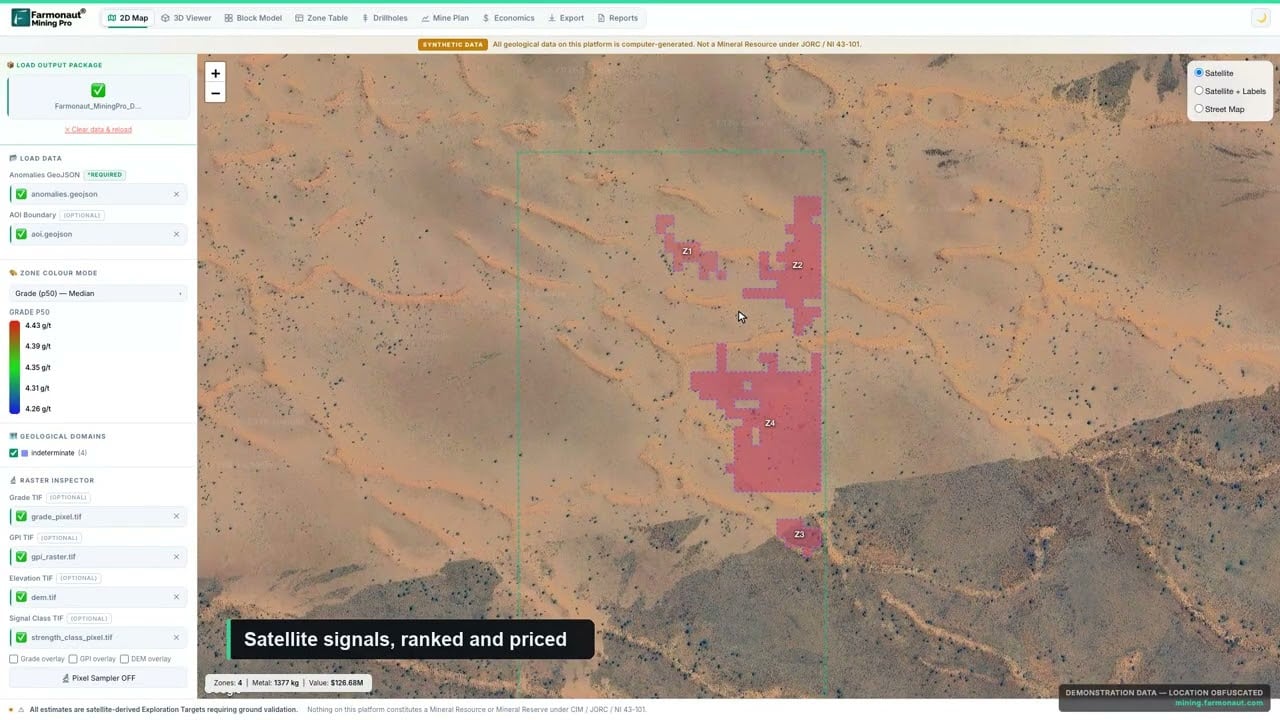
▶ A short look at Farmonaut Mining Pro, which turns a licence boundary into a mapped geological picture. · 4:56
For the rest of the region’s mineral belts, see the DRC minerals map.
Frequently asked questions
Where is Nchanga copper mine?
Nchanga is at Chingola in Zambia’s Copperbelt Province, at about 12.5 degrees south and 27.85 degrees east, near the border with the DR Congo.
Who owns Nchanga mine?
KCM operates it. Reuters reports that KCM’s main shareholder holds 79.4% and ZCCM-IH, the Zambian state investor, holds 20.6% (May 2026).
Is Nchanga an open pit or underground mine?
Both. The Nchanga complex has an open pit and underground orebodies. KCM does not publish a current split of output between the two.
How big is the Nchanga open pit?
KCM does not publish current pit dimensions, so no reliable figure is quoted here. Satellite images can measure pit growth over time.
How much copper does Nchanga produce?
No separate figure is published. KCM as a whole made about 80,000 tonnes in 2025 and targets 300,000 tonnes a year by 2031 (Mining Technology, September 2026).
What is Chingola B?
Chingola B is part of the Nchanga complex. Mining restarted there on 21 May 2026, and ore output should pass 200,000 tonnes a month at steady state (Reuters).
What are the main copper mines in Zambia?
Nchanga, Lumwana, Kansanshi and Sentinel are four of the largest copper mines; the table above gives each operator and latest output.
What is the Katanga copperbelt?
It is the DR Congo section of the Central African Copperbelt, hosted by the same Katangan Supergroup rocks as Nchanga. The USGS counts Zambia and the DR Congo as one copper district.
How does copper from Zambia reach the coast?
By truck and rail to ports at Dar es Salaam, Walvis Bay, Beira and Durban, with smaller volumes through Nacala and Lobito (Freight News, August 2026).
What is the copper price used in the calculator?
The calculator starts with US$14,400 a tonne, close to the LME cash price of 653.85 US cents a pound reported on 23 October 2026 (Reporte Minero, citing Cochilco). Use today’s price.
This page is for information only. It is not investment advice and names no security to buy or sell. Mine figures come from the cited sources and may change.
Farmonaut mining
Map your Copperbelt licence from space
Get a satellite quote to map a licence area and rank exploration targets before you plan field work.

Mining Pro sample view, synthetic data
Keep reading
Sources
- Reuters via Kitco, Konkola reopens Chingola copper mine (21 May 2026): kitco.com
- Mining Indaba, Konkola Chingola copper mine (September 2026): miningindaba.com
- Reuters via Mining.com, ownership agreement (6 November 2023): mining.com
- Mining Technology, KCM US$498 million tailings plant contract (September 2026): mining-technology.com
- ZCCM-IH, company history: zccm-ih.com.zm
- USGS, Sediment-hosted stratabound copper deposits (SIR 2010-5070-M): pubs.usgs.gov
- USGS, Mineral Commodity Summaries 2026: Copper: pubs.usgs.gov
- USGS, Mineral Commodity Summaries 2026: Cobalt: pubs.usgs.gov
- Reuters via Mining.com, Zambia 2025 copper production (27 January 2026): mining.com
- Freight News, Copper volumes prompt route diversification (21 August 2026): freightnews.co.za
- Mining Technology, Lumwana copper mine: mining-technology.com
- First Quantum Minerals, second quarter 2026 results: first-quantum.com
- Presidential Delivery Unit Zambia, mining sector to 2031: pdu.gov.zm
- The Zambian Economist, Zambia’s copper engine (6 August 2026): zambianeconomist.com
- Reporte Minero, LME copper price (23 October 2026): reporteminero.cl
- Parliament of Zambia, Mines and Minerals Act: parliament.gov.zm
Discussion
Questions, corrections or field experience? Share them below. First-time comments are reviewed before they appear, and your email is never published.
No comments yet. Be the first to add a question or your experience.

 Qader Group
 Ileys General Trading
 SG Gold Mining LLC
 VRV Global Pte Ltd
 Omsri International FZE
 G.I.T.T.
 Jaunita Erss Ltd
 Almosi SARL
 SRK Consulting
 Berks Gold Limited
 Mwerezi Minerals Company Limited
 Mining SARL
 SenGold Invest SAS
 Sean Mining Limited
 NTS Group (Pty) Ltd
 Mine4Africa
 Lithspo Minerals Limited
 Tintina Mining Group

 Licence holder · Nigeria · Gold + lithium










