

Placer gold · Price guide
Placer Gold Price per Gram: Purity, Payouts, Calculator
A raw gram of placer gold at Alaska’s average purity holds about 0.889 g of gold, worth US$118.54 at the 15 October 2026 Kitco spot bid of US$133.34 per gram. See what refiners pay, then run your own numbers.
Key takeaways
- Kitco’s spot bid was US$133.34 per gram (US$4,147.20 per troy ounce) at 8:58 a.m. EDT on 15 October 2026; that is the price of pure gold, not of raw placer gold.
- Alaska placer gold averaged 889 fine across 550 creeks (1900-1974 mint returns), with single creeks from 567 to 995 (University of Alaska, 1981).
- Two published refiner offers read on 15 October 2026: TCB guides 85 to 93 percent of spot by lot size; Midwest Refineries pays 95 percent of pure gold content with no refining or assay fees.
- The USGS average price was US$3,300 per troy ounce in 2025 (estimate), up 38 percent on 2024; one troy ounce is 31.103 g (USGS, 2026).
- Net payout per raw gram = grams x fineness x spot per gram x payout rate, less any fee; the calculator does the sum.
In this article
- How much is placer gold worth? A worked example
- Fineness: how purity changes what placer gold is worth
- What refiners and buyers actually pay for placer gold
- Placer gold price per gram calculator
- Where the spot price comes from and how to check it
- From a gravel sample to grams and dollars
- Before you sell or dig: rules, safety and satellite screening
- Frequently asked questions
Placer gold is worth less than the headline gold price, because raw gold from a stream is an alloy and a buyer pays only for the pure gold inside it. At Kitco’s spot bid on 15 October 2026 (8:58 a.m. EDT), pure gold was US$133.34 per gram, or US$4,147.20 per troy ounce. A gram of raw placer gold at the Alaska average purity holds about 0.889 g of gold, which is worth about US$118.54 at that spot price. Buyers then pay a share of that value, so the cash in hand per raw gram is lower again.
This page shows each step between the pan and the pouch: purity (fineness), what refiners and local buyers pay, how the spot price is set, and how to turn a sample into grams and dollars. It ends with a calculator where you enter your own weight, assay, price and payout rate. Lead is a separate market with different economics, so it has its own page: see lead mining, minerals and market trends.
Terms used below. A placer is a deposit where flowing water has concentrated heavy minerals such as gold in gravel, sand or old stream beds. Fineness is gold purity in parts per thousand. Spot price is the price for immediate delivery of pure gold. A troy ounce (31.103 g) is the weight unit for precious metals. Prices on this page are US dollars and are examples dated 15 October 2026; use today’s price when you decide anything.
How much is placer gold worth? A worked example
The rule is one line: value = weight of raw gold x fineness x spot price x the payout rate you are offered. The first three terms give the gold content at spot. The table below does that sum for one raw gram and one raw troy ounce at the 15 October 2026 spot bid, before any payout discount or fee.
| Fineness (parts per 1,000) | Pure gold in 1 raw gram | Value of 1 raw gram at spot | Value of 1 raw troy ounce at spot |
|---|---|---|---|
| 700 | 0.700 g | US$93.34 | US$2,903.04 |
| 800 | 0.800 g | US$106.67 | US$3,317.76 |
| 850 | 0.850 g | US$113.34 | US$3,525.12 |
| 889 (Alaska mean) | 0.889 g | US$118.54 | US$3,686.86 |
| 900 | 0.900 g | US$120.01 | US$3,732.48 |
| 950 | 0.950 g | US$126.67 | US$3,939.84 |
| 980 | 0.980 g | US$130.67 | US$4,064.26 |
Calculated by Farmonaut from the Kitco spot bid of US$133.34 per gram and US$4,147.20 per ounce on 15 October 2026. A raw ounce at 889 fine is worth about US$460 less than a pure ounce at the same spot price. That gap is the first reason placer gold sells below the quoted price.
Watch the unit. The spot price is quoted per troy ounce, and a troy ounce is 1.09714 times an ordinary (avoirdupois) ounce, or 31.103 g, in the USGS conversion table. A kitchen scale set to ounces will not give troy ounces, so weigh in grams and divide.
Fineness: how purity changes what placer gold is worth
Natural gold is rarely pure. It carries silver, and sometimes copper or other metals, and the share changes from one stream to the next. The Washington Department of Natural Resources explains that fineness is purity out of 1,000, so gold that is 915 fine is 91.5 percent pure, and that jewellers use carats instead, where 24 carat is pure gold.
Chart
Placer gold fineness by Alaska region
Mean fineness, parts per 1,000 (gold / gold plus silver); creeks with over 100 oz produced, 1900-1974
The deepest public record of placer fineness is for Alaska, which produced about 20.8 million fine ounces of placer gold from 1880 to 1968 (a fine ounce is a troy ounce of pure gold). A University of Alaska study used mint return records for 550 creeks that each produced over 100 troy ounces between 1900 and 1974. It found a mean fineness of 889, a 95 percent confidence interval of 880 to 898, and individual creeks from 567 to 995. Most regional means sit close together, as the chart shows. The outlier is the Kantishna district, with a mean of 789 and the widest spread between samples.
Two cautions. First, the Alaska study measures gold as a share of gold plus silver only, so a sample with copper or iron in it assays lower on a full-alloy basis. Second, this is historical production data for one state. Your creek can differ from its neighbour, so the only number that counts for payment is the assay of your own gold.
Purity is not the only thing a buyer checks. A refiner that sells to placer miners states that placer gold can range from 50 to 98 percent pure and that it uses fire assay (melting a sample with a lead-based flux and weighing the gold bead left behind), adding spectrum analysis for lots under 2 troy ounces. Black sand, the heavy dark grains that travel with gold in a pan, is not gold. Weigh your gold clean and dry, because any black sand left in the pouch is weight you will not be paid for.
What refiners and buyers actually pay for placer gold
A refiner pays for the gold content, not the bar weight. The Washington DNR’s 1979 guide to selling says refiners pay for the actual gold content but charge for assaying, melting and refining, that minimum handling charges can exceed the value of a very small lot, and that you should ask for payment for the silver or the refiner may not pay for it. That guide is old, but refiners’ published terms still turn on the same points: how the gold is assayed, what is deducted, and how small a lot they accept.
Chart
Cash per raw gram of placer gold at published payout rates
US$ per raw gram at the 15 October 2026 Kitco spot of US$133.34 per gram; fineness 800 (left) and 950 (right)
We read two published offers on 15 October 2026. Both apply their rate to the assayed gold content at spot, so the percentages can be compared, but check each buyer’s minimum lot and wire fees.
- TCB Metals and Refining publishes a guide of 85 percent of spot for 5 to 15 grams, 90 percent for 15 grams to 2 ounces, and 93 percent for 2 ounces and up, with a 5 gram minimum. Its worked example multiplies weight by assayed gold content, then by spot, then by the payout rate.
- Midwest Refineries (Florida) says it pays 95 percent of the pure gold content at 100 percent of the spot price on settlement day, with no separate refining, assay or treatment fees (a bank wire costs US$35 domestic or US$60 international). It melts and assays orders of 3 troy ounces or more and lists gold dust among the material it accepts. Ask how it tests smaller lots.
Local cash buyers pay less for speed. One Alaska placer guide reports that cash buyers in Nome pay about 80 percent of spot and that a few percent is lost as melt loss when impure gold is cast into bars. That is one seller’s account, not a price list. The Washington DNR notes the other side: private buyers have no middleman commission or delay, and pay more over the market price for large nuggets that suit specimens and jewellery.
The chart applies the published rates to one raw gram at two purities. It shows that a refiner’s payout rate moves the result by about as much as a big change in fineness does.
Before you ship anything, ask each buyer for four things in writing: the payout rate and what it is a rate of (spot, or assayed gold), the assay and handling fees, the minimum lot, and which day’s spot price they use.

▶ A short claymation following one gold nugget from rock through refining to a finished ring. · 5:27
Placer gold price per gram calculator
Use this calculator to turn the weight of your raw gold and its assay into a net payout. Enter the spot price per troy ounce on the day, the fineness from your assay, the payout rate from your buyer’s quote and any flat fee. The defaults are round examples, not a quote from any buyer.
Calculator
What will a buyer pay for your placer gold?
Enter your own weight, assay, price and payout rate. Results update as you type.
- Pure gold in your lot (g): 88.0 g
- Pure gold in your lot (troy oz): 2.83 oz
- Value of that gold at spot: $11,317
- Net payout per raw gram: $102
- Net payout as share of pure-gold spot value: 89.8%
Example values only, not a quote or a benchmark. Spot price is an input: example, use today’s price (US$ per troy ounce, from Kitco or the LBMA). Fineness comes from your assay. The payout rate and flat fee come from your buyer’s written terms. The sum uses 31.1035 g per troy ounce (USGS conversion tables give 31.103 g) and ignores shipping, insurance and tax.
Where the spot price comes from and how to check it
Spot is a live market price. Kitco shows a bid and an ask in US dollars per ounce, gram and kilogram, and gave a day’s range of US$4,099.20 to US$4,162.80 per ounce on 15 October 2026. The LBMA Gold Price is set twice a day in auctions at 10:30 and 15:00 London time, run by ICE Benchmark Administration, and the World Gold Council describes it as an important benchmark throughout the gold market. Refiners name the day they price from: Midwest Refineries uses the settlement day, while TCB says it uses the date you ship. That is why the pricing date belongs in the written quote.
Chart
Gold price in US$ per gram: annual averages and one spot day
2021-2025: USGS average Engelhard price per troy ounce divided by 31.1035 (2025 is an estimate); last bar: Kitco spot bid, 15 Oct 2026
For the longer view, the USGS reports an average Engelhard price of US$3,300 per troy ounce for 2025 (an estimate from January to November data), up 38 percent on 2024 and a record annual average. Converted to grams, that is about US$106 per gram, against about US$58 per gram in 2021 and 2022. The chart shows those annual averages next to the 15 October 2026 spot. The spot bar is one moment in time and the other bars are year averages, so compare them with care.
From a gravel sample to grams and dollars
Placer sampling usually reports gold per volume of gravel, not per tonne of rock. The USGS survey of Alaska placers, for example, reports tenor in value per cubic yard of gravel. Whoever samples your ground should tell you which unit they use and how they treated oversize rocks and clay.
Infographic
From gravel to cash in 5 steps
- 1SampleTake a measured volume of gravel and pan or sluice it.
- 2WeighDry the gold, remove black sand, weigh in grams.
- 3AssayGet fineness from a fire assay or a refiner.
- 4QuoteAsk for rate, fees, minimum lot and the price date.
- 5SettlePayout = pure gold x spot x rate, less fees.
The working sum is: grams recovered = gravel processed x grade x recovery, then net dollars = grams x fineness x price per gram x payout rate. Here is an illustration with made-up round numbers, not a typical placer grade. If you process 2,000 tonnes of gravel at 1.5 g per tonne and recover 90 percent, you recover 2,000 x 1.5 x 0.9 = 2,700 g, which is 2.7 kg, or about 86.8 troy ounces of raw gold.
Whether that pays depends on cost per recovered gram. Add up labour, fuel, equipment wear, water and permit costs, assays, insurance and reclamation, then divide by the grams recovered. Compare that with your net payout per raw gram from the calculator. If your cost is above the net payout, the ground does not pay at today’s price, however good the spot price looks. Recovery matters as much as grade: very fine gold can be hard to catch, so test your recovery on a known sample before you scale up.
For claims you might buy, read our checklist of checks before you pay for a gold claim, and for a worked placer region see Yukon gold mining claims and placer records.
Before you sell or dig: rules, safety and satellite screening
Sell only gold you have the right to mine. Get the licence or claim in order and the landowner’s permission first, stay off other people’s claims and protected ground, and keep records of weights, assays and sale receipts. Never use mercury to catch fine gold: it poisons the person and the stream, and gravity methods recover gold without it.
If you do not yet know where the gold is, the first job is choosing ground worth sampling. Satellites cannot see gold grains in a stream, but they can map the rock, clay and iron staining of a catchment and highlight valleys worth walking. Farmonaut screens an area you supply as a KML, KMZ or polygon in 5 to 20 business days, and the result is an exploration target, not a resource estimate: only sampling and assay can tell you grams per cubic metre. Our guide to prospecting for gold: deposit types, signs and methods explains the ground methods, and the satellite mineral detection page explains the screening. To price a screening of your own area, use the mining quote form or contact the team.
▶ What a satellite gold map shows and how to read it: iron-oxide, clay, silica and faults, not gold itself. · 4:18
Related reading on this site: 1 Gram of Uranium Price: Chart and Calculator.
Frequently asked questions
How much is placer gold worth per gram?
Multiply the grams by the fineness (as a fraction) and by the spot price per gram, then by the payout rate. At the 15 October 2026 spot of US$133.34 per gram, one raw gram at 889 fine holds US$118.54 of gold before any payout discount or fee.
How much is placer gold worth per ounce?
One raw troy ounce at 889 fine holds about US$3,687 of gold at the 15 October 2026 spot bid of US$4,147.20 per ounce. A refiner then pays a share of that, so the cash result is lower. Use the calculator with today’s price.
Is placer gold worth less than refined gold?
Per gram of raw weight, yes, because part of the weight is silver and other metals. Per gram of pure gold it is worth the same once refined. Large, attractive nuggets can sell above their gold value to collectors, as the Washington DNR notes.
How pure is placer gold?
It varies by creek. The University of Alaska study found a mean of 889 fine across 550 Alaska creeks, with single creeks from 567 to 995. A refiner says placer gold can range from 50 to 98 percent gold, so only an assay of your own sample gives your figure.
What does fineness 900 mean?
It means 900 parts in 1,000 are gold, or 90 percent. The rest is usually silver with some copper. In carats, 900 fine is about 21.6 carat, because 24 carat is pure gold.
How much do refiners pay for placer gold?
Published offers we read on 15 October 2026 ranged from 85 to 95 percent of the gold content at spot: TCB quotes 85 to 93 percent of spot by lot size, and Midwest Refineries quotes 95 percent of pure gold content with no refining or assay fees. Always ask what the rate is a rate of.
Do I get paid for the silver in my gold?
Not always. The Washington DNR advises asking for payment for the silver, because the refiner may otherwise pay only for the gold. Ask whether silver credit is in the quote.
What is the minimum amount of placer gold I can sell?
It depends on the buyer. TCB sets a 5 gram minimum, while Midwest Refineries says it has no minimum order. For very small lots, fixed assay and handling charges can eat a large share of the value.
Why is my payout lower than the spot price?
Three things stack up: fineness below 1,000, a payout rate below 100 percent, and any fees or melt loss. For example, 889 fine and a 90 percent payout leaves about 80 percent of the pure-gold spot value per raw gram.
Where can I check the gold price per gram?
Kitco shows spot in dollars per ounce, gram and kilogram, and the LBMA publishes its benchmark price twice each London business day. Refiners usually say which price and which day they use in their terms.
How do I weigh placer gold correctly?
Dry it, remove black sand, and weigh in grams on a scale that reads to 0.01 g. If a buyer quotes in ounces, check that they mean troy ounces (31.103 g), not ordinary ounces.
Can a satellite tell me how much gold a river holds?
No. A satellite screening can rank areas for further sampling, but the gold content of gravel is only known from samples. Treat any satellite result as an exploration target.
This page is for information only. It is not investment advice. Prices are examples dated 15 October 2026, and refiner terms change: get written terms and an assay before you sell. Satellite results are exploration targets, not a resource estimate. When prospecting, get a licence and the landowner’s permission, stay off other people’s claims and protected land, and never use mercury.
Farmonaut mining
Screen a river valley from space before you sample
Investors and explorers can see how satellite data screens an area as an exploration target, ahead of any sampling or resource estimate.
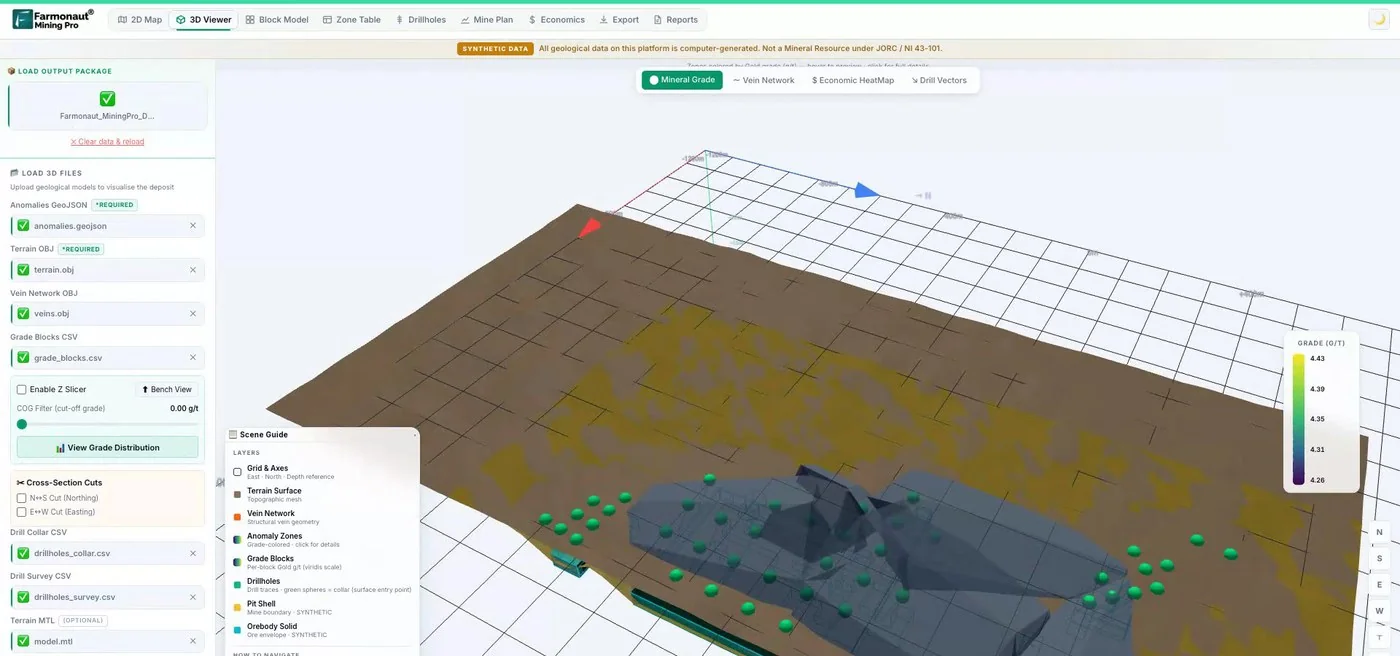
Mining Pro sample view, synthetic data
Keep reading
Sources
- Kitco, Gold price today (spot bid, gram and ounce), 15 October 2026: kitco.com
- USGS, Mineral Commodity Summaries 2026: Gold: pubs.usgs.gov
- USGS, Mineral Commodity Summaries 2026: Appendixes (unit conversions): pubs.usgs.gov
- University of Alaska, MIRL Report 45: Gold fineness values from Alaska placer deposits (1981): dggs.alaska.gov
- USGS Bulletin 1374: Placer Deposits of Alaska (Cobb, 1973): pubs.usgs.gov
- Washington DNR, Bulletin 42: Gold in Washington: dnr.wa.gov
- Washington DNR, Placer Gold Mining in Washington (Moen, 1979): dnr.wa.gov
- LBMA, Precious metal prices (how the LBMA Gold Price is set): lbma.org.uk
- World Gold Council, Gold spot prices and market history: gold.org
- TCB Metals and Refining, Placer gold purchasing terms (read 15 October 2026): tcbinter.com
- Midwest Refineries, Gold buyers and brokers: payout terms (read 15 October 2026): midwestrefineries.com
- Bering Sea Paydirt, Where do gold miners sell their gold? (2022): beringseapaydirt.com
Discussion
Questions, corrections or field experience? Share them below. First-time comments are reviewed before they appear, and your email is never published.
No comments yet. Be the first to add a question or your experience.

 Critica Metals Limited
 Congo Mining Solutions
 Mining SARL
 SenGold Invest SAS
 Sania Corporation
 Sean Mining Limited
 NTS Group (Pty) Ltd
 Mine4Africa
 Lithspo Minerals Limited
 Tintina Mining Group
 Dalgety Minerals Pty Ltd
 Vortex Minerals Pty Ltd
 Faith At Work (Pty) Ltd
 Geotech Mining Solutions plc
 Vulcan International Limited
 Kidepo Associates
 GKY Mining
 Alkimy SARL
 Double A Trading
 GemSprout Metals Limited
 Qader Group
 Ileys General Trading










