

Red spinel – Price and locations guide
Red Spinel Price per Carat: 7 Mining Districts
GIA reported wholesale quotes of US$12,000 per carat for a 9.82 ct Burmese red and US$7,000 for a 21.56 ct Sri Lankan pink in 2017. See the dated prices, seven mining districts and a rough-to-carats calculator.
Key takeaways
- GIA’s Spring 2017 report quoted US$12,000 per carat wholesale for a 9.82 ct strong orangy-red Burmese spinel, about US$15,000 above 10 ct, and US$7,000 for a 21.56 ct Sri Lankan pink (GIA, 2017).
- A top 5 ct red spinel might sell for about a tenth of an equivalent ruby (GIA); Christie’s sold reddish-pink spinel earrings of 22.42 and 21.87 ct for US$2,228,000 on 10 December 2024 (JCK).
- Red spinel from Myanmar and Vietnam is more highly regarded than that from other origins, and origin is becoming as important to value as for ruby (GIA, Gems & Gemology, 2026).
- Spinel is magnesium aluminium oxide, not corundum; chromium makes it red. Seven districts are covered: Mogok, Namya, Kuh-i-Lal, Mahenge, Lang Chap, An Phu and Ratnapura.
- Clean, facetable rough usually yields 25% to 33% with custom cutting and 15% to 25% with factory cutting (International Gem Society, 2025); the calculator turns grams of rough into finished carats.
In this article
- Red spinel price per carat: the dated figures
- What moves the price of a red spinel
- Seven red spinel mining locations compared
- How we chose these seven locations
- From rough to carats: yield and a value calculator
- Licences, permits and buying at the source
- Footprint and land use around spinel pits
- Screening a licence area before you pit or drill
- Frequently asked questions
Fine red spinel has no single price. The wholesale figures published by the Gemological Institute of America (GIA) put a strong orangy-red Burmese stone of about 10 carats at US$12,000 per carat and a larger one near US$15,000, while a bright pink Sri Lankan stone of 21.56 carats was US$7,000 per carat. Those 2017 quotes are the latest per-carat reference used on this page. GIA reports that spinel prices have trended upward since, so get a current dealer quote before you buy or sell. Below you will find every dated price from a named publisher, what moves the price up or down, seven districts where gem spinel is mined, a calculator that turns a parcel of rough into finished carats and value, and the permit rules a buyer meets at the source.
Spinel is magnesium aluminium oxide (MgAl2O4) and belongs to the cubic crystal system. It is not a type of ruby or corundum, although fine red spinel was long mistaken for ruby and was only recognised as its own species in the 1800s. Traces of chromium give red spinel its colour, and the more chromium, the stronger the red. A carat (ct) is 0.2 gram, and the prices below are in US dollars per carat unless stated.
Red spinel price per carat: the dated figures
There is no public exchange or benchmark for coloured stones, so prices come from dealer interviews, auction results and lab reports. The table lists the figures from named publishers, with the date and what each one measures. They are not a price list, and a stone’s colour, clarity and size can change its value a great deal.
Chart
One auction lot against its estimate
US$ thousand; pair of reddish-pink spinel earrings with diamonds, Christie’s, 10 December 2024
| Date | Item | Price | What it measures | Source |
|---|---|---|---|---|
| Spring 2017 report | Burmese spinel, 9.82 ct, strong orangy red (“flame” colour) | US$12,000 per ct | Wholesale quote from a US dealer | GIA, Gems & Gemology |
| Spring 2017 report | Burmese spinel above 10 ct, same colour | About US$15,000 per ct | Dealer’s estimate for a larger stone | Same report |
| Spring 2017 report | Sri Lankan lilac-pink spinel, 21.56 ct | US$7,000 per ct | Wholesale quote | Same report |
| Spring 2017 report | Rose-coloured spinel from Vietnam, Sri Lanka and Myanmar | US$1,000 to 1,800 per ct | Wholesale range | Same report |
| 10 December 2024 | Pair of Harry Winston earrings with reddish-pink spinels of 22.42 ct and 21.87 ct | US$2,228,000 for the pair (estimate US$400,000 to 600,000) | Auction result with diamonds and mounting | JCK, 23 December 2024 |
The auction result works out to roughly US$50,000 per carat of spinel if you divide the sale price by the 44.29 carats of spinel, but that overstates the stone value because the total also covers the diamonds, the mounting and the maker’s name. Treat it as a ceiling for exceptional matched stones, not a price for a typical gem.
Two other benchmarks help. GIA states that a top-quality 5-carat red spinel might sell for around a tenth of the price of an equivalent ruby, and that the gap has narrowed as demand has grown. The International Gem Society adds that the finest red spinel is valued at a fraction of an identical ruby. For a broader view of per-carat values across minerals, see our guide to the most valuable minerals by price per carat.
What moves the price of a red spinel
Five factors decide most of the price, and they interact: a large stone is worth far more per carat only if the colour and clarity are also good.
Chart
Wholesale quotes for fine pink and red spinel
US$ per carat, three stones quoted at the AGTA GemFair, reported Spring 2017
- Colour. Pure red to slightly purplish red of medium to medium-dark tone is the most valuable, according to GIA’s quality guide. The line between red and pink is a matter of saturation and tone, and sellers tend to call borderline stones red to ask more.
- Clarity. Stones with no inclusions visible to the eye command the highest prices, and value falls as inclusions become easier to see.
- Size. Faceted spinel above three carats is impressive and collectors covet stones over five carats. GIA notes that availability drops and per-carat prices rise sharply for fine stones above five carats.
- Origin. The GIA authors of a 2026 study write that red spinel from Myanmar and Vietnam is more highly regarded than that from other origins, and that origin is becoming a larger factor in value, as it already is for ruby, sapphire and emerald. Origin is decided in a laboratory, which is why the study measured trace elements such as titanium and zinc.
- Natural or synthetic. Lab-created spinel is cheap and widely used in birthstone jewellery and class rings, according to the International Gem Society. A laboratory report is the safe way to confirm that a red stone is natural.
Spinel is also a hard-wearing gem. It has no cleavage, which gives it good resistance to blows, and a high refractive index, so a well-cut stone is brilliant in any colour (International Gem Society). In the 2026 study the red and orange samples had a refractive index of 1.710 to 1.728 and a specific gravity of 3.528 to 3.692.
Seven red spinel mining locations compared
Gem spinel is found where limestone and dolomite were baked and squeezed into marble, or where granite intruded magnesium-rich rock. Weathering then frees the hard crystals into gravels. The table sets out the seven districts that GIA, Chimia and other published studies name as spinel sources. Published production figures are not comparable between districts, so the table shows geology, deposit type and what the sources say, and does not rank by output.
Chart
Wholesale ranges by colour group
US$ per carat, Spring 2017 quotes from one dealer; fine pink-to-red group shows the three stones above
| District | Country | Deposit type and host rock | What the sources say |
|---|---|---|---|
| Mogok (including Man Sin) | Myanmar | Marble in the Mogok Metamorphic Belt; primary rock and gravels | Gem mining for centuries; Man Sin was confirmed as a new spinel source in August 2013 (pit owners reported first pocket in 2009) |
| Namya | Myanmar (Kachin State) | Ruby and spinel deposit east of the Hpakant jade area | Gem rush in December 2000; neon pinkish-red spinel |
| Kuh-i-Lal, Pamir | Tajikistan | Ultra-magnesian metamorphic rocks (Goran series) | One of the oldest known sources; source of the “Balas ruby” |
| Mahenge | Tanzania | Marble-hosted deposits in a narrow karst valley, worked by washing | Giant crystals up to 54 kg found in 2007 |
| Lang Chap, Luc Yen | Vietnam | Mostly secondary deposits over marble | Known for red to orange spinel |
| An Phu | Vietnam | Marble formed under granulite-facies conditions | Known for high-quality spinel |
| Ratnapura | Sri Lanka | Weathered alluvial gravel called illam | Spinel is one of many gems in the gravels |
Mogok and Man Sin, Myanmar
The Mogok Stone Tract in the Mandalay region has been worked for rubies since the sixth century, and the area also yields spinel in many colours. The geology is a belt of high-grade rock, with two metamorphic events linked to the continental collision that built the Himalaya: the first from the late Cretaceous to the Paleocene, the second from the late Eocene to the Oligocene. Spinel typically sits in marbles. Gemologist Vincent Pardieu reported in Gems & Gemology (Spring 2014) that Mogok reopened to foreign visitors in June 2013 and that a new source at Man Sin was confirmed that August. A local dealer told him that Man Sin stones now drew the highest prices in the Burmese market, because they were redder and larger than other recent finds. At the one pit he visited, about 20 people worked with an excavator, water cannons and two washing plants, and the owners renewed their mining licence every three years.
Namya, Myanmar
Namya is not part of Mogok. Pardieu describes it as a ruby and spinel deposit east of the Hpakant jade area in Kachin State, where a gem rush began in December 2000. Its spinel, with a neon pinkish-red colour, once fetched premium prices.
Kuh-i-Lal, Tajikistan
The Kuh-i-Lal mines lie on the Tajik side of the Badakhshan region in the south-west Pamir mountains. They are among the oldest in the world and supplied the so-called Balas rubies, which are in fact pale rose-tinted spinel. The host rock differs from the Asian marble belts: The mines sit in the Goran series, where the Chimia paper describes ultra-magnesian metamorphic rocks that include forsterite-rich skarns. GIA records a 123.14 ct spinel cut from a 532 ct piece of rough from the Pamir, a yield of about 23%.
Mahenge, Tanzania
Red spinel was found near Mahenge and in the Uluguru Mountains of Morogoro Province in the late 1980s, and the Mahenge deposit became famous after giant crystals of up to 54 kg were found in the summer of 2007. GIA field staff described Mahenge in 2016 as the second most active gemstone mining area in Tanzania, known for spinel and ruby. Pardieu compared the spinel pits to Man Sin: both lie in narrow karst valleys where crystals are washed out of the soil. Spinel was also found around Tunduru after 1994.
Luc Yen, Vietnam: Lang Chap and An Phu
Ruby was first found in northern Vietnam’s Luc Yen district in 1983, and serious mining began in 1988. Gem spinel comes mainly from secondary deposits, meaning gravel fillings in karst pockets and alluvial fans, and open-pit mining dominates. The 2026 GIA study sampled two sites in Yen Bai Province. Lang Chap, in the Luc Yen district, has been mined mostly from secondary deposits, and An Phu, in the Lo Gam zone, is known for high-quality spinel. The same study found that titanium and zinc plots showed separation between red spinel from Mogok, Lang Chap and An Phu, and the authors say trace elements show potential for partial separation of origins, so a lab uses them as one clue among several. Pure red is rare from Vietnam; pinks, oranges and purples are more common.
Ratnapura, Sri Lanka
Sri Lanka’s commercially important coloured-stone deposits are weathered alluvial gravels, called illam. GIA’s field team visited Ratnapura, Balangoda and Elahera and found only secondary gravel deposits. The gravels yield sapphire, ruby, chrysoberyl, spinel, garnet and other gems, so spinel is one product among many, and the miners work for whatever the gravel holds. The Sri Lankan stones in GIA’s 2017 price quotes were pink, lilac or rose-coloured rather than red.

▶ Africa example, relevant to Mahenge and Tunduru in Tanzania: can a foreigner get a small scale mining licence in Africa? · 5:16
How we chose these seven locations
We chose districts that a peer-reviewed paper, a GIA field report or a laboratory study names as a source of gem-quality spinel in red, pink or orange. The order is the order of the table, not a ranking by output or quality, because published production figures are not comparable between districts. The Kuh-i-Lal mines are on the Tajik side of the Badakhshan region, as the Chimia paper puts it.
From rough to carats: yield and a value calculator
A miner or buyer of rough needs to know how many finished carats a parcel will give. Most of the weight is lost in cutting. The International Gem Society says a clean, facetable piece usually yields 25% to 33% with custom cutting and 15% to 25% with factory cutting, and that cutting to a calibrated size lowers the yield further. That guidance covers gemstones in general, and the Pamir stone above (about 23%) sits inside it. Before the cutter starts, you also lose any fractured or cloudy part of the crystal, which is why the calculator asks for the clean share separately.
Enter your own rough weight, the clean share, the yield and a price per carat. The price is an input: use a current quote for a stone of the same colour, clarity and size from a dealer, not a headline figure.
Calculator
How many finished carats will your rough give?
Enter your own rough weight, clean share, yield and price. Results update as you type.
- Value of finished stones at your price: $112,500
- After cutting cost: $105,000
- Overall weight kept from the rough: 15.0%
Example values only, not benchmarks. A carat is 0.2 gram. Yield range of 25% to 33% for custom cutting and 15% to 25% for factory cutting is from the International Gem Society (2025) and covers gemstones in general. The price per carat and the cutting cost are inputs: use a current dealer quote for your stone, in US$.
Licences, permits and buying at the source
Rules differ by country, so confirm them with the regulator before you travel or buy. Three examples from field reports: in Myanmar the Man Sin pit owners had to renew their mining licence every three years through Myanmar Gem Enterprises, according to Pardieu’s 2014 report; in Tanzania, GIA’s 2016 field report found that miners sell to licensed brokers, who sell to licensed master dealers allowed to export, and that foreigners need approval from regional mining officers and a proper business visa to visit the deposits; in Sri Lanka, check licence rules with the national gem authority before you dig or buy.
Footprint and land use around spinel pits
Spinel pits are small compared with metal mines, but they still move soil and water. At Man Sin the crystals were unearthed by washing the ground in a narrow valley, and farmers there were also growing vegetables, mustard and wheat when Pardieu visited, so land use overlaps. In Sri Lanka, the gem pits sit among rice fields in Ratnapura, Elahera and Balangoda. Rehabilitation duties depend on the licence and the country. The video below explains the seven main environmental impacts of mining in plain terms.
▶ The seven environmental impacts of mining, explained in plain terms. · 2:31
Screening a licence area before you pit or drill
Gem districts are small and the gravels are patchy, so the first job is to see the ground: the valley floor, old workings, drainage and access. Farmonaut maps licence areas by satellite for early-stage screening and delivers the result as exploration targets, not a resource estimate. See our satellite-based mineral detection page for how a licence boundary is turned into a map. Our companion guide, red spinel price and top mining locations, and our dealer-side view of one district is in Mahenge spinel price per carat. For another phenomenal-effect gem, read asterism gemstones and their geology. For a different gem and a similar price question, read kunzite stone value and price.
Related reading on this site: Where Foreigners Can Legally Prospect for Gems: 12 Places.
We cover a connected topic in How Much Is Jadeite Worth? Auction Prices Per Carat.
Frequently asked questions
How much does a red spinel cost per carat?
It depends on colour, clarity, size and origin. GIA reported wholesale quotes of US$12,000 per carat for a 9.82 ct Burmese stone and US$7,000 for a 21.56 ct Sri Lankan pink in 2017, with rose-coloured stones at US$1,000 to 1,800. Prices have trended upward since, so ask a dealer for a current quote and a laboratory report.
Is red spinel cheaper than ruby?
Yes. GIA says a top-quality 5-carat red spinel might sell for about a tenth of the price of an equivalent ruby, though the gap has narrowed as demand has grown.
Is spinel a kind of ruby?
No. Ruby is red corundum (aluminium oxide). Spinel is magnesium aluminium oxide with a cubic crystal system. The historic Balas rubies from Kuh-i-Lal were in fact pale rose-tinted spinel.
Where is red spinel mined?
The main districts in the sources we opened are Mogok, Man Sin and Namya in Myanmar, Kuh-i-Lal in Tajikistan, Mahenge and Tunduru in Tanzania, Luc Yen (Lang Chap and An Phu) in Vietnam, and Ratnapura in Sri Lanka.
What gives red spinel its colour?
Chromium. In the 2026 GIA study, red samples had a chromium-to-vanadium ratio of at least 1.7, while orange samples had a ratio of 1.0 or less and were vanadium-rich.
Why is spinel from Myanmar priced above other origins?
GIA authors write that red spinel from Myanmar and Vietnam is more highly regarded than that from other origins, and that origin is becoming as important to value as it is for ruby and sapphire. In 2013 a Mogok dealer also said Man Sin stones drew the highest prices in the Burmese market.
How can I tell natural red spinel from synthetic?
Ask for a report from a recognised gem laboratory. Laboratories use trace-element analysis to separate natural from synthetic spinel and to identify treatments. Lab-created spinel is cheap and common in jewellery.
How many finished carats does a piece of rough give?
For a clean, facetable piece, about 25% to 33% with custom cutting and 15% to 25% with factory cutting, according to the International Gem Society. Use the calculator on this page to see the effect on value.
Is red spinel hard enough for rings?
The International Gem Society says spinel lacks cleavage, so it resists blows well, and its high refractive index gives brilliance. It suits any type of jewellery.
Can a foreigner buy rough spinel in Tanzania?
GIA found that foreigners need approval from regional mining officers and a proper business visa to visit the deposits, and that miners sell to licensed brokers and master dealers. Confirm the current rules with the Tanzanian mining authority before travelling.
What is a Balas ruby?
The name was historically used for pale rose-tinted spinel from Kuh-i-Lal in Tajikistan, according to the Chimia paper on spinel from the Himalayan belt.
This page is for information only. It is not investment advice, and it is not legal advice. Confirm licence and export rules with the regulator. Do not enter any mining area without permission, and never use mercury to recover stones.
Farmonaut mining
See a licence area from space before you commit
Request satellite exploration targets for your concession and get a map of where to look first.
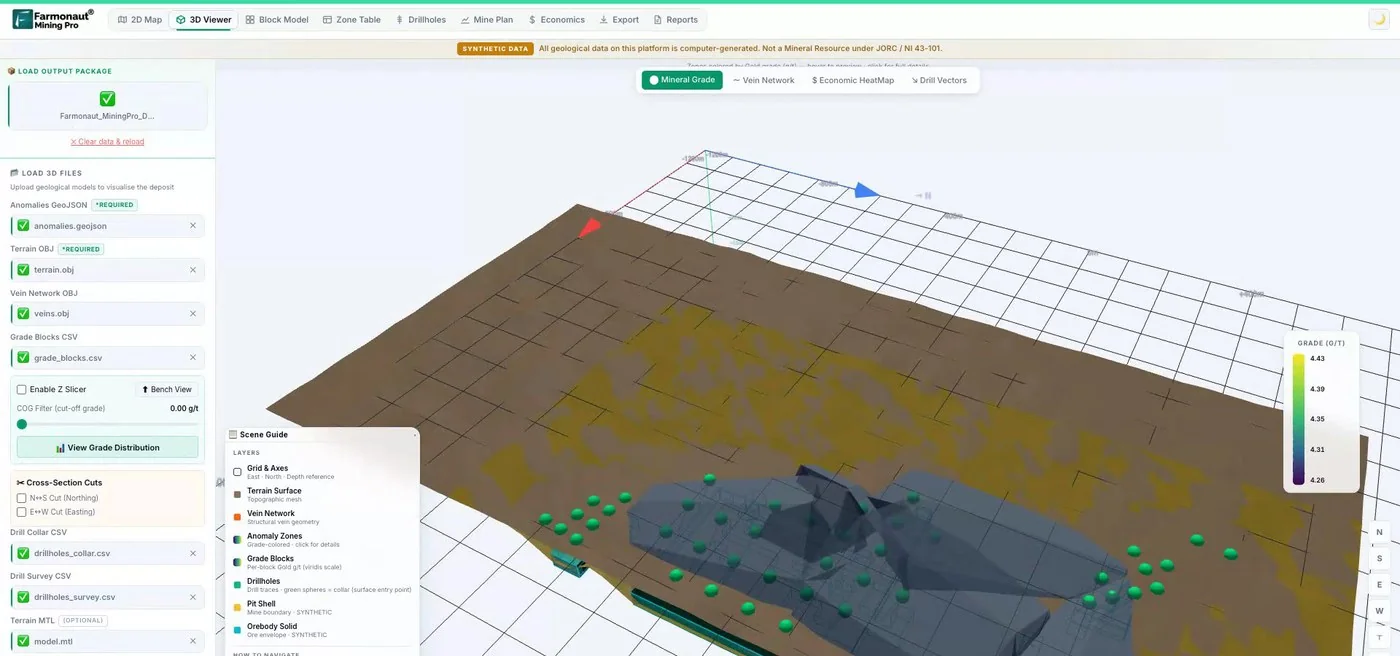
Mining Pro sample view, synthetic data
Keep reading
Sources
- GIA, Gems & Gemology Spring 2017: Fine gems update, Myanmar (AGTA GemFair interview): gia.edu
- GIA, Gems & Gemology Summer 2026: Characterization of red and orange spinel from Myanmar and Vietnam: gia.edu
- Pardieu, Hunting for Jedi spinels in Mogok, Gems & Gemology Spring 2014: cms.gia.edu
- Malsy et al., Distinction of gem spinels from the Himalayan mountain belt, Chimia 2010: chimia.ch
- GIA, Spinel quality factors: gia.edu
- GIA, Spinel description: gia.edu
- GIA, Gems & Gemology Fall 2016: Colored gemstone mining in Tanzania: gia.edu
- GIA, Sri Lanka: From mine to market, Part 1 (2014): my.gia.edu
- JCK, Red jewels reigned at auctions throughout holiday season (23 December 2024): jckonline.com
- International Gem Society, Is spinel expensive? (updated 22 October 2025): gemsociety.org
- International Gem Society, Spinel: gemsociety.org
- International Gem Society, What is the average gemstone faceting yield? (updated 30 July 2025): gemsociety.org
Discussion
Questions, corrections or field experience? Share them below. First-time comments are reviewed before they appear, and your email is never published.
No comments yet. Be the first to add a question or your experience.

 Qader Group
 Ileys General Trading
 SG Gold Mining LLC
 VRV Global Pte Ltd
 Omsri International FZE
 G.I.T.T.
 Jaunita Erss Ltd
 Almosi SARL
 SRK Consulting
 Berks Gold Limited
 Mwerezi Minerals Company Limited
 Mining SARL
 SenGold Invest SAS
 Sean Mining Limited
 NTS Group (Pty) Ltd
 Mine4Africa
 Lithspo Minerals Limited
 Tintina Mining Group
 Licence holder · Nigeria · Gold + lithium










