

Niger · Country guide
Uranium in Niger: Mines, Output and France Supply
Niger mined 962 tonnes of uranium in 2024, about 1.6% of world output (WNA). EU deliveries of Niger-origin uranium fell from 1,154 tU in 2024 to 33 tU in 2025 (Euratom Supply Agency).
Key takeaways
- Niger mined 962 tU in 2024, down from 4,667 tU in 2012 (WNA, August 2026).
- SOMAÏR at Arlit was nationalised in June 2025; Orano’s ICSID arbitration continues and a provisional order bars sales of its uranium (WNN, December 2025).
- Niger-origin uranium delivered to EU utilities fell from 1,154 tU in 2024 to 33 tU in 2025 (ESA Annual Report 2025).
- French reactors made 373 TWh in 2025, about 68% of French electricity (RTE).
- CRIIRAD and Orano disagree on the Arlit tailings and water risk; both views are on record.
In this article
- How much uranium does Niger produce
- Does France still get uranium from Niger
- Niger uranium mines and projects: who controls what
- Timeline: from the coup to the Arlit stockpile
- What is a uranium stockpile worth at your price
- Environmental legacy at Arlit and Akokan
- Local economy and who benefits
- How satellite data helps check a uranium district
- How to read uranium numbers in news about Niger
- What to watch next
- Frequently asked questions
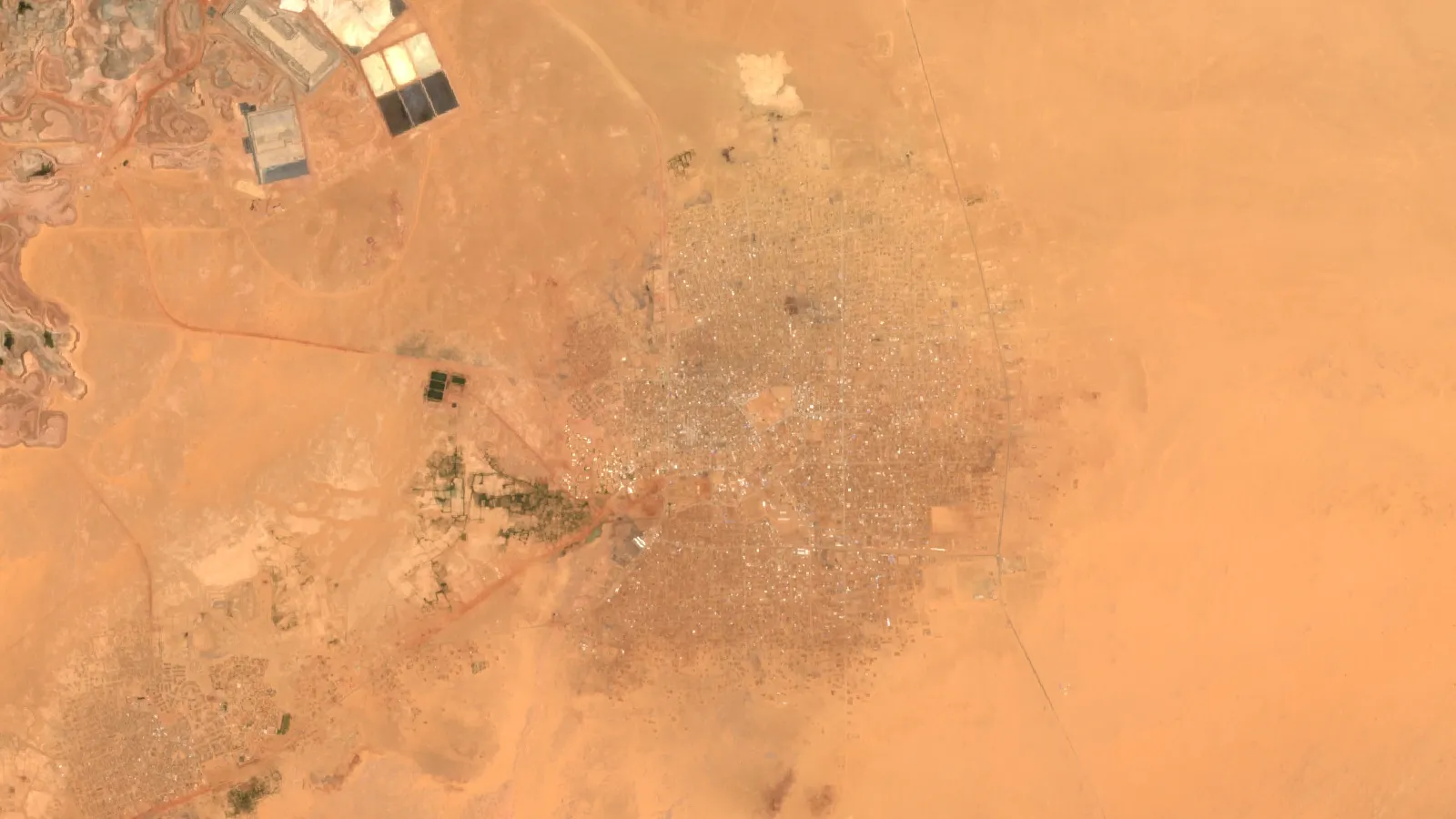
Niger mined 962 tonnes of uranium in 2024, about 1.6% of world output, according to the World Nuclear Association (WNA). Almost all of it came from one mine, SOMAÏR at Arlit, which the Niger state nationalised in June 2025. France and the rest of the EU have nearly stopped buying from Niger: the Euratom Supply Agency recorded just 33 tonnes of Niger-origin uranium delivered to EU utilities in 2025, against 1,154 tonnes in 2024. This page covers each mine and project, who controls it, the stockpile dispute, the water and tailings questions at Arlit and Akokan, and the local economy.
A quick word on units. Uranium output is reported in tonnes of uranium metal (tU). Buyers trade a different product, uranium oxide concentrate or “yellowcake” (U3O8), priced per pound. One tonne of uranium equals about 2,600 pounds of U3O8, which is the factor used in the calculator below.
How much uranium does Niger produce
Niger’s output has fallen by more than three quarters since its peak. The WNA’s country profile lists 4,667 tU in 2012 and 962 tU in 2024. Two things drove the fall. First, the COMINAK underground mine at Akokan closed in March 2021 after producing about 75,000 tU over more than 40 years. Second, after the July 2023 coup SOMAÏR could no longer export, and its output dropped from 2,020 tU in 2022 to 1,130 tU in 2023 and 959 tU in 2024 (WNA, Uranium in Niger, updated August 2026).
Chart
Niger uranium mine production
Tonnes of uranium (tU), selected years
Niger still matters for the long term because of what is in the ground. The WNA’s resource table lists 412,500 tU of identified resources recoverable at under US$130 per kg of uranium, about 5% of the world total (WNA, World Uranium Mining Production). The deposits are sandstone-hosted: uranium that was carried by groundwater and deposited in porous sandstone layers of the Tim Mersoï basin, on the southern edge of the Sahara near Arlit and the Aïr mountains.
Cumulative production from 1945 to 2024 was 158,889 tU, which ranks Niger ninth in the world on that measure. Ore grade matters here: SOMAÏR mined open-pit ore at roughly 0.2 to 0.35% uranium, which is low compared with the Canadian unconformity deposits, while the underground COMINAK ore averaged about 0.4% in 2015 (WNA). Grade is the share of the rock that is uranium, so a 0.3% ore holds 3 kg of uranium in every tonne of rock.
Does France still get uranium from Niger
For all practical purposes, no. France’s reactors produced 373 TWh in 2025, about 68% of the country’s electricity, according to RTE’s annual electricity review as reported by Connaissance des Énergies. Orano, the French nuclear fuel group, was the operator of the Niger mines until it lost control in December 2024. The best public figures cover the whole EU, not France alone, and they come from the Euratom Supply Agency (ESA).
Chart
Niger-origin uranium delivered to EU utilities
Tonnes of natural uranium (tU) per year
The ESA’s 2025 annual report shows how fast Niger dropped out. Niger-origin natural uranium delivered to EU utilities was 3,152 tU in 2016, 2,975 tU in 2022, 1,154 tU in 2024 and 33 tU in 2025. In 2025 the EU took 5,384 tU from Canada (36.7% of deliveries), 2,981 tU from Kazakhstan, 2,346 tU from Russia and 1,522 tU from Uzbekistan (ESA Annual Report, 2025). An older figure still repeated online says Niger supplied nearly 25% of EU uranium in 2021 (Nuclear Engineering International); that is no longer the case.
The ESA report also notes that at the end of 2025 Niger signed an agreement with Russia to cooperate on uranium mining and possibly open new mines. The report gives no volumes, so treat it as a stated intention.
Niger uranium mines and projects: who controls what
The table gives the status of each named project according to the WNA country profile (updated 24 August 2026) and Orano’s and the press’s reports of the dispute. “Operator” is the company running the site, not the full list of shareholders.
Chart
Natural uranium delivered to EU utilities by origin, 2025
Tonnes of uranium (tU)
| Project | Location and type | Status in the sources |
|---|---|---|
| SOMAÏR (Arlit) | Open pit and heap leach, near Arlit; mining since 1971 | Orano owned 63.4% and SOPAMIN, the Niger state mining-assets company, 36.6%. Orano reported loss of operational control on 4 December 2024. Nationalised June 2025. 959 tU produced in 2024. |
| COMINAK (Akouta, Akokan) | Underground, about 250 m deep; 1978 to 2021 | Closed March 2021 after about 75,000 tU. Orano reported remediation under way since April 2021, planned to last at least 12 years. |
| Imouraren | Large low-grade open-pit deposit about 80 km south of Arlit | Never built. Operating permit withdrawn by Niger in June 2024; Orano filed for arbitration on 20 December 2024. |
| Madaouela (GoviEx, now Atomic Eagle) | Sandstone deposits 15 km from Arlit | Mining rights removed July 2024. Arbitration was suspended in early 2025 while talks continued. A Mining Convention was signed in Niamey in September 2026 with Madaouela Mining Company (60% Atomic Eagle, 40% Niger state), and the arbitration is being discontinued (World Nuclear News, 25 September 2026). |
| Dasa (Global Atomic) | High-grade underground project in the Adrar Emoles area | Mine development reached the orebody in 2024. The company said in August 2026 that first production is scheduled for the second half of 2028, subject to financing. |
| Azelik (SOMINA) | Open pit and underground, alkaline leach, west of Arlit | On care and maintenance since 2015. State media said in May 2024 that restart was being prepared; no commercial production is confirmed. |
Sources for the table: WNA, Uranium in Niger; World Nuclear News, 4 December 2024; World Nuclear News, 21 January 2025. The pre-2023 “impact table” that used to be on this page listed per-mine water and land figures without a source, and it has been removed.
Timeline: from the coup to the Arlit stockpile
- July 2023: the government is overthrown. The Benin border closes, which cuts the traditional export route by truck to Parakou and rail to Cotonou port. Niger says no SOMAÏR uranium has been sold since 26 July 2023 (WNA).
- June 2024: Niger withdraws the Imouraren operating permit. In July 2024 it removes GoviEx’s Madaouela mining rights.
- 4 December 2024: Orano says Nigerien authorities have taken operational control of SOMAÏR. In January 2025 it files for ICSID arbitration, the World Bank’s investment-dispute centre.
- June 2025: the Council of Ministers nationalises SOMAÏR.
- September 2025: an ICSID tribunal orders Niger not to sell, transfer or help transfer uranium produced by SOMAÏR (World Nuclear News, 1 December 2025).
- 27 to 30 November 2025: Orano condemns a reported shipment from the site as illegal. President Abdourahamane Tiani announces that Niger will sell its uranium on the international market.
- May 2026: the Council of Ministers adopts decrees to annul the 1968 Arlit concession held by France’s CEA and to create a new state company, TSUMCO SA, in place of SOMAÏR. On 21 August 2026 the Council of Ministers adopted the draft decree awarding the In Azaoua large uranium mining permit, covering the former SOMAÏR perimeter at Arlit, to TSUMCO (World Nuclear News, 26 August 2026; also The Global Analyst, 29 September 2026).
- July 2026: in its half-year results Orano said no reconciliation was possible, as there was no channel for discussion with Niamey (AFP via Connaissance des Énergies, 31 July 2026).
Chart
Niger mine output by operation, 2018 and 2024
Tonnes of uranium (tU)
On the stockpile, President Tiani said in a televised address that uranium produced before the takeover would be allocated to Orano in proportion to its historical stake, while output since then belongs to the Niger state (Africa Business Insight). Orano disputes this and the ICSID provisional order remains the controlling legal document. Nigerien officials said roughly 2,000 tonnes of uranium have been produced under state control since nationalisation (Africa Business Insight); Orano has not published a figure for the stock. No final ICSID ruling date has been set.
What is a uranium stockpile worth at your price
The size of the stockpile is the number everyone argues about, so the calculator below lets you test it. Enter a quantity in tonnes of uranium, a U3O8 price per pound and the share you want to value. The defaults are round examples, not Niger’s actual inventory or a quotation.
Calculator
What is a uranium stockpile worth at your price?
Enter your own quantity, price and share.
- Pounds of U3O8 in stock: 2,599,800
- Value of 100% at your price (US$): $207,984,000
Example values only, not Niger’s inventory or a quote. 1 tonne of uranium is about 2,599.8 lb of U3O8 (molar-mass ratio 1.1792 x 2,204.62 lb per tonne). Prices are inputs: use today’s price.
Environmental legacy at Arlit and Akokan
Uranium mining leaves two lasting issues: tailings and water. Tailings are the finely ground waste left after the uranium is leached out. They still contain radium and other decay products, and they give off radon gas. At Arlit, the independent French laboratory CRIIRAD said that about 20 million tonnes of tailings lie on the surface and that groundwater near the former COMINAK site is affected, a risk it linked to the drinking water of more than 100,000 people (Nuclear Engineering International). CRIIRAD questioned whether a planned two-metre clay and rock cover would last long enough.
Orano’s April 2023 statement answering media reports on its Niger sites said the sites were certified to ISO 14001, that COMINAK remediation began in April 2021 and would run for at least 12 years, to 2032, and that it monitors workers with dosimeters and funds a regional health observatory (Orano, Responses to reports and articles on Orano in Niger). Both positions are on the record.
Water is the second concern in a desert region. Arlit and Akokan depend on groundwater from deep aquifers, and uranium leaching uses large volumes of it. The old figure on this page of 1,000 cubic metres per tonne of uranium had no source and has been removed. For how falling water tables are measured and slowed, see our guide on reversing groundwater loss.
▶ The seven environmental impacts of mining, explained in clay · 2:31
Local economy and who benefits
Mining has been the main formal employer in the Agadez region for decades. Orano stated in 2023 that the State of Niger received 85% of the direct economic benefits of its mining companies, and that mining was about 5% of Niger’s GDP. Those are company figures. The loss of export revenue since 2023 has hit the Niger treasury and the towns, and Orano said that 87% of COMINAK’s former staff had been reclassified to other roles after the 2021 closure (same Orano statement). The group counted nearly 800 employees across its three Niger sites at that time.
The new government frames the changes as sovereignty over its resources. Analysts quoted in the press expect the dispute to set a precedent for other African producers renegotiating with long-standing foreign operators (Africa Business Insight). For buyers, the practical lesson is supply diversification: the ESA says it favours sourcing from a wide range of origins because EU mining output is nil and some utilities rely on one supplier.
▶ What mining does for an economy: exports, jobs and revenue · 5:03
How satellite data helps check a uranium district
For consultants and explorers, the Niger story shows that a licence is only as useful as the data behind it. Sandstone-hosted uranium leaves surface signs that multispectral satellite imagery can map, such as bleached or altered ground, iron staining and old drainage channels. These maps rank where to drill first. They do not give a resource estimate, and any anomaly needs field checks and drilling. The same imagery also shows tailings footprints, roads and land-cover change, which helps with planning and monitoring before and after mining. Farmonaut offers satellite-based mineral detection that covers uranium among its target minerals, and you can request a quote for your own project area.
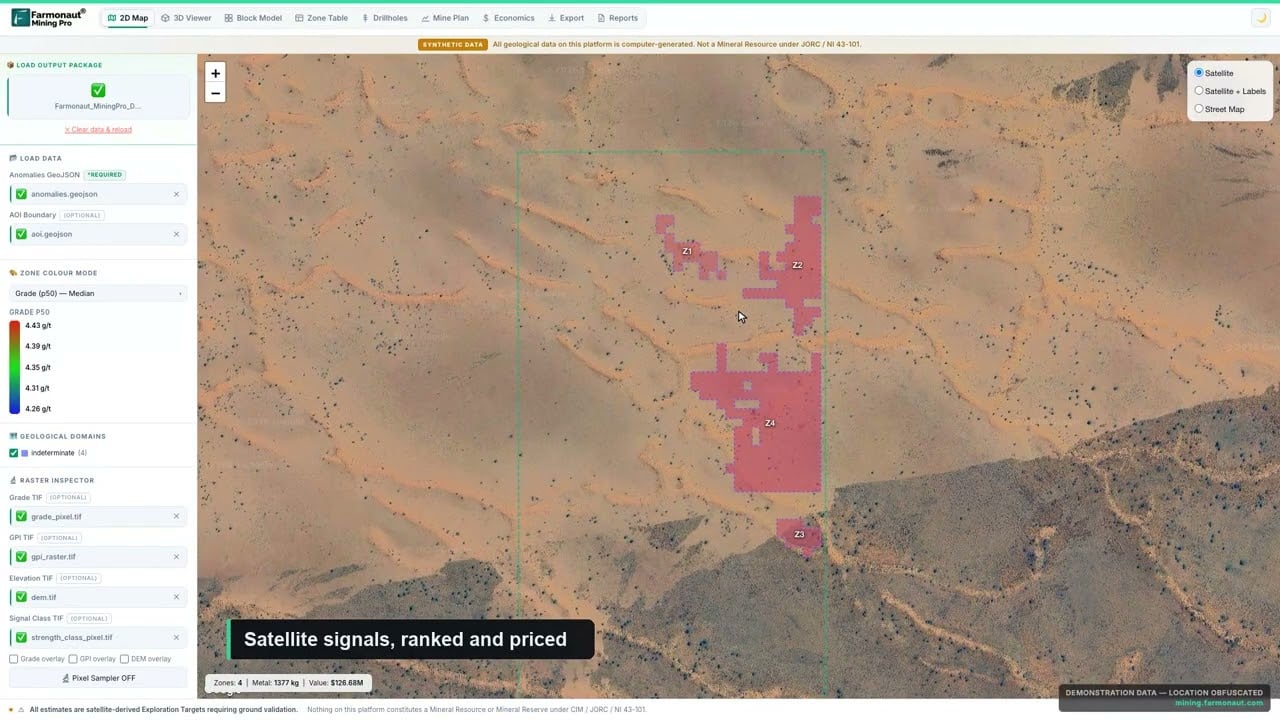
▶ What Farmonaut Mining Pro does with a licence boundary · 4:56
How to read uranium numbers in news about Niger
Three checks avoid most confusion. First, ask whether a figure is tonnes of uranium (tU) or tonnes of U3O8: the second is about 18% larger for the same metal. Second, separate what was mined from what was sold; since 2023 Niger has mined some uranium it has not been able to ship. Third, check whether a number refers to France or to the whole EU. The ESA publishes EU-wide origin data, and a single country’s share can look very different from the EU share. Reserves, resources and production are also different things: resources are what the rock may hold, reserves are what can be mined at a price, and production is what left the mill.
What to watch next
- An ICSID final decision on SOMAÏR, which would settle who owns the stored uranium.
- Whether any Niger-origin uranium reaches a buyer, and by which route, since the Benin corridor has been closed since 2023.
- Dasa financing and the 2028 production target, the only named project the WNA lists with a scheduled first production date.
- Whether Atomic Eagle’s Madaouela arbitration is formally withdrawn, and the outcome of the Imouraren arbitration.
- The next Euratom Supply Agency report, which shows whether Niger-origin deliveries to the EU recover from 33 tU.
Related reading on this site: Silver Lake Resources Limited Is Now Vault Minerals.
We cover a connected topic in Uranium Miners in Australia: Mines, Owners, Output.
Frequently asked questions
How much uranium does Niger produce?
962 tonnes of uranium in 2024, about 1.6% of world mine output, down from 4,667 tonnes in 2012 (WNA, updated August 2026).
Does France still buy uranium from Niger?
Almost none arrives. Niger-origin uranium delivered to EU utilities fell from 1,154 tonnes in 2024 to 33 tonnes in 2025 (Euratom Supply Agency). The ESA reports for the EU as a whole, not France alone.
Who owns the uranium mines in Niger now?
The state took over SOMAÏR, the only large producing mine, in June 2025 and planned a new state company, TSUMCO, to run it. COMINAK is closed, Imouraren and Madaouela had their permits or rights withdrawn (Madaouela was re-granted to a company 40% owned by the state in 2026), and Dasa is a Global Atomic project in which the state holds 20%.
Why can Niger not export its uranium?
The traditional route runs by road to Benin and then to Cotonou port, and the Benin border has been closed since July 2023. A provisional order from the ICSID tribunal also bars Niger from selling SOMAÏR uranium without Orano’s consent, a point Niger rejects.
What happened to the Imouraren uranium project?
Imouraren is a large, low-grade deposit that Orano planned to mine at up to 5,000 tU per year. Niger withdrew its operating permit in June 2024 and Orano began arbitration in December 2024.
What is TSUMCO?
Teloua Safeguarding Uranium Mining Company, a Niger state company created in 2026 to replace the nationalised SOMAÏR, according to the WNA and trade press.
Is the Arlit area contaminated by uranium mining?
CRIIRAD reports surface tailings and affected groundwater at the former COMINAK site; Orano says its monitoring shows levels within Nigerien and international norms. Both statements are attributed to their authors.
Where is the uranium in Niger?
Mainly in the Agadez region around the towns of Arlit and Akokan, about 900 km north-east of Niamey, in the western Aïr mountains and Tim Mersoï basin (WNA).
How much of France’s electricity comes from nuclear power?
Nuclear plants produced 373 TWh in 2025, about 68% of France’s electricity (RTE’s 2025 review).
Which countries supply uranium to the EU?
In 2025 the largest suppliers were Canada (36.7%), Kazakhstan (20.3%) and Russia (16.0%), followed by Uzbekistan, Australia and Namibia (ESA Annual Report 2025).
Can uranium be found with satellite data?
Satellites cannot see uranium deep underground. They map surface alteration and structure that guide where to sample and drill, so the results are targets, not a resource estimate.
This page is for information only. It is not investment advice and not legal advice. Mining rights, permits and arbitration outcomes change; confirm the position with the regulator and the court record. Do not enter a mine, tailings area or radiation-controlled zone without the operator’s permission and trained supervision.
Farmonaut mining
Map your mining site from space
Send a licence boundary and get a satellite screen of surface alteration and land cover to plan field work.
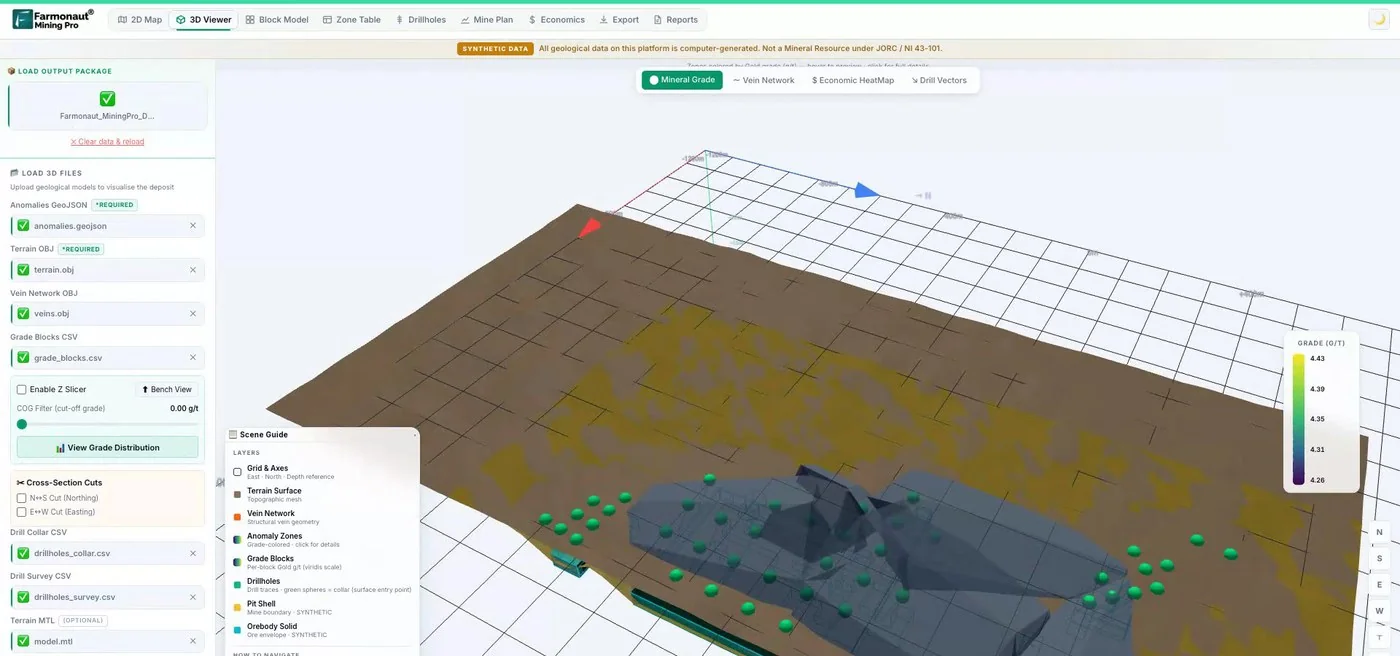
Mining Pro sample view, synthetic data
Keep reading
Sources
- World Nuclear Association, Uranium in Niger (24 August 2026): world-nuclear.org
- World Nuclear Association, World Uranium Mining Production: world-nuclear.org
- Euratom Supply Agency, Annual Report 2025: euratom-supply.ec.europa.eu
- World Nuclear News, Niger reveals plans to sell Somaïr uranium (1 December 2025): world-nuclear-news.org
- World Nuclear News, Nigerien authorities in control of SOMAÏR (4 December 2024): world-nuclear-news.org
- World Nuclear News, Orano lodges second arbitration (21 January 2025): world-nuclear-news.org
- Orano, Responses to reports and articles on Orano in Niger (April 2023): orano.group
- Nuclear Engineering International, Uranium mining waste threatens Niger’s water supply: neimagazine.com
- Africa Business Insight, Niger sets terms for uranium stockpile: africabusinessinsight.com
- The Global Analyst, Niger formalises end of Orano’s uranium monopoly (29 September 2026): theglobalanalyst.com
- Connaissance des Énergies, RTE 2025 low-carbon electricity record: connaissancedesenergies.org
- Connaissance des Énergies (AFP), Orano half-year results (31 July 2026): connaissancedesenergies.org
- World Nuclear News, Niger awards Arlit uranium mining permit to state-owned company (26 August 2026): world-nuclear-news.org
- World Nuclear News, Agreement clears way for resumption of Niger uranium project (September 2026): world-nuclear-news.org
Discussion
Questions, corrections or field experience? Share them below. First-time comments are reviewed before they appear, and your email is never published.
No comments yet. Be the first to add a question or your experience.

 Almosi SARL
 SRK Consulting
 Berks Gold Limited
 Mwerezi Minerals Company Limited
 Mining SARL
 SenGold Invest SAS
 Sean Mining Limited
 NTS Group (Pty) Ltd
 Mine4Africa
 Lithspo Minerals Limited
 Tintina Mining Group
 Dalgety Minerals Pty Ltd
 Vortex Minerals Pty Ltd
 Faith At Work (Pty) Ltd
 Geotech Mining Solutions plc
 Licence holder · Nigeria · Gold + lithium










