

Uranium · State guide
Uranium Mining in Utah: Mines, Mills and Moab Cleanup
Utah’s uranium comes from Energy Fuels’ La Sal and Pandora mines and the White Mesa Mill; Anfield’s Velvet-Wood is being reopened, and the Moab tailings cleanup has moved 17 million tons. Projects compared, with dated facts, claim fees and a calculator.
Key takeaways
- The White Mesa Mill near Blanding was the only one of four US uranium mills and heap-leach facilities listed as operating at the end of 2025 (EIA, June 2026).
- Energy Fuels mined 740,000 lb of U3O8 in the first half of 2026 across Arizona and Utah; about 115,000 lb came from the Utah La Sal and Pandora mines (our calculation: 740,000 minus about 625,000 lb from Arizona’s Pinyon Plain, company figures, 5 August 2026).
- Velvet-Wood fired its first underground blast in nearly 40 years in August 2026 but was not producing; treated-water discharge was targeted for November 2026 (Anfield, 10 September 2026).
- Utah produced about 130 million lb of U3O8 in total, 54 million lb of it from the Lisbon Valley district (Utah Geological Survey, 2007).
- Most of the Moab tailings pile has left the Colorado River bank: 17 million tons of tailings and other contaminated material moved by 29 September 2026, with closure expected in 2029 (US Department of Energy, GAO).
In this article
- Utah uranium mining at a glance
- Utah uranium companies and projects compared
- Where Utah's uranium is found
- How the Utah boom began in Moab
- What the Moab tailings cleanup has achieved
- US uranium output and imports in numbers
- Where US reactors buy their uranium
- Uranium price and what it means for Utah mines
- Permits, claims and fees for Utah uranium ground
- Environmental and community concerns
- How satellite screening fits Utah uranium exploration
- What to watch next
- Frequently asked questions
Utah’s uranium output today comes from a short list of sites: Energy Fuels’ La Sal and Pandora mines in the east of the state, and its White Mesa Mill near Blanding, which the US Energy Information Administration (EIA) lists as the only one of the four US uranium mills and heap-leach facilities it lists as operating at the end of 2025. A second company, Anfield Energy, is reopening the Velvet-Wood mine south of Moab but is not yet producing. Over the whole history of the state, the Utah Geological Survey puts cumulative output at about 130 million pounds of U3O8 (2007 estimate), which made Utah the third-largest uranium state. This guide lists each live Utah project with a dated status, then covers the geology, the Moab boom and cleanup, prices, claim fees and what to check before spending money.
A few terms first. U3O8 is triuranium octoxide, the powder (often called yellowcake) that a mill makes from uranium ore and that is the first step towards reactor fuel, as the EIA explains. A mill is the plant that crushes the ore and extracts the uranium. Tailings are the waste left after that extraction. Grade is the share of uranium in the rock, quoted here as a percentage of U3O8. Vanadium is a steel-alloy metal that occurs with uranium in Utah’s sandstones, so many Utah projects count both. All dates and prices below are as of 15 October 2026 unless a different date is given.
Utah uranium mining at a glance
The table shows the main projects that are mining, being reopened or being prepared in Utah, plus the one federal cleanup that shares the name Moab with the boom years. Status lines carry the date of the source.
| Project | Owner | Where | Status and date |
|---|---|---|---|
| White Mesa Mill | Energy Fuels | Near Blanding, San Juan County | Operating. A conventional ore run began in Q4 2025 and finished in Q2 2026 with about 2.3 million lb of U3O8; the next run is planned for Q4 2026 or early 2027 (company, 5 August 2026) |
| La Sal and Pandora mines | Energy Fuels | Eastern Utah | Mining. About 115,000 lb of contained U3O8 mined in the first half of 2026 (calculated from company figures) |
| Velvet-Wood mine | Anfield Energy | San Juan County, about 35 miles south of Moab | Being reopened. First underground blast announced 27 August 2026; no production yet (company, 10 September 2026) |
| Shootaring Canyon Mill | Anfield Energy | Garfield County, near Ticaboo | On standby at the end of 2025 (EIA, June 2026); restart needs a renewed state licence, which Anfield expects by the end of 2026 (company, 8 June 2026) |
| San Rafael project | Western Uranium & Vanadium | Emery County | Exploration permits in place; drilling and a shaft planned (company, 14 August 2026) |
| Moab tailings cleanup | US Department of Energy | Edge of Moab, Grand County | Cleanup, not mining. 17 million tons moved by rail by 29 September 2026 |
Sources: EIA 2025 Domestic Uranium Production Report (mill status), Energy Fuels second-quarter 2026 results, the US Department of Energy, plus company releases linked in the sections below. The La Sal and Pandora figure is the company’s 740,000 lb mined in the half-year minus the 625,000 lb it reports for Pinyon Plain, an Arizona mine that also feeds the Utah mill.
Utah uranium companies and projects compared
This is a factual comparison of three of the companies with live Utah uranium work, not a ranking of investments. “Who may want to follow it” says what a reader gets from tracking each one. For the wider US company list, including the in-situ recovery producers in Wyoming and Texas, see our guide to uranium in the USA.
1. Energy Fuels: White Mesa Mill, La Sal and Pandora
Who may want to follow it: readers who want the one Utah operation that is producing now.
Energy Fuels (NYSE American: UUUU; TSX: EFR) mined 315,000 lb of U3O8 across its Pinyon Plain, La Sal and Pandora mines in the second quarter of 2026, and 740,000 lb in the first half, according to its results release of 5 August 2026. Its full-year guidance is 2.0 to 2.5 million lb mined. The company’s La Sal Complex page describes a group of uranium and vanadium mines in eastern Utah (Beaver, Pandora, La Sal, Energy Queen and Redd Block) with an inferred resource of 0.8 million tons at 0.26% U3O8 (a 2018 estimate). Inferred means the least certain resource class.
The White Mesa Mill has a licensed capacity of more than 8 million lb of uranium a year and about 150 staff at full operation, and the company says it is the largest employer in San Juan County. The mill also has a separate vanadium circuit and is adding rare earth processing. That shift matters to other Utah miners: Anfield’s director said in late 2025 that Energy Fuels has shifted its focus away from uranium toll milling towards rare earths, which is one reason Anfield wants its own mill (Salt Lake Tribune, 7 November 2025).
- Pros: a licensed, working mill; stockpiled ore; reported production cost of about US$23 per lb on its high-grade Arizona ore, against a spot price of US$86.50 per lb on 31 July 2026 (company and TradeTech).
- Cons: most of the high-grade ore in 2026 came from Arizona, not Utah; the company gives a cost only for its Arizona ore, not for La Sal or Pandora; the company’s growth plans now lean towards rare earths.
- Facts row: mill run planned Q4 2026 or early 2027; spot US$86.50 and long-term US$97.00 per lb (TradeTech, 31 July 2026).
2. Anfield Energy: Velvet-Wood and Shootaring Canyon
Who may want to follow it: readers following a Utah mine that is being brought back from closure.
Anfield Energy (Nasdaq: AEC; TSX-V: AEC) owns Velvet-Wood, an underground uranium and vanadium mine that last produced in 1984, and the Shootaring Canyon Mill. The Bureau of Land Management (BLM) approved the Velvet-Wood plan on 23 May 2025, 11 days after Interior set a 14-day review window, and the mine portal reopened on 6 November 2025, according to the Salt Lake Tribune. On 10 September 2026 the company said the Utah Division of Water Quality had given concept approval for its water treatment plan and that it was targeting treated-water discharge as early as 7 November 2026, subject to final approval. It expects the decline to dewater in about a month of pumping and the full workings in two to three months (Anfield release).
The company’s preliminary economic assessment, filed on SEDAR+ in June 2026, estimates the Velvet and Wood historical mines at 0.63 million tons with 4.3 million lb of eU3O8 at 0.34% in the measured and indicated classes, plus a smaller inferred portion (release of 18 June 2026). The “e” means the grade comes from gamma-ray logs of drill holes rather than from chemical assays. A preliminary economic assessment (PEA) is an early-stage study: this one assumes uranium at US$100 per lb, includes inferred resources and is not a reserve estimate or a forecast.
- Pros: BLM approval and a state-approved mine plan and reclamation bond for Velvet-Wood, plus a mill site that already exists; the PEA puts mill upgrade spending at US$80.1 million.
- Cons: no production yet; Shootaring is on standby and needs its state licence renewed, which Anfield expects by the end of 2026, with production resuming in 2027 (company, 8 June 2026); the first ore still depends on mine-water, safety and county approvals, and the PEA’s larger plan adds Colorado projects.
- Facts row: Shootaring capacity 750 tons of ore a day today, with the PEA designing for 1,000; Velvet-Wood sits in San Juan County, about 35 miles south of Moab (AP, June 2025).
3. Western Uranium & Vanadium: San Rafael and the Green River mill site
Who may want to follow it: readers who want an early-stage Utah exploration project.
Western Uranium & Vanadium Corp. has its head office in Toronto. Its main mines are across the border in Colorado, but its second-quarter 2026 management report describes two Utah projects. The San Rafael project in Emery County has all permits needed for monitor wells and a shaft, with a first drilling stage of five groundwater wells to about 1,000 feet. The company also owns land at Green River, Utah, for a proposed Maverick Minerals Processing Plant, but its August 2026 report says that work is deferred while it puts a previously licensed mill site in Colorado (Mustang, formerly Pinon Ridge) first. In 2025 it delivered about 1,600 tons of Colorado ore to the White Mesa Mill under a one-year purchase agreement with Energy Fuels.
- Pros: several Utah and Colorado properties; an ore sale already completed with a Utah mill.
- Cons: neither Utah project is producing; the Green River mill work is deferred and any new mill would need a licence.
How we chose these three
We included only companies with a Utah uranium project that had an official or company document dated in 2026 and that we could open. We left out dormant claim holders and projects with no 2026 update. Companies are shown in the order of where they are in the cycle: producing, restarting, early stage. Nothing here is a view on any share price.
Where Utah’s uranium is found
Nearly all Utah production came from sandstone beds on the Colorado Plateau, in the south-east of the state. A Utah Geological Survey paper (2007) says the ore bodies sit in tabular or roll-front shapes (a roll front is a curved body formed where uranium-carrying groundwater meets chemically reducing rock) and line up along old stream channels. The principal host rocks are the Triassic Chinle Formation, which supplied roughly 80% of Utah’s uranium ore, the Jurassic Morrison Formation, which is the leading source of vanadium, and a smaller share from the Permian Cutler Formation (Krahulec, Geological Society of America, 2007).
The same paper names the Lisbon Valley district, south-east of Moab, as Utah’s largest, with nearly 54 million lb of U3O8 produced. It lists the largest known unmined resource then as about 20 million lb at the Bullfrog and Tony M deposits in the Henry Mountains, and says exploration was focused on Lisbon Valley, La Sal, La Sal Creek and the Henry Mountains. Those are 2007 figures: they show where the rock is favourable, not what is economic today. At the national scale the World Nuclear Association notes that resources on the western Colorado Plateau need conventional mining and milling, and that the United States ranks 14th for known resources recoverable at up to US$130 per kg of uranium (about US$50 per lb U3O8), with about 1% of the world total (World Nuclear Association).
For anyone planning a claim block, the practical lesson is that Utah uranium is small, scattered and low to moderate in grade, so mills matter. That is why the three company stories above each depend on a mill.
How the Utah boom began in Moab
Charles Steen, an out-of-work oil geologist, drilled into a uranium-rich bed south-east of Moab in July 1952, in the Lisbon Valley area. His Mi Vida mine moved 4,000 tons of ore within four months and in time delivered more than US$100 million worth of ore, according to the Science History Institute. Moab’s population jumped from about 1,200 to 7,000. A processing mill beside the Colorado River operated under private ownership from 1956 to 1984 (US Department of Energy). When the mining stopped, the town turned to tourism; the Associated Press put its population at about 5,200 in 2025.
US output then fell sharply. The World Nuclear Association records a peak of 16,800 tonnes of uranium in 1980 from more than 250 mines, with only 50 mines left by 1984, after federal subsidies had promoted the 1950s boom. Several of the live Utah projects today, including Velvet-Wood and the La Sal mines, are old workings being reopened rather than new discoveries.
What the Moab tailings cleanup has achieved
The mill’s leftovers did not go away. The DOE’s Moab project covers a 480-acre site with an estimated 16-million-ton pile of tailings next to the Colorado River. Since 2009 crews have moved the material by rail to an engineered disposal cell near Crescent Junction, about 30 miles north. On 29 September 2026 the DOE reported that 17 million tons had been removed, and in April 2026 the DOE marked the complete disposal of the tailings pile at a cumulative 16 million tons of residual radioactive material. The total is above the 16-million-ton pile estimate because the waste also includes buried mill buildings and equipment, and soil under the pile is still being removed.
A US Government Accountability Office report of July 2026, summarised by the American Nuclear Society, puts the project cost at about US$970 million to date and about US$1.16 billion at completion. Work left includes removing soil under the former pile, regrading, covering the disposal cell and, last, a final groundwater remedy, whose design is due to go to the Nuclear Regulatory Commission in 2027. Since 2003 an interim system has pulled about 1 million lb of ammonia and more than 5,000 lb of uranium out of the groundwater. Closure is expected in 2029, and the DOE may transfer most of the mill site to Grand County, which has floated a park or music venue (KUER, 2 October 2026).
The main lesson for any new Utah uranium project is that closure and groundwater costs run for decades after the last ore leaves. A Utah mine notice comes with a reclamation surety, so the cost is planned from the start.
▶ Explains the seven environmental impacts of mining in plain words, with satellite maps and sourced facts (2 min 31 s). · 2:31
US uranium output and imports in numbers
Utah-only production is not published, because the EIA withholds state figures that would reveal single companies. The national numbers give the context. US mills and in-situ plants produced about 2.1 million lb of U3O8 in 2025, up from 657,000 lb in 2024 and the most since 2017, and US uranium employment reached 711 full-time person-years, the highest since 2014 (EIA, June 2026). Exploration drilling rose to 1,824 holes in 2025 from 1,324 in 2024.
Chart
US uranium concentrate production, selected years
Thousand pounds of U3O8; 2020 withheld by EIA
The recovery is real but small next to demand. US reactor owners bought 46.9 million lb of U3O8 equivalent in 2025 at a weighted average price of US$58.46 per lb, so domestic mines supplied a small slice of what the fleet burns.
Where US reactors buy their uranium
Most uranium delivered to US reactors in 2025 was imported. Canada supplied 32%, Kazakhstan 28% and Australia 15%; US-origin material was 7% of deliveries (EIA, 28 August 2026). AP reported in 2025 that the country imports about 98% of the uranium it uses and that Russian uranium imports had been banned since 2024, which is the policy backdrop for the push to reopen Utah mines (AP via PBS, June 2025). Those two figures use different bases (one is a share of 2025 deliveries, the other a general import share), so compare them with care.
Chart
Origin of uranium delivered to US reactors, 2025
Share of U3O8 equivalent delivered; selected origins shown
Uranium price and what it means for Utah mines
Uranium is not traded on an open exchange. Buyers and sellers agree contracts privately, and Cameco publishes industry average prices built from month-end figures of the price reporters UxC and TradeTech (Cameco). At the end of September 2026 the spot price averaged US$89.63 per lb and the long-term contract price US$96.50. Spot is the price for delivery within weeks; long-term is the price in contracts running several years. Mine owners with long-term contracts depend more on the second figure.
Chart
Uranium spot and long-term prices at quarter ends
US$ per lb U3O8; industry average of UxC and TradeTech month-end prices
Costs differ widely between ore bodies. Energy Fuels reported US$14 per lb of mining and transport plus about US$9 per lb of milling for its high-grade Pinyon Plain ore, about US$23 per lb in total, and said this is at the bottom of its US$23 to US$30 range. The company gives no cost figure for its Utah mines. Anfield’s PEA, by contrast, assumes US$100 per lb. The calculator below lets you test your own grade, recovery, price and cost. It uses short tons (2,000 lb), the unit Utah operators and the EIA report in.
Calculator
What is a ton of uranium ore worth?
Enter your own grade, recovery, price and cost. Results update as you type.
- Gross value at your price: $459,000
- Mining and milling cost: $200,000
- Margin before royalty, tax and capital: $259,000
- Break-even grade at these inputs (% U3O8): 0.13
Example values only, not a forecast or a benchmark. Tons are short tons of 2,000 lb. The price is an input: use today’s price. The cost per ton is an example for you to replace. For comparison, Energy Fuels reported about US$23 per lb for very high-grade Arizona ore (company, 5 August 2026) and Anfield’s study assumes US$100 per lb. Margin excludes royalties, tax, capital and closure costs. Money is in US$.
Permits, claims and fees for Utah uranium ground
Most uranium ground in Utah is federal land managed by the BLM, plus state trust land and private land. This section covers the federal claim fee schedule and the state notices for exploring or mining. Not legal advice; confirm with the BLM and the Utah Division of Oil, Gas and Mining before you stake or dig.
- BLM lode claim, first year: US$25 processing fee, US$49 location fee and US$200 maintenance fee, US$274 in total per claim, based on the schedule updated 9 February 2026 (BLM). The notice says fees may change on 1 July 2026, so check the current page.
- Each later year: US$200 per lode claim, due on or before 1 September. Placer claims pay US$200 for each 20 acres or part of that.
- Small-miner waiver: a claimant and all related parties with 10 or fewer claims nationwide can file for a waiver of the maintenance fee and pay US$15 per claim for an affidavit of assessment work, due by 30 December (BLM fees page).
- Utah exploration notice: any surface-disturbing exploration, including drilling, needs a notice to the state, with a US$150 fee each year until reclamation is released and a progress report by 31 December.
- Utah mine notices: a small mining operation disturbs 10 or fewer acres in an incorporated area or 20 or fewer in an unincorporated one, with a US$150 annual fee. A large operation disturbs more, with annual fees of US$500 for 10 to 50 acres and US$1,000 above 50 acres (Utah Division of Oil, Gas and Mining).
Building a mill or running an in-situ plant needs separate radioactive-materials licences that are beyond this guide. Our guide to BLM mining claim fees and filing covers the federal process step by step. Safety note: get permission and the right permit before entering any claim or old mine, stay off other people’s claims and protected land, never enter abandoned workings, and avoid mercury and uranium dust. Old adits can hold bad air and radon.
Calculator
What does a block of lode claims cost to hold?
Enter the number of claims, years and fees. Results update as you type.
- First-year cost per claim: $274
- Yearly cost per claim after year one: $200
- Utah exploration notice fees: $300
- Total including Utah exploration fees: $11,040
Example values only. Uses the BLM fee schedule updated 9 February 2026 for lode claims: US$274 in year one (US$25 processing, US$49 location, US$200 maintenance) and US$200 a year after. The waiver only applies when you enter 10 or fewer claims (the tool ignores it above 10). With the small-miner waiver (10 or fewer claims nationwide), year one is US$104 (location, processing, a US$15 affidavit and a US$15 notice of intent) and later years US$15. Placer claims are charged per 20 acres and are not covered. The state fee is US$150 a year for an exploration notice. Fees can change: confirm with the BLM. Money is in US$.
Environmental and community concerns
The Velvet-Wood approval drew criticism. Sierra Club Utah and the Center for Biological Diversity said the 14-day review left no time for public or tribal input, and about 20 people from Moab and the White Mesa Ute Mountain Ute community protested near the site on 21 June 2025 (Salt Lake Tribune). The BLM found no significant impact, noting about three acres of new surface disturbance beyond the 22 acres permitted in the 1980s, and Anfield says the data behind the review were filed in 2024. Both views are part of the record.
The cleanup at Moab is the reason many residents are wary. The AP reported that the mill’s legacy makes some Moab residents cautious about restarting uranium processing. For readers weighing the impacts of mining more widely, our guide to abandoned uranium mines on Navajo land covers the legacy issue in the neighbouring state.
How satellite screening fits Utah uranium exploration
Satellites cannot see uranium underground. They can map surface clues over a licence or claim area: iron-oxide staining, bleached or clay-altered sandstone, faults and old channel patterns, which help decide where to send field crews. Radiometric surveys, sampling and drilling still decide whether a target is real. Farmonaut’s satellite-based mineral detection covers uranium among 20+ minerals, takes KML, KMZ or polygon input and returns an exploration-target report in 5 to 20 business days. Its results are targets that sit ahead of a resource estimate. They do not replace one and they do not guarantee a find.
If you hold ground in Utah and want a screening quote, use the mining quote form or contact us.
▶ Explains the six families of remote sensing instruments and why agreement between them matters (2 min 1 s). · 2:01
What to watch next
- November 2026: Anfield’s target for treated-water discharge at Velvet-Wood, which starts the dewatering of the old workings.
- Q4 2026 or early 2027: the next conventional ore run at White Mesa.
- 2027: Anfield expects the Shootaring Canyon licence renewal by the end of 2026 and a return to production in 2027, and the DOE expects to submit the final Moab groundwater remedy design to the Nuclear Regulatory Commission. Both depend on regulators.
- 2029: the DOE’s target to finish Moab site restoration and cleanup.
- Any time: uranium prices. The spot price has stayed between roughly US$84 and US$94 per lb at month ends from January to September 2026 (Cameco).
We cover a connected topic in Hudbay Minerals Flin Flon: Mines, Mills and Status.
Frequently asked questions
Is there uranium mining in Utah today?
Yes, on a small scale. Energy Fuels reported mining at its La Sal and Pandora mines in the first half of 2026 (about 115,000 lb of contained U3O8 by our calculation from its figures) and processes ore at the White Mesa Mill near Blanding. Anfield’s Velvet-Wood mine is being reopened but was not producing as of September 2026.
Where is uranium found in Utah?
Mostly in sandstone on the Colorado Plateau in the south-east: the Lisbon Valley, La Sal and Henry Mountains areas. The ore sits in the Chinle, Morrison and Cutler formations, according to the Utah Geological Survey’s 2007 summary.
Which companies mine uranium in Utah?
Energy Fuels operates the mines and mill that are producing. Anfield Energy is reopening Velvet-Wood and plans to restart the Shootaring Canyon Mill. Western Uranium & Vanadium has a Utah exploration project at San Rafael and a mill site at Green River where work is deferred (company, 14 August 2026).
Is the White Mesa Mill still operating?
Yes. The EIA lists it as operating at the end of 2025 (the only one of the four US uranium mills and heap-leach facilities in the EIA table), and Energy Fuels said it finished a conventional ore run in the second quarter of 2026 and planned another for Q4 2026 or early 2027.
Are there uranium mines in Moab?
Not in the town itself. The big site on Moab’s edge is a former uranium mill, now a federal cleanup. The ore came from mines in surrounding districts such as Lisbon Valley and La Sal. Mi Vida, the 1952 discovery that started the boom, was in the Lisbon Valley area south-east of town.
What happened to the Moab uranium mill tailings?
The DOE has moved 17 million tons by rail to a disposal cell near Crescent Junction, about 30 miles north, as of 29 September 2026. Final site closure and groundwater work run to 2029 and beyond.
How much uranium has Utah produced?
About 130 million lb of U3O8 in total up to 2007, according to the Utah Geological Survey, with nearly 54 million lb from the Lisbon Valley district alone. The EIA does not publish Utah-only output today.
How much does it cost to stake a uranium claim in Utah?
On BLM land a new lode claim costs US$274 in the first year (US$25 processing, US$49 location, US$200 maintenance) under the February 2026 schedule, then US$200 a year. Small holders with 10 or fewer claims may use a waiver and pay US$15 per claim for the assessment affidavit. Confirm current fees with the BLM.
Do I need a permit to explore for uranium in Utah?
If you disturb the surface (drilling, trenching, roads), the Utah Division of Oil, Gas and Mining requires a notice of intention for exploration with a US$150 annual fee, and the BLM has its own notice or plan rules on federal land. Hand sampling that does not disturb the ground is treated differently, so ask the agencies first.
Why is vanadium mined with uranium in Utah?
The two metals occur together in the same sandstones, especially the Morrison Formation. Anfield reports a vanadium-to-uranium ratio of 1.4 to 1 at Velvet-Wood, and Energy Fuels’ La Sal Complex page lists a vanadium resource alongside uranium.
Can satellites find uranium in Utah?
They can map surface alteration and structure that help rank ground before fieldwork, but they cannot measure uranium at depth. Drilling and sampling are still needed to confirm any target.
This page is for information only. It is not investment advice and not legal advice. Company status, prices and fees change; confirm claim and permit rules with the BLM and the Utah Division of Oil, Gas and Mining. Get permission before entering any claim or old mine.
Farmonaut mining
Get a quote to screen your Utah ground from satellite
Farmonaut screens an area of interest from satellite images before field crews go in, and takes KML, KMZ or polygon input.
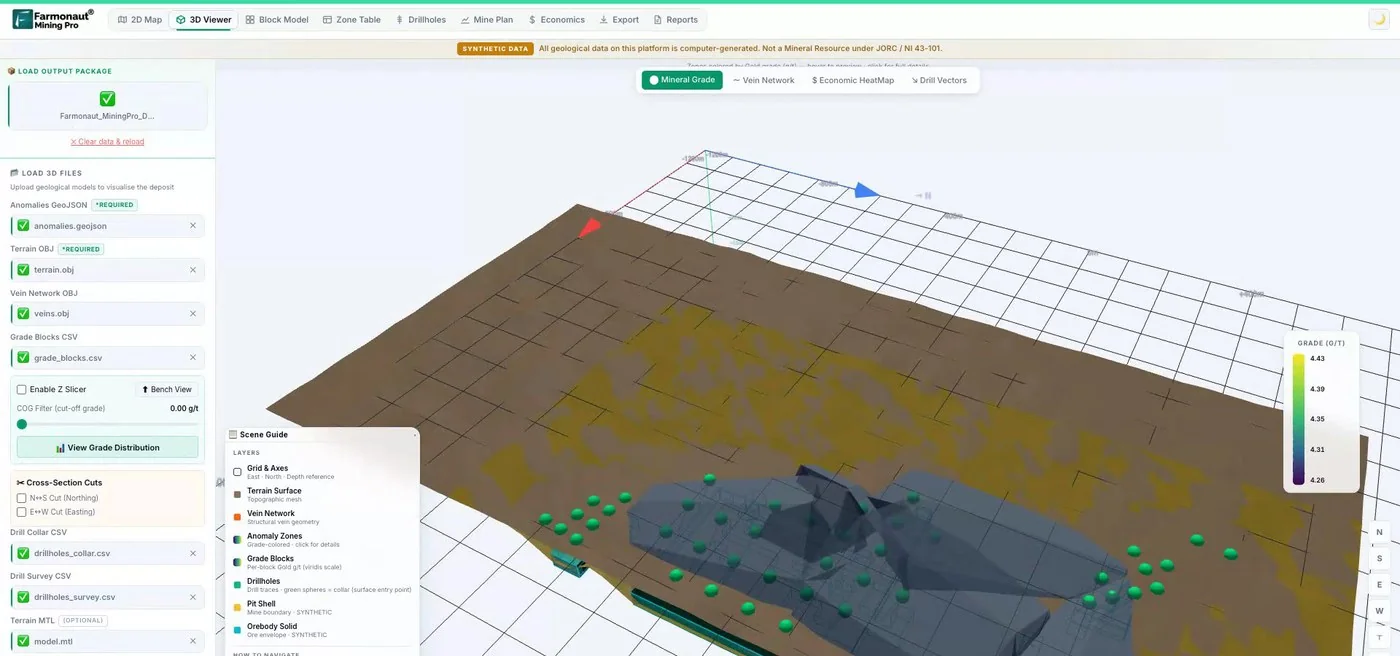
Mining Pro sample view, synthetic data
Keep reading
Sources
- EIA, 2025 Domestic Uranium Production Report (June 2026): eia.gov
- EIA, U.S. uranium production more than tripled in 2025 (28 August 2026): eia.gov
- US Department of Energy, Moab UMTRA Project: energy.gov
- US Department of Energy, Moab Marks Removal of 17 Million Tons (29 September 2026): energy.gov
- American Nuclear Society, GAO report describes cleanup progress at Moab Mill Site (21 July 2026): ans.org
- KUER, The end is in sight for Moab’s uranium tailings (2 October 2026): kuer.org
- Krahulec (Utah Geological Survey), Uranium in Utah, GSA abstract (2007): gsa.confex.com
- World Nuclear Association, US Nuclear Fuel Cycle: world-nuclear.org
- Science History Institute, Uranium Mania: sciencehistory.org
- Energy Fuels, Q2-2026 results (5 August 2026): investors.energyfuels.com
- Energy Fuels, La Sal Complex: energyfuels.com
- Energy Fuels, White Mesa Mill: energyfuels.com
- Anfield Energy, Velvet-Wood dewatering release (10 September 2026): finviz.com
- Anfield Energy, updated preliminary economic assessment release (18 June 2026): stockwatch.com
- Salt Lake Tribune, Velvet-Wood uranium mine construction begins (7 November 2025): sltrib.com
- AP via PBS News, Trump accelerates approval of uranium mine in Utah (June 2025): pbs.org
- Western Uranium & Vanadium, Management’s Discussion and Analysis, Q2 2026: western-uranium.com
- Cameco, Uranium price: cameco.com
- BLM, mining claim fees effective schedule (updated 9 February 2026): blm.gov
- BLM, Mining Claim Fees: blm.gov
- Utah Division of Oil, Gas and Mining, Minerals permitting: ogm.utah.gov
Discussion
Questions, corrections or field experience? Share them below. First-time comments are reviewed before they appear, and your email is never published.
No comments yet. Be the first to add a question or your experience.

 Ramani Investments Ltd
 Congo Mining Solutions
 Mining SARL
 SenGold Invest SAS
 Sania Corporation
 Sean Mining Limited
 NTS Group (Pty) Ltd
 Mine4Africa
 Lithspo Minerals Limited
 Tintina Mining Group
 Dalgety Minerals Pty Ltd
 Vortex Minerals Pty Ltd
 Faith At Work (Pty) Ltd
 Geotech Mining Solutions plc
 Vulcan International Limited
 Kidepo Associates
 GKY Mining
 Alkimy SARL
 Double A Trading
 GemSprout Metals Limited
