

Lithium · Water data guide
Water Usage in Lithium Extraction per Ton: Real Data
Two Argentine brine mines used 51.0 and 135.5 m³ of freshwater per tonne of lithium carbonate, plus 537.4 and 319.6 m³ of brine (Heliyon, 2025; 2021 data). Here is what each number counts, and how to convert permits.
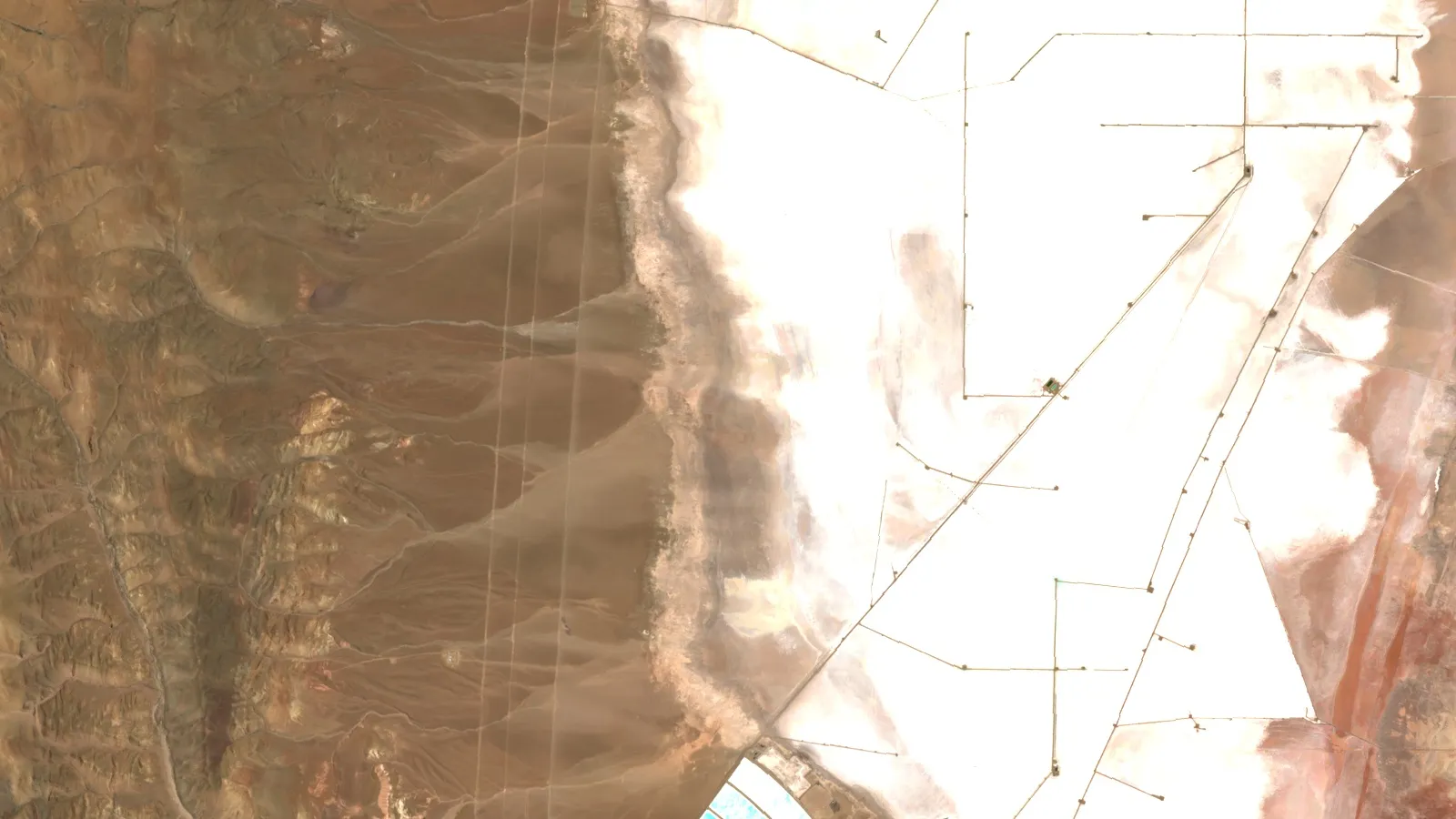
Key takeaways
- Freshwater footprint was 51.0 m³ per tonne of lithium carbonate at Olaroz (ponds) and 135.5 m³ at Fénix (direct extraction); brine consumed was 537.4 and 319.6 m³ per tonne (Heliyon, 2025; 2021 data).
- Earlier estimates run from 5 to 50 m³ of freshwater plus about 500 m³ of brine, to about 2,000 m³ in total, so check what each number counts (Heliyon, 2025, citing earlier work).
- SQM’s Salar de Atacama operation reported net brine extraction of 1,017 L/s and industrial well water of 103.9 L/s in 2025 (SEC technical report summary, 2026), about 32 and 3.3 million m³ a year.
- At Thacker Pass in Nevada, water demand of up to 5,200 acre-feet a year is about 9% of the basin’s perennial yield (US Department of Energy, 2023).
- Direct lithium extraction cuts brine losses but is not proven to cut freshwater use: the Argentine plant used 2.7 times more per tonne (Heliyon, 2025; Nature Reviews Earth & Environment, 2023).
In this article
- Water use per tonne of lithium at a glance
- Why published water-per-ton figures differ
- Measured data: two Argentine brine mines
- Salar de Atacama: brine and water in litres per second
- Clay and hard-rock projects use water too
- Does direct lithium extraction cut water use?
- How to check a lithium water claim in six steps
- What reduces water use per tonne
- Watching brine ponds and wetlands from space
- Frequently asked questions
Water use per tonne of lithium at a glance
Two Argentine brine lithium plants used about 51 and 136 cubic metres (m³) of freshwater per tonne of lithium carbonate, and consumed another 320 to 540 m³ of brine, according to a 2025 study of both mines based on 2021 data (Díaz Paz et al., Heliyon, 2025). One cubic metre is 1,000 litres or about 264 US gallons, so 51 m³ per tonne is roughly 13,500 gallons per metric tonne of product. Older estimates that people still quote run from a few tens of cubic metres of freshwater to about 2,000 m³ in total, because they count different things.
This page sorts those numbers by what each one counts, shows the measured mine data, and gives two calculators so you can turn a permit (litres per second, or acre-feet per year) into cubic metres per tonne. It is written for consultants, licence holders and analysts who have to judge a water claim in a project report, not for readers who want a definition.
| Figure | What it counts | Value | Source and vintage |
|---|---|---|---|
| Olaroz, Argentina (evaporation ponds) | Freshwater footprint per tonne of lithium carbonate | 51.0 m³/t (about 13,500 US gal per tonne) | Heliyon, 2025; 2021 data |
| Fénix, Argentina (direct lithium extraction) | Freshwater footprint per tonne of lithium carbonate | 135.5 m³/t (about 35,800 US gal per tonne) | Heliyon, 2025; 2021 data |
| Olaroz | Brine consumed per tonne | 537.4 m³/t | Heliyon, 2025; 2021 data |
| Fénix | Brine consumed per tonne | 319.6 m³/t | Heliyon, 2025; 2021 data |
| Company reports for the same two mines | “Water intensity index” | 48.0 to 71.3 m³/t | Quoted in Heliyon, 2025 |
| Earlier literature | Total water consumption, as stated in earlier literature | about 2,000 m³/t | Deniau et al., 2021, as cited in Heliyon, 2025 |
Every value above is per tonne of lithium carbonate, not per tonne of lithium metal. Lithium carbonate is only about 19% lithium by weight (by atomic weights, 1 tonne of lithium is 5.32 tonnes of carbonate), so a figure of 51 m³ per tonne of carbonate is about 270 m³ per tonne of contained lithium. A page that does not say which tonne it means cannot be compared with anything.
Why published water-per-ton figures differ
Three boundaries explain most of the spread. Check which one a figure uses before you put it in a report.
- Freshwater only. Water pumped from rivers or fresh aquifers for polishing, reagent preparation, washing and camps. The Heliyon study calls this the water footprint and treats it as water removed from the local system, because wastewater does not go back to the same source.
- Brine consumed. Brine is salty groundwater pumped from the salt flat and left to evaporate in ponds. It is not drinking water, but it is part of the same hydrological system. Reuters reports that about 90% of the water in the evaporation process is lost to the atmosphere (Reuters via Kitco, 2024).
- Total or life-cycle water. Freshwater plus brine, and sometimes the water embedded in electricity and chemicals. The Heliyon authors say their figure covers direct use only and leaves out the water behind the electricity the plants buy.
The same paper lists the earlier range: about 5 to 50 m³ of freshwater per tonne of carbonate, with about 500 m³ more lost during evaporative concentration, and a total of about 2,000 m³ per tonne in one earlier estimate (Deniau et al., 2021). Company sustainability reports for the two Argentine mines give 48.0 to 71.3 m³ per tonne. These numbers measure different things rather than contradict each other; the paper lists them but does not reconcile them.
Gross and net also matter. Pumped brine is not all consumed, because some is returned to the salt flat. In 2025 the SQM operation in the Salar de Atacama pumped 1,134 litres per second gross and reinjected 117 litres per second, for a net 1,017 litres per second (SQM technical report summary, filed with the SEC, effective 13 April 2026). A claim that does not say gross or net can be off by 10% before any chemistry starts.
Measured data: two Argentine brine mines
The clearest public measurement comes from a team at Argentina’s national research council CONICET, who read the environmental impact reports of two mines in the Puna plateau and divided the annual water inputs by the lithium carbonate produced in 2021. Olaroz uses evaporation ponds. Fénix (in the Salar del Hombre Muerto) uses direct lithium extraction, a family of methods, such as ion-exchange sorbents and solvent extraction, that pull lithium out of brine instead of leaving it to concentrate in ponds. In the study’s flowsheet Fénix still has evaporative concentration steps before and after that stage, which is why it still consumed 319.6 m³ of brine per tonne.
Chart
Water per tonne of lithium carbonate, two Argentine mines
Cubic metres per tonne, 2021 data from environmental impact reports
| 2021 data | Olaroz (ponds) | Fénix (DLE) |
|---|---|---|
| Lithium carbonate produced | 12,611 t | 19,000 t |
| Freshwater footprint per tonne | 51.0 m³ | 135.5 m³ |
| Freshwater footprint per year | about 643,000 m³ | about 2,574,000 m³ |
| Brine consumed per tonne | 537.4 m³ | 319.6 m³ |
| Brine consumed per year | about 6.78 million m³ | about 6.07 million m³ |
| Consumed freshwater (excluding the gray part) as share of local blue water available | 30% | 10% |
Source for the table: Díaz Paz et al., Heliyon, 2025, Tables 1 and 2. The Olaroz freshwater footprint of 51.0 m³ per tonne is 46.7 m³ of water consumed from surface and groundwater plus 4.3 m³ of allowance for diluting camp wastewater; Fénix is all consumed water. The 30% and 10% shares use the consumed part only (589,000 m³ a year at Olaroz). “Blue water available” is the water stored in rivers, lakes and aquifers in the basin minus the flow needed to keep the ecosystem alive.
Read it in two steps. Per tonne, the direct-extraction plant used 2.7 times more freshwater and about 40% less brine than the pond plant. Per basin, the picture reverses: the Olaroz use equalled 30% of the available blue water and the Fénix use 10%, because Fénix draws on a basin with more water. The authors write that the results are not conclusive and need longer studies, and that both projects were expanding. A low number per tonne does not make a project safe, and a high one does not make it unsafe, until it is set against the basin.
The study also expressed the freshwater use as a population equivalent: the water use of about 32,000 inhabitants at Olaroz and about 141,000 at Fénix. The authors add that the Olaroz use was 8 times the annual water consumption of everyone living in the Susques department, and the Fénix use was 70 times that of the Antofagasta de la Sierra department.
Salar de Atacama: brine and water in litres per second
Chile’s Salar de Atacama is the other large brine district, and its operators report in L/s, not cubic metres per tonne. That is the form a consultant sees in permits and filings, so it is worth being able to convert it. One litre per second running for a year is 31,536 m³.
Chart
SQM industrial well water against its limits
Litres per second, Salar de Atacama operation
The SQM operation, now held by Novandino Litio SpA (formerly SQM Salar SpA), reports net brine extraction of 1,215, 1,083 and 1,017 L/s for 2023, 2024 and 2025, and industrial freshwater from wells of 107.3 L/s in 2024 and 103.9 in 2025. Its environmental permit (RCA 226/2006) allows up to 240 L/s from wells, and a later commitment holds it to 120 (SQM technical report summary, 2026). In annual terms, 1,017 L/s of net brine is about 32 million m³ a year and 103.9 L/s of freshwater is about 3.3 million m³ a year. The operator pumps roughly ten times as much brine as freshwater.
The same filing gives the lithium recovery that makes the pumping so large. Average process efficiency for lithium is about 49%, so about half of the lithium in the pumped brine does not end up in product. Albemarle, the other producer on the salt flat, models its pond recovery rising from 43% to 60% by 2027 under a proposed yield improvement program, and assumes an average pumping rate of 230 L/s over the life of its mine, set to match its early warning plan (Albemarle Form 10-K for fiscal 2025). Higher recovery means less brine pumped for each tonne of carbonate.
The reason these numbers are tracked is the aquifer. A University of Chile study reported by Reuters found the salt flat sinking by 1 to 2 centimetres a year because brine is pumped faster than it is recharged, and Chilean environmental authorities have charged both producers with possible irregularities in brine extraction (Reuters via Kitco, 22 August 2024). A separate study on flamingo numbers used satellite images of the mining ponds to estimate the water taken; SQM disputes key parts of that study (Reuters via Mining.com, 2022).
Calculator
What is a permit in litres per second per tonne?
Enter a flow, an output and the brine figures. Results update as you type.
- Freshwater per year: 3,153,600 m3
- Net brine pumped per year: 25,228,800 m3
- Net brine pumped per tonne: 1,261 m3/tonne
- Freshwater per tonne in US gallons: 41,655 gal/tonne
Example values only, not benchmarks and not any company’s figures. One litre per second for 365 days is 31,536 m³. Per-tonne results depend on whether the output is lithium carbonate or metal; use the same tonne as the claim you are checking.
Clay and hard-rock projects use water too
Brine is not the only route. A clay project such as Thacker Pass in Nevada pumps groundwater for the whole process, including a sulfuric acid plant. The federal final environmental impact statement puts demand at 2,600 acre-feet a year for the first four years and 5,200 acre-feet a year after that, which is about 9% of the estimated perennial yield of the Quinn River Valley groundwater basin, a basin with fully allocated rights. The right would come from changing existing farm water rights to mining use (US Department of Energy, Thacker Pass Final EIS, 2023).
Chart
Water per tonne of lithium carbonate, selected sources
Cubic metres per tonne; boundaries differ, see text. The company index scope is not stated in the study
The same document gives about 33,000 tons of lithium carbonate equivalent a year for the first phase and about 66,000 for the second. Dividing 5,200 acre-feet (about 6.4 million m³, using 1,233 m³ per acre-foot from USGS Circular 1441) by 66,000 tons gives roughly 100 m³ per tonne (97 if the tons are metric, 107 if they are US short tons). That is our arithmetic on project-wide demand from a regulatory document, not a measured freshwater footprint, and it covers more of the process than the Argentine figures do. It still shows that a mine with no evaporation ponds needs water on the same order as the pond and direct-extraction plants in Argentina.
Production is concentrated in a few countries. The US Geological Survey estimates world mine output of lithium at about 290,000 tonnes of contained lithium in 2025 (the US figure is withheld and left out of the total), with Australia at 92,000, China at 62,000, Chile at 56,000 and Argentina at 23,000 (USGS Mineral Commodity Summaries 2026). Australian output is mostly hard rock, which has a different water and waste profile; for those numbers see our guide to the pros and cons of lithium mining.
Calculator
What is an acre-foot water right per tonne?
Enter a water right, an output and the basin’s perennial yield.
- Water per year: 2,466,960 m3
- Water per day: 6,759 m3
- US gallons per tonne: 26,068 gal/tonne
- Share of basin perennial yield: 5.0 %
Example values only, not benchmarks. One acre-foot is 1,233 m³ and 325,851 US gallons (USGS Circular 1441). Replace the defaults with the figures in the project’s permit or environmental statement.
Does direct lithium extraction cut water use?
Marketing for direct lithium extraction often says it saves water, and the physics supports part of that: it skips the evaporation ponds, so less brine is lost to the air. The IISD commodity profile lists reduced land and water use and faster processing as the potential advantages of the methods, and lists a high water footprint against brine evaporation (IISD, Commodity Profile: Lithium).
The measured freshwater data are more mixed. The Argentine DLE plant used 2.7 times the freshwater of the pond plant per tonne. A review in Nature Reviews Earth & Environment says the freshwater consumption of direct lithium extraction needs to be quantified urgently, and that many of the methods may need larger freshwater volumes than current evaporative practice, which would limit them in arid places (Vera et al., 2023). The same review says any DLE method still consumes brine, uses fresh water and produces residues, the latter two hopefully at considerably lower volumes. In short, DLE can lower brine losses; whether it lowers freshwater use depends on the method and on where the freshwater comes from.

▶ The 7 environmental impacts of mining, explained in clay (2:31). · 2:31
How to check a lithium water claim in six steps
- Find the tonne. Lithium carbonate, lithium hydroxide, lithium carbonate equivalent or contained lithium? The factor between carbonate and metal is 5.32.
- Find the boundary. Freshwater only, brine included, or life cycle? Ask for the two numbers separately.
- Check gross versus net. Is brine returned to the salt flat, and is the volume net of that?
- Check the year and the output. Per-tonne values swing when a plant ramps up. The Argentine study used one production year, 2021. Ask whether the plant ran at nameplate.
- Convert permits. Turn L/s or acre-feet per year into cubic metres per tonne with the calculators on this page, then compare with the measured values above.
- Put it against the basin. A volume means little without the freshwater available in that basin and the share other users already hold. The Argentine study shows the same plant type can be a 10% or a 30% draw depending on the basin.
What reduces water use per tonne
The levers with published numbers are recovery, reinjection, source choice and limits.
Chart
Brine pumping at the SQM Salar de Atacama operation
Litres per second; 2023 to 2025 reported, 2026 to 2030 filed plan
- Better recovery. Albemarle’s mine plan assumes pond recovery rising from 43% to 60% by 2027 under a proposed yield improvement program (Form 10-K, fiscal 2025). At 60% instead of 43%, about 28% less brine has to be pumped for the same lithium, if everything else is equal.
- Lower pumping. SQM’s filed plan cuts net brine extraction from 1,051 L/s in 2026 to 822 from 2028 to 2030, after 1,215 in 2023.
- Reinjection. The same operation returned 117 L/s to the salt flat in 2025, against 204 in 2023.
- Less freshwater. The SQM filing records industrial well water of 103.9 L/s in 2025, under its commitment of 120. Albemarle has set a goal to cut its freshwater intensity by 25% by 2030 from a 2019 base in areas of high or extremely high water risk such as Chile and Jordan.
- Early warning rules. Albemarle’s plan lowers pumping, and can halt it, if monitored brine and groundwater levels pass set thresholds.
The measured data do not support one percentage cut for every direct lithium extraction plant: the Argentine plant used more freshwater per tonne, not less. Treat any single savings figure as a claim to test with the six steps above.
Watching brine ponds and wetlands from space
Satellite images do not measure L/s, but they do show the things that water use changes: pond area, pond colour as brine concentrates, and vegetation and open water in surrounding wetlands. Sentinel-2 images come at 10 metre resolution in its main visible and near-infrared bands, and each area is revisited every five days under the same viewing conditions, which is enough to build a seasonal series (Copernicus Sentinel-2 mission description). The Atacama flamingo study cited above used satellite images of mining ponds to estimate the water extracted.
Farmonaut builds satellite mineral-detection maps for licence areas; see our overview of satellite-based mineral detection, or send a licence boundary through the mining query form to ask about a quote. For the wider set of effects around a lithium mine, read the guide to lithium mining environmental effects, and for the geology of brine, pegmatite and clay projects, see lithium deposits explained.
▶ Remote sensing for mining explained in 2 minutes. · 2:01
Frequently asked questions
How much water does it take to make one ton of lithium?
At two Argentine brine mines in 2021, 51.0 and 135.5 m³ of freshwater per tonne of lithium carbonate, plus 537.4 and 319.6 m³ of brine consumed (Heliyon, 2025). Earlier literature gives a total of about 2,000 m³ per tonne. Per tonne of contained lithium metal, multiply carbonate figures by 5.32.
Is it true that a ton of lithium needs 2 million litres of water?
Two million litres is 2,000 m³, the total water consumption estimate of Deniau et al. (2021), cited in the Heliyon paper. It is far above the measured freshwater plus brine at the two Argentine mines, which add up to about 588 and 455 m³ per tonne. The measured freshwater at the two Argentine mines was 51,000 and 135,500 litres per tonne of carbonate.
Is brine counted as water use?
It depends on the author. Classic water-footprint rules count only freshwater. The Heliyon authors argue brine should be reported next to it, because the water in brine is lost to the air during evaporation. Always ask for both.
How much water do evaporation ponds lose?
Reuters reports that about 90% of the water in the evaporation process is lost to the atmosphere (2024). Brine pumped from the salt flat is the main input, and the ponds take 12 to 18 months to concentrate it, according to the Heliyon paper.
Does direct lithium extraction use less water?
It can use less brine. At the Argentine plant studied, it used 2.7 times more freshwater per tonne than the pond plant. A 2023 review says its freshwater needs have to be measured at more sites.
How much water does the Salar de Atacama lithium industry use?
For the SQM operation alone, the filing reports net brine extraction of 1,017 L/s and industrial well water of 103.9 L/s in 2025. That is about 32 million m³ of brine and 3.3 million m³ of freshwater a year. Albemarle reports its own, separate pumping limits.
How many gallons per ton is 51 cubic metres per tonne?
About 13,500 US gallons per metric tonne, or about 12,200 gallons per short ton. Multiply cubic metres per tonne by 264 for gallons per metric tonne.
Does a clay or hard-rock lithium mine use less water than a brine mine?
Not by default. The Thacker Pass clay project’s water demand of up to 5,200 acre-feet a year works out at roughly 100 m³ per tonne of carbonate equivalent on our arithmetic, in the same range as the Argentine freshwater figures. The comparison is rough because the boundaries differ.
Can satellites measure how much water a lithium operation uses?
Not directly. They can track pond area, wetland vegetation and open water through the seasons, and researchers have used pond imagery to estimate extraction. Volumes still have to come from meters and filings.
How many L/s is a year of water at a mine?
One litre per second for a full year is 31,536 m³. A 100 litre-per-second well field is therefore about 3.15 million m³ a year, the scale of the SQM industrial wells above.
This page is for information only. It is not investment advice. Confirm project figures against company filings and regulator documents.
Farmonaut mining
Map your mining site from space
Request a quote for satellite maps of a licence area before fieldwork begins.

Mining Pro sample view, synthetic data
Keep reading
Sources
- Díaz Paz et al., The water footprint of lithium extraction technologies, Heliyon (2025): pmc.ncbi.nlm.nih.gov
- SQM / Novandino Litio SpA, Salar de Atacama technical report summary, SEC exhibit 96.1 (effective 13 April 2026): sec.gov
- Albemarle Corporation, Form 10-K for fiscal 2025: sec.gov
- Vera et al., Environmental impact of direct lithium extraction from brines, Nature Reviews Earth & Environment (2023): nature.com
- Reuters via Kitco, Lithium mining is slowly sinking Chile’s Atacama salt flat (22 August 2024): kitco.com
- Reuters via Mining.com, In Chile’s Atacama, lithium mining stirs fight over flamingos (2022): mining.com
- US Department of Energy, Thacker Pass Final Environmental Impact Statement, DOE/EIS-0561 (2023): energy.gov
- USGS, Mineral Commodity Summaries 2026: Lithium: pubs.usgs.gov
- IISD, Commodity Profile: Lithium (2026): iisd.org
- USGS, Circular 1441, Estimated Use of Water in the United States in 2015 (unit conversions): pubs.usgs.gov
- Copernicus, Sentinel-2 mission description (SentiWiki): sentiwiki.copernicus.eu
Discussion
Questions, corrections or field experience? Share them below. First-time comments are reviewed before they appear, and your email is never published.
No comments yet. Be the first to add a question or your experience.

 GemSprout Metals Limited
 Qader Group
 Ileys General Trading
 SG Gold Mining LLC
 VRV Global Pte Ltd
 Omsri International FZE
 G.I.T.T.
 Jaunita Erss Ltd
 Almosi SARL
 SRK Consulting
 Berks Gold Limited
 Mwerezi Minerals Company Limited
 Mining SARL
 SenGold Invest SAS
 Sean Mining Limited
 NTS Group (Pty) Ltd
 Mine4Africa
 Lithspo Minerals Limited











