

Potash fertilizer · Price and rate guide
White Potash Fertilizer: Price vs Red MOP and Rates
White potash is potassium chloride of about 98% purity and 62% K2O; red MOP is about 95% and 60%. Crops respond the same, so compare cost per pound of K2O. USDA’s asking prices for 16 October 2026: white $515 per ton in Illinois, red $494 in Iowa.
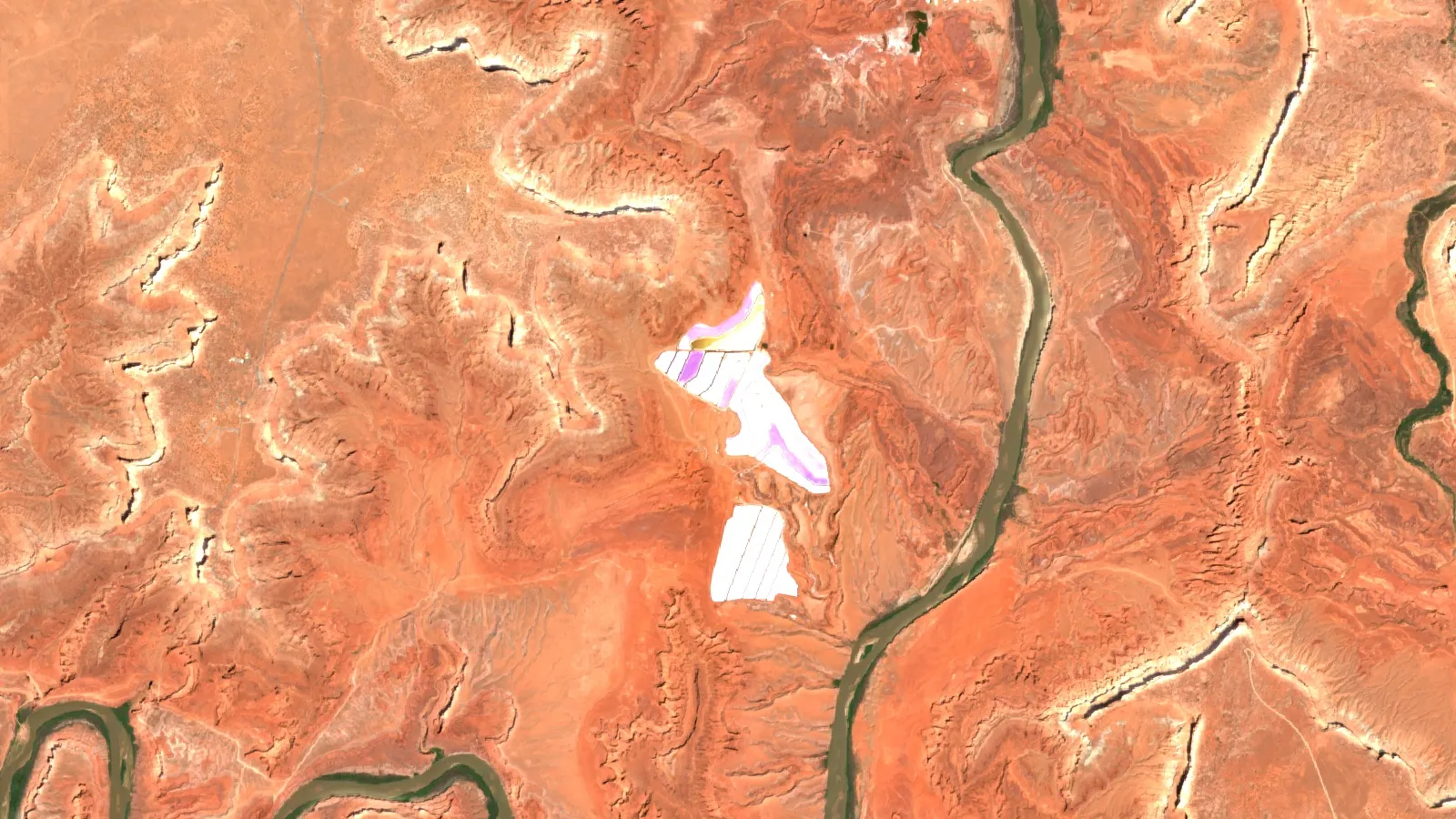
Key takeaways
- White MOP is about 98% KCl and roughly 62% K2O; red MOP is about 95% KCl and 60% K2O. Nutrien’s agronomists report no difference in crop performance (AgWeb, 2020; Nutrien eKonomics).
- USDA AMS asking prices, week ending 16 October 2026: white 0-0-62 averaged $515 per ton in Illinois; red 0-0-60 averaged $494 in Iowa. DTN’s US retail potash average was $503 per ton in the second week of October 2026.
- Per pound of K2O the Illinois white and Iowa red quotes differ by about 1% (our calculation), so compare K2O cost, not the ton price.
- Iowa State’s February 2023 guide for corn: 145 lb K2O per acre at very low soil-test potassium, 110 at low, 46 at optimum and none at high.
- The US imports most of its potash: net import reliance was 92% in 2025, and Canada supplied 79% of imports in 2021 to 2024 (USGS, 2026).
In this article
- White potash vs red potash: what really differs
- White potash price per ton: what US buyers pay
- How much potash per acre: Iowa State's rates
- Fertilizer uses of the white grade
- Where the product comes from and who supplies the US
- When potassium sulfate is the better choice
- How to buy it: 6 checks
- Using satellite maps to decide where to sample
- Frequently asked questions
White potash is muriate of potash (MOP), which means potassium chloride (KCl), in its white form. It is usually made by dissolving the ore under pressure in hot brine and letting it recrystallize as the brine cools, which gives about 98% KCl, while red MOP is floated out of crushed ore and runs about 95% KCl (AgWeb, 2020). On a fertilizer tag the white grade is typically 0-0-62 and the red grade 0-0-60: the three numbers are nitrogen, phosphate and K2O, the potassium oxide equivalent that all potash is sold on. Crops respond the same way to both. In USDA price reports for the week ending 16 October 2026, white 0-0-62 asked about $515 per ton in Illinois and red 0-0-60 about $494 per ton in Iowa (USDA AMS Illinois; USDA AMS Iowa), which works out to almost the same price per pound of K2O.
This guide is for buyers, consultants and investors who need the facts behind the colour: how the two grades differ, what each costs per ton and per unit of K2O, how much to apply per acre, where the product comes from, and which supply changes to watch. Every price carries its date and source. Prices are asking prices in US dollars per ton as the sources quote them, and the production figures are metric tons of K2O equivalent unless stated.
White potash vs red potash: what really differs
Potash ore, called sylvinite, is a mixture of sylvite (the potassium chloride mineral) and halite (rock salt). At Belle Plaine in Saskatchewan, for example, Mosaic describes the ore as a mixture of iron-oxide-stained halite, sylvite and some carnallite (Mosaic Belle Plaine technical report). Iron oxide is what colours red MOP: Mosaic notes that red MOP carries traces of iron oxide, and Nutrien’s agronomists say the reddish or pink tint comes from trace iron oxide in the ore, so the colour of potassium chloride runs from red to white depending on the ore and how it is processed (Nutrien eKonomics).
| Feature | White MOP | Red MOP |
|---|---|---|
| Typical process | Ore dissolved under pressure in hot brine, then cooled to recrystallize | Ore crushed to single-mineral grains, then floated; MOP is skimmed off |
| KCl purity | About 98% | About 95% |
| K2O content | About 62% | About 60% |
| Crop response | Same as red | Same as white |
| Main uses | Bulk spreading, potassium solutions, industrial uses | Direct application and bulk blending |
| Asking price, week ending 16 Oct 2026 (USDA AMS) | Illinois $515 per ton; Pacific Northwest $851 (one quote) | Iowa $494; Pacific Northwest $690 |
Sources for the table: purity and process from AgWeb; K2O from the 98% and 95% purity figures (our calculation, below); crop response and uses from Nutrien eKonomics and Mosaic’s annual report; prices from the three USDA AMS reports cited in the price section.
Pure KCl is 63.2% K2O by weight (a calculation from atomic masses). A product that is 98% KCl therefore carries about 62% K2O and one that is 95% KCl about 60%, which matches the 0-0-62 and 0-0-60 labels. Mosaic’s annual report says the same thing in words: white MOP has a higher K2O percentage, and it is used in many industrial applications besides farming, while the granular and standard red grades suit direct application and bulk blending (Mosaic Form 10-K, 2024).
The agronomic point is simple. Nutrien’s agronomists state that there is no difference in agronomic performance between red and white potassium chloride, and that white is the form mainly used to make potassium solutions. AgWeb adds that both are equally soluble, that each holds around 47% chloride, and that red is cheaper and easier to find, which is why it is the usual choice for most US growers. If you spread dry potash on a field, colour is a poor reason to pay more. Buy on K2O content, size grade and delivered cost.
White potash price per ton: what US buyers pay
The broadest US retail number comes from DTN, which collects fertilizer bids from agricultural retailers every week. For the second week of October 2026 it reported an average potash price of $503 per ton, 3% above a year earlier, alongside DAP at $937 and urea at $674 (DTN, 21 October 2026). DTN’s summary gives one potash average, with no split by colour.
Chart
Potash asking prices by region and grade, October 2026
US$ per ton. USDA AMS reports for the week ending 16 Oct 2026 and DTN retail average for the second week of Oct 2026
USDA’s Agricultural Marketing Service publishes distributor asking prices for several regions every two weeks, and two of its reports list the grades by colour. These are the latest asking prices in the reports on 26 October 2026:
| USDA AMS report | Grade | Price range, $ per ton | Average, $ per ton |
|---|---|---|---|
| Illinois, week ending 16 Oct 2026 | White 0-0-62 | 480 to 550 | 515.00 |
| Iowa, week ending 16 Oct 2026 | Red 0-0-60 | 470 to 520 | 494.00 |
| Pacific Northwest, week ending 16 Oct 2026 | Red 0-0-60 | 565 to 830 | 690.00 |
| Pacific Northwest, week ending 16 Oct 2026 | White 0-0-62 | One quote | 851.33 |
The figures come from the Illinois, Iowa and Pacific Northwest reports, which list prices as asks, FOB (the seller’s price before delivery is added). The Pacific Northwest white price rests on a single quote, so it shows the direction rather than a market average. Corn Belt prices sit close to $500, while the Pacific Northwest is well above them for both colours. Location moves the price at least as much as colour does.
Price per pound of K2O: the fair comparison
A ton of 0-0-62 holds more potassium than a ton of 0-0-60, so compare products on cost per pound of K2O: price per ton divided by (2,000 pounds times the K2O share). With the USDA figures above, in our calculation:
- Iowa red 0-0-60 at $494: about $0.41 per pound of K2O.
- Illinois white 0-0-62 at $515: about $0.42 per pound of K2O, only about 1% above Iowa red even though the price per ton is about 4% higher.
- Pacific Northwest red at $690: about $0.58. Pacific Northwest white at $851: about $0.69, roughly 19% above red in the same report.
Two different states are not a controlled test, so treat the Illinois-Iowa pair as a rough guide. It does fit what Mosaic’s technical report says about solution-mined potash at Belle Plaine, which runs about 62% K2O against the more common 60% and earns a modestly higher price. The same report adds that size matters: granular grade generally sells at a premium to standard grade. The first calculator below lets you test your own two quotes.
What moves the potash price
The world benchmark most often quoted is granular MOP delivered to Brazil. The World Bank put it at $367.5 per metric tonne in September 2026, at an average of $383.6 for the third quarter against $402.9 in the second quarter (World Bank Pink Sheet, 2 October 2026). It is a seaborne export price in metric tonnes, so it will not match a US retail quote in short tons, but it shows the direction of the market. The price depends on a few suppliers: Nutrien’s economists say Canada, Russia, Belarus and China produce about 80% of the world’s potash.
The USGS tariff table shows no normal-rate duty on imports. The USGS lists the normal trade relations tariff on potassium chloride as nil at 31 December 2025 (USGS Mineral Commodity Summaries 2026). Freight and logistics decide the delivered cost, which is why the same grade can differ by hundreds of dollars between regions.
Chart
Granular MOP benchmark price, quarterly average
US$ per metric tonne, spot, CFR Brazil (seaborne export benchmark, not a US retail price)
Calculator
Is white or red potash cheaper per pound of K2O?
Enter two quotes and the K2O percentage on each tag.
- Red MOP per pound of K2O: $0.41
- White MOP per pound of K2O: $0.42
- White price that matches red per pound of K2O: $506
Example values only, not market prices. Prices are inputs: example, use today’s price (US$ per ton as quoted). Pounds of K2O per ton = 2,000 x K2O share, so the calculator assumes a 2,000-pound ton; divide a per-tonne quote by 1.1023 first. Freight and spreading cost are not included.
How much potash per acre: Iowa State’s rates
A flat rate per acre is the wrong way to buy potash. The fertilizer needed depends on the soil-test potassium level, the crop and the yield you have actually been harvesting. Iowa State University’s guide for corn and soybean is a clear example. Its February 2023 edition sets the K2O to apply on corn at 145 pounds per acre for very low soil-test potassium, 110 for low, 46 for optimum and none for high or very high (Iowa State University, PM 1688, February 2023). The categories are based on a 6-inch soil sample. For dried samples tested by ammonium acetate or Mehlich-3, very low is 0 to 125 parts per million (ppm), low 126 to 170, optimum 171 to 220, high 221 to 270 and very high 271 and above.
Chart
K2O to apply by soil-test potassium category
Pounds of K2O per acre, Iowa State University, dry or moist test, corn and soybean
The same guide gives the chance that fertilizer pays: on average a yield response is expected in about 80% of cases at very low soil-test potassium, 55% at low, 25% at optimum, 5% at high and under 1% at very high. For optimum soils the 46 pounds is a removal-based rate. Iowa State lists corn grain as removing 0.22 pound of K2O per bushel and soybean 1.2 pounds per bushel, so removal-based rates rise with yield.
To turn K2O into product, divide by the K2O share. A field testing low (110 pounds of K2O) needs about 177 pounds of 0-0-62 or 183 pounds of 0-0-60:
| Corn soil-test potassium | K2O to apply, lb per acre | Pounds of 0-0-62 | Pounds of 0-0-60 |
|---|---|---|---|
| Very low | 145 | 234 | 242 |
| Low | 110 | 177 | 183 |
| Optimum | 46 | 74 | 77 |
| High or very high | 0 | 0 | 0 |
Product pounds are our calculation from Iowa State’s K2O rates. These rates are Iowa’s. Other states set their own, so check your state extension guide before you buy.
Step by step: from soil test to tons
- Take a soil sample at the depth your state guide specifies (6 inches in Iowa) and send it to a lab that reports the test method. Iowa State’s researchers warn that the dry potassium test is unreliable and not recommended for fine-textured soils with moderately poor to very poor drainage, so ask the lab how it handles samples.
- Find the potassium category for that method and soil handling in your guide.
- For very low and low fields, use the table rate. For optimum fields, multiply your prevailing yield by the removal figure. Iowa State’s Antonio Mallarino says prevailing yield means the last 2 to 4 years, not a goal and not one unusual season (Iowa State Integrated Crop Management, 15 September 2023).
- Divide the K2O by 0.62 for white MOP or 0.60 for red MOP. A 200-bushel corn yield removes about 44 pounds of K2O, which is about 71 pounds of 0-0-62 or 73 pounds of 0-0-60.
- Multiply by acres and by your quoted price per pound of product (price per ton divided by 2,000).
The second calculator below does steps 4 and 5 in one go for your own K2O rate, product grade, price and acreage.
Placement and timing
Iowa State finds that broadcast, planter-band and deep-band applications of phosphorus and potassium give equivalent crop response in most tillage systems. The exceptions are ridge-till, where bands in the ridge give higher yields, and no-till or strip-till corn, where deep banding at 5 to 6 inches can give larger increases that often do not pay for the extra application cost. Starter fertilizer in the seed furrow should stay at about 10 pounds of nitrogen plus K2O per acre or less to protect the stand, and no fertilizer should touch soybean seed. Iowa State recommends annual applications on sandy soils and for surface-applied potash on soils testing very low, to limit runoff and avoid excess uptake. On optimum soils the removal amount can go on each year or twice the annual amount every two years, and a new soil test is suggested about every two years.
Calculator
How much potash will your field need, and what will it cost?
Enter the K2O rate from your soil test, the product grade, a price and your acres.
- Product for the whole field: 14.2 tons
- Cost per acre: $44.35
- Total cost: $7,097
Example values only, not a recommendation. The default 110 lb K2O is Iowa State’s 2023 rate for corn at low soil-test potassium; your state’s rate may differ. Price is an input: example, use today’s price (US$ per 2,000-pound ton). Freight, spreading and blending fees are not included.
Fertilizer uses of the white grade
In the field
MOP accounts for about 90% of the potassium applied to US farmland (AgWeb, 2020). Plants use potassium to regulate water pressure, activate enzymes and move sugars and starches (Nutrien eKonomics). Most users spread it dry, either alone or blended with nitrogen and phosphate. The white grade has an extra use in water. Nutrien’s agronomist Alan Blaylock notes that potassium chloride can be dissolved for spray or fertigation (feeding crops through irrigation), while potassium sulfate has about one-third the solubility and does not suit that job (Nutrien eKonomics). Check the maker’s specification for insoluble matter before you put any grade through drip lines.
The trade-off is salt. The same source gives a salt index of 116 for 0-0-60 MOP against 46 for 0-0-50 SOP. For most crops at normal rates it makes little difference, but salty soils and irrigation water change that, as the sulfate section below explains.
Beyond the field
Fertilizer takes most of the tonnage. Natural Resources Canada says about 95% of Canadian potash goes into fertilizer, with small amounts used for detergents, ceramics, pharmaceuticals, water conditioners and alternatives to de-icing salt (NRCan, Potash facts). In the United States the USGS puts fertilizer at about 85% of potash sales, with the rest going to chemical and industrial uses (USGS, 2026). Mosaic lists de-icing, water-softener regeneration and animal-feed ingredients among its non-fertilizer sales. None of these uses requires white potash by definition, so check the product specification rather than assuming a colour.
Where the product comes from and who supplies the US
Two ways of getting potash out of the ground cover nearly all output. Canada produces by conventional underground mining or by injecting water underground and extracting the resulting brine, called solution mining (NRCan). In the US, the USGS describes New Mexico operations that treat sylvinite and langbeinite ores by flotation, dissolution-recrystallization, heavy-media separation, solar evaporation or combinations of them, and Utah operations that use deep-well solution mining, solar evaporation and flotation, plus brine from the Great Salt Lake that is turned into potassium sulfate (USGS, 2026). So the route to a white or red product depends on the plant, not simply on whether the mine is a shaft or a solution well. Mosaic’s technical report says the solution-mined potash at Belle Plaine has fewer impurities and about 62% K2O.
Chart
Largest potash producers, 2025 estimate
Million metric tons of K2O equivalent, mine production (eight largest producers shown; world total 49)
Canada leads by a wide margin. The USGS estimates world mine production at 49 million tons of K2O equivalent in 2025, with Canada at 15 million, Russia at 10 million, China at 6.3 million and Belarus at 6 million.
Why the US imports most of its potash
The USGS estimates US marketable production at 500,000 tons of K2O equivalent in 2025 against apparent consumption of 5.9 million tons, with imports of 5.6 million tons and net import reliance of 92%. Between 2021 and 2024 Canada supplied 79% of imports, Russia 12% and Israel 3%. World consumption of potash in fertilizer was estimated at 41.6 million tons of K2O in 2025 and is projected to reach 45.3 million tons in 2029. NRCan counts 10 active potash mines in Canada, all in Saskatchewan, producing an estimated 25 million tonnes of MOP in 2024; the difference from the USGS figure is units, because NRCan counts product and the USGS counts K2O. For more on that province’s mines, see our guide to Saskatchewan’s potash mines, and for company profiles see the largest potash producers.
Supply changes to watch
- New Mexico: Mosaic announced in December 2025 an agreement to sell its Carlsbad potash business to International Minerals Carlsbad for US$20 million up front, after which it said its potash production would be entirely in Saskatchewan (World Fertilizer, 23 December 2025).
- Belarus: World Fertilizer reported on 5 October 2026 that the first Belarusian potash shipment to the US in four years was set to arrive, while the US continues to buy Canadian potash (World Fertilizer).
- Saskatchewan: NRCan lists BHP’s Jansen project, with a first stage due to start production in 2027 at about 4.2 million tonnes a year and a second stage in 2031 that would take the mine to 8.5 million tonnes.
Anyone judging a potash explorer or producer should also understand how bulk deposits are found and tested; our guide to exploring for iron ore, bauxite, phosphate and potash covers that side.

▶ A plain-language claymation on the seven environmental impacts of mining. · 2:31
When potassium sulfate is the better choice
Potassium sulfate, also called sulfate of potash (SOP), holds about 50% K2O against 60 to 62% for MOP and costs more. Nutrien’s agronomist puts MOP at about 40 to 50% cheaper per pound of K2O than SOP. SOP is often preferred for chloride-sensitive crops such as potatoes, tobacco, some vegetables and fruits, and tree crops like almonds, walnuts and citrus, but the same article says most studies show little difference in field performance unless soil salinity or chloride in the irrigation water is near the crop’s tolerance. In other words, test the soil and the water first. USGS data show how big the specialty market is: more than 60% of US potash production in 2025 was SOP and the double sulfate of potash magnesia (langbeinite), the grades used on chloride-sensitive crops. Our post on potassium sulfate versus chloride compares the two in more detail.
How to buy it: 6 checks
- Read the grade. 0-0-62 and 0-0-60 differ by 2 points of K2O, so the cheaper ton may not be the cheaper potassium.
- Compare the price per pound of K2O, not the price per ton.
- Check the size grade. Mosaic’s technical report says granular product generally earns a premium over standard, and granular suits blending.
- Ask whether the quote is FOB or delivered. USDA marks its reports FOB, which excludes delivery.
- Match the grade to the job. Dry spreading does not need white potash. If the product will be dissolved, ask for the maker’s solubility and insoluble-matter figures.
- Take a soil test first. Iowa State’s table gives a 5% chance of a yield response at high soil-test potassium, so extra potash on a high-testing field is mostly wasted money.
Using satellite maps to decide where to sample
Satellite vegetation maps can help choose where to take soil samples, but the soil test, not the map, sets the potash rate.
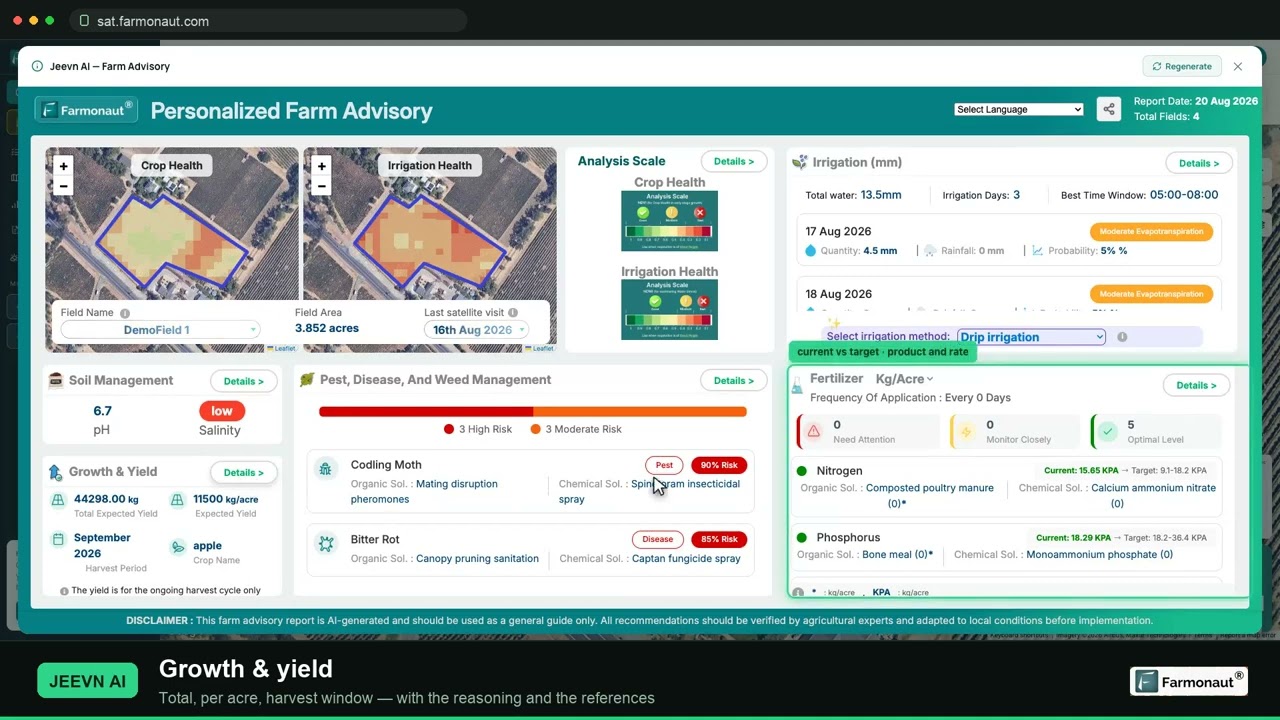
▶ A 20-minute walkthrough of reading NDVI crop-health maps and pulling a field report. · 19:36
Frequently asked questions
What is white potash?
White potash is white muriate of potash, potassium chloride (KCl) of about 98% purity and about 62% K2O, usually made by dissolving ore in hot brine and recrystallizing it (AgWeb; our K2O calculation).
Is white potash better than red potash?
Not for crop yield. Nutrien’s agronomists report no difference in agronomic performance. White MOP has more K2O per ton and is used for potassium solutions and some industrial uses, while red MOP is usually cheaper and more widely available.
How much does white potash fertilizer cost per ton?
USDA AMS recorded an average ask of $515 per ton for white 0-0-62 in Illinois in the week ending 16 October 2026, with a range of $480 to $550. DTN’s national retail potash average was $503 per ton in the second week of October 2026. Prices vary by region and delivery.
What is the difference between 0-0-62 and 0-0-60 potash?
The last number is the K2O percentage. 0-0-62 is typically the white grade and 0-0-60 the red grade. Divide the price per ton by 2,000 times the K2O share to compare them per pound of K2O.
Is potash white or red?
Both. Nutrien eKonomics says potassium chloride ranges from red to white depending on the ore and the processing, and the red or pink tint comes from trace iron oxide.
How much potash does corn need per acre?
Iowa State’s 2023 guide recommends 145 pounds of K2O per acre on very low soil-test potassium, 110 on low, 46 on optimum and none on high. That is about 177 pounds of 0-0-62 for the low category. Other states differ, so use your state guide.
Can white potash go through an irrigation system?
Potassium chloride dissolves well enough to be used in spray and fertigation, which is why the white form is mainly used for potassium solutions (Nutrien eKonomics). Check the product’s insoluble-matter specification first.
Is white potash the same as potassium sulfate?
No. White potash is potassium chloride with about 62% K2O. Potassium sulfate (SOP) has about 50% K2O, costs more per pound of K2O (Nutrien puts MOP at 40 to 50% cheaper than SOP) and is preferred for some chloride-sensitive crops.
Is white potassium the same thing as white potash?
Not exactly. Potassium is the nutrient. Potash is the group of salts that supply it, and the white form most often sold for farms is white muriate of potash.
Why does the US import most of its potash?
The USGS estimates 2025 US production at 500,000 tons of K2O equivalent against consumption of 5.9 million tons, so net import reliance is 92%. Canada supplied 79% of imports in 2021 to 2024.
Which countries produce the most potash?
Canada leads at an estimated 15 million tons of K2O equivalent in 2025, followed by Russia at 10 million, China at 6.3 million and Belarus at 6 million (USGS, 2026).
This page is for information only. It is not investment advice, and it names no company as a recommendation. Prices are asking prices on the dates shown; check current quotes before you buy. Rates and products vary by crop, soil and state: follow the product label and your local extension service or agronomist.
Farmonaut mining
Screen a licence area from space
Investors can see how satellite data screens a mineral licence area on land as an exploration target, ahead of a resource estimate.

Mining Pro sample view, synthetic data
Keep reading
Sources
- USDA AMS, Illinois Production Cost Report (week ending 16 Oct 2026): ams.usda.gov
- USDA AMS, Iowa Production Cost Report (week ending 16 Oct 2026): ams.usda.gov
- USDA AMS, Pacific Northwest Production Cost Report (week ending 16 Oct 2026): ams.usda.gov
- DTN, UAN32, UAN28 and anhydrous lead fertilizer prices higher (21 October 2026): dtnpf.com
- USGS, Mineral Commodity Summaries 2026: Potash: pubs.usgs.gov
- World Bank, Commodity Price Data (Pink Sheet), October 2026: thedocs.worldbank.org
- Iowa State University Extension, A General Guide for Crop Nutrient and Limestone Recommendations in Iowa (PM 1688, February 2023): iowadnr.gov
- Iowa State Integrated Crop Management, Fall phosphorus and potassium decisions (15 September 2023): crops.extension.iastate.edu
- AgWeb, What is the difference between red potash and white potash (2020): agweb.com
- Nutrien eKonomics, Potash mining and processing: nutrien-ekonomics.com
- Nutrien eKonomics, Potassium fertilizers: muriate of potash or sulfate of potash?: nutrien-ekonomics.com
- Mosaic Company, Form 10-K for fiscal 2024: s1.q4cdn.com
- Mosaic, Belle Plaine Potash Facility technical report summary (31 December 2024): minedocs.com
- Natural Resources Canada, Potash facts: natural-resources.canada.ca
- World Fertilizer, Mosaic sells potash mine in New Mexico (23 December 2025): worldfertilizer.com
- World Fertilizer, First shipment of Belarusian potash set to reach the US (5 October 2026): worldfertilizer.com
Discussion
Questions, corrections or field experience? Share them below. First-time comments are reviewed before they appear, and your email is never published.
No comments yet. Be the first to add a question or your experience.

 SenGold Invest SAS
 Sania Corporation
 Sean Mining Limited
 NTS Group (Pty) Ltd
 Mine4Africa
 Lithspo Minerals Limited
 Tintina Mining Group
 Dalgety Minerals Pty Ltd
 Vortex Minerals Pty Ltd
 Faith At Work (Pty) Ltd
 Geotech Mining Solutions plc
 Vulcan International Limited
 Kidepo Associates
 GKY Mining
 Alkimy SARL
 Double A Trading
 GemSprout Metals Limited
 Qader Group
 Ileys General Trading
 SG Gold Mining LLC
 VRV Global Pte Ltd
 Omsri International FZE
 G.I.T.T.
 Jaunita Erss Ltd

 Client · Tanzania · Gold
 Client & affiliate partner · Ghana · Gold










