

The Essential Stages of Crop Farming: A Comprehensive Guide to Modern Agriculture
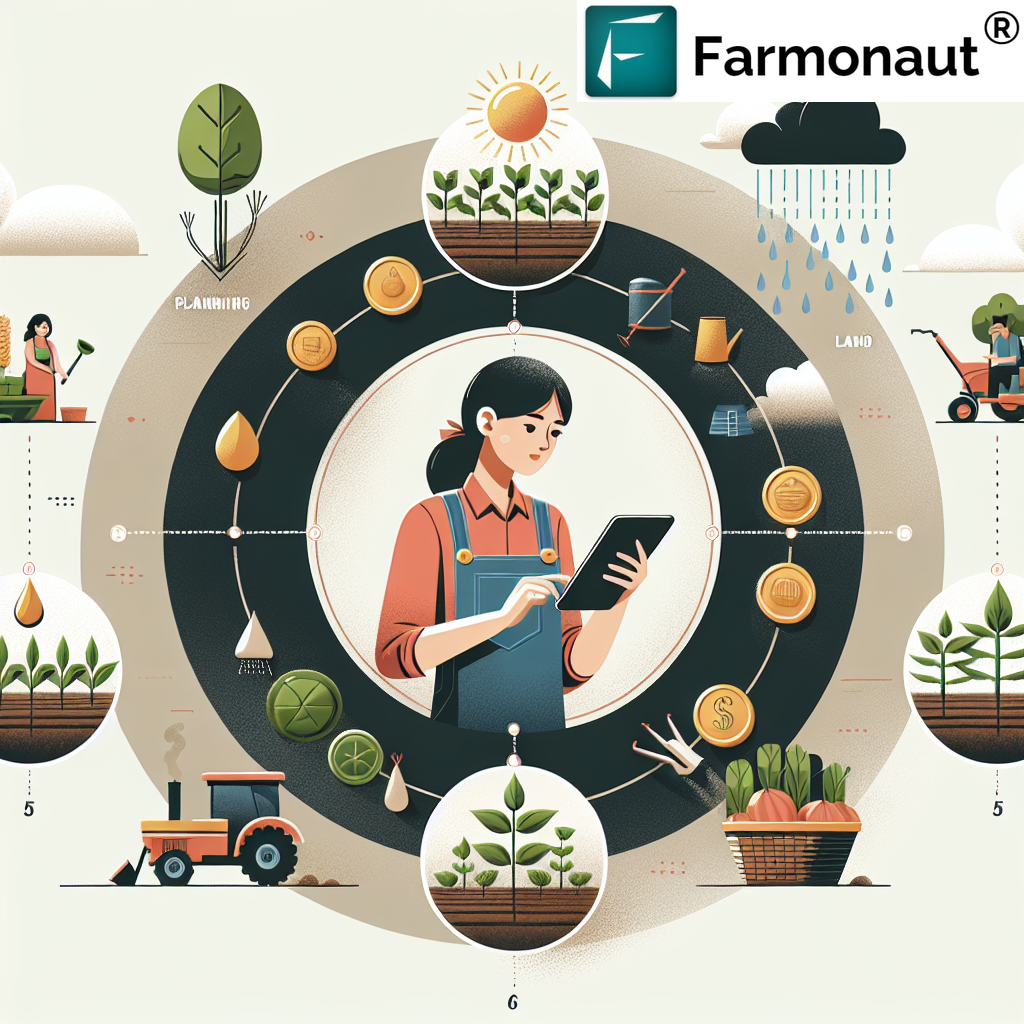
In the ever-evolving world of agriculture, understanding the stages of farming is crucial for both novice and experienced farmers alike. At Farmonaut, we recognize the importance of each phase in the crop production cycle and how modern technology can enhance these processes. In this comprehensive guide, we’ll delve deep into the stages of crop farming, exploring traditional methods and innovative techniques that are shaping the future of agriculture.
The Importance of Understanding Farming Stages
Before we dive into the specifics, it’s essential to grasp why knowledge of farming stages is so critical:
- Optimized Resource Allocation: Understanding each stage allows for better planning and resource management.
- Increased Yield: Proper care at each stage can significantly boost crop productivity.
- Risk Mitigation: Awareness of stage-specific challenges helps in preemptive problem-solving.
- Sustainable Practices: Knowledge of farming stages enables the implementation of eco-friendly techniques.
The Five Essential Stages of Crop Farming
Let’s explore the five fundamental stages of farming that form the backbone of crop production:
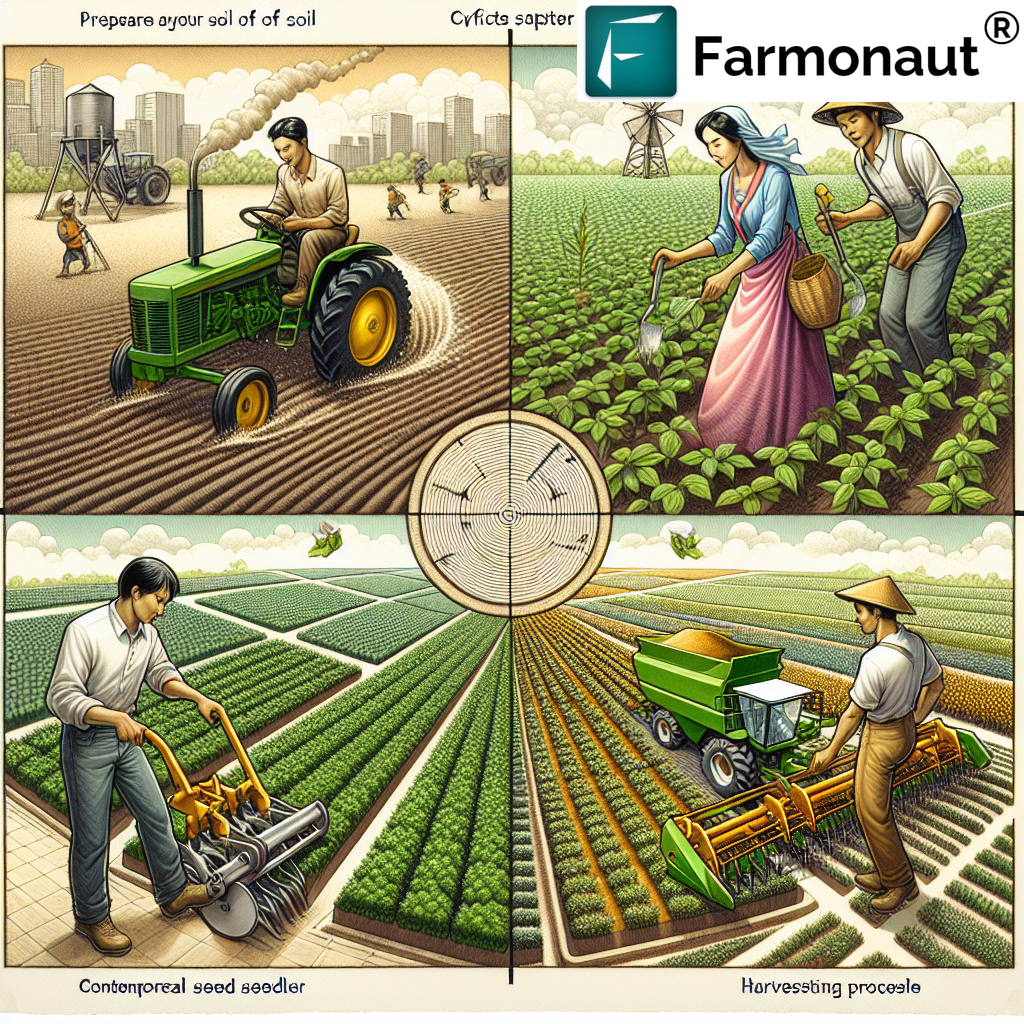
1. Preparation Stage
The preparation stage sets the foundation for a successful harvest. It involves several crucial steps:
- Soil Testing: Analyzing soil composition, pH levels, and nutrient content.
- Field Clearing: Removing debris, rocks, and remnants of previous crops.
- Tillage: Breaking up the soil to create an optimal seedbed.
- Fertilization: Adding necessary nutrients based on soil test results.
At Farmonaut, we enhance this stage with our satellite-based soil moisture analysis, helping farmers determine the best time for field preparation. Our Farmonaut app provides real-time insights into soil conditions, optimizing the preparation process.
2. Planting Stage
The planting stage is where the crop’s journey begins. Key aspects include:
- Seed Selection: Choosing high-quality seeds suitable for the local climate and soil conditions.
- Planting Method: Deciding between manual planting, mechanical seeding, or transplanting.
- Planting Depth and Spacing: Ensuring optimal conditions for germination and growth.
- Timing: Planting at the right time based on seasonal and weather patterns.
Our Jeevn AI Advisory System provides personalized recommendations for planting dates and methods, taking into account local weather forecasts and historical data.
3. Crop Management Stage
This stage is the longest and most intensive, involving continuous care and monitoring:
- Irrigation: Ensuring proper water supply throughout the growing season.
- Fertilization: Applying additional nutrients as needed.
- Pest and Disease Control: Monitoring and managing threats to crop health.
- Weed Management: Controlling weed growth to reduce competition for resources.
Farmonaut’s satellite-based crop health monitoring system is particularly valuable during this stage. Our NDVI (Normalized Difference Vegetation Index) analysis helps farmers detect early signs of stress, disease, or nutrient deficiencies, allowing for timely interventions.
4. Harvesting Stage
The harvesting stage is the culmination of all previous efforts:
- Determining Harvest Readiness: Assessing crop maturity and optimal harvest time.
- Harvesting Method: Choosing between manual or mechanical harvesting based on crop type and scale.
- Post-Harvest Handling: Proper cleaning, sorting, and storage of harvested crops.
Our AI-powered yield estimation tools help farmers predict harvest volumes and plan logistics accordingly, ensuring efficient resource allocation during this critical phase.
5. Post-Harvest Stage
Often overlooked, the post-harvest stage is crucial for maximizing the value of the crop:
- Storage: Implementing proper storage techniques to maintain crop quality.
- Processing: Converting raw produce into value-added products where applicable.
- Marketing and Distribution: Finding the best channels to sell the harvest.
- Field Restoration: Preparing the field for the next crop cycle.
Farmonaut’s blockchain-based traceability solution comes into play here, ensuring transparency and authenticity throughout the supply chain, from farm to consumer.
Innovative Technologies Transforming the Stages of Farming
As we navigate through these stages of crop farming, it’s important to highlight how modern technologies are revolutionizing each phase:
Satellite-Based Monitoring
Satellite technology has become a game-changer in agriculture. At Farmonaut, we leverage multispectral satellite imagery to provide farmers with valuable insights throughout the farming stages:
- Real-time crop health monitoring
- Early detection of pest infestations and diseases
- Precise irrigation management
- Yield estimation and harvest planning
Our satellite-based system offers several advantages over traditional monitoring methods:
| Feature | Farmonaut Satellite System | Drone-based Monitoring | IoT-based Monitoring |
|---|---|---|---|
| Coverage Area | Large scale (100s to 1000s of hectares) | Limited (10s of hectares) | Very limited (specific points) |
| Frequency of Data Collection | Regular (every 3-5 days) | On-demand (requires manual flight) | Continuous but localized |
| Initial Setup Cost | Low | High (equipment purchase) | Medium to High (sensors and network) |
| Maintenance | Minimal (cloud-based) | Regular (equipment maintenance) | Regular (sensor maintenance) |
| Data Processing | Automated (AI-driven) | Semi-automated | Automated but limited scope |
| Scalability | Highly scalable | Limited by equipment and manpower | Scalable but costly |
Artificial Intelligence and Machine Learning
AI and ML technologies are transforming decision-making processes across all farming stages:
- Predictive analytics for pest and disease outbreaks
- Optimized resource allocation based on historical and real-time data
- Automated crop classification and yield prediction
Our Jeevn AI Advisory System exemplifies the power of AI in agriculture, providing personalized recommendations throughout the crop cycle.
Blockchain Technology
Blockchain is revolutionizing the post-harvest stage by:
- Ensuring transparency and traceability in the supply chain
- Reducing fraud and improving food safety
- Enabling direct farmer-to-consumer connections
Farmonaut’s blockchain-based traceability solution is at the forefront of this technology, providing end-to-end visibility from farm to table.
Internet of Things (IoT)
IoT devices are enhancing precision across all stages of farming:
- Automated irrigation systems based on real-time soil moisture data
- Smart sensors for monitoring crop health and environmental conditions
- Connected farm equipment for optimized operations
While our focus is on satellite-based solutions, we recognize the complementary role of IoT in modern agriculture.
Sustainable Practices in Modern Farming Stages
As we progress through the stages of crop farming, incorporating sustainable practices is crucial for long-term agricultural success:
Conservation Tillage
During the preparation stage, conservation tillage methods help preserve soil structure and reduce erosion:
- No-till farming
- Reduced tillage
- Strip-till methods
Precision Agriculture
Across all stages, precision agriculture techniques optimize resource use:
- Variable rate application of fertilizers and pesticides
- Site-specific crop management
- GPS-guided planting and harvesting
Farmonaut’s satellite-based solutions are integral to precision agriculture, providing the data needed for targeted interventions.
Integrated Pest Management (IPM)
During the crop management stage, IPM strategies reduce reliance on chemical pesticides:
- Biological pest control
- Crop rotation
- Use of resistant crop varieties
Water Conservation
Efficient water use is crucial throughout the farming stages:
- Drip irrigation systems
- Rainwater harvesting
- Soil moisture sensors for optimized irrigation scheduling
Our soil moisture analysis tools help farmers make informed decisions about water management, promoting conservation and efficiency.
The Role of Data in Modern Farming Stages
Data has become the lifeblood of modern agriculture, influencing decisions at every stage of farming:
Data Collection
Various sources contribute to agricultural data:
- Satellite imagery
- Weather stations
- Soil sensors
- Farm equipment telematics
Farmonaut’s satellite-based system is a primary source of high-quality, large-scale agricultural data.
Data Analysis
Advanced analytics turn raw data into actionable insights:
- Predictive modeling for crop yields
- Risk assessment for pest and disease outbreaks
- Optimization algorithms for resource allocation
Our AI-powered analytics platform processes vast amounts of satellite and weather data to provide timely, accurate insights to farmers.
Data-Driven Decision Making
Insights derived from data analysis inform critical decisions across all farming stages:
- Optimal planting dates based on historical weather patterns
- Precision application of inputs based on crop health maps
- Strategic harvest timing to maximize yield and quality
The Farmonaut app puts these data-driven insights directly into farmers’ hands, enabling informed decision-making in real-time.
Challenges and Solutions in Modern Farming Stages
While technology has greatly enhanced the stages of farming, challenges remain. Here’s how we’re addressing some of the key issues:
Climate Change Adaptation
Challenge: Unpredictable weather patterns and extreme events disrupt traditional farming calendars.
Solution: Farmonaut’s AI-powered weather forecasting and crop modeling help farmers adapt their practices to changing climate conditions.
Resource Scarcity
Challenge: Diminishing water resources and soil degradation threaten agricultural sustainability.
Solution: Our precision agriculture tools optimize resource use, while our sustainability features help farmers track and reduce their environmental impact.
Market Volatility
Challenge: Fluctuating prices and demand make it difficult for farmers to plan and profit.
Solution: Farmonaut’s yield prediction and market intelligence features help farmers make informed decisions about what to grow and when to sell.
Technology Adoption
Challenge: Many farmers struggle with the complexity and cost of new agricultural technologies.
Solution: We’ve designed our platform to be user-friendly and accessible, with tiered pricing options to suit farms of all sizes. Our mobile apps for Android and iOS make it easy for farmers to access crucial data on the go.
The Future of Farming Stages
As we look ahead, several trends are shaping the future of crop farming stages:
Autonomous Farming
Self-driving tractors and robotic harvesters are set to revolutionize the planting and harvesting stages, increasing efficiency and reducing labor costs.
Vertical Farming
Urban agricultural systems are redefining the concept of farming stages, allowing for year-round production in controlled environments.
Gene Editing
CRISPR and other gene-editing technologies promise to create crop varieties with enhanced resilience and nutritional value, potentially altering the crop management stage.
AI-Powered Decision Support
Advanced AI systems will provide increasingly sophisticated recommendations across all farming stages, optimizing every aspect of crop production.
At Farmonaut, we’re continually innovating to stay at the forefront of these trends, ensuring that our solutions evolve alongside the changing landscape of agriculture.
Empowering Farmers Across All Stages
Our mission at Farmonaut is to empower farmers with the tools and knowledge they need to succeed in every stage of farming. From our satellite-based monitoring system to our AI-powered advisory services, we’re committed to making precision agriculture accessible and affordable for farmers worldwide.
To experience the power of Farmonaut’s solutions across all stages of farming, sign up for our services today:
Conclusion
Understanding the stages of crop farming is essential for successful agriculture in the 21st century. From preparation to post-harvest, each stage presents unique challenges and opportunities. By leveraging cutting-edge technologies and sustainable practices, farmers can optimize their operations, increase yields, and contribute to a more resilient food system.
At Farmonaut, we’re proud to be part of this agricultural revolution, providing farmers with the tools they need to thrive in an ever-changing world. Whether you’re managing a small family farm or overseeing large-scale agricultural operations, our solutions are designed to support you through every stage of the farming process.
For developers interested in integrating our powerful agricultural data into their own applications, check out our Satellite API and API documentation.
FAQs About Stages of Farming
Q: What are the main stages of crop farming?
A: The main stages of crop farming are preparation, planting, crop management, harvesting, and post-harvest. Each stage is crucial for successful crop production.
Q: How has technology changed the stages of farming?
A: Technology has revolutionized farming stages by introducing precision agriculture techniques, satellite monitoring, AI-powered decision support, and automated machinery, leading to increased efficiency and productivity.
Q: What is the most critical stage of farming?
A: While all stages are important, the crop management stage is often considered the most critical as it’s the longest and involves continuous care to ensure healthy crop growth and development.
Q: How does Farmonaut support farmers throughout the farming stages?
A: Farmonaut provides satellite-based crop monitoring, AI-powered advisory services, and data-driven insights that support farmers in making informed decisions at every stage of the farming process.
Q: Can sustainable practices be integrated into all farming stages?
A: Yes, sustainable practices can and should be integrated into all farming stages. From conservation tillage in the preparation stage to efficient post-harvest processing, sustainability can be a focus throughout the entire farming cycle.
Q: How important is data in modern farming stages?
A: Data is crucial in modern farming, informing decisions at every stage. From soil analysis during preparation to yield predictions at harvest, data-driven insights help optimize operations and increase productivity.
Q: What challenges do farmers face across different farming stages?
A: Farmers face various challenges including climate change, resource scarcity, pest and disease management, market volatility, and the complexity of adopting new technologies. Solutions like those offered by Farmonaut help address these challenges.
Q: How is AI changing the way we approach farming stages?
A: AI is transforming farming by providing predictive analytics, automating decision-making processes, and optimizing resource use across all farming stages. It’s enabling more precise and efficient farming practices.
Q: What role does satellite technology play in modern farming stages?
A: Satellite technology provides valuable data on crop health, soil moisture, and weather patterns. This information helps farmers make informed decisions throughout the growing season, from planting to harvest.
Q: How can small-scale farmers benefit from advanced farming technologies?
A: Small-scale farmers can benefit from advanced technologies through affordable, accessible solutions like Farmonaut’s platform, which provides valuable insights without the need for expensive on-farm equipment.
Discussion
Questions, corrections or field experience? Share them below. First-time comments are reviewed before they appear, and your email is never published.
No comments yet. Be the first to add a question or your experience.

 Reddane Farming
 Esri North East Africa
 Farmer Amigo
 Cresol
 Atur Kuliner
 MDCV UK
 Zerella Group
 Etech Consulting Madagascar
 Vestlandsforsking
 Agritein
 Delicio
 WB Dev
 Sama Premium
 Prochecker
 Tres Valles
 LACOS Geoinformation
 Magrifly
 LatConnect 60
 Blickwinkel
 Agricultural Credit Policy Council
