

Reviewed September 2026 against USDA NRCS EQIP program guidance and Fixr contractor cost data.
Try it: Satellite monitoring ROI: what it returns on your acreage →
Farm Fencing: Materials, Costs & Solar Options Compared
Fencing in agriculture is any structure — wire, wood, mesh, or electrified — that marks a boundary, contains livestock, or blocks wildlife and vehicle access to a field. Smooth wire fence, the most common budget option, runs $1.20–$2.50 per linear foot installed as of 2026, according to Fixr’s contractor-cost data. If you’re comparing materials, weighing solar-electric energizers against grid power, or checking whether USDA will help pay for the job, this article gives you the actual numbers and where to verify them yourself.



Table of Contents
- What Is Fencing in Agriculture?
- Farm Fencing Materials: Costs, Pros, and Cons
- Fencing Around a Farm: Planning the Perimeter
- Fence Cost Calculator
- Solar Electric Fencing: Where It Fits
- USDA EQIP Cost-Share for Fencing
- Comparison Table: Fence Materials Side by Side
- Satellite Monitoring for Fence Planning and Maintenance
- Maintenance and Best Practices
- FAQ: Farm Fencing
- Try it: Satellite monitoring ROI: what it returns on your acreage
What Is Fencing in Agriculture?
In agriculture, a fence is any barrier built to control the movement of livestock, deter wildlife, mark a legal or operational boundary, or protect a crop from grazing and trespass damage. That definition covers a wide range of structures: barbed wire strung on wood posts, woven wire mesh for sheep and goats, high-tensile smooth wire carrying an electric charge, post-and-rail wood fencing around a homestead or paddock, and permanent perimeter fencing that follows a property line for the life of the farm.
Fencing serves three distinct jobs on a working farm, and the material you choose depends on which job matters most:
- 🐄 Containment: Keeping livestock inside a pasture or rotational grazing cell. Woven wire, high-tensile electric, and barbed wire are the standard choices depending on species.
- 🦌 Exclusion: Keeping deer, feral hogs, or other wildlife out of row crops, orchards, and vineyards. This usually needs taller fencing or an electrified deterrent, since a low wire fence alone won’t stop a determined animal.
- 📍 Boundary marking: Establishing a visible, legal property line — often required for USDA program participation, lease agreements, or neighbor disputes over land use.
Before pricing materials, decide which of the three jobs above your fence needs to do. A boundary-marking fence for a crop farm has very different requirements — and a much lower cost per foot — than a containment fence built to hold cattle or a tall exclusion fence meant to stop deer.

Farm Fencing Materials: Costs, Pros, and Cons
“Farm fencing material” searches usually come down to five practical options. Here’s what each one actually costs to install and where it works best.
Smooth Wire (High-Tensile)
Smooth high-tensile wire is the lowest-cost option per linear foot on this list. Fixr’s 2026 contractor cost data puts installed smooth wire fence at $1.20–$2.50 per linear foot, which includes wire, posts, and labor for a standard single- or multi-strand run. That per-foot range is the number to anchor every other material comparison against, since it reflects actual installed jobs rather than material-only pricing.
Barbed Wire
Barbed wire on wood or steel T-posts remains common for cattle containment on larger acreages because material cost per foot is low and a single strand run of 3–5 wires covers long distances economically. It is not suitable for sheep, goats, or horses, and it does nothing to stop deer or smaller wildlife from passing through or under.
Woven Wire (Field Fence / Mesh)
Woven wire mesh fencing is the standard for sheep, goats, and mixed livestock operations where smaller animals could slip through wider-spaced strands. It costs more per foot than plain smooth or barbed wire because of the material density, and it’s the material most often specified in USDA conservation fencing practices where predator or livestock exclusion is the goal.
Wood Post-and-Rail / Split Rail
Wood fencing is chosen for visibility, curb appeal near a farmhouse or roadside frontage, and horse paddocks where a highly visible barrier reduces injury risk. It is the highest-maintenance material on this list — wood posts and rails are subject to rot, insect damage, and weathering, and replacement cycles are shorter than wire systems in wet climates.
Electric Fencing (Grid or Solar-Powered)
Electric fencing uses a smooth or high-tensile wire strand carrying a pulsed charge from an energizer, which can be powered from the grid, a battery, or a solar panel. It’s covered in full in the solar fencing section below, since the material cost is similar to plain smooth wire — the added cost is the energizer and, for solar setups, the panel and battery.
Smooth high-tensile wire, installed, at $1.20–$2.50/ft (Fixr, 2026).
Woven wire mesh — the tighter spacing stops sheep, goats, and young stock that would pass through wider strands.
Fencing Around a Farm: Planning the Perimeter
Fencing around a farm — the full perimeter rather than internal cross-fencing — is typically the single largest fencing expense a producer takes on, because total linear footage scales directly with the shape and size of the property. A square 40-acre parcel needs roughly 5,280 feet of perimeter fence; an irregularly shaped parcel of the same acreage can need considerably more footage to enclose the same area, since perimeter length depends on shape, not just acreage.
That relationship is the first thing to get right before pricing a job: get an accurate perimeter measurement from a survey, GPS boundary walk, or satellite-derived field boundary before requesting quotes, because contractors price per linear foot and an underestimated perimeter is the most common source of budget overruns on a farm fencing project.
- 📏 Measure first: Use a legal survey, GPS unit, or a mapped field boundary — not a rough pace-off — before requesting contractor bids.
- 🗺️ Terrain matters: Rocky, sloped, or wooded perimeter sections raise labor cost per foot above flat, cleared ground — get a per-section estimate, not one blended rate.
- 🚧 Gates and access points: Each gate adds hardware cost beyond the linear-foot fence price; count these separately when budgeting.
- 🧭 Legal boundary vs. working boundary: Confirm your fence line matches the surveyed property line — fencing built off the legal line can create boundary disputes with neighbors.
Producers often price fencing off acreage alone (“I have 80 acres, so fencing must cost about X”). Acreage tells you nothing about linear footage without knowing the shape. Get the actual perimeter distance in feet before you call a contractor, or you’ll be pricing the wrong job.

Fence Cost Calculator
Enter your perimeter length and material choice below to get an installed-cost estimate based on Fixr’s 2026 smooth-wire pricing range, adjusted for material type.
Satellite monitoring ROI: what it returns on your acreage
Change any figure. Nothing is pre-assumed about your farm.
Your inputs only — this tool contains no benchmark yield or price data. Use your own last-season figures, and treat any vendor’s yield-gain percentage as unproven until they show you two contrasting seasons.
Solar Electric Fencing: Where It Fits
Solar-powered electric fencing is a specific configuration of electric fence: a smooth or high-tensile wire strand, an energizer, and — instead of a grid connection or gas engine — a solar panel charging a battery that powers the energizer. It solves one specific problem: delivering a reliable electric pulse to fence lines in paddocks or perimeter sections too far from grid power to run a line economically.
- ⚡ How it works: A solar panel charges a battery through a charge controller; the battery powers the energizer, which sends a pulsed charge through the wire strand to deter wildlife or contain livestock.
- 📍 Best use case: Remote paddocks, rotational grazing cells, or perimeter sections with no nearby grid connection — anywhere running a power line would cost more than a self-contained solar unit.
- 🔋 Battery sizing is the risk point: An undersized battery bank is the most common failure mode — it leaves the fence under-powered during extended cloudy stretches, which is exactly when wildlife pressure or livestock testing the fence tends to be highest.
- 🔁 Maintenance profile: Panel cleaning, periodic battery inspection, and wire/connector checks after major weather — fewer moving parts than a fuel-powered energizer, but not maintenance-free.
Solar fencing material cost is close to standard smooth-wire pricing, since the wire and posts are the same; the added expense is the panel, charge controller, and battery, which is why the calculator above applies a higher multiplier to the solar-electric option than to grid-powered electric.
There is no USDA or industry-wide published figure for what share of US farms use solar versus grid-powered electric fencing, or total solar fencing costs specific to agricultural operations. If you need adoption benchmarks for a business case or grant application, contact your state NRCS office or an agricultural extension service directly — this figure is not centrally published.
USDA EQIP Cost-Share for Fencing
The USDA’s Environmental Quality Incentives Program (EQIP), run through the Natural Resources Conservation Service (NRCS), makes roughly $2 billion per year available nationally in cost-share funding for conservation practices — including fencing installed for rotational grazing, riparian buffer protection, and wildlife exclusion — according to FarmersNavigator’s EQIP program guide.
Fencing is filed under EQIP’s standard conservation practice codes, and payment rates are set at the state level and published annually — NRCS updates its per-state EQIP payment schedules each fiscal year, typically available starting November 1 for the fiscal year ahead. Because rates vary by state and by the specific fencing practice, there is no single national per-foot EQIP payment rate to quote here; the accurate way to get your number is:
- 📞 Contact your local USDA Service Center — rates and eligible practices are set and administered at the state and county level.
- 🔎 Search nrcs.usda.gov for your state’s current EQIP General Guidance document, which lists current fiscal-year payment rates by practice.
- 📋 Read the full application walkthrough at FarmersNavigator’s EQIP Program Guide, which covers eligibility and the application process in detail.
- 🧮 Use a payment-rate calculator — Powerflex’s EQIP cost-share guide walks through how state-level rate variation affects your net cost.
EQIP rates are refiled every fiscal year and differ by state and by fencing practice code, so any specific per-foot number printed here would go stale within months. Instead: call your county USDA Service Center, ask for the current EQIP General Guidance document for your state, and locate the fencing practice code (commonly filed as Practice 382 – Fence) and its published payment rate for the current fiscal year. That process stays accurate regardless of when you’re reading this.
Comparison Table: Fence Materials Side by Side
| Material | Relative Cost per Foot | Best For | Maintenance Level |
|---|---|---|---|
| Smooth high-tensile wire | $1.20–$2.50/ft installed (Fixr, 2026) | General perimeter, cattle, budget-conscious jobs | Low |
| Barbed wire | Below smooth-wire baseline (material only, similar labor) | Cattle containment on large acreage | Low–Medium |
| Woven wire mesh | Above smooth-wire baseline (denser material) | Sheep, goats, mixed livestock, predator exclusion | Medium |
| Electric (grid-powered) | Smooth-wire baseline plus energizer cost | Rotational grazing, deterrent fencing near grid access | Medium |
| Electric (solar-powered) | Smooth-wire baseline plus panel, controller, battery cost | Remote paddocks with no grid access | Medium (add panel cleaning, battery checks) |
| Wood post-and-rail | Highest of the group | Horse paddocks, homestead frontage, visibility priority | High (rot, insect damage, weathering) |
No peer-reviewed data comparing total cost of ownership — material, labor, and maintenance combined — across fence types over a 10–20 year lifecycle currently exists. The table above compares installed cost and maintenance level qualitatively; for a full lifecycle cost comparison specific to your region and material supplier, request itemized quotes that separate install cost from expected maintenance and replacement intervals.
Satellite Monitoring for Fence Planning and Maintenance
Before installing or repairing fencing, an accurate field boundary matters more than any material choice — it determines your actual linear footage and total cost. Farmonaut offers satellite-driven field mapping and monitoring that supports fence planning and ongoing land management.
- 🗺️ Field Boundary Mapping: Use satellite imagery to confirm field shape and perimeter distance before requesting fencing contractor quotes.
- 🌞 Solar Panel Siting: For solar-electric fencing, check for shadows or obstructions that could reduce panel charging efficiency at a proposed energizer location.
- 🌡️ Crop and Pasture Health: Pairing satellite data with ground checks helps you see where wildlife pressure or grazing damage is concentrated — useful for deciding where exclusion fencing is worth the added cost.
- 📲 Mobile & Web App: Our Farmonaut apps give field-level access to boundary maps, crop health, and monitoring data wherever you are.
- 🌍 Sustainability tracking: Farms documenting land management practices — including conservation fencing tied to programs like EQIP — can use Farmonaut’s carbon footprint monitoring to support reporting requirements.

For large-scale operations managing multiple fenced parcels, Farmonaut’s large-scale farm management tools help track boundaries, monitor pasture and crop condition across fenced units, and plan maintenance schedules from a single dashboard.
With Farmonaut blockchain-based traceability, producers documenting land stewardship practices — including fencing tied to conservation programs — can verify records for supply-chain and compliance purposes.
Pair fence maintenance schedules with Farmonaut’s fleet management to route equipment and crews efficiently across fenced parcels.

Maintenance and Best Practices
Whatever material you choose, fence lifespan and reliability come down to a short list of recurring checks. These apply across wire, wood, and electric systems, with extra items for solar-powered setups.
- 🔍 Post-season walk: Inspect the full fence line after major weather events for downed sections, loose wire, or rot at post bases.
- 🧽 Solar panel cleaning: For solar-electric setups, remove dust and debris from panels regularly — a dirty panel charges more slowly and can leave the battery undercharged during cloudy stretches.
- 🔋 Battery checks: Inspect battery connections for corrosion and follow the manufacturer’s replacement schedule — this is the single most common point of failure in solar fencing systems.
- 🪛 Wire tension and connections: Check for wear, rodent damage, and loose connectors, especially at corners and gate points.
- 🌲 Wood component inspection: For post-and-rail fencing, check for rot, insect damage, and weathering — wood requires the most frequent component replacement of any material on this list.
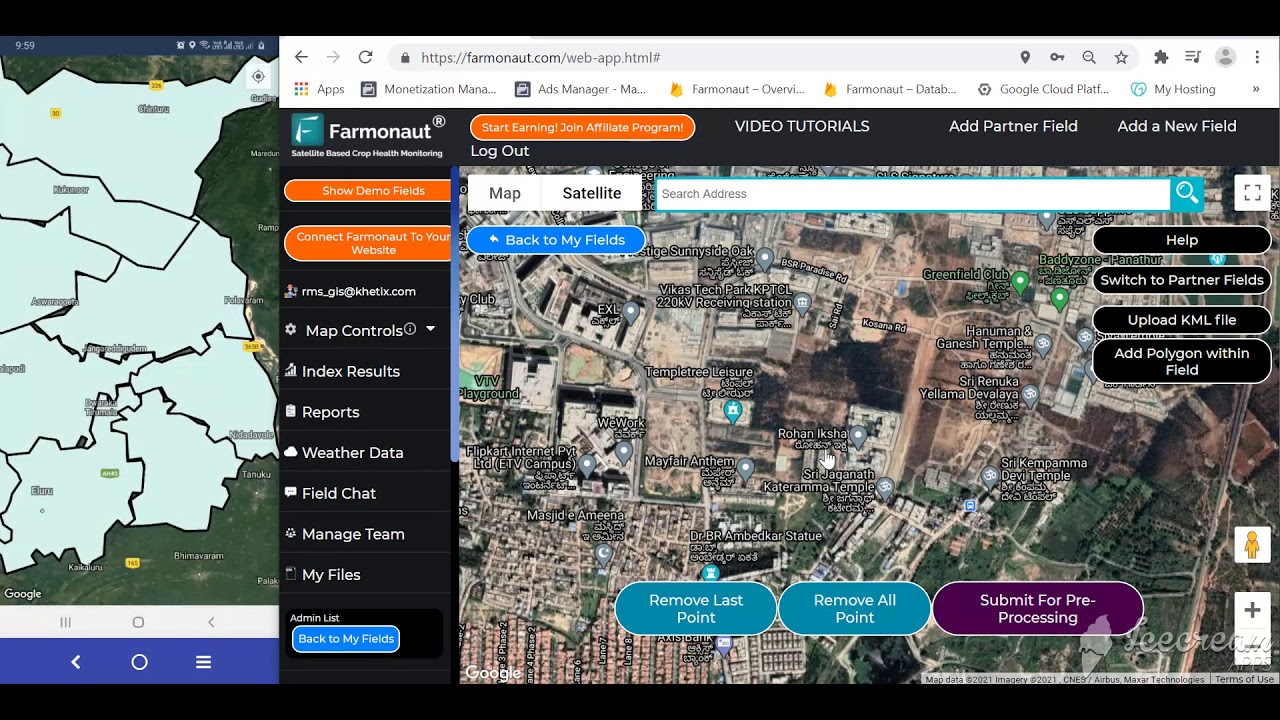
Link fence maintenance schedules with Farmonaut’s farm management platform to coordinate inspection rounds with other field operations and reduce redundant trips across the property.


FAQ: Farm Fencing
Farmonaut Subscription Plans
Use Farmonaut’s satellite monitoring tools to support fence planning, boundary verification, and land management alongside your fencing project. Explore subscriptions and developer APIs below:
For developers and agritech businesses: connect your systems with the Farmonaut API (API Docs).
Further reading:
Conclusion: Choosing the Right Fence for Your Farm
Fencing decisions on a working farm come down to three questions: what job does the fence need to do (contain, exclude, or mark a boundary), what does your actual perimeter length cost at your chosen material’s per-foot rate, and whether USDA EQIP cost-share can offset part of that cost through your state’s current program rates. Smooth wire remains the budget baseline at $1.20–$2.50 per linear foot installed; solar-electric fencing earns its higher upfront cost specifically where grid access isn’t practical; and EQIP’s roughly $2 billion in annual national funding is worth checking with your local USDA Service Center before you finalize a budget.
For the numbers this article couldn’t publish — state-specific EQIP rates, total lifecycle cost of ownership, and solar fencing adoption data — the durable path is the same: go to the primary source (your USDA Service Center, a licensed contractor’s itemized quote, or your state’s NRCS guidance document) rather than relying on a number that will be out of date within a year.
Measure your actual perimeter, match material to the job (containment, exclusion, or boundary), and check your state’s current EQIP payment rate before committing to a fencing budget — that process holds up regardless of which year you’re reading this.

 Godrej Agrovet
 Hayleys Agriculture
 Linx Agritech
 Adinet
 Save Your Soils
 GalaxEye Space
 Grandstream Algérie
 XOS Realty
 Geospatial Lab Africa
 Agro La Gándara
 HIPSAC
 ZOL Zimbabwe
 Juligerm
 AdBio
AdBio MISE Maroc
 NWNS
NWNS Red August Group
 Farm Inc
 WeMe Global
 Agrotoken
 Blue BearX
 Insignito
 DnCubed
 Indosistim Teknologi
 Liquify Digital
 CU Foods
 BeyondTech Global
 Rouge VC
 AgroRisk
 Oath Inc
 Esri North East Africa
 MDCV UK
 Etech Consulting Madagascar
 Vestlandsforsking
 WB Dev
 Sama Premium
 Tres Valles
 Blickwinkel
 Agricultural Credit Policy Council
 eKGIS
eKGIS Mostas Tech
 Andex
Andex Deluxe Conseil
 WICO
WICO Chimera Innovation
 SkyHarvest
 Teledarbas
 Exurbia Geospatial
 FieldZero
