

Drones · Mapping buyer guide
UAV Mapping Drone Guide: Choose One, With Costs
A mapping drone flies a grid, captures overlapping images and builds a measurable map or 3D model. This guide compares multirotor, VTOL and fixed-wing aircraft, RGB, multispectral and LiDAR sensors, software and service prices, and U.S. rules.
Key takeaways
- With RTK or PPK plus well-placed ground control points, studies reviewed by Wingtra report about 2-3 cm horizontal and 3-6 cm vertical error.
- A survey-method comparison quoted in a Frontiers (2022) quarry paper shows a drone cutting a volume survey from 11 hours to 5 hours and its cost from $2,235 to $1,316.50.
- U.S. drone mapping services list $5 to $20 per acre (The Drone U, 2026); PIX4Dfields lists $1,990 a year (October 2026).
- USDA ERS found drone, aircraft or satellite imagery on 7.0% of corn acres (2016) and 9.8% of soybean acres (2018).
- U.S. commercial flights need an FAA Part 107 certificate and $5 registration per drone, valid three years.
In this article
- What a UAV mapping drone actually produces
- How we chose and checked the numbers
- Fixed-wing, multirotor or VTOL: picking the aircraft
- Sensors: RGB, multispectral, LiDAR or thermal
- How accurate is a drone survey mapping solution?
- Time and cost: drone survey vs ground methods
- What mapping costs: buying, software and hiring
- Rules before you fly for work
- Step by step: planning a mapping flight
- UAV mapping drones on farms: what the data shows
- When satellite maps do the job instead
- Buyer checklist for a mapping drone
- FAQ
A UAV mapping drone is a small aircraft that flies a pre-set grid, takes hundreds of overlapping photos or laser scans, and turns them into a scaled map or 3D model. With RTK or PPK positioning and well-placed ground control points, published studies report errors of about 2–3 cm horizontally and 3–6 cm vertically, according to a Wingtra review of drone surveying accuracy. This guide helps farms, agtech teams and survey buyers pick the right aircraft, sensor and software, compare owning with hiring, and decide where satellite maps do the job instead.
What a UAV mapping drone actually produces
A mapping flight is not a video flight. The drone follows straight lines over the site, and the camera fires at set intervals so each photo shares a large part of its view with the next one. Software then matches shared features across the photos. The result is a set of files that a surveyor, agronomist or engineer can measure from.
- Orthomosaic: one large, distortion-corrected photo of the whole site. You can measure distances and areas on it.
- Digital surface model: a height grid of the top surface, including crops, trees and buildings.
- Digital terrain model: a height grid of bare ground. Laser (LiDAR) sensors do this better under canopy.
- Point cloud and 3D mesh: millions of measured points, used for volumes, cut and fill, and site models.
- Index maps: NDVI and similar crop-vigour maps, made from multispectral cameras.
Each pixel on the ground has a size called the ground sampling distance (GSD). A smaller GSD means more detail, but also lower flight height, more photos and more processing time. As a rule of thumb, Wingtra notes that absolute accuracy is about one to two times the GSD horizontally and two to three times the GSD vertically.
How we chose and checked the numbers
The old version of this page listed seven branded systems that we could not trace to real products. We removed that table. This version compares real aircraft classes, sensors and software, using maker spec sheets, dealer list prices, U.S. government reports and peer-reviewed field studies. Where a number comes from a maker or a dealer, we say so. Maker coverage and accuracy claims are best-case figures from their own tests, not independent results. Prices are list or dealer prices seen in October 2026 and change often.
Fixed-wing, multirotor or VTOL: picking the aircraft
The airframe sets how much ground you can cover per battery and where you can take off. There are three main types.
1. Multirotor (quadcopter)
Best for: small farms, single fields, stockpiles, building sites under about 50 hectares per flight. Multirotors take off from a small patch of ground, hover, and fly slowly, which suits detailed work and tight sites. Their weak point is range. Wingtra’s own comparison puts a compact enterprise quadcopter at typically under 50 ha per flight, and a large rig such as the DJI Matrice 350 with a full-frame camera at about 300 ha per flight at 5 cm GSD. Those are a rival maker’s figures, so treat them as rough.
2. VTOL fixed-wing
Best for: large farms, ranches, corridors and regional survey firms. These aircraft take off straight up like a multirotor, then fly forward on wings, which is far more efficient. Wingtra states that its WingtraRAY covers up to 550 ha in one flight at 2.7 cm GSD with up to 59 minutes in the air, and gives 3 cm absolute accuracy with PPK on its WingtraRAY product page. That is a maker claim. The trade-off is price: these aircraft sit in the premium bracket.
3. Classic fixed-wing (hand or catapult launch)
Best for: very large open areas where a runway-style landing strip is available. They are the most efficient per battery, but they need open space to land and cannot hover for detail. Many buyers now choose VTOL instead for that reason.
Sensors: RGB, multispectral, LiDAR or thermal
The sensor matters more than the airframe for most jobs. Match it to the question you need answered.
| Sensor | Best for | Main limit |
|---|---|---|
| RGB camera | Orthomosaics, terrain on open ground, stockpile volumes, drainage planning | Cannot see ground under dense canopy |
| Multispectral | NDVI and crop vigour maps, zone maps for variable-rate work | Lower resolution; needs calibration panels |
| LiDAR | Bare-earth terrain under trees, orchards, forest height | Higher price and larger data files |
| Thermal | Irrigation leaks, livestock checks, equipment hot spots | Coarse pixels; readings change with time of day |
Most survey teams start with RGB photogrammetry because it is simple and low cost. A full-frame mapping camera such as the DJI Zenmuse P1 lists at $7,499 at the U.S. dealer Dronefly (October 2026), and the dealer quotes 3 cm horizontal and 5 cm vertical accuracy without ground control points, per its Zenmuse P1 listing. For a deeper look at laser sensors on farms, see our comparison of LiDAR drones and agricultural mapping software.
How accurate is a drone survey mapping solution?
Accuracy depends on two things: how sharp the images are and how well each photo’s position is known. Wind, low light, motion blur and poor overlap hurt the first. Weak GNSS signal and no ground control hurt the second.
Three practical levels show up in published work and supplier guides:
- No correction, no ground control: fine for scouting and rough planning. A UK survey firm, Sky Scan Surveys, says standard photogrammetry without ground control gives about ±50 mm on its topographic survey cost page.
- RTK or PPK on the drone: photo positions are corrected to a few centimetres, so the map lines up with real coordinates without many targets.
- RTK/PPK plus a few ground control points and checkpoints: the level used for engineering and boundary work. The same UK firm says ground control lifts its accuracy to ±15–20 mm.
Field studies on volumes back this up. In a Malawi quarry, a team compared a low-cost quadcopter with traditional methods and found the drone volume fell within the ±3% tolerance they set, as reported in Frontiers in Built Environment (2022). A second stockpile study, flown at 50 m height with 75% overlap found the UAV volume within 2.94% of the measured volume, in Quaestiones Geographicae (2021). Always check your own map against a few independent checkpoints before you rely on it.
Time and cost: drone survey vs ground methods
The Malawi quarry study also reprinted an earlier comparison of survey methods (Fitzpatrick, 2015) that logged time and cost for each method. The drone method took less time in each test where both were measured, and the cost per job was lower. These are figures from one older comparison, not from the Malawi site, so read them as an example, not a rule.
Chart
Survey hours: traditional method vs drone
Hours per job by test, from a comparison quoted in a Malawi quarry paper
The numbers in that table: a cross-section volume survey took 11 hours against 5 hours by drone, and a terrestrial laser topographic survey took 10 hours against 7 hours by drone. Cost fell from $2,235 to $1,316.50 for the volume job and from $4,600 to $2,450 for the laser survey.
What mapping costs: buying, software and hiring
Costs split into three parts: the aircraft and sensor, the processing software, and the people who fly and check the data.
Chart
Drone service rates in the U.S.
Top of each typical hourly range, US$ per hour, The Drone U guide
Hardware
Mapping kits range from a few thousand dollars for a compact RTK quadcopter to well over $20,000 for a large rig with a full-frame camera or LiDAR. A U.S. dealer listed the DJI Matrice 350 RTK, now marked discontinued, at $11,129 on sale against a $17,302 regular price in October 2026, without batteries. For farms, the USDA Economic Research Service reported a mean drone replacement cost of $2,610 among surveyed farms in 2018, well below the list price of large survey rigs (USDA ERS, EIB-248).
Software
Most buyers pay a yearly licence. PIX4Dfields, a farm-focused mapping tool, listed at $1,990 per year billed yearly, excluding taxes, on its pricing page in October 2026. DroneDeploy showed annual plans at $1,908 and $4,188 billed annually on its pricing page at the same date. Our guide to drones supported by Pix4D lists which aircraft and cameras work with that software.
Hiring a service
If you map only once or twice a year, hiring can cost less. The Drone U, a U.S. training company, gives typical 2026 rates of $5 to $20 per acre for drone mapping and $250 to $600 per hour for construction and survey work in its drone service pricing guide. These are its asking-rate ranges, not audited prices. In the UK, Sky Scan Surveys lists drone topographic surveys from £799 for 3–5 acres to £3,499–£5,499 for 20–50 acres, with ground control an extra £399–£599.
The calculator below compares a year of owning with a year of hiring, using your own numbers.
Try the numbers for your own farm below.
Calculator
Is owning a mapping drone cheaper than hiring?
Enter your own acres, quotes and costs.
- Hiring cost per year: $5,400
- Owning cost per year: $5,400
- Owning cost per acre mapped: $9
Example values only, not a benchmark or a forecast; they are set close to break-even. Kit price is spread evenly over the years you expect to use it, with no resale value, insurance, repairs or financing included. Get local quotes for both options.
Rules before you fly for work
In the United States, commercial drone work falls under FAA Part 107. The rule covers drones under 55 pounds, daylight flying, or twilight with anti-collision lights, and a minimum visibility of three miles, according to the FAA Part 107 summary. Pilots must be at least 16 and pass the Unmanned Aircraft General knowledge test, as set out on the FAA page for certificated remote pilots. Each drone must be registered; Part 107 registration costs $5 per drone and lasts three years, per the FAA registration page.
Canada, the UK, the EU, Australia and New Zealand each have their own pilot, registration and airspace rules. Check your national aviation authority and any local rules before flying, and get professional advice for survey work that will be used in legal or boundary disputes.
Step by step: planning a mapping flight
- Define the output. Decide whether you need a crop vigour map, a terrain model or a volume. This sets the sensor and GSD.
- Draw the boundary. Import the field or site outline into the flight app.
- Set height and overlap. Many photogrammetry jobs use high front and side overlap; a published stockpile study used 75% at 50 m.
- Place targets. Lay a few ground control points and separate checkpoints if you need survey-grade work.
- Check weather and light. Avoid strong wind and fast-changing cloud, which cause blur and patchy colour.
- Fly and review. Check photo count, positioning status and gaps before you leave the site.
- Process and validate. Build the map, then compare it to your checkpoints and record the error.
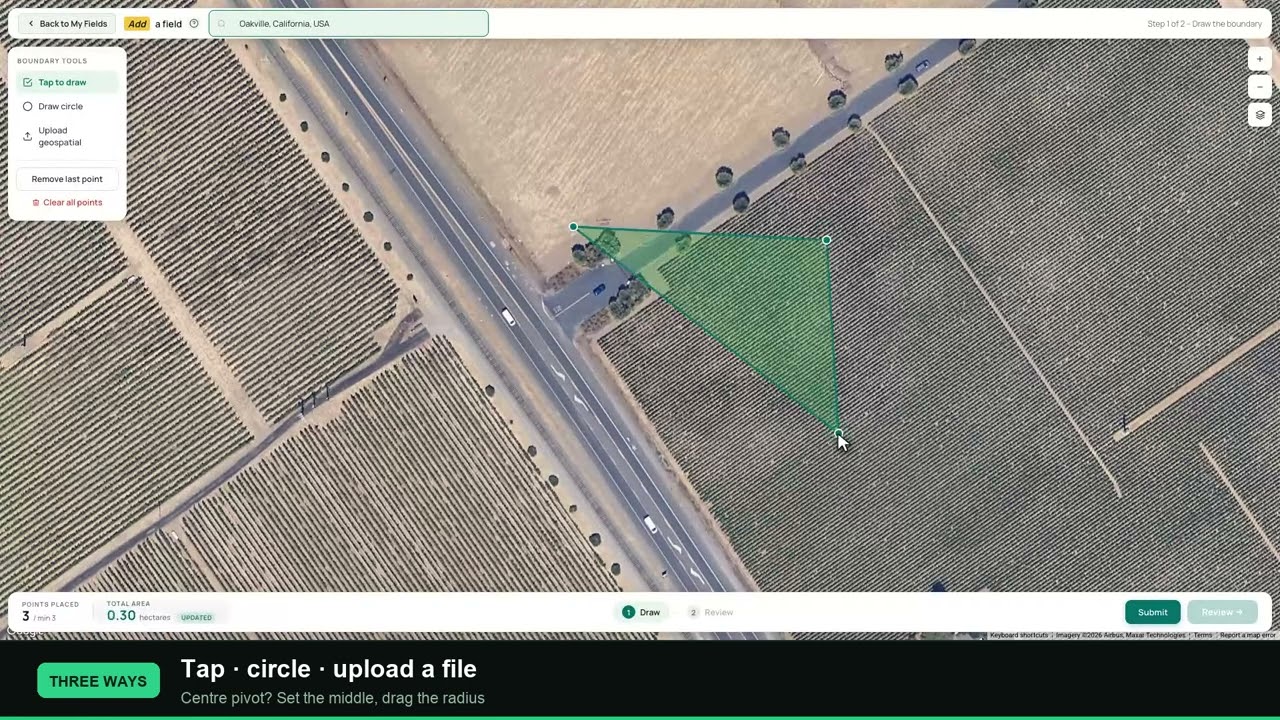
▶ How to draw or upload a field boundary in a farm mapping app, the first step before any map. · 2:21
UAV mapping drones on farms: what the data shows
On U.S. farms, aerial imagery is still a minority tool. USDA survey data show drones, aircraft or satellite imagery were used on 7.0% of corn acres in 2016 and 9.8% of soybean acres in 2018, but only 2.8% of cotton acres in 2019. The survey could not separate drones from aircraft and satellites. ERS suggests cost, complexity and a sense of few uses on the farm may hold adoption back.
Chart
Share of U.S. crop acres using aerial imagery
Percent of planted acres managed with drone, aircraft or satellite imagery, survey year in label
Where drones do help on farms:
- Drainage and levelling: a terrain model shows low spots and water paths before tile or land-forming work.
- Stand counts and replant calls: high-resolution photos show gaps in rows soon after emergence.
- Orchard and vineyard maps: tree counts, canopy size and missing vines.
- Problem scouting: a quick flight over a patch flagged on a satellite map shows what is going on up close.
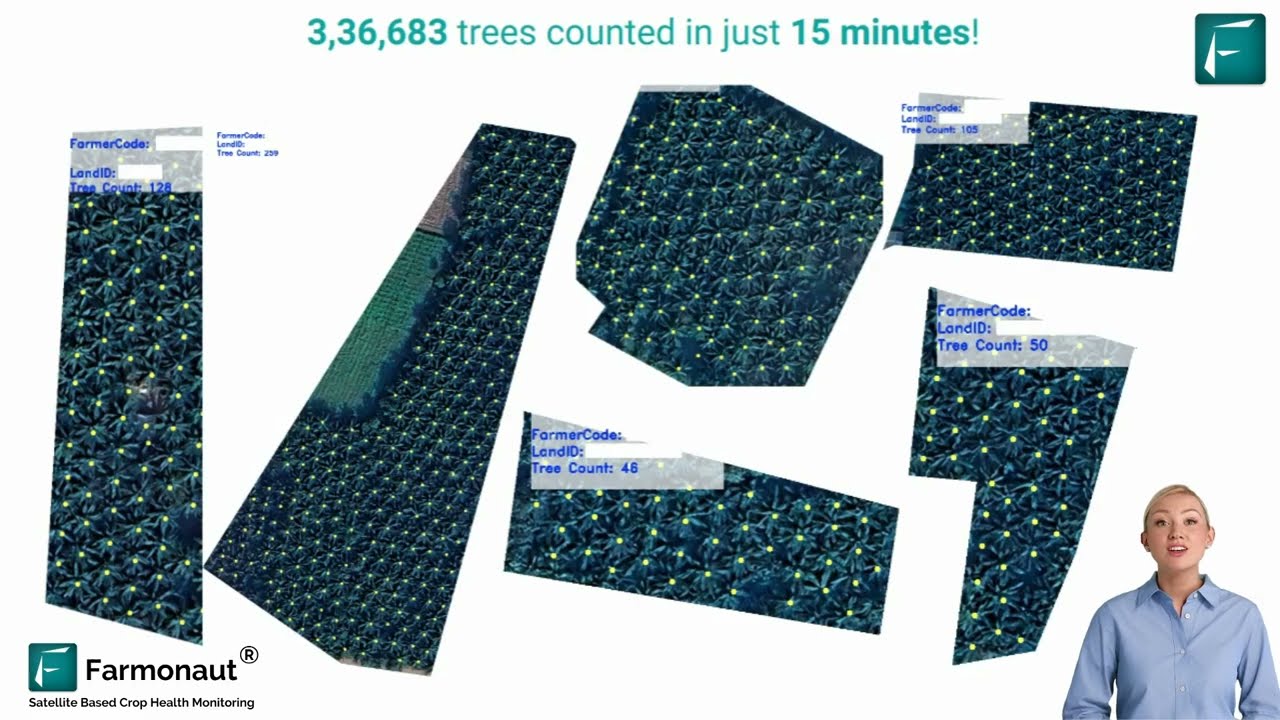
▶ Automated tree detection, counting and location mapping on plantations from imagery and AI. · 4:05
When satellite maps do the job instead
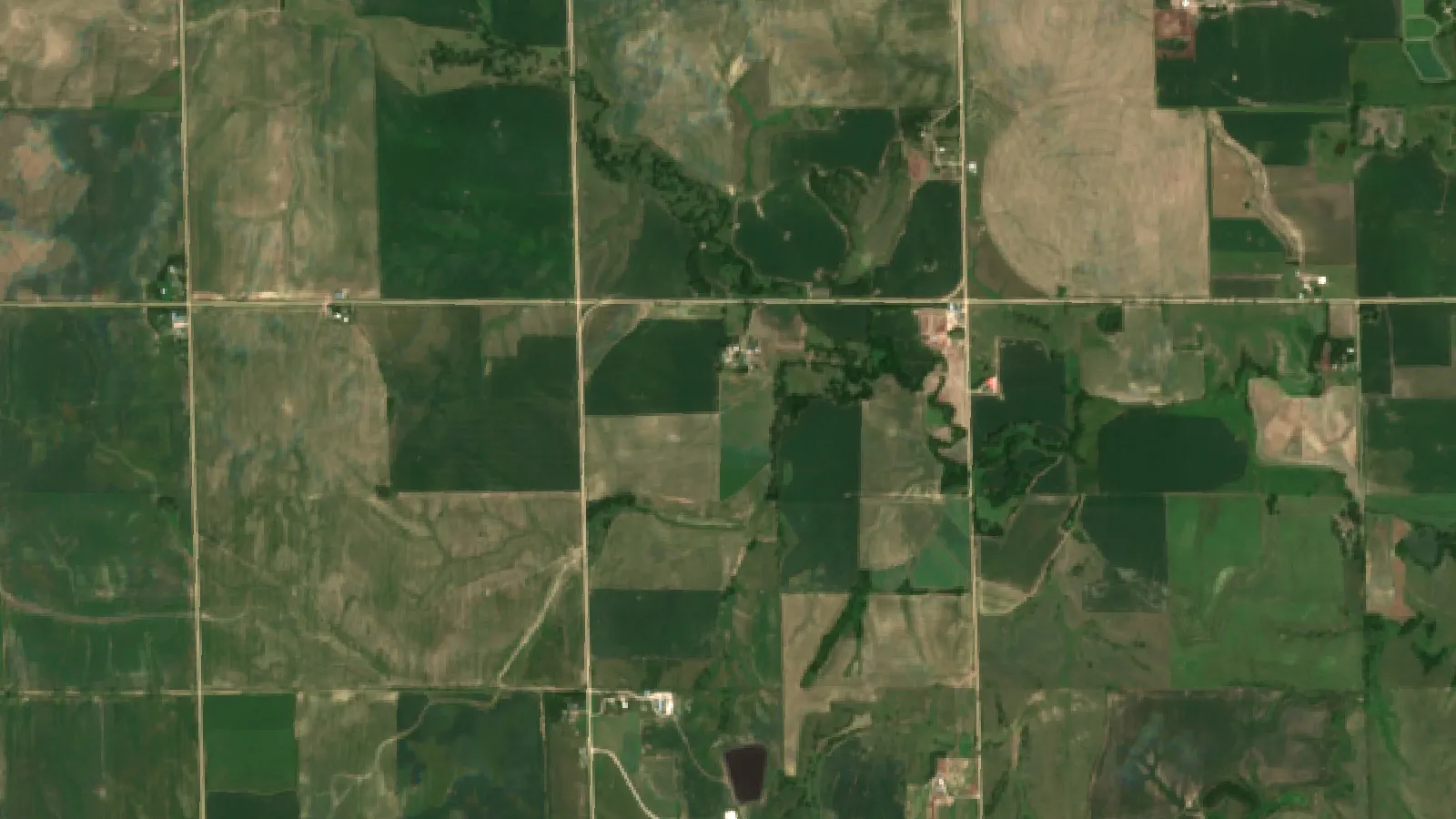
A drone gives centimetre detail on the day you fly. A satellite gives a coarser view, often 10 m pixels for public Sentinel-2 data, but it revisits every few days without anyone going to the field. For season-long crop vigour tracking across many fields or farms, satellite maps are often the easier first layer, with drones sent only where a closer look is needed.
Farmonaut is a satellite crop monitoring company, not a drone maker. Its Satellite + AI Farm Monitoring System gives vegetation index maps by field, and agtech teams can pull the same data into their own tools through the agriculture API.
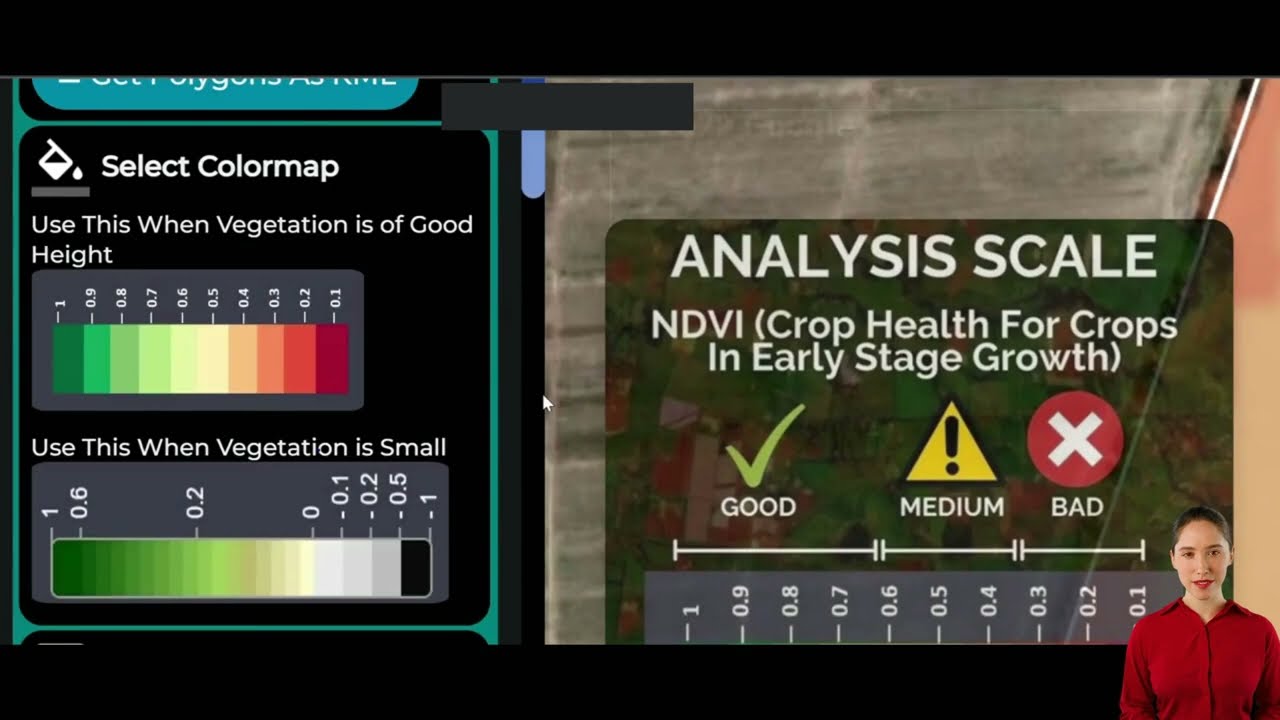
▶ A walk-through of the Farmonaut web app and how to read its satellite crop maps. · 10:16
Buyer checklist for a mapping drone
- Area per year: under a few hundred acres often favours hiring or a compact quadcopter; thousands of acres favour VTOL.
- Accuracy needed: scouting needs no correction; design and volumes need RTK or PPK and checkpoints.
- Sensor: RGB for terrain and volumes, multispectral for crops, LiDAR for canopy, thermal for water and heat.
- Software: check that your aircraft and camera are supported and that exports work in your GIS, CAD or farm software.
- Support and parts: ask about repair times, spare batteries and local dealers.
- Rules: confirm pilot licence, registration and airspace approvals for every site.
- Data handling: plan storage; LiDAR and high-overlap jobs create large files.
Related pages on our site: Farmonaut home, large-scale farm management, web and mobile apps, satellite data API, API developer docs, product traceability, farm-to-fork traceability, carbon footprinting, crop loan and insurance checks, fleet management.
FAQ
What is the difference between a mapping drone and a camera drone?
A mapping drone flies an automatic grid and tags each photo with an accurate position, so software can build a measurable map. A camera drone is flown by hand for photos and video. Many enterprise drones can do both, but survey work needs the flight planning, positioning and processing steps.
Do I need RTK for a drone survey?
Not for scouting or rough planning. For maps that must line up with real coordinates, RTK or PPK cuts the number of ground targets you need. For engineering or boundary work, add ground control points and checkpoints as well.
How much area can one flight map?
It depends on the aircraft, GSD and wind. Wingtra’s own comparison suggests a compact quadcopter maps under about 50 ha per flight, while its VTOL claims up to 550 ha. Lower GSD means less area per battery.
Is LiDAR better than photogrammetry?
LiDAR is better where you need bare ground under trees or crops. On open ground, RGB photogrammetry is cheaper and can reach centimetre accuracy with RTK or PPK and checkpoints.
Should a farm buy a mapping drone or hire one?
Compare a year of ownership, including software and staff time, with what a local service would charge for the same acres. Use the calculator on this page with quotes from local dealers and providers.
Farmonaut agriculture API
Add satellite field maps to your own platform
Agtech teams can pull Farmonaut field-level vegetation index maps into their apps through the agriculture API, alongside their drone data.




Keep reading
Sources
- Wingtra, Drone surveying: how it works and what accuracy to expect (2026): wingtra.com
- Wingtra, WingtraRAY survey and mapping drone product page (2026): wingtra.com
- Dronefly, DJI Zenmuse P1 full-frame aerial camera listing (October 2026): dronefly.com
- Sky Scan Surveys, Topographic survey cost UK (2026): skyscansurveys.co.uk
- Frontiers in Built Environment, Comparative utilization of drone technology vs. traditional methods in open pit stockpile surveys (2022): frontiersin.org
- Ajayi and Ajulo, UAV photogrammetry for stockpile volume, Quaestiones Geographicae 40(1) (2021): qg.web.amu.edu.pl
- USDA Economic Research Service, Precision Agriculture in the Digital Era: Recent Adoption on U.S. Farms, EIB-248 (2023): ers.usda.gov
- PIX4D, PIX4Dfields pricing (October 2026): pix4d.com
- DroneDeploy, Pricing (October 2026): dronedeploy.com
- The Drone U, Drone service pricing guide (2026): thedroneu.com
- FAA, Small Unmanned Aircraft Systems Regulations (Part 107): faa.gov
- FAA, Certificated remote pilots including commercial operators: faa.gov
- FAA, How to register your drone: faa.gov
- Blue Skies Drone Shop, DJI Matrice 350 RTK listing (October 2026): blueskiesdroneshop.com
Discussion
Questions, corrections or field experience? Share them below. First-time comments are reviewed before they appear, and your email is never published.
No comments yet. Be the first to add a question or your experience.

 Agreeta Solutions
 Agricultural Credit Policy Council
 BayWa
 MCSOD
 Marei Nursery
 eKGIS
 Mostas Tech
 Native Seeds
 Andex
 FCF India
 Unifrutti Gulf
 Deluxe Conseil
 TVS Electronics
 WICO
 Chimera Innovation
 SkyHarvest

 Licence holder · Niger · Gold
 Licence holder · Nigeria · Gold + lithium










