

Short Stature Corn: Yield Data and Hybrid Comparison Guide
Reviewed September 2026 against USDA NASS and University of Illinois trial data.
Try it: Run your own numbers →
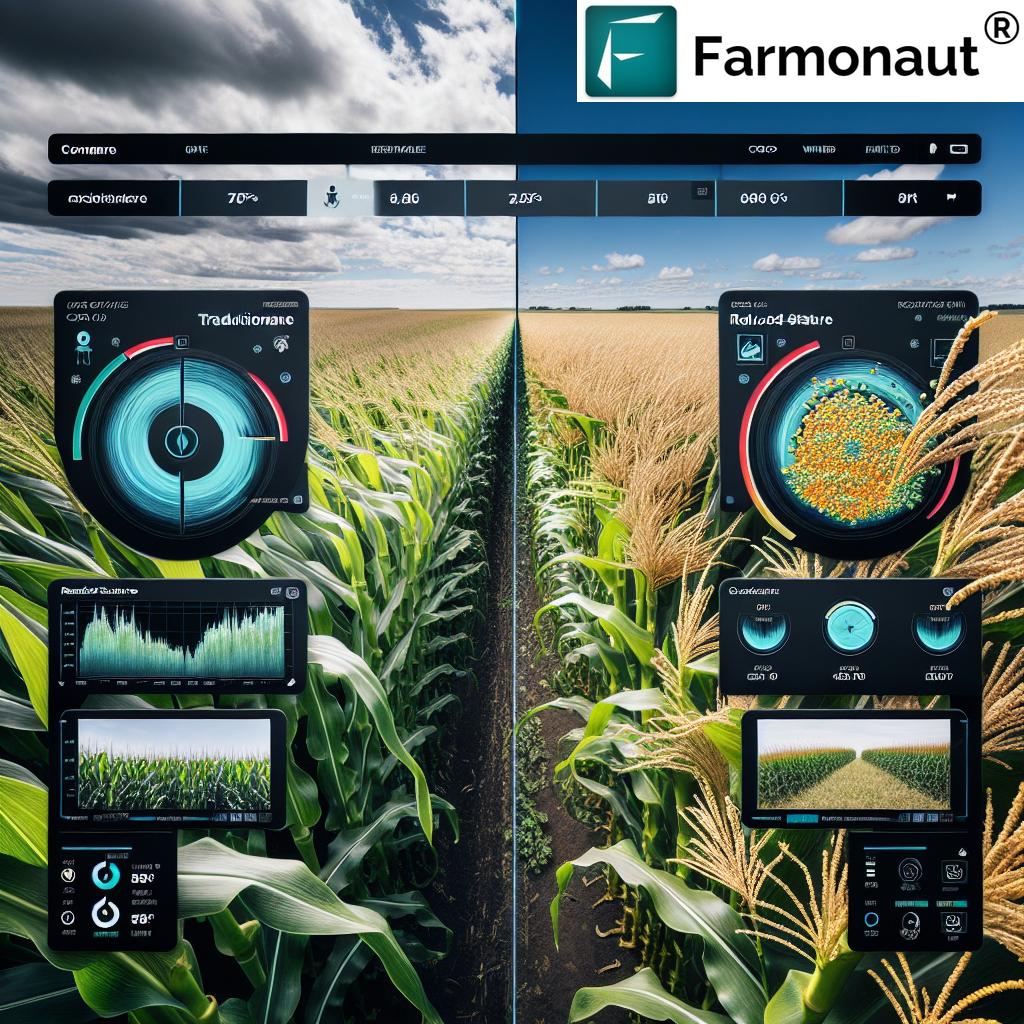
Short stature corn — also called reduced-stature corn or short corn hybrids — is corn bred to stand 60-76 inches tall instead of the 84-120 inches typical of conventional hybrids, roughly 30% shorter. In University of Illinois field trials, short stature corn combined with enhanced management produced a 16 bu/acre advantage over traditional tall corn. In Iowa dryland comparisons reported by Stine Seed, short corn hybrids reached 275 bu/acre and higher against 231 bu/acre for traditional tall corn on the same ground. This article works through what short corn is, what the yield and acreage numbers actually show, and how to decide whether a short stature corn hybrid belongs in your rotation.
Table of Contents
- What Is Short Stature Corn?
- Short Stature Corn Yield: What the Numbers Show
- Short Stature Corn Hybrids and Adoption Acreage
- The Genetics Behind Short Corn Varieties
- Lodging Losses and Why Short Corn Hybrids Exist
- Short Corn vs. Traditional Corn: Full Comparison
- Lodging Loss and Short-Corn Yield Calculator
- Reduced-Stature Breeding Beyond Corn
- Monitoring Short Corn With Satellite Data
- Adoption Challenges and Open Questions
- FAQ
- Try it: Run your own numbers
What Is Short Stature Corn?
Short stature corn is a category of hybrid corn bred for reduced plant height — typically 60-76 inches versus 84-120 inches for conventional hybrids — while targeting equal or higher yield per acre. The term covers several company breeding programs, most visibly Bayer’s Preceon Smart Corn System, alongside Stine Seed’s short-stature lines and ongoing university trial work. “Short stature corn,” “short corn varieties,” “short corn hybrids,” and “reduced-stature corn (RSC)” all refer to the same underlying trait: shorter internodes and a thicker stalk, achieved through conventional breeding rather than genetic engineering in the commercial Preceon line.
The shorter architecture is not simply a smaller version of an existing hybrid. Breeders select for agronomic practices that let the plant redirect resources that would otherwise go into stalk elongation toward the ear and root system, and toward a stalk thick enough to resist wind and lodging at a shorter height.
- Enhanced wind resistance from a lower center of gravity
- Improved standability through the season
- Reduced risk of lodging (stalks bending or breaking near the ground)
- Easier late-season fungicide, insecticide, and nitrogen applications via ground rigs, since equipment can pass over a shorter canopy
- Improved harvestability and reduced header losses
Short Stature Corn Yield: What the Numbers Show
The question every grower asks about a shorter plant is whether it costs bushels. On the national scale, corn yield has kept climbing regardless of stature mix: USDA NASS put the 2024 US corn average yield at 179.3 bu/acre, and USDA NASS’s 2025 projection lifts that to 186.0 bu/acre, on a forecast 2025 grain production of 16.8 billion bushels. Those are national blended averages across all hybrid types, not a short-corn-specific figure — USDA does not currently break out yield by plant stature in its published series, so there is no USDA number isolating short corn’s contribution to that increase.
The direct stature comparison comes from two sources in the current record. Stine Seed’s dryland trial data, reported via Key Cooperative, put 2024 Iowa dryland yields at 231 bu/acre for traditional tall corn versus 275 bu/acre and higher for its short stature hybrids on comparable ground. Separately, a 2022 University of Illinois trial found that short stature corn under enhanced management out-yielded traditional tall corn by 16 bu/acre. These are the only two stature-specific, sourced yield comparisons available; treat any other “short corn yields X% more” claim you see elsewhere as unsourced until you can trace it to a trial report.
Two things to note about reading these figures going forward. First, USDA NASS updates the national corn yield series monthly, with a formal report on approximately the 12th of each month during the growing and harvest season, plus quarterly crop progress surveys; the current number is always at USDA NASS Corn Yield Charts. Second, the Iowa dryland comparison is company-reported trial data, not a randomized multi-year university study — useful as a directional signal, but growers evaluating a hybrid for their own operation should ask their seed dealer for local plot data from their soil type and rainfall pattern before extrapolating the 275 bu/acre figure to their own fields.
Short Stature Corn Hybrids and Adoption Acreage
Short stature corn hybrids moved from trial plots to commercial acreage over the past several seasons. Bayer’s Preceon Smart Corn System reached 100,000 acres planted across the Midwest in 2025, according to Bayer Crop Science figures reported via Key Cooperative. That acreage sits against a US corn planted base of roughly 95 million acres in 2025 (USDA/industry data) — meaning short stature hybrids under this one program account for roughly 0.1% of total US corn acreage at that point, still an early-adoption stage rather than a mainstream shift.
The brief for this article did not surface a published state-by-state or company-by-company breakdown of short stature acreage beyond that aggregate Midwest figure, and no confirmed price premium for short-stature seed versus conventional hybrid seed. Both numbers move fast in a growing seed category. If you need the current adoption figure, Bayer and other seed companies typically report acreage expansion in their annual earnings calls and sustainability reports — search “Preceon adoption” plus the current year, or check Bayer’s investor relations page directly, for the latest disclosed number rather than relying on a fixed figure here.
Named short stature corn hybrid programs currently on the market or in advanced trials include Bayer’s Preceon Smart Corn System and Stine Seed’s short-stature lines; both are conventionally bred, not genetically engineered, which matters for growers selling into markets with GMO labeling sensitivities. When your seed dealer offers a “short corn hybrid” or “short stature corn hybrid” for your zone, ask specifically which breeding program it comes from and request that dealer’s local replicated trial data — company aggregate figures like the ones above are a starting point, not a substitute for a plot on your own soil type.
The Genetics Behind Short Corn Varieties
Reduced plant height in commercial short corn hybrids comes from selecting for genes that shorten internode length and thicken the stalk, most commonly working through the plant’s gibberellin hormone pathway — the hormone group that drives stem elongation. Breeders select plants with reduced sensitivity to, or reduced production of, gibberellins, which keeps the stalk shorter while the plant continues normal ear and root development. This is a conventional trait-selection process using existing corn genetics, refined over multiple breeding cycles and field trials, not a single inserted gene.
- Genetic selection: Breeding for existing height and stalk-architecture genes across parent lines
- Hormone pathway effects: Reduced gibberellin sensitivity shortens internodes without stunting ear development
- Multi-year field trials: Candidate lines are tested across soil types, rainfall patterns, and wind exposure before commercial release
- Phenotypic selection: Breeders retain lines that hold yield while gaining stalk strength, discarding those that trade off too much of either
The commercial bar for a short stature hybrid is not simply “shorter.” It has to clear the yield bar set by the tall hybrids already in a grower’s rotation — which is why the Stine and University of Illinois figures above matter more than the height figure alone.
Lodging Losses and Why Short Corn Hybrids Exist
The economic case for short stature corn starts with lodging. Corn lodging — stalks bending or breaking near the base, usually from wind, heavy rain, or a derecho-type storm event — causes an annual yield loss in the range of 5-20%, according to research published in Scientific Reports (Nature). That range covers ordinary wind events through severe storm damage; a full derecho passing through standing tall corn late in the season can sit at the high end of that range or push a field past it entirely, since lodged corn is also slower and lossier to combine even when the kernels themselves are intact.
A shorter plant with a thicker stalk lowers the center of gravity and increases the stalk’s resistance to bending, which is the direct mechanism behind the lodging-risk reduction short corn hybrids are bred for. This matters most in regions with a documented history of high-wind events during the grain-fill and pre-harvest window — the central and eastern Corn Belt has had multiple derecho events on record, most notably the August 2020 Iowa derecho, which is the kind of event that makes a 5-20% lodging loss concrete rather than theoretical for growers in that footprint.
Short Corn vs. Traditional Corn: Full Comparison
| Characteristic | Traditional Corn | Short Stature Corn |
|---|---|---|
| Average plant height | 84-120 inches | 60-76 inches |
| Stalk thickness | Standard | Thicker, bred for standability |
| Lodging loss exposure | 5-20% in wind/storm events (Nature, 2022) | Lower; not separately quantified in published data |
| Late-season ground-rig access | Limited once canopy closes | Extended, due to shorter canopy height |
| 2024 Iowa dryland yield (Stine trial data) | 231 bu/acre | 275+ bu/acre |
| 2022 University of Illinois enhanced-management trial | Baseline | +16 bu/acre over traditional |
| 2025 US planted acreage (approx. share, Preceon only) | ~99.9% of ~95 million acres | ~100,000 acres (Bayer Preceon) |
| Breeding method | Conventional | Conventional (not GMO for Preceon) |
The comparison shows short stature corn ahead on every trial-sourced yield figure available and structurally favored on lodging exposure, while still representing a small fraction of total planted acreage — a hybrid category still building its multi-year, multi-region trial record rather than a fully established default choice.
Lodging Loss and Short-Corn Yield Calculator
Use your own field’s acreage, expected yield, and corn price to see what a lodging event could cost you, and what closing part of that gap with a short stature hybrid’s trial-reported yield bump is worth in dollars.
Run your own numbers
Assumptions: lodging loss is applied as a flat percentage of expected yield across all acres, which is a simplification — real lodging damage is often patchy rather than field-wide. The short stature yield advantage is drawn from the University of Illinois 2022 trial figure and the Stine Seed Iowa dryland comparison cited above; it is not a guarantee for your own soil, hybrid choice, or season. This tool excludes seed cost differentials (no published premium figure is available), equipment or agronomic transition costs, and does not model partial lodging recovery at harvest.

Reduced-Stature Breeding Beyond Corn
Corn’s short stature push follows a pattern already proven in wheat: the Green Revolution dwarfing genes bred into wheat decades ago remain the reference case for how a shorter cereal crop can out-yield its taller predecessor by resisting lodging and redirecting growth into grain fill. Plant breeders are now working similar height-reduction approaches into other row crops:
- Wheat: Semi-dwarf genetics with improved lodging resistance, the longest-established example of this breeding strategy
- Rice: Compact varieties bred for standability under storm conditions and more efficient nutrient use
- Soybeans: Shorter canopy architecture aimed at better light interception in narrow rows
- Sorghum: Reduced-height lines paired with drought-tolerance breeding
None of these programs have a sourced yield comparison in the current research base for this article the way corn does with the University of Illinois and Stine Seed figures above — treat any specific yield claim for short-stature wheat, rice, soybeans, or sorghum as something to verify against your local extension service or seed supplier before acting on it.

Monitoring Short Corn With Satellite Data
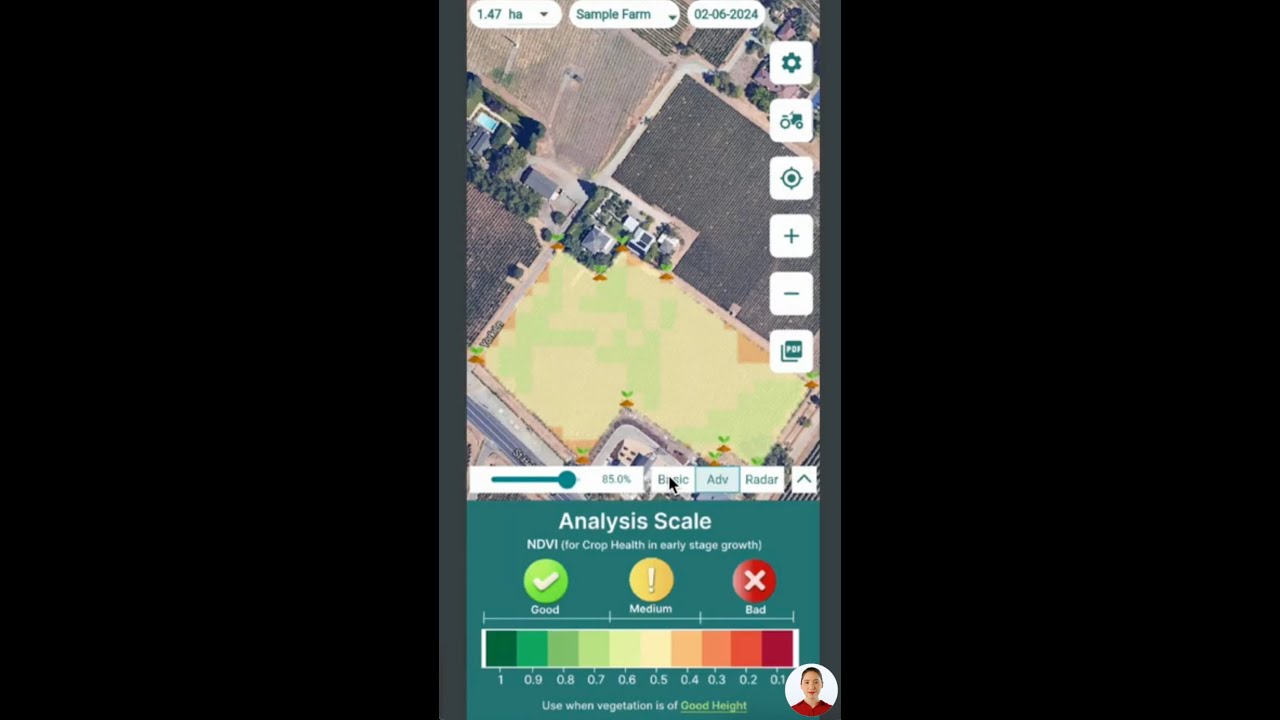
Short stature hybrids change what a grower needs to watch for during the season. A shorter canopy is easier to scout by ground rig but harder to judge for stress by eye from a truck window, since the visual cues growers rely on for tall corn — canopy closure timing, tassel height relative to the cab — shift with a shorter plant. Satellite-based crop monitoring tools track vegetation index trends across the field regardless of plant height, which makes them a useful cross-check when transitioning part of an operation to a shorter hybrid for the first time.
Farmonaut’s satellite monitoring platform tracks field-level vegetation health, generates AI-driven advisory alerts, and layers in field-specific weather forecasting — relevant here because wind-event timing relative to the grain-fill stage is exactly the variable that determines whether lodging risk turns into an actual yield loss on a given field.
- Satellite-based crop monitoring: Vegetation index tracking through the season, independent of plant height
- AI-driven advisory alerts: Flags stress signals that may be harder to spot by eye on a shorter canopy
- Field-specific weather forecasting: Useful for timing pre-storm decisions in high-wind-risk windows
- Resource management tools: Supports the late-season input applications that short stature hybrids are specifically bred to make easier to deliver by ground rig

Access Farmonaut’s tools through the web app, or download the mobile apps directly:



Developers integrating field weather and satellite data directly into farm management software can use the API:
Farmonaut API | API Developer Docs
Adoption Challenges and Open Questions
Short stature corn’s biggest open question is not agronomic performance — the trial data available shows it holding or beating traditional corn on yield — it is how fast the seed supply and pricing catch up to demonstrated trial results. At 100,000 Preceon acres against roughly 95 million total US corn acres in 2025, the category is still in early commercial rollout, which means:
- Limited hybrid selection per maturity zone: Fewer relative maturity and trait-package options than in the established tall-corn lineup for any given zone
- No published seed price premium: The research available for this article found no confirmed price differential between short stature and conventional hybrid seed — ask your dealer directly for current pricing on any hybrid you are considering
- Limited long-term regional trial history: Multi-year, multi-location university trial data is still accumulating; the University of Illinois 2022 trial is the primary published academic source at this point
- Equipment fit: Head height and settings on some combines may need adjustment for a shorter stalk, which growers should confirm with their equipment dealer before the first harvest on short corn
None of these are reasons to dismiss the category — they are the normal signature of a hybrid class in its first several years of commercial scale-up. The way to track progress is direct: check USDA NASS’s monthly yield releases for the national trend, and check with your seed dealer or Bayer’s investor disclosures for the current Preceon acreage figure, since both update on a predictable schedule and will move past the figures cited here.

For growers evaluating whether a shorter hybrid fits a broader resilience and farm sustainability strategy, the short-corn decision sits alongside other structural choices — cover cropping, tile drainage, variable-rate nitrogen — that also trade a near-term adjustment cost for a longer-term stability gain.
FAQ
Q: What is short stature corn?
A: Short stature corn is corn bred to grow 60-76 inches tall instead of the 84-120 inches typical of conventional hybrids, roughly 30% shorter, while targeting equal or higher yield through a thicker stalk and altered resource allocation.
Q: Do short corn varieties actually yield more than traditional corn?
A: In the two sourced trial comparisons available, yes. University of Illinois’s 2022 trial found a 16 bu/acre advantage for short stature corn under enhanced management, and Stine Seed’s 2024 Iowa dryland data showed 275+ bu/acre for short stature hybrids versus 231 bu/acre for traditional tall corn on comparable ground.
Q: How widely planted are short stature corn hybrids?
A: Bayer’s Preceon Smart Corn System reached 100,000 acres across the Midwest in 2025, against roughly 95 million total US corn acres that year — still a small fraction of total plantings. Check current Bayer investor disclosures for the latest acreage figure.
Q: Are short stature corn hybrids genetically modified?
A: Bayer’s Preceon Smart Corn System is developed through conventional breeding, not genetic engineering. Confirm the breeding method with your seed dealer for any specific hybrid, since methods can differ by company and product line.
Q: How much yield does corn lodging typically cost without a short stature hybrid?
A: Published research in Scientific Reports (Nature) puts annual lodging-related yield loss in a 5-20% range, driven by wind and storm events during the grain-fill and pre-harvest window.
Q: Where can I find the current US corn yield average?
A: USDA NASS publishes the national average monthly, with a formal report around the 12th of the month during the season, at its Corn Yield Charts and Maps page. The 2024 average was 179.3 bu/acre; the 2025 projection is 186.0 bu/acre.
Q: Is there a price premium for short stature corn hybrid seed?
A: No confirmed premium figure is published as of this review. Ask your seed dealer directly for current pricing on any short stature hybrid against the conventional hybrids you would otherwise plant.
Discussion
Questions, corrections or field experience? Share them below. First-time comments are reviewed before they appear, and your email is never published.
No comments yet. Be the first to add a question or your experience.

 Fyllo
Fyllo FieldZero
 Indico Company
 Kubota
 FFBS
FFBS Jontra
 Kalustyan
 Tucor
Tucor Geno
Geno Hayleys Agriculture
 Linx Agritech
 Adinet
 Save Your Soils
