

Salton Sea lithium · Project comparison
Salton Sea Lithium Projects: Status, Output and Tax
No Salton Sea project was selling lithium in September 2026. This page compares the three developers, their planned output and timing, the court ruling that stalled Hell’s Kitchen, and what California’s lithium tax would cost a producer.
Key takeaways
- None of the three main projects was near full operation in September 2026 (CalMatters); US commercial lithium output comes from a Nevada brine operation (USGS, 2026).
- DOE and Berkeley Lab put the region’s lithium at 760 kt proven, 2,600 kt accessible today and 3,400 kt with better technology (DOE, 2023).
- Planned capacity runs from 20,000 t a year (ATLiS, hydroxide) to about 100,000 t a year (Hell’s Kitchen full build, carbonate); all are company targets.
- An August 2026 appeals ruling sent the Hell’s Kitchen environmental review back to Imperial County over water supply and air quality.
- California’s lithium tax has a base rate of US$400 a tonne of LCE up to 20,000 t, rising to US$800 above 30,000 t, indexed from 2025 (Imperial County).
In this article
- Salton Sea lithium projects compared
- How much lithium is under the Salton Sea
- How lithium is taken from geothermal brine
- Project by project: where each one stands
- Why nothing is producing yet
- Lithium tax in California: what a producer would pay
- Other minerals in the brine, including rare earths
- Jobs, water and dust: what the evidence supports
- Watching a brine-field site from space
- What to watch next
- Frequently asked questions
Salton Sea lithium projects compared
No Salton Sea project was selling lithium in September 2026. Three developers are working on it: Controlled Thermal Resources (CTR) at Hell’s Kitchen, EnergySource Minerals (ESM) at Project ATLiS, and BHE Renewables with Oxy at existing CalEnergy plants. CalMatters reported in September 2026 that none of them was near full operation, and the US Geological Survey (USGS) says domestic commercial-scale production still comes from one brine operation in Nevada.
The table lists each project with its planned size and its stated timing. All capacities and dates are company targets, not output. The product also differs: hydroxide and carbonate are both lithium chemicals used in batteries, and carbonate-equivalent (LCE) is the common yardstick.
| Project | Developer | Planned product and size | Stated timing | Status |
|---|---|---|---|---|
| Hell’s Kitchen | Controlled Thermal Resources | Stage 1: 50 MW geothermal power, then 25,000 t a year of battery-grade lithium. Full build: about 650 MW and about 100,000 t a year of lithium carbonate | Stage 1 power 2028; Stage 1 lithium 2030 | Appeals court ruled on 11 August 2026 that the environmental review must be corrected (case remanded to the Superior Court); listing through a Plum Acquisition Corp. IV merger expected in the fourth quarter of 2026 |
| Project ATLiS | EnergySource Minerals | Up to 20,000 t a year of lithium hydroxide, plus zinc and manganese | No timeline given to CalMatters in September 2026 | Permitted; US Department of Energy (DOE) conditional commitment of up to $1.36 billion for a loan, announced 15 January 2025; no closing found as of 16 October 2026 |
| CalEnergy demonstration | BHE Renewables with Oxy (TerraLithium) | Demonstration plant at Calipatria; commercial scale could reach about 90,000 t a year of LCE | Demonstration to start by the end of 2026 and run through 2027, then a go or no-go decision | Pilot completed, company says; commercial plant not decided |
Sources: ThinkGeoEnergy on CTR, Mining Technology on ATLiS, BHE Renewables and CalMatters. A conditional commitment means the DOE intends to lend if technical, legal, environmental and financial conditions are met; it is not a closed loan.
How we chose what to include
We list every Salton Sea project that CalMatters named as active in September 2026 and that has a public company or agency statement behind it. Smaller research pilots and early-stage claims are left out. The projects are shown side by side, not ranked, because none has produced a tonne of product yet.
How much lithium is under the Salton Sea
A 2023 analysis by Lawrence Berkeley National Laboratory for the DOE estimated that the region’s geothermal brine could supply lithium for more than 375 million electric-vehicle batteries. The DOE fact sheet splits the resource into three tiers, shown in the chart: 760 thousand tonnes of lithium it calls proven, 2,600 thousand tonnes it calls accessible today, and 3,400 thousand tonnes it expects to become accessible with better technology.
Chart
Salton Sea lithium resource tiers
Thousand tonnes of lithium, as labelled by the DOE
The same fact sheet says the field’s existing geothermal plants (400 megawatts in 2023) sit over an estimated 21,500 tonnes of lithium in brine each year, none of it recovered at the time of the 2023 analysis. It also says the field could host up to 2,950 megawatts of geothermal power, which is why developers talk about pairing lithium with power. Because the lithium is a by-product of brine that is already pumped for electricity, the heat and the pumping cost are shared.
The California Energy Commission (CEC) describes the Salton Sea region as the fifth largest lithium deposit in the world and says its brine is believed to hold the highest lithium concentration of any geothermal brine. For scale, the USGS counts 30 million tonnes of measured and indicated lithium resources in the United States from all sources, including geothermal brines, and 4.4 million tonnes of US reserves. A resource is lithium in the ground that may one day be recoverable; a reserve is the part that can be mined profitably under today’s conditions.
Why the brine is so rich
CalMatters describes the lake as sitting in an active volcanic zone with lava domes, boiling mud pots and reservoirs of hot, mineral-rich water. A USGS paper by Donald White on a 5,232-foot test well near the sea found a very salty brine, about 185,000 parts per million chloride, with unusually high levels of potassium, iron, manganese, zinc, lead, copper and silver. That 1960s well is the early evidence behind today’s interest in the brine as a mineral source. Other lithium sources, such as the pegmatites and clay deposits described in our guide to lithium deposit types and the spodumene mines of Australia, are mined from rock, not pumped.
How lithium is taken from geothermal brine
Hot brine is pumped from wells a mile or more deep to a power plant. Its pressure is dropped so that part of it flashes to steam, which turns a turbine. The cooled brine then passes through a direct lithium extraction (DLE) unit, a selective chemical or sorbent process that pulls lithium out of the liquid. The spent brine is injected back into the reservoir. BHE Renewables describes this closed loop as reducing land use and water use compared with evaporation ponds.
Infographic
From brine to battery chemical in 5 steps
- 1PumpHot brine is brought up from wells a mile or more deep.
- 2FlashPressure drops, steam forms and turns a turbine.
- 3ExtractA direct lithium extraction unit pulls lithium from the cooled brine.
- 4RefineLithium is turned into hydroxide or carbonate.
- 5ReinjectSpent brine goes back into the reservoir.
The DOE fact sheet says DLE needs 99 percent less water per tonne of lithium than current lithium mining processes. That is a comparison with ponds and hard rock, and it does not cover the cooling water that geothermal plants themselves need, which is the point the Hell’s Kitchen court ruling turned on. For the step-by-step chemistry, see our explainer on the lithium brine extraction process.
Project by project: where each one stands
Hell’s Kitchen (Controlled Thermal Resources)
CTR plans an integrated site of about 4,000 acres in the Imperial Valley. Its plan puts a 50 MW geothermal plant first, with commercial operation targeted for 2028, then a first lithium stage of 25,000 tonnes a year of battery-grade product targeted for 2030. The wider plan is about 650 MW of geothermal power. CTR says it has raised more than US$285 million in private capital, and that its direct lithium extraction process has run on live brine at one-fifteenth of commercial scale.
Chart
Planned lithium output by project
Tonnes a year, company targets; hydroxide for ATLiS, carbonate or LCE for the others
In August 2026 an appeals court found that the project’s environmental report did not show that the Imperial Irrigation District could supply water for 50 years, did not account for possible Colorado River cuts, and did not assess how water use could affect air quality as the lakebed dries. It partly reversed the trial court and sent the case back to the Imperial County Superior Court, so the county must correct the review. CTR told CalMatters it is reviewing its legal options. Separately, CTR signed a business combination with Plum Acquisition Corp. IV in March 2026; the deal values CTR at a pro forma enterprise value of US$4.7 billion by the companies’ own figure, and closing is expected in the fourth quarter of 2026 under the ticker CTRH, subject to approvals. CTR has also said about US$245 million of convertible debt would be retired at closing: roughly US$205 million converting to equity and about US$40 million converting into a planned private placement (PIPE). This is a description of a pending deal, not investment advice.
Project ATLiS (EnergySource Minerals)
ESM plans a plant that takes brine after it has gone through a geothermal plant and makes up to 20,000 tonnes a year of lithium hydroxide, enough for about 52 gigawatt-hours of batteries a year, with zinc and manganese as co-products. Mining Technology reported the DOE’s conditional commitment of up to US$1.36 billion and up to 300 construction jobs and 71 operating jobs, as the project expects. ESM chief executive Eric Spomer told CalMatters the company is working to move the project forward as quickly as possible but gave no schedule.
BHE Renewables and Oxy (CalEnergy)
BHE Renewables runs 10 geothermal plants in the Imperial Valley with 345 megawatts of net capacity under the CalEnergy name. With Oxy it is testing TerraLithium’s DLE technology. BHE says recovering lithium from its existing plants could produce about 90,000 tonnes of LCE a year. A pilot has produced battery-grade compounds, and a demonstration plant at Calipatria is due by the end of 2026 and to run through 2027, after which BHE will decide whether to build a commercial plant. Because the wells and plants already exist, this route avoids new drilling, which is why it is a useful benchmark for the other two.
Why nothing is producing yet
Four things have slowed the field. First, legal challenges: community groups challenged the Hell’s Kitchen environmental report in 2024, lost in the trial court in January 2025, then won in part on appeal. Second, funding: CTR said the lawsuit disrupted its financing and set it back a year or more. Third, the lithium price. USGS records the average price of battery-grade lithium carbonate falling from US$63,700 a tonne in 2022 to US$9,000 in 2025 (an estimate, in real dollars), and a California Energy Commission spokesperson told CalMatters that development has been slower than expected largely because of global lithium markets and prices. Fourth, federal policy: CalMatters reports that federal clean-energy commitments were cut in 2025 and that federal tax credits for electric cars were ended.
Chart
Battery-grade lithium carbonate, annual average price
US$ a tonne, real dollars; 2025 is a USGS estimate
Prices have since recovered somewhat. Benchmark Mineral Intelligence assessed battery-grade lithium carbonate at US$19,750 a tonne (spot, CIF Asia) on 2 September 2026. Investing News Network, citing Benchmark data, reports that Chinese carbonate ended the third quarter at US$19,025 a tonne, down 20.8 percent on the quarter, and that the most active Guangzhou futures contract fell to about US$15,650 on 12 October 2026. Prices move weekly, so check a current assessment before using any number in a model.
Lithium tax in California: what a producer would pay
California’s Lithium Extraction Tax Law, part of SB 125, applies from 1 January 2023 to every metric tonne of lithium carbonate equivalent extracted in the state. The statutory base rate depends on lifetime cumulative output: US$400 a tonne up to 20,000 tonnes, US$600 from 20,001 to 30,000 tonnes and US$800 above that, according to the Imperial County Lithium Valley site. From 1 January 2025 the rates are adjusted each year for the change in the California Consumer Price Index (Revenue and Taxation Code section 47010(c), per the California Department of Tax and Fee Administration), so the figures here are base rates, not today’s bill. Other lithium products are converted to LCE with fixed factors, for example 0.880 for lithium hydroxide monohydrate and 5.323 for lithium metal.
The county’s funding plan, written in 2024 when no commercial producer existed, says that for tax collected in Imperial County 80 percent of the revenue goes to Imperial County, with at least 30 percent of that amount going to the communities most affected, and 20 percent goes to a lithium subaccount of the Salton Sea Restoration Fund. The split is as stated in that plan. The calculator below turns your own output and price into a tax figure.
Calculator
What lithium tax would a Salton Sea producer owe?
Enter output in tonnes of lithium carbonate equivalent (LCE) and your cumulative output to date.
- Revenue at your price (US$): $380,000,000 US$
- Average tax per tonne (US$): 400.0 US$/t
- Tax as a share of revenue: 2.1 %
Example values only. Base rates from the Imperial County Lithium Valley site: US$400 a tonne up to 20,000 t lifetime, US$600 to 30,000 t, US$800 above (SB 125). From 2025 rates are indexed to the California CPI, so the real bill differs. The price is an input: example, use today’s price (US$).
Other minerals in the brine, including rare earths
Lithium is not the only metal in the brine. The USGS well study found manganese, zinc, lead, copper and silver at unusually high levels, and ESM and Mining Technology both name zinc and manganese as planned co-products. CTR describes its target as battery-grade lithium plus other critical minerals without naming them. In the project descriptions cited here, none names rare earth elements as a planned product, so claims that the Salton Sea is a rare earth source go beyond what the developers say. Readers comparing rare earth geology can start with our rare earth deposit map guide.
Jobs, water and dust: what the evidence supports
Jobs figures are project estimates. The ATLiS estimate, reported by Mining Technology, is up to 300 construction jobs and 71 operating jobs. CalMatters reports that San Diego State University opened an US$80 million science and technology facility in Imperial County to train workers, and that its president warned graduates could face an empty job market if progress stalls.
On water, the DOE says DLE uses far less water than ponds or hard-rock processing, while the plaintiffs in the Hell’s Kitchen case ask where the water will come from and what falls to the lake if the Colorado River supply drops. Both statements can be true at the same time. Dust from the drying lakebed is a separate and long-running issue; the 20 percent of lithium tax that goes to the Salton Sea Restoration Fund is the only direct funding link between lithium and the lake in the sources we reviewed, and no tax has been collected because no project is producing.

▶ Explains seven environmental impacts of mining in plain words, with satellite maps. · 2:31
Watching a brine-field site from space
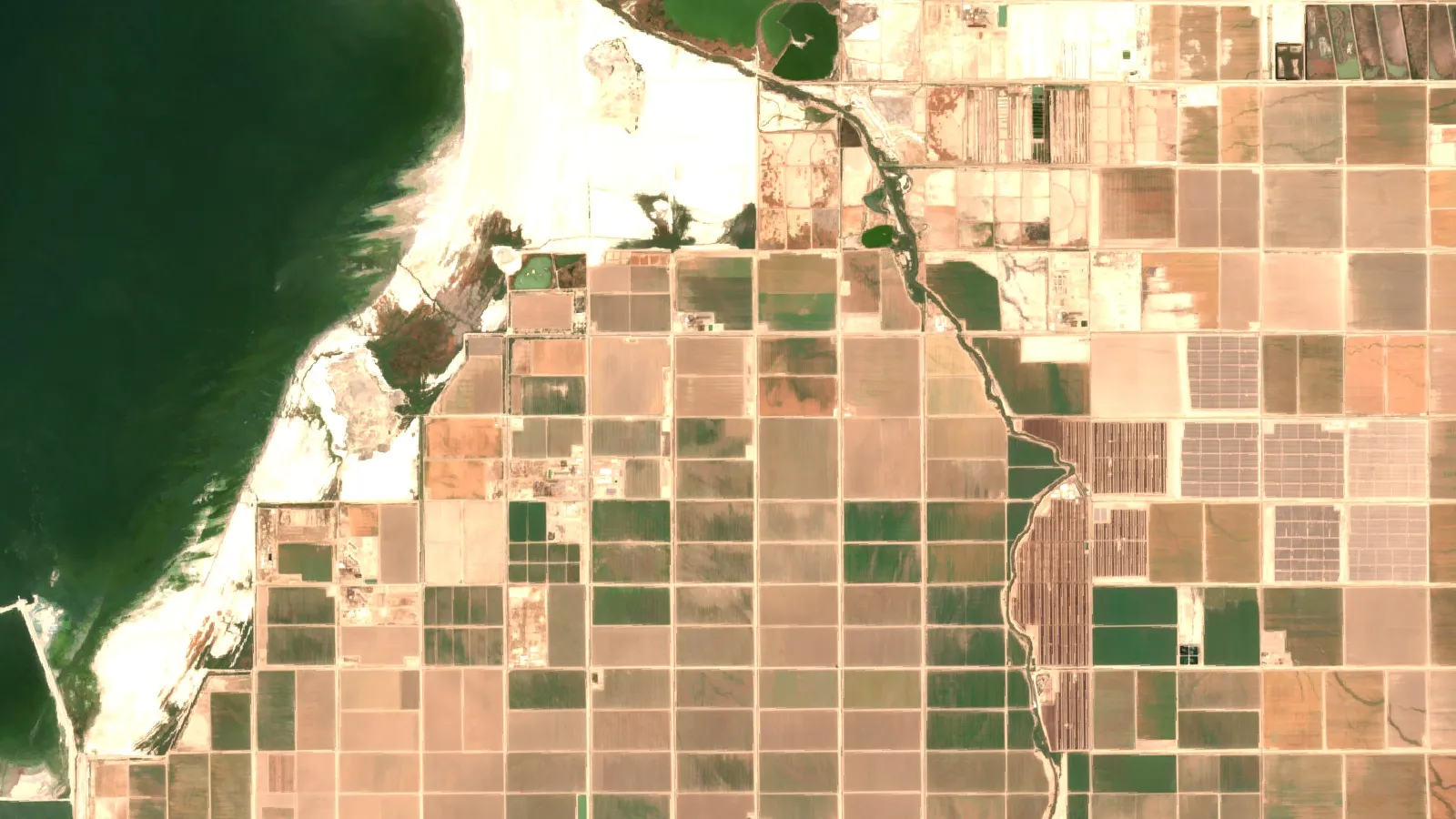
A geothermal and lithium site changes the surface in ways that satellites can record: well pads, ponds, pipelines, plant footprints and the shoreline of the lake. A Sentinel-2 image, like the one at the top of this page, helps a consultant document the baseline before construction and compare it later. Farmonaut maps licence areas from satellite imagery for mining teams; the output is a set of exploration targets or a surface record, not a resource estimate and not an environmental clearance.
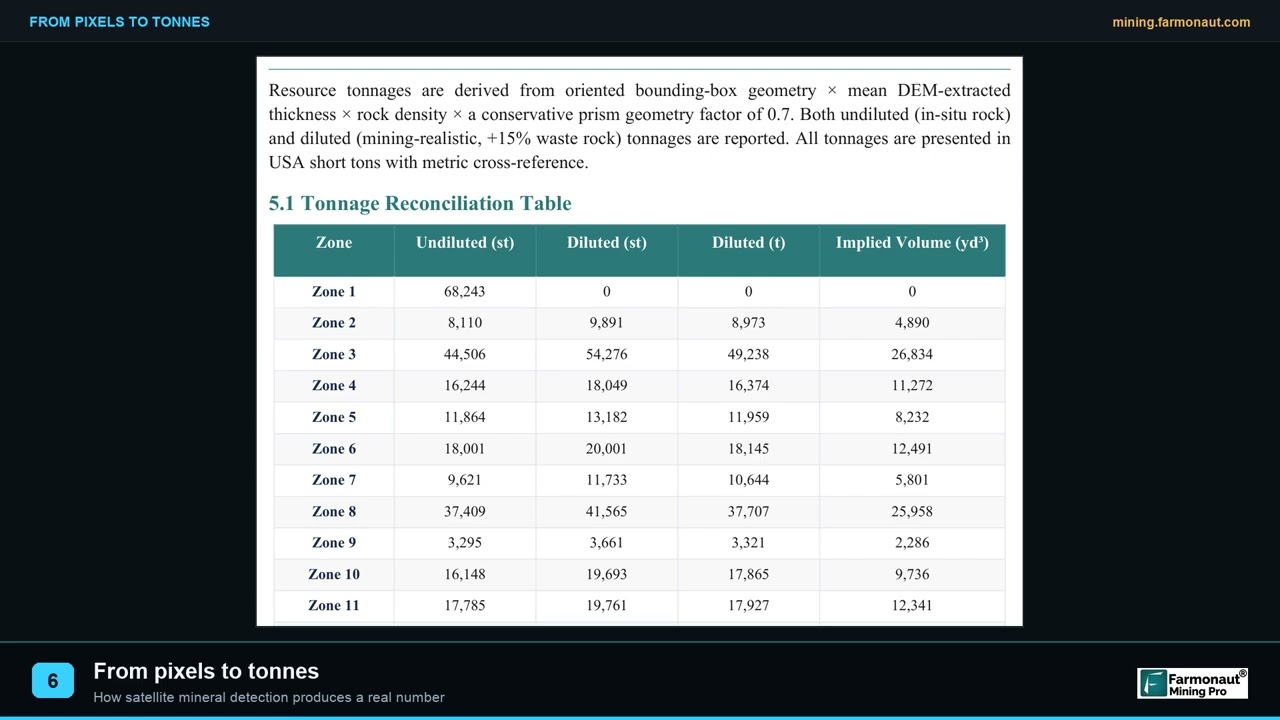
▶ Shows how a satellite picture becomes a map, a tonnage and a grade, and which inputs are measured or assumed. · 2:54
What to watch next
- The Plum Acquisition Corp. IV and CTR closing, expected in the fourth quarter of 2026.
- Imperial County’s decision on how to fix the Hell’s Kitchen environmental review after the appeals ruling.
- The start-up of the BHE Renewables and Oxy demonstration plant at Calipatria, due by the end of 2026.
- The county’s Lithium Valley Specific Plan and program environmental report, meant to set one planning framework for future projects.
- Whether the DOE conditional commitment for ATLiS becomes a closed loan.
For a closer look at a related question, see our guide: Flow Through Shares: Tax Credits and After-Tax Cost.
If this topic matters to you, read Thacker Pass Lithium Mine: Capex, Output, Court Status next.
Frequently asked questions
How much lithium is under the Salton Sea?
The DOE fact sheet based on Lawrence Berkeley National Laboratory work gives three estimates: 760 thousand tonnes proven, 2,600 thousand tonnes accessible today and 3,400 thousand tonnes accessible with future technology. It says this could support more than 375 million electric-vehicle batteries.
Is lithium being produced at the Salton Sea now?
No. CalMatters reported in September 2026 that none of the Salton Sea lithium projects was near full operation. USGS reports that US commercial lithium production comes from a brine operation in Nevada.
Which companies are developing Salton Sea lithium?
Controlled Thermal Resources (Hell’s Kitchen), EnergySource Minerals (Project ATLiS), and BHE Renewables with Oxy’s TerraLithium unit (CalEnergy plants). The table near the top of this page gives each project’s size and timing.
Why was the Hell’s Kitchen project delayed?
A lawsuit challenged its environmental report. A trial court backed the company in January 2025, but in August 2026 an appeals court found gaps on long-term water supply and on air quality from a drying lakebed, and returned the review to Imperial County. CTR also reported that the dispute disrupted its financing.
How much lithium tax will producers pay in California?
The base rate is US$400 a tonne of lithium carbonate equivalent for the first 20,000 tonnes a producer extracts, US$600 for the next 10,000 and US$800 after that, adjusted yearly for inflation from 2025. Use the calculator on this page to test your own numbers.
Does the Salton Sea have rare earth minerals?
The sources reviewed here document lithium, manganese, zinc and other metals in the brine. The developers’ project descriptions name lithium, manganese and zinc, or unspecified critical minerals, and none lists rare earth elements as a planned product.
How is lithium taken out of geothermal brine?
Brine is pumped up, used for power, passed through a direct lithium extraction unit and then injected back underground. The lithium is then turned into a battery chemical such as hydroxide or carbonate.
Is geothermal lithium better for the environment than evaporation ponds?
The DOE says DLE uses 99 percent less water per tonne than current lithium mining processes and emits almost no carbon dioxide. Local groups question the water supply for the plants and the effect on air quality, so the net result depends on each project’s permits and measured use.
Where is Lithium Valley?
It is the area around the southern end of the Salton Sea in Imperial County, California, in the Imperial Valley and the Eastern Coachella Valley, near the Mexican border, according to the California Energy Commission.
Will Salton Sea lithium end US lithium imports?
Not on current plans. USGS lists US net import reliance for lithium as more than 50 percent, and the planned capacities of the three main projects, from 20,000 to about 100,000 tonnes a year, are company targets that have not been built.
This page is for information only. It is not investment advice or legal advice. Company figures are targets, not results; confirm tax rules with the California Department of Tax and Fee Administration.
Farmonaut mining
Map your mining site
Consultants can record the surface of a licence or brine-field site from satellite imagery as a baseline for exploration targets, which sit ahead of any resource estimate.

Mining Pro sample view, synthetic data
Keep reading
Sources
- CalMatters, Is California’s ‘lithium valley’ dream fading? (September 2026): calmatters.org
- US Department of Energy, Improved Quantification of Lithium Resources in the Salton Sea Region (November 2023): energy.gov
- California Energy Commission, Lithium Valley Vision: energy.ca.gov
- Imperial County, Lithium Excise Tax: lithiumvalley.imperialcounty.org
- USGS, Mineral Commodity Summaries 2026: Lithium: pubs.usgs.gov
- USGS, White, Deep geothermal brine near Salton Sea, California: pubs.usgs.gov
- BHE Renewables, The Power of Geothermal Energy: bherenewables.com
- ThinkGeoEnergy, CTR restructures debt to advance Hell’s Kitchen: thinkgeoenergy.com
- ThinkGeoEnergy, CTR enters public listing: thinkgeoenergy.com
- Mining Technology, US backs ATLiS lithium project with conditional loan: mining-technology.com
- EnergySource Minerals, company site: esminerals.com
- Benchmark Mineral Intelligence, Lithium prices (2 September 2026): benchmarkminerals.com
- Investing News Network, Lithium market trends: Q3 2026 review: investingnews.com
Discussion
Questions, corrections or field experience? Share them below. First-time comments are reviewed before they appear, and your email is never published.
No comments yet. Be the first to add a question or your experience.

 Congo Mining Solutions
 Mining SARL
 SenGold Invest SAS
 Sania Corporation
 Sean Mining Limited
 NTS Group (Pty) Ltd
 Mine4Africa
 Lithspo Minerals Limited
 Tintina Mining Group
 Dalgety Minerals Pty Ltd
 Vortex Minerals Pty Ltd
 Faith At Work (Pty) Ltd
 Geotech Mining Solutions plc
 Vulcan International Limited
 Kidepo Associates
 GKY Mining
 Alkimy SARL
 Double A Trading
 GemSprout Metals Limited
 Qader Group
 Ileys General Trading
 SG Gold Mining LLC
 VRV Global Pte Ltd











