

TSX junior financing · Flow-through shares
Flow Through Shares: Tax Credits and After-Tax Cost
Flow through shares let a Canadian exploration company pass its exploration spending to investors as a 100% tax deduction, and individual investors can add a 15% federal credit (30% for listed critical minerals) plus provincial credits of 5% to 30%, which can cut the after-tax cost of each dollar invested to well under half.
Key takeaways
- Flow through shares let an exploration company renounce its Canadian exploration expense to investors, who deduct 100% of it.
- Individuals can add the 15% federal METC (extended to agreements made by March 31, 2027) or the 30% CMETC for listed critical minerals, never both on the same expense.
- Provincial credits stack on top for work in that province: Ontario 5% (refundable), British Columbia 20%, Saskatchewan and Manitoba 30%.
- The shares are deemed to cost zero, so the whole sale price is usually a capital gain, and the credits are taxed the following year.
- Issuers must spend within 24 months, or during the next calendar year under the look-back rule, or pay Part XII.6 tax on the shortfall.
In this article
- How flow through shares work, explained in plain numbers
- The mineral exploration tax credit and the critical mineral exploration tax credit
- Flow through shares example and tax calculator
- Provincial credits: Ontario's focused flow through share tax credit, BC, Saskatchewan and Manitoba
- CRA flow through shares deadlines: the 24-month rule, the look-back rule and Part XII.6 tax
- The Ontario Junior Exploration Program (OJEP) and other support
- Where flow-through money goes: exploration spending and satellite screening
- Frequently asked questions about flow through shares
If you run or advise a junior explorer, flow through shares are probably how a large share of your drilling gets paid for. They are also one of the most misread instruments in Canadian finance. Investors hear “60% tax credit” and forget the capital gain on the way out; issuers sign agreements without a plan to spend the money before the clock runs out. This guide sets out how the federal and provincial credits stack, what the Canada Revenue Agency (CRA) expects from issuers, and what a C$10,000 subscription really costs once every line is counted. If you hold ground, our overview of gold exploration across Canada covers the claim systems that sit underneath these financings.
In 2022 the 15% exploration credit supported about 200 companies selling eligible shares to more than 10,100 investors.
How flow through shares work, explained in plain numbers
Start with the problem the rules solve. An exploration company with no revenue builds up tax deductions it cannot use, because it has no taxable income to deduct them from. Section 66 of the Income Tax Act lets a principal-business corporation in mining or exploration issue flow through shares and “renounce” its exploration spending to the people who bought them. The company gives up deductions it could not use. The investor takes them against salary, business or investment income.
The deduction categories matter. The federal Budget 2025 tax measures describe the split: Canadian exploration expense (CEE) is deductible at 100%, and Canadian development expense (CDE) at 30% a year on a declining balance. Almost every flow-through financing by a junior explorer is a CEE financing, because grassroots work is exploration, not development.
What counts as Canadian exploration expense
The definition of CEE in section 66.1(6) covers spending to determine “the existence, location, extent or quality” of a mineral resource in Canada. It names prospecting, geological, geophysical and geochemical surveys, drilling by rotary, diamond, percussion or other methods, and trenching, test pits and preliminary sampling. Environmental studies and community consultations undertaken to obtain a right, licence or privilege to explore also qualify. Spending tied to a mine already in production, or to its extension, does not.
For a geologist planning a program, that list reads like a field season: mapping and sampling, a geophysical survey, then exploration drilling. Whether a particular contract qualifies is a judgement for the company’s tax advisers, and the CRA can reduce renunciations it disagrees with. Plan the budget line by line with that in mind.
The investor’s side: deemed cost of zero
Here is the part promoters of flow through shares skip. The CRA’s investor page says flow through shares are deemed to have a cost of zero when purchased, “even if no expenses have been renounced.” When you sell, the capital gain is generally the entire sale price. The investor deducts renounced amounts on line 22400 using Form T1229, and claims the federal credit on line 41200 using Form T2038(IND). Direct investors get a T101 slip; investors in a flow-through limited partnership get a T5013, and the deduction is taken at the partner level, not by the partnership.
So flow through shares are a trade. You get a deduction now and pay capital gains tax later, when you sell. Because only part of a capital gain is taxed, the trade usually favours the investor, but only if the shares hold enough value. That is why the calculator further down works out a break-even sale value rather than a headline “credit”.
▶ Video (5:03): why governments subsidize the slowest, riskiest step in mining, deciding where to look, which is the step flow-through money pays for. · 5:03
The mineral exploration tax credit and the critical mineral exploration tax credit
On top of the deduction, individuals (not trusts) can claim one of two federal investment tax credits on eligible flow-through mining expenditures. Which one applies to your flow through shares depends on what the company is exploring for, and the two cannot be combined on the same expense.
The 15% mineral exploration tax credit (METC)
The mineral exploration tax credit has been renewed many times. It was due to expire on March 31, 2025. On March 3, 2025 the Department of Finance announced a two-year extension to March 31, 2027, and the Budget 2025 annex lists that extension among the measures the government intends to proceed with. Finance says the credit supported about 200 companies raising equity through eligible flow through shares in 2022, sold to more than 10,100 investors. Gold, silver and most base-metal programs outside the critical list sit here, at 15%.
The 30% critical mineral exploration tax credit (CMETC)
The critical mineral exploration tax credit, introduced in 2022, pays 30% of “specified mineral exploration expenses” incurred in Canada and renounced to investors. According to the Budget 2025 supplementary information, it covered nickel, cobalt, graphite, copper, rare earth elements, vanadium, tellurium, gallium, scandium, titanium, magnesium, zinc, platinum group metals, uranium and lithium (including lithium from brines). Budget 2025 proposes to add bismuth, cesium, chromium, fluorspar, germanium, indium, manganese, molybdenum, niobium, tantalum, tin and tungsten for agreements entered into after November 4, 2025 and on or before March 31, 2027.
That second list is new money for some juniors. A tungsten or tin explorer that could offer only the 15% credit a year ago can now market flow through shares carrying the 30% credit, if its agreement falls in the window and the expenses target the listed minerals. A lithium explorer in Canada has had the higher credit since 2022.
Chart
Federal cost of the METC and CMETC
Tax expenditure estimates and projections, millions of dollars, 2022 to 2026
Those numbers come from the Report on Federal Tax Expenditures 2026, which estimates the revenue each measure costs. The same table puts the personal flow-through share deductions themselves at 190 to 215 million dollars a year from 2022 to 2026, larger than either credit. Note the jump in 2023, the first full year of the critical mineral credit, when battery-metal financings were at their peak.
| Credit | Rate | Who claims it | Refundable? | Form or line |
|---|---|---|---|---|
| Federal METC | 15% | Individuals, not trusts | Generally no; carry back 3, forward 20 years | T2038(IND), line 41200 |
| Federal CMETC | 30% | Individuals, listed critical minerals | Generally no | T2038(IND), line 41200 |
| Ontario focused flow-through credit | 5% | Ontario residents at year end | Yes | ON479 and T1221 |
| BC mining flow-through share credit | 20% | Individuals, not trusts or estates | No; 3 back, 10 forward | BC return |
| Saskatchewan SMETC | 30% | Saskatchewan residents | Check with the province | Provincial return |
| Manitoba METC | 30% | Investors in qualifying Manitoba explorers | Check with the province | Provincial return |
Federal and provincial credits on flow-through mining expenditures, from the CRA, the Budget 2025 annex, Ontario’s Ministry of Finance, British Columbia’s Income Tax Act, Saskatchewan’s Ministry of Energy and Resources and Manitoba Finance, as published to October 2026.

▶ Video (2:25): Canadian critical-mineral exploration, the kind of program the 30% credit was built to fund. · 2:25
Flow through shares example and tax calculator
What do flow through shares cost you after tax? Take the Ontario Ministry of Finance’s own worked example. On a C$1,000 purchase from a company exploring in Ontario, the investor claims a 5% Ontario credit of C$50, a C$1,000 deduction, and a federal credit of C$142.50, which is 15% of C$950, because the provincial credit is subtracted before the federal credit is worked out. Both credits must then be included in income the following year. That last line is the one most back-of-envelope sums miss.
The calculator below follows that published method. Enter your amount, your own marginal tax rate and the credits that apply. It returns the net cost after the deduction and both credits (less the tax on the credits next year), and the sale value at which you would break even once capital gains tax on a zero-cost share is paid.
Calculator
What do flow through shares cost you after tax?
Enter your amount, your own marginal tax rate and the credits that apply to the program.
- Tax saved by the deduction (C$): $5,000
- Provincial credit (C$): $500
- Federal credit (C$): $1,425
- Tax on the credits next year (C$): $962
- Break-even sale value (C$): $5,383
- Break-even as share of amount paid: 54 %
Example values only, not advice. Amounts in Canadian dollars (C$). Assumptions: every dollar is renounced as CEE and qualifies for the credits you enter; federal credit 15% (METC) or 30% (CMETC), worked out on the amount less the provincial credit, and both credits taxed at your marginal rate the following year, as in the Ontario Ministry of Finance example; provincial credit 5% Ontario, 20% British Columbia, 30% Saskatchewan or Manitoba; shares deemed to cost zero, so the whole sale price is a capital gain (CRA); 50% inclusion rate after the proposed increase was cancelled on March 21, 2025. The marginal rate is an example, not a published figure. Excludes alternative minimum tax, fees, partnership structures and provincial rules that differ from Ontario’s. General information, not tax, legal or investment advice; confirm with your advisers.
Read the default result carefully. A C$10,000 subscription in an Ontario gold explorer, for an investor at a 50% marginal rate, costs about C$4,038 after every credit and the clawback. If the shares are later sold for C$5,383 or more, the investor is ahead of where they would have been without investing at all. If the shares fall by more than about 46%, the tax savings have been spent on a loss. Juniors fall that far often enough that the break-even line deserves more attention than the credit rate.
Other flow through shares examples worth running
- ✔ Saskatchewan critical-mineral program: set the federal credit to 30 and the provincial credit to 30. The province says the combined credit is 45% to 60%.
- ✔ British Columbia gold program: federal 15, provincial 20. Check the BC credit against your BC tax, because it is non-refundable.
- No provincial credit: set the provincial field to 0 to see what flow through shares are worth on federal rules alone.
- ⚠ A lower tax bracket: try 30%. The deduction is worth less, and the break-even sale value rises sharply.
Ontario’s example: C$1,000 of flow-through shares earns a C$50 provincial credit and C$142.50 federally, both taxed next year.
Provincial credits: Ontario’s focused flow through share tax credit, BC, Saskatchewan and Manitoba
Four provinces add their own credit for flow through shares to the federal one. Each applies only to exploration carried out in that province, and each has its own residency and claimant rules. Quebec and other provinces run separate systems that are outside this guide; confirm them with the provincial finance ministry.
Ontario focused flow through share tax credit
The Ontario focused flow through share tax credit is refundable and equals 5% of eligible Ontario mineral exploration expenses plus 5% of eligible Ontario critical mineral exploration expenses renounced to you. You must have lived in Ontario on the last day of the tax year and bought the shares that year from a qualifying company exploring in Ontario. Trusts, corporations and corporate partners cannot claim it. Claim it with forms ON479 and T1221, and expect it to reduce your cumulative CEE pool in the following tax year. The ministry’s page was updated on September 1, 2026.
▶ Video (2:53): Ontario's gold belts from Timmins to Hemlo, the ground most Ontario flow-through gold programs are drilling. · 2:53
BC mining flow-through share tax credit and the BC mining exploration tax credit
British Columbia has two credits, and juniors confuse them. The BC mining flow-through share tax credit, in section 4.721 of the province’s Income Tax Act, gives individual investors (not trusts or estates) 20% of BC flow-through mining expenditures renounced to them. It reduces BC tax otherwise payable, so it is non-refundable, and unused amounts can be applied against the 3 preceding or the following 10 years’ tax.
The BC mining exploration tax credit in section 25.1 belongs to the company. It equals 20% of qualified mining exploration expenses, plus another 10% for work in a prescribed area, which the province’s budget describes as the enhancement for prescribed areas added after February 20, 2007. The catch: any amount renounced under a flow-through agreement is an “excluded expense.” The company cannot claim the BC exploration credit on dollars it has already passed to investors. Every BC raise is a choice between the two.
The BC Budget and Fiscal Plan 2026/27 to 2028/29 puts the cost of the flow-through credit at 35 million dollars in each of 2024/25, 2025/26 and 2026/27, and the company credit at 48, 73 and 60 million. It also aligns the BC exploration credit with the federal clarification that feasibility work is not exploration.

▶ Video (3:11): copper and gold exploration in British Columbia, where issuers choose between the investor credit and the company credit. · 3:11
Saskatchewan and Manitoba: 30% each
The Saskatchewan Mineral Exploration Tax Credit is 30%, which the province says makes 45% to 60% combined with the federal credit. Companies must apply first to the Ministry of Energy and Resources with their CRA Form T100A, the CRA letter giving the selling instrument number, and the disposition numbers where the work will happen. After the sale they file Form T100B and copies of their T101 forms with the ministry. Investors must be Saskatchewan residents.
Manitoba Finance lists a Mineral Exploration Tax Credit equal to 30% of qualifying investments in flow through shares of qualifying exploration companies, and notes that the province amended its law so the credit still applies to critical-mineral spending under the newer federal rules.
Chart
Credit rates on flow-through mining expenditures
Percent of eligible renounced expenses; provincial credits apply only to work in that province
CRA flow through shares deadlines: the 24-month rule, the look-back rule and Part XII.6 tax
For an issuer, the tax benefit is only as good as its paperwork. The CRA’s instructions for the flow-through share program set the calendar, and late or missing forms have real costs.
Before and at closing
Form T100A, which gets the selling instrument its identification number, is due on or before the last day of the month after the earlier of the month the agreement is made and the month the selling instrument is first delivered to a potential investor. Form T100B, with subscriber details, follows as soon as that information is available. A late T100A can be accepted within 90 days if the penalty is paid on filing.
Spending and renouncing: the general rule
Under the general rule, the company can renounce only expenses incurred from the agreement date to 24 months after the end of the month the agreement was made. It files Form T101A with T101 slips for each investor. If it never files the T101A, the renunciation is not effective. If it renounces more than it actually spent, a 25% penalty may apply on the excess. And only the original subscriber is entitled to the renunciation, which matters if shares change hands early.
The look-back rule
Most December financings of flow through shares use the look-back rule. The company renounces in January, February or March of the next year (Year 2), with an effective date of December 31 of the year the investor paid (Year 1). The investor gets the deduction a year early; the company still has all of Year 2 to do the work. Conditions include payment in money before the end of Year 1 and arm’s-length dealing throughout Year 2. Amounts still unspent after February of Year 2 attract Part XII.6 tax, worked out monthly, and an extra 10% applies to whatever is not spent by the end of December of Year 2. That is the deadline that drives so many winter drill programs.
Infographic
A look-back flow-through financing, step by step
- 1File T100ABy the end of the month after the agreement month.
- 2Close in Year 1The investor pays in money before December 31.
- 3RenounceJanuary to March of Year 2, effective December 31 of Year 1.
- 4Investor claimsT101 slip, T1229 deduction and T2038(IND) credit.
- 5Spend in Year 2Incur the CEE by December 31 of Year 2.
- 6Settle any shortfallPay Part XII.6 tax and reduce the renunciation if money is unspent.
Securities rules that sit alongside the tax rules
Flow through shares sold by listed juniors are usually issued in private placements under prospectus exemptions, so resale is governed by National Instrument 45-102. For a reporting issuer, the rule as published by the Ontario Securities Commission sets a four-month restricted period from the distribution date, and the certificates carry a legend with the date four months and a day later. The TSX Venture Exchange, TSX and CSE each add their own pricing and approval rules for private placements. General information, not tax, legal or investment advice; confirm with your advisers and the exchange.
The Ontario Junior Exploration Program (OJEP) and other support
Flow-through money is not the only public support for grassroots work. The Ontario Junior Exploration Program (OJEP) pays junior mining companies up to C$200,000 per project, covering 50% of eligible costs, and prospectors up to C$50,000, also at 50%. Both can get up to another C$15,000, at 100% of eligible costs, for projects that support Indigenous employment and business opportunities.
Eligibility is narrow. A junior must be non-producing, with a market capitalization up to C$100 million, registered on the Ontario Business Registry and holding the mining lands tenure. Applicants must show proof of funds for 100% of project costs and carry at least C$2 million of commercial liability insurance per occurrence. The program runs critical-mineral, general exploration and prospector streams, first come, first served. The ministry’s page, updated June 29, 2026, says the 2026-27 intake has closed, so watch for the next one.
Can you combine OJEP with flow through shares on the same program? Grants are a form of government assistance, and the tax rules treat assistance carefully. Ask your tax adviser how an OJEP grant affects the CEE you can renounce before you put both in the same budget.
Where flow-through money goes: exploration spending and satellite screening
Juniors carry Canadian exploration, and flow through shares are a large part of why. Natural Resources Canada’s mineral exploration bulletin, published in April 2026, puts total exploration and deposit appraisal spending at C$4.2 billion in 2024, C$4.4 billion in 2025 (preliminary) and C$5.3 billion in 2026 spending intentions. Junior companies spent C$2.11 billion in 2024 and plan C$2.91 billion for 2026, which NRCan calls a new nominal record.
Chart
Junior company exploration spending in Canada
Exploration and deposit appraisal, billions of Canadian dollars
By province, the 2026 intentions lead with Quebec at C$1.16 billion, British Columbia at C$1.03 billion, Ontario at C$999 million and Saskatchewan at C$823 million. Three of those four pay a provincial credit on top of the federal one.
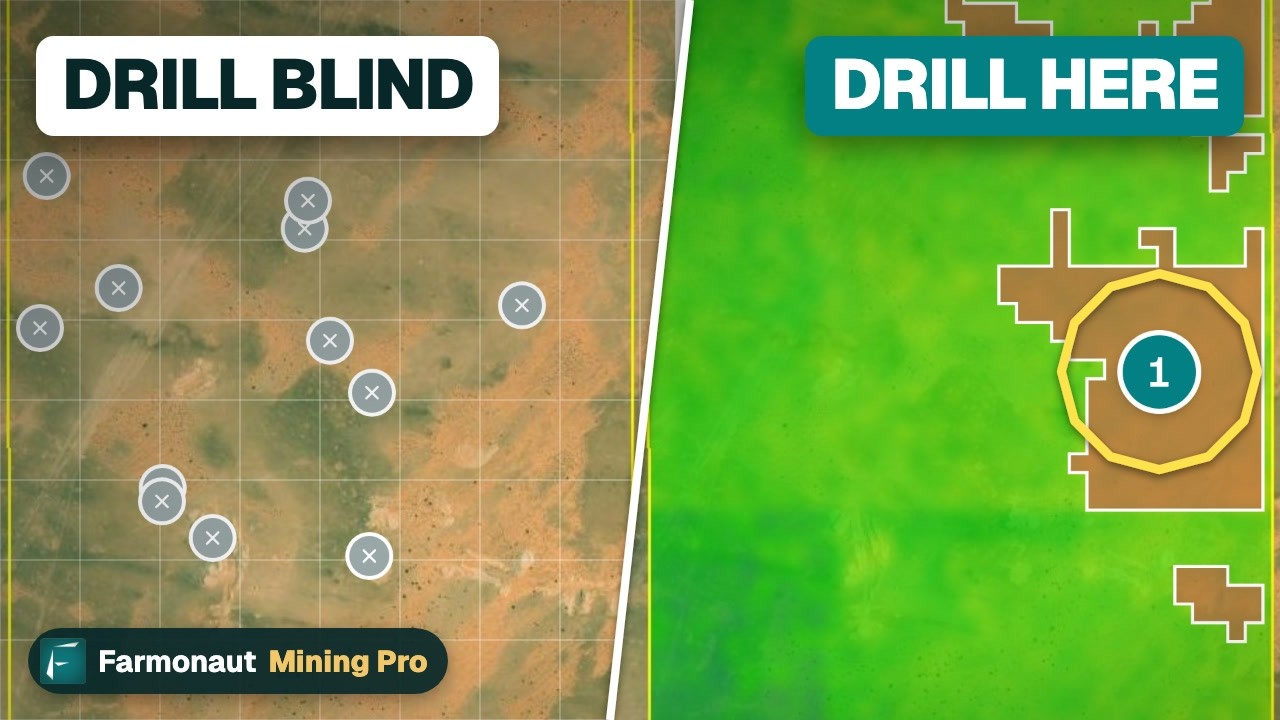
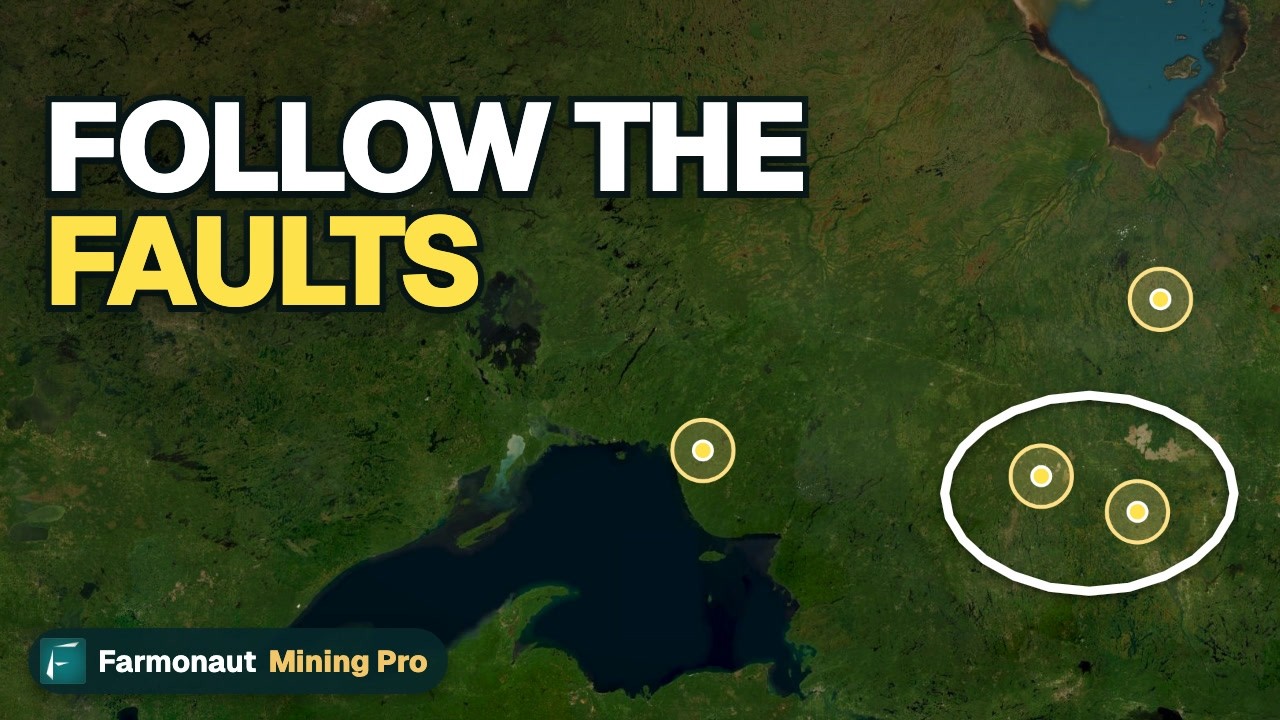
All of that money runs against a deadline. When a flow-through raise closes in December, the company has a year to turn it into exploration expense, and every week spent deciding where to look is a week less in the field. This is where we fit. Farmonaut’s satellite-based mineral detection analyses multispectral and hyperspectral imagery for alteration halos, faults and fractures and other deposit-related patterns across a whole property, so a team can rank targets before crews mobilize. It shortens that desk stage from months to days and can lower early-exploration cost by up to 80 to 85%.
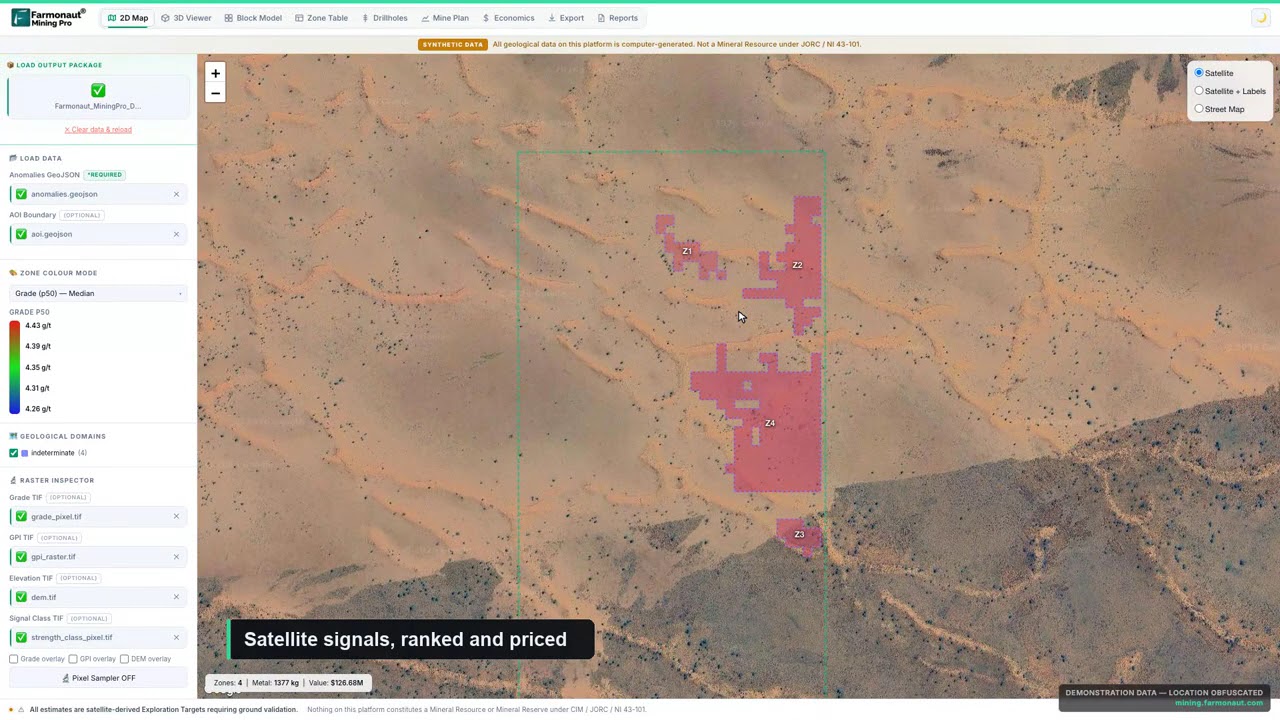
▶ Video (4:26): what satellite exploration software does and who uses it, the screening step that comes before a flow-through-funded field season. · 4:26
The workflow is short. You send coordinates, a KML or KMZ file, or a polygon of your claims, plus the target mineral. We pick the data source, run the analysis and deliver in 5 to 20 business days, depending on size and mineral complexity. The premium report covers high-potential zones, prospectivity heatmaps, estimated location and depth ranges, indicative quantity and geological interpretation, with georeferenced GIS files. Premium+ adds TargetMax™ drilling intelligence and 3D prospectivity models. We have scanned more than 100,000 hectares for over 20 mineral types in more than 25 countries.
Be clear about what this is and is not. Our results are exploration targets that sit ahead of any resource estimate; they carry no NI 43-101 status and do not replace a Qualified Person. Whether any particular study counts as CEE for your financing is a question for your tax adviser, not for us. We are not a tax adviser, broker or investment adviser. To see your ground first, open Map Your Mining Site, or get a quote for a specific claim block.
Frequently asked questions about flow through shares
What are flow through shares in Canada?
They are shares of a mining or exploration company that agrees to spend the subscription money on Canadian exploration expense and renounce it to the investor. The investor deducts the renounced amount, and individuals may claim a 15% or 30% federal credit plus any provincial credit.
How does the mineral exploration tax credit work?
It is a 15% federal investment tax credit on eligible flow-through mining expenditures renounced to individuals. It is claimed on Form T2038(IND) and line 41200, and Finance Canada extended it to agreements made by March 31, 2027.
Which minerals qualify for the critical mineral exploration tax credit?
Nickel, cobalt, graphite, copper, rare earth elements, vanadium, tellurium, gallium, scandium, titanium, magnesium, zinc, platinum group metals, uranium and lithium. Budget 2025 proposes adding bismuth, cesium, chromium, fluorspar, germanium, indium, manganese, molybdenum, niobium, tantalum, tin and tungsten for agreements after November 4, 2025.
Can I claim both the 15% and the 30% credit?
No. Finance Canada says the critical mineral credit cannot be claimed in addition to the 15% credit on the same expenses. You can stack a provincial credit on either one.
What is the focused flow through share tax credit in Ontario?
A refundable Ontario credit of 5% of eligible Ontario mineral exploration expenses and 5% of eligible Ontario critical mineral exploration expenses renounced to you, for Ontario residents. Claim it with forms ON479 and T1221.
What is the BC mining flow-through share tax credit?
A non-refundable 20% BC credit for individuals on BC flow-through mining expenditures, under section 4.721 of BC’s Income Tax Act. It is separate from the company-level BC mining exploration tax credit, which cannot be claimed on renounced amounts.
What happens when I sell flow through shares?
The CRA deems the shares to cost zero, so the capital gain is generally the whole sale price. Only part of a capital gain is taxable, which is why the after-tax result can still be positive.
Are flow-through tax credits taxable?
Yes, in effect. Ontario’s Ministry of Finance says both the federal and Ontario credits must be included in income the following year and are taxed then.
What is the look-back rule for flow through shares?
It lets a company renounce in January to March of Year 2 with an effective date of December 31 of Year 1, while incurring the expenses during Year 2. Unspent amounts after February of Year 2 attract Part XII.6 tax.
What is OJEP and who can apply?
The Ontario Junior Exploration Program funds up to C$200,000 per project at 50% for non-producing juniors with market caps up to C$100 million, and up to C$50,000 for licensed prospectors. The 2026-27 intake has closed.
Is there a flow through shares tax calculator?
Yes, the calculator on this page applies the Ontario Ministry of Finance method: deduction, provincial credit, federal credit on the reduced amount, tax on the credits next year and a break-even sale value. It is illustrative, not tax advice.
Authored by: Farmonaut Research & Content Team · Reviewed by: Farmonaut Mining & Mineral Exploration Team · Updated October 2026
General information, not tax, legal or investment advice; confirm with your advisers and the exchange. Credit rates, eligible minerals and expiry dates change with each budget, and some measures described here were proposals when we checked. Farmonaut targets are exploration targets ahead of any resource estimate and carry no NI 43-101 status.
Farmonaut mineral detection
Map your mining site from space
Send your claim boundary as KML, KMZ or a polygon. Farmonaut returns ranked satellite exploration targets, usually in 5 to 20 business days, so a flow-through program can start when the money lands.

Keep reading
Sources
- Canada Revenue Agency, Instructions for the Flow-Through Share Program: canada.ca
- Canada Revenue Agency, Flow-through shares: reporting your investments: canada.ca
- Canada Revenue Agency, Line 41200 Investment tax credit: canada.ca
- Department of Finance Canada, Budget 2025 Tax Measures: Supplementary Information (2025): budget.canada.ca
- Department of Finance Canada, Government extending support for mineral exploration in Canada (2025): canada.ca
- Department of Finance Canada, Report on Federal Tax Expenditures, Part 2 (2026): canada.ca
- Justice Laws Website, Income Tax Act, section 66.1: laws-lois.justice.gc.ca
- Natural Resources Canada, Canadian Mineral Exploration Information Bulletin (2026): natural-resources.canada.ca
- Ontario Ministry of Finance, Ontario Focused Flow-Through Share Tax Credit (2026): ontario.ca
- Government of Ontario, Ontario Junior Exploration Program (2026): ontario.ca
- British Columbia, Income Tax Act, sections 4.721 and 25.1: bclaws.gov.bc.ca
- Government of British Columbia, Budget and Fiscal Plan 2026/27 to 2028/29 (2026): bcbudget.gov.bc.ca
- Government of Saskatchewan, Saskatchewan Mineral Exploration Tax Credit: saskatchewan.ca
- Manitoba Finance, Personal Tax Credits: gov.mb.ca
- Ontario Securities Commission, NI 45-102 Resale of Securities (2016): osc.ca
- Prime Minister of Canada, cancellation of the proposed capital gains inclusion rate increase (2025): pm.gc.ca
- Ontario Environmental Registry, exploration permit decision notice (2025): ero.ontario.ca
Discussion
Questions, corrections or field experience? Share them below. First-time comments are reviewed before they appear, and your email is never published.
No comments yet. Be the first to add a question or your experience.

 GKY Mining
 Alkimy SARL
 Double A Trading
 GemSprout Metals Limited
 Qader Group
 Ileys General Trading
 SG Gold Mining LLC
 VRV Global Pte Ltd
 Omsri International FZE
 G.I.T.T.
 Jaunita Erss Ltd
 Almosi SARL
 SRK Consulting
 Berks Gold Limited
 Mwerezi Minerals Company Limited
 Mining SARL
 SenGold Invest SAS
 Sean Mining Limited
 NTS Group (Pty) Ltd
