

Critical minerals · Ring of Fire, Ontario
Ring of Fire Ontario: the deposits, who owns them, where the roads stand and how claims and permits work
The Ring of Fire in Ontario is a roadless critical-minerals district about 500 km northeast of Thunder Bay, best known for the Eagle’s Nest nickel-copper-PGE deposit and the Black Thor chromite deposit; two First Nation-led access roads won approval in 2026, but no mine has been approved yet.
Key takeaways
- The Ring of Fire Ontario district sits in the Hudson Bay Lowlands near McFaulds Lake, about 500 km northeast of Thunder Bay, with an active claim area of about 8,000 km² (Ontario).
- Wyloo, through Wyloo Ring of Fire Ltd., holds Eagle’s Nest and the Black Thor and Black Label chromite deposits; The Canadian Chrome Company (formerly KWG Resources) and Bold Ventures hold other chromite interests.
- Ontario approved the Webequie Supply Road in June 2026 and the Marten Falls Community Access Road in August 2026; the Northern Road Link that joins them is still in its assessment.
- Ontario dropped the old Eagle’s Nest environmental assessment in June 2025 and Ottawa declined to designate the mine in February 2026, but there is no mine approval or construction decision yet.
- Peat and a limestone cap hide the bedrock, so the deposits were found with airborne geophysics and drilling; optical satellites help with access, wetlands and logistics far more than with direct targeting.
In this article
- What and where is the Ring of Fire Ontario district?
- Ring of Fire Ontario minerals: the deposits and their geology
- Ring of Fire mining companies: who owns what now
- Ring of Fire Ontario roads: what is approved and what is not
- Ring of Fire Ontario permits, First Nations and claims
- Ring of Fire Ontario exploration challenges: muskeg, cover and access
- Ring of Fire mining outlook: prices, timing and what to watch
- Ring of Fire Ontario: frequently asked questions
If you hold ground, raise money or advise a board on Ring of Fire Ontario projects, the questions that matter are short: what is actually in the ground, who owns it, when can a truck get there, and what does it cost and take to keep claims alive and drill them. This page answers each one from Ontario, federal and company sources checked in October 2026, and is plain about the gaps.
This is a district brief, not a gold guide. For Ontario’s gold camps see our gold deposits in Ontario guide, and for how other countries run their registers, our mining cadastre portal guide by country.
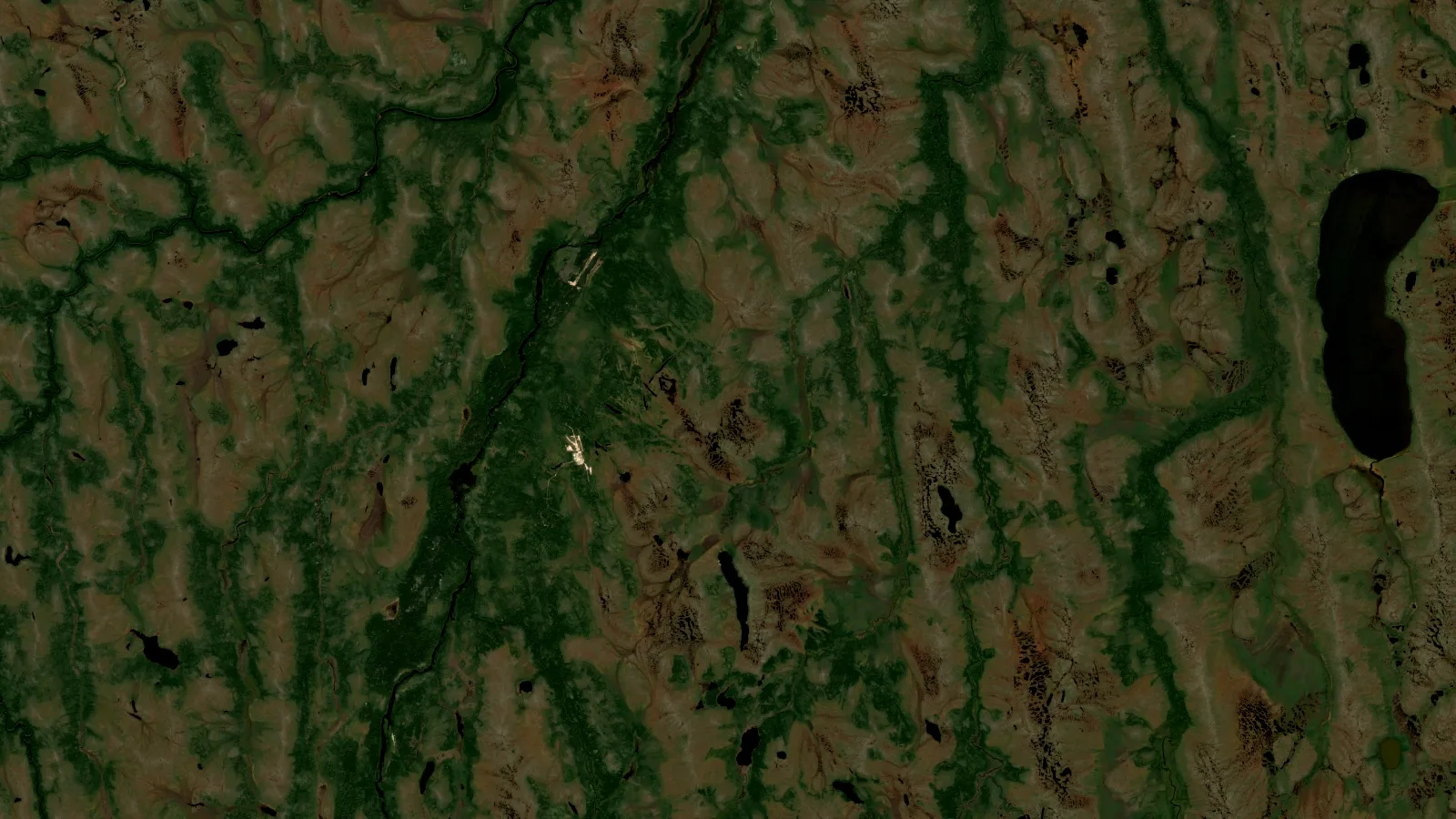
Eagle’s Nest sits under about eight metres of limestone and sandstone, on a pipe-like body roughly 200 metres long.
What and where is the Ring of Fire Ontario district?
Start with the official description. The Government of Ontario’s Ring of Fire page places the area more than 500 kilometres northeast of Thunder Bay, gives its active claim area as about 8,000 square kilometres, and lists chromite, copper, nickel, platinum and titanium among its critical minerals. The same page claims Ontario’s critical minerals could create more than 70,000 jobs and add over $22 billion to the economy over 30 years. Treat those as government projections for the whole sector, not as a forecast for any one Ring of Fire Ontario project.
The deposits cluster around McFaulds Lake in the Kenora District. Federal filings for the Eagle’s Nest mine put the site about 540 km north of Thunder Bay and 240 km west of James Bay, so you will see both distances quoted. There is no all-season road. Today the camp is reached by air or by winter road, which is why the road approvals of 2026 are the biggest change in years.
Nine First Nations belong to Matawa First Nations Management, a non-profit tribal council founded in 1988: Aroland, Constance Lake, Eabametoong, Ginoogaming, Long Lake #58, Marten Falls, Neskantaga, Nibinamik and Webequie. Matawa says eight of them are in the Treaty 9 area, five are reached only by air and winter road, and together they have more than 10,000 people. Webequie and Marten Falls are the two communities leading the road projects.
Why the Ring of Fire minerals matter for Canada’s nickel supply
Canada is already a nickel producer, which is why a new district gets attention. Natural Resources Canada reports 125,364 tonnes of nickel mined in 2024 (preliminary), fourth in the world with about 3.5% of global output. Ontario led the provinces with 50,000 tonnes, or 39.9%. Ring of Fire Ontario nickel would add a second Ontario nickel district far to the north, alongside large chromite resources.
Chart
Nickel mined in Canada by province, 2024
Thousand tonnes of nickel mined, preliminary figures
Ring of Fire Ontario minerals: the deposits and their geology
Most of the named deposits sit on one intrusion. The Ontario Mineral Inventory record for the Black Creek chromite deposit describes the McFaulds Lake mafic-ultramafic sill, also called the Ring of Fire Intrusion, emplaced along a granodiorite-greenstone contact over about 20 km. About 15 km of it is known to be mineralized, from the Blackbird deposit in the southwest to Black Thor and Black Label in the northeast. A thin cap of Paleozoic sedimentary rock, mainly limestone and less than 40 m thick, lies over the volcanic package.
Two very different deposit types share that sill. Chromite forms layers in the olivine-rich base of the intrusion. Nickel, copper and platinum group elements (PGE) sit in magmatic sulphides, where molten sulphide separated from the magma and sank. Ring of Fire Ontario minerals therefore split into a bulk chromite story and a high-grade nickel-copper-PGE story, with very different plants and markets.
Eagle’s Nest: the nickel-copper-PGE deposit
The Eagle’s Nest record calls it a magmatic massive sulphide deposit in a serpentinized peridotite dyke: a pipe-like body about 200 m long and up to tens of metres thick, with granodiorite in the footwall and about 8 m of dolomitic limestone and sandstone on top. Airborne geophysics was flown in 2003. Noront Resources drilled the discovery holes in 2007, then 127 holes totalling 63,076 m between 2007 and 2011.
The record lists a 2012 NI 43-101 Proven and Probable Mineral Reserve of 11.1 million tonnes at 1.68% nickel, 0.87% copper, 0.89 g/t platinum and 3.09 g/t palladium. Within that, the Proven part is 5.26 Mt at 2.02% nickel and the Probable part is 5.87 Mt at 1.38% nickel. Separately, it lists a Measured and Indicated Mineral Resource of 11.0 Mt at 1.78% nickel and Inferred resources of 8.97 Mt in the Main Zone and 1.62 Mt in the East Zone.
Chart
Eagle’s Nest: tonnes in each 2012 NI 43-101 category
Million tonnes; reserves and resources are separate categories and must not be added
Black Thor, Black Label, Big Daddy and other chromite deposits
Black Thor is the big one. The Black Thor record describes stratiform massive chromite hosted in dunite within a layered intrusion. It lists a 2012 Measured and Indicated resource of 137.7 Mt at 31.5% Cr₂O₃ and an Inferred resource of 26.8 Mt at 29.3% Cr₂O₃, both at a 20% cut-off and both reported in Cliffs Natural Resources’ annual report. Cliffs placed the project on care and maintenance on 20 November 2013.
Nearby deposits fill out the chromite inventory. The Canadian Chrome Company (formerly KWG Resources) reports an Inferred resource of 85.9 Mt at 34.5% Cr₂O₃ for Black Horse, from a 2015 technical report, and Measured 23.3 Mt at 32.1% plus Indicated 5.8 Mt at 30.1% for Big Daddy, from 2014. The Black Creek record lists 8.6 Mt Measured and Indicated at about 37.4% Cr₂O₃. All of these are resources, not reserves, and none has a current mine plan.
| Deposit | Main metal | Holder (checked Oct 2026) | Latest category in public record |
|---|---|---|---|
| Eagle’s Nest | Nickel, copper, PGE | Wyloo Ring of Fire Ltd. | Reserve, 2012 NI 43-101 |
| Black Thor | Chromite | Wyloo (bought from Cliffs by Noront, 2015) | Resource, 2012 |
| Black Label | Chromite | Wyloo (bought from Cliffs by Noront, 2015) | No figure in this brief |
| Big Daddy | Chromite | Wyloo 70%, Canadian Chrome 30% | Resource, 2014 |
| Black Horse (Koper Lake) | Chromite | Canadian Chrome and Bold Ventures joint venture | Inferred resource, 2015 |
| Black Creek | Chromite | Not confirmed this month | Resource, 2015 report |
Ring of Fire Ontario deposits and holders. Sources: Ontario Mineral Inventory records, the Cliffs 2015 sale release, Impact Assessment Agency of Canada, and company sites linked in the next section. Where we could not confirm a current holder, we say so.
Ring of Fire mining companies: who owns what now
Searches for Ring of Fire mining companies still turn up names that no longer hold ground. Cliffs Natural Resources sold its chromite assets in 2015: its 28 April 2015 release announced the sale to Noront Resources for US$27.5 million, covering Black Thor, Black Label and a 70% interest in Big Daddy. Noront is now part of Wyloo: Ontario’s registry describes the Eagle’s Nest proponent as Wyloo (formerly Noront Resources Ltd.), and the federal registry lists Wyloo Ring of Fire Ltd.
Here is the short list of mining companies in the Ring of Fire that we could confirm from their own sites or government filings this month:
- Wyloo Ring of Fire Ltd. (private, part of Wyloo): Eagle’s Nest, Black Thor, Black Label and 70% of Big Daddy. The largest holder by far.
- The Canadian Chrome Company (CSE: CACR, formerly KWG Resources): 30% of Big Daddy, interests in Black Horse at Koper Lake, and mining claims along a 330 km rail route it promotes through the wetlands.
- Bold Ventures (TSXV: BOL): a Ring of Fire property of 873 claim cells covering 16,785 ha near McFaulds Lake, plus a 10% carried interest in the Black Horse chromite resource.
The Canadian Chrome and Bold Ventures sites describe the Black Horse joint venture split differently, so read both companies’ filings before relying on either number. Other juniors have staked or optioned ground in the district, but we left out any we could not confirm as current.
Where the Eagle’s Nest mine stands now
Two approvals were removed, and that is often misread as a green light. In Ontario, the Environmental Registry notice 025-0396 records that the old voluntary agreement for a comprehensive environmental assessment was ended and its terms of reference revoked by Bill 5, the Protect Ontario by Unleashing our Economy Act, 2025, effective 5 June 2025. The province says the project changed a lot since 2015 and stays subject to environmental oversight and the duty to consult.
Federally, the Impact Assessment Agency of Canada decided on 20 February 2026 that the project does not warrant designation under the Impact Assessment Act. The registry describes an underground nickel, copper and PGE mine producing about 3,000 tonnes of ore a day for roughly 12 to 15 years, on a surface footprint of about 100 ha. Neither decision is a permit to build. Construction still needs the provincial permits, a closure plan and a road.
Calculator
How much nickel is contained in a deposit?
Enter tonnes, nickel grade, recovery and an example price to see contained and recoverable nickel.
- Recoverable at your recovery rate: 12,000 t
- Gross value of recoverable nickel before any costs (US$): $201,768,000
Example values only, not a forecast. Formula: tonnes x grade (%) / 100 = tonnes of contained nickel. The default price is the 2024 average of monthly nickel prices, US$16,814 per tonne, from Natural Resources Canada; it is an example only, so check today’s LME price. Gross value is in US dollars (US$), not C$, and ignores mining, processing, smelter terms, royalties, taxes and capital, so it is not a valuation. For a real deposit use the company’s NI 43-101 tonnes and grade, and never add resources to reserves. Not investment advice.
At the defaults, one million tonnes at 1.5% nickel holds 15,000 tonnes of nickel. At 80% recovery that is 12,000 recoverable tonnes, worth about US$202 million gross at the 2024 average price, before a single dollar of cost. Try Eagle’s Nest’s 2012 reserve figures (11.1 Mt at 1.68%) to see why the deposit draws attention, then remember the road does not exist yet.
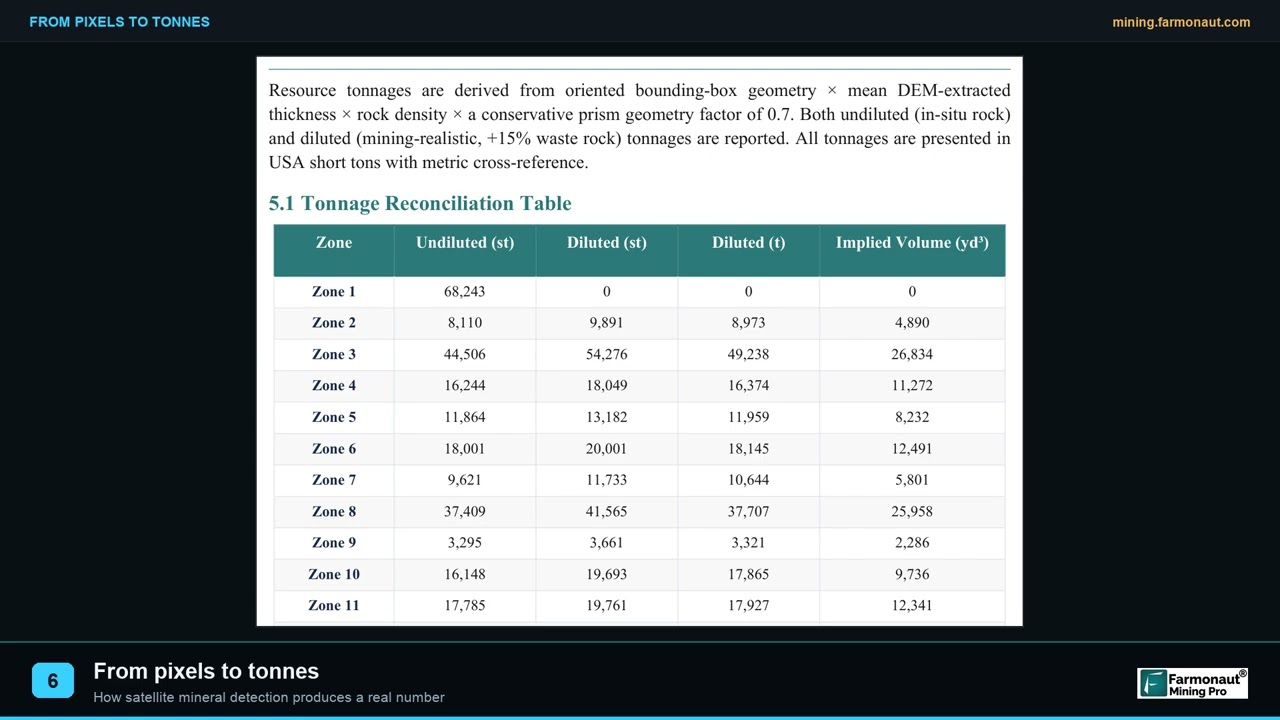
▶ How tonnage and grade estimates are built, and which inputs are measured versus assumed; useful before you compare Ring of Fire resource figures (2:54). · 2:54
Ring of Fire Ontario roads: what is approved and what is not
Four road pieces make up the planned Ring of Fire Ontario network, and the province’s March 2026 road delivery schedule names them: the Webequie Supply Road, the Northern Road Link, the Marten Falls Community Access Road, and upgrades to the Anaconda and Painter Lake roads. The same document says Ontario signed partnership agreements with three First Nations in 2025 and a co-operation agreement with the federal government to avoid duplicate environmental and impact assessments.
- Webequie Supply Road. Proposed by Webequie First Nation as a 107 km all-season road from the Webequie airport to the McFaulds Lake area. Ontario’s project page records approval in June 2026 for the 90 km off-reserve portion, and Order in Council 929/2026 sets the conditions.
- Marten Falls Community Access Road. About 184 km from the end of the Painter Lake forestry road north of Nakina to Marten Falls. Ontario’s project page shows the decision to approve on 26 August 2026, and the First Nation’s project site reports a federal Decision Statement the same month.
- Northern Road Link. Proposed jointly by Marten Falls and Webequie to join the two roads. Its terms of reference were approved on 3 March 2023, and the province’s schedule runs its assessment to spring 2028.
- Highways 584 and 643. Ontario says upgrades at the gateway to the region were completed in November 2024.
Chart
Ring of Fire roads: years until each road opens
Years after 2025 until the roadway opens: initial plan vs accelerated plan (March 2026)
The Webequie approval comes with real conditions, not a blank cheque. The order requires a compliance monitoring program, an environment committee that invites Indigenous communities, wetland carbon dioxide and methane monitoring, moose and eastern migratory caribou programs, and cumulative-effects monitoring coordinated with the Marten Falls and Northern Road Link projects. Ontario’s schedule also lists federal permits it wants sped up, including Fisheries Act and Species at Risk Act authorizations for caribou and lake sturgeon.
Money is still being argued over. The same schedule says Ontario is pressing the federal government to match or exceed its $1 billion investment in Ring of Fire infrastructure. Until the Northern Road Link is approved and built, there is no continuous road from the provincial highway network to Eagle’s Nest, whichever spur is finished first.
Ring of Fire Ontario permits, First Nations and claims
Consent and consultation shape every Ring of Fire Ontario timeline. Ontario says it works with Indigenous partners through bilateral agreements, and the road approvals are led by Webequie and Marten Falls. Not every nearby community agrees: CBC reported in January 2024 that some First Nations still oppose development in the region. A junior that plans a program without early contact with the closest communities is planning a delay.
A wider study runs in parallel. The federal Regional Assessment in the Ring of Fire Area moved to its next phase in January 2025, when 15 First Nation partners and the Impact Assessment Agency finalized its terms of reference. A working group of community members and the agency runs it, with administrative support from Matawa and Mushkegowuk councils, and its report goes to the Chiefs and the federal environment minister.
Provincial rules that changed for the Far North
Two legal changes matter for anyone reading older Ring of Fire mining analysis. First, the Far North Act amendments of December 2021 repealed section 12, so development where no community-based land use plan exists no longer needs a special order under that Act; other approvals still apply. Second, Ontario says its newer legislation lets it name regions with several critical mineral deposits as regions of strategic importance, including the Ring of Fire, under a “One Project, One Process” approval model.
How to stake a Ring of Fire Ontario mining claim
Ring of Fire Ontario claims follow the same online system as the rest of the province. You register cells in the Mining Lands Administration System (MLAS), whose Map Viewer shows active claims and withdrawn land. The ministry’s glossary defines each cell as 15 seconds of latitude by 22.5 seconds of longitude. By our arithmetic that is about 19.5 ha (48 acres) at McFaulds Lake’s latitude, smaller than further south.
The fees are modest; the work commitment is not. The mining lands fee schedule, updated 1 April 2026, charges C$50 per cell to register and C$40 for a five-year prospector’s licence. The ministry’s decision on ERO notice 019-6053, posted 6 June 2023, keeps the requirement at C$400 of assessment work per cell each year. Under the assessment credits policy, a claim can be credited for the current year plus five more.
Calculator
What does it cost to hold a Ring of Fire claim block?
Enter your cells, the years you plan to hold them and the current fee and work rates (C$).
- Registration (C$): $1,250
- Assessment work over the period (C$): $30,000
- Area in hectares, about: 488 ha
- Area in acres, about: 1,205 acres
All amounts are Canadian dollars (C$). Assumptions: C$50 per cell to register (Ontario mining lands fee schedule, updated 1 April 2026); C$400 of approved assessment work per cell for each assessment year (ministry decision posted 6 June 2023, ERO 019-6053). Area uses about 19.5 ha per cell, our arithmetic from the 15 by 22.5 second provincial grid at about 52.7 degrees north near McFaulds Lake (ministry glossary). Excludes the C$40 prospector’s licence, consultation, camp and flying costs. General information, not legal advice; confirm due dates with the Ontario Ministry of Energy and Mines.
At the defaults, a 25-cell block costs C$1,250 to register and needs C$30,000 of approved work over three assessment years, about 488 ha in all. In the Ring of Fire, budget separately for flying, winter-road timing and consultation, which this calculator leaves out.
Plans, permits and the consultation clock
A claim lets you hold ground, not disturb it. Ontario’s exploration plans and permits guide says plans and permits are circulated to potentially affected Aboriginal communities and consulted on. A plan takes effect 30 days after circulation and lasts two years. A permit is posted on the Environmental Registry for 30 days, processing is expected to take 31 to 50 days, and the guide asks for start dates more than 35 days (plan) or 55 days (permit) after you submit. Surface rights owners must get notice where they exist.
Infographic
From open ground to a drill hole in the Ring of Fire
- 1Check the MLAS mapActive claims and withdrawn land are shown online in the MLAS Map Viewer.
- 2Licence and cellsA C$40 five-year prospector’s licence, then C$50 a cell, up to 25 cells per claim.
- 3Plan or permitCirculated to potentially affected Indigenous communities; a plan takes effect on day 30, a permit takes 31 to 50 days.
- 4Assessment workC$400 of approved work per cell each year; credits cover up to the current year plus five.
- 5Drill and reportHeavier drills need a permit; file the work for assessment credit.
Ring of Fire Ontario exploration challenges: muskeg, cover and access
The ground itself is the first obstacle. A 2014 review in Arctic, Antarctic, and Alpine Research calls the Hudson Bay Lowlands the largest peatland complex in North America. It says Ontario’s Far North covers about 45 million hectares, that peatlands make up nearly half of it, and that the lowlands have the southernmost non-alpine permafrost on the continent. In Ring of Fire Ontario fieldwork, that peat, or muskeg, means soft ground in summer and frozen access only in winter.
Then there is cover. Eagle’s Nest lies under about 8 m of limestone and sandstone, and the intrusion is capped by up to 40 m of Paleozoic rock. Nobody found these deposits by walking outcrop. The provincial records show airborne geophysics first, then ground geophysics and gravity, then drilling. If you want to understand why magnetics and electromagnetics led here, our geophysics methods guide walks through what each survey sees.
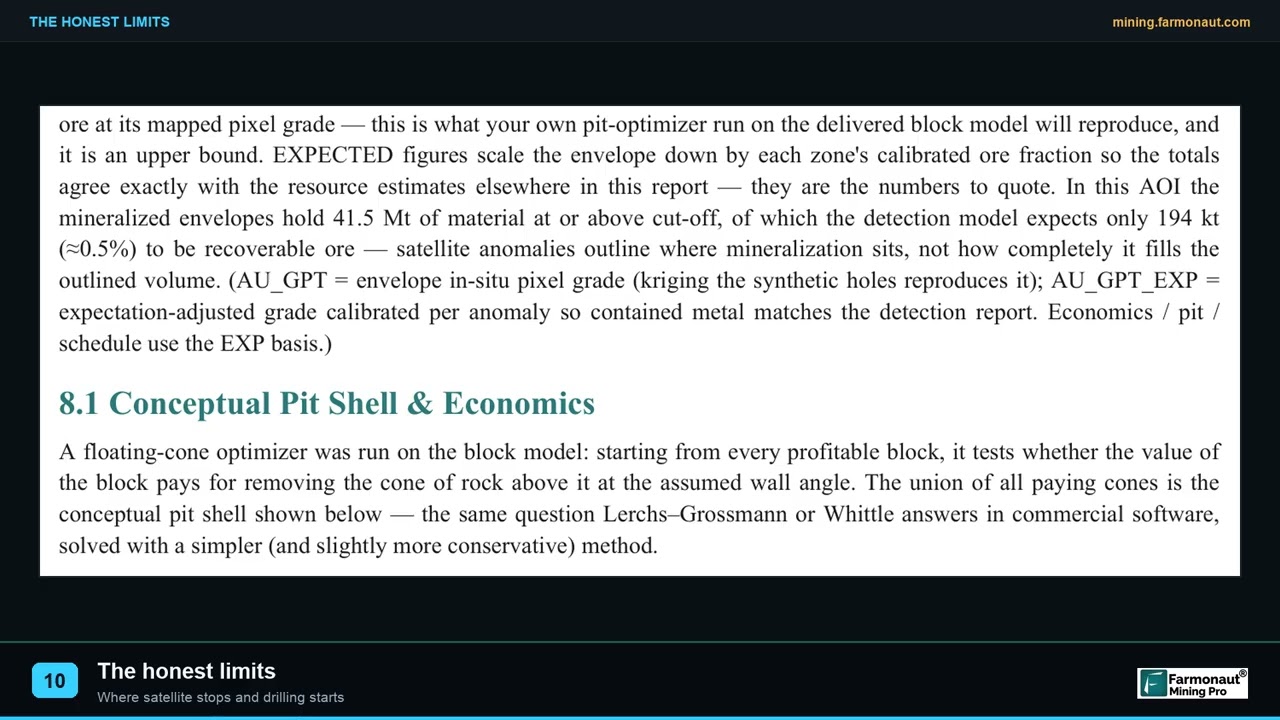
▶ The three limits of satellite exploration that matter in due diligence, and where drilling has to take over; all three apply on Ring of Fire peat (2:08). · 2:08
What satellites can and cannot see over Ring of Fire Ontario claims
Be honest about this terrain. Optical satellites read the surface, and here the surface is peat, water and forest sitting on limestone, not the ultramafic rock that hosts the metal. A spectral image will not show chromite or nickel sulphide under that cover. Cloud is the next problem: optical images can only be used on clear days, while radar can see through cloud, which matters in a short northern field season.
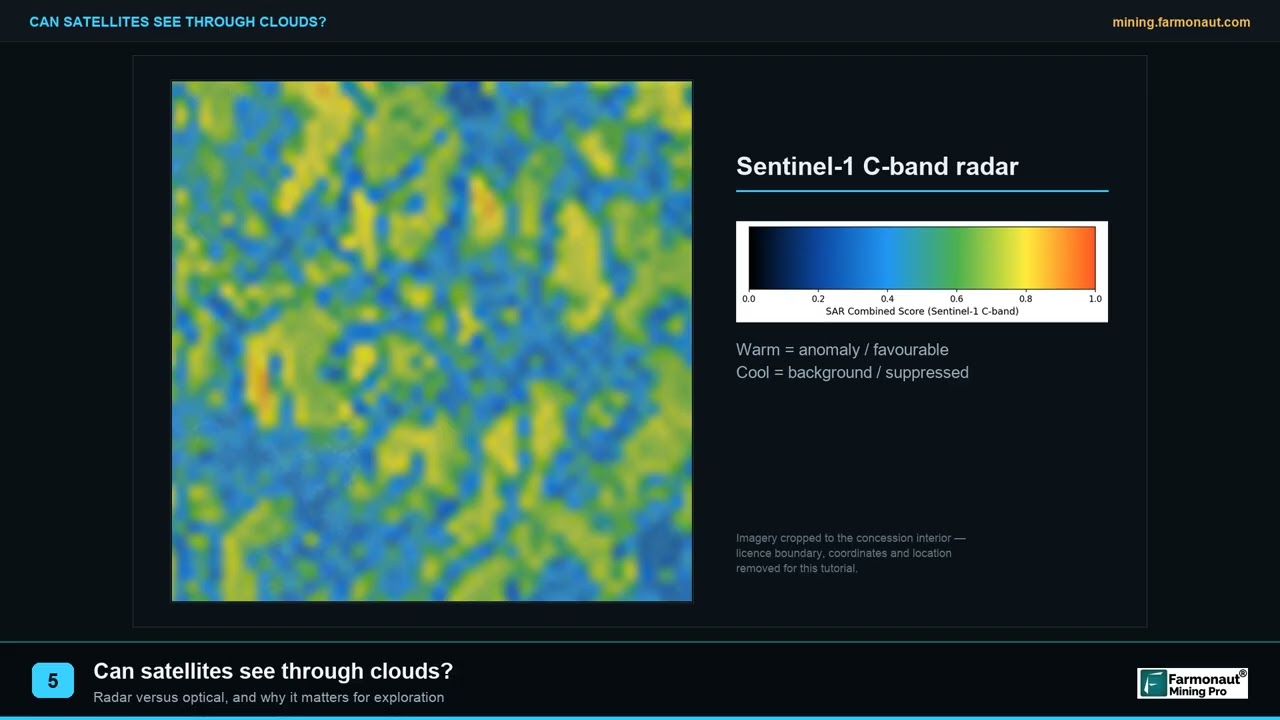
▶ Why optical satellites lose cloudy days and how radar fills the gap; relevant to planning a short Ring of Fire field season (2:14). · 2:14
Where remote sensing does help on Ring of Fire Ontario claims:
- ✔ Access and logistics: mapping eskers, drier ridges, lakes for float planes and winter-road crossings from repeat imagery.
- 📊 Wetland and water mapping: a baseline of peatland, open water and drainage before a program, useful where approvals ask for wetland monitoring.
- ⚠ Change detection: tracking camp, trail and drill-pad disturbance against that baseline for reporting.
- Screening the edges: where the Shield rises out of the lowlands, exposed bedrock and structure can be read and ranked before ground work.
That last point is where Farmonaut’s satellite-based mineral detection fits best: claims on exposed or thinly covered ground, where multispectral and hyperspectral data can flag alteration, structure and deposit-associated patterns. We deliver in 5 to 20 business days from a KML, KMZ or polygon, we have scanned 100,000+ hectares across 25+ countries, and our detectable list covers 20+ minerals, including nickel, copper and other base metals. Our results are exploration targets ahead of any resource estimate, not NI 43-101 figures, and on thick peat we will tell you so before you pay.
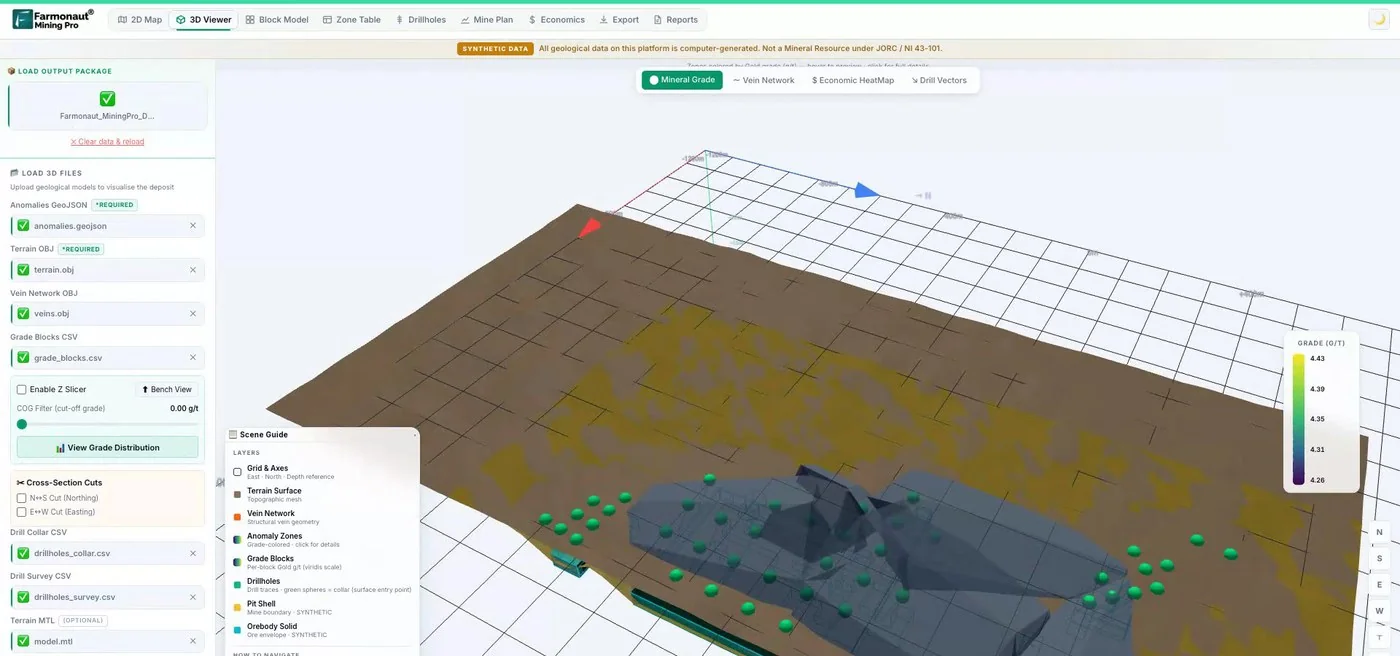
You can also Map Your Mining Site yourself to see how a boundary is set up, or get a quote for a block you already hold. For a look at 3D outputs, see our satellite-driven 3D mineral prospectivity mapping sample.
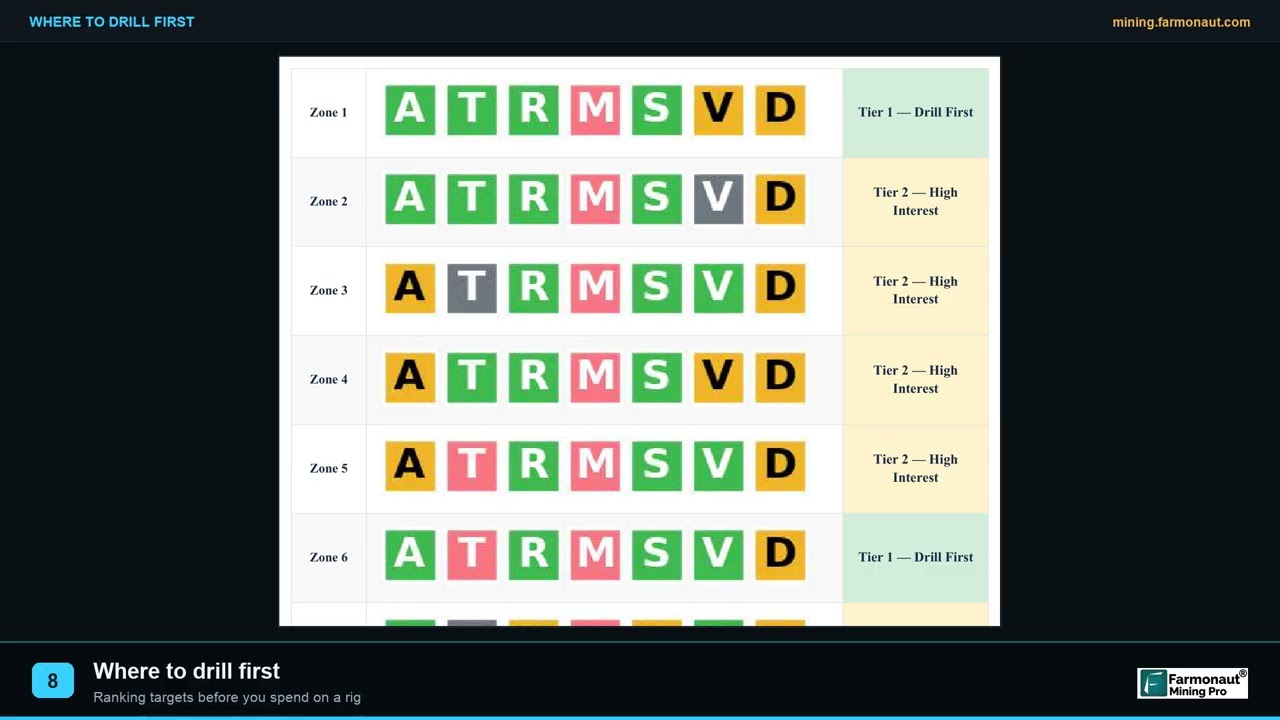
▶ How a set of targets becomes a drill order you can defend; the same logic applies when every Ring of Fire hole needs a helicopter (2:19). · 2:19
Ring of Fire mining outlook: prices, timing and what to watch
Nickel prices move a lot, and Ring of Fire Ontario economics will be judged on the price when a mine is financed, not today’s. NRCan’s nickel price series shows annual averages of monthly prices ranging from US$9,595 per tonne in 2016 to US$25,834 in 2022, then falling to US$16,814 in 2024. A project that works at the 2022 price can look very different at the 2016 one.
Chart
Nickel price, annual average of monthly prices
US dollars per tonne, for the years printed on the NRCan chart (selected years)
Ontario mined 39.9% of Canada’s nickel in 2024, about 50,000 tonnes.
What to watch over the next two years, in order of how much it moves the district:
- Webequie Supply Road and Marten Falls road construction: the province’s accelerated plan schedules early works from mid-2026; watch for federal permits and the first contracts.
- Northern Road Link assessment: the missing middle piece; the schedule runs its assessment to spring 2028.
- A new Eagle’s Nest technical report: any updated NI 43-101 study filed on SEDAR+ would replace the 2012 figures.
- Community agreements: partnership agreements with the closest First Nations, and the federal regional assessment report.
- Power and processing: Ontario lists transmission planning for the region; where concentrate and chromite would be processed is still open.

▶ What AI does and does not do in exploration, and how to test a vendor's claim; useful when pitches for the Ring of Fire mention AI (4:37). · 4:37
Ring of Fire Ontario: frequently asked questions
What is the Ring of Fire in Ontario?
It is a mineral district in Ontario’s Far North, near McFaulds Lake in the Kenora District, with an active claim area of about 8,000 km² according to the province. It hosts the Eagle’s Nest nickel-copper-PGE deposit and several large chromite deposits, including Black Thor.
Where is the Ring of Fire Ontario located?
Ontario places it more than 500 km northeast of Thunder Bay; federal filings for Eagle’s Nest say about 540 km north of Thunder Bay and 240 km west of James Bay. It sits in the Hudson Bay Lowlands and has no all-season road yet.
What minerals are in the Ring of Fire?
Ontario lists chromite, copper, nickel, platinum and titanium. In practice the district has two deposit types: chromite layers such as Black Thor, Black Label, Big Daddy and Black Horse, and nickel-copper-PGE sulphides at Eagle’s Nest.
Which mining companies are in the Ring of Fire?
The largest holder is Wyloo, through Wyloo Ring of Fire Ltd., with Eagle’s Nest, Black Thor, Black Label and 70% of Big Daddy. The Canadian Chrome Company (CSE: CACR, formerly KWG Resources) and Bold Ventures (TSXV: BOL) hold other chromite interests and claims. Cliffs and Noront are former owners. Not investment advice.
Is there a road to the Ring of Fire yet?
Not an all-season one. Ontario approved the Webequie Supply Road in June 2026 and the Marten Falls Community Access Road in August 2026. The Northern Road Link that would join them is still being assessed, and the province’s plan has roads opening from November 2030.
When could Eagle’s Nest become a mine?
No date is confirmed. Ontario ended the old provincial assessment in June 2025, and Ottawa decided in February 2026 not to designate the project, but provincial permits, a closure plan and road access are still needed before construction.
Which First Nations are involved in Ring of Fire Ontario projects?
The nine Matawa communities are the closest: Aroland, Constance Lake, Eabametoong, Ginoogaming, Long Lake #58, Marten Falls, Neskantaga, Nibinamik and Webequie. Webequie and Marten Falls lead the road projects, 15 First Nations are partners in the federal regional assessment, and some communities still oppose development in the region.
How do you stake a mining claim in the Ring of Fire?
Buy a prospector’s licence (C$40) and register cells online in MLAS at C$50 per cell, after checking the Map Viewer for open ground. Each cell then needs C$400 of approved assessment work a year. Confirm current rules with the Ministry of Energy and Mines.
Why is exploration in the Ring of Fire Ontario region so hard?
The area is peatland with patches of permafrost, there is no road, and the bedrock is hidden under peat and a limestone cap. Crews fly in or use winter roads, and drill programs need plans or permits that are circulated to First Nations first.
Can satellites find nickel or chromite in the Ring of Fire?
Not directly under thick peat and limestone. Satellites help there with access, wetland mapping and change detection, while geophysics and drilling find the ore. On exposed or thinly covered ground nearby, satellite screening can rank targets before fieldwork.
Is the Ring of Fire a good investment?
We do not give investment advice. The district has large published resources, but timing depends on roads, permits, community agreements and metal prices, and most public figures are more than ten years old. Read each company’s latest filings and get independent advice.
Farmonaut mineral detection
Map your mining site from space
Send your claim or licence boundary as KML, KMZ or a polygon. Farmonaut returns ranked satellite exploration targets for it, usually in 5 to 20 business days.
Keep reading
Sources
- Government of Ontario, Ontario's Ring of Fire (2025): ontario.ca
- Government of Ontario, Ring of Fire road delivery schedules (March 2026): news.ontario.ca
- Government of Ontario, Webequie Supply Road project (2026): ontario.ca
- Government of Ontario, Order in Council 929/2026, Webequie Supply Road approval (2026): ontario.ca
- Government of Ontario, Marten Falls Community Access Road project (2026): ontario.ca
- Government of Ontario, Northern Road Link project (2023): ontario.ca
- Ontario Geological Survey, Ontario Mineral Inventory record MDI000000000695, Eagle's Nest (2025): geologyontario.mndm.gov.on.ca
- Ontario Geological Survey, Ontario Mineral Inventory record MDI000000000704, Black Thor (2022): geologyontario.mndm.gov.on.ca
- Ontario Geological Survey, Ontario Mineral Inventory record MDI000000000956, Black Creek (2022): geologyontario.mndm.gov.on.ca
- Environmental Registry of Ontario, ERO 025-0396, changes to the Eagle's Nest mine project (2025): ero.ontario.ca
- Environmental Registry of Ontario, ERO 019-2684, Far North Act amendments (2021): ero.ontario.ca
- Impact Assessment Agency of Canada, Eagle's Nest Mine Project registry (2026): iaac-aeic.gc.ca
- Impact Assessment Agency of Canada, Regional Assessment in the Ring of Fire Area milestone (2025): canada.ca
- Natural Resources Canada, Nickel facts (2026): natural-resources.canada.ca
- Ontario Ministry of Energy and Mines, Mining lands fee schedule (2026): geologyontario.mndm.gov.on.ca
- Environmental Registry of Ontario, ERO 019-6053 assessment work requirement decision (2023): ero.ontario.ca
- Ontario Ministry of Energy and Mines, Assessment work credits policy (2018): geologyontario.mndm.gov.on.ca
- Ontario Ministry of Energy and Mines, Mining lands glossary (2018): geologyontario.mndm.gov.on.ca
- Government of Ontario, Mining Lands Administration System (2025): ontario.ca
- Government of Ontario, Exploration plans and permits (2025): ontario.ca
- McLaughlin and Webster, Effects of climate change on peatlands in the Far North of Ontario, Arctic, Antarctic, and Alpine Research (2014): bioone.org
- Cliffs Natural Resources, Sale of chromite assets to Noront, news release (2015): clevelandcliffs.com
- The Canadian Chrome Company, Company website and resource table (2026): canadachrome.com
- The Canadian Chrome Company, Big Daddy project page (2026): canadachrome.com
- Bold Ventures, Ring of Fire project page (2026): boldventuresinc.com
- Matawa First Nations Management, About us (2026): matawa.on.ca
- CBC News Thunder Bay, Wyloo update and First Nations resistance (2024): cbc.ca
Discussion
Questions, corrections or field experience? Share them below. First-time comments are reviewed before they appear, and your email is never published.
No comments yet. Be the first to add a question or your experience.

 Mwerezi Minerals Company Limited
 Congo Mining Solutions
 Mining SARL
 SenGold Invest SAS
 Sania Corporation
 Sean Mining Limited
 NTS Group (Pty) Ltd
 Mine4Africa
 Lithspo Minerals Limited
 Tintina Mining Group
 Dalgety Minerals Pty Ltd
 Vortex Minerals Pty Ltd
 Faith At Work (Pty) Ltd
 Geotech Mining Solutions plc
 Vulcan International Limited
 Kidepo Associates
 GKY Mining
 Alkimy SARL
 Double A Trading
 Licence holder · Nigeria · Gold + lithium










