

Antimony · Price data guide
Antimony Price per Tonne: Chart and Drivers
USGS puts the 2025 average antimony price at US$25 per pound, about US$55,100 per tonne, up from US$10.24 in 2024. SMM had China’s 1# ingot at 105,000 yuan per tonne on 18 September 2026. Benchmarks, drivers and a value calculator.
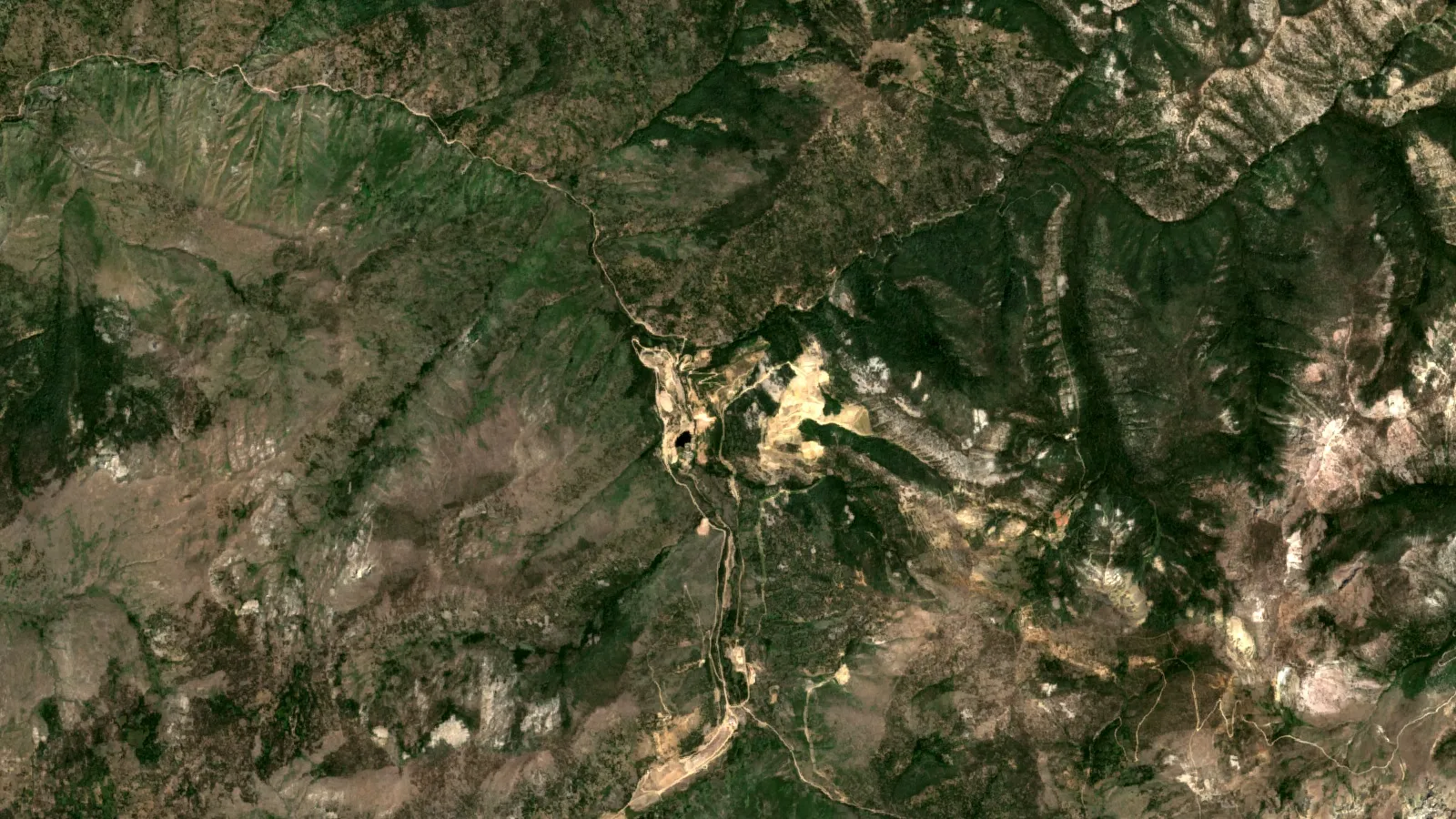
Key takeaways
- The USGS 2025 average antimony price was US$25 per pound (about US$55,100 per tonne), against US$5.49 in 2023 and US$10.24 in 2024 (USGS, 2026).
- The USGS monthly average peaked at US$27.50 per pound in June 2025 and was US$20.30 in November 2025 (USGS, 2026).
- China’s 1# ingot averaged 105,000 yuan per tonne on 18 September 2026, after 109,500 on 8 July and 100,500 on 26 August (SMM, 2026).
- Fastmarkets assessed in-warehouse Rotterdam metal at US$18,000 to 20,500 per tonne on 5 August 2026; benchmarks use different grades and places, so they do not subtract cleanly.
- China, Russia and Tajikistan mined about 85% of world antimony in 2025 (94,000 of 110,000 tonnes), and China’s US export ban suspension runs to 27 November 2026 (USGS; Fastmarkets).
In this article
- Antimony price per tonne: what each benchmark measures
- Antimony price history in US dollars per pound
- China antimony ingot price
- What moves the antimony price
- Where antimony comes from: mine supply by country
- How to read an antimony price quote
- What antimony in ore is worth: a worked example
- Antimony price outlook: what to watch
- Antimony projects and satellite screening
- Frequently asked questions
The USGS puts the average antimony price in 2025 at US$25 per pound, which is about US$55,100 per tonne, against US$10.24 per pound in 2024 (USGS Mineral Commodity Summaries, 2026). In China, the largest antimony producer (about 36% of 2025 mine output), the Shanghai Metals Market (SMM) put the 1# ingot price at 105,000 yuan per tonne on 18 September 2026, after a fall from mid-year highs (SMM weekly review, 18 September 2026).
There is no single antimony price. Each benchmark measures a different grade, a different place and a different currency, so the numbers on this page are always shown with their source, basis and date. Antimony is a metalloid (an element between a metal and a non-metal) that is mined mainly as stibnite, an antimony sulphide mineral. It goes into flame retardants, lead-acid battery alloys, ammunition, glass and ceramics. This page covers the main price series, the 2026 China market, what moves the price, a calculator for the value of antimony in ore, and the dated events to watch. For the producers themselves, see our guide to antimony mining companies.
Antimony price per tonne: what each benchmark measures
Antimony trades in small volumes by contract, so prices come from reporting agencies that survey buyers and sellers, not from a futures exchange. Four series matter to most readers. They are not interchangeable, and the table shows why.
| Benchmark | Basis | Latest value | Date |
|---|---|---|---|
| USGS annual average (from Argus) | Metal, 99.65% minimum antimony, cost, insurance and freight (CIF) | US$25 per lb (about US$55,100 per tonne) | 2025 average |
| Fastmarkets in-warehouse Rotterdam | Metal, maximum 100 ppm bismuth, stock held in a Rotterdam warehouse | US$18,000 to 20,500 per tonne | 5 August 2026 |
| SMM China 1# ingot | Domestic ingot, yuan per tonne | 105,000 yuan per tonne | 18 September 2026 |
| Fastmarkets cif Rotterdam/Antwerp | Metal ingot, 99.65% minimum, minimum 25 tonnes, shipment within 90 days | Proposed twice-weekly assessment (paid access) | Proposed launch 3 March 2026 |
Fastmarkets corrected its 5 August in-warehouse Rotterdam range on 8 September 2026 to US$18,000 to 20,500 per tonne, from US$18,500 to 20,500. That is US$8.16 to 9.30 per pound. The USGS figure for November 2025 was US$20.30 per pound, but it uses a different assessment (Argus, CIF, 99.65% minimum), so do not subtract one from the other. Both sit well below the USGS monthly high of US$27.50 per pound in June 2025.
The reason Fastmarkets proposed CIF assessments is also a lesson for anyone reading a price. In its January 2026 proposal, Fastmarkets said the gap between in-warehouse prices and CIF prices had widened after a long period of weak demand and ample supply, and that sellers, especially new smelters in Southeast Asia, were offering shipment material well below prompt material held in European warehouses (Fastmarkets, 26 January 2026). A buyer who needs metal this week and a buyer who orders for delivery in three months can face different prices on the same day.
Units and conversions
One pound is 0.4536 kg, so one tonne (1,000 kg) is 2,204.62 pounds. To turn a price in US dollars per pound into dollars per tonne, multiply by 2,204.62. A price of US$10 per pound is US$22,046 per tonne. Chinese prices are quoted in yuan per tonne and include the domestic market rules, so convert them at the exchange rate of the day before comparing them with a Rotterdam quote. Antimony ore and concentrate are often priced by the metal unit, which is 1% of a tonne, or 10 kg of contained antimony; the calculator below works in tonnes of contained metal.
Antimony price history in US dollars per pound
The USGS annual averages show a long flat period and then a sharp rise. Between 2021 and 2023 the average stayed between US$5.31 and US$6.18 per pound. In 2024 it reached US$10.24, and in 2025 the average was US$25 per pound (USGS, 2026). The table converts each year to tonnes.
Chart
Monthly average antimony price, selected months
US$ per pound; only the months USGS reports
Chart
Average antimony price, 2021 to 2025
US$ per pound, metal, annual average; 2025 is an estimate
| Year | US$ per pound | US$ per tonne (rounded) |
|---|---|---|
| 2021 | 5.31 | 11,707 |
| 2022 | 6.18 | 13,625 |
| 2023 | 5.49 | 12,103 |
| 2024 | 10.24 | 22,575 |
| 2025 (estimate) | 25.00 | 55,116 |
The monthly path inside 2024 and 2025 is what most buyers remember. USGS records the monthly average moving from US$9.80 per pound in August 2024 to US$18.10 in December 2024, after China announced export restrictions on antimony in August and then banned all antimony exports to the United States in December. The price rose a further 52% to US$27.50 per pound by June 2025, then fell to US$20.30 in November 2025 (USGS, 2026). In tonnes, that is about US$21,600 in August 2024, US$39,900 in December 2024, US$60,600 at the June 2025 peak and US$44,800 in November 2025.
The USGS notes that the United States relied on imports for 91% of its apparent antimony consumption in 2025 (estimate), and that apparent consumption was 45,000 tonnes, of which imports of antimony oxide were 39,000 tonnes. In the 2021 to 2024 period, China supplied 55% of imported antimony metal and oxide (USGS, 2026). A price move in China can therefore reach United States buyers. Our page on antimony minerals and mines in the USA covers the domestic projects in more detail.
China antimony ingot price
The 2026 market has been a two-way market after the 2025 peak. SMM reported on 17 June 2026 that antimony prices fell sharply the week before, as some companies sold inventory to meet mid-year sales targets while flame retardant operating rates declined and photovoltaic (PV) glass demand contracted (SMM, 17 June 2026). By 8 July the 1# ingot averaged 109,500 yuan per tonne, down from 110,500 on 6 July. SMM wrote that mining quotas for antimony ore remained restricted and small and medium mines were leaving the market, while imported ore kept raw material supply comfortable: ore imports were up about 202% year on year from January to May 2026 (SMM, 9 July 2026).
Chart
China 1# antimony ingot, 2026
Thousand yuan per tonne, SMM average
By late August the direction had reversed. The 1# ingot averaged 100,500 yuan per tonne on 26 August, up 3,000 yuan (+3.1%) on the week. SMM said smelters facing losses held prices firm, that some large producers’ costs had approached spot prices after mining and smelting fees, and that July ore imports fell 49.5% from June to 5,400.89 tonnes. It also reported zero unwrought antimony exports in July and said export channels remained constrained by state-trading and dual-use controls (SMM, 28 August 2026). In mid-September the price was described as consolidating at a high level: 104,500 yuan per tonne on 11 September, 105,000 from 14 to 18 September, a weekly gain of 0.48%.
Two points help when you read these reports. First, the China ingot price and the Rotterdam price are separate markets because exports of unwrought antimony are tightly controlled; in the SMM reports above, exports were zero in January to May and in July 2026. Second, SMM weekly reviews are dated and quote averages for 1# ingot, so always check which grade a chart is quoting. SMM’s review of 10 October 2026 kept the 1# ingot at 105,000 yuan per tonne on 8 and 9 October, unchanged for four weeks; the 18 September figure is used in the table above.
What moves the antimony price
Four things explain most of the price moves since 2024: export controls, concentrated mine supply, demand from a few end uses and the arrival of new mines outside China.
Export controls from China
The USGS dates the price rise to China’s August 2024 export restrictions and the December 2024 ban on shipments to the United States. On 9 November 2025 China’s Ministry of Commerce suspended the ban on exports of gallium, germanium, antimony and superhard materials to the United States until 27 November 2026, while the December 2024 direct prohibition on dual-use items for United States military users was not addressed in the announcement (Fastmarkets, November 2025). That end date matters to buyers, because a suspension can be extended, ended or replaced.
| Date | Event | Source |
|---|---|---|
| August 2024 | China announces export restrictions on antimony | USGS |
| December 2024 | China bans all antimony exports to the United States | USGS |
| June 2025 | USGS monthly average peaks at US$27.50 per lb | USGS |
| 23 September 2025 | US Defense Logistics Agency awards a sole-source contract worth up to US$245 million for antimony ingots | United States Antimony Corporation, SEC filing |
| 9 November 2025 | China suspends the US export ban until 27 November 2026 | Fastmarkets |
| March 2026 | Fastmarkets plans to start cif Rotterdam/Antwerp antimony assessments (3 March proposed launch) | Fastmarkets |
| 29 July 2026 | Antimony processing plant opens at Idaho National Laboratory | Perpetua Resources |
Concentrated mine supply
Mine output is more concentrated than in most metals. The USGS estimates world mine production at 110,000 tonnes of contained antimony in 2025, of which China produced 40,000, Russia 32,000 and Tajikistan 22,000. Those three countries together are about 85% of the total. Bolivia (5,000), Burma (4,500) and Turkey (3,000) follow (USGS, 2026). The chart in the next section shows the leading producers.
Where antimony comes from: mine supply by country
The chart uses the USGS 2025 estimates. Reserves, which are the part of resources that can be mined economically today, are more spread out: the USGS lists 830,000 tonnes in China, 350,000 in Russia, 310,000 in Bolivia and 260,000 in Kyrgyzstan, with world reserves above 2 million tonnes. Geoscience Australia puts Australia’s economic demonstrated resources at 142.4 thousand tonnes of antimony at December 2025, fifth in the world and about 6% of world resources, but only about 1% of world production (USGS estimates Australian output at 1,300 tonnes in 2025, Geoscience Australia 0.8 thousand tonnes) (Geoscience Australia, 2026 preliminary tables). A deposit that exists is not the same as supply, and building a mine takes years.
Chart
Antimony mine production by country, 2025
Tonnes of contained antimony, estimate
Demand from a few end uses
In the United States the leading uses in 2025 were metal products such as flame retardants (49%), antimonial lead and ammunition (40%), and ceramics, glass and rubber products (11%) (USGS, 2026). Flame retardants and PV glass are the demand lines that SMM keeps naming in its 2026 reports: weak PV glass production and low purchases of sodium pyroantimonate (a chemical used as a clarifier in glass) were cited as reasons for price weakness in July. The USGS lists organic compounds and hydrated aluminium oxide as substitutes in flame retardants, and combinations of calcium, copper, selenium, sulphur and tin as substitutes for antimony in lead-acid battery alloys, which is why very high prices can erode demand over time.
New supply outside China
The USGS reports that one domestic company began mining antimony in Montana in 2025, that a company in Idaho broke ground on an antimony mine in October 2025, and that primary antimony metal and oxide made in the United States still came from imported feedstock (USGS, 2026). Perpetua Resources reported in August 2026 that the Stibnite Gold Project in Idaho received final federal approval in 2025 and is in early works and critical-path construction, and that a modular plant at Idaho National Laboratory, opened on 29 July 2026, will process Stibnite antimony samples into antimony trisulfide for military use (Perpetua Resources construction update, August 2026). On the demand side for United States supply, the Defense Logistics Agency awarded United States Antimony Corporation a five-year contract worth up to US$245 million for antimony metal ingots for the National Defense Stockpile; the figure is a ceiling, not a purchase commitment (company press release filed with the SEC, 23 September 2025).
How to read an antimony price quote
Before comparing two numbers, check six things.
- Product. Metal ingot, trioxide (the white powder used in flame retardants), concentrate and ore are priced separately.
- Grade. Fastmarkets quotes a maximum of 100 ppm bismuth; the proposed cif assessments quote a minimum of 99.65% antimony. Higher purity sells at a premium.
- Location. In-warehouse Rotterdam, CIF Rotterdam/Antwerp and China domestic are three different markets.
- Currency and unit. US dollars per pound, US dollars per tonne and yuan per tonne all appear in reports.
- Time basis. A single-day assessment, a weekly average and an annual average behave differently in a fast market.
- Access. Fastmarkets and Argus prices sit behind a paywall; SMM publishes weekly reviews with the price in the text. A figure quoted on a website without a date or a source name is not a benchmark.
What antimony in ore is worth: a worked example
A mine does not receive the full metal price. The ore must be crushed and processed into a concentrate or metal, some antimony is lost in processing (recovery), and the buyer pays only a share of the metal price for a concentrate (the payable percentage). The calculator below uses five inputs you control. With the example values, 100,000 tonnes of ore at 1.0% antimony gives 1,000 tonnes of contained metal; at 85% recovery, 850 tonnes are recovered, and at 70% payable and a metal price of US$20,000 per tonne the recovered metal is worth about US$11.9 million. The example price is chosen for the arithmetic only; enter the price from the benchmark you actually sell against.
Calculator
What is the antimony in your ore worth?
Enter your own tonnage, grade, recovery, payable share and metal price.
- Contained antimony in ore (tonnes): 1,000
- Value at the metal price (US$): $17,000,000
- Payable value after the payable share (US$): $11,900,000
- Your price in US$ per pound: 9.07
Example values only, not a benchmark or a forecast. The metal price is an input in US$ per tonne of antimony: use the benchmark you sell against today (for conversion, 1 US$ per lb = 2,204.62 US$ per tonne). Payable share and recovery depend on your contract and plant.
Antimony price outlook: what to watch
This page gives no price target. Anyone claiming a precise antimony price for next year is guessing, because the main driver is a policy decision in Beijing. What can be said is which dated items would move the market and where to check them.
- 27 November 2026. The date on which China’s suspension of its antimony export ban to the United States ends (Fastmarkets, November 2025). Watch the Ministry of Commerce announcements.
- Chinese ore imports. SMM reported that July 2026 ore imports fell 49.5% from June to 5,400.89 tonnes after a surge earlier in the year. Lower imports tighten smelter supply.
- Smelter margins. SMM said in August that some producers’ costs had approached spot prices. Prices near cost tend to bring output cuts, and the 2026 pattern of rebound after a sharp fall fits that.
- Demand lines. PV glass and flame retardant operating rates, as named by SMM in June and July 2026.
- Non-Chinese supply. Montana production and the Stibnite project in Idaho, both named by the USGS and Perpetua Resources.
- Stockpile buying. Orders placed under the Defense Logistics Agency contract, which will appear in company filings.
Not investment advice: the sources above report prices and events; they do not tell you what the price will do.
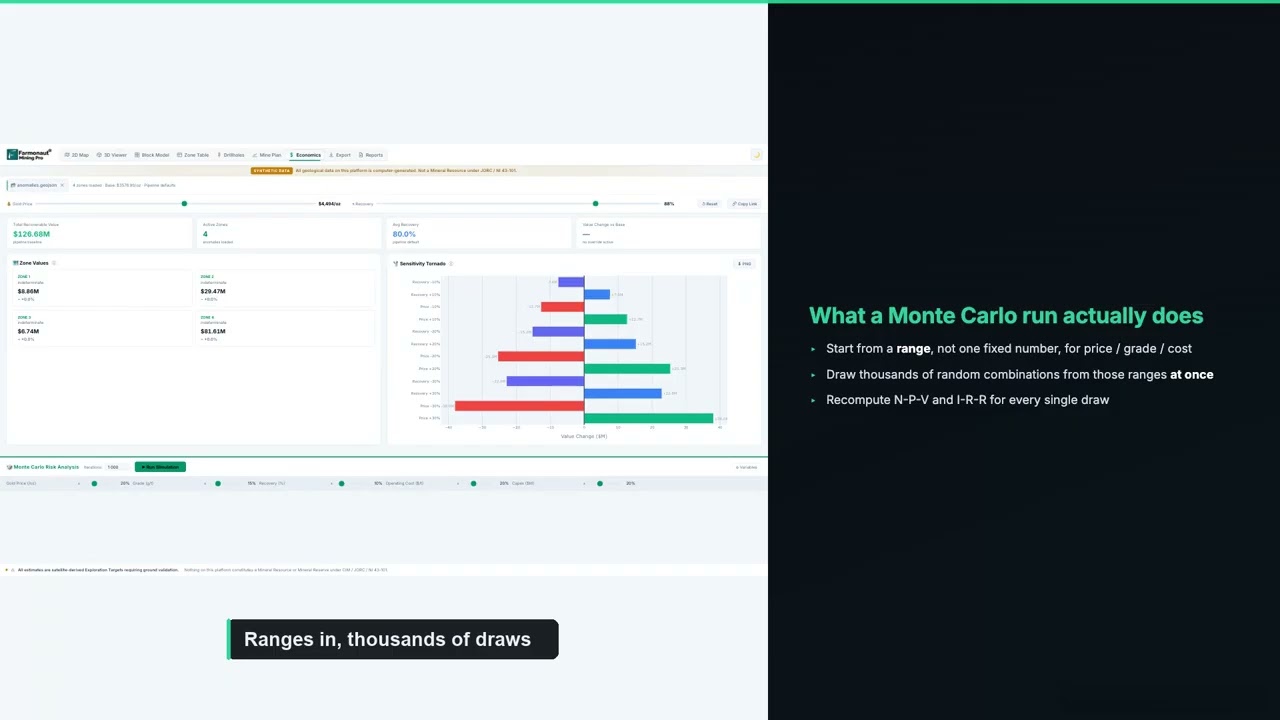
▶ Explains how a Monte Carlo run across price, grade and cost uncertainty gives a range of outcomes for a mining project. · 14:59
Antimony projects and satellite screening
Antimony deposits usually form in veins and replacement zones where hot fluids deposited stibnite, often together with gold, lead, silver or tungsten. That is why Perpetua’s Stibnite project reports gold and antimony together, with drill intercepts such as 6.4 metres at 16.2 g/t gold and 1.7% antimony in the August 2026 update, and why antimony is often recovered as a by-product. Our page on tungsten and antimony in Canada shows the same pairing in another country. For a licence holder, a high price raises the value of any antimony in the ground, but the first question remains where the mineralised structures are.
Farmonaut produces satellite-based exploration targets from a licence boundary, so that a licence holder can see which parts of the ground are worth sampling first. The results are exploration targets that come before any resource estimate. If you hold a licence, you can read how satellite mineral detection works or send the boundary through the mining query form to ask for a quote.
If you are comparing the cost of exploration with the value at stake, our overview of mineral exploration spending in Canada gives a sourced benchmark.
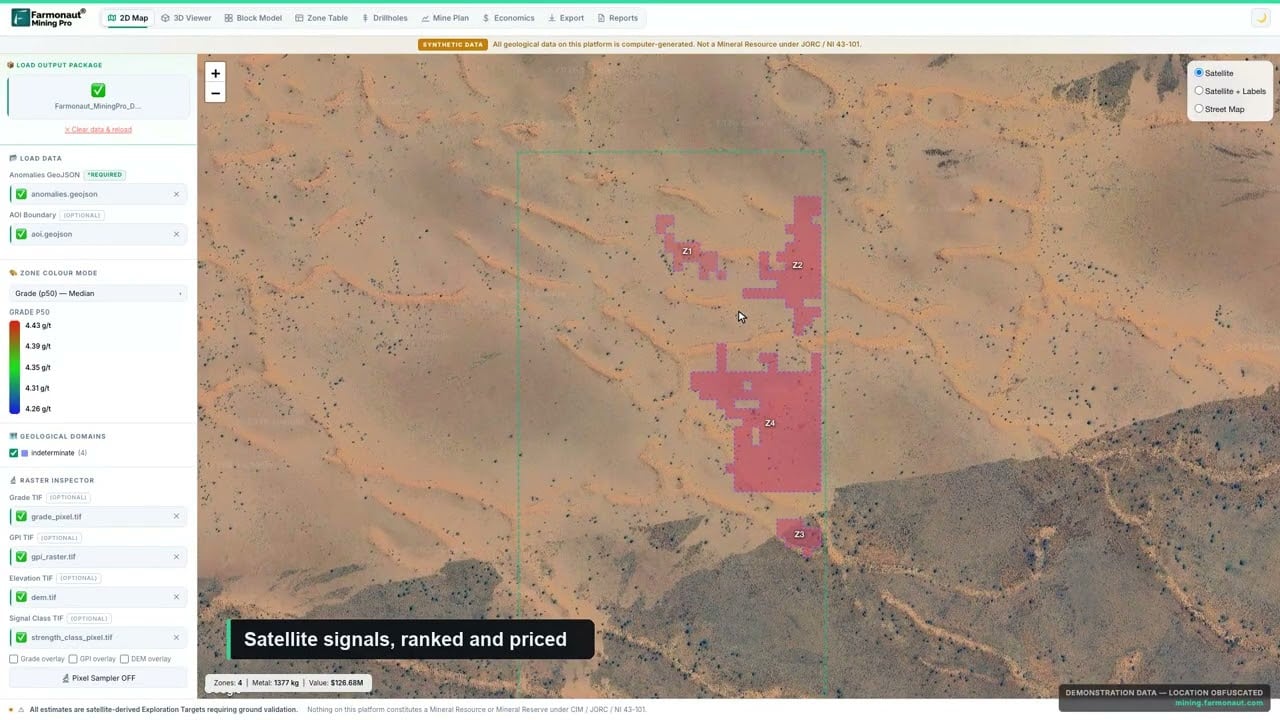
▶ A short look at Farmonaut Mining Pro, which turns a licence boundary into a geological and economic picture. · 4:56
We cover a connected topic in Scandium Price: Chart, Drivers, Indium and Europium.
For a closer look at a related question, see our guide: Magnetite Price per Tonne: Chart and Drivers.
Frequently asked questions
What is the antimony price per tonne?
It depends on the benchmark. SMM put the China 1# ingot at 105,000 yuan per tonne on 18 September 2026, and the USGS average for 2025 was US$25 per pound, about US$55,100 per tonne. Fastmarkets assessed in-warehouse Rotterdam metal at US$18,000 to 20,500 per tonne on 5 August 2026.
What is the antimony price per pound?
The USGS gives US$25 per pound as the 2025 average, US$10.24 for 2024 and US$5.49 for 2023. Divide a price per tonne by 2,204.62 to get the price per pound.
Why did the antimony price rise so sharply?
The USGS links the rise to China’s August 2024 export restrictions and its December 2024 ban on antimony exports to the United States. The monthly average went from US$9.80 per pound in August 2024 to US$27.50 in June 2025.
Why has the antimony price fallen from its peak?
SMM and Fastmarkets point to weak demand, ample supply and inventory selling in 2026. USGS shows the monthly average easing from US$27.50 in June 2025 to US$20.30 in November 2025, and Fastmarkets quoted US$18,000 to 20,500 per tonne in Rotterdam in August 2026 on a different basis.
Is there an antimony futures contract?
The benchmarks used in this page are assessments by Argus, Fastmarkets and SMM based on trades and offers.
Which countries produce the most antimony?
China produced an estimated 40,000 tonnes in 2025, Russia 32,000 and Tajikistan 22,000 out of about 110,000 tonnes world production (USGS, 2026).
What is antimony used for?
In the United States, 49% of 2025 use was in metal products including flame retardants, 40% in antimonial lead and ammunition, and 11% in ceramics, glass and rubber (USGS, 2026).
Does the United States produce antimony?
The USGS reports that one domestic company began mining antimony in Montana in 2025 and that a company in Idaho broke ground on a mine in October 2025. Primary antimony metal and oxide made in Montana still used imported feedstock, and net import reliance was 91% in 2025 (estimate).
What happens on 27 November?
That is the end date of China’s suspension of its antimony export ban to the United States, announced on 9 November 2025. The 9 November announcement did not address the separate prohibition on dual-use exports to United States military users (Fastmarkets).
Where can I check the antimony price today?
Fastmarkets (in-warehouse Rotterdam assessments MB-SB-0001 and MB-SB-0002), Argus Media and SMM are the main sources. SMM’s weekly review is public; the others require a subscription.
How much antimony is in an ore deposit worth?
Multiply the contained metal by recovery and by the payable share, then by the metal price. The calculator on this page does that arithmetic with your own inputs.
This page is for information only. It is not investment advice.
Farmonaut mining
Get a quote for satellite screening of your licence
Send a licence boundary as KML, KMZ or a polygon and ask for a quote on satellite-derived exploration targets, ahead of any resource estimate.

Mining Pro sample view, synthetic data
Keep reading
Sources
- USGS, Mineral Commodity Summaries 2026: Antimony: pubs.usgs.gov
- SMM, Antimony prices consolidate at high levels (18 Sep 2026): news.metal.com
- SMM, Antimony prices continued to rise (28 Aug 2026): news.metal.com
- SMM, Antimony prices continue downward trend (9 Jul 2026): news.metal.com
- SMM, Antimony prices plunge as supply surges and demand weakens (17 Jun 2026): news.metal.com
- Fastmarkets, China suspends export prohibition on gallium, germanium, antimony to US (Nov 2025): fastmarkets.com
- Fastmarkets, Correction to antimony in-warehouse Rotterdam assessment on August 5 (Sep 2026): fastmarkets.com
- Fastmarkets, Proposal to launch two antimony metal cif Rotterdam/Antwerp assessments (Jan 2026): fastmarkets.com
- United States Antimony Corporation, press release filed with the SEC (23 Sep 2025): sec.gov
- Perpetua Resources, Construction update (Aug 2026): perpetuaresources.com
- Geoscience Australia, Australia’s Identified Mineral Resources 2026 preliminary tables: ga.gov.au
Discussion
Questions, corrections or field experience? Share them below. First-time comments are reviewed before they appear, and your email is never published.
No comments yet. Be the first to add a question or your experience.

 Rains of Favour
 Tintina Mining Group
 Dalgety Minerals Pty Ltd
 Vortex Minerals Pty Ltd
 Faith At Work (Pty) Ltd
 Geotech Mining Solutions plc
 Vulcan International Limited
 Kidepo Associates
 GKY Mining
 Alkimy SARL
 Double A Trading
 GemSprout Metals Limited
 Qader Group
 Ileys General Trading
 SG Gold Mining LLC
 VRV Global Pte Ltd
 Omsri International FZE
 G.I.T.T.
 Jaunita Erss Ltd
 Almosi SARL
 SRK Consulting
 Berks Gold Limited
 Mwerezi Minerals Company Limited

 Exploration consultancy · South Africa · Gold










