

Critical minerals · Canada
Tungsten in Canada: Mactung, Sisson, Cantung and Antimony
Canada has world-class tungsten and antimony deposits but no producing mine of either today: Cantung (NWT) stopped in 2015, Mactung (Yukon–NWT) and Sisson (New Brunswick) are pre-construction, and USGS records zero Canadian antimony mine output in 2024 and 2025.
Key takeaways
- Tungsten and antimony are both on Canada’s list of 34 critical minerals, first published in 2021 and updated in 2024.
- Cantung in the Northwest Territories stopped mining in 2015 and is in care and maintenance while closure is planned; no tungsten mine operates in Canada today.
- Mactung (Fireweed Metals, TSXV: FWZ) holds 41.5 Mt Indicated at 0.73% WO3; Sisson (Northcliff, TSX: NCF) holds 276.8 Mt of reserves at 0.075% WO3 and targets a construction decision in late 2027.
- Beaver Brook in Newfoundland is Canada’s known antimony mine, but USGS records no Canadian antimony mine production in 2024 or 2025.
- China mined about 79% of the world’s tungsten in 2025, and its export controls pushed tungsten and antimony prices sharply higher.
In this article
- Why tungsten is a critical mineral in Canada, and antimony too
- Tungsten supply: China's share and the export-control price jump
- Antimony mines in Canada and the world supply picture
- Where tungsten is found in Canada: Cantung, Mactung and Sisson
- Antimony in Canada: the Beaver Brook mine in Newfoundland, and Trail
- How tungsten and antimony deposits form, and what to look for
- Where satellite screening fits in tungsten Canada exploration
- What juniors and investors should check on a tungsten or antimony project
- Tungsten and antimony in Canada: questions people ask
Ask what tungsten Canada produces today and the honest answer is none from its own mines. The country has some of the largest tungsten skarn deposits outside China, a stibnite deposit in Newfoundland that a provincial geologist called globally significant, and an antimony refinery in British Columbia. It also has, since 2015, no operating tungsten mine. This guide sets out who owns each deposit, what the latest technical reports say, why prices moved so far in 2025, and what an exploration company should check before it stakes ground for either metal.
This page stays with tungsten and antimony. For the rules that govern how a resource can be reported, read our NI 43-101 guide to qualified persons and resource categories; for staking and claim systems province by province, use the mining cadastre portal guide.
Canada mined no antimony in 2024 or 2025, yet USGS credits it with 78,000 tonnes of antimony reserves.
Why tungsten is a critical mineral in Canada, and antimony too
Natural Resources Canada keeps an official critical minerals list of 34 minerals and metals. The list was first released in 2021 and updated in 2024, and both tungsten and antimony are on it. The same page names New Brunswick and Yukon as the places with advanced tungsten projects, which matches the two deposits this guide spends most time on: Sisson and Mactung. Any tungsten Canada brings to market would supply a mineral the government has formally classed as critical.
Why does a tungsten critical mineral listing matter to a junior? Mostly because it opens doors to programs that only cover listed minerals. It also shapes how governments talk about a project. The federal government describes tungsten and molybdenum as minerals that make durable industrial parts and matter to defence and aerospace, in its August 2025 announcement of C$8.2 million for the Sisson Project.
What tungsten and antimony are used for
Tungsten is the metal of hard, heat-resistant parts. In the United States, the largest market next door, an estimated 60% of tungsten went into cemented carbide parts for cutting and wear-resistant tools used in construction, metalworking, mining and drilling, according to the USGS tungsten summary for 2025. The rest went into alloys and specialty steels, electrical and lighting parts, and chemicals. Carbide tooling is the biggest single market any tungsten Canada mines in future would sell into.
Antimony is smaller in tonnage but just as hard to replace. USGS reports that U.S. antimony use split into metal products including flame retardants (49%), antimonial lead and ammunition (40%), and non-metal products such as ceramics, glass and rubber (11%). Recycled antimony from spent lead-acid batteries met 12% of U.S. demand in 2025; the rest was imported.
- ✔ Tungsten ore minerals: scheelite (a calcium tungstate) and the wolframite group. Canadian skarn deposits are scheelite deposits.
- 📊 How tungsten is priced: per metric ton unit (mtu) of tungsten trioxide, WO3. One mtu is 10 kg of WO3 and holds 7.93 kg of tungsten metal. Any tungsten Canada mine would sell concentrate on this basis.
- ✔ Antimony ore mineral: stibnite, antimony sulphide, often in quartz veins.
- How antimony is priced: per pound or per tonne of metal at 99.65% purity.

▶ How satellites and soil science are being used in the search for Canada's critical minerals. · 2:25
Tungsten supply: China’s share and the export-control price jump
How concentrated is tungsten supply? China mined an estimated 67,000 tonnes of contained tungsten in 2025 out of a world total of about 85,000 tonnes, according to the USGS Mineral Commodity Summaries 2026. That is about 79%. Vietnam was a distant second at 3,000 tonnes, and the year’s growth came mainly from a new mine at Boguty in Kazakhstan. Canada does not appear in the table at all. For the tungsten Canada holds in the ground, that table is the competition.
Chart
Tungsten mine production, 2025 (estimated)
Metric tons of contained tungsten, selected countries; world total about 85,000 t
USGS also records that China stayed the world’s leading importer and consumer of tungsten concentrate, and that its imports rose sharply in 2025. When the largest producer is also a growing buyer, less concentrate is left for everyone else. That is the core of the supply argument behind every tungsten Canada project now seeking finance.
Export controls and tariffs moved the price
Two policy moves set up 2025. At the end of 2024 the United States raised tariffs to 50% on several Chinese tungsten products, and in February 2025 China put new export controls on selected tungsten items. USGS says prices rose sharply through the year as a result. In Rotterdam, 65% concentrate went from US$266 to US$551 per mtu, and ammonium paratungstate (APT, the main traded intermediate) from US$331 to US$675.
Chart
Rotterdam tungsten prices, start vs end of 2025
US dollars (US$) per metric ton unit (mtu) of WO3; one mtu holds 7.93 kg of tungsten
Prices like these change project economics fast. Northcliff’s August 2026 feasibility update for Sisson assumes forecast European concentrate prices of US$1,520 per mtu WO3 in 2030, rising to US$1,880 by 2040, taken from an Argus market study. Its reserves, though, were calculated at a much lower US$330 per mtu. Keep the two numbers apart when you read any tungsten study: reserve prices are deliberately conservative, while economic forecasts are not. For any tungsten Canada might sell from a new mine, the price deck is the first thing to test.
Antimony mines in Canada and the world supply picture
Antimony supply is even tighter. The USGS antimony summary estimates 2025 world mine production at about 110,000 tonnes. China and Russia each produced tens of thousands of tonnes, and Tajikistan 22,000. Canada produced nothing in either 2024 or 2025, yet USGS lists Canadian antimony reserves at 78,000 tonnes, more than four times Mexico’s 18,000. The gap between those two numbers is the whole story of antimony mines in Canada.
Chart
Antimony mine production, 2025 (estimated)
Metric tons of contained antimony, selected countries; world total about 110,000 t
China’s antimony export ban and what it did to price
USGS describes the sequence clearly. China announced export restrictions on antimony in August 2024 and then banned all antimony exports to the United States in December 2024. The average monthly price nearly doubled between those months, from US$9.80 to US$18.10 per pound, rose another 52% to US$27.50 by June 2025, and then eased to US$20.30 in November 2025. The annual average for 2025 was US$25 per pound, more than double 2024.
Chart
Average antimony metal price
US dollars (US$) per pound, 99.65% antimony, CIF, annual average (2025 estimated)
Prices like that bring old antimony occurrences back into view. USGS notes that in October 2025 a company in Idaho broke ground on an antimony mine backed by conditional U.S. government funding, and that mining started at a site in Montana. For Canadian explorers, the question is whether known stibnite districts can be advanced before the price cycle turns. Treat every price in this section as history, not a forecast.
Where tungsten is found in Canada: Cantung, Mactung and Sisson
Three deposits define the tungsten Canada has on record, and none is producing. Two sit in the Selwyn Mountains on the Yukon–Northwest Territories boundary; the third is in central New Brunswick. Here is where each one stands, checked against the owner or a government source this month.
Cantung, Northwest Territories: care and maintenance, closure planning
Cantung is where the history of tungsten Canada mined at scale starts. The former Cantung mine lies in the southwest corner of the Northwest Territories, about 720 km west of Yellowknife, with seasonal road access from Watson Lake, Yukon. Crown-Indigenous Relations and Northern Affairs Canada (CIRNAC) records that tungsten was found there in 1954 and the mine ran from 1962 to 1986. North American Tungsten bought it in 1997 and operated it in several periods until mining stopped in October 2015, after the company sought creditor protection.
North American Tungsten still owns the site and is responsible for it under its water licence, valid until January 2027. A court-appointed monitor, Alvarez & Marsal Canada, has been funded by the Government of Canada since November 2015. A joint sale effort with the territorial government ran from 2019 and ended without an acceptable bid; in April 2022 Canada and the monitor decided to plan for permanent closure. CIRNAC says care and maintenance continues until closure plans are approved.
In 2007, Cantung and nearby Mactung reportedly held 15% of the world’s known tungsten, according to CIRNAC.
Mactung, Yukon–NWT border: Fireweed Metals, working toward a new feasibility study
Mactung straddles the Yukon–NWT boundary near Macmillan Pass, reached by the North Canol Road. It sits in the traditional territories of the Kaska Dena Nation and the First Nation of Na-cho Nyäk Dun, and in the Sahtu Settlement Area. The Government of the Northwest Territories bought Mactung for C$4.5 million in 2015 during North American Tungsten’s insolvency, and in June 2022 agreed to sell it to Fireweed for C$15 million.
Fireweed Metals (TSXV: FWZ) reports an NI 43-101 resource effective 28 July 2023: 41.487 million tonnes Indicated at 0.73% WO3 (about 30.2 million mtu) and 12.247 million tonnes Inferred at 0.59% WO3, with no Measured category. In December 2024 the company announced US$15.8 million from the U.S. Department of Defense under the Defense Production Act to take Mactung toward a final investment decision, plus up to C$12.9 million from Canada’s Critical Minerals Infrastructure Fund for road and power planning. Both are public bets on new tungsten Canada supply.
Sisson, New Brunswick: Northcliff Resources, feasibility update done
Sisson is about 100 km by road northwest of Fredericton. It is owned by the Sisson Limited Partnership: Northcliff Resources (TSX: NCF) 88.5% and a subsidiary of Todd Corporation of New Zealand 11.5%. Northcliff describes it as a large, structurally controlled, intrusion-related tungsten-molybdenum deposit suited to open-pit mining. Provincial and federal environmental approvals came in 2015 and 2017.
The August 2026 feasibility study update reports proven and probable reserves of 276.8 Mt at 0.075% WO3 and 0.023% Mo, effective 11 August 2026, mined at 30,000 tonnes a day over 27 years. It forecasts average output of 598,000 mtu of WO3 a year at 78% recovery, initial capital of C$1,528 million and a post-tax NPV of C$6,915 million at 8%. Northcliff says it is working toward a construction decision in the latter part of 2027. The federal Major Projects Office took the project on in November 2025.
| Deposit | Owner (checked October 2026) | Status | Latest estimate, as reported |
|---|---|---|---|
| Cantung, NWT | North American Tungsten (under creditor protection; federal funding) | Care and maintenance; closure planning since 2022 | No current estimate published |
| Mactung, Yukon–NWT | Fireweed Metals, 100% | Field and metallurgical work toward a new feasibility study | 41.5 Mt Indicated at 0.73% WO3; 12.2 Mt Inferred at 0.59% (2023) |
| Sisson, New Brunswick | Northcliff 88.5%, Todd 11.5% | Pre-construction; decision targeted for late 2027 | 276.8 Mt proven and probable at 0.075% WO3, 0.023% Mo (2026) |
| Beaver Brook, Newfoundland (antimony) | China Minmetals at the 2019 reopening; confirm today | No Canadian antimony mine output in 2024 or 2025 (USGS) | About 2.1 Mt at 4.3% Sb (historical, provincial geologist’s figure) |
Resources and reserves sit in separate columns of company reports for a reason. Mactung’s figure is a resource: it has reasonable prospects of economic extraction but no demonstrated economics yet. Sisson’s 276.8 Mt is a reserve, the part of a larger 421.6 Mt Measured and Indicated resource that the feasibility study shows can be mined at a profit. Northcliff’s resources are reported inclusive of reserves, so the two must never be added together.
Calculator
How much WO3 is in a deposit, and what is it worth gross?
Enter ore tonnes, grade, recovery and a concentrate price. Money is in US dollars (US$), in millions.
- Contained WO3: 207,600 t
- Contained WO3: 20.76 million mtu
- Contained tungsten metal: 164,627 t
- Recovered WO3: 16.19 million mtu
Example values, not a forecast. Defaults are Sisson’s proven and probable reserves (276.8 Mt at 0.075% WO3) and 78% WO3 recovery from Northcliff’s August 2026 feasibility update, and the 2025 average Rotterdam concentrate price of US$380 per mtu from USGS. One mtu is 10 kg of WO3 and holds 7.93 kg of tungsten (USGS). Amounts are US$ millions of gross metal value only: no mining, processing, transport, royalty or tax costs, so this is not a project value. Indicated or Inferred resources are not reserves. Not investment advice.
With the defaults, 276.8 Mt at 0.075% WO3 holds about 207,600 tonnes of WO3, or 20.76 million mtu. Northcliff’s own table shows 20.69 million mtu; the small gap comes from the rounded grade. At 78% recovery that becomes about 16.2 million mtu, close to the study’s life-of-mine figure of 16.1 million. Try Mactung’s Indicated numbers (41.487 Mt at 0.73%) and the contained WO3 rises to about 30 million mtu from far fewer tonnes. That is what “high-grade” means for a skarn. Run the same check on any tungsten Canada project you are reviewing, using the numbers in its own technical report.
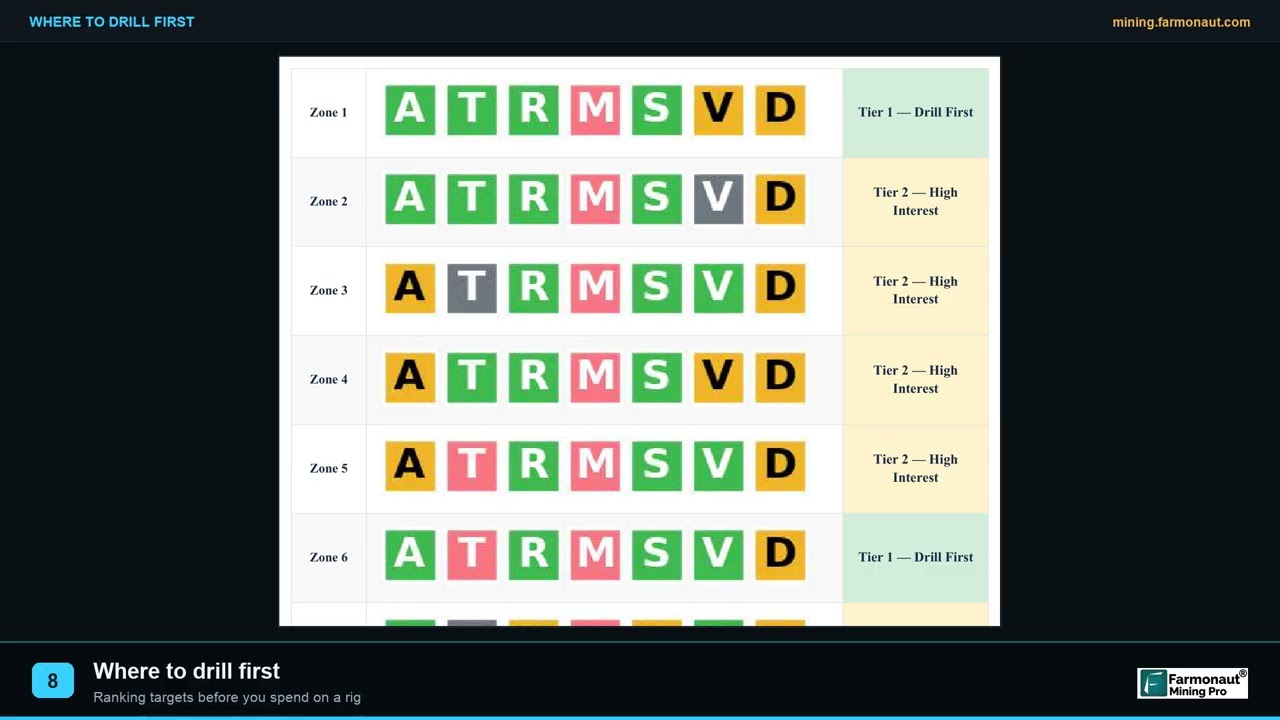
▶ How exploration teams rank targets and decide where the first drill holes go. · 2:19
Antimony in Canada: the Beaver Brook mine in Newfoundland, and Trail
The antimony mine Newfoundland is known for is Beaver Brook, about 42 km southwest of Glenwood in central Newfoundland. A 2017 Geological Survey of Newfoundland and Labrador poster by Hamish Sandeman calls it one of North America’s few economic antimony deposits, globally significant for its resource of about 2.1 million tonnes of ore and its 4.3% Sb grade. That figure is a geologist’s summary, not a current NI 43-101 estimate.
How was it found? The province’s prospector resource sheet records that Noranda Exploration prospectors found the Beaver Brook mine and the nearby Hunan and Xingchang prospects in 1989, during follow-up of a stream silt anomaly 8 km long and a soil anomaly 4.5 km long. Regional gold exploration, cheap geochemistry and patient follow-up found a stibnite district. That sequence still works.
Who owns Beaver Brook, and is it producing?
When the mine reopened in March 2019, the Government of Newfoundland and Labrador named China Minmetals Corporation as the owner, with about 100 jobs and up to 160,000 tonnes of antimony ore a year at full production, processed into concentrate. USGS now shows no Canadian antimony mine production in 2024 or 2025. We could not find a current provincial or company page confirming the mine’s owner and status today, so confirm both with the Department of Industry, Energy and Technology before relying on them.
Calculator
How much antimony is in a stibnite vein deposit?
Enter ore tonnes, grade and an antimony price. Money is in US dollars (US$), in millions.
- Contained antimony: 90,300 t
- Contained antimony: 199.1 million lb
Example values, not a forecast. Defaults are the approximate Beaver Brook figures of 2.1 million tonnes at 4.3% Sb from the 2017 Geological Survey of Newfoundland and Labrador poster (a historical summary, not an NI 43-101 estimate) and the 2025 average antimony metal price of US$25 per pound from USGS. One tonne is 2,204.62 lb (fixed in the formula). Amounts are US$ millions of in-ground value only: no dilution, recovery, concentrate payables, costs or taxes. Not investment advice.
At 2.1 million tonnes and 4.3% Sb, the deposit holds about 90,300 tonnes of antimony, equal to about 82% of estimated world mine output in 2025. The in-ground figure at US$25 a pound looks large, but it is only a starting point: recovery, concentrate terms and costs come off before anything reaches a company’s books.
Trail: antimony production in British Columbia
Canada does produce antimony metal products without a producing antimony mine. In July 2026 the federal government announced the first agreement under the Canada Critical Minerals Accelerator: up to C$400 million of equity-like investment from the Canada Growth Fund toward a Teck expansion at Trail that could double the site’s production capacity for germanium and antimony. The deal still depends on final documents and approvals. A refinery needs feed, which is one reason a Canadian antimony mine is back on the agenda.
How tungsten and antimony deposits form, and what to look for
Most of the tungsten Canada has on record sits in skarns, which makes skarn geology the starting point for new targets. A USGS grade and tonnage model for tungsten skarn deposits (2020) describes them as tabular or lens-shaped bodies along the contact between carbonate rocks (limestone, dolostone, marble, calcareous shale) and evolved granitic intrusions. Scheelite is the main ore mineral, with garnet and pyroxene as typical gangue. The model cites Mactung as one of its type examples.
The same USGS model, built from 41 well-explored deposits worldwide, gives a median of about 6.03 million tonnes at 0.44% WO3. One deposit in ten holds at least 49.3 million tonnes, and one in ten grades at least 0.88% WO3. On those yardsticks Mactung’s 0.73% Indicated grade is well above the median, while Sisson is a different style: a large, lower-grade intrusion-related deposit mined in bulk.
- ✔ Look for the contact. Mapped granite stocks cutting limestone or calcareous shale are the first filter for a skarn target.
- ✔ Use a UV lamp. Scheelite glows bright blue under shortwave ultraviolet light, as shown in this USGS specimen image; prospectors have long searched outcrop and drill chips at night this way. Assays, not glow, decide grade.
- 📊 Antimony follows structure. At Beaver Brook, Sandeman describes fracture- and fault-controlled stibnite-quartz veins along a crustal-scale structure called the Dog Bay Line, with gold in the same system.
▶ How minerals leave spectral fingerprints that hyperspectral sensors can pick up. · 1:49
Where satellite screening fits in tungsten Canada exploration
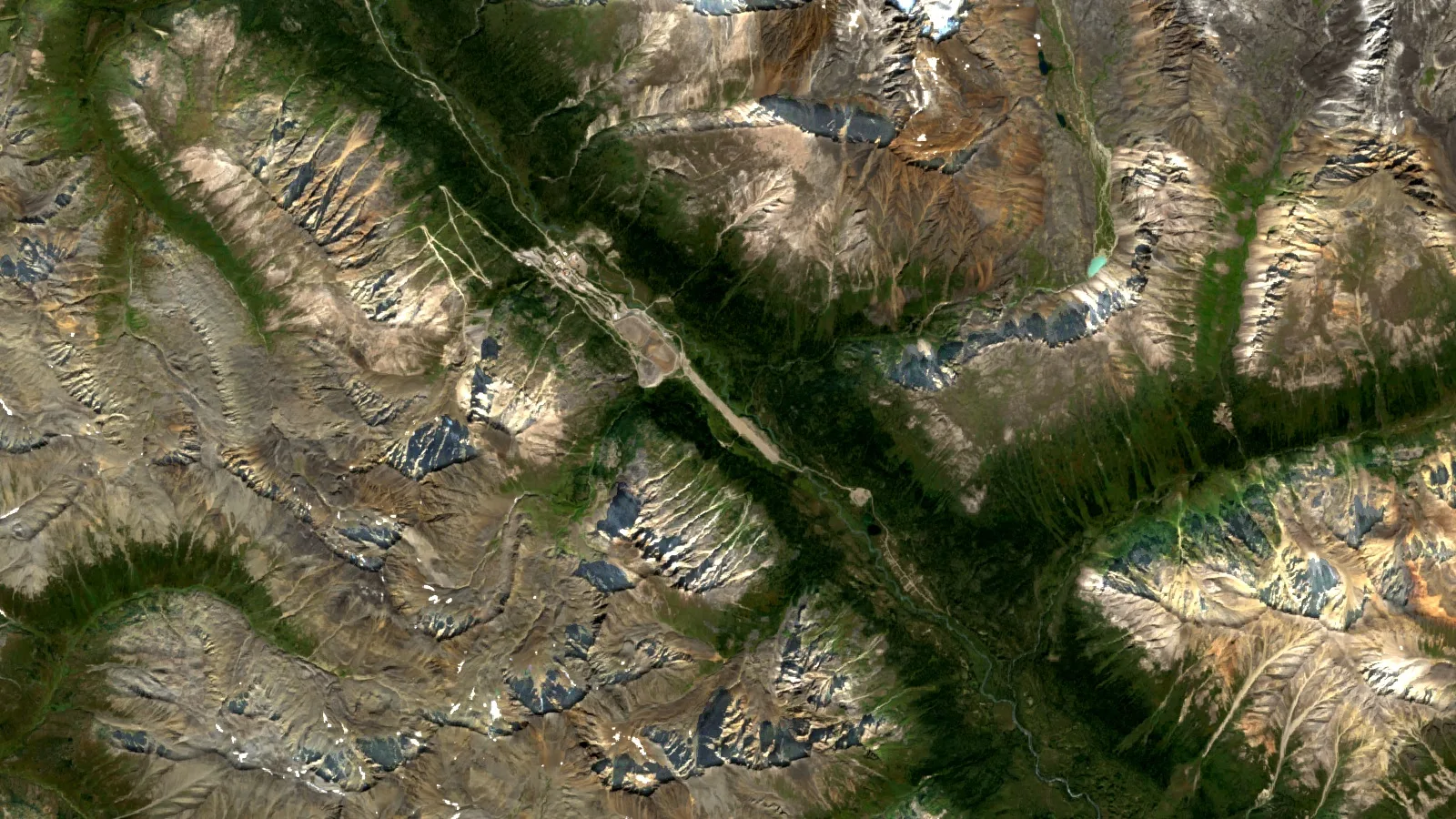
Satellite data cannot see scheelite or stibnite grains. What it can do is map the rocks and structures those minerals favour across a whole district before field crews go in. Skarn targets depend on contacts between intrusions and carbonate rocks; antimony veins depend on faults. Both leave patterns that show up in multispectral imagery and terrain models. On tungsten Canada ground, that means tracing intrusion contacts and faults across a whole district. The tungsten Canada has in the Selwyn Mountains also lies in high, northern terrain where snow and cloud limit the imaging season, so every clear summer scene counts.
Our satellite-based mineral detection work analyses multispectral and hyperspectral data for alteration zones, faults and fractures, and host-rock patterns, and returns prospectivity heatmaps with georeferenced GIS files. We publish a list of the materials we detect directly: gold, silver, copper, cobalt, nickel, zinc, iron, manganese, lithium, uranium, rare earths and others. Tungsten and antimony are not on it, so for these targets we would deliver the structural and alteration layers that guide where to sample, not a tungsten map. For a tungsten Canada target, say so up front in any quote request.
Infographic
From open ground to a tungsten or antimony mine
- 1Check the groundOpen claims, parks and Indigenous territories come first.
- 2Screen and mapSatellite and desk study, then stream and soil sampling, as at Beaver Brook.
- 3Drill and estimateAn NI 43-101 resource signed by a qualified person.
- 4Study the projectPEA, then pre-feasibility and feasibility.
- 5Assess, permit, financeProvincial and federal assessment, permits, then a construction decision; Sisson aims for late 2027.
On timing and cost, the claims we make are the ones in our brand file: satellite screening moves early exploration from months to days, can cut early-exploration cost by up to 80 to 85%, and reports arrive in 5 to 20 business days depending on area and complexity. We have screened more than 100,000 hectares for 20+ mineral types in 25+ countries. You send the area as coordinates, KML/KMZ or a polygon, plus the target mineral. Results are exploration targets ahead of any resource estimate; they are not a resource and do not replace drilling or NI 43-101 work.
▶ What remote sensing measures in mining, in plain language. · 2:01
What juniors and investors should check on a tungsten or antimony project
Can Canada supply tungsten again? Possibly, but each project has to clear the same hurdles before any tungsten Canada produces reaches a buyer. Before you value any tungsten Canada junior on the TSX, TSXV or CSE, or option ground from one, check these points against filings on SEDAR+ and the company’s own site, not press summaries.
- ✔ Category and date of every number. Indicated, Inferred and reserves are not interchangeable, and Mactung has no Measured resource. Check the effective date and the qualified person.
- ✔ Grade basis. Tungsten Canada reports, like all others, quote grades as % WO3, not % W. Multiply by about 0.793 to get tungsten metal.
- 📊 Price decks. Compare the reserve price, the resource price and the forecast curve, as in the Sisson example above.
- ⚠ Funding conditions. Government awards come with milestones and due diligence; Fireweed’s infrastructure funding was announced pending final due diligence.
- Product route. Northcliff’s 2026 study switched from making APT on site to selling concentrate, citing market research. A change like that moves capital cost and price.
- Infrastructure and season. Mactung is reached by the North Canol Road or the Macmillan Pass aerodrome; Cantung by a seasonal road from Watson Lake.
For the step from resource to study, our guide to scoping, PFS and feasibility studies explains what each stage must show. For geology data to start a desk study, see our page on the BC Geological Survey and other geological agencies, and for ground methods that follow up a satellite target, our overview of geophysical survey methods.
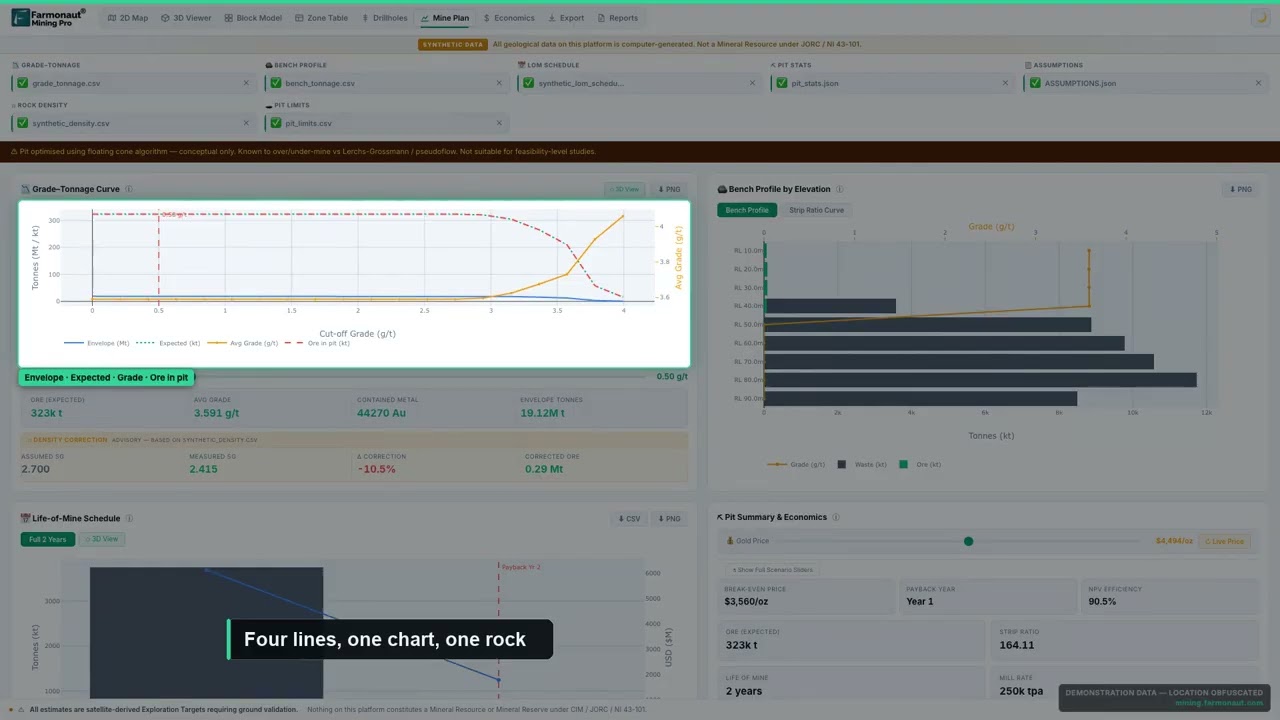
▶ How a grade-tonnage curve shows the trade-off between cut-off grade and tonnes, the same trade-off behind Sisson's bulk-tonnage plan. · 4:46
Tungsten and antimony in Canada: questions people ask
Does Canada mine tungsten?
Not at present. Cantung, a source of the tungsten Canada mined in several periods between 1962 and 2015, stopped mining in October 2015 and is in care and maintenance with closure being planned (CIRNAC). Mactung and Sisson are development projects. Sisson targets a construction decision in late 2027.
Where is tungsten found in Canada?
The tungsten Canada has on record sits mainly in three deposits: Cantung and Mactung in the Selwyn Mountains on the Yukon–Northwest Territories boundary, and Sisson in central New Brunswick, about 100 km by road northwest of Fredericton.
Is tungsten a critical mineral in Canada?
Yes. Tungsten and antimony are both on Natural Resources Canada’s list of 34 critical minerals, first released in 2021 and updated in 2024. Tungsten Canada projects such as Sisson have since received federal critical-mineral funding.
Who owns the Mactung tungsten deposit?
Fireweed Metals (TSXV: FWZ), which agreed to buy it from the Government of the Northwest Territories for C$15 million in 2022. Its 2023 NI 43-101 resource is 41.5 Mt Indicated at 0.73% WO3.
How big is the Sisson tungsten project?
Northcliff’s August 2026 feasibility update reports 276.8 Mt of proven and probable reserves at 0.075% WO3 and 0.023% Mo, mined at 30,000 tonnes a day over 27 years, with average output of 598,000 mtu of WO3 a year.
Are there antimony mines in Canada?
Beaver Brook in central Newfoundland is Canada’s known antimony mine. It reopened in 2019, but USGS records no Canadian antimony mine production in 2024 or 2025. Teck’s Trail operation in BC produces antimony.
Where is the antimony mine in Newfoundland?
Beaver Brook lies about 42 km southwest of Glenwood in central Newfoundland, on a structure geologists call the Dog Bay Line. It was found by Noranda prospectors in 1989.
How much antimony does Canada have?
USGS estimates Canadian antimony reserves at 78,000 tonnes of contained antimony, with zero mine production in 2024 and 2025.
Why did tungsten and antimony prices rise?
USGS links both to Chinese export controls: on antimony from August 2024, with a ban on exports to the United States in December 2024, and on selected tungsten items from February 2025, plus higher U.S. tariffs on Chinese tungsten products.
Can satellites find tungsten or antimony?
Not directly. Satellites map alteration, rock types and faults that point to prospective ground. Tungsten and antimony are not on Farmonaut’s published list of directly detected materials, and any satellite result is an exploration target, not a resource.
General information, not legal, tax or investment advice. Owners, project status, resources and prices change; confirm with the company’s SEDAR+ filings, the provincial or territorial regulator and the exchange. Farmonaut is not a licensing agent, land-title adviser, broker or investment adviser. Farmonaut results are exploration targets ahead of any resource estimate.
Farmonaut mineral detection
Screen a skarn or stibnite trend before you stake
Send the area as KML, KMZ or a polygon with the target mineral. Farmonaut returns ranked satellite exploration targets with alteration and structure layers, usually in 5 to 20 business days.

Keep reading
Sources
- Natural Resources Canada, Canada's critical minerals list (2021, updated 2024): canada.ca
- U.S. Geological Survey, Mineral Commodity Summaries 2026: Tungsten (2026): pubs.usgs.gov
- U.S. Geological Survey, Mineral Commodity Summaries 2026: Antimony (2026): pubs.usgs.gov
- U.S. Geological Survey, Grade and Tonnage Model for Tungsten Skarn Deposits, SIR 2020-5085 (2020): pubs.usgs.gov
- U.S. Geological Survey, Scheelite under shortwave ultraviolet light (image): usgs.gov
- Crown-Indigenous Relations and Northern Affairs Canada, Cantung Mine Closure and Reclamation Project (2025): rcaanc-cirnac.gc.ca
- Government of the Northwest Territories, GNWT agrees to sell Mactung property to Fireweed Zinc Ltd. (2022): gov.nt.ca
- Fireweed Metals, Mactung Project and Mineral Resource Estimate (2023): fireweedmetals.com
- Fireweed Metals, Joint US-Canadian government funding for Mactung (2024): fireweedmetals.com
- Northcliff Resources, Results of Feasibility Study Update for Sisson Project (2026): f9767f56-5492-4801-b791-735467e2e77c.usrfiles.com
- Northcliff Resources, Sisson Project overview: northcliffresources.com
- Major Projects Office, Northcliff Resources' Sisson Mine (2026): canada.ca
- Natural Resources Canada, Government of Canada invests in New Brunswick (2025): canada.ca
- Department of Finance Canada, Budget 2025 Tax Measures: Supplementary Information (2025): budget.canada.ca
- Natural Resources Canada, First agreement under the Canada Critical Minerals Accelerator (2026): canada.ca
- Geological Survey of Newfoundland and Labrador, Sandeman, Beaver Brook and the Dog Bay Line poster (2017): gov.nl.ca
- Government of Newfoundland and Labrador, Prospectors Resource Room, Beaver Brook property sheet: gov.nl.ca
- Government of Newfoundland and Labrador, Reopening of the Beaver Brook Mine (2019): gov.nl.ca
- Canadian Securities Administrators, NI 43-101 Standards of Disclosure for Mineral Projects (BCSC, 2023): bcsc.bc.ca
Discussion
Questions, corrections or field experience? Share them below. First-time comments are reviewed before they appear, and your email is never published.
No comments yet. Be the first to add a question or your experience.

 Alkimy SARL
 Double A Trading
 GemSprout Metals Limited
 Qader Group
 Ileys General Trading
 SG Gold Mining LLC
 VRV Global Pte Ltd
 Omsri International FZE
 G.I.T.T.
 Jaunita Erss Ltd
 Almosi SARL
 SRK Consulting
 Berks Gold Limited
 Mwerezi Minerals Company Limited
 Mining SARL
 SenGold Invest SAS
 Sean Mining Limited
 NTS Group (Pty) Ltd
