

Yttrium · Price guide
Yttrium Metal Price per Ton: Chart and Drivers
Yttrium oxide was listed at about US$7.76 per kg in China on 10 September 2026, while Argus data reported by Reuters put it near US$1,100 per kg outside China by May 2026. This page shows each dated quote, the drivers and a price calculator.
Key takeaways
- Yttrium oxide averaged US$9 per kg and metal US$40 per kg in 2025, FOB China (USGS, 2026); a tonne is the kg figure times 1,000.
- European oxide reached US$270 per kg in November 2025, up 4,400% since January, while Chinese prices stayed near US$7 (Argus data via Reuters).
- Outside China the oxide was reported near US$1,100 per kg by May 2026, about 140 times the pre-April-2025 level (Argus via Reuters and The Oregon Group, secondary).
- The cause is export licensing: China produced most of the world’s yttrium in 2025 and tightened controls in April 2025 (USGS, 2026).
- Quotes differ by grade, delivery point and date, so the calculator takes your own price as an input.
In this article
- Yttrium oxide price by market: the dated public quotes
- Reading the chart: China against the rest of the world
- Yttrium metal versus oxide: why the price per ton differs
- USGS yttrium price history, oxide and metal
- Yttrium price per ton: converting the quotes
- What drives the yttrium price
- Yttrium uses and why buyers pay the premium
- Where yttrium comes from: supply, reserves and processing
- Calculator: what an order or an ore body is worth
- Yttrium price risk in a mining project
- How to check a yttrium price quote before you rely on it
- Finding yttrium ground: what exploration needs
- What could move the yttrium price next
- Frequently asked questions
Yttrium has no single world price. As of mid-September 2026, yttrium oxide was listed at about US$7.63 to US$7.90 per kilogram inside China (Shanghai Metal Market, 10 September 2026), which is roughly US$7,700 per tonne. Outside China, the same chemical has been reported at several hundred dollars per kilogram, and Argus data reported by Reuters and The Oregon Group put it near US$1,100 per kilogram by May 2026. The gap of well over 100 times comes from China’s export licences, not from the cost of the ore. This page lays out every dated public quote we could verify, explains why they differ, and gives you a calculator where you type your own price.
A quick unit note. FOB means the quote is for goods loaded at the exporting port. Prices below are in US dollars per kilogram unless stated. To get a price per tonne, multiply by 1,000, so US$7.76 per kilogram is US$7,760 per tonne and US$270 per kilogram is US$270,000 per tonne. USGS tonnes are metric tonnes. Yttrium oxide is written Y2O3; “five nines” or 99.999% is the purity that electronics and coating buyers usually specify.
Most online pages give one number for “yttrium metal price” with no date, purity or delivery point. That is not usable. A price means something only when you know the product (oxide or metal), the purity, where it is delivered, and the day it was quoted. We show those four things for every figure.
Yttrium oxide price by market: the dated public quotes
The table lists every quote we could trace to a named source, oldest to newest. Read the last column before comparing rows, because the rows do not measure the same thing. A price inside China is for material sold in China. A European price is for material that has already cleared export licensing and been shipped.
| Date | Market and basis | Reported level (US$/kg) | Source and quality |
|---|---|---|---|
| Annual average 2025 (estimate) | Y2O3 99.999%, FOB China | 9 | USGS Mineral Commodity Summaries, citing Argus (primary government table) |
| November 2025 | Y2O3, Europe | 270 (China about 7) | Argus data reported by Reuters, 18 November 2025 |
| May 2026 | Y2O3, outside China | nearly 1,100 | Argus data via Reuters, repeated by The Oregon Group on 10 June 2026 (secondary) |
| 22 June 2026 | Y2O3, Rotterdam | 457.50 | A secondary report cited by InvestorNews; specification not stated |
| 22 June 2026 | Y2O3, European indication | 1,175 | Baiinfo, as cited by the same InvestorNews column; specification not stated |
| 10 September 2026 | Y2O3, China domestic | 7.63 to 7.90 | Shanghai Metal Market public table, cited by InvestorNews (domestic indication, not an export offer) |
Three things stand out. First, the Chinese price stayed low: the USGS average for 2025 is US$9 per kilogram FOB China (USGS, 2026), and the September 2026 Shanghai quote is below that. Second, the price outside China rose by orders of magnitude in about a year. Third, the two June 2026 European quotes differ by a factor of 2.6, and the source column says why: nobody states the grade, the delivery terms or the volume.
One more data point shows how loose the public record is. A procurement-industry blog by Octopart reported the price moving from under US$8 at the end of 2024 to roughly US$120 to US$130 per kilogram within a year, and called it a 1,500% rise. That is far below the Argus figures for the same period, and it is a blog, so we do not put it in the table. It is a reminder that “the price” depends on whose survey, which week and which supplier.
Reading the chart: China against the rest of the world
The chart below plots the oxide quotes from the table on one axis. The bars do not form a time series, because the products and delivery points differ. They show the size of the split between China and the rest of the world.
Chart
Yttrium oxide quotes by market and date
US$ per kg; products and delivery points differ; not a time series
Yttrium metal versus oxide: why the price per ton differs
Yttrium oxide is the intermediate product that comes out of a separation plant. Yttrium metal is made from it with an extra reduction step, so metal always costs more per kilogram. USGS tracks both on the same FOB China basis (the seller loads the goods at a Chinese port). The oxide averaged US$9 per kilogram in 2025 and the 99.9% metal averaged US$40 per kilogram (USGS, 2026). The 2025 oxide average was 42% above 2024 and the metal average 22% above 2024; the rounded table figures shown in the chart give slightly different percentages.
Chart
USGS average price change, 2024 to 2025
US$ per kg, FOB China, rounded table values
The metal’s average rose by a smaller percentage than the oxide’s. The Shanghai Metal Market listed metal of 99.9 to 99.95% purity, delivered to works in China, at US$34.21 to US$35.52 per kilogram on 9 September 2026, as cited by Jack Lifton in InvestorNews. That is slightly below USGS’s 2025 average of US$40 and about 4.5 times the oxide quote on the same day.
Do not compare a metal quote with an oxide quote. If a page says “yttrium metal US$50 per kilogram” and another says “yttrium oxide US$1,000 per kilogram”, they may both be right and still not conflict. Always write the form next to the number.
USGS yttrium price history, oxide and metal
The longest public series is the USGS average price table. It covers five years and shows a market that was quiet and cheap until export controls arrived. In 2021 the oxide averaged US$6 per kilogram, rising to US$12 in 2022, then US$8 in 2023, US$6 in 2024 and US$9 in 2025 (USGS, 2026). The metal moved between US$33 and US$41 per kilogram across the same years.
Chart
USGS average yttrium prices, oxide and metal
US$ per kg, FOB China, 2021 to 2025 (2025 estimated)
These averages are on a China FOB basis, which is why they do not capture the 2025 and 2026 jump in Europe. If you rely on the USGS series alone you will think yttrium stayed cheap. That is true for a buyer who can get a Chinese export licence and false for everyone else. The same USGS chapter notes that China tightened its export controls in April 2025, specifically listing yttrium metals, oxides, alloys and compounds, and that as of December 2025 the controls remained in place even though China had begun issuing general licences to selected exporters.
Yttrium price per ton: converting the quotes
Buyers of concentrates and miners think in tonnes, so here are the same dated numbers converted. Each row is the kilogram figure multiplied by 1,000. Treat the tonne figures as an arithmetic conversion of the kilogram quote, not as contract prices, since nobody sells a tonne of five-nines oxide in one lot at spot.
| Quote (see table above) | US$ per kg | US$ per tonne |
|---|---|---|
| USGS 2025 average, oxide, FOB China | 9 | 9,000 |
| USGS 2025 average, metal, FOB China | 40 | 40,000 |
| China domestic oxide, 10 September 2026 | 7.76 (midpoint) | 7,760 |
| Europe oxide, November 2025 (Argus via Reuters) | 270 | 270,000 |
| Rotterdam oxide, 22 June 2026 (secondary) | 457.50 | 457,500 |
| Outside China, May 2026 (Argus via Reuters) | about 1,100 | about 1,100,000 |
Compare that with the mine side. USGS estimates 2025 world mine production at 10,000 to 15,000 tonnes of yttrium oxide equivalent inside rare-earth concentrates. At the Chinese oxide price, that is worth US$78 million to US$116 million a year in finished oxide terms, which is tiny next to copper or gold. At the ex-China price it would be worth over US$10 billion, but no one is buying anything like that tonnage at that price. The outside-China quotes may reflect small, urgent lots; their volumes are not stated.
What drives the yttrium price
Export licences, not ore cost
In April 2025 China placed export controls on seven heavy rare earths: samarium, gadolinium, terbium, dysprosium, lutetium, scandium and yttrium. The controls require exporters to hold licences from Beijing. Reuters reported in November 2025 that, according to four traders and an Argus analyst, licences issued so far covered small shipments and delivery delays were long. Customs data showed Chinese yttrium exports to the United States had slowed early in 2025 and then stopped after the April controls, while exports to the rest of the world fell about 30% over the same period. By June 2026, The Oregon Group, citing Reuters and Chinese customs data, said shipments of yttrium, dysprosium and terbium were still down about 50% compared with the 12 months before the controls.
A tiny market with one dominant source
Yttrium is a small market by volume. USGS puts world mine production at 10,000 to 15,000 tonnes of oxide equivalent for 2025 and says China produced most of it, with Burma also a significant share. The United States had 100% net import reliance for yttrium in each year from 2021 to 2025, with about 70% of imports of yttrium alloys, compounds and metals coming from China in 2021 to 2024 (USGS, 2026). When a market is this small and this concentrated, a licence rule changes the delivered price much more than a mine opening or closing would.
Stocks outside China
The Reuters story reported that six industry sources gave estimates of stocks outside China between one and twelve months of consumption, varying widely by company. A buyer holding six months of stock can wait; one holding one month cannot. That spread explains why the price looks like an auction: a few desperate buyers set the price for the lot, and buyers with stock stay out. Reuters also quoted a trader who said material elsewhere was unlikely to flow to US buyers because intermediaries feared that China could restrict their own shipments in return.
Byproduct supply
Yttrium is not mined on its own. USGS measures world output as yttrium oxide contained in rare-earth mineral concentrates, so supply follows the mining of rare-earth ore. USGS estimates that yttrium made up only about 0.12% of the rare earths in the Mountain Pass bastnaesite ore in California, and its production there was not reported. A mine that is run for other rare earths cannot simply add yttrium output when the price rises, and separating it needs a refinery. Expect a slow supply response even at very high prices.
Demand that cannot easily switch
For most of its main uses yttrium has no good substitute. USGS says that in electronics, lasers and phosphors yttrium is generally not subject to direct substitution, and that in zirconia ceramics calcium oxide or magnesium oxide can replace yttrium oxide but with lower toughness. When demand cannot switch away, the price rises until demand is destroyed or supply arrives. Neither has happened yet.
How the price is measured
Benchmarks changed because of the shortage. Fastmarkets lists a weekly assessment of yttrium oxide 99.999% ex-warehouse Rotterdam in US dollars per kilogram, launched on 7 August 2025; the values sit behind a subscription. Argus has a CIF Europe oxide assessment. They are different products: CIF Europe is material delivered to the import destination, ex-warehouse Rotterdam is material available in a warehouse. Jack Lifton’s InvestorNews column makes the same point: the “actual” price is the price at which a specified quantity of a specified product can be delivered to a particular buyer.
Yttrium uses and why buyers pay the premium
USGS says the leading United States and world end uses of yttrium are ceramics and phosphors, with smaller amounts used for fibre optics, optical glass, pigments and yttrium-aluminium-garnet (YAG) crystals used in lasers for communication, industrial and medical work (USGS, 2026). Each of these uses is small in tonnes, but a few are expensive to interrupt.
- Heat-shield coatings and jet engines. Yttrium oxide stabilises zirconia ceramics used as thermal barrier coatings. The Aerospace Industries Association told Reuters that yttrium is essential to the world’s most advanced jet engines. Coatings are also used on gas turbine blades in power plants.
- Chipmaking. Reuters reported that yttrium is used as a protective coating and insulator in semiconductor equipment. One industry source rated the severity of shortage risk as 9 out of 10; the chief executive of Great Lakes Semiconductor said shortages would lengthen production times and raise costs, though immediate shutdowns were unlikely.
- Phosphors. USGS lists phosphors among the two leading end uses, alongside ceramics.
- Lasers. Yttrium-aluminium-garnet is the crystal in Nd:YAG lasers.
- Fibre optics, glass and pigments. Smaller volumes, listed by USGS.
The shock reaches buyers who never think about yttrium. The Octopart article describes how lead times lengthen before prices move, and how electronic parts carrying yttrium-based phosphors, sputtering targets and ceramics come to cost more. For a deeper look at what pure yttrium is used for, see our guide to pure yttrium and its applications, and for the wider group of elements see what rare earths are used for.
Where yttrium comes from: supply, reserves and processing
Yttrium is one of the rare-earth elements, but it is a heavy one, and it sits with the minerals xenotime and, in smaller amounts, monazite. The USGS fact sheet on rare earths describes xenotime (yttrium phosphate, YPO4) as a less common mineral that has been recovered as a source. USGS lists large yttrium resources in monazite and xenotime in placer deposits, carbonatites, uranium ores and weathered clay (ion-adsorption) deposits, with more in apatite-magnetite rocks, niobium-tantalum deposits, phosphate rocks and other uranium ores.
Reserves of yttrium oxide itself are not quantified. USGS names Australia, Brazil, China, Russia and Vietnam as the leading countries for total rare-earth-oxide reserves, and says reliable information on yttrium reserves was not available for the other producing countries. In 2025, USGS estimated that China exported about 1,600 tonnes of yttrium compounds and metal (Y2O3 equivalent), mostly to Japan, South Korea, the United States and Germany, in that order.
Refining is the real bottleneck. USGS reports that no fully commercial facilities in the United States could separate or refine yttrium, and that nearly all imports of yttrium metal and compounds were derived from mineral concentrates processed in China. The country shares of imports in 2021 to 2024 were China 70%, Germany 11%, Austria 8% and South Korea 4%. For the heavy rare-earth supply picture beyond yttrium, see our guides to rare earth deposits and maps and to monazite and xenotime concentrate prices per tonne.
Calculator: what an order or an ore body is worth
The calculator below has two uses. A buyer can enter an order size and a price quote to see its cost. A project owner can enter ore tonnes, a yttrium oxide grade, recovery and a payable share to see the recoverable oxide and its value at a price you choose. The default price of US$100 per kilogram is an example only; use a current quote for the product and delivery point you care about.
Calculator
What is my yttrium oxide worth or cost?
Enter your own ore, grade and price, or an order size, to see recoverable oxide and values.
- Value at your price (US$): $1,800,000
- Producer value at payable share (US$): $540,000
- Price per tonne of oxide (US$): $100,000
- Cost of buyer order (US$): $5,000
All values are examples, not benchmarks. Price is an input: example, use today’s price for your product and delivery point. Payable share is the part of the oxide price a producer may receive; it is an assumption you set. 1 tonne = 1,000 kg.
Yttrium price risk in a mining project
Most yttrium sits in the ore of rare-earth projects as a minor component, and a project’s economics almost never depend on yttrium alone. Heavy rare-earth projects pay attention to dysprosium and terbium first. Even so, a yttrium credit can matter in a feasibility model if the project makes a separated oxide product. The trap is to put an ex-China price into a long-term model. Quotes of US$457 to US$1,100 per kilogram may reflect small, urgent lots, and a plant producing tonnes would meet very different buyer terms, floors and discounts. The first binding offtake announced by Iluka Resources, as reported in its quarterly to 30 June 2026 (1,200 tonnes of magnet oxides in total, starting in 2028 for an initial four years, sold under a take-or-pay contract, meaning the buyer pays whether or not it takes the oxide) carries minimum prices; floors like that are the kind of term lenders look for instead of a spot-price assumption.
A sound approach is to run three price cases (China domestic, a mid case, and an ex-China case) and see which one the project can survive. The Farmonaut Mining Pro course chapter on Monte Carlo analysis explains how price, grade and cost uncertainty combine into a range of outcomes, rather than a single number.
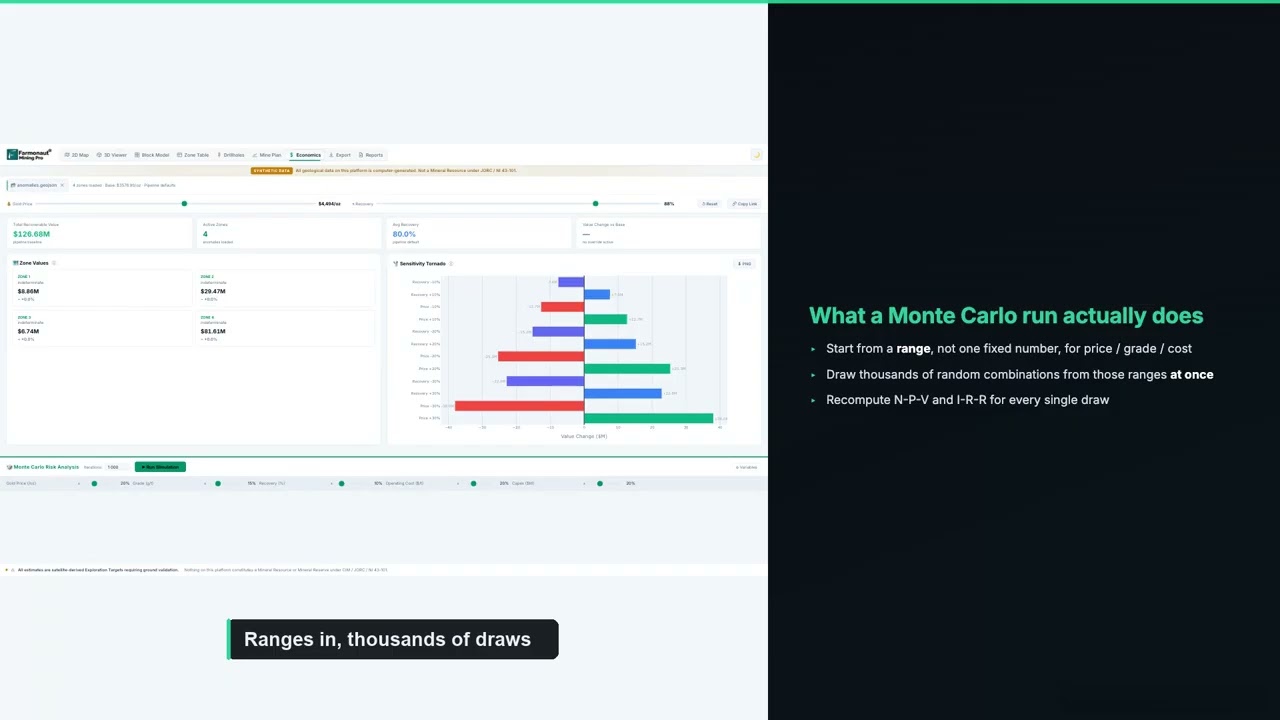
▶ Farmonaut Mining Pro course chapter on Monte Carlo P10/P50/P90: how price, grade and cost uncertainty combine into a range of outcomes. · 14:59
How to check a yttrium price quote before you rely on it
- Write down the product. Oxide or metal? What purity (3N, 4N, 5N)? Powder, ingot, or sputtering target?
- Write down the delivery terms. FOB China, CIF Europe, ex-warehouse Rotterdam and delivered to works are all different prices.
- Write down the date and the source. A price quote on a trading website without a date is not a quote.
- Check licensing. A cheap offer for material that still needs a Chinese export licence is not a real offer to a buyer outside China.
- Compare at least three firm offers. Lifton’s guidance is to get three offers against the same specification and normalise freight, duties and recoverable taxes.
- Separate trades from asking prices. Reporting agencies base their assessments on transactions, bids, offers and judgement.
If you are an investor reading price headlines, apply the same test. An article that says “yttrium up 4,400%” refers to a European oxide price over ten months. It does not mean yttrium metal in China, or the price a miner will receive for its concentrate. A related look at the long-term tonnage economics is in our guide to mining investments across metals.
Finding yttrium ground: what exploration needs
USGS reports yttrium only as part of rare-earth concentrates, so explorers target rare-earth deposits that carry it. Explorers look for heavy rare-earth minerals in a few settings: xenotime-bearing rocks and placers, carbonatites, weathered ion-adsorption clays, and uranium or phosphate ores that carry rare earths. Satellite imagery can narrow the search area by mapping alteration, structure, regolith and drainage over a licence, but it cannot measure the yttrium content of the ground. Only sampling and assays do that. The output is a ranked set of exploration targets, not a resource estimate. Check local licence and land-access rules before any fieldwork, and follow safety rules when you prospect.
Farmonaut’s satellite-based mineral detection turns a licence boundary into mapped targets that a field team can check; the stated range for early-exploration cost reduction is up to 80 to 85%, with results in 5 to 20 business days. If you hold a licence and want a quote, use the mining query form or contact the team.

▶ Farmonaut video on what AI does in mineral exploration, where it fails, and how to check any claim. · 4:37
What could move the yttrium price next
We do not forecast prices. We list what to watch, each of which can be checked.
- Licence policy. USGS reports that China began issuing general export licences to selected exporters from late 2025. A wider rollout would narrow the gap between Chinese and European quotes. A halt would widen it.
- Published assessments. The Argus and Fastmarkets European oxide assessments, and the Shanghai Metal Market public table, give a dated read every week or day.
- Customs data. Monthly Chinese export tonnage for yttrium shows whether volumes are rising from the 2025 low. The Oregon Group reported them still down about 50% as of June 2026.
- Non-Chinese separation capacity. USGS says there is no fully commercial yttrium separation in the United States. New heavy rare-earth separation plants elsewhere would add supply, but their start dates are the company’s targets, not facts, until output is reported.
- Demand shifts. Aerospace and semiconductor buyers can hold more stock, qualify second sources or change coating specifications, but each takes months to years.
The wider rare-earth price picture, including neodymium and praseodymium, is a separate market with its own drivers. It is covered in our companion pages, such as rare-earth price trends.
For a closer look at a related question, see our guide: Price of Lithium per Ton and Copper: Chart and Drivers.
Frequently asked questions
What is the price of yttrium metal per kilogram?
The USGS average for 99.9% yttrium metal in 2025 was US$40 per kilogram, FOB China (USGS, 2026). The Shanghai Metal Market listed metal at US$34.21 to US$35.52 per kilogram on 9 September 2026, delivered to works in China. We did not find a public outside-China quote for the metal.
How much is yttrium worth per ton?
Multiply the kilogram price by 1,000. At the Shanghai oxide quote of about US$7.76 per kilogram on 10 September 2026, a tonne of oxide is about US$7,760. At the metal average of US$40 per kilogram, a tonne of metal is US$40,000. At the roughly US$1,100 per kilogram reported outside China in May 2026, a tonne would be about US$1.1 million, but that figure is for small urgent lots.
Why is yttrium so expensive outside China?
Because China controls most supply and requires export licences. USGS says China produced most of the world’s yttrium in 2025, and that nearly all imports of yttrium metal and compounds came from concentrates processed in China. The licences slowed exports, and buyers outside China competed for the limited volume that cleared.
Is yttrium really a rare earth?
Yes. Geoscience Australia lists yttrium (Y) among the 16 rare earth elements, and it is found with the others in monazite and xenotime. It is not a lanthanide, but it behaves like the heavy ones.
Why did yttrium prices jump?
China tightened export controls on yttrium and six other heavy rare earths in April 2025. By November 2025, Argus data cited by Reuters had European yttrium oxide at US$270 per kilogram, up 4,400% since January, while Chinese prices stayed near US$7.
Which is the price to use for my project model?
Use the price your product will actually receive: a Chinese domestic price if you sell in China, or a negotiated offtake price outside it. Run a low, mid and high case. Avoid using the highest reported ex-China spot figure as a long-term assumption.
What is yttrium used for?
USGS lists ceramics and phosphors as the leading uses, followed by fibre optics, optical glass, pigments and YAG laser crystals. Reuters adds aerospace and gas-turbine coatings and semiconductor equipment.
Where is yttrium mined?
USGS says China produced most of the world’s yttrium in 2025 and that Burma produced a significant share. In the United States, the Mountain Pass mine in California is the primary rare-earth source, with yttrium making up about 0.12% of the rare earths in its ore, and there were no fully commercial separation facilities for yttrium.
Can you invest in yttrium directly?
We found no public exchange benchmark for yttrium in the sources we checked. Prices come from reporting agencies and trade quotes. Companies with yttrium exposure typically hold broader rare-earth assets. This page does not recommend any security.
Does China still sell yttrium to the United States?
China exported about 1,600 tonnes of yttrium compounds and metal in 2025 (oxide equivalent), and the United States was the third-largest destination, behind Japan and South Korea (USGS, 2026). Reuters customs data through September 2025 showed shipments to the US had stopped after the April controls. USGS says China began issuing general licences to selected exporters, so flows depend on who holds a licence.
How often should I update a yttrium price check?
At least monthly while the export licence regime is unsettled. Weekly assessments exist from Fastmarkets and Argus, and the Shanghai Metal Market table is public. Note the date on any number you store.
This page is for information only. It is not investment advice. Prices are dated reports from named sources, several are secondary, and none is an offer to trade.
Farmonaut mining
Map your own licence area from space
Farmonaut satellite exploration turns a licence boundary into ranked targets for a field team to check.

Mining Pro sample view, synthetic data
Keep reading
Sources
- USGS, Mineral Commodity Summaries 2026: Yttrium: pubs.usgs.gov
- USGS, Mineral Commodity Summaries 2026: Rare earths: pubs.usgs.gov
- USGS, Rare Earth Elements: Critical Resources for High Technology, Fact Sheet 2014-3078: pubs.usgs.gov
- Reuters via AJOT, A new rare earth crisis is brewing as yttrium shortages spread (18 Nov 2025): ajot.com
- The Oregon Group, Rare Earth prices surge as China keeps export restrictions (10 Jun 2026): theoregongroup.com
- InvestorNews (Jack Lifton), The Real Price of Yttrium Is the Price at Which It Can Be Delivered (11 Sep 2026): investornews.com
- Fastmarkets, Yttrium oxide 99.999% ex-whs Rotterdam $/kg (MB-RAE-0009): fastmarkets.com
- Octopart / Altium, The Yttrium Shock (9 Apr 2026): resources.altium.com
- Iluka Resources, quarterly report to 30 June 2026 (ASX, 28 Jul 2026): announcements.asx.com.au
- Geoscience Australia, Critical minerals (rare earth element list): ga.gov.au
Discussion
Questions, corrections or field experience? Share them below. First-time comments are reviewed before they appear, and your email is never published.
No comments yet. Be the first to add a question or your experience.

 Omsri International FZE
 G.I.T.T.
 Jaunita Erss Ltd
 Almosi SARL
 SRK Consulting
 Berks Gold Limited
 Mwerezi Minerals Company Limited
 Mining SARL
 SenGold Invest SAS
 Sean Mining Limited
 NTS Group (Pty) Ltd
 Mine4Africa
 Lithspo Minerals Limited
 Tintina Mining Group
 Dalgety Minerals Pty Ltd

 Licence holder · Nigeria · Gold + lithium










