

Mining investment · Guide
Mining Investment: 7 Ways to Invest and Their Risks
Mining investment runs through seven routes, from producer shares to royalties and claims. This guide compares them, shows where exploration money went in 2025 by metal and region, and gives a pre-deal checklist.
Key takeaways
- Seven routes: producer shares, explorer shares, funds, royalties and streams, private placements, direct claim interests, and services; risk differs most between producers and explorers.
- Global exploration budgets were US$12.4 billion in 2025; gold took US$6.15 billion and copper US$3.27 billion, while lithium fell 46% (S&P Global, 2025 data).
- Grassroots exploration was only 21% of 2025 budgets, the lowest share in the S&P data set, while juniors raised US$21.43 billion.
- Fraser Institute’s 2025 survey ranks Nevada, Ontario and Saskatchewan as the top three of 68 jurisdictions; Nunavut ranks 43rd on policy.
- South Africa mined about 45% of the world’s chromite in 2025 (USGS estimate), so chrome investment is a concentrated bet.
In this article
- Ways to invest in mining compared
- How each mining investment route works
- Where mining investment money is going by metal
- Alaska mining investment outlook
- Canada mining investment and Nunavut
- Western Australia mining investment
- Mining investment in Europe
- Which jurisdictions mining executives rank highest
- Chrome mining investment: where the ore is
- Early-stage mining investment: how juniors raise money
- Mining technology investments
- Mining investment strategy: a checklist before you buy
- How satellite screening helps a mining investor
- Frequently asked questions
Mining investment means putting money into the companies, projects or cash flows that find, build and run mines. There are seven main routes: shares in producers, shares in explorers, exchange-traded funds, royalties and streams, private placements and flow-through shares, direct project or claim interests, and mining services and technology. They carry very different risk. A large producer pays out of current cash flow; an explorer can lose everything on one drill hole. This guide compares the routes, shows where exploration money is going by metal and region, and gives a checklist for any deal.
It is written for licence and claim owners, consultants and investors. It is general information, not advice, and it names no company as a recommendation. Spot gold was quoted at US$4,127.40 an ounce on Kitco at 3:14 a.m. ET on 5 November 2026, and the LME copper cash settlement was US$14,201 a tonne on 4 November 2026. Prices move daily, so use them as a dated reference only.
Ways to invest in mining compared
The table sets the seven routes side by side. “Cash flow” means the business already sells metal; “discovery risk” means the value depends on finding or proving a deposit.
| Route | What you own | Main driver of return | Main risk |
|---|---|---|---|
| Shares in producers | Part of a company that runs mines | Metal price, grade, costs, output | Cost inflation, a mine stoppage, a falling metal price |
| Shares in explorers (juniors) | Part of a company with claims but no mine | Drill results, studies, takeover interest | Discovery risk, share dilution, running out of cash |
| Exchange-traded funds | A basket of mining shares or a metal | Sector or metal price | Sector swings, fund fees, holdings you did not pick |
| Royalties and streams | A right to a share of revenue or metal from a mine | Mine output and price, no operating costs | Mine operator decisions, long wait for new deals |
| Private placements and flow-through shares | Newly issued shares in a small company | Exploration success, tax treatment where it applies | Resale limits, dilution, loss of the whole stake |
| Direct project or claim interest | A title or a share in a project company | Selling or developing the ground | Title, permits, funding calls, no easy exit |
| Mining services and technology | A business that sells to miners | Mine spending and contracts | Customer concentration, budget cuts when prices fall |
No route is “best” for everyone. A reader who wants steady cash flow looks at producers and royalties. A reader who accepts a high chance of loss for a chance of a large gain looks at explorers. A claim owner thinking of raising money or selling ground sits on the other side of these deals, so it helps to know what each buyer checks.
How each mining investment route works
Shares in producing mining companies
A producer owns mines that already sell metal. Its results depend on the metal price, the grade of ore, and all-in sustaining cost (AISC), the cost to keep a mine running and replace what is mined, quoted per ounce for gold. A mine with a low AISC makes money at a lower metal price. Large producers also pay dividends in some years, but a dividend is a choice by the board and can be cut.
Compare producers on cost per ounce or per tonne, mine life, the share of output from one asset, and debt. A company with one mine in one country carries the risk of that mine and that government. Company details change often, so check the latest filing before you rely on any figure. Companies that have mining as a material part of their business must report resources and reserves to the US Securities and Exchange Commission (SEC) under rules explained in the due diligence section below.
Shares in exploration and development companies
An explorer, often called a junior, holds mineral claims and spends money drilling and testing them. It has no mine and no sales. A resource is a body of mineralised rock with reasonable prospects of economic extraction; a reserve is the part of it that studies show can be mined at a profit. Most explorers never reach a reserve. The few that do can rise many times in value, which is why the group attracts speculators.
The money is tight for this group. S&P Global Market Intelligence reported that junior exploration budgets fell 13% to US$4.39 billion in 2025, even as the wider financing market improved. An explorer with cash for the next technical milestone can keep drilling after a poor hole. One that must raise money at a low share price dilutes its owners. The early-stage section below shows the arithmetic.
Mining exchange-traded funds
An exchange-traded fund (ETF) holds a basket of assets and trades on an exchange like a share. Mining ETFs fall into groups: gold miners, junior gold miners, copper miners, uranium, lithium and broad metals and mining. Each charges a yearly expense ratio and each follows its own index rules, so two funds with similar names can hold very different companies. Read the fund’s fact sheet for its index, top holdings, expense ratio and the date of the data before comparing. A fund spreads company risk but not metal-price risk: a gold miners fund still falls when gold falls, and often falls faster.
Royalties and streams
A royalty is a right to a share of a mine’s revenue or output, paid by the operator, with no share of the operating cost. A stream is a contract to buy a set share of a mine’s metal at a fixed low price in return for money paid up front. Both help mine owners fund construction without selling new shares. For the holder they offer exposure to price and output with fewer cost risks.
Franco-Nevada, a Toronto-based royalty company, reported record 2025 revenue of US$1,822.8 million from 519,106 gold equivalent ounces (GEOs) sold, up 64% in revenue on 2024, and said it had no debt. A gold equivalent ounce converts other metals into ounces of gold at set prices. A royalty has smaller operating risk, but it can still lose value if a mine closes or its operator cuts output. Royalties also exist at project level: Agnico Eagle pays a net-profits royalty to Nunavut Tunngavik Inc. on its Amaruq mine. Our guide on how royalty owners are valued is a separate topic; this page only places royalties in the wider set of routes.
Private placements and flow-through shares
A private placement sells new shares to selected investors outside the open market. Buyers often get shares or units with warrants, at a price that can sit below the market, but the shares are usually locked for a period before resale. In Canada, a flow-through share lets an exploration company pass certain exploration expenses to the investor for tax purposes. The federal Critical Mineral Exploration Tax Credit equals 30% of specified mineral exploration expenses renounced to flow-through share investors, and the 2025 federal budget proposed adding chromium, manganese, molybdenum, tin and tungsten to the list of eligible critical minerals, for agreements signed on or before 31 March 2027. Tax rules differ by country and by person, so a tax adviser must confirm what applies to you.
Direct project and claim interests
You can also buy a claim, a licence or a share in a project company. The return comes from selling the ground, joining with an operator, or funding development. There is no market to trade on, so exit is slow. Title, permits, access, and the rules on foreign ownership decide whether the interest is worth anything. The gold-focused companion to this page covers how to invest in a gold mine directly, including the steps for a small owner.
Mining services and technology
Drilling contractors, assay laboratories, equipment makers, software and data firms earn from mine spending, not from the metal price directly. Their sales follow the same cycle: when exploration budgets fall, drilling and consulting work falls too. Check how much revenue comes from one customer and how much from exploration versus operating mines. The section on technology below covers where artificial intelligence and satellite data fit.
Where mining investment money is going by metal
Exploration spending shows where companies expect value. S&P Global reported that global exploration budgets slipped 1% to US$12.4 billion in 2025, the third yearly fall since a US$13.1 billion peak in 2022. Gold took half of it: gold budgets rose 11% to US$6.15 billion and copper budgets rose 2% to US$3.27 billion, a 12-year high. Battery metals fell: lithium budgets dropped 46% to US$595 million, nickel 37% to US$332 million and cobalt 41% to US$31 million.
Chart
Exploration budgets by metal in 2025
US$ billion, global budgets
Two other numbers matter for anyone buying explorers. Spending at and around existing mines rose 13% to a record US$5.63 billion, 45% of the total. Grassroots exploration, the search for new deposits, fell 8% to US$2.57 billion, only 21% of budgets, the lowest share in the data set. Junior and intermediate miners raised US$21.43 billion in 2025, up 109%, so funding rose while discovery spending fell. Capital went to building mines, not to finding new ones.
Metal prices set the mood. The USGS puts the average gold price at US$1,801 an ounce in 2021 and an estimated US$3,300 in 2025, and the average London Metal Exchange copper price at 422.5 US cents a pound in 2021 and an estimated 440 in 2025. The same report says Nevada produced about 64% of US gold and Alaska about 22% in 2025.
Alaska mining investment outlook
Alaska has large gold operations and many placer mines. The USGS reports that Alaska produced about 22% of US gold in 2025, behind Nevada at about 64%, with several large placer mines in Alaska and numerous smaller ones. The Alaska Division of Geological & Geophysical Surveys states that Alaska’s mines produced metal worth about US$4 billion in 2024, roughly 12% of US metal production.
Chart
Average gold price, 2021 to 2025
US$ per troy ounce, annual average (2025 estimate)
For an investor the questions are practical. Is the project near a road, a port or power? Is it on state, federal, Native corporation or private land? Which claims are state mining claims and which are federal? Remote ground costs more to explore and build, and a short field season limits drilling. Our guide to Alaska mining companies, operators and output by mine lists the working operations if you want names and assets.
Canada mining investment and Nunavut
Canada runs one of the most closely tracked exploration markets. Natural Resources Canada’s bulletin reports that exploration and deposit appraisal spending was a preliminary C$4.4 billion in 2025, up 4%, with companies planning C$5.3 billion for 2026. Ontario led in 2025 with C$1.08 billion, ahead of Quebec at C$955 million and Saskatchewan at C$711 million. Precious metals took 50% of the total and uranium rose 20% to C$458 million.
Chart
Canadian exploration spending by metal group
C$ billion, 2025 preliminary versus 2026 company intentions
Nunavut is a remote Arctic territory where logistics add cost. NRCan lists a 2026 spending intention of C$268 million for Nunavut. Agnico Eagle (NYSE and TSX: AEM) runs the Meliadine and Meadowbank gold operations there and approved the Hope Bay project on 19 May 2026. The preliminary economic assessment contemplates an underground mine with a 6,000 tonne-a-day plant, annual gold production of 400,000 to 435,000 ounces over an 11-year initial life, and initial capital of about US$2.4 billion. The plan includes inferred resources, and the company states there is no certainty the forecast output will be realised. Treat it as a study, not a reserve.
The Fraser Institute’s 2025 survey shows the policy gap in the north. Nunavut ranks 17th for mineral potential but 43rd when only policy factors are counted, and it placed 8th among Canadian jurisdictions. Yukon ranked 11th for potential and 47th on policy. Geology is good; permitting and land access carry the doubt. Our Canada mineral deposits map shows where each metal is mined.
Western Australia mining investment
Western Australia is the larger-scale case. The state government’s 2024-25 statistics digest reports A$220 billion of mineral and petroleum sales, A$122 billion of iron ore, and record gold sales of A$29 billion from 6.7 million ounces. Mineral exploration spending was A$2.57 billion, the sector employed 138,257 full-time equivalent people on site in mining and exploration, and royalties and related grants reached A$10.6 billion.
That scale suits investors who want listed producers and service firms with a stable regulator, a long history of project approvals, and well-known infrastructure. For smaller explorers the state’s open data on titles and geology helps screening. The Fraser survey places Western Australia sixth in the world on its 2025 investment index, behind Nevada, Ontario, Saskatchewan, South Australia and Arizona.
Mining investment in Europe
Europe has less mining than other regions, but policy is changing it. In March 2025 the European Commission selected 47 strategic projects in 13 member states under the Critical Raw Materials Act, needing about €22.5 billion of capital. The list has 25 extraction, 24 processing, 10 recycling and 2 substitution projects, with lithium in 22 of them, nickel in 12, graphite in 11 and cobalt in 10, since some projects cover more than one material. Strategic status aims at permitting in no more than 27 months for extraction projects and 15 months for other projects, against a typical five to ten years today. The Act’s 2030 targets are 10% of EU demand from EU extraction, 40% from processing and 25% from recycling.
The risks are different from other regions. Local opposition, protected-area rules and water permits slow projects, and metal prices for battery materials have been weak. Our guide to lithium mining in Europe ranks the projects by stage. Norway and Sweden both sit in the top ten of the Fraser Institute’s 2025 survey, which points to a good record on policy in the Nordic countries.
Which jurisdictions mining executives rank highest
Fraser Institute’s annual survey asks mining executives and managers where they would invest. The 2025 edition covered 68 jurisdictions, down from 82 the year before, and had about 256 respondents who answered between 5 August and 26 November 2025. Its top ten on the investment attractiveness index were Nevada, Ontario, Saskatchewan, South Australia, Arizona, Western Australia, Botswana, Norway, Sweden and Saudi Arabia. The index blends mineral potential with policy perception. It is an opinion survey, not a measure of returns, and a jurisdiction needs at least five responses to be included.
Use it as a first filter. A place that ranks high on both potential and policy has fewer surprises. A place with high potential and low policy scores, such as the Canadian territories, may offer cheaper ground and a harder road to permits.
Chrome mining investment: where the ore is
Chromite is the ore of chromium, used mainly to make ferrochrome for stainless steel. Supply is concentrated. The USGS estimates world chromite mine production of 51 million tonnes in 2025, of which South Africa mined 23 million, Turkey 9 million and Kazakhstan 7 million. That puts South Africa at about 45% of world output. The same table shows 2025 estimates of 2 million tonnes each for Brazil and Zimbabwe and 1.9 million for Finland. The USGS also says about 95% of world chromium resources lie in Kazakhstan and southern Africa.
Chart
World chromite mine production, 2025 estimate
Million tonnes of ore, selected countries only
The price tells an investor how the market looks. USGS annual averages for chromite ore (gross weight) were US$331 a tonne in 2024 and an estimated US$290 in 2025, and for ferrochromium US$1.76 and US$1.60 a pound of chromium content. A falling price squeezes smaller producers first. The United States has no chromium mine production and relied on imports for an estimated 79% of its apparent consumption in 2025. For explorers, Canada’s proposed addition of chromium to its critical minerals tax credit list may help funding for chromite projects there; check the final law.
Chromite assets sit mainly in the Bushveld and Kazakhstan, with exploration in Finland, Brazil and Canada. Ask where the smelter is, how the ore is railed, and what power costs. Chromite is bulky and low in value per tonne, so logistics decide the margin.
Early-stage mining investment: how juniors raise money
An early-stage company sells shares to pay for each drilling season. Each raise adds new shares, so the percentage you own falls unless you buy more. The usual path is: claim staking, mapping and sampling, a first drilling programme, a maiden resource estimate, then a preliminary economic assessment. Money comes from public offerings, private placements with warrants and, in Canada, flow-through shares.
Two numbers help you judge a raise. Runway is the months of spending that cash can cover: unrestricted cash minus committed bills and a safety reserve, divided by the monthly burn. Dilution is the share of the company that new buyers take. The calculator below works both out on your own numbers.
Crux Investor, summarising S&P data, notes why selection matters. Major miners are buying early-stage ground, taking equity stakes and funding exploration through earn-ins to replace depleted reserves. A junior with a funded partner, a clear drilling plan and enough cash for the next result is in a different position from one that must raise on bad news.
Calculator
How long does an explorer’s cash last, and how much will a raise dilute me?
Enter the company’s own numbers from its latest filing.
- Runway after the raise (months): 30.0
- New shares issued (millions): 10.0
- Dilution of existing owners (%): 7.7
Example values only, not a forecast or a company. Runway = (cash minus committed bills) divided by monthly burn. Dilution = new shares divided by total shares after the raise. Share counts in millions; amounts in US$ million; share price in US$ (example, use today’s price).
Mining technology investments
Technology spending in mining covers drilling tools, sensors, fleet software, data platforms and exploration analytics. The key question is whether a tool changes a decision that costs money: where to drill, which target to drop, whether to buy a claim. Ask for a test you can check. For satellite and data tools, that means a prediction made before drilling and compared with the result after it.
Investors who buy technology companies should check the same things as in any other business: revenue, customer concentration, contract length and how much sales depend on exploration budgets, which fell for three years to 2025. Satellite imagery can screen large areas for iron-oxide staining, clay minerals and structure at low cost. It points to targets and does not prove a deposit, and it does not replace drilling.
▶ What an AI mining app does, which jobs it can do and who makes one · 3:52
Mining investment strategy: a checklist before you buy
Start with the stage, because it sets the risk. Then work down the list: metal and price case, jurisdiction, title and permits, resource category, costs, funding, people and exit. Write down what would make you walk away before you look at the share price.
Infographic
Check a mining deal in 5 steps
- 1Name the stageProducer, developer, explorer or royalty holder.
- 2Check the groundTitle, permits and land access with the regulator.
- 3Read the technical reportWho is the qualified person and which resource class is stated.
- 4Test the moneyCash, burn rate, debt, and who funds the next step.
- 5Set your exitKnow how you would sell and what loss you can accept.
- Stage. Producer, developer, explorer or royalty holder. Each fails in a different way.
- Disclosure. Under the SEC’s mining rules, resource and reserve statements must rely on a qualified person with at least five years of relevant experience, and a dated, signed technical report summary is filed when reserves or resources are first disclosed. For resources the report is an initial assessment; for reserves it is a pre-feasibility or feasibility study. Inferred resources have the lowest confidence of the three resource classes.
- Jurisdiction. Read the policy score, not only the geology. Check royalty rates, tax changes and permitting times.
- Title. Who holds the claims, and are fees paid? Is there an option or a royalty on the ground that takes part of the value?
- Costs. For a producer, AISC and mine life. For a developer, capital cost and funding gap.
- Funding. Cash, burn rate and runway, and who owns the largest blocks of shares.
- Exit. A listed share can be sold in a day; a claim interest may take a year.
Mining shares can lose all of their value, so only money you can afford to lose should be exposed to them. Most explorers do not become mines. Shares in small companies can also be promoted hard; treat any message that pushes a quick purchase as a warning sign.
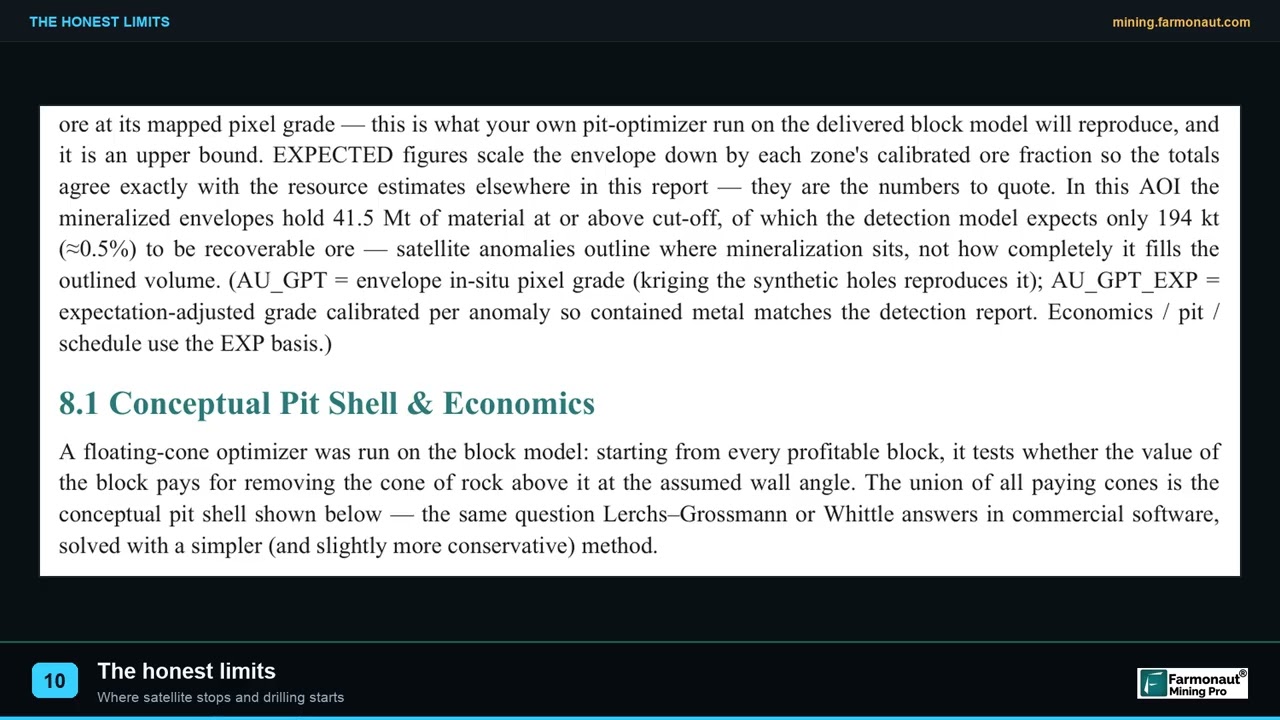
▶ The three limits of satellite exploration that matter in mining due diligence · 2:08
How satellite screening helps a mining investor
Before buying a claim or a stake in a project, you can screen the ground from space. Multispectral and radar data show alteration, rock type, structure and land use such as settlements, farmland or water, which can block a mine even if the rock is good. A report that maps targets ahead of drilling helps an owner decide where to spend the first dollar, and helps a buyer test a seller’s claims. Farmonaut’s satellite mineral detection gives exploration targets, not a mineral resource or reserve, and it does not replace drilling. A licence owner who wants a report on a boundary can request a quote.
Frequently asked questions
What is mining investment?
It is putting money into companies, projects or cash flows linked to mines. The main routes are shares, funds, royalties and streams, private placements, direct project interests, and services to miners. Each has a different mix of cash flow, discovery risk and liquidity.
What are the best mining investment opportunities right now?
No list stays “best” for long, and this page does not recommend any company. The data shows where money is moving: gold took half of the US$12.4 billion global exploration budget in 2025 and copper budgets hit a 12-year high, while lithium, nickel and cobalt budgets fell. Opportunities depend on your risk limit, time frame and country.
Is mining a good investment?
It can be, but it is cyclical. Returns follow metal prices, costs and the stage of the company. Producers carry cost and price risk; explorers carry discovery risk and can lose the whole stake. Our guide on margins and AISC by metal shows how profit differs between mines.
How do I start investing in mining stocks?
Open a brokerage account that offers the exchanges where the shares trade, read the company’s latest filing for assets, cash and debt, and compare it to others at the same stage. Many investors set a loss limit before they buy. This is not investment advice.
What is the difference between a mining stock and a mining ETF?
A stock is part of one company. An ETF holds many, so it spreads company risk but still follows the metal or sector. Read the fund’s index, holdings and expense ratio.
What is early-stage mining investment?
It means buying shares or units in companies that hold claims but have no mine. They raise money in stages, so dilution and runway matter. Many early-stage companies use private placements and, in Canada, flow-through shares.
Is chrome mining a good investment?
Chromite supply is concentrated: South Africa mined about 45% of the world’s 2025 estimated output according to the USGS. Prices for ore and ferrochromium fell from 2024 to 2025. Margins depend on logistics, power and stainless steel demand.
Which countries are best for mining investment?
The Fraser Institute’s 2025 survey ranks Nevada first, then Ontario and Saskatchewan, among 68 jurisdictions. The index mixes mineral potential and policy. It reflects executive opinion, not returns, so read the policy score alongside the geology.
Is there mining investment in Europe?
Yes. The EU has 47 strategic projects in 13 member states under the Critical Raw Materials Act, covering lithium, graphite, nickel, cobalt and more, with a stated capital need of about €22.5 billion. Permitting and local opposition are the main hurdles.
How much do mining investment returns vary?
A lot. A cash-paying royalty holder may earn a steady yield; an explorer may return nothing or many times the stake. The USGS average gold price rose from US$1,801 an ounce in 2021 to an estimated US$3,300 in 2025, which lifted producers, yet explorers faced falling budgets over the same time.
How can I check a mining project before I invest?
Read the technical report, check who the qualified person is, confirm title and permits with the regulator, and compare the stated costs with similar mines. A satellite screen of the ground can add a check on alteration and land use before drilling.
This page is for information only. It is not investment, financial, legal or tax advice, and it does not recommend any company, fund or security. Mining shares can lose all of their value. The calculator is arithmetic on your own inputs. Satellite results are exploration targets, not mineral resources or reserves.
Farmonaut mining
Screen a project area before you commit money
Request a quote for a satellite mineral-detection report on a licence boundary, so you can test the ground before you invest.

Mining Pro sample view, synthetic data
Keep reading
Sources
- Agnico Eagle, Hope Bay investment decision release (19 May 2026), via Finviz: finviz.com
- USGS, Mineral Commodity Summaries 2026: Gold: pubs.usgs.gov
- USGS, Mineral Commodity Summaries 2026: Chromium: pubs.usgs.gov
- USGS, Mineral Commodity Summaries 2026: Copper: pubs.usgs.gov
- BusinessDay, S&P Global World Exploration Trends coverage (9 April 2026): businessday.co.za
- Crux Investor, Shrinking exploration budgets (20 October 2026): cruxinvestor.com
- Natural Resources Canada, Canadian Mineral Exploration Information Bulletin (April 2026): natural-resources.canada.ca
- BNN Bloomberg, Fraser Institute 2025 survey coverage (26 February 2026): bnnbloomberg.ca
- Government of Western Australia, Statistics Digest 2024-25: wa.gov.au
- Alaska DGGS, Alaska minerals publications: dggs.alaska.gov
- Global Mining Review, European Commission selects 47 strategic projects (27 March 2025): globalminingreview.com
- Lavery, Federal Budget of 4 November 2025: critical minerals exploration tax credit: lavery.ca
- SEC, Modernization of Property Disclosures for Mining Registrants: Small Entity Compliance Guide: sec.gov
- Agnico Eagle, Q4 2025 results news release: s205.q4cdn.com
- Franco-Nevada, 2025 results (10 March 2026): placera.se
- Kitco, gold spot price (5 November 2026): kitco.com
- Westmetall, LME copper cash settlement (4 November 2026): westmetall.com
Discussion
Questions, corrections or field experience? Share them below. First-time comments are reviewed before they appear, and your email is never published.
No comments yet. Be the first to add a question or your experience.

 Jaunita Erss Ltd
 Almosi SARL
 SRK Consulting
 Berks Gold Limited
 Mwerezi Minerals Company Limited
 Mining SARL
 SenGold Invest SAS
 Sean Mining Limited
 NTS Group (Pty) Ltd
 Mine4Africa
 Lithspo Minerals Limited
 Tintina Mining Group
 Dalgety Minerals Pty Ltd
 Vortex Minerals Pty Ltd
 Faith At Work (Pty) Ltd

 Licence holder · Nigeria · Gold + lithium










