

Uranium · Price and cost guide
Uranium-235 Price per kg: Enriched Uranium Cost by Assay
Pure U-235 is not sold. Uranium enriched to 5% U-235 costs about US$3,500 per kg at the 30 October 2026 spot price (US$91.55/lb, Cameco) and the 2025 average SWU price (US$108.70, EIA), roughly US$70,000 per kg of U-235 contained.
Key takeaways
- U-235 is only sold inside enriched uranium; the price depends on the assay (the % U-235).
- 1 kg of 5% enriched uranium needs about 10.4 kg of natural uranium and 7.9 SWU at 0.25% tails (World Nuclear Association).
- At US$91.55/lb U3O8 (Cameco, 30 Oct 2026) and US$108.70/SWU (EIA, 2025 average), 5% product costs about US$3,500 per kg before fabrication.
- The cost per kg of U-235 contained rises only from about US$64,000 at 3% to about US$80,000 at 90%.
- Weapons-grade HEU is not traded; it reaches the market only after blending down, as under the 500-tonne Megatons to Megawatts deal (WNA).
In this article
- Uranium-235 price per kg: the short answer
- Why pure U-235 has no market price
- Enriched uranium price per kg by enrichment level
- How the price of enriched uranium is built
- What moves the U3O8 and SWU prices
- Spot versus contract: what utilities actually paid
- HALEU and highly enriched uranium: why they cost more
- How to estimate the cost of enriched uranium
- What this means for uranium miners and investors
- Frequently asked questions
Uranium-235 is not sold on its own, so there is no quoted “U-235 price”. What buyers pay for is enriched uranium. At the 30 October 2026 month-end spot price of US$91.55 per pound of U3O8 (Cameco, average of UxC and TradeTech) and the US$108.70 per SWU that US utilities paid on average for enrichment in 2025, one kilogram of uranium enriched to 5% U-235 costs about US$3,500 before it is made into fuel. That is roughly US$70,000 for each kilogram of U-235 the product contains.
This guide shows where that number comes from, how the price changes with the enrichment level, and gives a calculator so you can re-price it with today’s quotes.
Uranium-235 price per kg: the short answer
Three numbers decide the price of enriched uranium: the price of natural uranium (U3O8, also called yellowcake), the price of conversion (turning U3O8 into uranium hexafluoride gas, UF6), and the price of enrichment, sold in separative work units (SWU). A SWU is a measure of the work an enrichment plant does to raise the U-235 share of a batch of uranium.
Natural uranium holds only about 0.7% U-235; the rest is U-238 (World Nuclear Association, Uranium Enrichment). Most power reactors need 3% to 5%. To make 1 kg of 5% product with a tails assay of 0.25% (the U-235 left in the depleted stream) the plant needs about 10.4 kg of natural uranium and 7.9 SWU, according to the same WNA page.
- Natural uranium: US$91.55 per lb U3O8 is about US$202 per kg of U3O8, or about US$238 per kg of uranium metal (U3O8 is 84.8% uranium by weight).
- Low-enriched uranium (LEU) at 5%: about US$3,500 per kg of uranium, at the prices above and US$16 per kgU conversion.
- U-235 contained in that LEU: about US$70,000 per kg.
- Weapons-grade highly enriched uranium (HEU): not traded. It is held by governments and only enters the civil market after it is blended down to LEU.
If you need the price of ordinary uranium rather than the enriched isotope, see our guide to the uranium price per kg in US dollars, and for daily market quotes our page on current uranium prices.
Why pure U-235 has no market price
U-235 and U-238 are chemically the same element. They differ only in mass, by about 1%, so they cannot be split apart by chemistry. Enrichment plants use thousands of spinning centrifuges to shift the ratio a little at a time. Nobody produces a kilogram of pure U-235: the product is always a uranium mix with a stated U-235 share, called the assay.
Uranium is also a controlled nuclear material. Sales are made under private contracts between utilities, miners, converters and enrichers, inside national licences and international safeguards. Even natural uranium “does not trade on an open market”, as Cameco puts it; published prices come from price-reporting firms that survey deals. Enriched product is sold as “enriched uranium product” (EUP) or, more often, a utility supplies its own natural uranium and buys the SWU and conversion as separate services.
So when people search for the price of uranium-235 per kg, the useful answer is either the price per kg of enriched uranium at a given assay, or that price divided by the U-235 share, which gives a cost per kg of contained U-235. Both are shown below.
Enriched uranium price per kg by enrichment level
The table uses the standard enrichment formulas with natural feed at 0.711% U-235 and a 0.25% tails assay. Prices: U3O8 at US$91.55/lb (Cameco month-end, 30 October 2026), conversion at US$16/kgU (WNA example, September 2021) and enrichment at US$108.70/SWU (EIA, average paid by US reactor owners in 2025). Our feed and SWU figures closely match the WNA worked example for 5% (WNA: 10.4 kg feed and 7.9 SWU; our table: 10.3 kg and 7.9 SWU). Fabrication into fuel pellets and assemblies is not included.
Chart
Cost of 1 kg of enriched uranium by assay
US$ per kg of uranium, before fabrication; 0.25% tails
| Product (% U-235) | Use | Natural U feed (kg) | SWU | Cost per kg (US$) | Per kg of U-235 contained (US$) |
|---|---|---|---|---|---|
| 3% | Older light-water reactor reloads | 6.0 | 3.8 | 1,930 | 64,300 |
| 4% | Typical PWR/BWR fuel | 8.1 | 5.8 | 2,700 | 67,500 |
| 5% | Upper limit for most power reactors | 10.3 | 7.9 | 3,480 | 69,600 |
| 10% | HALEU (some advanced designs) | 21.2 | 18.9 | 7,420 | 74,200 |
| 19.75% | HALEU (top of civil range) | 42.3 | 41.0 | 15,200 | 77,000 |
| 90% | Weapons-grade HEU (not sold) | 194.7 | 208.0 | 72,100 | 80,100 |
Two things stand out. First, cost per kg rises almost in line with the assay, because each extra percent of U-235 needs more natural feed and more SWU. Second, the cost per kg of U-235 contained only creeps up, from about US$64,000 at 3% to about US$80,000 at 90%. That is why the old claim of “US$95,000 to US$140,000 per kg for highly enriched uranium” made little sense: even 90% material, priced at civil feed and SWU rates, works out near US$72,000 per kg of uranium. In practice HEU is never priced this way, because it is not offered for sale. The 90% row is arithmetic only.
The HALEU rows also understate real prices today. HALEU (5% to 20% U-235) is made in very small amounts; the US demonstration cascade run by Centrus had produced just over 1,900 kg by June 2026 (WNA). Contract prices for such small, specialised volumes are not published.
How the price of enriched uranium is built
Each step in the front end of the fuel cycle adds cost. The WNA prices one kilogram of reactor fuel this way (prices approximate, September 2021):
Infographic
From ore to enriched uranium in 4 steps
- 1Mine and millOre is processed into U3O8 concentrate.
- 2ConvertU3O8 is turned into UF6 gas.
- 3EnrichCentrifuges raise the U-235 share, priced in SWU.
- 4FabricateEnriched uranium becomes pellets and fuel assemblies.
- Mining and milling: ore is mined (open pit, underground or in-situ leaching) and processed into U3O8. WNA example: 8.9 kg U3O8 at US$94.6 per kg = US$842, or 51% of the cost.
- Conversion: U3O8 becomes UF6 gas. 7.5 kg U at US$16 = US$120 (7%).
- Enrichment: centrifuges raise the U-235 share. 7.3 SWU at US$55 = US$401 (24%).
- Fabrication: the enriched UF6 is turned into UO2 pellets, rods and assemblies, about US$300 per kg (18%).
The total was US$1,663 per kg of fuel (WNA, Economics of Nuclear Power). Since then both the uranium and the SWU price have roughly doubled, so the same kilogram costs much more today. Uranium is still the biggest single input, which is why the price of mined yellowcake matters so much to anyone pricing U-235.
There is also a trade-off between the two main inputs. A lower tails assay squeezes more U-235 out of each kilogram of feed, so it needs less natural uranium but more SWU. WNA’s example: 5% product needs 10.4 kg feed and 7.9 SWU at 0.25% tails, but 9.4 kg feed and 8.9 SWU at 0.20% tails. When uranium is dear and SWU is cheap, enrichers “underfeed” (run lower tails); when SWU is dear, they do the opposite.
What moves the U3O8 and SWU prices
The spot price of U3O8 rose from US$75.80 per lb at the end of November 2025 to US$91.55 at the end of October 2026, while the long-term contract price climbed steadily from US$85.00 to US$98.00 over the year to October 2026 (Cameco month-end data). US uranium futures were above US$91 per lb in early November 2026, the highest since February (Trading Economics, 10 November 2026).
Chart
Uranium spot and long-term price, month-end
US$ per pound U3O8, October 2025 to October 2026
The main drivers are:
- Reactor demand: new builds, reactor life extensions and power deals for data centres raise the fuel that utilities must contract years ahead.
- Mine supply: a few countries and companies dominate output, so a missed target at one large mine shifts the market. See our map of uranium deposits for where supply comes from.
- Enrichment capacity and trade rules: world capacity was about 68 million SWU per year in 2025, with Rosatom the largest operator at about 29 million (WNA). Since 2022 Western utilities have tried to diversify away from Russian supply, which has split the market and raised SWU prices for non-Russian enrichment.
- New Western capacity: Urenco is adding 700,000 SWU per year at its New Mexico plant (the sixth of eight new cascades started in October 2026) and Orano is expanding Georges Besse II in France by 2.5 million SWU, with first new modules expected in 2028 (WNA).
- Inventories and secondary supply: stockpiles held by utilities and governments, and down-blended military material, can stand in for new mine output.

▶ A short clay-animation explainer on uranium in Zimbabwe and across Africa. · 4:27
Spot versus contract: what utilities actually paid
Most uranium is bought under long-term contracts, so the spot price is a poor guide to what a reactor operator pays. In 2025, owners and operators of US reactors paid a weighted average of US$58.46 per lb of U3O8: 87% of deliveries came under long-term contracts at US$55.91, and only 13% at spot at US$76.01 (EIA, Uranium Marketing Annual Report, released 29 July 2026).
The same report shows they bought 13 million SWU in 2025 at an average US$108.70 per SWU, up 11% from 2024. About 77% of that enrichment was of foreign origin, with Russia supplying 26%, France 18% and the United Kingdom 14% (American Nuclear Society summary of the EIA data). Price reporters such as UxC and TradeTech publish separate spot and long-term SWU indicators for subscribers; the long-term figure reflects multi-year offers.
For anyone estimating the value of enriched uranium, this means two prices can be right at once: a contract-weighted figure (what was paid for past deliveries) and a spot figure (what new uncontracted material would cost today). The calculator below lets you use either.
HALEU and highly enriched uranium: why they cost more
HALEU (high-assay low-enriched uranium) means 5% to 20% U-235. Several advanced and small modular reactor designs need it, as do some research reactors. Only Russia has sold it in volume. In the US, the Department of Energy awarded Centrus US$900 million in January 2026 towards commercial HALEU production at Piketon, Ohio, starting with 12 tonnes per year of capacity and first new output expected in 2029 (WNA). Until that capacity exists, HALEU is scarce, and its price will sit well above the formula cost in the table.
Chart
Cost per kg of U-235 contained, by assay
US$ thousand per kg of U-235, formula cost at civil prices
Highly enriched uranium (20% U-235 or more; weapons use needs at least 90%) is not a commercial product. US and Russian military stockpiles hold about 1,500 tonnes of HEU, roughly seven times one year of world mine production (WNA, Military Warheads as a Source of Nuclear Fuel). Under the 1993 “Megatons to Megawatts” deal, Russia converted 500 tonnes of weapons HEU into LEU bought by the USA for power reactors, under a US$13 billion implementing contract signed in 1994. That is how HEU reaches the market: blended down, and sold at LEU prices.
How to estimate the cost of enriched uranium
You can price any assay in five steps:
- Choose the product assay (for example 4.5% U-235) and the tails assay (0.20% to 0.30% is the usual range).
- Work out the natural uranium feed per kg of product: (product assay minus tails) divided by (0.711 minus tails).
- Look up the SWU per kg for that pair of assays (the table above gives common values; 7.9 SWU for 5% at 0.25% tails).
- Multiply feed by the uranium price per kgU plus the conversion price; multiply SWU by the SWU price.
- Add the two. Divide by the assay (as a fraction) for the cost per kg of U-235 contained.
Uranium price per kgU = price per lb U3O8 × 2.20462 ÷ 0.848. At US$91.55/lb that is about US$238 per kg of uranium.
Calculator
What does 1 kg of enriched uranium cost at my prices?
Enter your assays and today’s prices to price 1 kg of enriched uranium and the U-235 inside it.
- Natural uranium feed (kg): 10.30
- Uranium and conversion (US$): $2,617
- Enrichment (US$): $859
- Per kg of U-235 contained (US$): $69,520
Example values only, not a quote. Defaults: U3O8 US$91.55/lb (Cameco month-end, 30 Oct 2026), SWU US$108.70 (EIA, 2025 average paid by US reactor owners), conversion US$16/kgU (WNA, September 2021). Natural uranium is taken as 0.711% U-235 and U3O8 as 84.8% uranium. SWU per kg must match your assays: 3.8 for 3%, 5.8 for 4%, 7.9 for 5%, 18.9 for 10%, 41.0 for 19.75% (0.25% tails; WNA gives 7.9 for 5%). Prices are inputs: example, use today’s price. All money in US$.
What this means for uranium miners and investors
Mined uranium is the largest input to enriched uranium, so the value of a uranium deposit follows the U3O8 price rather than any “U-235 price”. For a licence holder or investor, the useful numbers are grade (usually given as % U3O8 or ppm), tonnage, recovery and the long-term contract price, not the price of enriched product. A deposit is valued on the U3O8 it can deliver; enrichment margins go to the enrichers.
Early exploration is where costs can be cut. Satellite imagery and radiometric and geological data can help rank parts of a large licence before ground surveys and drilling. Farmonaut’s satellite mineral detection service turns a licence outline (KML, KMZ or polygon) into ranked exploration targets, typically in 5 to 20 business days; these are targets that sit ahead of drilling and any resource estimate. Licence owners can send a mining query or contact the team for a quote.
For more on uranium values at small scale, see the price of 1 gram of uranium, and for the market benchmark see our explainer on the uranium spot price.
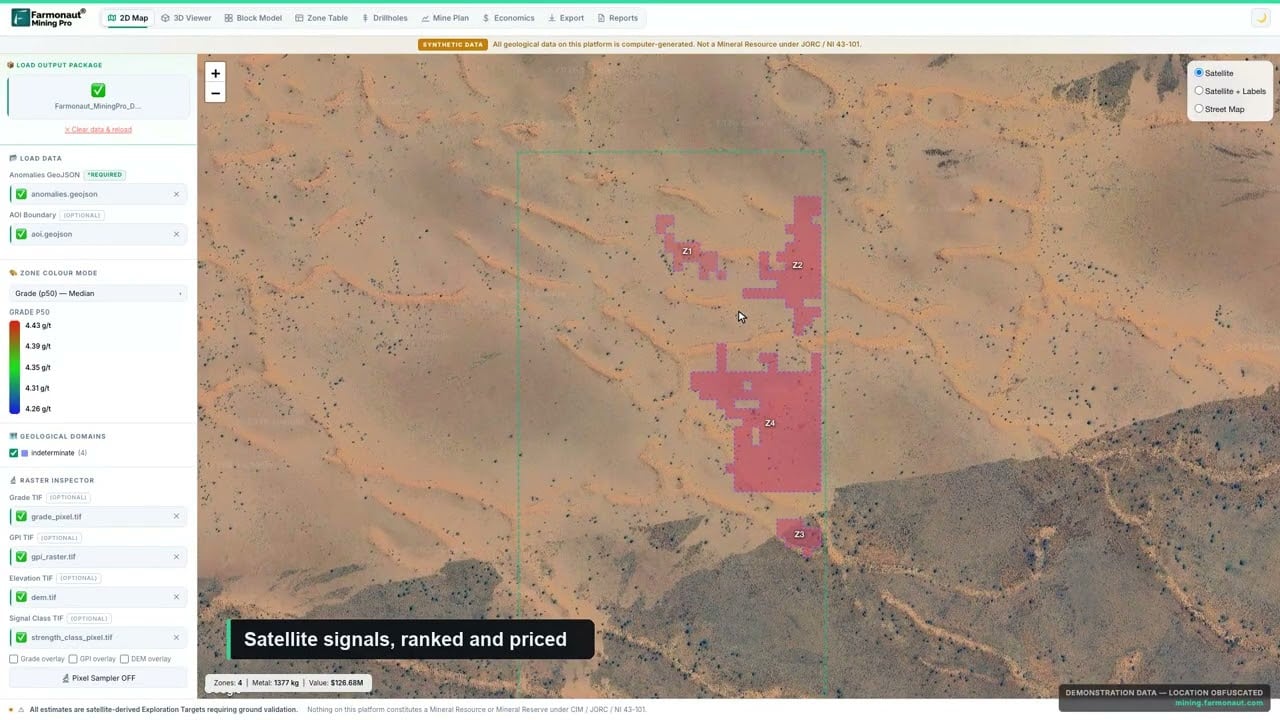
▶ What Farmonaut Mining Pro does with satellite data for exploration targets. · 4:56
Frequently asked questions
What is the price of uranium-235 per kg?
Pure U-235 is not sold. Enriched uranium at 5% U-235 costs about US$3,500 per kg at October 2026 spot uranium (US$91.55/lb, Cameco) and 2025 average SWU prices (US$108.70, EIA), which equals roughly US$70,000 per kg of U-235 contained.
How much does 1 kg of enriched uranium cost?
It depends on the assay. At the prices above, about US$1,900 at 3%, US$2,700 at 4% and US$3,500 at 5%, before fabrication into fuel.
How much does weapons-grade uranium cost?
It has no market price, because it is not sold. Formula cost at civil prices would be about US$72,000 per kg at 90% U-235, but military HEU only enters trade after being blended down into reactor fuel.
Why is enriched uranium so much more expensive than natural uranium?
Each kilogram of 5% product needs about 10 kg of natural uranium plus about 8 SWU of enrichment work, and conversion to UF6 on top.
What is a SWU?
A separative work unit measures the enrichment effort needed to split uranium into an enriched and a depleted stream. It is priced in US$ per SWU; US utilities paid an average US$108.70 in 2025 (EIA).
How much U-235 is in natural uranium?
About 0.7% by weight (WNA). The rest is almost all U-238.
Can you buy uranium-235?
Not as a private buyer. Enriched uranium is sold only between licensed companies and governments under nuclear safeguards. Small uranium ore samples are a different matter and are covered by national rules.
What is HALEU and what does it cost?
HALEU is uranium enriched to between 5% and 20% U-235. Formula cost at civil prices is about US$7,400 per kg at 10% and US$15,200 at 19.75%, but real contract prices are not published and are higher because supply is very small.
Where does the uranium price come from?
Uranium is traded through private contracts. Price reporters UxC and TradeTech publish spot and long-term indicators, and Cameco publishes the month-end average of the two.
Does the enrichment level change the value of a uranium mine?
No. A mine sells U3O8 concentrate, so its value follows the U3O8 price, grade, tonnage and costs. Enrichment is a separate service sold later in the fuel chain.
This page is for information only. It is not investment advice. Enriched uranium is a controlled nuclear material traded only between licensed parties under national and international safeguards.
Farmonaut mining
Rank targets on a uranium licence from space
Investors and licence owners can see how satellite data ranks parts of a licence area as exploration targets ahead of drilling and a resource estimate.

Mining Pro sample view, synthetic data
Keep reading
Sources
- Cameco, Uranium Price (UxC and TradeTech month-end averages): cameco.com
- Trading Economics, Uranium Hovers Near 9-Month High (10 November 2026): tradingeconomics.com
- US Energy Information Administration, Uranium Marketing Annual Report (data for 2025): eia.gov
- American Nuclear Society, Uranium prices steady as EIA releases annual market report (5 August 2026): ans.org
- World Nuclear Association, Uranium Enrichment: world-nuclear.org
- World Nuclear Association, Economics of Nuclear Power: world-nuclear.org
- World Nuclear Association, Military Warheads as a Source of Nuclear Fuel: world-nuclear.org
- World Nuclear Association, Uranium Markets: world-nuclear.org
- UxC, Nuclear Fuel Price Indicators (definitions): uxc.com
- TradeTech, Uranium Price Definitions: uranium.info
- TradeTech, Uranium prices and analysis: uranium.info
Discussion
Questions, corrections or field experience? Share them below. First-time comments are reviewed before they appear, and your email is never published.
No comments yet. Be the first to add a question or your experience.

 Omsri International FZE
 G.I.T.T.
 Jaunita Erss Ltd
 Almosi SARL
 SRK Consulting
 Berks Gold Limited
 Mwerezi Minerals Company Limited
 Mining SARL
 SenGold Invest SAS
 Sean Mining Limited
 NTS Group (Pty) Ltd
 Mine4Africa
 Lithspo Minerals Limited
 Tintina Mining Group
 Dalgety Minerals Pty Ltd

 Licence holder · Nigeria · Gold + lithium
 Client · Somalia · Gold










