

Rhizoctonia Blight Treatment: Fungicides, Organic Options & IDs
Reviewed August 2026 against University of Idaho graduate research on Rhizoctonia yield loss and USDA historical crop-loss records.
Try it: Run your own numbers →
Rhizoctonia blight treatment starts with matching the control to the crop stage: seed-applied fungicides (azoxystrobin, flutolanil, penthiopyrad) protect germinating seedlings from damping-off, soil-applied fungicides and biofungicides suppress the pathogen in the root zone during the growing season, and foliar sprays are reserved for above-ground web blight once it appears on leaves. No single product clears an infested field for good — Rhizoctonia solani survives for years as sclerotia in soil and crop debris, so treatment is really a repeated, seasonal decision rather than a one-time fix. University of Idaho field research on Rhizoctonia AG-8 in Pacific Northwest dryland cereal systems measured 10-30% yield loss where the pathogen was established, which is the scale of loss that makes early identification and the right product choice worth the investment.
This guide breaks down what Rhizoctonia and Rhizoctonia solani actually are, how to tell rhizoctonia leaf spot and web blight apart from other fungal symptoms, which treatments work at which stage, and how satellite crop monitoring shortens the gap between infection and detection — the single biggest lever a grower has over how much of that 10-30% loss actually happens on their own fields.
What Is Rhizoctonia? Understanding the Fungus
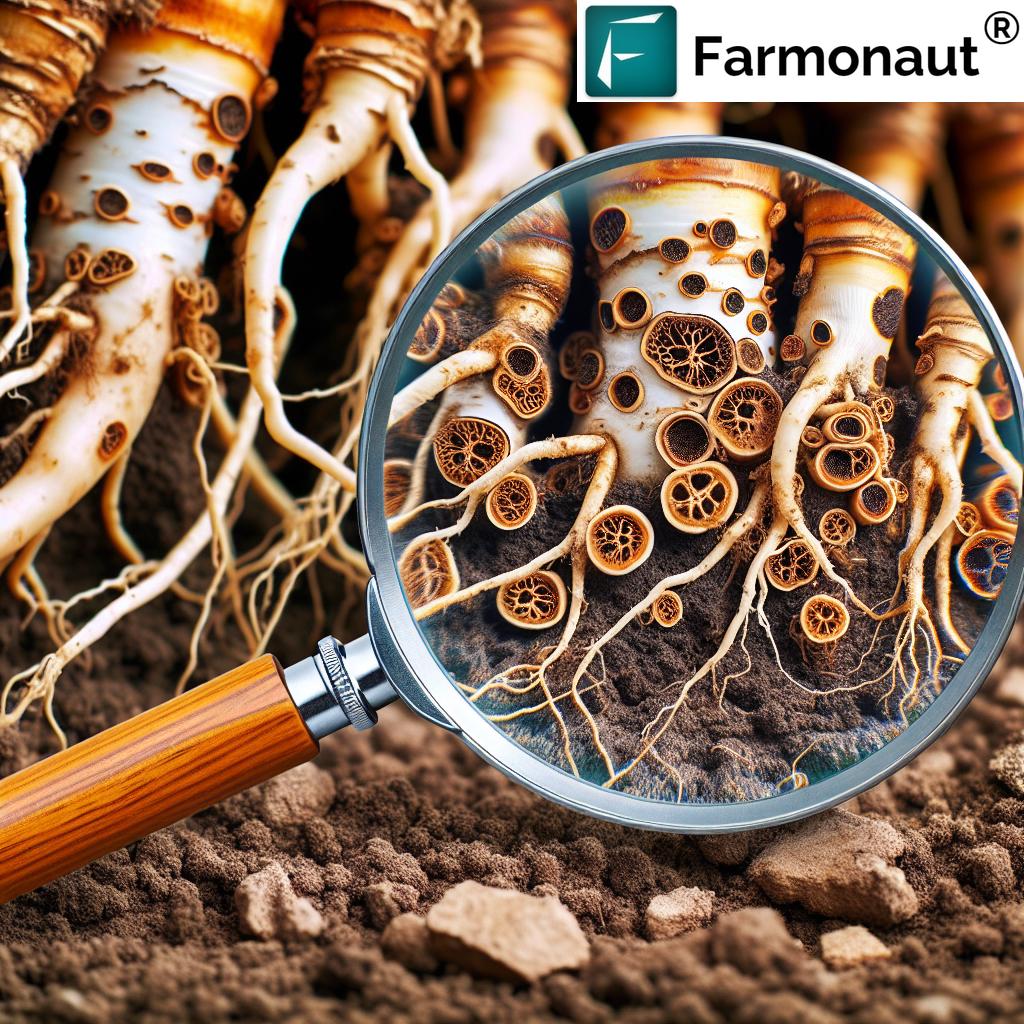
Rhizoctonia is a genus of soil-borne fungi, and Rhizoctonia solani is the species responsible for most of the crop damage growers report. It doesn’t produce airborne spores the way rust or powdery mildew fungi do — it spreads instead as mycelium (thread-like fungal growth) and as sclerotia, small hardened survival structures that sit dormant in soil or in leftover plant debris between seasons. That survival mechanism is why Rhizoctonia solani treatment plans have to account for the soil itself as a long-term reservoir of infection, not just the current crop.
Rhizoctonia solani causes four distinct problems depending on which part of the plant it reaches:
- Root rot — brown, sunken lesions on roots that cut off water and nutrient uptake
- Damping-off — rapid collapse and death of seedlings within days of emergence
- Stem cankers — dark, sunken lesions at or just below the soil line
- Rhizoctonia web blight / foliar blight — brown, water-soaked patches on leaves that expand under humid conditions, giving the “web” appearance the name refers to
Rice, sugar beet, cucumber, strawberry, potatoes, corn, and soybeans are all documented hosts, and the fungus is equally damaging to turfgrass and ornamental grass species — where it’s the cause of the disease turf managers call brown patch. Because the host range is this wide, a rotation plan that looks safe on paper (switching from soybeans to corn, for instance) may not actually break the disease cycle if both crops are Rhizoctonia hosts.
The Rhizoctonia Life Cycle: Why It Keeps Coming Back
Understanding the life cycle explains why growers searching for a single “rhizoctonia treatment” that ends the problem don’t find one — the fungus is built to survive control efforts. It runs through six stages every season:
- Survival: Sclerotia persist in soil or in undecomposed plant debris, sometimes across multiple seasons.
- Germination: Warm, moist soil (roughly 59-95°F / 15-35°C) triggers sclerotia to germinate and mycelium to begin spreading.
- Infection: The fungus enters plant tissue through wounds or natural openings in roots, stems, or leaves.
- Colonization: Once inside, it spreads through host tissue, disrupting water and nutrient transport.
- Symptom development: Lesions, wilting, and stunted growth become visible — usually well after infection has already progressed.
- Reproduction: New sclerotia form and return to the soil, ready to restart the cycle the following season.
The gap between stage 3 (infection) and stage 5 (visible symptoms) is the window where treatment does the most good and scouting does the least — by the time a plant looks sick, the fungus has usually been established for days to weeks.
Identifying Rhizoctonia: Root Rot, Web Blight, and Leaf Spot
Because Rhizoctonia produces different symptoms depending on which tissue it reaches, misdiagnosis is common. Here’s how to separate the presentations:
| Symptom | What it looks like | Where it appears | Commonly confused with |
|---|---|---|---|
| Root rot | Brown, sunken lesions on roots; wilting despite adequate soil moisture | Below ground, root system | Fusarium root rot, nutrient deficiency |
| Damping-off | Seedlings collapse and die within days of emergence | Soil line, newly emerged seedlings | Pythium damping-off, seed-corn maggot damage |
| Stem canker | Dark, sunken lesions at or below the soil line | Lower stem | Sclerotinia stem rot |
| Rhizoctonia web blight / foliar blight | Brown, water-soaked patches that expand into a web-like pattern under humidity | Leaves, especially lower canopy | Bacterial leaf blight, other foliar fungal spots |
| Rhizoctonia leaf spot | Discrete brown-to-tan spots, sometimes with a darker margin | Upper and lower leaf surfaces | Alternaria leaf spot, bacterial spot |
Additional field signs worth checking for: yellowing or wilting that’s most pronounced during the warmest part of the day, and stunted growth relative to neighboring plants in the same field. None of these symptoms is exclusive to Rhizoctonia, which is exactly why lab confirmation or remote monitoring that flags the anomaly early matters more than a visual guess.
Farmonaut’s satellite-based monitoring analyzes multispectral imagery across a field to flag changes in plant health — chlorophyll stress, canopy density shifts — that can precede visible Rhizoctonia symptoms. It doesn’t replace a soil test or a plant pathologist’s diagnosis, but it narrows down which part of a field to walk and sample first, which matters when the field runs to hundreds of acres and a single scout can’t check all of it every week.
Traditional Scouting vs. Satellite Monitoring for Early Detection
| Aspect | Traditional Field Scouting | Farmonaut’s Satellite Monitoring |
|---|---|---|
| Detection speed | Slow — requires physical inspection, field by field | Fast — full-field imagery reviewed in minutes |
| Accuracy | Depends on scout’s training and how recently the field was walked | Multispectral analysis flags stress patterns not yet visible to the eye |
| Coverage area | Limited by labor hours available per week | Whole-farm coverage, including hard-to-reach or low-priority acres |
| Cost per acre scouted | Rises with acreage — more acres means more scouting hours | Scales across acreage without adding labor |
Neither method replaces the other — satellite monitoring tells you where to look and how urgently; scouting and, when needed, lab diagnostics confirm what’s actually there. The combination shortens the interval between infection (stage 3 of the life cycle above) and treatment, which is the interval that determines how much of a field’s yield loss is preventable versus already locked in.
Environmental Conditions That Favor Rhizoctonia
Rhizoctonia solani is opportunistic — it needs specific conditions to move from dormant sclerotia to active infection:
- Soil temperatures between 59-95°F (15-35°C)
- High soil moisture combined with poor drainage
- High relative humidity, particularly for foliar and web blight symptoms
- Plant debris left in the field from a prior infected crop
- Plants already stressed by drought, compaction, or nutrient deficiency
Fields with heavy, poorly drained soils and a history of susceptible crops are the highest-risk combination. Tile drainage improvements and residue management after an infected crop are two of the few interventions that address the environment itself rather than just the pathogen.
Rhizoctonia Blight Treatment: Organic Control Options
For growers who want to hold off on chemical fungicides, or who are managing certified organic ground, several non-synthetic controls have research and field-use support:
- Crop rotation: Alternate susceptible crops (soybeans, potatoes, sugar beet) with confirmed non-host species. Verify host status before assuming a rotation crop is safe — the wide host range described above catches growers who rotate between two susceptible species without realizing it.
- Soil solarization: Cover moist soil with clear polyethylene sheeting during the hottest, sunniest weeks of the season. The trapped heat raises soil temperature high enough to kill or weaken sclerotia near the surface. This works best on smaller plots or high-value ground where the labor of sheeting is justified.
- Compost and organic soil amendments: Well-decomposed compost improves soil structure and builds populations of beneficial microorganisms that compete with Rhizoctonia for space and resources in the root zone.
- Biofumigation: Incorporating Brassica species such as mustard into the soil releases natural fungicidal glucosinolate compounds as the plant tissue breaks down.
- Biological control agents: Trichoderma species applied to soil or as a seed treatment can suppress Rhizoctonia through direct competition and parasitism. Bacillus subtilis-based products are also used as biological seed and soil treatments. Field-scale efficacy data for either under current US commercial conditions isn’t consolidated in a single public dataset — the most reliable source is your state land-grant university’s extension plant pathology program, which runs new fungicide and biocontrol efficacy trials each growing season (Iowa State, University of Minnesota, and Ohio State all publish updated results annually).
- Improved drainage: Tiling or grading to remove standing water directly removes one of the two conditions (moisture, warmth) Rhizoctonia needs to germinate.
- Resistant varieties: Where seed companies offer varieties with documented Rhizoctonia tolerance, they’re the lowest-cost long-term control — check with your seed supplier for current variety ratings, since resistance breeding is an active area and ratings change between seed catalogs.
Rhizoctonia Solani Treatment: Chemical Fungicide Options
Where organic controls aren’t sufficient on their own — typically on fields with a documented history of heavy infection — chemical treatment options fall into three categories by application timing:
| Treatment type | When applied | Common active ingredients | Targets |
|---|---|---|---|
| Seed treatment | Before planting | Azoxystrobin, flutolanil, penthiopyrad | Damping-off, early root rot |
| Soil fungicide | At or after planting, in-season | Azoxystrobin, flutolanil, penthiopyrad | Root rot, stem canker |
| Foliar spray | After above-ground symptoms appear | Product-specific — consult label for foliar-labeled active ingredients | Rhizoctonia web blight, foliar blight, leaf spot |
Two things to check before applying any of these: current label registration in your state (fungicide registrations change, and a product legal in one state may not be labeled for the same crop elsewhere), and pre-harvest interval requirements. Always follow the manufacturer’s label instructions, which are the legally binding version of the application rate and timing — not a summary like this one. For current-season fungicide efficacy comparisons specific to turf brown patch, USGA and university turf pathology programs at NC State, University of Maryland, and University of Wisconsin run new trials annually and publish results through their extension websites.
Integrated Pest Management: Combining Controls
An Integrated Pest Management (IPM) approach avoids relying on any single control method and instead sequences them:
- Prevention: Manage irrigation and rotation to reduce infection risk before planting.
- Monitoring: Combine weekly visual inspection during critical growth stages with continuous satellite-based monitoring to catch stress signals between scouting visits.
- Thresholds: Set a clear trigger point — percentage of affected plants or field area — for when treatment becomes justified rather than treating preventively every season regardless of pressure.
- Control: Apply organic methods first where pressure is moderate; escalate to chemical treatment where a field has a confirmed history of heavy Rhizoctonia loss.
- Evaluation: Record what was applied, when, and what the outcome was, so next season’s threshold decision is based on this field’s own history rather than a general rule.
Technology Tools for Rhizoctonia Management
Farmonaut’s platform supports the monitoring and evaluation stages of an IPM plan with the following tools:
- Satellite-based crop health monitoring: Multispectral imagery flags plant-health changes that can precede visible Rhizoctonia symptoms, narrowing down where to scout first. Learn more about our crop monitoring app.
- Jeevn AI advisory system: Combines satellite imagery, weather data, and field history to generate management recommendations tailored to a specific field.
- Weather forecasting: Forecast data helps time fungicide applications around the warm, moist windows that favor Rhizoctonia infection, and avoid spraying just before rain washes product off. Check out our weather API for developers.
- Mobile access: Field data and alerts on Android and iOS.
Full technical detail on the underlying satellite and weather data feeds is in the developer documentation, useful if you’re building Rhizoctonia risk alerts into your own farm management software rather than using the app directly.
Rhizoctonia Blight Treatment Cost Calculator
Use the calculator below to compare the rough per-acre cost of a seed-treatment-only program against a seed treatment plus one in-season soil fungicide application, based on your own field size and product pricing.
Run your own numbers
Assumes the treatment prevents the full percentage of loss entered, which will not hold in every field — actual efficacy depends on infection pressure, product, timing, and weather. It excludes application labor, equipment cost, and any yield loss from causes other than Rhizoctonia. Use your own agronomist’s loss estimate and current local product pricing for a real decision, not the defaults shown.
Best Practices Checklist for Rhizoctonia Prevention
- Practice field hygiene: Remove and destroy infected plant material rather than leaving it to decompose in place, which reduces the sclerotia load carried into next season.
- Optimize planting conditions: Plant when soil temperature and moisture favor rapid seedling emergence — the faster a seedling establishes, the shorter its damping-off vulnerability window.
- Manage soil moisture: Avoid overwatering; ensure drainage removes standing water within hours, not days.
- Choose resistant varieties where your seed supplier documents Rhizoctonia tolerance ratings.
- Rotate with confirmed non-hosts, verifying host status rather than assuming.
- Monitor continuously: Pair weekly visual scouting during critical growth stages with satellite-based monitoring for early stress signals between visits.
- Apply treatments by threshold, not by calendar — use an IPM trigger point rather than routine preventive spraying every season regardless of pressure.
- Keep field-level records of disease occurrence, treatment applied, and outcome, so next season's decisions are based on that field's own history.
The Economic Case for Treatment
The most-cited historical figure for Rhizoctonia's economic impact on US agriculture is a 1986 USDA-era estimate of $50-60 million in annual losses — that number is nearly four decades old and has no current equivalent published in a single consolidated source, so treat it as a historical marker of scale rather than a current-dollar figure. What is current and verifiable is the yield-loss percentage: the University of Idaho's Pacific Northwest field research on Rhizoctonia AG-8 puts losses at 10-30% in affected dryland cereal fields. To translate that into a dollar figure for your own operation, multiply your expected yield loss percentage by your crop's current price (USDA Agricultural Marketing Service publishes current soybean, corn, and small-grain prices) and your acreage — the calculator above does exactly that arithmetic once you enter your own numbers.
For current, US-specific figures on Rhizoctonia incidence, prevalence by state, or adoption rates for seed treatments versus foliar sprays, the direct answer is that no consolidated USDA or NASS dataset publishes these broken out by pathogen — NASS Quick Stats tracks planted acreage, yield, and general pest-loss categories but not Rhizoctonia specifically. The closest current data comes from land-grant university extension field trials, which are run and republished every growing season; checking your state's extension plant pathology page each year is the most reliable way to get a figure newer than anything printed here.
Where Rhizoctonia Research Is Headed
Several lines of research are active in Rhizoctonia management, though none has yet produced the kind of consolidated, citable dataset the rest of this article draws on:
- Gene editing for enhanced varietal resistance to Rhizoctonia solani
- Nanotechnology-based delivery for more targeted fungicide or biocontrol application
- Machine learning and satellite-driven prediction models for earlier detection ahead of visible symptoms
- Microbiome engineering to strengthen a crop's natural competitive defenses against soil-borne pathogens
As these move from research trials to commercial products, the university extension sources cited throughout this guide will carry the field-verified efficacy numbers before any commercial marketing does — that's the most reliable way to track when a new option is actually ready to use rather than still in development.
Frequently Asked Questions
Q: What is the most effective rhizoctonia blight treatment?
A: There isn't one single most-effective treatment — it depends on crop stage. Seed treatments (azoxystrobin, flutolanil, penthiopyrad) protect germinating seedlings; soil fungicides using the same active ingredients target root rot during the season; foliar sprays address web blight once it's visible on leaves. Combining these within an IPM plan, rather than relying on one alone, is what the research supports.
Q: What crops are most susceptible to Rhizoctonia?
A: Rice, sugar beet, cucumber, strawberry, potatoes, corn, soybeans, and turfgrass are all documented hosts of Rhizoctonia solani.
Q: How does rhizoctonia fungus spread in the field?
A: Through contaminated soil, infected plant debris, water movement, and on farm equipment moved between fields. It does not spread by airborne spore the way many foliar fungal diseases do.
Q: Is there an effective antifungal soil treatment for Rhizoctonia?
A: Soil-applied chemical fungicides (azoxystrobin, flutolanil, penthiopyrad) are the standard chemical antifungal soil treatments. Non-chemical soil treatments with research support include soil solarization, biofumigation with Brassica species, and Trichoderma-based biological soil treatments.
Q: Are there organic treatments for rhizoctonia blight?
A: Yes — soil solarization, Trichoderma and Bacillus subtilis biological control agents, crop rotation with confirmed non-hosts, biofumigation, and organic soil amendments all have research and field-use support.
Q: How effective is soil solarization against Rhizoctonia?
A: Solarization heats soil under clear polyethylene sheeting during hot, sunny periods to temperatures high enough to kill or weaken sclerotia near the surface. It's most practical on smaller or high-value plots given the labor of sheeting an entire field.
Q: Can rhizoctonia root rot be treated once symptoms appear?
A: Once root rot lesions are visible, the damage to that tissue is already done — treatment at that point focuses on protecting the rest of the root system and preventing spread to neighboring plants, rather than reversing existing lesions. This is why early detection, before visible symptoms, is where the largest yield savings happen.
Q: Can Rhizoctonia be completely eliminated from a field?
A: No. Sclerotia can persist in soil for years, so complete eradication is not realistic. Effective management reduces the population and limits the damage each season rather than eliminating the pathogen outright.
Q: How can satellite monitoring help with Rhizoctonia specifically?
A: Multispectral satellite imagery detects changes in canopy health that can precede visible symptoms, which narrows down where to scout and sample first. It supplements rather than replaces ground-truth diagnosis.
Q: How often should fields be monitored for Rhizoctonia?
A: Weekly visual inspection during critical growth stages (emergence and early vegetative growth for damping-off risk; canopy closure for web blight risk) combined with continuous satellite monitoring between visits.
Q: Does soil moisture affect Rhizoctonia risk?
A: Yes — high soil moisture combined with poor drainage is one of the two core conditions (with warm temperature, 59-95°F / 15-35°C) that Rhizoctonia needs to move from dormant sclerotia to active infection. Improving drainage directly reduces risk.
Conclusion
Rhizoctonia blight treatment works best as a sequence matched to the pathogen's life cycle and to your own field's history: seed treatment at planting, soil fungicide or biological control during the season if pressure is confirmed, foliar treatment only if web blight actually appears, and continuous monitoring throughout so the next season's threshold decision is based on data rather than guesswork. The University of Idaho's 10-30% yield-loss figure for affected Pacific Northwest dryland cereal fields is the clearest available benchmark for what's at stake; use the calculator above with your own crop value and acreage to see what that range means in dollar terms for your specific field.
Farmonaut's satellite monitoring, Jeevn AI advisory system, and weather API are built to support the monitoring and timing decisions in that sequence — not to replace the diagnostic and treatment decisions that belong to you and your agronomist. For further reading on how Rhizoctonia fits alongside other major threats, see our guide to the top 10 crop diseases and pests every farmer must know.

 BW Pipelines
 WICO
WICO Gen Chayat
 Chimera Innovation
 Hiteshi Infotech
 SkyHarvest
 Polaris Digitech
 Teledarbas
 Wild Oak Farm
 SFX
SFX BACF Africa
 Doodlakine
 Exurbia Geospatial
 FieldZero
 Indico Company
