

Vineyard pests · Organic control guide
Erineum Mites on Grapes: Sulfur Timing and Organic Control
Erineum mites raise felty blisters on grape leaves, but UC IPM’s home and landscape guide says no control is warranted. If you must act, sulfur at bud break or after harvest is the published advice. In Napa trials, one postharvest spray left next-season blisters under 10% of the starting score, against 16% to 49% in untreated blocks.
Key takeaways
- Feeding generally does not affect grape yield, says UC IPM, and the Pacific Northwest handbook sets no damage or action thresholds.
- Check young vines, propagation blocks and shoot tips first: these are where damage matters or shows late.
- In the 2015 and 2016 Napa trials, blocks with one postharvest sulfur spray fell below 10% of the pretreatment score, against 16% to 49% untreated (California Agriculture, 2020).
- For 11 of 12 Napa site-seasons, the best spray window fell between the last week of September and the first week of November. Double-sided tape shows your local timing.
- Paraffinic oil killed 35% to 80% of directly sprayed adult predatory mites; micronized sulfur caused no significant direct deaths (Oregon State University, 2014).
In this article
Erineum mites are microscopic pests that feed only on grapes and raise felty blisters on the leaves. UC IPM says in its home and landscape guide that no control is warranted, because feeding generally does not affect fruit yield. Where you do need control, the sources back sulfur: around bud break, or during the autumn migration back to the buds, which is the timing with trial data.
This guide shows how to identify the damage, when treatment makes sense, and how to time a spray. It includes three charts from the Napa County sulfur trials and a calculator that gives the break-even for one autumn pass.
What erineum mites are
The grape erineum mite is an eriophyid mite, Colomerus vitis. Older articles often call it Eriophyes vitis. The mite is carrot or wedge shaped, pale yellow to whitish and about 0.25 mm long, according to UC IPM. You cannot see it with the naked eye, so growers diagnose it from the damage.
UC IPM describes three strains, which may be separate species. Each one damages the vine in a different way, and this matters because the erineum strain is usually the mildest of the three.
| Pest | Where it feeds | What you see | Level of concern |
|---|---|---|---|
| Erineum strain | Underside of young leaves | Warty upper-leaf swellings over felty patches below | Often cosmetic; watch young vines and nurseries |
| Bud strain | Inside buds all year | Dead buds, short internodes, flattened canes, witches’ broom | Can kill buds |
| Leaf-curl strain | Inside leaf buds | Emerging leaves curl downward, sometimes into a ball; stunted shoots | Can stunt shoots |
| Rust mite | Leaves and shoots | Malformed leaves, scarred and stunted shoots | Losses up to 23% reported |
The rust mite is a different species, Calepitrimerus vitis. The 23% loss figure comes from a California Agriculture paper (2020) citing Oregon work, and it applies to rust mite, not erineum mite. The same paper notes that erineum damage is limited to blisters on leaves, and that the erineum strain is the most widespread eriophyid symptom on California’s North Coast. In the Pacific Northwest and Australia, it says rust and bud mites predominate.
Life cycle
- Winter: mites shelter under bud scales and in crevices of terminal twigs.
- Spring: as leaves flush, erineum-strain mites move out and feed in groups on the underside of soft young leaves.
- Blister formation: erinea form 10 to 30 days after feeding starts, UC IPM says. Mature, hardened leaves cannot form new ones.
- Summer: in warm weather an egg reaches the reproductive adult stage in 2 to 3 weeks, with several generations a year.
- Autumn: from mid-August to leaf drop, mites move back to the bud scales.
That autumn move is the weak point. Inside a blister, the mites have cover from predators and sprays, as the Pacific Northwest handbook explains. On the way to the buds, they are exposed.
The trial paper adds a useful detail: leaves wider than about 0.5 inch (1.3 cm) are no longer susceptible to new infection. So fresh blisters in late summer point to shoot tips and lateral shoots, where young leaves still grow.
Chart
Local spray windows can differ by weeks
Best sulfur window in days after 1 September, 8 selected of 12 Napa site-seasons
How to identify erineum mite damage
Check both sides of a young leaf. UC IPM gives these signs:
- Upper surface: round, warty swellings. They start green, turn yellow, and are brown by August.
- Lower surface: felty patches in a depression. They start whitish, then turn yellow and finally reddish brown.
- Severe cases: some leaves only partly expand, and they can die and drop early.
The felt is a mass of enlarged leaf hairs made by the plant. It can look like fungal growth, the Pacific Northwest handbook notes. A hand lens helps you see the hairs. Mites are hard to pick out even then, so if you remain unsure, send a sample to your local extension office or diagnostic lab.
Scouting routine
- Start when new growth emerges in spring. Look at the youngest leaves first.
- In late summer, check shoot tips and laterals. The Napa authors often found blisters there during berry ripening.
- Map where blisters appear by block and row, and rate them on a simple scale.
- Give young vines extra attention. Washington State University says large infestations can cause major stress on young vines.
- Keep dated notes on each spray, so next year’s block maps can be compared with this year’s.
We found no published action level to scout against. The Pacific Northwest handbook states there are no damage or management thresholds, so your records and your tolerance for leaf damage set the decision.

▶ Our video on monitoring and managing grape erineum mites on vine leaves. · 19:02
Do erineum mites need treatment?
Usually not. Infestation may not reduce the amount or quality of the crop, UC IPM says. The Pacific Northwest handbook says the mites are found sporadically in western Oregon vineyards and rarely lead to economic problems or crop losses.
Three situations can change the answer:
- Young vines and propagation blocks. The California Agriculture authors list high populations on young field vines and in plant propagation facilities as exceptions to the nuisance view, along with certain grape cultivars.
- Less sulfur in your mildew program. The same authors linked less in-season sulfur on the North Coast with more leaf blistering, both early and late in the season.
- Virus risk. The mite can vector Grapevine pinot gris virus, which causes leaf mottling, deformation and stunted shoots. UC IPM calls its importance in home vines uncertain, and the Pacific Northwest handbook says its extent in the region is not yet known. Ask your adviser if the virus is present near you.
Older advice sometimes warns of lost marketability for table grapes or of weaker vines open to other pests. The sources in this guide do not give figures for those effects, so treat them as reasons to look closer, not as reasons to spray.
Organic control: start with sulfur timing
Sulfur is the main option, and many mildew programs already apply it. The USDA National List (7 CFR 205.601) allows elemental sulfur, lime sulfur and narrow-range horticultural oils in US organic crop production. Check each product with your certifier. Rules differ in Canada, the UK, the EU, Australia and New Zealand.
Option 1: around bud break
UC IPM says micronized or wettable sulfur applied around bud break can reduce both the mite and powdery mildew. For commercial blocks, the Pacific Northwest handbook rates wettable sulfur above flowable formulations against this mite. It also says chemical controls are usually ineffective because galls protect the mites. The Napa trial below used dry flowable sulfur, so the formulation question is not settled. Its bud mite section gives woolly bud to budbreak timing for high-volume wettable sulfur, with a follow-up 7 to 10 days later. That advice targets bud mites, but it shows why spray volume and timing matter.
Option 2: after harvest
This is the option with the clearest published trial results. Cooper and colleagues tested one postharvest sulfur spray in commercial Napa County vineyards, then scored blisters in the next growing season. Sulfur used was dry flowable at 5 lb per acre in 75 gallons of water. In the 2016 trial, dusting sulfur at 12 lb per acre was added. These are trial rates, not label advice.
- 2013 trial: no blisters were found on treated vines at any posttreatment check in 2014.
- 2015 trial: control blocks fell to 39% to 40% of their pretreatment score. Sulfur blocks fell below 10%.
- 2016 trial: control blocks fell to 49%, then 16%. Both sulfur treatments fell below 10%. By the second check, dry flowable was significantly better than dust. The authors call the dust result confounded, because those blocks started with lower scores.
Note the control blocks. They fell without treatment, so a lower blister count after a spray does not prove the spray worked. Leave an unsprayed strip if you want a fair test on your own farm.
Find your autumn window with sticky tape
In the Napa work, 11 of 12 site-seasons had their best application period between the last week of September and the first week of November. The authors tell growers in other regions to check local patterns, since timing was only tested there. UC IPM’s method is simple:
- Wrap several twigs near blistered leaves with clear double-sided tape.
- Replace the tape at least weekly, and check it under magnification.
- Spray when you catch many mites, after harvest and before leaf drop.
In the Southern Hemisphere, use the same growth stages rather than the same months. The Napa dates cannot be moved across directly, and the trial did not cover Australia or New Zealand.
Mite activity lined up better with the calendar than with degree days, the authors found. Day length is their likely explanation. Peak activity came anywhere from about 2,316 to 3,772 degree days (°F) across sites, so a degree-day target would have been a poor guide there.
Sulfur and oil safety
- Do not spray sulfur in hot weather. UC IPM warns it can damage foliage.
- UC IPM warns against sulfur within 1 month before or after horticultural oil. A University of Connecticut fact sheet gives at least 2 weeks and says some plants need longer. Use the longer gap unless the label says otherwise.
- Follow the product label and local rules on rates, re-entry and pre-harvest intervals. Some products are limited to licensed applicators.
Chart
When erineum mite activity peaked
Number of monitored site-seasons by month of numerical peak, Napa County, 2013 to 2016 (12 in total)
Other organic tools for grape mites
Each tool below has a narrower case than sulfur. For wider background, see our guides to organic mite control and organic pesticides for farming.
Chart
Blisters also fell without treatment in the 2016 trial
Score as % of pretreatment; dry flowable sulfur is plotted at 10, the ceiling the authors report (actual: under 10%)
Dormant oils
The Pacific Northwest handbook says dormant-season oils used for other pests usually help control this mite, and WSU says dormant oil or wettable sulfur may be helpful. In Australia, a Barossa viticulture sheet lists wettable sulphur and canola oil for bud mite, the closely related strain. Oil has a cost: it needs direct contact, and it is hard on predators, as the next section shows.
Predatory mites and beetles
The Pacific Northwest handbook names predatory mites and beetles as important biological control agents. The California Agriculture paper is more careful: phytoseiid mites may give control under some conditions. Protect the predators you already have, and do not count on them alone.
Oregon State University tested sprays on Typhlodromus pyri, a key predator of rust mite. Results from its report (2014):
- Paraffinic oil: 35% to 80% mortality in directly sprayed adults, and over 80% in immatures.
- Micronized sulfur: no significant direct mortality at the rates tested, but immatures that were exposed had lower fertility as adults.
Sulfur still has limits. The Pacific Northwest bud mite section says over-use may cause a decline in predatory mites, and Wine Australia (2022) reports that high rates can reduce them too. That article also describes native Typhlodromus doreenae mites released by drone across 12 vineyards in Orange and Mudgee, aimed at bud, blister and rust mites. It reports the release, so treat it as a project to follow, not a proven result.
Canopy care and sanitation
Mites spread on animals, equipment and hands, and by wind and splashing rain, says UC IPM. Scout clean blocks first, and work through blistered blocks last. WSU, however, lists no non-chemical option known to be effective against this mite, so do not expect pruning, leaf removal or airflow to give control by themselves.
Neem, garlic and essential oils
Neem has general pest activity. The National Pesticide Information Center says its most active part, azadirachtin, reduces insect feeding and disrupts insect hormones. But the UC IPM, WSU and Pacific Northwest pages on this mite name sulfur and oil, not neem, garlic or essential oils. Mites inside blisters are also shielded from contact sprays. If you try one, use a registered product, follow the label, and leave an unsprayed strip to compare.
An organic plan for the season
Use this as a checklist, and match it to your own climate and label.

▶ Our video on spider mites and predator-based control, a related mite problem. · 13:25
- Dormant: review last season’s block map. Decide if any block merits action, and plan any oil around your sulfur dates.
- Bud swell to bud break: if damage was intolerable last year, or you have young vines, consider sulfur that also covers mildew.
- Spring to bloom: scout young leaves. Spot blisters are often no reason to spray.
- Late summer: check shoot tips and laterals, and hang tape on twigs near blisters in the worst blocks.
- After harvest: if tape catches climb, make one sulfur pass before leaf drop, and leave a check strip.
- Next spring: compare the sprayed block with the strip, then decide if the pass paid.
The trial authors did not establish how long one application lasts or how often to repeat it, so judge each year from your own counts. Pest mites differ too. If you see malformed shoots or dead buds rather than blisters, read our guide to grape gall mites, since bud-strain damage calls for a different timing.
Is one autumn sulfur pass worth it?
With no economic threshold or yield loss figure for the erineum strain in the sources used here, the honest question is how small a benefit would cover the cost. Use the calculator below with your own numbers. If you expect no crop effect, the benefit is zero, and the pass makes sense only for young vines, virus concerns or leaf appearance.
Try the numbers for your own farm below.
Calculator
What would one sulfur pass need to save?
Enter your own block, sulfur price and crop value.
- Cost per acre (US$): $45
- Cost for the block (US$): $450
- Break-even crop value protected: 0.90 %
All defaults are examples near break-even, not benchmarks or forecasts; use today’s prices. The 5 lb per acre default is the dry flowable rate from the Napa trials (California Agriculture, 2020), not label advice, so use your product’s label rate. The sources used here give no yield loss figure for this strain, so the crop benefit may be zero.
Where satellite monitoring fits
Satellites do not see mites. Blisters on some leaves rarely change a vegetation map, and a drop in vigor can have many causes, such as water stress, disease or soil. So use imagery to decide where to walk first, then confirm with a hand lens.
Farmonaut gives satellite vegetation maps of your blocks through the season, on the web app, Android or iOS. Developers can use the satellite API and the weather API documentation, for instance to line up spray records with hot spells.
Related pages on our site: bio-pesticide volatility studies.
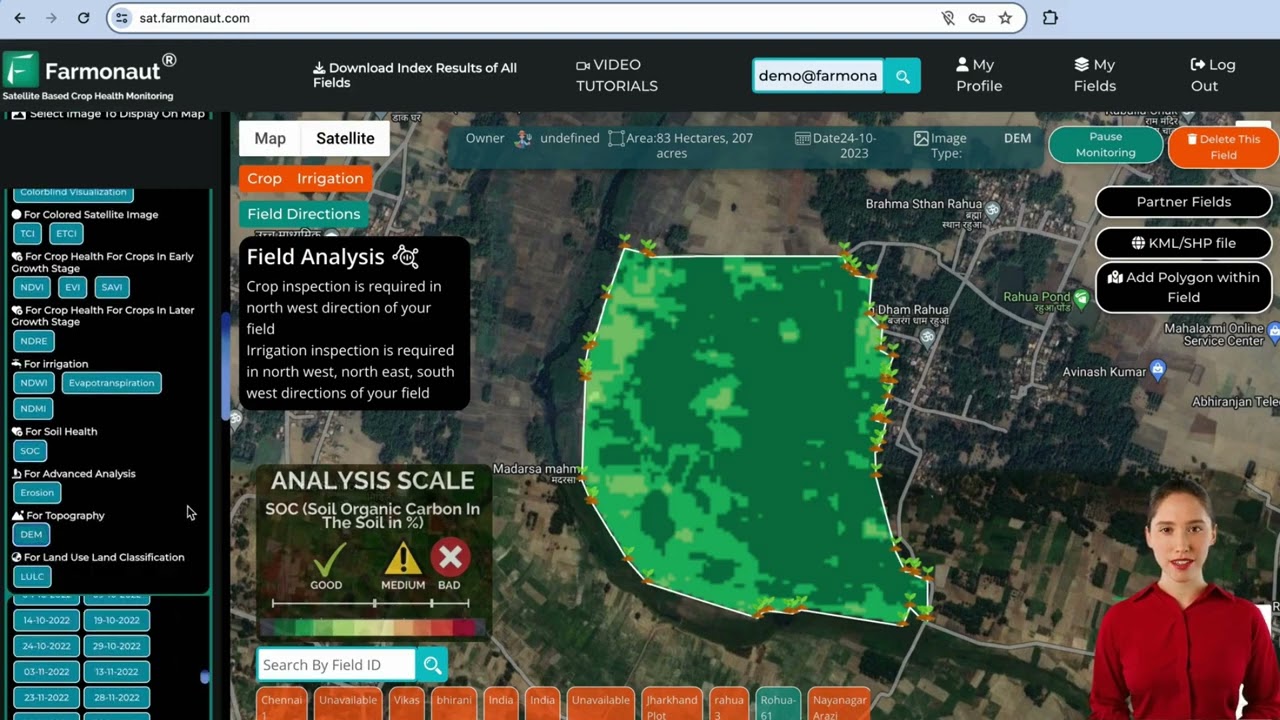
▶ A walkthrough of the Farmonaut web app for satellite monitoring. · 8:02
FAQ
What are erineum mites?
They are microscopic eriophyid mites, about 0.25 mm long, that feed on grapes. Their feeding makes the vine grow masses of enlarged leaf hairs in pockets under the leaf, with raised blisters above.
What is the best grape leaf blister mite treatment?
Often none. If damage is intolerable, the sources point to micronized or wettable sulfur around bud break, or sulfur after harvest during the autumn migration. Follow the label and local rules.
Can you cut off leaves with blisters?
You can, but blisters on existing leaves do not heal, and mature leaves cannot form new ones. Do not rely on it for control. WSU lists no non-chemical option known to be effective, and heavy leaf removal adds vine stress.
Do erineum mites hurt the grapes?
UC IPM says infestation may not reduce yield or quality. The Pacific Northwest handbook says that, in rare cases, the mites may infest clusters in early spring. The virus link is the main reason for new interest.
Will the mites spread to other plants?
No. UC IPM says this species feeds only on grapes. It does spread between vines on insects, tools, hands, wind and splashing rain.
Can you get rid of them completely?
Plan to manage them, not to eliminate them. One Napa trial found no blisters the season after treatment, but later trials reduced them to below 10% of the starting score, and mites can arrive again from nearby vines.
Farmonaut crop monitoring
Know which vineyard blocks to walk first
Draw your blocks once and Farmonaut shows satellite vegetation maps through the season, so your agronomist can direct scouting to areas that change.




Keep reading


Sources
- UC IPM, Grape Erineum Mite (Home and Landscape): ipm.ucanr.edu
- Cooper, Hobbs, Strode and Varela, Grape erineum mite: Postharvest sulfur use reduces subsequent leaf blistering, California Agriculture 74(2), 2020: escholarship.org
- Pacific Northwest Pest Management Handbooks, Grape erineum mite: pnwhandbooks.org
- Pacific Northwest Pest Management Handbooks, Grape bud mite: pnwhandbooks.org
- Washington State University Hortsense, Grape erineum mite: hortsense.cahnrs.wsu.edu
- Oregon State University Extension, EM 9095, effects of oil and sulfur on T. pyri (2014): extension.oregonstate.edu
- eCFR, 7 CFR 205.601, synthetic substances allowed in organic crop production: ecfr.gov
- Wine Australia, Up, up and away: mites in the sky (2022): wineaustralia.com
- Barossa viticulture technical sheet, Bud mite (2018): barossa.com
- National Pesticide Information Center, Neem oil fact sheet: npic.orst.edu
- University of Connecticut Home and Garden Education Center, Horticultural oils: homegarden.cahnr.uconn.edu
- UC IPM, Grape powdery mildew: ipm.ucanr.edu
- Android: play.google.com
- iOS: apps.apple.com
Discussion
Questions, corrections or field experience? Share them below. First-time comments are reviewed before they appear, and your email is never published.
No comments yet. Be the first to add a question or your experience.

 Adgrid
 eKGIS
 Mostas Tech
 Native Seeds
 Andex
 FCF India
 Unifrutti Gulf
 Deluxe Conseil
 TVS Electronics
 BW Pipelines
 WICO
 Chimera Innovation
 SkyHarvest
 Polaris Digitech
 Teledarbas

 Licence holder · Niger · Gold
 Client · Tanzania · Gold
 Client · Somalia · Gold
 Client & affiliate partner · Ghana · Gold










