

Reviewed August 2026 against USDA Economic Research Service, IndexBox Market Analysis, and the CropLife/Purdue Precision Adoption Survey.
Try it: Run your own numbers →
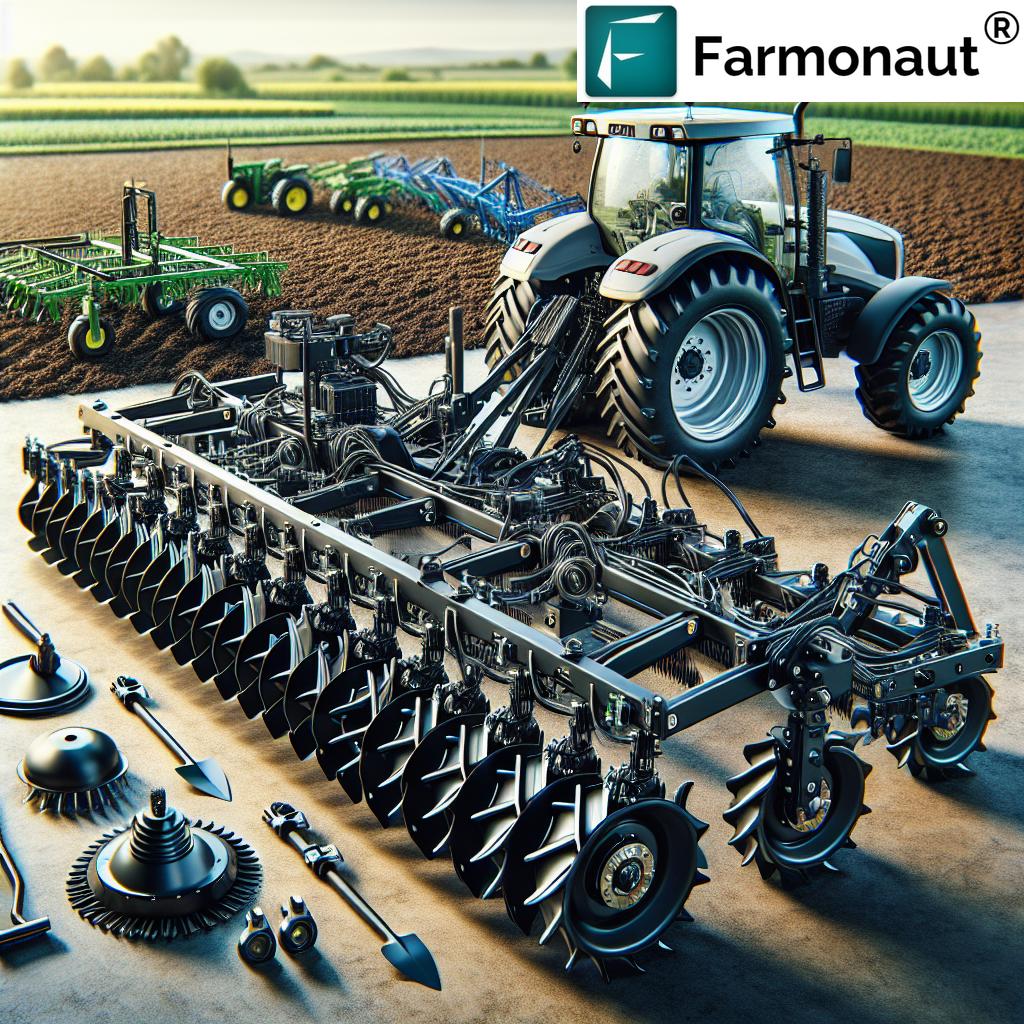
A tandem disc harrow is a tillage implement with two rows of angled disc gangs — front gangs throwing soil outward, rear gangs throwing it back in — used to break up soil, cut crop residue, and finish a seedbed in a single pass. It differs from an offset disc plow (rear gang set to one side of the tractor centerline, built for orchard and terrace work) and from a pull-type disc (towed behind the tractor rather than mounted on a three-point hitch, favored for wide acreage where transport width matters less than raw coverage). If you’re comparing agricultural implements for soil prep, the choice between tandem, offset, and pull-type configurations comes down to field shape, residue load, and how the disc integrates with the GPS and data systems already running on your operation.
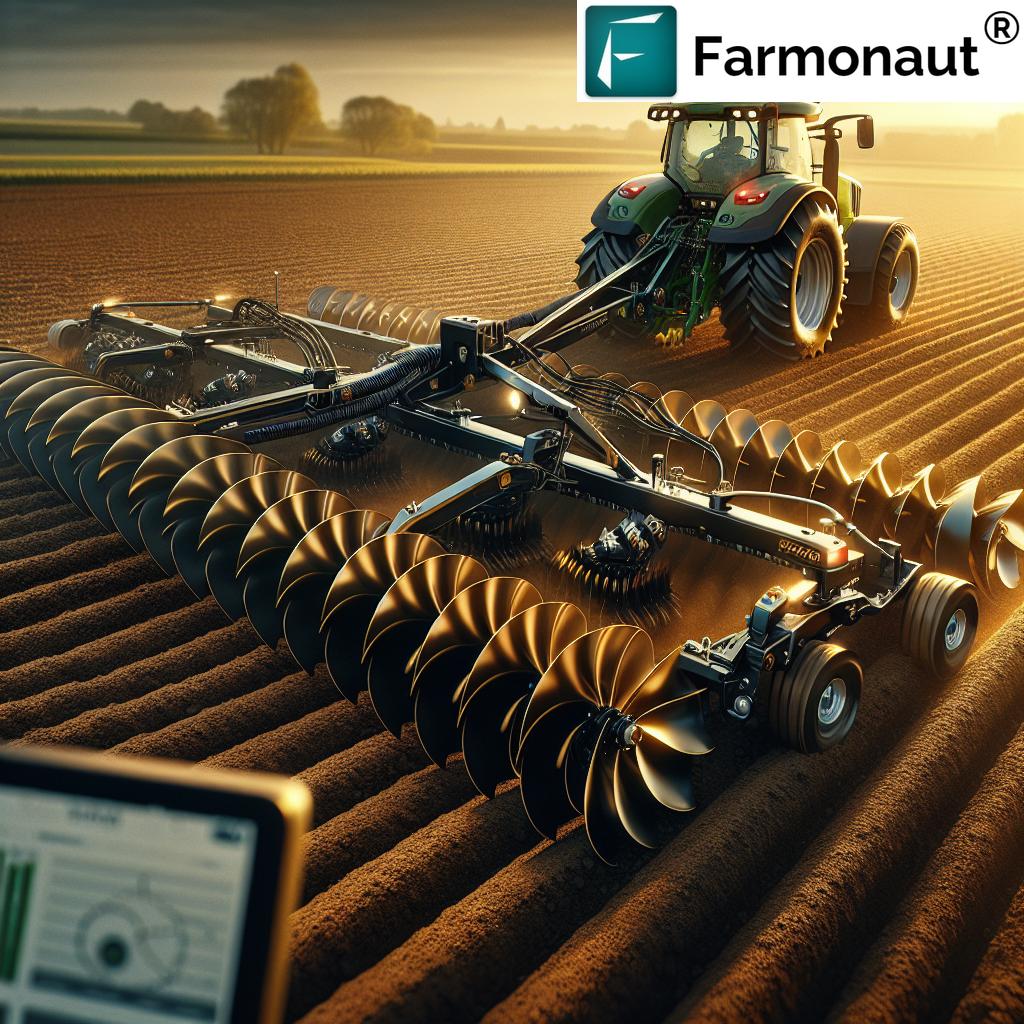
Table of Contents
- US Disc Harrow Market: Size and Scale
- Tandem vs. Offset Disc vs. Pull-Type: A Direct Comparison
- Disc Blade Design, Gang Angle, and Spacing
- How Precision Farming Technology Companies Fit In
- Increasing Agricultural Productivity With Disc Harrow Data
- Calculator: Tillage Depth and Fuel Estimate
- Attachments: Scraper Kits and Furrow Fillers
- FAQ
- Try it: Run your own numbers
US Disc Harrow Market: Size and Scale
US farms consumed an estimated 122,000 disc harrow units across all types in 2024, while domestic manufacturers produced roughly 69,000 units in the same year — a gap of about 53,000 units filled by imports, according to IndexBox Market Analysis. That gap matters for buyers: if you’re shopping tandem, offset, or pull-type configurations and a specific gang width or blade spacing is backordered, imported models are filling a meaningful share of current US inventory. IndexBox updates this production-and-consumption dataset annually, so check their current report before assuming the 2024 figures still hold.
Separately, the broader precision farming market that disc harrows increasingly plug into was valued at $11.8 billion in US revenue for 2024, per Market.us analysis aggregating multiple industry sources. That figure covers GPS guidance, variable-rate systems, sensors, and software — the layer that turns a mechanical disc harrow into a data-generating field tool.
Tandem vs. Offset Disc vs. Pull-Type: A Direct Comparison
These three configurations solve different problems. A tandem disc harrow (two gangs, front-and-back) is the default for row-crop seedbed prep on open fields. An offset disc plow shifts the rear gang laterally so the tractor can run outside the disc’s working width — useful under low tree canopies, along terraces, or in orchard middles where a centered tandem would straddle obstacles. A pull-type disc is towed via drawbar rather than carried on a three-point hitch, which sacrifices some maneuverability for the ability to run much wider gangs without overloading the tractor’s hydraulic lift capacity.
| Configuration | Gang Arrangement | Best Fit | Attachment Method | Typical Limitation |
|---|---|---|---|---|
| Tandem disc harrow | Two gangs, front-back opposed | Open row-crop fields, general seedbed prep | Three-point hitch or pull-type frame | Straddles obstacles at full working width |
| Offset disc plow | Rear gang offset to one side | Orchards, terraces, low-canopy or bordered fields | Three-point hitch, tractor runs beside worked strip | Narrower working width per pass than tandem |
| Pull-type disc | Tandem or single-gang, towed | Wide open acreage, minimal transport-width limits | Drawbar, no hydraulic lift load on tractor | Wider turning radius, longer transport length |
The gang-angle mechanics are the same physics across all three: steeper angles throw more soil and cut deeper but draw more horsepower per foot of working width, while shallower angles trade tillage intensity for lower fuel burn. What changes between tandem, offset, and pull-type is how that gang geometry is mounted and transported, not the soil-engagement principle itself.
Disc Blade Design, Gang Angle, and Spacing
Notched Disc Blades vs. Smooth Blades
Notched blades cut residue and penetrate compacted soil more aggressively than smooth blades, at the cost of faster edge wear in abrasive or rocky soils. The trade-off is straightforward: notched blades are the standard choice where corn stover or heavy stubble needs to be sliced and incorporated, while smooth blades hold an edge longer in lighter-residue or sandy conditions where cutting isn’t the bottleneck.
Adjustable Gang Angles
Gang angle is the primary field-adjustable control on a tandem disc harrow. Steeper angles increase tillage intensity and depth per pass; shallower angles reduce draft load and fuel consumption for lighter finishing work. Because angle changes directly trade depth for horsepower demand, matching angle to soil moisture and residue load on a given day — rather than running one fixed setting all season — is the main lever an operator has over both fuel cost and finish quality.
Disc Spacing and Tilling Depth
Wider disc spacing (commonly cited around 9 inches in current tandem models) allows deeper soil engagement and better residue burial than narrower spacings, which are better suited to shallow finishing passes. Wider spacing is the right call when compaction below the surface is the problem you’re solving; narrower spacing is better when the goal is a fine, shallow seedbed finish rather than deep fracturing.
How Precision Farming Technology Companies Fit In
Disc harrows themselves are mechanical, but the tractors pulling them increasingly aren’t running blind. USDA’s Economic Research Service reports that 70% of large-scale US crop farm acreage used autoguidance or GPS steering as of 2023, and 68% of that same acreage used yield monitors and yield mapping. Those two adoption rates describe the tractor cab a tandem disc harrow is now typically hitched behind on large US operations — not universal, but no longer a minority practice either.
More recent dealer-reported data narrows the picture further. The 2025 CropLife/Purdue Precision Adoption Survey found autoguidance adoption reached 85% of custom-sprayed acres, and sprayer boom/nozzle control reached 76% of custom-sprayed acres. Those figures come from custom applicators and dealers rather than USDA’s farm-level survey, so they run higher than the ERS numbers — a useful reminder to check which population a precision-ag adoption statistic is describing before comparing it across sources.
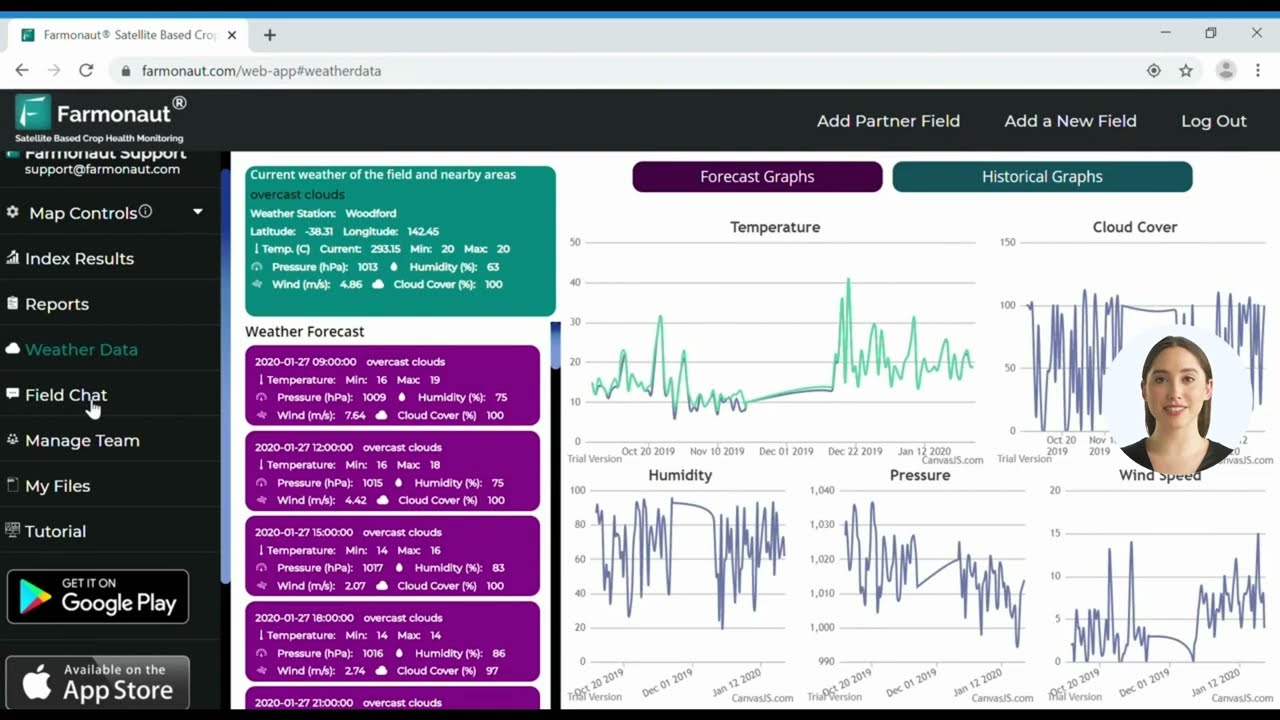
For readers evaluating precision farming technology companies broadly rather than tillage specifically, our overview of precision agriculture technology categories breaks down the major system types, and our piece on farm equipment trends for soil preparation covers where tillage implements sit inside that broader shift. Where a disc harrow connects directly to this data layer is depth and moisture timing: soil moisture readings determine whether a field is dry enough for a deep-angle pass without smearing clay, and Farmonaut’s satellite API and API developer docs expose that moisture and weather data for operations that want to time tillage passes programmatically rather than by eye.

Farmonaut’s  surfaces that same field-condition data for operators checking moisture and residue-cover status ahead of a tillage pass, without needing to walk every field first.
Increasing Agricultural Productivity With Disc Harrow Data
Here’s where we have to be direct about a gap: there is no published USDA figure quantifying yield lift (in bushels per acre) attributable specifically to disc harrowing versus reduced-till or no-till in US corn, soybeans, or wheat. The published literature covers soil-property changes — infiltration rate, macroporosity, aggregate stability — but does not connect those changes to a dollar or bushel figure at a national level. Similarly, there’s no routine USDA NASS reporting on what percentage of US cropland is treated with disc harrows in a given year; that detail appears only sporadically in the five-year Census of Agriculture, and per-acre custom-operation costs for disc harrowing aren’t published by equipment dealers either — they quote purchase price, not operating cost per acre.
If you need current numbers for your own operation, here’s the method rather than a guess: check the latest USDA NASS Census of Agriculture (released every five years) for tillage-practice adoption by state and farm size; pull your own fuel-per-acre figure from your tractor’s hour meter and fuel log across a measured tillage pass, since no national per-acre cost figure exists to substitute for it; and track your own yield data year-over-year against your specific tillage regime using yield monitor data, since that comparison depends on your soil type and rotation more than any national average could capture.
What the productivity gains attributed to disc harrow features in marketing materials (percentage figures for “tillage efficiency” or “field preparation flexibility”) actually represent is manufacturer-reported design comparisons between blade or spacing configurations, not independently verified agronomic outcomes — treat feature comparisons below as relative design trade-offs, not proven yield or ROI figures.
| Feature | Trade-off | Best Suited To |
|---|---|---|
| Notched disc blades | Faster cutting and penetration vs. quicker edge wear | Heavy residue, compacted or clay soils |
| Adjustable gang angles | Depth and intensity vs. fuel draw | Fields with variable moisture or residue across passes |
| Wider disc spacing (~9 in.) | Deeper tillage vs. rougher surface finish | Subsurface compaction relief |
| Scraper kits | Reduced downtime vs. added mechanical complexity | Sticky, high-moisture or clay soils |
| Furrow filler attachments | Smoother finish vs. added draft load | Operations wanting single-pass seedbed finish |
Calculator: Tillage Depth and Fuel Estimate
Gang angle and disc spacing trade off against fuel draw in a predictable direction even without a universal per-acre dollar figure — use this to compare two settings on your own field before committing a full pass. Enter your own tractor and field numbers; nothing here is pre-filled with an assumption about your operation.
Run your own numbers
Attachments: Scraper Kits and Furrow Fillers
Scraper kits mount against each disc blade to strip adhered soil in sticky or high-moisture conditions, preventing the buildup that otherwise reduces effective disc diameter and penetration mid-pass. Furrow fillers trail the rear gang to backfill the furrow left between gangs, producing a level finish in one pass instead of requiring a separate leveling pass. Both are mechanical add-ons rather than data-connected systems today, though depth-control and leveling sensors are the logical next integration point as more tillage implements pick up ISOBUS connectivity.
For farms scaling equipment investment around precision farming techniques, tandem disc harrows compatible with three-point hitches on compact utility tractors and larger drawbar-pulled units for row-crop tractors cover most of the range between small-acreage and large-scale operations. The broader shift toward connected field equipment is also visible in adjacent machinery categories — see our coverage of autonomous tractor systems for where tillage hitching may be headed as unmanned operation moves from pilot programs toward wider deployment.
Farmonaut’s mobile apps for  and
and  carry field moisture and weather data to the cab, which is the practical use case for checking conditions before a disc pass without a separate soil-probe trip.

FAQ
- What is a tandem disc harrow?
A tillage implement with two rows of angled disc gangs, front and rear, used to break up soil, cut and incorporate crop residue, and prepare a seedbed in one pass. - What’s the difference between a tandem disc harrow and an offset disc plow?
A tandem harrow runs both gangs centered on the tractor; an offset disc plow shifts the rear gang to one side so the tractor can travel outside the worked strip — useful in orchards, terraces, or bordered fields where a centered tandem can’t fit. - What’s the difference between a pull-type disc and a mounted tandem disc harrow?
A pull-type disc is towed via drawbar, avoiding load on the tractor’s hydraulic lift and allowing wider gangs; a mounted tandem harrow attaches to the three-point hitch, trading maximum width for tighter maneuverability. - How much does gang angle affect fuel use?
Steeper gang angles increase draft load and fuel burn per acre because the discs engage more soil per foot of travel; there’s no single published per-acre dollar figure for this trade-off, so measuring your own fuel log across a pass at two angle settings is the direct way to quantify it for your tractor and soil. - How many disc harrows are in use across US farms?
IndexBox Market Analysis estimated 122,000 units consumed against 69,000 units produced domestically in 2024, with the gap filled by imports; check IndexBox’s current report for the latest annual figures. - Do disc harrows integrate with GPS and precision farming systems?
Yes — as of 2023, USDA ERS reported 70% of large-scale US crop farm acreage used autoguidance/GPS steering and 68% used yield monitors, meaning most large operations are already running the tractor-side systems a disc harrow pass benefits from. - Is there a proven yield increase from disc harrowing versus no-till?
No national USDA figure connects disc harrowing to a specific bushel-per-acre or dollar yield gain; published research covers soil-property changes like infiltration and macroporosity but not a direct yield lift figure, so this depends on comparing your own yield monitor data across tillage regimes on your specific soil.

 Inclusive Growth Chain
 AdBio
AdBio MISE Maroc
 Drift-Sense
 NWNS
NWNS Red August Group
 Farm Inc
 WeMe Global
 Agrotoken
 Blue BearX
 Insignito
 Croptimum
 DnCubed
 Field Capacity
 Indosistim Teknologi
 Liquify Digital
 CU Foods
 BeyondTech Global
