

GM crops · Evidence guide
GM Crops: Pros, Cons and Environmental Impact Explained
Most GM crops carry one of two traits: herbicide tolerance or insect resistance. A 2014 meta-analysis of 147 studies found average gains in yield and profit and less pesticide, but results differ by trait and country. Test your own numbers below.
Key takeaways
- In 2025, 94% of US corn, 97% of upland cotton and 96% of soybean acres were planted with genetically engineered varieties (USDA ERS).
- A 2014 meta-analysis of 147 studies found average gains of 22% in yield and 68% in farmer profit, and 37% less chemical pesticide quantity. Gains were larger for insect-resistant crops (Klümper and Qaim).
- Pesticide results depend on the trait. Insect-resistant maize used 11.2% less insecticide, but glyphosate-tolerant soybean used 28% more herbicide by weight (Perry et al., 2016).
- The National Academies (2016) found no substantiated evidence that foods from GM crops are less safe than foods from non-GM crops. It also found that weeds and insects can evolve resistance.
- Your net return depends on seed cost, yield, price and chemical cost. Use the calculator to compare GM and conventional seed on your own field.
In this article
- The Evolution of GM Crops: A Scientific Perspective
- GM Crop Benefits: Evidence and Limits
- Environmental Impact of GM Crops: A Balanced View
- Precision Agriculture Tools and GM Crops
- Scientists and the Public: Different Views
- Global Food Production Challenges: What GM Crops Address
- Sustainable Agriculture Technology: Beyond GM Crops
- Agricultural Innovation and Climate Change: Adapting for the Future
- Genetically Modified Crops: Pros and Cons
- GM Crops and On-Farm Biodiversity: What the Evidence Shows
- Global Adoption of GM Crops: Where They Are Grown
- Comparison: GM Traits in US Corn, Cotton and Soybeans
- GM Crops and Precision Farming: Goals and Open Questions
- Regulatory Landscape and Public Perception
A 2014 meta-analysis of 147 studies found that GM crops raised yields by 22% on average and cut the quantity of chemical pesticide by 37%. Results differ by trait, crop and country.
Climate change and a growing population put pressure on farmers to harvest more with fewer losses. Genetically modified (GM) crops are one tool for that job, next to better seed, soil and water management and field monitoring. This guide separates the two main commercial traits, herbicide tolerance and insect resistance, and looks at what the evidence says about yield, pesticide use, cost, resistance and regulation.
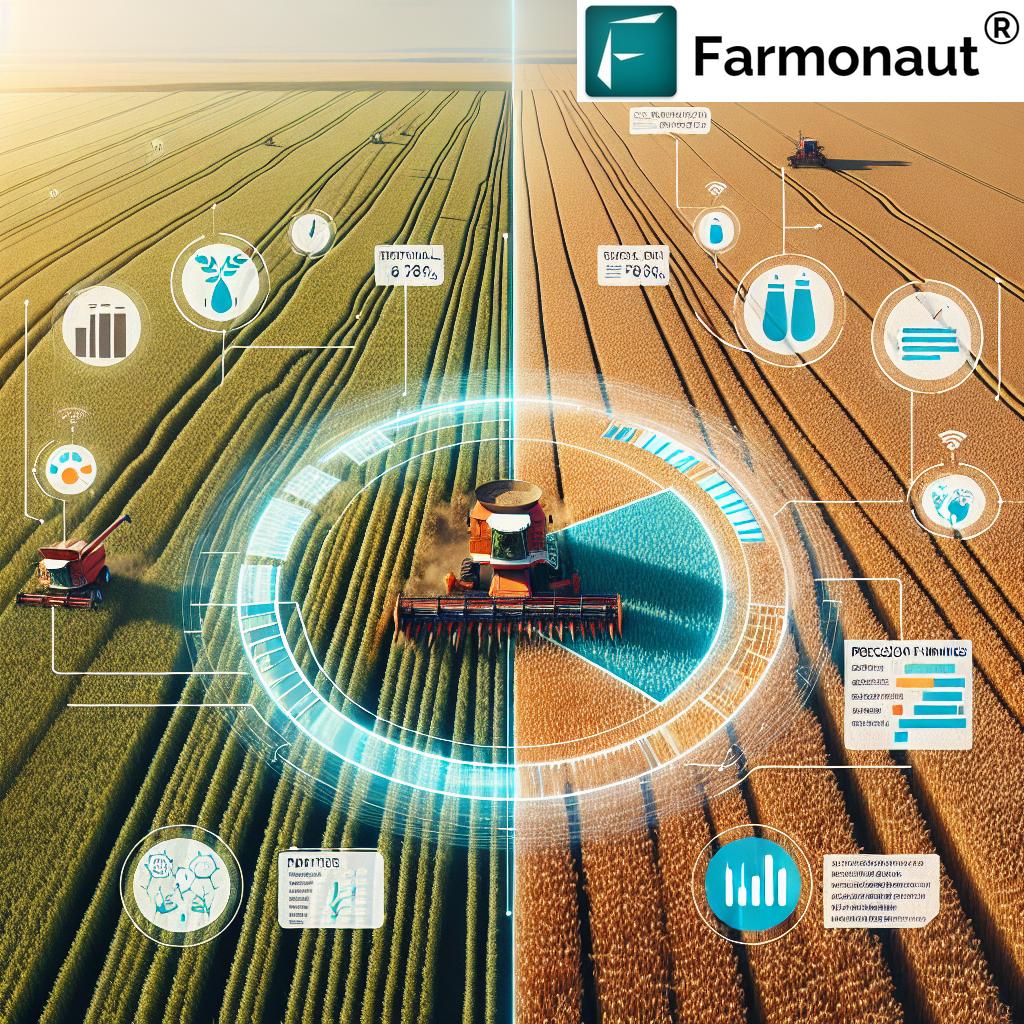
The Evolution of GM Crops: A Scientific Perspective
Genetically modified crops have come a long way since their introduction in the 1990s. Initially met with skepticism and concern, these crops have been studied closely. Most GM traits that were developed never reached the market. The two that did, herbicide tolerance and insect resistance, are grown mainly in a few crops such as soybean, maize, cotton and canola.
Chart
Share of US acres planted with genetically engineered varieties
Percent of planted acres, all GE varieties, selected years
- Higher harvested yield where pests or weeds cause losses
- Less insecticide on insect-resistant (Bt) maize and cotton
- Some traits aim at nutrition, such as Golden Rice
- Resistance to certain insects and viruses
A 2016 review by the National Academies of Sciences, Engineering, and Medicine found no substantiated evidence that foods from genetically engineered crops are less safe than foods from non-GM crops. The same review said that long-term effects are harder to study than short-term ones.
In the United States, USDA surveys show how fast farmers adopted GM seed. In 2025, 94% of corn, 97% of upland cotton and 96% of soybean acres were planted with genetically engineered varieties (USDA Economic Research Service, 2025). Most of this area uses one or both of two traits: herbicide tolerance (HT) and insect resistance (Bt). Stacked seed, which has both traits, is counted in each group.
GM Crop Benefits: Evidence and Limits
The UN projects that the world population will peak at about 10.3 billion in the mid-2080s, so food production has to keep growing. GM crops help with some parts of that task. Here is what the evidence supports and where it is weaker:
Chart
Average difference between GM and non-GM crops in 147 studies
Percent; the pesticide bar shows the fall in quantity used
- Increased Yields: Insect-resistant GM crops protect yield from pest damage, so harvested yield can rise where those pests are a problem. This is not higher yield potential: the National Academies found that GM crops do not have greater potential yield than non-GM crops. Whether higher yield cuts the need for agricultural expansion is not measured in the sources cited in this guide.
- Pest and Disease Resistance: Insect-resistant (Bt) maize and cotton resist certain insects, and studies found less synthetic insecticide spraying on them. Virus-resistant papaya is another example. Few other traits are on the market.
- Drought Tolerance: Some GM varieties are designed to cope better with water stress. The 2016 National Academies review described drought tolerance as a trait still in development, so check the result for each variety before you rely on it.
- Nutritional Enhancement: Golden Rice is engineered to make beta-carotene. It passed food-safety reviews in Australia and New Zealand, Canada and the United States in 2018, but it needs approval in each growing country before it can be deployed.
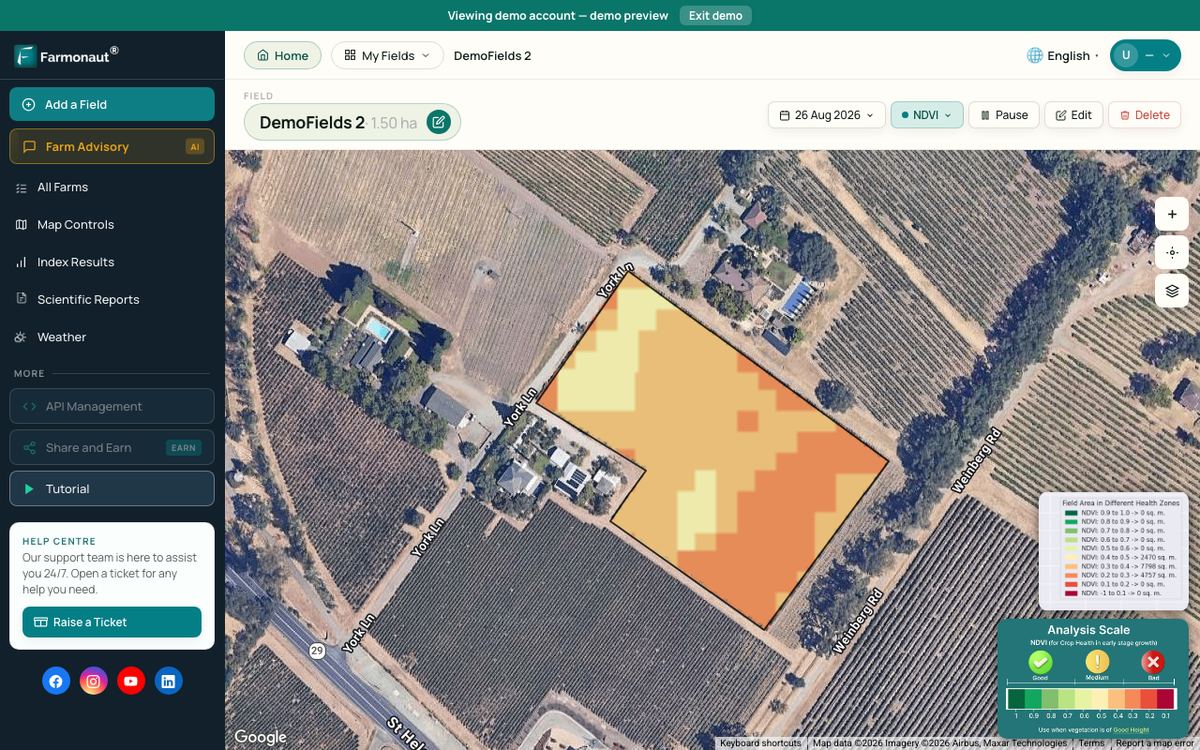
At Farmonaut, our satellite-based crop health monitoring system tracks vegetation health in each field over the season, whichever seed is planted.
What the evidence says about yield, pesticide use and profit. A 2014 meta-analysis pooled 147 studies of GM soybean, maize and cotton. On average, GM adoption went with 22% higher yield, 37% less chemical pesticide quantity and 68% higher farmer profit (Klümper and Qaim, PLOS ONE, 2014). Gains were larger for insect-resistant crops than for herbicide-tolerant crops, and larger in developing countries than in developed ones. The authors note that some studies did not report sample sizes or variance, and the paper counts pesticide quantity, not toxicity. These are averages across very different farms, crops and years.
The National Academies took a more careful view of yield. Experiments suggest GM traits add to actual yield, but USDA national data showed no sign that they sped up the rate of yield gain in US maize, soybean and cotton (National Academies, 2016).
Environmental Impact of GM Crops: A Balanced View
The environmental impact of GM crops has been debated for years. The record differs by trait, as the chart below shows. These points summarise what the evidence supports:
Chart
Pesticide use of GM adopters compared with non-adopters, US plots
Absolute percent difference, 1998 to 2011. Bt = insect-resistant, HT = glyphosate-tolerant. The soybean EIQ result was not statistically different from zero (shown as 0).
- Insect-resistant maize and cotton have cut insecticide spraying, but herbicide use has not fallen in the same way
- The National Academies (2016) found no conclusive evidence of cause-and-effect between GM crops and environmental problems, and said long-term effects are hard to assess
- Weeds can evolve resistance to glyphosate, so diverse weed management is needed to delay it (National Academies, 2016)
- Herbicide-tolerant crops have helped spread no-till farming, which can reduce soil erosion (USDA, 2014)
The Farmonaut Satellite + AI Farm Monitoring System gives field-level advice from satellite images, and the farmer decides which practices to use. Follow the product label and local rules for any herbicide or insecticide.
Pesticide use differs by trait. A study of plot-level data from US maize and soybean farmers, 1998 to 2011, found a different result for each trait (Perry et al., Science Advances, 2016). Growers of insect-resistant maize used 11.2% less insecticide by weight. Growers of glyphosate-tolerant maize used 1.2% less herbicide, and growers of glyphosate-tolerant soybean used 28% more. The authors also scored each product by its environmental impact quotient (EIQ), an estimate of its environmental impact. On that score, soybean herbicide use was about the same, and maize herbicide and insecticide use were 9.8% and 10.4% lower. Over the years, herbicide use by glyphosate-tolerant adopters rose relative to non-adopters, which fits the spread of glyphosate-resistant weeds. The National Academies likewise found that the early fall in herbicide weight on herbicide-resistant crops has not generally lasted (2016). Follow the product label and local rules for any pesticide.
Precision Agriculture Tools and GM Crops
Precision agriculture tools such as satellite imagery, sensors and drones can be used on GM and non-GM fields. Common tools include:
- Satellite imagery for precise crop monitoring
- AI-driven advisory systems for tailored farm management
- Drone technology for targeted application of inputs
- Field sensors for soil and weather data
Farmonaut’s platform uses these precision agriculture techniques, mainly satellite imagery and AI-based advice. Our satellite-based monitoring system, combined with AI analytics, can help farmers decide where to scout and when to irrigate or apply inputs.
Explore Farmonaut’s API for advanced agricultural solutions
Scientists and the Public: Different Views
Scientists and the public hold different views of GM foods. Supporters of GM crops point to the evidence below. Critics raise the points listed after the survey results:
- Safety reviews: the National Academies (2016) found no substantiated evidence that foods from GM crops are less safe than foods from non-GM crops
- Yield and profit: a 2014 meta-analysis of 147 studies found higher average yield and profit, and USDA found Bt corn and Bt cotton generally more profitable (Klümper and Qaim, 2014; USDA ERS, 2014)
- Less insecticide spraying on Bt maize and cotton (National Academies, 2016; Perry et al., 2016)
- No-till farming: herbicide-tolerant crops have helped spread conservation tillage in the US (USDA ERS, 2014)
A 2014 Pew Research Center survey asked 3,748 US scientists who belong to the AAAS and 2,002 US adults whether GM foods are generally safe to eat. 88% of the scientists and 37% of the adults said yes.
The gap between the two groups shows why clear information and open dialogue matter.

Critics point to:
- Resistance. Weeds have evolved glyphosate resistance in many places, and Bt resistance has appeared where high-dose and refuge rules were not followed, so the benefits can fade (National Academies, 2016).
- Herbicide use. The early fall in herbicide weight on herbicide-resistant crops has not generally lasted, and glyphosate-tolerant US soybean growers used 28% more herbicide by weight (National Academies, 2016; Perry et al., 2016). The National Academies also said that weight alone is a poor guide to risk, because herbicides differ in toxicity.
- Seed prices and patents. USDA reported that GM corn and soybean seed prices in the US rose about 50% in real terms from 2001 to 2010 (USDA ERS, 2014). The National Academies noted that patent holders with legal and financial resources can secure protection that limits access for small farmers and plant breeders, and it asked for research on whether seed market concentration affects seed prices (National Academies, 2016).
- Health and trust. The National Academies found no evidence of higher health risk from current GM foods, but said any new food may have subtle effects that testing does not detect, and expert committees disagree on the health risk of glyphosate used on GM crops (National Academies, 2016). In a 2014 Pew survey, 67% of US adults said scientists do not clearly understand the health effects of GM crops (Pew Research Center, 2015).
Global Food Production Challenges: What GM Crops Address
The agricultural industry faces numerous challenges in meeting the food demands of a growing global population:
- Climate change impacts on crop yields
- Limited arable land
- Water scarcity
- Soil degradation
- Pest and disease outbreaks
GM crops address some of these challenges, mainly losses to insects and weeds. Insect-resistant crops can cut insect damage with less insecticide. Water scarcity, soil degradation and climate change also need other tools.
At Farmonaut, we’re committed to helping farmers navigate these challenges. Our blockchain-based traceability tools record where products come from in the food supply chain.
Access Farmonaut’s API Developer Docs for in-depth information
Sustainable Agriculture Technology: Beyond GM Crops
GM crops are one of several farm technologies. Others include:
- Vertical farming
- Hydroponics and aeroponics
- Robotics and automation
- Blockchain for supply chain management
- Big data analytics for farm management
These technologies can be used with GM or non-GM crops. Farmonaut’s platform covers some of them, such as satellite monitoring and traceability.
Agricultural Innovation and Climate Change: Adapting for the Future
Climate change poses significant threats to global agriculture, including:
- Increased frequency of extreme weather events
- Shifts in precipitation patterns
- Rising temperatures affecting crop growth cycles
- Expansion of pest ranges
Breeders are working on stress-tolerant crops, and some of these are GM and some are not. Flood-tolerant rice with the Sub1 gene, for example, was developed by marker-assisted backcrossing, a crossing method guided by DNA markers, and not by genetic engineering. Drought tolerance was a GM trait still in development in the 2016 National Academies review.
Farmonaut’s satellite monitoring shows how vegetation in each field changes over a season, which can help a farmer decide where to scout after heat, drought or flooding.
Genetically Modified Crops: Pros and Cons
Benefits and costs depend on the trait, the crop and the place. These are the main points on each side:
Pros:
- Higher harvested yield where insects or weeds cause losses
- Less insecticide on Bt maize and cotton
- Some traits aim at nutrition, for example Golden Rice, but few are in wide use
- Resistance to certain insects and viruses
- Traits such as drought tolerance were still in development in 2016 (National Academies)
Cons:
- Concerns about long-term health effects. The National Academies (2016) found no substantiated evidence of harm but said long-term effects are harder to study
- Weeds and insects can evolve resistance, so the benefits can fade
- Higher seed prices and patent rules; USDA reported that US prices of GM corn and soybean seed rose about 50% in real terms from 2001 to 2010
- Public skepticism and regulatory hurdles
At Farmonaut, we believe that transparent information and data-driven decision-making are key to navigating these pros and cons. Satellite monitoring cannot tell you which seed trait to buy, but it can show how each field performs over a season, which helps you compare your own results.
Resistance and cost. Pests adapt. The National Academies found that in many places some weeds have evolved resistance to glyphosate. For insects, the high-dose and refuge strategy delayed Bt resistance in the US, but resistance has occurred where high doses or refuges were not used (2016). USDA reported that the price of GM soybean and corn seed rose about 50% in real terms from 2001 to 2010. It found Bt corn and Bt cotton generally more profitable than conventional seed, while the profit effect of herbicide tolerance was mixed (USDA ERS, 2014). The calculator below lets you test the seed, yield and chemical numbers for your own field.
Try the numbers for your own farm below.
Calculator
Does GM seed pay on my field?
Enter your own seed cost, yield, price and chemical cost for each seed type. The starting values are equal for both seeds.
- GM net return per acre: $750
- Conventional net return per acre: $750
- Difference for the whole field: $0
- Your yield difference (GM minus conventional): 0.0 bu/acre
- Yield change GM needs to break even: 0.0 bu/acre
All starting values are round example numbers, not benchmarks or typical farm figures. They are equal for both seeds, so the starting result is zero. Net return here is grain revenue minus seed and chemical costs. Labour, fuel, fertilizer, machinery and land are assumed equal for both seeds. USDA ERS (2014) used a wider variable-cost measure, so treat this as a simple comparison. Enter a premium-adjusted price if non-GM grain earns a premium. Follow the product label and local rules for any herbicide or insecticide.
GM Crops and On-Farm Biodiversity: What the Evidence Shows
The National Academies (2016) looked at biodiversity on farms. Its main findings were:
- Fields with Bt crops tended to have more insect biodiversity than similar fields sprayed with insecticide
- In the US, fields with glyphosate-sprayed herbicide-tolerant maize and soybean had weed biodiversity similar to non-GM fields
- US crop diversity and crop rotation have declined since 1987, but the committee found no studies that tested whether GM crops cause this
Biodiversity effects depend on the trait and on how each farm manages weeds and insects.
Global Adoption of GM Crops: Where They Are Grown
The adoption of GM crops varies significantly across the globe:
Chart
Area of GM crops in 2019, selected countries
Million hectares, selected from ISAAA’s list of 29 growing countries
- The United States, Brazil and Argentina had the largest GM crop areas in 2019 (ISAAA)
- The European Union requires authorisation, traceability and labelling for GM food and feed
- Developing countries grew 56% of the world’s GM crop area in 2019 (ISAAA)
Other points to watch:
- Africa went from three GM-growing countries in 2018 to six in 2019, but its area was only 1.54% of the world total (ISAAA)
- Traits that fit local needs: the National Academies (2016) gave virus-resistant papaya as a GM crop that suits small-scale farmers because it solves one pest problem without extra inputs
- Public acceptance is mixed: 37% of US adults said GM foods are generally safe to eat in a 2014 Pew survey
Farmonaut’s satellite monitoring works on fields of any size. Whether a GM crop may be grown depends on local law.
ISAAA, a group that promotes crop biotechnology, counted 190.4 million hectares of GM crops in 29 countries in 2019. Developing countries grew 56% of that area, and the five largest growers planted 91% of it (ISAAA, 2019). USDA does not collect global GE seed data and points to ISAAA for these estimates (USDA ERS). The 2019 brief is the one used here, so check for newer figures before you quote them as current.
Comparison: GM Traits in US Corn, Cotton and Soybeans
| Crop and trait | Share of US planted acres, 2000 | Share of US planted acres, 2025 | Yield evidence | Pesticide evidence | Main limit |
|---|---|---|---|---|---|
| Corn, Bt (insect-resistant) | 19% | 87% | Protects yield where insects are a problem (USDA, 2014) | Insecticide 11.2% lower by weight (Perry et al., 2016) | Target insects can evolve resistance (National Academies, 2016) |
| Corn, HT (herbicide-tolerant) | 7% | 92% | Evidence is mixed (USDA, 2014) | Herbicide 1.2% lower by weight for glyphosate-tolerant maize (Perry et al., 2016) | Weeds can evolve glyphosate resistance (National Academies, 2016) |
| Corn, stacked (HT and Bt) | 1% | 84% | Tends to yield more than conventional or single-trait seed (USDA, 2014) | Not reported separately in the studies cited | Inferred, not studied separately: the resistance risks of both traits may apply |
| Cotton, Bt | 35% | 91% | Higher net returns when pest pressure is high (USDA, 2014) | Less synthetic insecticide spraying (National Academies, 2016) | Bt resistance has occurred where refuges were not kept (National Academies, 2016) |
| Cotton, HT | 46% | 93% | Evidence is mixed (USDA, 2014) | Early fall in herbicide weight has not generally lasted (National Academies, 2016) | Weeds can evolve glyphosate resistance (National Academies, 2016) |
| Soybeans, HT | 54% | 96% | Evidence is mixed (USDA, 2014) | Herbicide 28% higher by weight, about the same on the EIQ score (Perry et al., 2016) | Weeds can evolve glyphosate resistance (National Academies, 2016) |
The table compares traits, not GM against non-GM grain in general. The stacked-corn cells for pesticide use and main limit are not from a study of stacked seed. Acreage shares are percent of planted US acres from USDA ERS adoption data (2000 is the HT-only or Bt-only share plus the stacked share). Evidence comes from USDA ERS, 2014, Perry et al., 2016 and the National Academies, 2016. Results are US averages and can differ on your farm.
GM Crops and Precision Farming: Goals and Open Questions
GM crops can be used with precision farming tools such as satellite monitoring. The aims are listed below. They are goals, not measured results, because the sources in this guide did not test them:
- Maximize crop yields while minimizing resource use
- Reduce environmental impact through targeted interventions
- Enhance food security by optimizing production in various climates
- Improve farmer profitability through increased efficiency
Farmonaut offers satellite monitoring and AI-based insights that can be used on GM and non-GM fields.
Regulatory Landscape and Public Perception
The regulatory landscape for GM crops varies globally, with some regions embracing the technology while others maintain strict regulations. Key aspects include:
- Safety assessments and approval processes
- Labeling requirements for GM products
- International trade considerations
Public views differ by country and by group, as the Pew survey above shows.
How rules differ. In the EU, GM authorisations for cultivation last up to 10 years and can be renewed, and EU countries may restrict or ban cultivation on their own territory (European Commission). EU countries that grow GM crops must also set up coexistence measures at their borders with EU countries that do not grow them (same source). Food and feed with GM ingredients must be labelled, except for adventitious or technically unavoidable traces up to 0.9% of an ingredient (European Commission). ISAAA reported that only Spain and Portugal planted GM maize in the EU in 2019, on 111,883 hectares in total (ISAAA, 2019). In May 2026 the Council of the EU adopted new rules for plants made with new genomic techniques such as gene editing. Herbicide-tolerant plants are excluded from the lighter category, and the Council expects the framework to apply from mid-2028 (EU IP Helpdesk). Rules in other countries differ, so check with your national authority before you plant.
Conclusion: What the Evidence Supports
GM crops are one tool among many for feeding a growing population. The evidence shows clear benefits in some cases, such as less insecticide on Bt maize and cotton, and mixed results in others, such as herbicide use and weed resistance.
At Farmonaut, we support farmers with satellite-based farm monitoring, whichever seed they plant.
How much GM crops contribute depends on the trait, the crop, the farm and local rules. Food security also depends on soil, water, prices, trade and policy.
Frequently Asked Questions
Q: Are GM crops safe for human consumption?
A: GM crops are approved only after a safety assessment, and the National Academies (2016) found no substantiated evidence that foods from GM crops are less safe than foods from non-GM crops. Approval rules differ by country.
Q: How do GM crops contribute to sustainability?
A: Insect-resistant crops have cut insecticide spraying, and herbicide-tolerant crops have helped spread no-till farming in the US. Herbicide results vary, and weed and insect resistance can reduce the gains.
Q: Can GM crops coexist with organic farming?
A: It depends on local rules and management. Growing GM crops next to organic farming systems needs planning. Rules for organic producers differ by country and by certification scheme, so ask your certifier and your national authority.
Q: How do GM crops impact biodiversity?
A: The National Academies (2016) found that Bt crops tended to have more on-farm insect biodiversity than similar sprayed crops without the trait. It found no conclusive evidence that GM crops cause environmental problems.
Q: What role does Farmonaut play in GM crop management?
A: Farmonaut provides satellite-based monitoring and AI-based insights that help farmers track crop health in each field, for GM and non-GM crops.
Farmonaut crop monitoring
See your own fields from space
Farmonaut Satellite + AI Farm Monitoring System shows crop health for each of your fields, whichever seed you plant.



Keep reading
Sources
- USDA Economic Research Service, Adoption of Genetically Engineered Crops in the United States, data 2000-2025 (updated December 2025): ers.usda.gov
- USDA Economic Research Service, Recent Trends in GE Adoption (updated December 2025): ers.usda.gov
- USDA Economic Research Service, Genetically Engineered Crops in the United States, ERR-162 (February 2014): ers.usda.gov
- National Academies of Sciences, Engineering, and Medicine, Genetically Engineered Crops: Experiences and Prospects, Executive Summary (2016): nationalacademies.org
- National Academies of Sciences, Engineering, and Medicine, Genetically Engineered Crops: Experiences and Prospects, Summary (2016): nationalacademies.org
- Klümper and Qaim, A Meta-Analysis of the Impacts of Genetically Modified Crops, PLOS ONE (2014): journals.plos.org
- Perry et al., Genetically engineered crops and pesticide use in U.S. maize and soybeans, Science Advances (2016): pmc.ncbi.nlm.nih.gov
- Pew Research Center, Public and Scientists’ Views on Science and Society (January 2015): pewresearch.org
- ISAAA, Brief 55 executive summary, Global Status of Commercialized Biotech/GM Crops in 2019: agrobio.org
- European Commission, GMO traceability and labelling: food.ec.europa.eu
- European Commission, GMO authorisations for cultivation: food.ec.europa.eu
- EU Intellectual Property Helpdesk, Council adopts regulation on new genomic techniques (5 May 2026): intellectual-property-helpdesk.ec.europa.eu
- IRRI, Golden Rice meets food safety standards in three leading regulatory agencies (May 2018): irri.org
- Septiningsih et al., Development of submergence-tolerant rice cultivars: the Sub1 locus and beyond, Annals of Botany (2009): pmc.ncbi.nlm.nih.gov
- United Nations, Population (World Population Prospects 2024 figures): un.org
Discussion
Questions, corrections or field experience? Share them below. First-time comments are reviewed before they appear, and your email is never published.
No comments yet. Be the first to add a question or your experience.

 Contec Global
 ASQI
ASQI Teledarbas
 Wild Oak Farm
 SFX
SFX BACF Africa
 Doodlakine
 Exurbia Geospatial
 FieldZero
 Indico Company
 Kubota
 FFBS
FFBS Jontra
 Tucor
Tucor
