

Canada gold claims · Buyer guide
Canadian Gold Claims for Sale: Province-by-Province Guide
A Canadian gold claim is a right to explore, not a mine. Ontario charges C$50 per cell and C$400 of work a year; BC charges C$1.75 per hectare. Fees, sales channels and checks for each province.
Key takeaways
- Ontario registers claims by cell for C$50 and needs C$400 of assessment work per cell a year (Ontario fee schedule, April 2026; ERO 019-6053).
- Quebec rights designated from 15 July 2026 cost C$53.95 under 25 ha south of the 52nd parallel (Quebec government rates page).
- BC charges C$1.75 per hectare to register and C$5 to C$20 per hectare of work a year; Saskatchewan charges C$0.60 per hectare, with no work in year one (BC Reg. 529/2004; Saskatchewan Table 2).
- Ontario produced 69,687 kg of gold in 2024 and Quebec 58,259 kg, together about 69% of Canada’s 185,555 kg (NRCan, 2024).
- A claim is not land ownership: check the holder, work credits, surface rights and consultation duties before paying.
In this article
- What you are buying when you buy a gold claim in Canada
- Where gold claims and mines for sale in Canada are listed
- Where Canada's gold comes from: output by province
- Ontario: claims and mines for sale
- Quebec: exclusive exploration rights for sale
- British Columbia: cell claims for sale
- Saskatchewan: claims by the hectare
- What claims cost to hold: BC against Saskatchewan
- Nova Scotia: exploration licences
- Yukon quartz claims and other territories
- Buying a mine rather than a claim
- Six checks before you buy a Canadian gold claim
- How satellite screening helps before you pay
- Frequently asked questions
A Canadian gold claim is a registered right to explore a block of ground, not a gold mine and not the land itself. Prices are set by the seller, but the cost of holding a claim is fixed by each province: in Ontario a claim cell costs C$50 to register and needs C$400 of approved work a year, while in British Columbia the work starts at C$5 a hectare. This guide goes province by province, shows what each registry charges, where claims and mines are offered for sale, and which checks to run before you pay anyone.
It is written for licence and claim owners, consultants and investors. Every fee below comes from the government page or regulation that sets it, with the date of the schedule where one is published. Fees change, so confirm the current figure with the registry before you sign.
What you are buying when you buy a gold claim in Canada
Canada has no single national claim. Each province and territory runs its own system, and the Crown owns most of the minerals. A claim, licence or exclusive exploration right gives its holder the exclusive right to explore for minerals in a set area, as long as the holder keeps it in good standing by doing and reporting work. It does not give ownership of the surface. Ontario states this plainly: a surface rights owner owns the land but not the mining rights, and mining claim registration and transfer both require contact with surface rights owners and holders (Ontario mining sequence guide).
A claim also sits at the very start of the path to a mine. The Ontario guide lists five stages: early exploration, advanced exploration, mine development, mine production and closure. Early exploration starts with choosing a target and registering a claim, and the later stages need permits, consultation with Aboriginal communities and closure planning. A claim for sale is therefore a position at stage one, and its value depends on what the ground has already shown, not on the fact that it is in a gold province.
Three tenure types are sold in practice:
- Unpatented claims, licences or exclusive exploration rights. These are the low-cost entry point and the main subject of this page. Each province holds the register.
- Mining leases and older patented ground. These carry production rights and heavier obligations. In Ontario a lease application fee is C$90, and consent to transfer a lease or an interest in it is C$100 plus HST (Ontario administrative fee schedule, updated 1 April 2026).
- Placer claims. These cover gold in gravels and follow separate rules from hard-rock claims.
Where gold claims and mines for sale in Canada are listed
There is no official national marketplace. Claims change hands through a handful of channels, and each has its own risks.
- The registries themselves. Ontario’s MLAS, Quebec’s GESTIM, British Columbia’s Mineral Titles Online and Saskatchewan’s MARS show who holds each parcel. Ground shown as open can be registered directly from the government, which usually costs far less than buying it from a third party. Check this before paying a seller a premium for ground that is open.
- Junior exploration companies. Listed explorers sell or option properties they no longer want to drill, and they announce the terms in news releases and filings. These properties usually come with a history of work.
- Prospectors and brokers. Individual holders and mining brokers advertise claims in classified listings and on social media. Quality varies from well-documented blocks to bare ground with a story attached.
- Operating and idle mines. Mines for sale are usually handled by corporate advisers and sold to other mining companies. They come with leases, permits, closure obligations and royalty agreements, so a buyer needs lawyers and a qualified person, not only a map. Our guide on how to sell a mine explains the seller’s side of that process.
Whatever the channel, ask for the claim identifiers, not a lat-long and a photograph. Every Canadian registry can confirm a holder, an expiry date and the work credits on file from those identifiers.
Where Canada’s gold comes from: output by province
Gold output tells you which districts have infrastructure, contractors and buyers for ground. Natural Resources Canada and Statistics Canada report gold produced in Canada in 2024 at 185,555 kg, and five provinces and territories produced most of it (NRCan mineral production table G01, 2024). Ontario produced 69,687 kg, which is about 37.6% of the Canadian total, and Quebec 58,259 kg, about 31.4%. Nunavut followed with 27,028 kg, then British Columbia with 19,794 kg and Manitoba with 6,678 kg. The table hides the Saskatchewan and Yukon gold figures for confidentiality, so they cannot be shown on a chart. The sections below cover Ontario and Quebec first, then British Columbia, Saskatchewan, Nova Scotia and the Yukon.
Chart
Gold produced in Canada by province, 2024
Tonnes of gold produced; Saskatchewan and Yukon figures are suppressed in the table
High output does not mean easy ground. In Ontario and Quebec most of the obvious ground near the large mines has been held for decades. New buyers mostly pick up ground that earlier holders dropped, ground with a drilling history that did not meet a company’s targets, or ground under glacial cover that has had little modern work. For the geology behind each belt see our guides to Canada’s mineral deposits map and gold exploration in Canada.
Ontario: claims and mines for sale
Ontario is the largest gold producer and the easiest market to read, because claims are registered online by cell. The provincial grid is made of cells, each about 17.7 hectares in the north and 24 hectares in the south, and a claim is one or more cells, up to 25 in a multi-cell claim (MLAS glossary; MLAS Directive 3).
The official fees that matter to a buyer are short:
- Registering a claim costs C$50 per cell, and a prospector’s licence costs C$40 for a five-year term.
- Recording an agreement or other instrument against a claim, such as a transfer or option, costs C$20 per claim.
- A mining claim abstract, the document that shows the record on a claim, is charged at C$7.50 per 15 minutes of service plus HST.
These figures come from the same fee schedule, updated 1 April 2026. A prospector licence is required to register a claim, and an applicant must have completed the Mining Act Awareness Program within 60 days before obtaining it (Directive 3 and the MLAS pages).
The ongoing cost is the assessment work. The Ministry’s decision notice on the assessment work policy states that C$400 per cell a year is needed to keep a claim in good standing (ERO notice 019-6053). Credits can be applied from the reserve of a claim, allocated from contiguous lands that share a holder, or replaced by a payment in place made through MLAS. A claim can receive credits for the current year and the five following years at most (Ontario assessment work policy). When you buy a claim, the credits already in its reserve are part of what you are paying for, so ask for the credit balance and the expiry date.
Ontario mines for sale follow the lease route. The producing camps at Timmins, Kirkland Lake, Red Lake and Hemlo have changed hands several times, and the owners named in older articles are often out of date. Our Ontario gold deposits guide lists current owners by camp and explains exploration plans and permits in more detail.
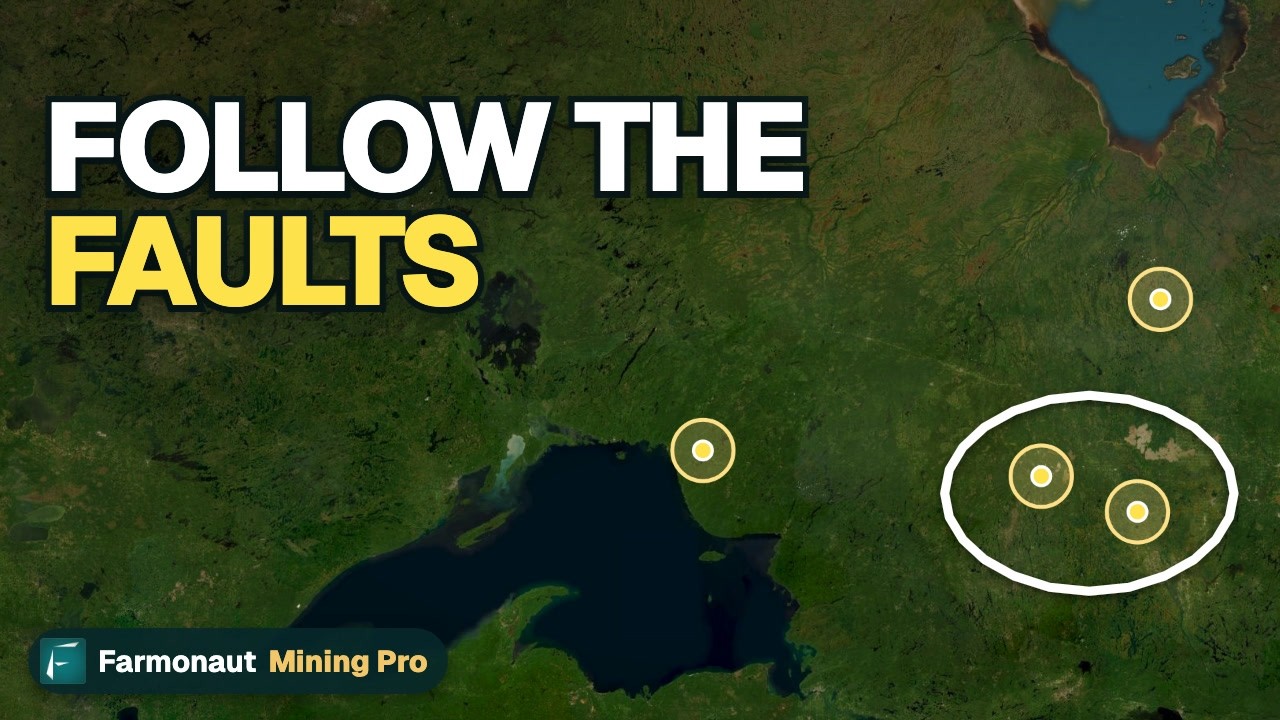
▶ Where Ontario’s gold sits and how prospecting starts in the province. · 2:53
Quebec: exclusive exploration rights for sale
Quebec calls its claims exclusive exploration rights. They are obtained by designating a polygon on a map through the GESTIM mining title system rather than staking on the ground. The government’s rate page lists the registration fee for each right by polygon size, and it applies to rights designated from 15 July 2026 (Quebec rates and indexation of mining exploration rights). South of the 52nd parallel, a right under 25 hectares costs C$53.95, a right from 25 to 100 hectares costs C$104.98 and one above 100 hectares costs C$158.60, for up to 40 rights registered the same day. Above 40 rights on one day, the fee per right is higher. North of the 52nd parallel the bands are different and top out at C$244.40 per right for polygons above 50 hectares.
Chart
Registration fee for one claim unit
Canadian dollars per claim, licence or right; unit sizes differ by province
Renewal fees match the registration fees for each size band, and the rates are indexed on 1 January each year to the change in Quebec’s consumer price index, which the page sets at 2.05% for 2026. The cost of holding a Quebec right is therefore mainly the exploration work needed to renew it, and a buyer should check the work credits and renewal date in GESTIM for each right. A seller who asks for a large sum for a right that costs about C$54 to register should be able to explain the work history behind the price.
Quebec shares the Abitibi greenstone belt with Ontario, and ground near the producing camps has been held for a long time, so open ground close to a mine is rare. Whenever a royalty is attached to a right, read how the royalty is defined in the agreement before you agree to it.
British Columbia: cell claims for sale
British Columbia uses cell claims, selected on a grid in Mineral Titles Online. The Mineral Tenure Act Regulation sets registration of a mineral cell claim at C$1.75 per hectare, with a minimum value of work each year after that: C$5 per hectare in each of the first two anniversary years, C$10 in years three and four, C$15 in years five and six and C$20 for every later year. Paying cash instead of doing the work costs double those amounts (Mineral Tenure Act Regulation, B.C. Reg. 529/2004). Work done in one year can be applied to future anniversary years, up to ten.
Since 25 March 2025 a new claim application is no longer registered instantly. The province introduced a Mineral Claims Consultation Framework after a 2023 court ruling in Gitxaala v. British Columbia found that First Nations had to be consulted at the time of claim staking (BC Government news release, 26 March 2025). For a buyer this means that purchasing an existing registered claim is faster than applying for open ground, so a claim already on the register avoids that wait. Our guide to British Columbia gold claims for sale covers the checks and costs in more depth.
Saskatchewan: claims by the hectare
Saskatchewan registers claims online through the Mineral Administration Registry (MARS). Under the Mineral Tenure Registry Regulations, registration costs C$0.60 per hectare with a C$300 minimum, and a claim can cover up to 6,000 hectares. A claim needs no expenditure in its first 12-month period. From the second to the tenth period it needs C$15 per hectare, with a minimum of C$240 per claim, and from the eleventh period C$25 per hectare, with a minimum of C$400 (The Mineral Tenure Registry Regulations, Table 2). The same table lists transfer of a mineral disposition at no fee.
The per-hectare formula is the reason large Saskatchewan blocks can be expensive to hold: a 2,000-hectare claim needs C$30,000 of work in each of years two to ten. Our Saskatchewan gold guide covers the Seabee district and the tenure options.
What claims cost to hold: BC against Saskatchewan
The next chart sets the required work per hectare side by side for the two provinces that publish a per-hectare formula. A BC claim starts cheaply and gets more expensive each two years, while a Saskatchewan claim needs nothing in its first year and then a flat amount.
Chart
Required work per hectare by claim year
Canadian dollars per hectare per year, mineral claims
Nova Scotia: exploration licences
Nova Scotia issues exploration licences made of map-designated claims. The provincial mining portal states that each claim is 16 hectares, a licence can include 1 to 80 claims, and a licence lasts two years and can be renewed as long as the holder keeps up the assessment work and files reports (Nova Scotia mining portal). The permits directory lists an initial application fee of C$10 per claim and renewal fees of C$20 per claim for the first to fourth renewals, rising to C$40 per claim for the fifth to seventh and C$80 for the eighth to twelfth (Nova Scotia mineral exploration licence page). An applicant also needs landowner permission before entering land, and permission on Crown land comes through a permit.
Fees are low, so the real costs are access and work. Confirm the landowner’s permission first, and take the current assessment work amounts from the Mineral Resources Regulations, not from older guides.
Yukon quartz claims and other territories
The Yukon still uses ground staking for quartz (hard-rock) claims. Under the Quartz Mining Act a claim is marked with posts and averages about 457 metres square, roughly 21 hectares, and the Act has no map-staking provision (Yukon quartz claim staking guidelines). The territory charges a C$10 fee per claim to record it, which must happen within 30 days of staking, and a claim needs C$100 of representation work a year, or a C$100 payment in place of the work plus a C$5 certificate fee (Yukon, apply for a quartz claim; renew your quartz claim). Placer claims are governed by the Placer Mining Act and have their own requirements. New staking is also prohibited in parts of the Yukon, including the Ross River area, after court rulings on consultation with First Nations, although claims registered before a prohibition can still be explored and developed (Yukon Executive Council Office briefing note on staking prohibitions). Check the Mining Recorder’s prohibition list before you stake or buy.
The Northwest Territories, Nunavut, Manitoba and Newfoundland and Labrador each have their own systems. Manitoba reported 6,678 kg of gold in 2024, and Nunavut reported 27,028 kg, mostly from large producing mines held by major companies, so claims for sale there are mostly sold between companies rather than listed for individuals.
Prospecting safety line: always get the owner’s or Crown’s permission before entering ground, hold the licence the province requires, and do not use mercury to recover gold.
Buying a mine rather than a claim
When the search is for a gold mine for sale in Canada, the price is no longer about claim fees. Things that come with a mine and not with a claim:
- Leases and permits. The lease, water and environmental approvals have to be transferred or reissued, and in Ontario the lease transfer needs the Ministry’s consent.
- Closure and rehabilitation. In Ontario progressive rehabilitation is a legal obligation of the Mining Act, and every closure plan must set out its schedule, so the buyer takes on that liability with the mine (Ontario mining sequence guide).
- Technical reports. A listed company discloses resources and reserves under National Instrument 43-101, which requires the disclosure to rest on work by or under a qualified person (NI 43-101 text, Ontario Securities Commission). An unlisted seller’s estimate does not have that status. Read the estimate’s date, cut-off grade and gold price assumption.
- Royalties. Ask for every royalty or similar agreement recorded against the property, because they reduce the revenue the buyer keeps.
The calculator below shows what a claim block costs to hold, which is the first number a buyer needs when comparing an asking price with the cost of registering open ground.
Calculator
What does an Ontario claim block cost to hold?
Enter your own numbers: cells, years and the seller’s asking price.
- Registration at C$50 per cell (C$): 500
- Assessment work over the period (C$): 20,000
- Total cost per hectare (C$): 228
Example values only, not a benchmark. Uses the Ontario registration fee of C$50 per cell and C$400 of assessment work per cell per year (Ontario fee schedule, April 2026; ERO notice 019-6053). Asking price is an input: example, use the seller’s price. All amounts in C$.
Six checks before you buy a Canadian gold claim
These checks apply in every province. They cost little compared with the purchase price, and most can be done from home.
Infographic
Buying a claim in 6 steps
- 1Confirm the holderUse the claim identifiers to pull the registry record.
- 2Check credits and expiryKnow the work credits and the next due date.
- 3Check surface rightsFind the land owner and the access rules.
- 4Ask about consultationConfirm permits and Indigenous consultation duties.
- 5Review the work historyAsk for assays, maps and reports.
- 6Read the transfer termsCheck royalties, options and the recorded transfer.
- Confirm the holder and the status in the registry. Use the identifiers, not a map screenshot. Ontario sells a claim abstract for C$7.50 per 15 minutes of service plus HST.
- Check the work credits and the expiry date. Ground that expires in weeks needs work or a payment before you hold it. In Ontario, credits can cover the current year and five more.
- Check the surface rights. The mining right does not give access. In Ontario a title search through ONLand identifies the surface owner.
- Ask about Indigenous consultation and permits. Exploration beyond light work needs a plan or permit, and consultation with Aboriginal communities is part of the Ontario process; in British Columbia it now happens at the claim application stage.
- Ask for the work history. Request assay certificates, maps and reports, and compare them with the provincial geoscience databases. A story about a nearby mine is not evidence for the claim.
- Read the transfer terms and royalties. A recorded transfer in Ontario costs C$20 per claim. Ask if a net smelter return royalty, option or earlier sale agreement is already attached.
The short video above explains why a claim is a right to the minerals and not ownership of the land, which is the point most first-time buyers miss.
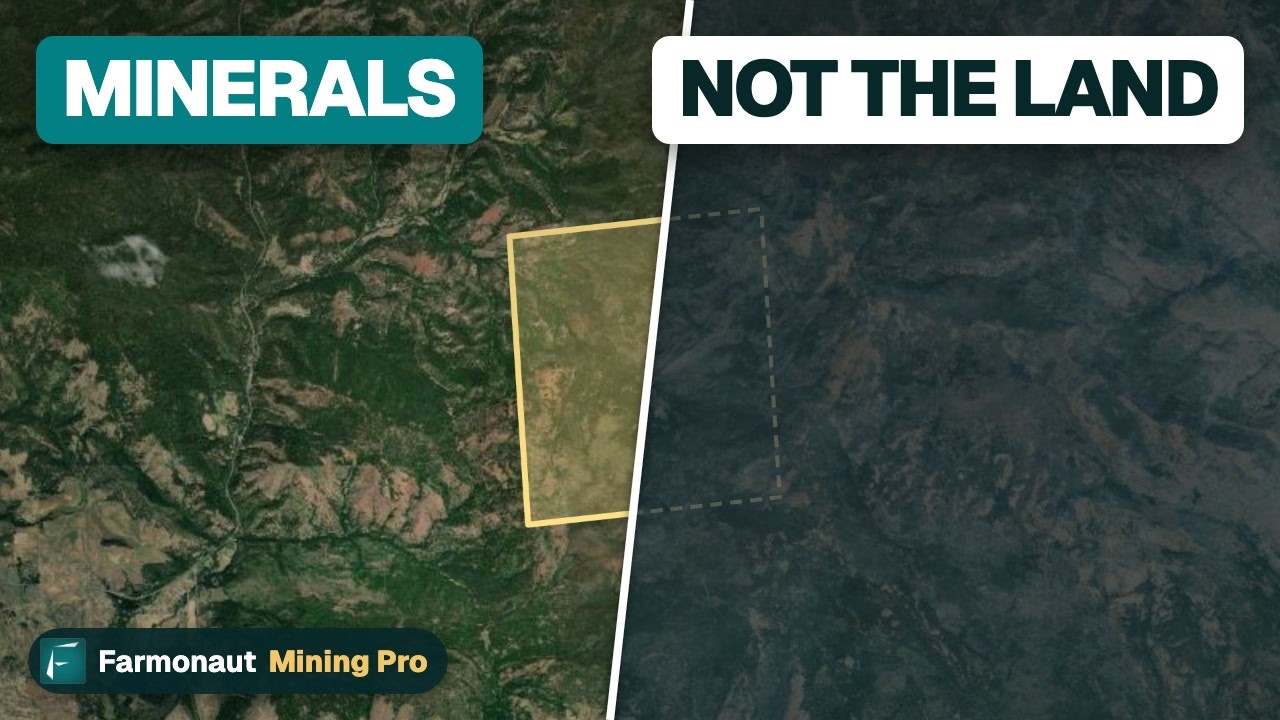
▶ Why a gold claim is a right to the minerals, not ownership of the land. · 3:19
How satellite screening helps before you pay
Satellite data cannot see gold under forest, snow or glacial till. It does map rust-coloured iron oxide, clay and mica alteration, silica and straight structures on exposed rock, which helps a buyer rank the parts of a claim block that deserve fieldwork first and decide how much of a large block to hold. Farmonaut offers this screening on a licence boundary and its results are exploration targets that sit ahead of a resource estimate, not a substitute for sampling, drilling or a qualified person’s report.

▶ What satellites can and cannot show when screening ground for gold. · 4:25
Frequently asked questions
Where can I find Canadian gold claims for sale?
Claims are advertised by individual holders, mining brokers and junior exploration companies, and some are offered in company news releases. The provincial registries do not list asking prices, but they confirm who holds a claim and whether open ground nearby can be registered directly.
How much does a gold claim cost in Canada?
The asking price is set by the seller. What is fixed is the cost to register and hold. An Ontario cell costs C$50 to register and C$400 of work a year. A BC claim costs C$1.75 per hectare to register, and a Saskatchewan claim C$0.60 per hectare with a C$300 minimum. A Yukon quartz claim costs C$10 to record.
Are there gold claims for sale in Ontario?
Yes. Ontario claims are cell claims on the provincial grid, and holders can sell them by recording the transfer against each claim for C$20. Always check the claim abstract and the assessment work credits first.
Are there gold claims for sale in Quebec?
Quebec exclusive exploration rights are transferable titles registered in GESTIM. A right under 25 hectares south of the 52nd parallel costs C$53.95 to register, so ask the seller how the asking price relates to the work already done.
Can I buy gold claims in Saskatchewan or Nova Scotia?
Both provinces allow it. Saskatchewan claims are registered online in MARS and up to 6,000 hectares can be held in one claim. Nova Scotia exploration licences are made of 16-hectare claims, from 1 to 80 per licence.
Who can register a Canadian gold claim?
Rules depend on the province. Ontario requires a prospector’s licence to register a claim, and individuals applying for a BC claim need the province’s miner certificate. Ask the registry who may hold a transferred claim before you sign a contract.
How do I check who owns a gold claim in Canada?
Search the provincial registry with the claim identifier: MLAS in Ontario, GESTIM in Quebec, Mineral Titles Online in British Columbia and MARS in Saskatchewan. The record shows the holder and the status, and Ontario sells a claim abstract for C$7.50 per 15 minutes of service plus HST.
Is a gold mine for sale in Canada worth more than a claim?
A producing or idle mine carries leases, permits, closure liability and royalties, so its value comes from a technical report and an economic model. A claim’s value comes from the evidence on the ground. The two are not comparable by price per hectare.
This page is for information only. It is not legal or investment advice. Confirm the rules and current fees with the regulator and a lawyer before buying. Prospecting needs permission, the right licence and no mercury.
Farmonaut mining
Screen a claim block from space
Send the claim boundary for a satellite mineral detection screening before you commit to a purchase.

Mining Pro sample view, synthetic data
Sources
- Ontario Ministry of Mines, Administrative Fees for Mining Lands (updated 1 April 2026): geologyontario.mndm.gov.on.ca
- Ontario, MLAS Directive 3: How to Register a Mining Claim: geologyontario.mndm.gov.on.ca
- Ontario MLAS glossary (provincial grid cell size): mlas.mndm.gov.on.ca
- Environmental Registry of Ontario, notice 019-6053 (assessment work policy): ero.ontario.ca
- Ontario, Assessment Work: Allocating Credits, Applying Credits and Payment in Place: geologyontario.mndm.gov.on.ca
- Ontario, Mining sequence guide: ontario.ca
- Quebec government, Rates and indexation of rights related to mining exploration: quebec.ca
- B.C. Mineral Tenure Act Regulation, B.C. Reg. 529/2004: bclaws.gov.bc.ca
- BC Government news release, new framework for First Nations consultation on mining claims (26 March 2025): news.gov.bc.ca
- Saskatchewan, The Mineral Tenure Registry Regulations (C-50.2 Reg 27): publications.saskatchewan.ca
- Nova Scotia mining portal: mining.novascotia.ca
- Nova Scotia, Mineral Exploration Licence permit page: novascotia.ca
- Yukon government, Guidelines for quartz claim staking: yukon.ca
- Yukon government, Apply for a quartz claim: yukon.ca
- Natural Resources Canada, Mineral production in Canada 2024, table G01: sead.nrcan-rncan.gc.ca
- Ontario Securities Commission, NI 43-101 Standards of Disclosure for Mineral Projects: osc.ca
- Yukon government, Renew your quartz claim: yukon.ca
- Yukon Executive Council Office, Mineral staking prohibitions briefing note: open.yukon.ca
Discussion
Questions, corrections or field experience? Share them below. First-time comments are reviewed before they appear, and your email is never published.
No comments yet. Be the first to add a question or your experience.

 G.I.T.T.
 Jaunita Erss Ltd
 Almosi SARL
 SRK Consulting
 Berks Gold Limited
 Mwerezi Minerals Company Limited
 Mining SARL
 SenGold Invest SAS
 Sean Mining Limited
 NTS Group (Pty) Ltd
 Mine4Africa
 Lithspo Minerals Limited
 Tintina Mining Group
 Dalgety Minerals Pty Ltd
 Vortex Minerals Pty Ltd

 Licence holder · Nigeria · Gold + lithium










