

Exploration companies · Vetting guide
Mineral Exploration Companies: Types, Spend, How to Vet
Exploration companies range from juniors to majors and services firms. Global budgets were about US$12.4 billion in 2025 (S&P Global). Use the 10-point checklist and the cash-runway calculator to vet one from public filings.
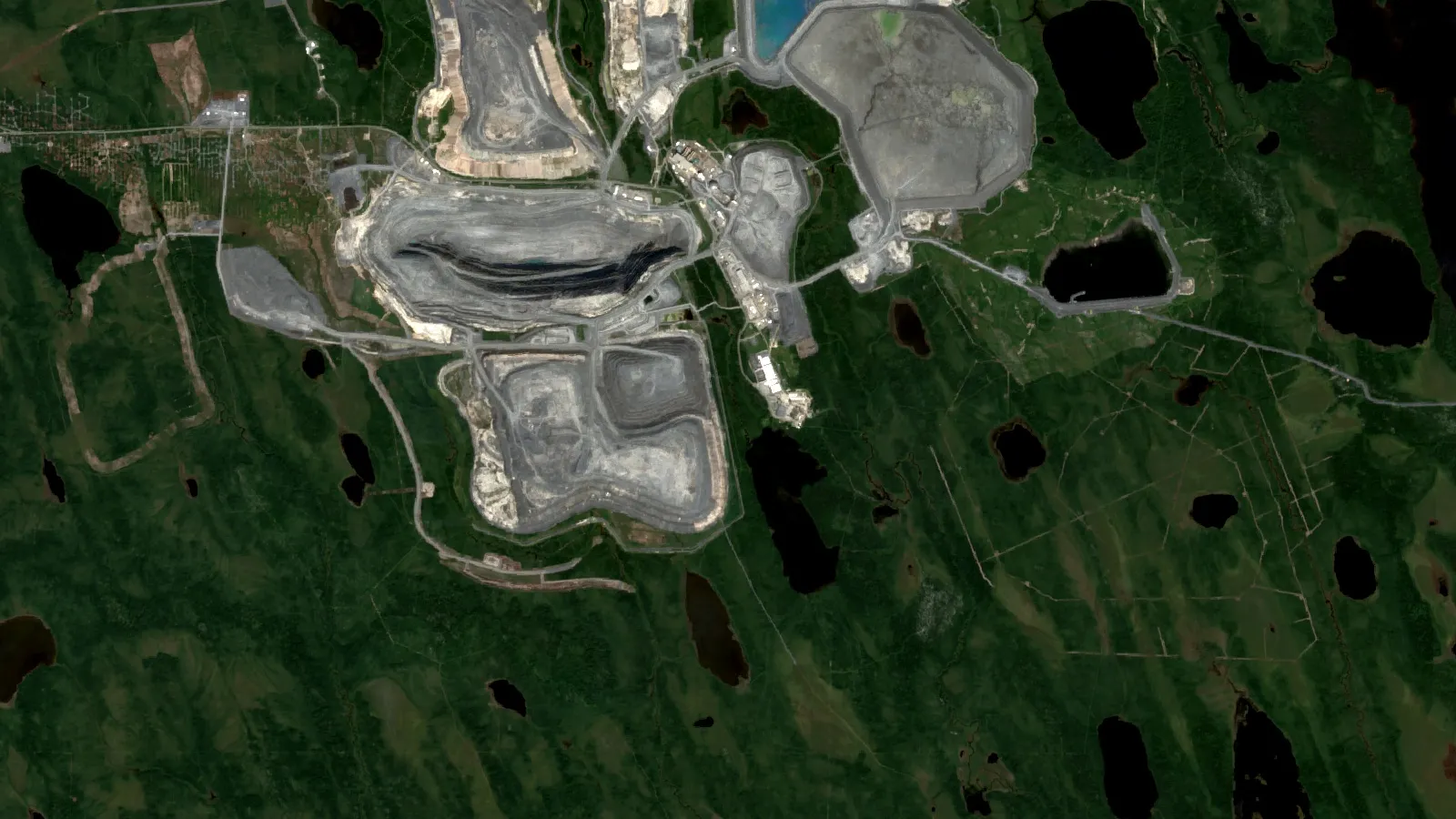
Key takeaways
- Global non-ferrous exploration budgets were about US$12.4 billion in 2025, down 1%, with gold at US$6.15 billion (S&P Global via BusinessDay).
- Minesite work took a record 45% of budgets while grassroots fell to 21%; junior budgets fell 13% to US$4.39 billion.
- Canada planned C$5.3 billion of exploration spending for 2026, up 21% (NRCan, April 2026).
- Check licence ownership, a named qualified person, resource category and cash runway before trusting a company’s drill news.
- NI 43-101, the JORC Code and SEC subpart 1300 each require a named expert behind technical claims.
In this article
- Mineral exploration companies at a glance
- The main types of explorer
- How much the industry spends and where
- Where juniors raise money and list
- How to vet a mineral exploration company: a 10-point checklist
- Reporting standards: NI 43-101, JORC and S-K 1300
- Red flags in news releases
- Mineral exploration companies in the USA
- Mineral exploration companies in the UK
- Explorers by metal: cobalt, vanadium, tin and zinc
- Geology and exploration services companies
- Check how long an explorer's cash lasts
- Where satellite data fits in vetting a project
- Frequently asked questions
Mineral exploration companies at a glance
A mineral exploration company searches for deposits and measures them well enough to sell the project or build a mine. Most have no revenue and live on money raised from investors. Global exploration budgets for non-ferrous metals were about US$12.4 billion in 2025, down 1% and the third yearly fall, according to S&P Global figures reported by BusinessDay. Gold took about half of it.
This page does three jobs. It sorts exploration companies into types, shows where the money goes, and gives a vetting checklist that a licence owner, consultant or investor can run in an afternoon using public filings. It names companies only where a filing or company page was opened and checked, and it is not investment advice.
| Type | What it does | How it is paid | Example in this guide |
|---|---|---|---|
| Junior explorer | Drills early-stage targets, no mine | Share sales, joint-venture payments | Listed juniors on TSXV and ASX |
| Developer | Has a defined resource, runs studies and permits | Equity, debt, offtake and royalty deals | Elementos (ASX: ELT), tin |
| Mid-tier or major with an exploration arm | Explores near its own mines and in new districts | Mine cash flow | Agnico Eagle (NYSE and TSX: AEM) |
| Exploration services firm | Geology, drilling, geophysics, sampling on contract | Fees from the owner of the licence | See the services section |
| Private or licence-holding company | Holds a claim or licence, often sells or joint-ventures it | Owner funds, option payments | Small licence owners |
The main types of explorer
Juniors hold early-stage ground and have no production. They raise cash, drill, publish results and hope to sell the project to a larger firm. Their value rests on drill results, so news releases are frequent and, as the red-flag section shows, easy to over-read.
Developers sit one step later. They hold a mineral resource (an estimate of the tonnes and grade in the ground) and, sometimes, a mineral reserve (the part shown to be economic to mine). They spend on feasibility studies, permits and financing. Elementos, an ASX-listed tin company, is a clear example: its quarterly report for the period to 30 June 2026 describes the Oropesa tin project in Andalusia, Spain, as at the permitting, financing and offtake stage after a 2025 definitive feasibility study, with cash of about A$40.3 million (Elementos quarterly report, ASX, 23 July 2026). The company itself calls Oropesa the most advanced tin development project in Europe, which is a company claim, not an independent ranking.
Mid-tier and major producers run their own exploration departments. Agnico Eagle reported an average of 120 diamond drill rigs turning in 2025, which drilled 1.4 million metres of core, and guided 2026 exploration expenditures and project expenses of US$565 to 635 million (Agnico Eagle release, 12 February 2026). The release does not split this work by site, so treat it as one example of a major’s exploration scale. The next section shows where global budgets go.
Services firms do not own deposits. They sell geology, drilling, geophysical surveys and laboratory work to the owners. If you own a licence and need a contractor rather than a partner, that is the group to hire. Compare quotes on a per-metre or per-line-kilometre basis, and read our guides to picking a drilling contractor and to airborne geophysical survey contractors.
How much the industry spends and where
S&P Global Market Intelligence counted US$12.4 billion of exploration budgets in 2025. Gold rose 11% to US$6.15 billion, copper rose 2% to US$3.27 billion (a 12-year high), while lithium fell 46% to US$595 million, nickel fell 37% to US$332 million and cobalt fell 41% to US$31 million (BusinessDay, 9 April 2026). The commodity split is also published in a MiningVisuals summary of the S&P report.
Chart
Exploration budgets by metal in 2025
US$ billion, selected metals (global total US$12.4 billion)
Two other numbers change how to read a company. Minesite budgets (work at and around existing mines) rose 13% to a record US$5.63 billion, or 45% of the total. Grassroots budgets (first-pass work on new ground) fell 8% to US$2.57 billion, only 21% of the total, the lowest in the dataset. Junior budgets fell 13% to US$4.39 billion. So the typical explorer is competing for a shrinking pot of early-stage money, while larger companies concentrate on ground they already know.
Money raised moved the other way. Junior and intermediate companies raised US$21.43 billion in 2025, up 109% and the second-highest total on record, and drilling activity covered 56,015 drillholes across 1,244 projects (BusinessDay, citing S&P). Funding and budgets are different measures: money raised can sit in the bank for a year before it is spent.
In Canada, Natural Resources Canada reported preliminary 2025 exploration and deposit-appraisal spending of C$4.4 billion and 2026 spending intentions of C$5.3 billion, up 21%, which would be a record if realised. The agency says Canada takes nearly one fifth of global exploration spending and that gold is the leading target (NRCan, Canadian Mineral Exploration Information Bulletin, April 2026). Our breakdown by province and company type is in mineral exploration spending in Canada.
Where juniors raise money and list
Toronto is a major centre of the junior market. TSX and TSXV say about 40% of the world’s public mining companies list on their exchanges (TMX, mining sector profile). Australian explorers list on the ASX and report under the JORC Code; London’s AIM market hosts a smaller group of mining companies; US-focused explorers file with the SEC, or list in Toronto or Sydney and file under local rules. The exchange matters because it decides which technical standard the company must follow and which filing database you search. Listing tiers and costs are compared in TSX vs TSXV vs CSE listing requirements for miners.
Chart
Canadian exploration spending
C$ billion; 2026 is spending intentions
A listing is not a quality mark. Venture and junior boards accept companies with little more than a property option and a work programme. Use the listing to know where the filings are, not to judge the project.
How to vet a mineral exploration company: a 10-point checklist
Run these checks in order. Each one uses a public document, and the first failed check is usually enough to stop.
- Who owns the ground? Find the licence or claim numbers in the company’s latest annual report or technical report, then match them to the government register (for example the provincial mining recorder, the BLM in the US, or a state mining cadastre). A company can hold an option on a claim, which is weaker than ownership. See how to read a mineral claims map in Canada for one register example.
- Is the licence in good standing? Look for the expiry date, the annual fee or work commitment, and whether it has been paid. Many explorers lose ground quietly through missed assessment work.
- Is there a qualified person? Technical statements must be prepared or approved by a named expert: a qualified person in Canada and the US, a competent person under JORC. Check the name, the professional body and whether the person is independent of the company.
- What category is the number? A mineral resource is an estimate with a confidence class (inferred, indicated, measured). An exploration target is a range, not a resource. A drill intercept is a single hole. Do not treat them as the same thing.
- How much cash is left? Read the latest quarterly or interim statement and divide cash by the monthly spend. The calculator below does this for you. Under 12 months of cash means a financing is coming.
- How was cash spent? Compare field spending with salaries, promotion and consulting. Explorers that spend most of their money off the ground are a warning.
- Who funds it? Look at placements, warrants and the share count over three years. Heavy dilution with little drilling is a pattern, not a surprise.
- What have the drill results shown over time? Look for true widths, not only downhole lengths, and for assay tables, not only headlines. Check that the company reports its misses.
- Who are the people and advisers? Check directors in the regulator’s disciplinary lists and the securities filing history of the officers.
- Does an independent source agree? A government survey map, a published technical report or a peer-reviewed paper that matches the company’s geology claim is worth more than a company slide.
For a licence owner choosing a partner, add two checks: who pays for the first drilling, and what the company gets in return (an option to earn a share, a royalty, or full ownership). For a consultant, add whether the technical report was written by someone with no stake in the company.
Reporting standards: NI 43-101, JORC and S-K 1300
Three rule sets cover most listed exploration companies. They are worth knowing because they decide what the company may say about its ground.
Canada: NI 43-101. National Instrument 43-101, “Standards of Disclosure for Mineral Projects”, sets the rules for public technical disclosure by Canadian-listed issuers, including the use of a qualified person and the technical report (Ontario Securities Commission, 43-101 page).
Australia: the JORC Code and ASX rules. JORC sets the minimum standards for reporting exploration results, mineral resources and ore reserves, and requires a competent person statement. The ASX mining reporting FAQ states that an exploration target in a public report must carry a competent person statement and a cautionary statement, and that its potential quantity and grade must be expressed as ranges (ASX, mining reporting FAQs; JORC Code 2012). JORC released a draft updated Code for public consultation on 1 August 2024 (see jorc.org), so check the current edition before quoting rules. Our guide to how to read a JORC resource table goes line by line.
United States: Regulation S-K subpart 1300. The SEC consolidated mining property disclosure into subpart 1300 which replaces the older Industry Guide 7 once all registrants must comply. Its small-entity guide says a registrant must follow it if mining operations are material to its business, and that disclosure of exploration results, resources or reserves must rest on the work of a qualified person (SEC compliance guide for mining registrants). A technical report summary is optional, not required, for exploration results.
Reading across the three. The codes are close but not identical. A “resource” under any of them is not proof of a profitable mine. Treat any figure that does not name its standard as unverified.
Red flags in news releases
- Grab-sample headlines. A rock sample picked by hand at surface can assay far above what a drill hole returns. A release that leads with one grab sample and never reports drilling is selling hope.
- “Potential” without a range or a basis. Under the ASX guidance above, a target must be given as ranges and carry a cautionary statement. If it does not, ask why.
- Neighbouring-mine comparisons. “Next to” a major mine tells you nothing about the explorer’s ground; deposits end at faults and contacts.
- Silent licence status. No licence numbers, no expiry date, no register link.
- Frequent financings and thin drilling. Count metres drilled against money raised.
- Promotion bursts. Paid newsletters, sponsored videos and social posts timed with a placement. Check the disclosure line in each one.
- Unnamed experts. Any technical claim with no qualified or competent person named.
Mineral exploration companies in the USA
US exploration works on federal land (managed by the BLM and Forest Service), state land and private land, and the rules differ for each. A company working on US ground should show claim numbers in BLM records, state permits and, if it files with the SEC, a subpart 1300 property description. US-focused explorers often list in Toronto or Sydney, so search SEDAR+ and ASX as well as EDGAR. The Alaska mining companies guide shows what an operator-by-operator table looks like for one state, with output taken from company filings. For US critical minerals, USGS publishes domestic production and import reliance for each metal every year (see the metal tables below).
Mineral exploration companies in the UK
Few explorers operate in Great Britain itself. The UK is a financing and listing base: companies on London’s AIM market explore abroad. London Stock Exchange guidance for mining, oil and gas companies recommends that applicants include an independently produced competent person’s report in the admission document, and sets minimum expectations for the report and the person who writes it (London Stock Exchange, AIM Note for Mining, Oil and Gas Companies). That note is dated June 2009, so confirm the current AIM rules on the exchange site. When you vet a UK-listed explorer, check that the competent person’s report is recent and written by a firm independent of the company, then run the same 10 checks as above on the foreign licences.
Explorers by metal: cobalt, vanadium, tin and zinc
Searchers often want a list by metal. The better first step is to see where the metal is mined, because the exploration companies cluster in the same countries and the same regulators. The USGS Mineral Commodity Summaries 2026 give production by country for each of the four below.
Chart
Tin mine output by country in 2025
Thousand tonnes of contained tin (estimate), top eight producing countries
Cobalt. World mine output was about 310,000 tonnes in 2025, and the Democratic Republic of the Congo produced about 230,000 tonnes of it, with Indonesia next at about 44,000 tonnes. The US produced about 300 tonnes and imported most of its cobalt, with a net import reliance of 79% (USGS, cobalt, 2026). Exploration budgets for cobalt were only US$31 million worldwide in 2025 (BusinessDay), so cobalt explorers are few and mostly small. Electra Battery Materials (Nasdaq and TSXV: ELBM) describes itself on its site as building the first cobalt sulfate refinery in North America, which makes it a processor more than a pure explorer. For targets and geology, see graphite, nickel, cobalt and vanadium exploration.
Vanadium. World mine output was about 110,000 tonnes in 2025, with China at about 82,000, Russia 21,000, Brazil 5,300 and South Africa 5,000. USGS reports no US primary vanadium mining; Colorado Plateau output stopped in 2020, and US production now comes from ash, residues and spent catalysts (USGS, vanadium, 2026). Australian Vanadium (ASX: AVL) describes its Gabanintha project in Western Australia as aimed at production on its company site, which is one example of a vanadium developer outside the main producing countries.
Tin. World mine output was about 290,000 tonnes in 2025. China made about 71,000 tonnes, Indonesia 61,000 and Peru 33,000; the US has no tin mine and relies on imports for 77% of refined tin (USGS, tin, 2026). Elementos is the listed developer covered above. For geology, see tin exploration in granites and placers and cassiterite mining and top mines.
Zinc. World mine output was about 13 million tonnes in 2025, led by China (4.1 million), Peru (1.5 million) and Australia (1.1 million), and US mines produced about 670,000 tonnes (USGS, zinc, 2026). Zinc is usually found with lead and silver, so a “zinc explorer” often reports several metals; check which one carries the value. The producers and mines are listed in zinc mining: top producing countries and biggest mines.
Geology and exploration services companies
Searches for “exploration geology companies” usually mean contractors. Typical services are geological mapping, soil and rock sampling, geophysical surveys, drilling, core logging, laboratory assays and resource estimation. Ask for three things before hiring: the qualified person who will sign the work, the lab and its accreditation, and the cost basis (day rate, per metre or per line-kilometre). A small licence owner can often save money by buying staged work: desktop study first, field sampling second, drilling last. The stages are explained in mineral exploration: stages, methods, costs and timelines.
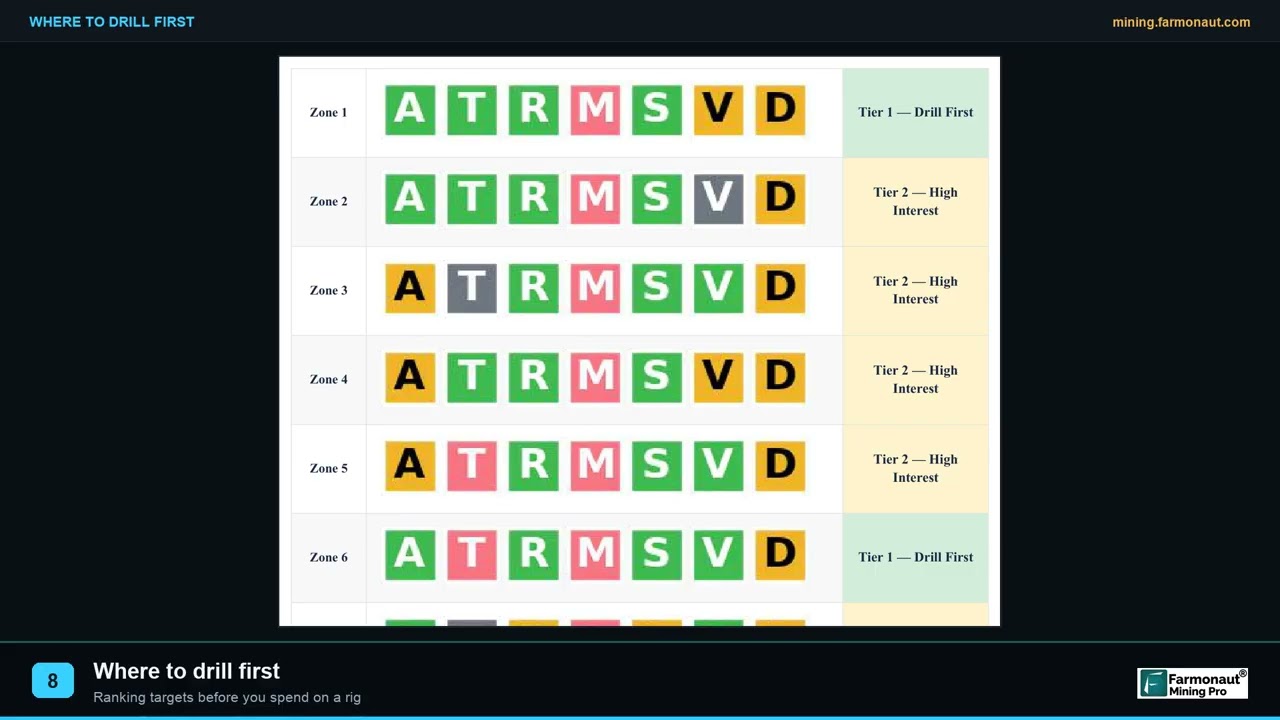
▶ Farmonaut video on exploration targeting: how to decide where to drill first. · 2:19
Check how long an explorer’s cash lasts
The quickest test of a junior is its runway: months of cash divided by monthly spending, including the drilling it promises. Enter the cash from its latest quarterly report, its monthly overhead and the metres it plans to drill.
Calculator
How many months of cash does an explorer have?
Enter figures from the company’s latest quarterly report.
- Monthly drilling spend: $166,667
- Total monthly spend: $246,667
- Annual spend: $2,960,000
Example values only, not a benchmark. Take cash and overhead from the company’s own filing; drilling cost per metre varies by country and rig, so use a quote.
Where satellite data fits in vetting a project
Satellite imagery can screen ground before a licence is bought or a partner is chosen: it shows alteration colours, structures, vegetation stress and old workings across the whole licence in one view. It cannot give grade or tonnes, and it does not replace sampling, drilling or a qualified person’s report. Farmonaut offers satellite mineral-detection reports from a licence boundary in 5 to 20 business days, which an owner can use to rank targets before spending on drilling.
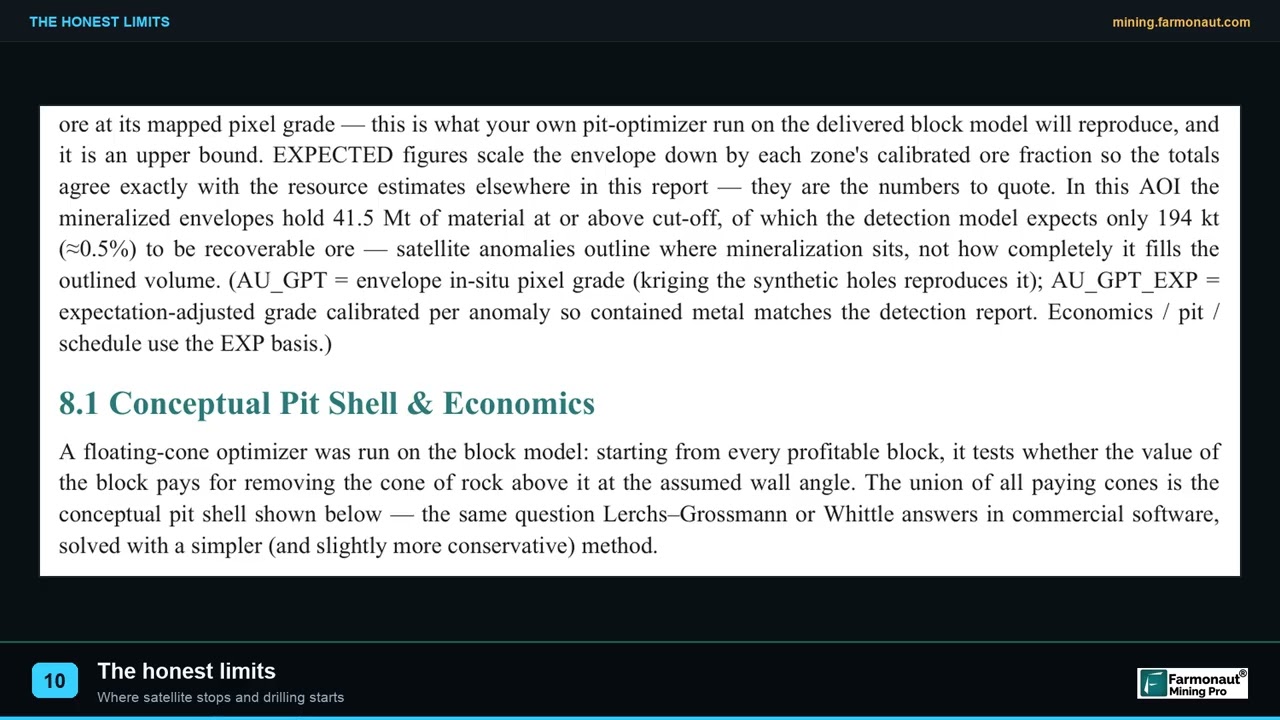
▶ Farmonaut video on what satellite exploration can and cannot do in mining due diligence. · 2:08
Frequently asked questions
What is a mineral exploration company?
A company that searches for mineral deposits and tests them with mapping, sampling, geophysics and drilling. Most have no revenue and fund their work by selling shares or by joint-venture deals.
What is the difference between a junior explorer and a major?
A junior has no producing mine and relies on investors. A major runs mines and funds exploration from cash flow. Agnico Eagle, for example, guided exploration and project spending of US$565 to 635 million for 2026 (company release).
How do I check whether an exploration company is legitimate?
Match its licence numbers to the government register, find the qualified person’s name, read the latest technical report and cash statement, and compare spending on the ground with spending on promotion. The 10-point checklist above covers each step.
Which exchanges list the most mineral exploration companies?
TSX and TSXV say they hold about 40% of the world’s public mining companies (TMX). The ASX is the other large market for explorers, and AIM in London hosts a smaller group.
Are mineral exploration companies a safe investment?
No. Most exploration projects never become mines, and share prices move on drill results and financings. This page is for information only and is not investment advice.
Who are the biggest mineral exploration companies?
There is no single official ranking. Majors with the largest exploration programmes include producers such as Agnico Eagle, which drilled 1.4 million metres in 2025. Published rankings use different methods, so name the source and year before quoting one.
Which mineral exploration companies work in the USA?
Companies explore for gold, copper, uranium, lithium and critical minerals on federal, state and private land. Check BLM claim records, state permits and SEC filings, and also search Canadian and Australian filings, because many US-focused explorers list there.
Which mineral exploration companies are based in the UK?
Few explore inside Great Britain. Most are AIM-listed companies exploring abroad, with a competent person’s report in their admission document, as London Stock Exchange guidance recommends.
Who explores for cobalt, vanadium, tin and zinc?
Mostly small and mid-size companies in the countries that mine them: the DRC and Indonesia for cobalt, China, Russia and South Africa for vanadium, China, Indonesia and Peru for tin, and China, Peru and Australia for zinc (USGS, 2026). Check each company’s technical report for the metal and the grade.
What does an exploration geology company do?
It sells technical services: mapping, sampling, geophysical surveys, drilling supervision, assay management and resource estimation. The client owns the licence and the results.
Can a licence owner work with an exploration company?
Yes, usually through an option or joint-venture agreement where the company funds work in return for a share of the project. Agree who runs the work, what is reported and who holds the licence before signing, and take legal advice.
This page is for information only. It is not investment advice. Company facts come from the filings named and carry their dates. Confirm licence and reporting rules with the regulator.
Farmonaut mining
Screen a licence area from space
Send a licence boundary and request a quote for a satellite mineral-detection report in 5 to 20 business days.

Mining Pro sample view, synthetic data
Sources
- BusinessDay, gold drives mining exploration as global budgets fall for third year (S&P Global data): businessday.co.za
- MiningVisuals, 2025 global exploration budget by commodity (citing S&P Global): miningvisuals.com
- Natural Resources Canada, Canadian Mineral Exploration Information Bulletin (April 2026): natural-resources.canada.ca
- Agnico Eagle, 2025 exploration results and 2026 plans (12 February 2026): newswire.ca
- TMX, TSX and TSXV mining sector profile: tsx.com
- Ontario Securities Commission, National Instrument 43-101: osc.ca
- JORC Code 2012: jorc.org
- ASX, mining reporting FAQs: asx.com.au
- SEC, compliance guide: property disclosures for mining registrants: sec.gov
- London Stock Exchange, AIM Note for Mining, Oil and Gas Companies: lseg.com
- Elementos, quarterly report to 30 June 2026 (ASX): announcements.asx.com.au
- USGS, Mineral Commodity Summaries 2026: Cobalt: pubs.usgs.gov
- USGS, Mineral Commodity Summaries 2026: Vanadium: pubs.usgs.gov
- USGS, Mineral Commodity Summaries 2026: Tin: pubs.usgs.gov
- USGS, Mineral Commodity Summaries 2026: Zinc: pubs.usgs.gov
- Electra Battery Materials, company site: electrabmc.com
- Australian Vanadium, company site: australianvanadium.com.au
Discussion
Questions, corrections or field experience? Share them below. First-time comments are reviewed before they appear, and your email is never published.
No comments yet. Be the first to add a question or your experience.

 Geoticgy
 GemSprout Metals Limited
 Qader Group
 Ileys General Trading
 SG Gold Mining LLC
 VRV Global Pte Ltd
 Omsri International FZE
 G.I.T.T.
 Jaunita Erss Ltd
 Almosi SARL
 SRK Consulting
 Berks Gold Limited
 Mwerezi Minerals Company Limited
 Mining SARL
 SenGold Invest SAS
 Sean Mining Limited
 NTS Group (Pty) Ltd
 Mine4Africa
 Lithspo Minerals Limited











