

Hiring geologists · Buyer guide
Geological Consulting Firms: Services, Fees, How to Hire
Match the firm to the stage of your ground, check who will sign the report, and compare written rate sheets. The US median geoscientist earned US$101,920 in May 2025, the pay base under any day rate.
Key takeaways
- Six supplier types cover most needs: global consultancies, resource-modelling specialists, regional contractors, individual geologists, structural specialists and environmental practices.
- NI 43-101, JORC and SEC S-K 1300 all require a signing person with at least five years of relevant experience and membership of an accountable professional body.
- Global nonferrous exploration budgets were US$12.4 billion in 2025, down 1%, with minesite work a record 45% of the total and grassroots work 21% (S&P Global via Business Day, April 2026).
- The US median pay for geoscientists was US$101,920 a year in May 2025 (US Bureau of Labor Statistics), so a firm’s day rate must sit well above salary divided by working days.
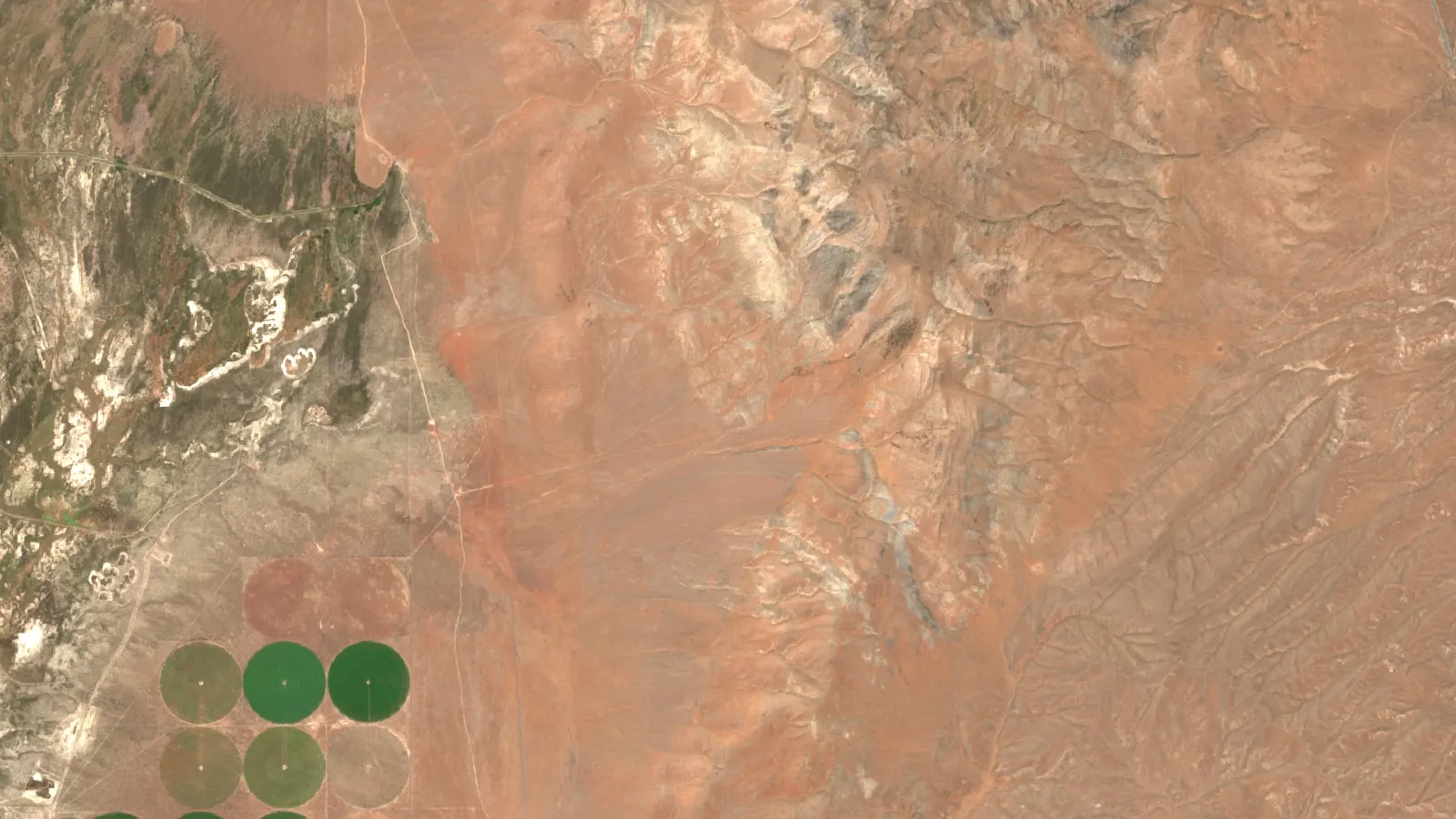
- Satellite screening can narrow ground before field days, but a geologist must test targets and a qualified person must sign any public report.
In this article
- What geological consulting firms actually do
- Where the demand for consultants is coming from
- Types of geological consulting firms and when to use each
- Resource geology and estimation: the work that supports a report
- Structural geology consultants
- Exploration targeting and field programmes
- Who can sign the report: Qualified Person and Competent Person
- How consulting fees are built
- How to hire a geological consultant in seven steps
- Interview checklist and warning signs
- Where satellite screening fits before you hire
- Frequently asked questions
Geological consulting firms sell independent technical judgement on mineral ground: mapping, sampling plans, 3D geological models, resource estimates and the signed reports that banks, buyers and stock exchanges accept. For a licence or claim owner the practical question is which type of firm matches the stage of the property, and what the work will cost. Fees come from days worked, field costs and lab bills, and in the United States the median geoscientist earned US$101,920 a year in May 2025 (US Bureau of Labor Statistics), which is the pay base a firm’s day rate has to cover and then exceed.
This guide is for licence and claim owners, consultants who need to subcontract or refer work, and investors who read technical reports. It explains the main kinds of firm, what each service delivers, who is allowed to sign a report under the Canadian, Australian and US rules, how consulting fees are built, and a seven-step way to hire. It also shows where cheaper satellite screening fits before a field programme. It is general information, not advice on a specific engagement.
What geological consulting firms actually do
A geological consultant is an outside geologist or team hired for a defined job. The job usually falls into one of five groups. Understanding which group you need keeps you from paying a resource-estimation specialist to do reconnaissance mapping, or the reverse.
- Exploration planning and targeting. Reviewing old data, choosing where to sample or drill, and ranking targets. SRK Consulting’s site lists targeting, remote sensing and geophysics, exploration geochemistry, field structural analysis, sampling and QA/QC, and field services as separate service lines (SRK Consulting).
- Field work. Geological mapping, soil and rock sampling, core logging and supervision of drilling contractors.
- Modelling and resource estimation. Building 3D geological and domain models, then estimating tonnes and grade in categories that a reporting code recognises.
- Technical reports and audits. Writing or reviewing a public technical report, or an independent review of someone else’s data for a buyer or lender.
- Valuation and due diligence. Judging what a property is worth, or whether a purchase has hidden technical problems.
Grade is the amount of metal in the rock, usually grams per tonne (g/t) for gold or percent for base metals. A resource estimate is a calculated quantity of mineralised material that has reasonable prospects of eventual economic extraction. Both depend on the geology being understood first, which is why modelling and structural work sit at the heart of the trade.
Where the demand for consultants is coming from
Consultants are hired out of exploration and project budgets, so the spending pattern shows where the work is. S&P Global Market Intelligence put global nonferrous exploration budgets at US$12.4 billion for 2025, down 1% on 2024 and the third straight annual fall, after a peak of US$13.1 billion in 2022 (Business Day, 9 April 2026, citing S&P). Gold took US$6.15 billion, about half the total, and copper US$3.27 billion, a 12-year high for that metal. Lithium fell 46% to US$595 million and nickel fell 37% to US$332 million.
Chart
Gold and copper take most exploration money
Global nonferrous exploration budget by commodity, 2025, US$ billion
The same report shows spending moving toward ground that is already known. Minesite exploration, meaning work around existing mines, rose 13% to a record US$5.63 billion, 45% of the total (MiningVisuals, 24 March 2026, citing S&P). Grassroots work on new ground fell 8% to US$2.57 billion, 21% of the total and the lowest level in the data set. Drilling still ran at 56,015 holes across 1,244 projects. For an owner this has two practical meanings. Firms with resource-modelling and mine-geology teams are busy, and an early-stage property has to show a clear reason to be funded.
Types of geological consulting firms and when to use each
There is no single market for geological advice. The table lists the main types of supplier, what each is best for, and a cost trade-off. Named examples are for illustration of the model and are not a ranking or a recommendation.
| Type of supplier | Best for | Trade-off |
|---|---|---|
| Global mining consultancy (for example SRK Consulting, SLR Consulting, Snowden Optiro) | Reports for exchange listings, lender-grade reviews, multi-discipline studies | Broad bench and name recognition; higher fees and minimum project sizes |
| Specialist resource and modelling firm | Block models, geostatistics, domain interpretation, audits of someone else’s estimate | Deep in one skill; you may need a second firm for field work or metallurgy |
| Regional exploration contractor | Mapping, soil and rock sampling, core logging, drill supervision in one country or district | Local knowledge and low travel costs; may not be able to sign an independent report |
| Individual consulting geologist | Property review, target selection, structural interpretation, second opinions | Flexible and direct; availability and professional-liability cover vary by person |
| Structural geology specialist | Faults, folds and vein orientation that control where ore sits | Narrow scope; most valuable before a drill programme is designed |
| Environmental or geotechnical geology practice | Slope stability, water, permits, baseline studies | Different skill set from ore-body geology; check mining experience |
The large firms are often small combinations of acquisitions. For example, Datamine announced in December 2021 that it had bought the advisory firm Optiro and merged it with Snowden, which Datamine had acquired in 2020, to form Snowden Optiro (International Mining, 2 December 2021). SLR Consulting appears as the named qualified person on US-style technical report summaries, for example the Selebi Mines report for Premium Nickel Resources, dated 27 June 2024 (SEC EDGAR). Always confirm that the individuals named on your proposal, not just the firm brand, hold the credentials you need.
Resource geology and estimation: the work that supports a report
Resource geologists turn drilling and sampling into a model of the deposit. The work starts with logs, assays and survey data, and the quality of those inputs decides everything downstream. The Canadian Institute of Mining, Metallurgy and Petroleum (CIM) guidelines for exploration best practice describe sample preparation, analysis, security and QA/QC (quality assurance and quality control) as core parts of any programme (CIM, 2018). Blank samples, duplicates and certified standards inserted into the sample stream let a reviewer see whether the lab can be trusted.
The model-building step defines geological domains, the zones in which grade behaves in a similar way, and then estimates grade into blocks. Under the JORC Code, reporting a Mineral Resource requires enough confidence in the continuity of mineralisation to correlate between sample points, which depends on understanding the geological and structural framework (SRK Consulting, 2018). Software such as Leapfrog and Datamine is common here; our comparison of 3D geological modelling software explains what each tool does.
Ask for the deliverables in writing: the model files, the estimation parameters, the validation checks and the QA/QC review. A report you cannot reproduce is hard to defend to a buyer. If you own a property with only surface samples, a resource estimate is premature; a target-ranking study costs less and is the honest next step. Our guide to core samples, logging and assay costs covers the drilling data these models rely on.
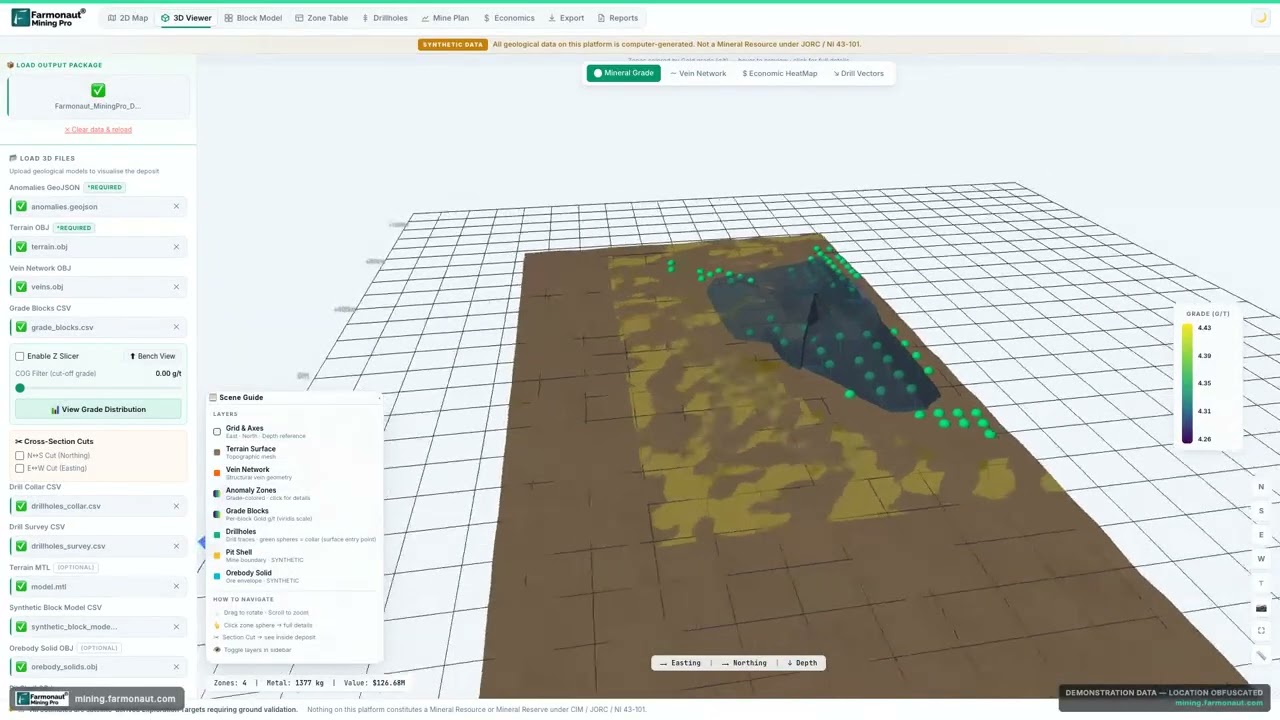
▶ Farmonaut Mining Pro builds a 3D exploration scene from satellite data (de-identified demo data). · 5:12
Structural geology consultants
Structural geology is the study of how rocks are broken and folded. For many gold, copper and base-metal deposits the fault, shear zone or fold hinge decides where the metal collected, so the grade shells in a model have to follow the structure. SRK’s example of the Maud Creek gold deposit in the Northern Territory shows the point: 3D structural modelling of the Maud Creek fault and its host mafic tuff showed a strong fault control on gold, and the vein wireframes were then built to fit those controls (SRK Consulting).
When to hire a structural specialist:
- Before drilling. To choose hole orientation so holes cut the mineralised structure at a useful angle rather than along it.
- When assays do not correlate between holes. A fault offset or a plunging shoot is a common reason.
- For open-pit or underground design. Slope and tunnel stability depend on the same structures, so the work feeds geotechnical studies.
Expect field days with a compass and a mapping tablet, an interpretation of existing drill core, and a short report with oriented diagrams. The output you should receive is a structural model and a list of recommended drill orientations, not a general description of the district.
Exploration targeting and field programmes
Targeting is the cheapest place to use a consultant. The consultant reviews your geology, geophysics, geochemistry and any old drill logs, scores the ground, and proposes a staged work plan. Stage gates matter: a first programme of mapping and soil sampling should end with a clear go or no-go decision before drill money is spent.
Chart
Exploration budgets stay below the 2022 peak
Global nonferrous exploration budgets, US$ billion
The money tends to flow to later stages, as the S&P figures above show. In 2025 grassroots work was only 21% of exploration dollars and fell 8% in value, while minesite work rose 13%. A junior-stage owner is therefore competing for funding with better-defined projects, and a consultant’s independent targeting study is a useful way to show a buyer or partner that your ground has been looked at by someone outside the owner’s circle.
What a good targeting scope contains
- A data compilation with the sources and quality of every dataset listed.
- A short geological model: host rocks, structures, alteration and the deposit type being sought. Our guide to types of ore deposits helps you describe the target you expect.
- Ranked targets, each with a reason, and what would disprove it.
- A staged budget with decision points and sample-count and metre estimates.
- A map product, because geological mapping at an agreed scale is the base for the rest.
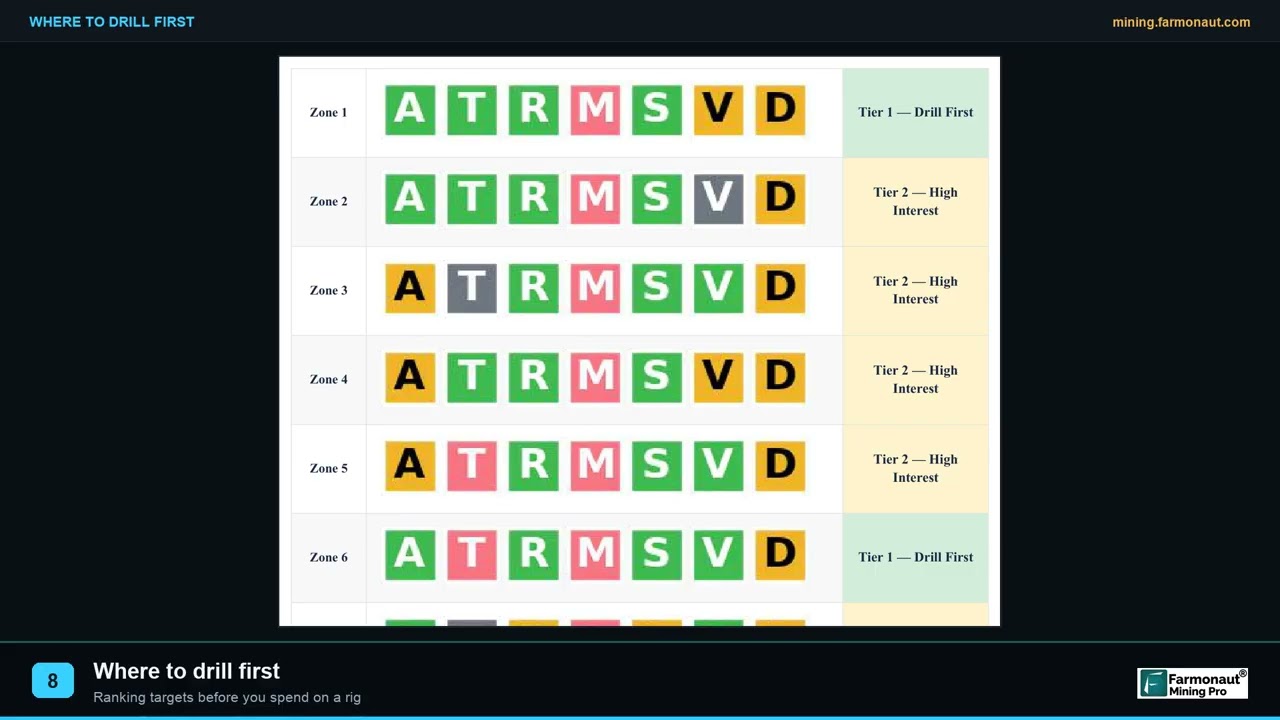
▶ How satellite targets are ranked into a drill order. · 2:19
Who can sign the report: Qualified Person and Competent Person
If a technical report will be filed publicly, the author’s credentials are set by the reporting code, not by the firm. The three regimes owners meet most often differ in detail but share the same shape: years of relevant experience plus membership of an accountable professional body.
- Canada, NI 43-101. A qualified person is an engineer or geoscientist with at least five years of experience in mineral exploration, mine development or operation or mineral project assessment, with experience relevant to the subject matter, and in good standing with a professional association (Ontario Securities Commission). Section 5.3 requires an independent qualified person for certain filings, such as a first-time preliminary assessment or resource, or a change of 100% or more in total resources or reserves; the test of independence is whether a reasonable person aware of the facts would see a circumstance that could interfere with the person’s judgement.
- Australia, JORC Code. A Competent Person needs a minimum of five years of relevant experience in the style of mineralisation and the activity being undertaken, and must belong to the Australian Institute of Geoscientists, the AusIMM or another recognised professional organisation (JORC Code, 2012). ASX rules add consent and sign-off statements for listed companies (ASX mining reporting FAQs).
- United States, SEC S-K 1300. A qualified person is a mineral industry professional with at least five years of relevant experience in the type of mineralisation and activity, and an eligible member or licensee in good standing of a recognised professional organisation (SEC final rule 33-10570). The Society for Mining, Metallurgy and Exploration notes that its Registered Member status does not by itself make someone a qualified person (SME).
Two points save money. First, ask whether you need a public report at all: a private sale, an option or an internal review may need only a competent geologist’s letter. Second, if you do need one, hire the person who will sign, not just the firm, and ask for that person’s registration number, body and years in your deposit type. Most US states also license geologists who offer services to the public, with rules that vary by state (BLS).
How consulting fees are built
Published price lists for mining geology are rare because every job differs. The fee is built from the same few parts, and understanding them lets you compare quotes fairly.
Chart
Where US geoscientists work
Share of US geoscientist employment in selected industries, percent
- Time and materials. You pay for hours or days at agreed rates by grade of staff, plus expenses at cost. This suits uncertain scopes, but you should set a cap and ask for monthly burn reports.
- Fixed fee. A set price for a defined deliverable, such as a target-ranking report. It transfers overrun risk to the consultant, so the scope must be tight.
- Retainer. A monthly sum for on-call advice, used by companies with several properties.
- Expenses. Travel, vehicles, lodging, field assistants, sample shipping, lab fees, software licences and data purchases, normally billed on top.
Pay is the starting point. The BLS reports a median of US$49.00 an hour or US$101,920 a year for US geoscientists (May 2025). Dividing that salary by 260 working days gives about US$390 a day before benefits, insurance, software, office costs and the days nobody can bill, so a consultancy’s day rate has to be well above it. Rates also rise with seniority, with the need for a signing qualified person, and with the country of the work. Treat any rate you see quoted without a date, currency and scope as unreliable, and ask each bidder for a written rate sheet.
The calculator below builds a first budget from your own numbers. The rate and lab cost are example inputs: use today’s quote from the firm. Our assay services guide covers lab costs and turnaround in more detail.
BLS data also shows where US geoscientists work, which hints at who competes for the same people: 27% are in architectural, engineering and related services, 17% in mining, quarrying and oil and gas extraction, 14% in management, scientific and technical consulting and 9% each in state and federal government (BLS, page updated August 2026). Mining firms and consultancies draw from one small pool of about 25,400 people, so senior availability, not just price, can set your timetable.
Calculator
What might a consulting engagement cost?
Enter your own days, rate and lab numbers from a quote.
- Consultant fees: $12,000
- Field expenses: $1,250
- Lab fees: $4,000
- Contingency: $1,725
Example values only, not benchmarks. The day rate, field cost and lab cost are example inputs: use today’s quote from the firm. Salary context: BLS median geoscientist pay was US$101,920 a year in May 2025.
How to hire a geological consultant in seven steps
- Define the decision. Write one sentence: “I need to know whether to drill, sell, option or drop this ground.” The scope follows from it.
- Collect your data. Maps, assays, logs, permits and reports, in a single folder with an index. Messy data adds billed hours.
- Decide the credentials. Does the result need a Qualified Person or Competent Person who is independent? If not, a good individual is cheaper.
- Shortlist three suppliers. Mix a large firm, a specialist and an individual, and ask for relevant past projects in your deposit type and country.
- Send the same brief to each. Compare proposals on scope, named people, deliverables, timeline and rate sheet, not on the headline price alone.
- Check references and conflicts. Ask for two clients you can call, and confirm the firm has no interest in neighbouring ground that would bias its advice.
- Contract in stages. Pay by milestone, define who owns the data and models, add a confidentiality clause and agree how the report may be used.
Infographic
Hiring a geological consultant in seven steps
- 1Define the decisionDrill, sell, option or drop.
- 2Collect your dataMaps, assays, logs, permits.
- 3Set credentialsDecide if a signing person is needed.
- 4Shortlist threeLarge firm, specialist, individual.
- 5Send one briefCompare scope, people, rates.
- 6Check referencesAnd conflicts of interest.
- 7Contract in stagesPay by milestone, own the data.
Interview checklist and warning signs
A short interview shows whether a consultant has done similar work. Useful questions are: Which deposits of this type have you modelled and what happened when they were drilled? Who exactly will do the work, and who signs? How do you check the lab’s QA/QC? What would make you recommend we stop?
Warning signs include a guarantee of a discovery or resource size, no named author, a report priced far below competitors with no scope detail, refusal to share a sample report, and advice that always ends in more drilling. Claim-for-sale readers and small buyers in particular should treat any promise of outcome as a red flag, because geology gives probabilities, not guarantees. Before you buy a property from someone else, our gold mine due-diligence checklist lists what a consultant should test.
Where satellite screening fits before you hire
A consultant’s field days are the most expensive part of early work, so many owners narrow the ground first. Satellite data can show iron-oxide staining, clay and mica alteration, silica and lineaments across a whole licence. This is screening evidence, not a resource: it points to places where a geologist should walk and sample, and it does not replace the fieldwork or the signed report. Farmonaut produces satellite mineral-detection reports from a KML, KMZ or polygon boundary, delivered in 5 to 20 business days, which an owner can hand to the consultant as a starting map.
The consultant still decides what the evidence means. A good brief therefore says which datasets you already have, what the satellite layers show, and which targets you want checked on the ground. Use the findings to shorten the scope, not to skip the review.

▶ Six kinds of AI geology tools and three questions to ask before choosing one. · 3:18
Frequently asked questions
What does a geological consulting firm do?
It supplies independent geologists for exploration planning, mapping and sampling, 3D modelling, resource estimation, technical reports, audits and due diligence. Large firms cover several disciplines and smaller ones concentrate on one.
How much do geological consultants charge?
There is no standard price list. Fees depend on seniority, country, scope and whether a signing qualified person is needed, and expenses and lab costs come on top. The US median pay of US$101,920 a year for geoscientists (BLS, May 2025) gives a reference point for a firm’s day rate. Get written rate sheets from at least three suppliers and use the calculator above for a first budget.
How do I choose a geology consulting company?
Match the firm to the stage of your property, check the named individuals’ credentials and deposit-type experience, compare three proposals on scope and deliverables, and call references. Ask whether the report needs an independent qualified person before you pick.
What is a qualified person in mining?
Under Canada’s NI 43-101 it is an engineer or geoscientist with at least five years of relevant experience who is in good standing with a professional association. The US SEC and Australian JORC definitions are similar and also require five years and recognised professional membership.
Do I need an independent geologist to value or sell my claim?
Not always. Public filings can require an independent qualified person in certain cases, but a private sale may only need a competent geologist’s review. A buyer will usually want one anyway, so check what your likely buyers expect.
What do structural geology consultants do?
They map and model faults, folds, shear zones and vein orientations that control where mineralisation sits, and advise on drill-hole direction and ground stability. The work is most useful before drilling and during resource modelling.
What is a resource geologist or resource geology consultant?
A resource geologist builds the geological model and the grade estimate for a deposit and checks the data quality behind it. Many firms offer audits, where a second geologist tests an existing estimate for a buyer or lender.
What is the difference between a consultant and an in-house geologist?
An in-house geologist works for one owner on an ongoing basis. A consultant is hired for a defined task, brings outside experience and independence, and can sign a report that an employee often cannot.
How long does a consulting job take?
A desktop review can take a few weeks, a target study a couple of months with field time, and a technical report longer, depending on data quality and the consultant’s workload. Ask for a dated milestone plan in the proposal.
Can satellite data replace a geological consultant?
No. Satellite screening narrows the ground and ranks areas for checking, but a geologist must test the targets on the ground and, where a public report is needed, a qualified person must sign it.
Not investment or legal advice. Confirm the reporting and licensing rules with the regulator that applies to your property.
This page is for information only. It is not investment advice or legal advice. Confirm reporting and licensing rules with the regulator that applies to your property. Field work needs landowner or licence-holder permission, a site safety plan and no mercury use.
Farmonaut mining
Map your ground before the field crew arrives
Request a quote for a satellite mineral-detection report on your licence boundary to give your consultant a starting map.

Mining Pro sample view, synthetic data
Sources
- US Bureau of Labor Statistics, Geoscientists, Occupational Outlook Handbook: bls.gov
- Business Day, Gold drives mining exploration as global budgets fall for third year (9 April 2026): businessday.co.za
- MiningVisuals, 2025 global exploration budget by commodity (24 March 2026): miningvisuals.com
- Ontario Securities Commission, National Instrument 43-101: osc.ca
- JORC Code (2012): jorc.org
- ASX, Mining reporting FAQs: asx.com.au
- US SEC, Modernization of Property Disclosures for Mining Registrants, final rule 33-10570: sec.gov
- SME, Registered Member Program: smenet.org
- SRK Consulting, Geological and Structural Modelling for Better Mineral Resource Estimation (2018): srk.com
- International Mining, Datamine acquires Optiro and merges it with Snowden (2 December 2021): im-mining.com
- SEC EDGAR, SLR Consulting consent of qualified person, Premium Nickel Resources (June 2024): sec.gov
- CIM, Mineral Exploration Best Practice Guidelines (2018): mrmr.cim.org
Discussion
Questions, corrections or field experience? Share them below. First-time comments are reviewed before they appear, and your email is never published.
No comments yet. Be the first to add a question or your experience.

 VRV Global Pte Ltd
 Omsri International FZE
 G.I.T.T.
 Jaunita Erss Ltd
 Almosi SARL
 SRK Consulting
 Berks Gold Limited
 Mwerezi Minerals Company Limited
 Mining SARL
 SenGold Invest SAS
 Sean Mining Limited
 NTS Group (Pty) Ltd
 Mine4Africa
 Lithspo Minerals Limited
 Tintina Mining Group

 Licence holder · Nigeria · Gold + lithium










