

Best Forestry Colleges in Karnataka for Sustainable Careers: Your Comprehensive Guide to Eco-Focused Education
“Karnataka hosts over 10 top forestry colleges, pioneering sustainable forest management and agroforestry education in India.”
“Nearly 70% of Karnataka’s forestry graduates contribute to rural livelihoods and conservation-focused careers annually.”
Forestry colleges in Karnataka empower students to blend traditional silviculture with modern forest ecology, agroforestry, and GIS, forming skilled professionals for sustainable careers.
Why Choose Forestry Colleges in Karnataka?
If you are passionate about forests, sustainability, and building a resilient rural future, forestry colleges in Karnataka offer pivotal pathways for impactful, long-term careers. Karnataka’s unique landscape—spanning tropical, dry, and mixed forest ecosystems—makes it an ideal learning ground for diverse forestry education. Students not only study the management and conservation of forest resources but also get deeply embedded in practical field-based experiences, interfacing forest science with rural community needs and agroforestry integration.
- ✔ Proximity to Karnataka’s dense forest cover, Western Ghats, and agro-ecological zones ensures hands-on field immersion
- 🌱 Sustainability focus through curricula integrating traditional and modern forestry, soil health, and biodiversity
- 🛤 Strong career prospects spanning government forestry, research centers, wildlife management, community outreach, and private sector
- 📈 Graduates often contribute directly to rural livelihoods, agricultural resilience, and landscape-scale restoration
- 💡 Innovative technology like remote sensing, satellite monitoring, and blockchain increasingly integrated into forestry programs
Many overlook the difference between classic forestry and today’s integrated programs in Karnataka, which also teach agroforestry, conservation planning, and rural livelihood support.
India’s Forestry Education Hotspot
Karnataka stands out as a leader in forestry education, alongside states like Uttarakhand and Kerala. Notably, the region’s commitment to agroforestry integration and innovative land management links forestry to the core of sustainable agriculture and rural development. This is especially important for students looking to connect resource planning, climate adaptation, and biodiversity conservation across traditional and modern contexts.
- 🦚 Diverse Wildlife and Ecosystems: Studies in evergreen, moist deciduous, and dry forests.
- 🌲 Reforestation and Biodiversity: Focus on tree plantation, soil health, and ecosystem restoration.
- 🛰 Technology Integration: GIS, remote sensing, and AI-driven forest resource monitoring.
- 👩🌾 Community Stewardship: Collaborate with rural & tribal populations for forest-based livelihoods.
- 💧 Watershed & Soil Conservation: Secure water cycles and reduce erosion for surrounding agricultural land.
Karnataka’s Forestry Education: Key Strengths
The state’s forestry colleges deliver comprehensive academic and practical programs focused on managing, conserving, and restoring forest landscapes. Here’s what sets Karnataka’s forestry education apart:
- ✔ Field-based experiential learning in natural and plantation forests across the Western Ghats, dry zones, and urban fringes
- 🌳 Blended learning: Traditional silviculture meets cutting-edge disciplines like forest ecology, GIS, pest monitoring, and climate-smart land use
- 👩🔬 Research and innovation: Students often join research centers or collaborate with government departments, NGOs, and allied sectors
- 🔗 Direct policy links: Curricula emphasize forest governance, stakeholder engagement, and policy literacy, enabling graduates to participate in and influence state and national programs
- 🌱 Plantation Establishment & Monitoring: Learn to design, implement, and assess plantations for timber, agroforestry, and ecosystem protection
- 🦋 Pest & Disease Surveillance: Build skills in forest health monitoring and integrated pest management
- 📊 Inventory & Assessment: Conduct forest resource inventories (timber, NTFP, biodiversity)
- 🕸 Socio-economic Evaluation: Understand community needs, tenure, and market access in forest fringe areas
- 🖥 Technology-Enabled Insights: GIS, AI, and satellite data for mapping, crop planning, and ecosystem health
The ongoing growth of climate-resilient forestry, smart plantation monitoring, and blockchain traceability opens new investment avenues for the geospatial, forestry, and agriculture sectors in Karnataka.

Top Forestry Colleges in Karnataka: Sustainability & Career Comparison
| College Name | Location | Courses Offered | Key Focus Areas | Annual Intake (Est.) | Notable Sustainable Projects/Initiatives | Placement/Research Opportunities |
|---|---|---|---|---|---|---|
| College of Forestry, Sirsi (UAS Dharwad) | Sirsi, Uttara Kannada | BSc, MSc, PhD | Sustainable Forestry, Agroforestry, Biodiversity Conservation | ~60 | Western Ghats biodiversity restoration, NTFP promotion | Forest Dept., NGOs, Research, Industry |
| Forest College & Research Institute, Ponnampet (UAS Bengaluru) | Kodagu | BSc, MSc, PhD | Silviculture, Wildlife, Watershed Management | ~60 | Evergreen forest reforestation, soil and watershed resilience | Academia, Conservation, Plantation sector |
| College of Agriculture (Forestry Wing), Hassan (UAS Bengaluru) | Hassan | BSc, MSc | Agroforestry, Forest Ecology | ~30 | Agroforestry models, smallholder integration | Extension, NGOs, Rural Development |
| College of Forestry, Keladi (UAS Raichur) | Shimoga | BSc, MSc | Dry Forest Management, Ecosystem Restoration | ~40 | Watershed programs, arid land restoration | Forest Service, DRDA, Private Sector |
| College of Forestry, Sagar (University of Horticultural Sciences, Bagalkote) | Sagar, Shivamogga | BSc | Agroforestry, Plantation Forestry | ~30 | Fruit-based agroforestry, sandalwood conservation | Horticulture, Plantation Enterprises |
Compare these forestry colleges in Karnataka based on their sustainability projects, annual intake, and rural placement opportunities to find the right fit for your sustainable career.




Forestry Curriculum & Sustainable Landscapes
The core curricula at forestry colleges in Karnataka are designed for 21st-century environmental challenges. They balance theory with practical, skill-based learning to prepare students for the sustainable management of forests, watershed protection, rural livelihoods, and integrating agroforestry with local farming systems. Typical key areas of study include:
- 🌳 Forest Ecology & Biodiversity Conservation
- 🗺 GIS-based Forest Planning & Remote Sensing
- 🦌 Wildlife Management, Habitat Restoration
- 🌿 Agroforestry System Design & Implementation
- 💧 Watershed Management, Soil Erosion Control
- 🌱 Plantation Establishment & Nursery Techniques
- 🐜 Pest & Disease Monitoring, Forest Health
- 🏡 Community Forestry & Resource Governance
- 📈 Socio-economic Assessments of Forest-dependent Communities
- 🔄 Climate Change Adaptation & Resilience Planning
This multifaceted education addresses not just forest productivity but also the impact of organic farming and contract farming in agriculture sector of Karnataka, by empowering students to analyze how sustainable land use strategies can enhance food security, rural incomes, and ecological integrity. Joint exposure to poultry farming business plan in Karnataka and saffron farming training in Karnataka further expands career options for graduates keen to integrate diversified rural enterprises with conservation.
Karnataka’s forestry curricula emphasize hands-on skills—field inventory, plantation design, GIS, and stakeholder engagement—making graduates highly employable across environmental and rural development sectors.

Connecting to Allied and International Education Trends
While Karnataka leads in national forestry education, students often benchmark their programs against agriculture colleges in Georgia and other global models—especially for innovations in agroforestry, climate adaptation, and community-based conservation. This global outlook prepares graduates for careers not only in the state but also in research and policy circles worldwide.
Field Experience & Learning in Diverse Biomes
One of the most compelling reasons to study at a forestry college in Karnataka is the immersive, field-based component. Students gain practical experience in:
- ✔ Managing tropical evergreen forests (Western Ghats, Kodagu region) and dry deciduous forests (central, eastern districts)
- ✔ Adapting conservation strategies to diverse wildlife habitats (Bandipur, Nagarhole, Soligas region)
- ✔ Monitoring reforestation projects, nurseries, and soil health in both high rainfall and drought-prone zones
- ✔ Engaging with tribal and smallholder communities for participatory forest and natural resource management

Forestry and the Broader Agricultural Nexus
Forestry education in Karnataka is intimately linked with the state’s agricultural priorities. Graduates learn to balance forest management, agroforestry system planning, and support for crop and animal husbandry (including poultry farming business plan in Karnataka models) to bolster both food security and environmental resilience.
- ✔ Trees on farms provide shade, windbreaks, fuelwood, and NTFP (non-timber forest products)
- 🌾 Agroforestry models improve soil fertility, enhance water retention, and mitigate drought/flood risks for staple crops
- 🌳 Community-focused programs help smallholders diversify income streams with fruit trees, medicinal plants, and silviculture
- 🤝 Forestry professionals partner with agriculture, resource conservation, and rural development agencies
Leverage innovations in forestry, blockchains, and satellite crop monitoring with platforms like Farmonaut’s large-scale farm management tools to streamline reforestation planning, crop inventory, and plantation health tracking for sustainable results.

Career Pathways: Forestry Colleges in Karnataka and Beyond
Forestry graduates from Karnataka institutions enjoy a spectrum of sustainable career prospects across public, private, research, and non-profit domains. Here’s where a degree from a top forestry college can take you:
- 🛡 Forest Department/IFS: Forest conservation, wildlife management, forest law enforcement
- 🔬 Research Institutes & Centers (state, central): Wildlife research, biodiversity, climate science
- 🌿 NGOs & Community Organizations: Project design, implementation, and monitoring for rural and tribal development
- 🏢 Private Sector: Plantation companies, timber certification, natural resource consulting, agroforestry products value chains
- 💼 Environmental Consulting: EIA, land-use planning, climate adaptation assessment
- 🔗 Government & Policy: Advisory roles in forestry governance, drafting of forestry/agroforestry policies
Opportunities to specialize in areas like forest product value chain management, eco-tourism, GIS-based planning, and wildlife ecology are expanding, with increasing demand for data-driven and technology-enabled forest professionals. For those interested in poultry farming business plan in Karnataka or saffron farming training in Karnataka, interdisciplinary programs further boost employability.
Interested in bolstering your expertise in environmental impact? Explore Farmonaut’s carbon footprinting solutions for insights on reducing emissions and promoting sustainable practices across farm and forest landscapes.

Agroforestry: The Bridge Between Forestry, Agriculture & Rural Prosperity
Agroforestry is central to sustainable land use in Karnataka. Through innovative curriculum and research at forestry colleges in Karnataka, students learn to integrate trees into farm systems, optimizing both ecological and economic outputs. Key benefits of agroforestry in Karnataka:
- 🌿 Reduces soil erosion and runoff, securing long-term soil productivity
- 💧 Enhances water infiltration and watershed resilience, bolstering agricultural yields
- 🥭 Diversifies farm income with fruit, timber, medicinal plants, and NTFPs
- 🌳 Improves biodiversity at the farm and landscape level
- ☀ Shields crops from wind, heat, and drought, ensuring better climate adaptation
Want to implement modern agroforestry practices? Our Crop Plantation & Forest Advisory tools offer actionable satellite insights for optimal plantation design and resource monitoring.

Ignoring the importance of stakeholder engagement—successful agroforestry projects always involve communities, smallholders, and local institutions.
Policy, Governance & Community: The Heart of Sustainable Forest Management
A major emphasis of Karnataka’s forestry education is on policy literacy and community engagement. Students develop the skills to:
- ✔ Analyze and interpret state/national forest policies and legal frameworks
- ✔ Design participatory planning projects with rural and tribal populations, particularly in marginalized and forest-fringe areas
- ✔ Facilitate equitable benefit sharing from forest products and eco-tourism initiatives
- ✔ Monitor and evaluate forest management programs for transparency and ecological integrity
- ✔ Promote inclusive governance ensuring benefits reach smallholders & tribal stakeholders
This approach is vital to ensuring that Karnataka’s forest resources are not just preserved, but also actively improve local livelihoods, stakeholder resilience, and broader rural economies.
For advanced sector governance and supply chain authentication, explore Farmonaut Traceability Solutions designed for the agriculture, forestry, and allied sectors.
Farmonaut Satellite Solutions for Forestry & Agriculture
At Farmonaut, we believe in maximizing technology for sustainable land management, offering satellite-based monitoring, AI advisory, and blockchain tools to forestry professionals, students, and institutions alike in Karnataka and beyond. Our platform allows the following:
- ✔ Real-time crop, soil, and plantation health monitoring via satellite imagery for forestry and farm landscapes
- ✔ AI-powered pest and disease alerts, maximizing yield and forest integrity (Large-Scale Farm Management interface)
- ✔ Blockchain-based traceability to ensure transparency and authenticity in forest and agricultural product supply chains (Traceability Solutions)
- ✔ Satellite-driven tools for water, fleet, and resource management, supporting both conservation and economic goals (Fleet Management)
- ✔ Carbon footprint monitoring to aid in sustainable forest and farm operations (Carbon Footprinting Tools)
Our technology is affordable, accessible, and scalable—facilitating better participation in reforestation, biodiversity stewardship, and rural development initiatives.
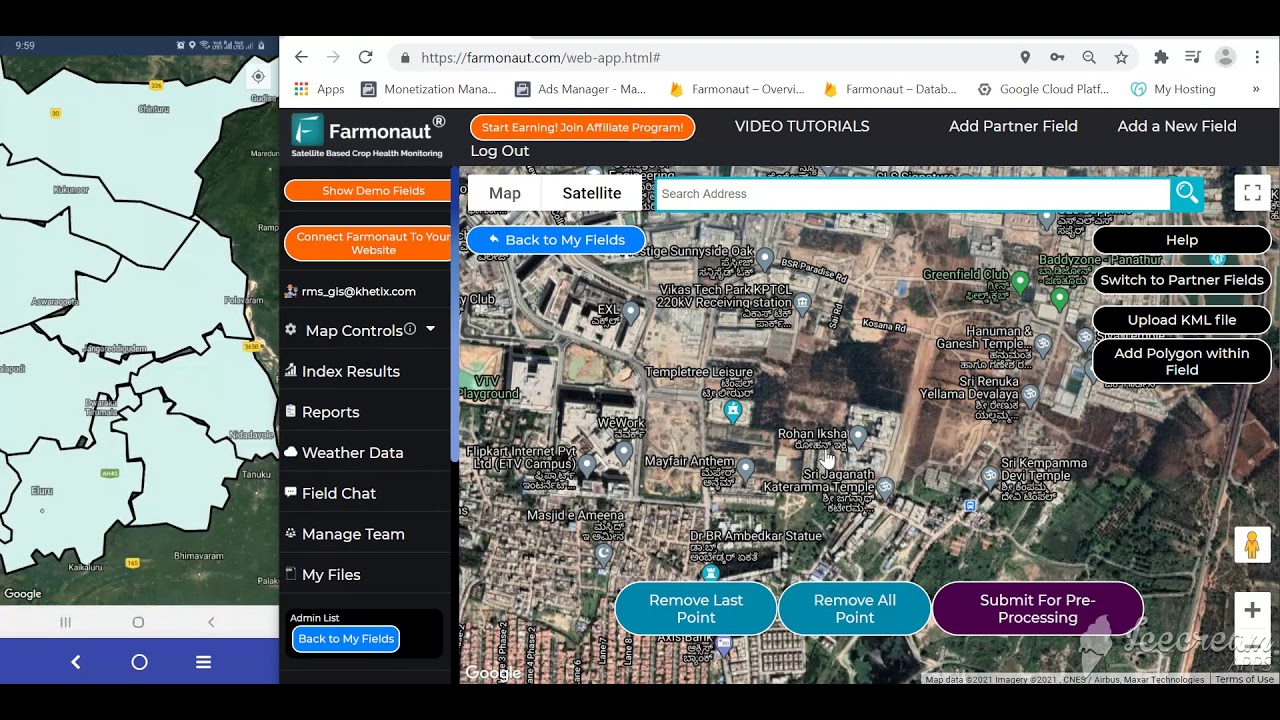
Developers and researchers can access advanced monitoring functionalities via our Farmonaut API and detailed developer documentation for custom forestry, agriculture, and environmental applications.
With satellite imagery, Farmonaut enables forestry students and professionals in Karnataka to visibly track changes in forest cover, detect illegal logging, and optimize plantation cycles—critical tools in integrated landscape management.
“Karnataka hosts over 10 top forestry colleges, pioneering sustainable forest management and agroforestry education in India.”
“Nearly 70% of Karnataka’s forestry graduates contribute to rural livelihoods and conservation-focused careers annually.”
Frequently Asked Questions
1. Which are the top forestry colleges in Karnataka?
Notable ones include College of Forestry (Sirsi and Ponnampet), College of Agriculture (Forestry Wings in Hassan and Shimoga), and the Forestry program at the University of Horticultural Sciences, Bagalkote (Sagar). Each offers unique strengths in sustainable agriculture, reforestation, and community engagement.
2. What job opportunities are available to forestry graduates from Karnataka?
Graduates often find roles in the Forest Department/Indian Forest Service, research institutes, NGOs, private sector natural resource management, consultancy, and environmental impact assessment, as well as community project design and implementation.
3. How are forestry colleges linked to rural development?
Forestry graduates are instrumental in supporting rural livelihoods by leading projects in agroforestry, watershed management, non-timber product value chains, and biodiversity conservation across Karnataka’s rural and tribal communities.
4. What is the role of technology in forestry education?
Satellite remote sensing, GIS mapping, and AI-driven resource assessment play an essential part in modern forestry programs, enabling better planning, real-time monitoring, pest/disease alerts, and climate adaptation planning.
5. Are there sustainable projects or internships linked to these colleges?
Yes, most leading forestry colleges are embedded in state and national reforestation initiatives, watershed restoration, climate-smart agriculture projects, participatory rural appraisals, and industry-led value chain development.
Studying at a forestry college in Karnataka is more than just a career move—it’s a commitment to ecological integrity, rural livelihoods, and sustainable development for future generations.
Conclusion: Building Sustainable Futures Through Karnataka’s Forestry Education
Forestry colleges in Karnataka are transforming the landscape of sustainable forest management and rural development in India. Through diverse curricula, field-based learning, and an emphasis on ecological balance and community engagement, these institutions offer essential pathways for students to become the next generation of conservation leaders, agroforestry experts, and policy influencers.
- ✔ Field immersion prepares students for real-world ecosystem management
- 🌍 Integration with agriculture and allied sectors ensures broader impact—enhancing food resource sustainability, watershed health, and rural prosperity
- 🛠 Technology (satellite monitoring, blockchain, AI) is reshaping forestry education and career opportunities
- 💼 Career prospects are broad—spanning government, industry, research, and grassroots engagement
- 🌲 Graduates play a crucial role in reforestation, watershed protection, timber value chains, and landscape resilience initiatives
With a growing emphasis on carbon-smart farming, soil health, data-driven decision-making, and transparent resource management, Karnataka’s forestry colleges are leading the way for India’s next green revolution—training professionals to safeguard both the state’s forests and its rural future.
Every step you take in forestry education at Karnataka’s best colleges contributes directly to the ecological balance, sustainable rural livelihoods, and climate resilience across India’s second most forest-rich state.

 Farmitopia
 TVS Electronics
 BW Pipelines
 WICO
WICO Gen Chayat
 Chimera Innovation
 SkyHarvest
 Polaris Digitech
 Teledarbas
 Wild Oak Farm
 SFX
SFX BACF Africa
 Doodlakine
 Exurbia Geospatial
 FieldZero
 Indico Company
