

Reviewed September 2026 against USDA Economic Research Service, the Food and Agriculture Organization, and World Bank agricultural data.
Try it: Run your own numbers →
Farming startups in Southeast Asia are building precision-agriculture, automation, and traceability tools around one hard constraint: the region grows roughly 25% of the world’s rice, per USDA’s Economic Research Service, yet faces water scarcity projected by the FAO to cut regional rice output by as much as 3.8% by 2100. Southeast Asia sustainable farming isn’t a marketing phrase here — it’s the difference between a smallholder plot staying viable through the next drought cycle or not. This guide covers what these startups actually build, what the verified numbers say about the region’s agricultural trajectory, and how a US-based reader can check every figure independently.
Introduction: What “Farming Startups” Actually Means in Southeast Asia
When people search “farming startups,” they usually mean one of two things: companies building tools for smallholders in emerging regions, or the broader agritech investment story. Southeast Asia sits at the center of both. The region’s farms are dominated by smallholders working fragmented plots across equatorial and subtropical climates — rice paddies in the Mekong Delta, oil palm and rubber plantations across Indonesia and Malaysia, and coffee and fruit orchards in the highlands of Vietnam and Thailand. Farming startups here are not chasing novelty; they’re responding to a specific, measurable production risk.
Vietnam’s agricultural sector grew at an annual rate of 3.9% in recent World Bank reporting on Malaysia and Southeast Asia — a pace that outstrips many mature agricultural economies but still leaves smallholders exposed to weather shocks that erase a season’s gains in weeks. That gap between steady long-run growth and acute short-run vulnerability is exactly where farming startups position their products: soil sensors, satellite advisories, irrigation automation, and traceability platforms that convert raw field data into decisions a farmer can act on before a loss happens, not after.
Southeast Asia produces roughly a quarter of the world’s rice (USDA Economic Research Service), and the FAO projects regional rice output could fall by up to 3.8% by 2100 under water-scarcity scenarios. Farming startups in the region are built around closing that specific gap — not general digitization for its own sake.
Farming in Southeast Asia: The Numbers Behind the Headlines
Southeast Asia farming is often described in adjectives — “fragmented,” “smallholder-dominated,” “climate-vulnerable” — without numbers attached. Here are the ones that are actually published and checkable:
- Rice output share: Southeast Asia accounts for approximately 25% of global rice production, according to USDA’s Economic Research Service rice sector overview.
- Vietnam agricultural growth: 3.9% annual growth in agricultural production in recent years, per World Bank reporting on the Malaysia and broader Southeast Asia economic outlook.
- Disaster losses: Natural disasters cost Asian agriculture an estimated $10 billion annually in productivity losses, according to the FAO’s assessment of climate change and water availability in the region.
- Drought yield impact: In rainfed, drought-prone rice areas, yield reductions during severe drought years average 17–40%, according to a peer-reviewed study published in Frontiers in Plant Science.
These four figures, read together, explain why farming startups in the region cluster so heavily around water management, early-warning systems, and satellite-based crop monitoring rather than, say, general-purpose farm accounting software. A platform that can shave even a few percentage points off that 17–40% drought-year yield loss has a direct, quantifiable case for adoption.
On the funding side: the region’s agritech investment totals by sub-sector (crop monitoring, irrigation, pest management, supply-chain) are not broken out in any USDA, FAO, or World Bank publication we could verify for this article — those bodies track production and trade, not startup capital flows. For current funding-by-sector breakdowns, the Tracxn B2B AgriTech Dashboard tracks this on a monthly-to-quarterly cadence, with its next full-year update expected in late Q4 2025 to capture complete annual figures. If you need current numbers for investment decisions, that dashboard — not this article — is the primary source to check.
Climate Risk and Water Scarcity: The Case for Precision Tools
Farming in Southeast Asia is limited by water availability more than almost any other single factor, and the FAO’s assessment of climate change and water availability in Asia lays out why: rainfall variability is increasing, dry-season water stress is intensifying in the Mekong and Chao Phraya basins, and the region’s dependence on rice — a crop that needs standing water for much of its cycle — makes it disproportionately exposed. The FAO’s 3.8%-by-2100 production decline projection is a long-run number, but the near-term signal is sharper: severe drought years already cut rainfed rice yields by 17–40%, per the Frontiers in Plant Science study cited above.
US readers have a useful domestic comparison point here. USDA’s Economic Research Service recorded US rough rice production falling from 191.6 million hundredweight (cwt) in 2021 to 160.4 million cwt in 2022 — a drought-driven decline of roughly 16% in a single season, in one of the world’s most mechanized and irrigation-capable rice sectors. If a drought that severe can cut US output by that much despite extensive irrigation infrastructure, the 17–40% losses reported in less-irrigated, rainfed Southeast Asian systems are not an exaggeration — they’re consistent with what happens when water security is thinner to begin with.
This is the throughline connecting “farming startups,” “southeast asia sustainable farming,” and “farming in southeast asia” as search terms: they’re really one question — can technology reduce the gap between a normal year and a drought year? Satellite soil-moisture monitoring, early pest and disease detection, and precision irrigation scheduling are the three product categories startups build specifically to compress that gap, and they’re covered in the next two sections.

Precision & Smart Farming: Where Southeast Asia Farming Startups Focus
Precision agriculture is the largest single category among Southeast Asia sustainable farming startups, and for good reason: it’s the most direct lever against the drought and disaster losses documented above. The core toolset looks similar across companies, even though the branding differs:
- 🌾 Soil & Crop Health Monitoring: Multispectral sensors, satellites, and mobile tools generate soil health, nutrient, and biomass maps that flag stress before it’s visible to the eye.
- 🌦 Microclimate Analytics: Field-level weather stations and satellite weather layers track moisture, temperature, and disease-risk conditions on a daily basis.
- 📉 Pest & Disease Early Warning: Computer vision and sensor networks flag stressors early enough to intervene before yield loss compounds.
- 🚰 Irrigation Optimization: Automated scheduling matches water delivery to actual crop need rather than a fixed calendar — the single highest-leverage tool against the drought losses in the section above.
- 🧪 Precision Fertilizer & Pesticide Application: Variable-rate application reduces runoff and cuts input costs simultaneously.
- 🔬 Field Surveillance: Drones and satellite imagery track crop progress and anomalies across fragmented, non-contiguous landholdings — a structural feature of Southeast Asian farm ownership that Western precision-ag tools weren’t originally designed around.

A durable way to evaluate any precision-ag claim from a startup pitch deck, whether it’s based in Southeast Asia or anywhere else: ask what baseline drought-year yield loss it’s measured against, and whether that baseline comes from a named, dated study. The Frontiers in Plant Science figure (17–40% yield reduction in rainfed drought-prone rice) is a reasonable public baseline to request a comparison against — if a vendor can’t tell you which baseline their improvement claim is measured relative to, treat the claim as unverified.

Advanced carbon footprint tracking platforms now allow farm managers, cooperatives, and even mining operations to monitor and report environmental impact at field, plot, or region scale — useful both for regulatory compliance and for qualifying for carbon-credit or green-financing programs.
Automation, Robotics, and Farm Machinery: Addressing Labor Gaps
Labor availability is a persistent constraint on Southeast Asian farms, particularly for seasonal and physically demanding tasks like weeding, transplanting, and harvest. Farming startups are responding with machinery models built around the region’s small average plot size rather than the large-acreage equipment common in the US Midwest.
Key Innovations:
- 🤖 Autonomous Weeding Machines: Purpose-built for rice, maize, and root-crop rows, reducing manual weeding labor.
- 👩🌾 Tiered Harvesting Platforms: Modular equipment for tree-fruit and palm-oil harvesting, sized for smaller plantation blocks.
- 🚚 Machinery-as-a-Service: Pay-per-use access to drones, planters, and harvesting equipment removes the upfront capital barrier for smallholders — a model increasingly common on plots under 2 hectares.
- 🔧 Fleet and Equipment Telematics: IoT sensors track equipment utilization, maintenance timing, and fuel efficiency across mixed machinery fleets.
Farmonaut’s own fleet management tools apply this same telematics logic to mixed farm and mining equipment fleets — tracking usage and maintenance in real time so operators can extend equipment life and cut unplanned downtime, regardless of whether the fleet is three tractors or thirty.
Digitization & Traceability: Empowering Decision Making and Value Chains
Digitization is the connective layer between farm-level data and market-level value. Farm management platforms — usually mobile-first, given inconsistent broadband access in rural Southeast Asia — combine crop calendars, input planning, and yield records into a single interface.
- ✏️ Crop Planning Calendars synchronize field activity with weather, irrigation, and pest cycles.
- 💳 Digital Input Purchasing streamlines access to fertilizer, seed, and crop-protection products.
- 📊 Yield Data & Analytics improves forecasting accuracy and reduces post-harvest waste from poor distribution planning.
- 🔗 Traceability Platforms track products from field to buyer, supporting quality control and premium market access.
- 💲 Fintech-Enabled Credit extends financing for inputs or equipment based on verified field data rather than collateral alone.
- ✔ Blockchain Traceability: Keeps supply chains transparent and reduces fraud in commodity transactions.
- ✔ API & Data Sharing: Centralizes field and weather data on platforms accessible via API, such as the Farmonaut API, for integration into third-party systems.
- ✔ Direct Market Access: Digital platforms connect growers directly with international buyers, cutting out layers of intermediaries.
- ✔ Adoption Gap: Digital literacy varies significantly across the region; platforms without built-in training see much slower uptake.

Many digitization platforms overlook robust data privacy and identity management. Choose farm-data platforms with clear, published terms on data ownership and access control before onboarding a cooperative’s full membership.
Forestry and Agroforestry: Monitoring, Stewardship, and Resource Conservation
Forestry and agroforestry are structurally tied to farming livelihoods across Indonesia, Malaysia, Vietnam, and the Philippines, where mixed land use — cropping alongside managed forest and conservation zones — is the norm rather than the exception. Startups apply the same remote-sensing toolkit used for crop monitoring to forest health, deforestation tracking, and post-mining land rehabilitation.
- 🌳 Remote Sensing for Forest Health: Satellite imagery and drones monitor deforestation, reforestation progress, and vegetation stress, supporting regulatory compliance.
- 🌲 Biodiversity Tracking: AI-assisted analysis flags wildlife corridors, invasive species pressure, and disease outbreaks in managed forest blocks.
- 💧 Water Resource Management: Sensing platforms track watershed condition to support reforestation planning tied to water-security goals.
- ⚡ Land Rehabilitation Post-Mining: Agricultural and mining-adjacent monitoring tools inform restoration planning so land returns to productive cropping or conservation use.

On regional forest-protection figures specifically: this article’s research brief does not contain a verified, sourced figure for hectares protected via satellite monitoring programs in Indonesia or elsewhere in the region. Rather than repeat an unsourced number, the honest answer is that country-level forest-cover and deforestation-rate data is published by national forestry agencies and by FAO’s Global Forest Resources Assessment; check those directly for a current, citable figure for any specific country or year.
Post-Harvest, Value Addition, and Reducing Losses
Post-harvest loss is a major driver of value destruction across Southeast Asian supply chains, driven by spoilage, transport delays, and volatile market access. Startups address this with a mix of hardware and market-access tools:
Key Solutions:
- 📦 Smart Storage & Cold Chain: IoT temperature and humidity monitoring extends shelf life and supports export-quality standards.
- 👁 Automated Sorting/Grading: Computer vision separates premium-grade produce, unlocking better pricing at sale.
- 🌀 Decentralized Processing: On-farm drying, milling, and packaging cuts losses tied to transport to distant processing facilities.
- 🌐 Digital Market Platforms: Direct farmer-to-buyer connections improve traceability and cut out layers of margin-taking intermediaries.
As with forest-cover figures, this article’s research brief does not include a verified, sourced percentage for regional post-harvest loss rates by crop. If you need a specific figure for a particular commodity, the FAO’s post-harvest loss studies and USDA’s commodity-specific ERS reports are the primary sources to check — cite the specific report and year rather than a rounded regional average, since loss rates vary sharply by crop, storage infrastructure, and distance to market.
Comparison Table: Farming Startups by Technology and Focus
Startup names, funding rounds, and market share figures in this space change quickly and are not tracked by USDA, FAO, or World Bank — the sources this article otherwise relies on. Rather than publish potentially stale funding numbers, here is a durable comparison by technology category and the problem each one solves, which you can map against current company names using the Tracxn B2B AgriTech Dashboard referenced above.
| Technology Category | Primary Crop/System Fit | Problem Addressed | Typical Buyer | How to Verify Current Players |
|---|---|---|---|---|
| Satellite/Remote-Sensing Crop Monitoring | Rice, oil palm, rubber, coffee | Drought and disease early warning; ties directly to the 17–40% drought-year yield loss documented by Frontiers in Plant Science | Smallholders via cooperatives; large plantation operators | Tracxn AgriTech Dashboard, crop-monitoring category |
| IoT Aquaculture Monitoring | Shrimp, fish farming | Feed optimization, water-quality monitoring | Aquaculture operators, Indonesia and Vietnam | Tracxn AgriTech Dashboard, aquaculture category |
| Digital Marketplaces | Fresh produce, staple grains | Market access, intermediary cost reduction | Smallholders, agri-cooperatives | Tracxn AgriTech Dashboard, distribution category |
| Blockchain Traceability | Export-grade commodities (coffee, cocoa, honey) | Provenance verification for premium/export markets | Exporters, certification-seeking cooperatives | Tracxn AgriTech Dashboard, traceability category |
| Machinery-as-a-Service | Rice, maize, root crops on sub-2-hectare plots | Labor shortage, upfront capital barrier | Smallholders unable to own equipment outright | Tracxn AgriTech Dashboard, farm equipment category |
| Cold Chain & Smart Storage | Perishable fruit, vegetables, seafood | Post-harvest spoilage reduction | Exporters, urban distributors | Tracxn AgriTech Dashboard, post-harvest category |
Calculator: Estimate Your Drought-Year Yield Risk
The Frontiers in Plant Science figure of 17–40% yield loss in rainfed, drought-prone rice areas is a range, not a single number — where your fields fall in that range depends on your irrigation coverage. Use the calculator below to estimate a drought-year yield-loss range for your own acreage based on that published range and the share of your land under reliable irrigation.
Run your own numbers
Assumptions: applies the 17–40% drought-year yield-loss range for rainfed, drought-prone rice reported in Frontiers in Plant Science only to the share of your acreage without reliable irrigation; irrigated acreage is assumed to hold normal-year yield. Excludes crop-specific variation, soil type, drought severity, and input-cost effects. Use it to size the scale of the risk, not as a yield guarantee.
Farmonaut: Satellite Technology for Farming Startups and Growers
Farmonaut is a satellite technology company offering monitoring and advisory tools for agriculture, mining, infrastructure, and forestry, accessible via Android, iOS, browser, and API. The goal is the same one driving farming startups across Southeast Asia: turn satellite data into a decision a grower can act on before a loss occurs.
Key Farmonaut Technologies and Benefits:
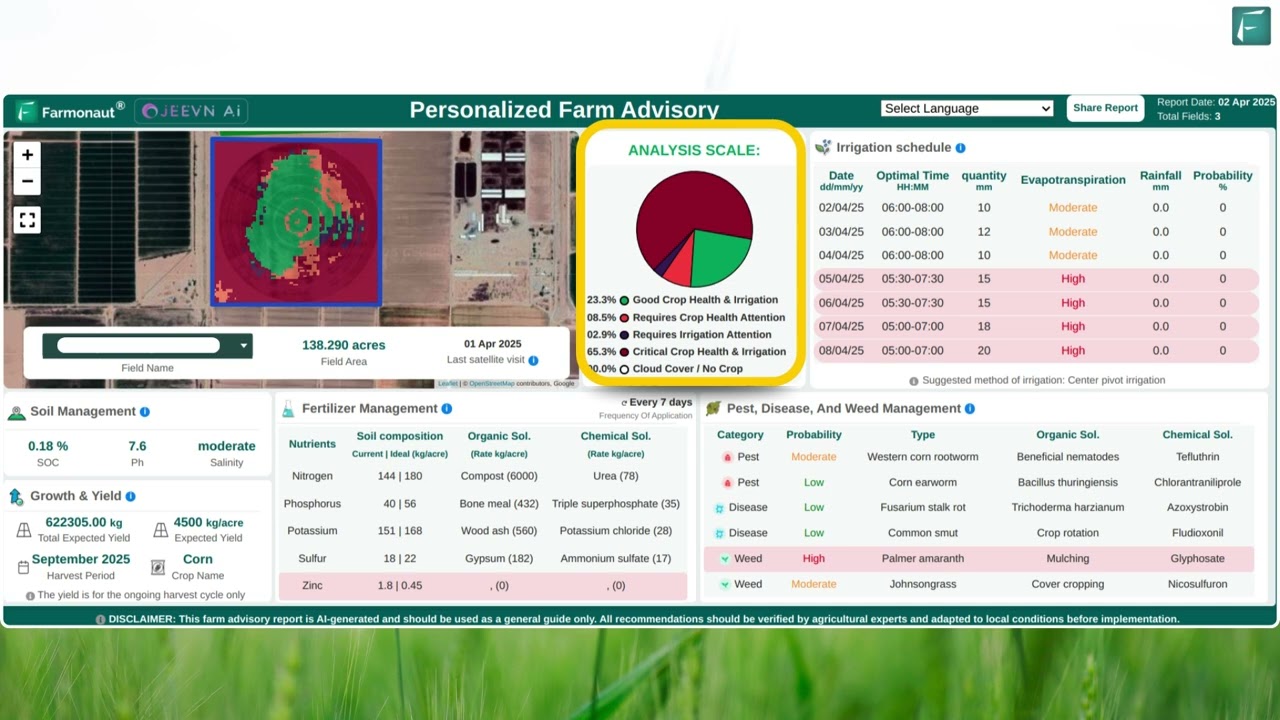
- 🛰 Satellite-Based Monitoring: Multispectral imagery delivers real-time soil, crop health (NDVI), and resource-management data.
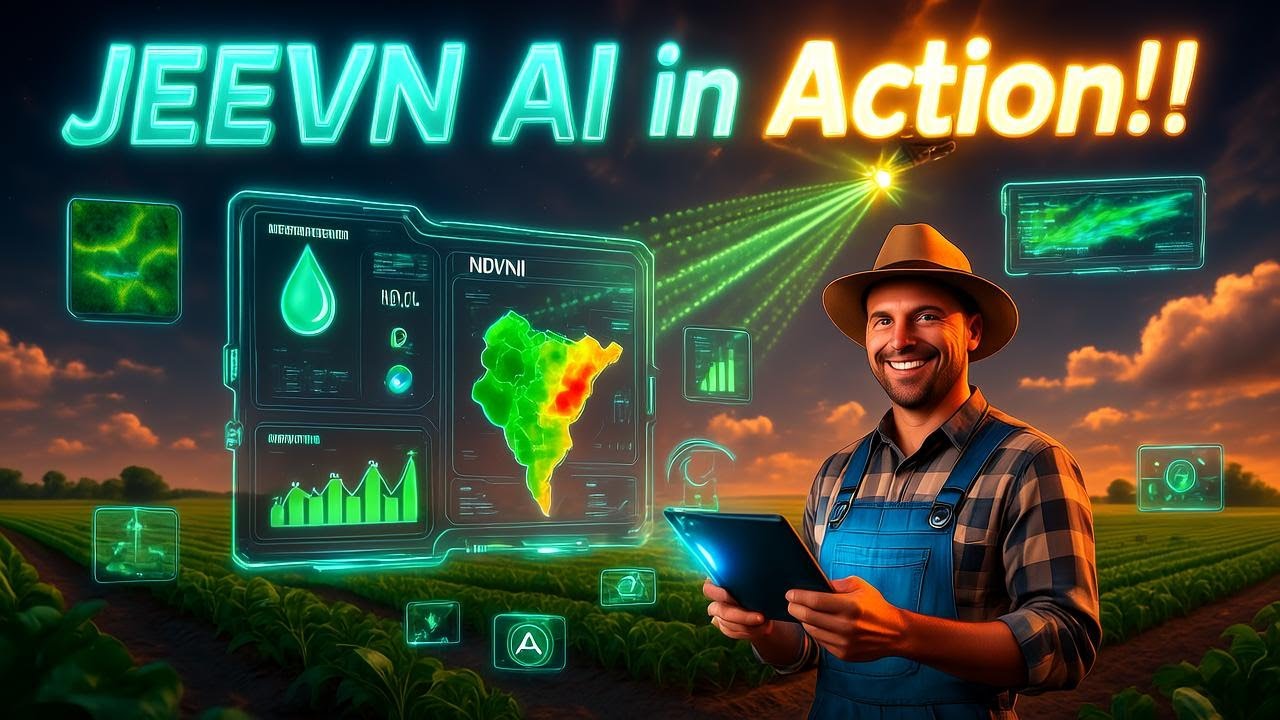
- 🤖 Jeevn AI Advisory System: Combines satellite analytics, microclimate data, and historical trends into irrigation, input, and operational guidance.
- 🔗 Blockchain Traceability: The blockchain-based traceability platform verifies origin and prevents fraud across agriculture and mining supply chains.
- 🚜 Fleet and Resource Management: Fleet management tools monitor equipment usage in real time, cutting operational costs.
- 🌍 Environmental Impact Monitoring: Carbon footprint tracking supports regulatory compliance and sustainability incentive programs.
- 🌳 Crop, Plantation, and Forest Advisory: The Farmonaut App covers planting, monitoring, and pest/disease tracking for both agriculture and forestry.

Unlike hardware-intensive monitoring setups, Farmonaut's satellite-powered platform delivers actionable analytics and remote access for farms, agri-businesses, and planners without requiring on-ground sensor networks.
How to Access Farmonaut's Solutions:



Developers and enterprise users can integrate Farmonaut's satellite, weather, and advisory services via API (view developer docs).

Inclusive Collaboration and Building Resilient Ecosystems
Farming startups that succeed at scale in Southeast Asia consistently share one trait: they co-design with the cooperatives and farmer groups who will actually use the tool, rather than deploying a product built for a different market and translating the interface.
- 🌏 Localization: Vernacular-language advisory and region-specific crop recommendations, not a one-size interface.
- 👩🌾 Farmer Training: Digital literacy and data-interpretation training that continues past the initial onboarding.
- 🙋♀️ Inclusion: Participatory design that specifically brings in women, youth, and marginalized groups within farming communities.
- 🔁 Feedback Loops: Ongoing refinement driven by farmer feedback rather than a static product roadmap.
Rolling out a technology solution without ongoing engagement or training leads to slow adoption and limited impact regardless of how good the underlying sensing or AI is. Continuous support and co-creation are what separates a pilot that scales from one that stalls.
What's Next: A Durable Framework for Evaluating Farming Startups
Rather than forecast which specific companies will lead — a list that turns over within a year or two — here is a framework that stays useful regardless of which names are currently trending: evaluate any farming startup, in Southeast Asia or elsewhere, against three questions.
- What baseline does it measure improvement against? A credible startup can point to a specific, dated, sourced baseline — like the 17–40% drought-year yield-loss range from Frontiers in Plant Science — and show its claimed improvement relative to that baseline, not a vague "increases yield" claim.
- Does the business model match the target farm size? Machinery-as-a-Service and mobile-first, low-bandwidth interfaces fit sub-2-hectare smallholder plots; hardware-heavy, subscription-only models built for large-acreage US or European farms often fail on fragmented Southeast Asian landholdings.
- Is there a training and localization plan, or just a product launch? As the collaboration section above shows, adoption failure is overwhelmingly a training and localization problem, not a technology problem.
This framework doesn't expire when funding totals or company names change — it's the checklist to re-run every time a new "top startups" list gets published for this region.
- 🌟 Scalability & Local Fit: Favor startups adapting proven technology to Southeast Asia's specific smallholder and cropping-system constraints, not importing a Western large-farm model unchanged.
- 💸 Service-First Models: Machinery-as-a-Service and pay-as-you-go digital platforms consistently scale better than upfront-purchase hardware in this market.
- 📉 Risk Management: Solutions addressing weather, disease, and input-cost volatility show the clearest return on investment, given the documented 17–40% drought-year yield exposure.
- 🔓 Open Integration: API-first platforms with accessible data, like the Farmonaut API, unlock partnership potential across adjacent sectors including forestry and mining.



Frequently Asked Questions (FAQ)
-
What do farming startups in Southeast Asia typically build?
The dominant categories are satellite/remote-sensing crop monitoring, farm management platforms, machinery-as-a-service, supply-chain traceability, and post-harvest cold-chain tools. Each addresses a specific, documented risk: for context, drought years cut rainfed rice yields by 17–40% according to Frontiers in Plant Science, and Southeast Asia produces roughly 25% of the world's rice per USDA's Economic Research Service. -
Why is Southeast Asia sustainable farming so tied to water management?
Because the region's dominant crop, rice, requires standing water for much of its growth cycle, and the FAO projects regional rice output could decline by up to 3.8% by 2100 under water-scarcity scenarios. Sustainable farming approaches here center on irrigation efficiency and drought resilience more than on any single other input. -
How does farming in Southeast Asia compare to US rice production risk?
US rough rice production fell from 191.6 million cwt in 2021 to 160.4 million cwt in 2022 during a drought year, per USDA's Economic Research Service — roughly a 16% decline despite extensive US irrigation infrastructure. Southeast Asia's rainfed systems, with less irrigation coverage, see steeper drought-year losses in the 17–40% range. -
Where can I find current farming-startup funding figures for the region?
USDA, FAO, and World Bank track agricultural production and trade, not startup capital flows. The Tracxn B2B AgriTech Dashboard tracks funding by sub-sector on a monthly-to-quarterly basis, with a full-year update expected in late Q4 2025 — check it directly for current totals rather than relying on any single article's snapshot. -
How does Farmonaut support smart farming and satellite analytics?
Farmonaut provides satellite-based crop monitoring, AI advisory through its Jeevn AI system, blockchain traceability, and fleet management for agriculture, forestry, and mining, delivered via web, mobile app, or API. -
Are these agritech platforms suitable for smallholders specifically?
Yes — many are purpose-built for smallholder plots, often under 2 hectares, with mobile-first interfaces and machinery-as-a-service models designed to remove the upfront capital barrier that blocks equipment ownership. -
What's the single most reliable way to evaluate a farming startup's yield claims?
Ask what dated, sourced baseline the improvement is measured against. A credible claim references a specific study or dataset — like the 17–40% drought-year yield-loss range from Frontiers in Plant Science — rather than a generic "increases yield" statement with no comparison point.
Farming startups in Southeast Asia are not chasing a trend — they're building against a documented, quantifiable risk: a region producing a quarter of the world's rice, exposed to drought-year yield losses of 17–40% in rainfed systems, and facing a projected multi-decade decline in water-driven productivity. The startups worth watching are the ones whose claims trace back to a dated baseline and a verifiable source, not the ones with the largest funding headline.

 SkyHarvest
 Sarvome
 Polaris Digitech
 Teledarbas
 Wild Oak Farm
 SFX
SFX BACF Africa
 Doodlakine
 Exurbia Geospatial
 FieldZero
 Indico Company
 Kubota
 FFBS
FFBS Jontra
