

Agribusiness Examples: Blockchain IP & Traceability Uses
Reviewed September 2026 against USDA NASS, USDA Economic Research Service, and USDA Agricultural Marketing Service data.
Try it: Estimated value at risk while trace is unresolved →
Agribusiness examples of blockchain in practice fall into five recurring categories: seed and input IP provenance, cold-chain freshness verification, certified-material chain of custody, mineral/fertilizer input traceability, and export contract payments. Each solves a specific traceability or intellectual-property problem that paper records and spreadsheets cannot: proving where a seed lot’s genetics came from, cutting a produce trace from days to seconds, or releasing payment the moment a delivery is verified. The rest of this article works through all five with the numbers behind them, plus how blockchain-based IP traceability specifically defends seed patents and plant variety protection in a U.S. market where four companies already control the overwhelming majority of corn genetics.
What Counts as an Agribusiness Example
Agribusiness is the full commercial chain around farming: input suppliers (seed, fertilizer, crop protection), the roughly 1.9 million operations that farm the land, processors, distributors, and exporters. USDA’s National Agricultural Statistics Service put the average U.S. farm at 466 acres in 2024, and large family farms with more than $350,000 in annual revenue accounted for 60% of all U.S. agricultural production in the 2024 Census of Agriculture — concentration that matters directly for traceability, because a small number of large operations generate most of the volume any blockchain system needs to track. When people search “examples of agribusiness,” they’re usually looking for concrete cases, not a textbook definition — so the five below are built around named use cases with quantified outcomes, not abstractions.
The U.S. Market Behind These Examples
U.S. crop cash receipts reached $238.4 billion for the 2025 calendar year, with corn and soybeans alone contributing $104.1 billion, according to USDA’s Agricultural Marketing Service. That’s the revenue base every traceability and IP system in this article sits on top of. The technology layer built to protect and track it is growing faster than the underlying commodity revenue: the U.S. agricultural supply chain software market was sized at $1.58 billion in 2025 and is projected to reach $2.86 billion by 2030, per industry market analysis. Zooming out further, the U.S. food traceability and blockchain market specifically is projected to hit $97.17 billion by 2032, growing at an 11.2% compound annual rate from 2025 to 2032, according to multiple market research firms tracking FDA FSMA Rule 204 compliance demand.
These aren’t abstract projections. FSMA Rule 204 is the concrete regulatory driver: it requires enhanced recordkeeping for a defined list of high-risk foods, and it’s the reason produce distributors and retailers are the fastest-adopting segment of this market. If you supply into retail or food-service channels handling leafy greens, melons, or soft cheeses, Rule 204 compliance dates are the practical trigger for evaluating a system — check the current compliance timeline directly with FDA rather than relying on a market report’s summary of it, since enforcement dates have shifted before.
5 Agribusiness Examples of Blockchain Traceability
Each agribusiness example below covers a distinct commercial function — inputs, cold chain, certified materials, mineral sourcing, and contract payments — so treat this as five separate decision points, not five features of one system.
1. Seed and Input IP Provenance
This is the example most directly tied to blockchain for IP traceability. Seed genetics are patented, licensed, and increasingly concentrated: USDA’s Economic Research Service found that the top four seed corporations owned 95% of U.S. corn intellectual property as of 2023. That concentration is precisely why provenance tracking matters commercially — a company holding patent or Plant Variety Protection Act rights on a hybrid needs an auditable record of which lots were licensed to which grower, to enforce royalty terms and detect unauthorized seed-saving or resale.
Concentrated IP ownership has a direct price effect: USDA’s Agricultural Marketing Service documented a 170% increase in crop seed prices paid by U.S. farmers between 1990 and 2020, tracing to expanded patent and Plant Variety Protection coverage that reduced the availability of lower-cost farmer-saved seed. A blockchain ledger doesn’t set that price, but it is the mechanism that makes IP licensing terms enforceable at scale — each seed lot gets a digital identity at the point of sale, and every downstream transfer, treatment, or replant is logged immutably against it.
- ✔ Every seed lot is assigned a digital identity at first sale, cryptographically linked to its patent or PVP certificate number.
- ✔ Treatment and replant history is timestamped and immutable, giving licensors an audit trail without physical inspection.
- ✔ QR codes or RFID tags let input dealers, crop insurers, and licensors verify a lot instantly at any point in its life.
The exact count of active Plant Variety Protection certificates and what share of U.S. farms use any form of digital seed traceability are not published in a discoverable national dataset as of this review — USDA’s Plant Variety Protection Office does publish annual certificate counts, but not broken out in a form suited to citation here. If you need a current count, request it directly from the USDA Plant Variety Protection Office rather than relying on a secondary summary.
2. Farm-to-Retail Cold-Chain Verification
The clearest quantified case study here is Walmart’s pilot with IBM Food Trust, documented in the Journal of the British Blockchain Association. Before the pilot, tracing a package of sliced mangoes back to its farm of origin took seven days using paper and spreadsheet records across the supply chain. On a blockchain ledger recording every custody transfer from farm to distribution center to store shelf, the same trace took 2.2 seconds.
That gap is the entire commercial argument for cold-chain blockchain adoption: a contamination event that used to take a week to isolate — during which a retailer often pulls an entire product category off shelves as a precaution — can be narrowed to the specific lot and farm in under three seconds. IoT sensors embedded in a shipment log temperature and humidity continuously, and every reading writes to the same ledger as an immutable, timestamped record that a retailer or insurer can audit without contacting the shipper.
- ✔ IoT sensors log temperature and humidity throughout transit, not just at pickup and delivery.
- ✔ Any cold-chain breach is recorded permanently — no after-the-fact dispute about whether a shipment was held at the wrong temperature.
- ✔ Recall scope narrows from a full product category to a specific lot and origin farm, based directly on the Walmart/IBM 7-day-to-2.2-second result above.

3. Certified-Material Chain of Custody
Packaging and pallet timber is a routine input across U.S. agribusiness exporters, and buyers in regulated markets increasingly require proof that wood packaging originates from certified, legally harvested sources. Blockchain applies here the same way it does to seed lots: every transfer from harvested log to sawmill to packager to end manufacturer is timestamped on a shared ledger, so a certification claim can be checked against an unbroken custody record instead of a paper certificate that’s easy to falsify or lose.
The commercial value is market access, not just compliance optics — buyers who require Forest Stewardship Council or equivalent certification for packaging inputs can verify a supplier’s claim directly rather than trusting a static PDF. A national dataset quantifying blockchain adoption specifically within U.S. agricultural packaging-timber supply chains does not appear to be published; if this applies to your supply chain, the practical step is asking your certifying body (FSC-US, SFI) whether they support or require a specific chain-of-custody digital standard.
4. Fertilizer and Mineral Input Traceability
Fertilizer and soil amendment inputs draw on mined minerals — potash, phosphate rock — whose origin, environmental impact, and compliance status increasingly matter to buyers making ESG claims. The blockchain application mirrors the seed example: each batch is traced from mine to refinery to blend to farm application, with environmental disclosure data (land impact, processing emissions) logged alongside the custody chain rather than published separately in a sustainability report that can’t be cross-checked against the physical batch.
The practical risk here is data quality, not blockchain technology itself: a ledger that faithfully immortalizes an inaccurate field entry just makes a bad claim permanent and harder to correct. Any operation adopting this should budget for source-data verification — sensor calibration, lab assay checks — before the ledger, not after.
5. Export Contract Farming & Smart Payments
Grain and specialty-crop exporters working with growers under forward contracts face a recurring friction point: payment release depends on manual verification of delivered quantity and quality grade, which can take days and creates cash-flow strain for the grower. A smart contract automates this — payment releases the moment delivery weight and quality-grade data are confirmed against the contract terms, both written immutably to the same ledger.
- ✔ Contract terms (quantity, grade thresholds, delivery window) are encoded and tamper-proof from signing.
- ✔ Payment triggers automatically on verified delivery data, instead of waiting on manual reconciliation.
- ✔ Lenders and insurers get a shared, auditable record for credit and claims decisions, reducing dispute time on both sides.

Blockchain for IP Traceability: Why Seed Patents Need It
“Blockchain for IP traceability” is a narrower and more specific question than general supply-chain tracking, and it’s worth separating out because the two get conflated. General traceability answers “where did this product come from.” IP traceability answers a legal question: “was this specific unit of genetic material licensed for this use, by this party.” With 95% of U.S. corn IP concentrated in four companies (USDA ERS, 2023) and seed prices up 170% from 1990 to 2020 alongside expanded patent and PVP coverage (USDA AMS), the commercial incentive to enforce licensing terms — and the commercial incentive for growers to understand exactly what they’re bound by — are both larger than they were a generation ago.
A blockchain-based IP ledger gives a licensor three things a paper contract doesn’t: an immutable timestamp proving when a lot was licensed and to whom, a query-able record across every downstream transfer (resale, replanting, cross-licensing to a custom applicator), and a shared source of truth that doesn’t depend on either party’s filing system. For a grower, the same ledger is a defense — proof of a lawful purchase and the exact terms attached to it, without relying on a paper receipt that can be lost or disputed years later.
Comparison Table: The 5 Examples Side by Side
| Example | Primary Function | Quantified Evidence | Source |
|---|---|---|---|
| Seed & Input IP Provenance | License enforcement, royalty tracking, anti-counterfeiting | 95% of U.S. corn IP held by 4 firms (2023); seed prices +170% (1990–2020) | USDA ERS / USDA AMS |
| Cold-Chain Verification | Recall speed, spoilage proof | Trace time: 7 days → 2.2 seconds | Walmart/IBM Food Trust pilot, 2018 |
| Certified-Material Chain of Custody | Legal sourcing proof for packaging/timber inputs | National adoption data not published — verify via certifying body | FSC-US / SFI (direct inquiry) |
| Fertilizer & Mineral Input Traceability | ESG disclosure, origin validation | No national adoption survey published — data quality is the limiting factor, not the ledger | — |
| Export Contract Smart Payments | Automated payment on delivery/quality verification | Market growing 11.2% CAGR 2025–2032 (traceability tech overall) | Market research consensus, via bahrainfoodmonitor.org |
Two of the five examples above have a genuine, sourced number attached; two do not, and this article says so directly rather than filling the gap with a plausible-sounding estimate. That’s a deliberate choice: an invented adoption percentage for timber chain-of-custody or mineral traceability would look more complete and be worth nothing to a reader trying to make a real decision.
Traceability ROI Calculator: Recall Cost Avoided
The Walmart/IBM result above — a trace time cut from seven days to 2.2 seconds — only becomes a dollar figure once you apply it to your own recall scope and daily holding cost. Use the calculator below with your own numbers.
Estimated value at risk while trace is unresolved:
Assumes the 7-day vs. 2.2-second trace-time gap documented in the Walmart/IBM Food Trust pilot applies proportionally to your holding-cost exposure. Excludes legal, reputational, and downstream retailer-relationship costs, which don’t scale linearly with trace time. Adjust every input to your own shipment volume and product value — the defaults are illustrative, not a benchmark.
Implementation Checklist
- ✔ Data governance: Define who can write, verify, and read each record before deployment — licensors and regulators need access; competitively sensitive practices can still be shielded field-by-field.
- ✔ Interoperability: Confirm the system supports RFID/QR standards and GS1 or equivalent framework compatibility before committing — a closed, proprietary ledger recreates the “data island” problem it’s meant to solve.
- ✔ Start narrow: Pilot on the highest-value or highest-risk segment of your supply chain — a single seed line under active licensing dispute, or a single perishable SKU under FSMA Rule 204 — before scaling chain-wide.
- ✔ Source-data quality controls: Since the ledger only immortalizes what’s entered, build calibration and audit checks into the data-capture step, not just the ledger step.
- ✔ Check FSMA Rule 204 compliance dates directly with FDA if you handle any food on the Food Traceability List — the enforcement timeline is a moving target and shouldn’t be sourced from a market report’s summary.
Farmonaut’s Traceability & Satellite Tools
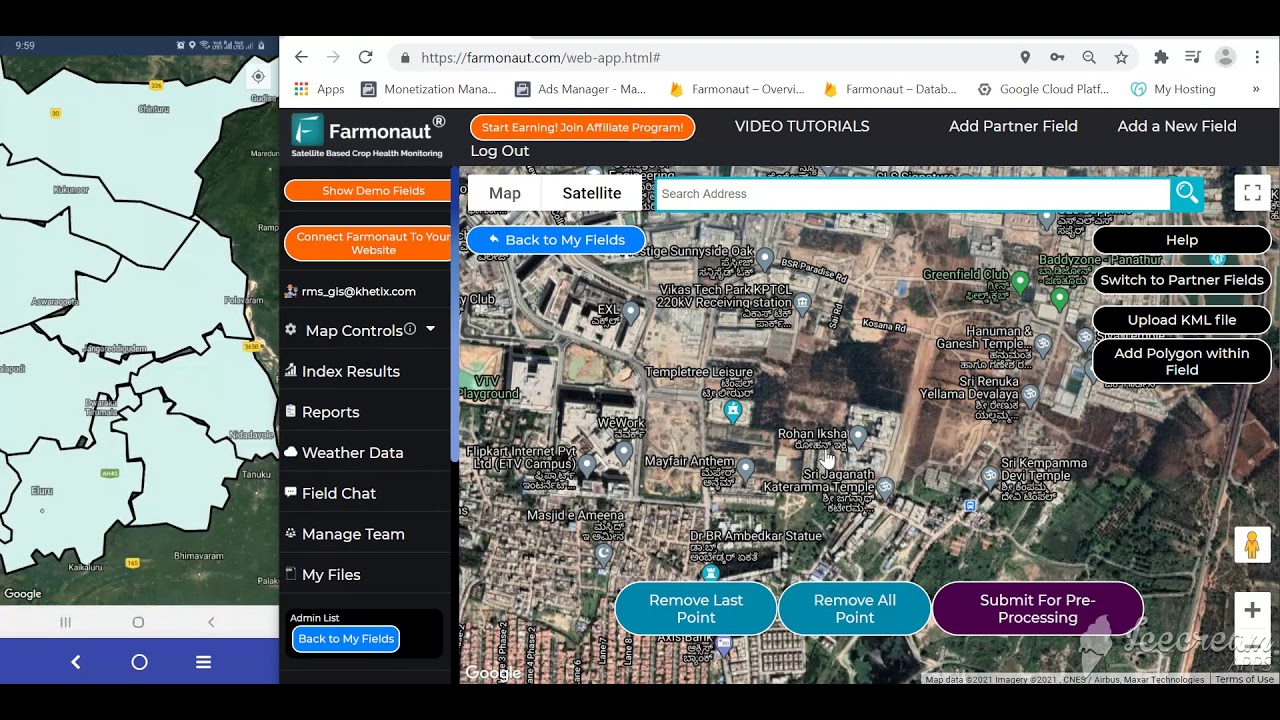
Farmonaut combines satellite crop monitoring with blockchain-based traceability, giving the source-data quality layer described above a verifiable, field-level foundation rather than relying on manual entry alone.
- ✔ Satellite-based monitoring of crops and inputs for field-level verification tied to traceability records
- ✔ Blockchain-integrated traceability — learn more about our traceability solutions
- ✔ Environmental and carbon impact monitoring for ESG disclosure — read about our carbon footprinting tools
- ✔ Fleet and resource management for cold-chain and logistics oversight — explore fleet management features



Developers and corporate teams can integrate satellite and traceability data directly into ERP or logistics systems via Farmonaut APIs (API Developer Docs). For managing large-scale estates or multi-farm portfolios with compliance oversight, see the Large Scale Farm Management App.


FAQ: Agribusiness Blockchain Examples
-
What are the most common agribusiness examples of blockchain use?
Seed and input IP provenance, cold-chain freshness verification, certified-material (timber/packaging) chain of custody, fertilizer and mineral input traceability, and export contract smart payments — the five covered above, each solving a distinct commercial problem rather than one generic “blockchain for farming” use case. -
How does blockchain help with IP traceability specifically?
It creates an immutable, timestamped record of licensing and custody for patented or Plant Variety Protection-covered genetics, which matters more as ownership concentrates — USDA ERS found 95% of U.S. corn IP held by four companies as of 2023. The ledger gives both licensor and grower a shared, tamper-proof record of what was licensed, to whom, and under what terms. -
How much faster is blockchain tracing versus paper records?
In the documented Walmart/IBM Food Trust pilot, tracing sliced mangoes from shelf to farm origin dropped from 7 days with paper records to 2.2 seconds on a blockchain ledger — a result specific to that pilot’s setup, not a universal guarantee, but the clearest quantified case available. -
Is there published data on what share of U.S. farms use blockchain traceability?
No national survey breaking this out by farm size or region has been published as of this review. What is published: the U.S. agricultural supply chain software market was $1.58 billion in 2025, projected to reach $2.86 billion by 2030, and the broader food traceability/blockchain market is projected at $97.17 billion by 2032 (11.2% CAGR from 2025). Those are spending trajectories, not adoption-rate surveys — treat them as different questions. -
Why did seed prices rise so much, and how does traceability relate?
USDA’s Agricultural Marketing Service documented a 170% increase in crop seed prices paid by U.S. farmers between 1990 and 2020, tied to expanded patent and Plant Variety Protection coverage. Traceability doesn’t cause this price trend, but it’s the enforcement mechanism that makes expanded IP protection commercially workable at scale.
Conclusion
The five agribusiness examples above — seed and input IP provenance, cold-chain verification, certified-material custody, mineral input traceability, and export smart payments — share one underlying method: replace a paper or spreadsheet record that can be lost, falsified, or disputed with a timestamped, shared ledger that every stakeholder can independently verify. The clearest quantified proof of value remains the Walmart/IBM pilot’s 7-day-to-2.2-second trace time. The clearest quantified reason blockchain-based IP traceability matters more each year is the seed market: 95% corn IP concentration in four firms as of 2023, and a 170% seed-price increase from 1990 to 2020, both from USDA.
Where this article couldn’t find a published number — timber chain-of-custody adoption rates, mineral-traceability adoption, farm-level blockchain usage broken out by size or region — it says so directly rather than filling the gap. That’s the durable part: the method for checking these figures yourself (USDA NASS Census of Agriculture for farm-level data, USDA ERS for IP concentration, USDA AMS for price and receipts data, and your own certifying body for chain-of-custody standards) still works whether the specific figures above are six months old or three years old. Check USDA NASS Census of Agriculture, USDA ERS on seed IP concentration, and the Journal of the British Blockchain Association’s Walmart/IBM case study directly for the current versions of the numbers cited here.
- ✔ Seed and input IP provenance is the highest-stakes blockchain use case given 95% corn IP concentration in four firms.
- ✔ Cold-chain trace time dropped from 7 days to 2.2 seconds in the documented Walmart/IBM pilot — the strongest single proof point available.
- ⚠ Timber and mineral traceability adoption data is not nationally published — verify directly with certifying bodies for your specific supply chain.
- ✔ The U.S. traceability software market is growing from $1.58B (2025) toward $2.86B (2030 projected), signaling sustained investment regardless of any single year’s headline.
Discussion
Questions, corrections or field experience? Share them below. First-time comments are reviewed before they appear, and your email is never published.
No comments yet. Be the first to add a question or your experience.

 SFX
SFX BACF Africa
 Nivia
Nivia Doodlakine
 Exurbia Geospatial
 FieldZero
 Indico Company
 Kubota
 FFBS
FFBS Jontra
 Tucor
Tucor Hayleys Agriculture
 Licence holder · Niger · Gold
 Licence holder · Nigeria · Gold + lithium










