

Agriculture Chart of Accounts: Essential Accounting Steps for Modern Farming and Agri-Businesses (2025 Guide)
Table of Contents
- Summary: Why Agriculture Accounting and Chart of Accounts Matter in 2025
- Key Trivia: Digital Adoption Trends
- Understanding Agriculture Accounting: The Unique Nature of Farm Transactions
- Defining the Agriculture Chart of Accounts (CoA)
- Core Components of an Agriculture Chart of Accounts
- The Role of Digital Tools and Advancements in Agri-Accounting
- Comparative Table of Traditional vs. Digital Agriculture Chart of Accounts
- Accounting for Farmland, Crops, Livestock & Biological Assets
- Essential Steps for Implementing an Agriculture Chart of Accounts
- Integrated Digital Tools for Account Farming – Farmonaut’s Advanced Solutions
- Video Tutorials: Modern Farming Financial Management
- Benefits of Robust Agriculture Accounting and a Specialized CoA
- Key Trivia: Financial Error Reduction
- FAQs – Agriculture Chart of Accounts & Financial Management
- Conclusion: Unlocking the Future of Agricultural Management
Agriculture Accounting and the Role of a Chart of Accounts in Modern Farming
In today’s rapidly evolving landscape of agriculture, accurate and effective financial management has become indispensable for farm owners and agribusinesses. This transformation is driven by advancements in technology, increasing regulatory requirements, and the growing need to sustain profitability while ensuring the viability of farming operations. At the heart of this transformation lies the agriculture chart of accounts, which forms the central backbone for robust accounting for agriculture.
This guide unpacks the essential steps to building and sustaining a modern chart of accounts (CoA) tailored to the agri-sector. We highlight the importance of specialized farmlands accounts, digital platforms, and regulatory compliance, emphasizing how digital innovation is reshaping agriculture accounting for 2025 and beyond.
“Over 70% of modern farms use digital accounting tools to streamline their agriculture chart of accounts and financial tracking.”
Understanding Agriculture Accounting: The Unique Nature of Farm Transactions
Agriculture accounting refers to the systematic recording, categorizing, and reporting of financial transactions unique to farming operations. Unlike typical business accounting, accounting for agriculture must address the inherent challenges posed by the seasonal nature of activities, fluctuating commodity prices, complex biological assets (crops and livestock), and long production cycles. These cycles impact everything from revenue recognition to valuation on farm accounts.
Key elements specific to agriculture accounting include:
- Tracking Inputs: Monitoring seeds, fertilizers, labor, feed, fuel, and more for each farming operation.
- Managing Assets & Liabilities: Including farmland accounts, buildings, machinery, breeding stock, crop inventory, loans, and lease obligations.
- Accurately Measuring Output: Such as sales from crops and livestock, or non-cash revenues like government subsidies and grants.
- Dealing with Biological Assets: Regularly valuing growing and harvested crops and livestock.
- Ensuring Compliance: Maintaining up-to-date records for tax, subsidy, and environmental reporting.
These unique requirements mean that farm business management and financial reporting need to be more granular and activity-linked than in other industries.
What Is an Agriculture Chart of Accounts? (Focus Keyword: Agriculture chart of accounts)
A chart of accounts (CoA) is essentially the master list of all account names and numbers used to categorize every financial transaction in business. For agriculture, a specialized CoA serves as the foundation for precise accounting—enabling accurate cost tracking, asset management, and reporting that match farming cycles and farm business needs.
- Systematic Listing: The CoA is a complete, organized indexing of all assets, liabilities, equity, income, and expense accounts used by the farm enterprise.
- Categorization: It categorizes transactions accurately, ensuring clarity, compliance, and easier decision-making.
- Tailoring: An agriculture chart of accounts is customized for the unique operational and regulatory needs of account farming.
Core Components of an Agriculture Chart of Accounts (COA)
A robust agriculture chart of accounts typically organizes financial information in the following major sections:
- Assets:
- Farmland and Land Improvements (irrigation, drainage)
- Buildings and Structures
- Machinery and farm equipment
- Breeding stock
- Growing and harvested crops inventory
- Accounts Receivable
- Liabilities:
- Farm loans and mortgage obligations
- Accounts Payable
- Land/asset leases and deferred tax liabilities
- Equity:
- Owner’s equity
- Retained earnings
- Capital invested in farm assets
- Income/Revenue:
- Sales of crops, livestock, and agricultural products
- Government grants, subsidies, and other operating revenues
- Expenses:
- Seeds, fertilizers, pesticides, and chemicals
- Veterinary costs, feed, and animal care
- Labor and contract services
- Machinery fuel, maintenance; land rent
- Depreciation, interest, insurance, and environmental compliance costs
By mapping all financial activities—from buying seeds to selling crops, from managing assets to meeting tax requirements—onto a tailored CoA, farmers and agribusinesses gain oversight and actionable insights.

Discover Farmonaut’s Agriculture Accounting Digital Platform & Apps

Farmonaut Android App for On-the-Go Field Accounting and Monitoring

Farmonaut iOS App for Real-Time Agri-Financial Oversight
The Role of Digital Tools, Technology, and Advancements in Agri-Accounting
As agriculture evolves into a more data-driven and technology-enabled industry, digital solutions are redefining what’s possible for account farming and agriculture chart of accounts management. The shift away from manual ledgers and spreadsheets is accelerating—farming owners and managers now leverage cloud-based financial systems, IoT-enabled data collection, AI analytics, and satellite-driven monitoring.
- Cloud Accounting Platforms: Allow for real-time data entry, integration with field operations, and instant access from any location.
- Automated Asset Tracking: Using digital tools to monitor machinery, crop status, and biological assets in alignment with their categories in the chart of accounts.
- Remote Environmental & Compliance Monitoring: Digital tracking helps farmers manage environmental risks, carbon footprint, and ensures meeting growing regulatory demands (learn about Farmonaut’s carbon footprint monitoring).
- Integration with Subsidies & Tax Tools: Links accounts directly with government grant/subsidy documentation and tax compliance modules for seamless reporting.
- API Integrations: Use powerful APIs for integrating third-party and satellite-driven data into accounting systems; Farmonaut API for agriculture data integration (developer documentation).

Learn how satellite data and AI-driven insights elevate farm accounting accuracy and operations in this complete Farmonaut tutorial.
Comparative Table of Traditional vs. Digital Agriculture Chart of Accounts
The shift from traditional to digital accounting for agriculture has dramatically improved the effectiveness of farm finance management. The table below demonstrates key differences, practical features, and measurable efficiency gains for each account type in the CoA, making the benefits of modernization abundantly clear.
| Account Type | Traditional Methods | Digital Tools & Features | Estimated Efficiency Gain (%) |
|---|---|---|---|
| Assets (Land, Machinery, Livestock) | Manual ledgers, physical inspection logs, paper-based asset registers | Cloud inventory management, satellite data, RFID/barcode tracking, asset value real-time updates | 30% |
| Liabilities (Loans, Leases) | Spreadsheet tracking, receipt filing, calendar reminders | Automated reminders, digital document storage, bank integrations, scheduled payment modules | 25% |
| Revenues (Crop/Livestock Sales) | Paper invoices, manual entry, hand-calculated balances | Digital invoicing, POS integration, real-time revenue recording linked to production data | 32% |
| Expenses (Fertilizer, Seeds, Labor) | Physical receipts, manual spreadsheets, cash logbooks | Mobile app-based expense capture, automated expense allocation, rule-based approvals | 28% |
| Compliance & Regulations | Physical binder filing, post-season data collation, paper-based audits | Automated compliance tracking, digital audit trails, instant compliance report generation | 40% |
| Management Reports & Analysis | Annual summaries, ad-hoc calculations, manual compilations | Dashboards, instant KPI analytics, scenario simulations, multi-farm aggregation | 35% |
* Efficiency gain estimates are based on industry benchmarks and reflect reduction in time/spend versus traditional manual methods. Actual efficiency may vary based on digital adoption rate and platform features.
Accounting for Farmland, Crops, Livestock & Biological Assets
Biological assets pose special accounting challenges and require specific treatment in the agriculture chart of accounts. Let’s break down the unique considerations for farmland accounts, growing and harvested crops, and livestock:
- Farmland/Land: Classified as a non-depreciable asset, but its value may change due to market price fluctuations, improvements (drainage, irrigation), and regulatory changes. Accurate records enhance balance sheets and aid in loan negotiations.
- Growing Crops: Biological assets like standing crops must be assigned fair value at every reporting date. Under IAS 41 (International Accounting Standards for Agriculture), farmers must report them at “fair value less costs to sell,” reinforcing the need for constant data-driven valuation.
- Livestock: Herds accounted for in the assets section, updated for births, deaths, sales, and biological transformation. Requires regular reconciling for accurate inventory and asset valuation.
- Harvested Crops: On harvest, value transferred from biological assets to stock/inventory, with further tracking of sales/value realization.
Banking, loan, and insurance institutions now increasingly demand digital validation of on-ground farming activity, assets, and compliance for finance approval.
Explore how Farmonaut’s crop loan and insurance verification services integrate with digital farm financial management.
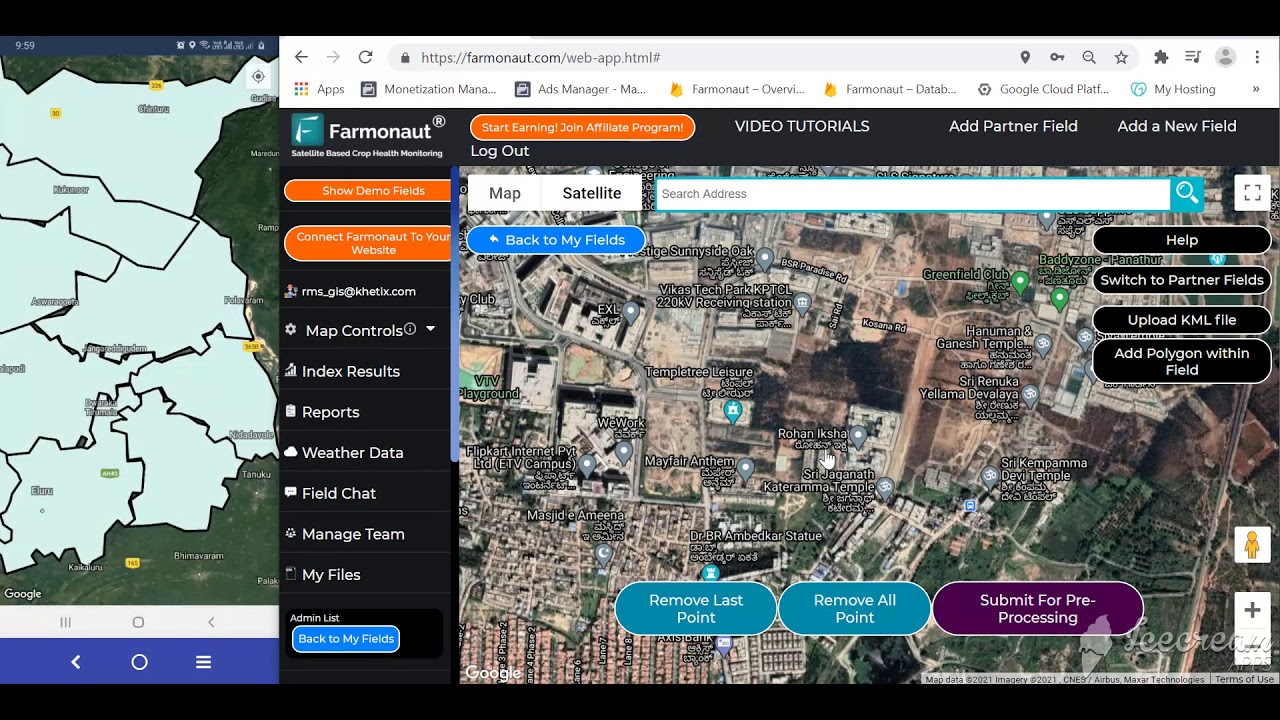
Learn the essential steps for digital mapping, monitoring, and recording field-level data directly into your chart of accounts using advanced tools.
Essential Steps for Implementing an Agriculture Chart of Accounts
Effective management and compliance start with setting up an accurate, systematic, and digital-ready chart of accounts. Here’s a structured process for farm owners, managers, and agribusinesses:
-
Determine Business Structure:
- Are you an individual farm, partnership, corporate agribusiness, or a cooperative?
- Taxation and reporting needs differ for each structure.
-
List and Categorize All Accounts:
- Include all relevant assets, liabilities, revenues, and expenses.
- Ensure every farming activity and operation is reflected.
-
Design Account Coding and Naming:
- Assign logical names and systematic numbering (e.g., 101.00 for farmland, 201.00 for crop inventory).
- Separate codes for each crop, livestock type, or farm location for granular tracking.
-
Integrate with Digital Systems:
- Set up cloud-based platforms for real-time entry and access.
- Connect with field sensors, satellite, and IoT data for accurate recording.
-
Establish Data Collection Processes:
- Create routines for capturing farm input/output, labor, sales, expense receipts, and compliance documentation.
- Link all transactions with the correct CoA category at the point of origin.
-
Regular Reconciliation & Valuation:
- Perform monthly/quarterly asset and inventory counts.
- Update biological asset values as required by standards (e.g., at reporting dates).
-
Automate Reporting & Compliance:
- Use digital tools to auto-generate required management, financial, tax, and sustainability reports.
- Maintain audit-ready digital trails for all transactions and asset movements.
Pro Tip: Leverage platforms that accommodate custom CoA templates specific to local and global agricultural standards for hassle-free compliance.

Discover how digital admin tools can facilitate multi-farm, large-scale accounting—linking maps, assets, and financial entries for better oversight and planning.
Integrated Digital Tools for Account Farming: Farmonaut’s Advanced Offerings
The role of digital tools in account farming is to enable real-time, accurate, and compliant recording of all agriculture chart of accounts activities. We at Farmonaut specialize in delivering next-generation technologies for agriculture, supporting every stage from in-field data capture to asset and sustainability management:
- Satellite Monitoring & AI: Capture crop health, soil quality, and biological status, which feed into asset valuation and resource planning.
- Blockchain Traceability: Securely track every product’s journey and related financial transactions in the CoA. Learn more about Farmonaut’s blockchain agriculture traceability platform.
- Fleet & Resource Management: Digitally monitor equipment usage, maintenance costs, and fuel consumption, directly connecting these data points to expense and asset sections of the CoA. Farmonaut’s Fleet Management module enables better tracking and cost allocation.
- Jeevn AI Advisory System: Receive AI-driven suggestions for field management, risk reduction, and expense minimization, boosting overall profitability while documenting financial decisions against actual field activity.
- Environmental Impact & Compliance Tracking: Automated carbon and sustainability analytics ensure compliance with current and emerging standards.
Our modular platform works for individual farmers, agribusinesses, and institutional operators—scaling as your operations grow and regulatory demands increase. Every dataset—from satellite images to financial records—can be integrated for comprehensive farm management and strategic reporting.
Farmonaut subscriptions also enable users to access premium features and ongoing satellite data updates for digital agriculture accounting innovation:
Video Tutorials: How Digital Tools Improve the Agriculture Chart of Accounts
Step into the future of accounting for agriculture with these essential YouTube guides. Tap for practical demos, digital tool walkthroughs, and high-level insights into advanced agri-management:


For a comprehensive guide on mapping, field management, and integrated financial tracking across multiple farms—see our detailed Agro Admin App walkthrough:

Benefits of Robust Agriculture Accounting and a Specialized Chart of Accounts
A well-designed agriculture chart of accounts—especially when digitized and integrated with field data—delivers critical benefits that empower farm owners and agribusinesses to thrive in an increasingly competitive and regulated world:
- Enhanced Decision-Making: Detailed financial tracking enables strategic choices in crop planning, investment, pricing, and input purchase.
- Regulatory Compliance: Accurate, up-to-date accounts minimize tax errors and streamline subsidy and grant applications.
- Improved Access to Finance: Transparent, audited-ready records build trust with lenders, insurers, and investors.
- Sustainability & Risk Management: Activity-level tracking reveals resource use patterns, highlights areas for sustainability improvement, and identifies operational risks for timely intervention.
- Scalability and Growth: Digitally managed accounts are easily adapted as farm size or complexity grows, supporting everything from smallholdings to large corporate estates.
- Reduced Errors and Audit Overhead: Automated processes and real-time validation drop error rates and cut season-end admin work.
“Adopting agri-accounting software can reduce farm financial errors by up to 40% compared to manual bookkeeping.”
Frequently Asked Questions (FAQ): Agriculture Chart of Accounts & Farm Accounting
What is the agriculture chart of accounts and why is it important for farms?
The agriculture chart of accounts is a systematic listing of all accounts—assets, liabilities, equity, income, and expenses—tailored for farm business operations. It is crucial for accurate financial recording, regulatory compliance, cost analysis, and business sustainability, especially with the complexity of farm transactions and regulatory needs.
How do digital tools improve farm accounting and chart of accounts management?
Digital tools centralize data, automate transaction entries, enable real-time reconciliation, and directly connect field, inventory, and financial data. This reduces manual workload, errors, and ensures timely, accurate reporting—delivering insights for better management decisions and easier compliance.
Can small farms benefit from a specialized chart of accounts and digital financial platforms?
Absolutely. Even small operations require granular tracking for profitability and compliance. Digital solutions—often available via mobile and cloud—enable smallholders to compete on equal footing, reduce admin time, and access tailored financial reports for their scale.
How are biological assets like crops and livestock accounted for under modern standards?
Biological assets (crops, livestock) are measured at fair value less estimated sale costs at each reporting date. Their values are updated as they grow, are harvested, or transferred to inventory, in alignment with international standards like IAS 41.
What role do environmental and sustainability metrics play in farm accounting?
Sustainability metrics, such as carbon footprinting and resource use tracking, are increasingly mandated in regulatory reporting and for access to green finance. Integrating these into your chart of accounts supports compliance, enables new market opportunities, and enhances your environmental stewardship.
How does Farmonaut support digital agriculture accounting and operations?
We provide advanced satellite-enabled platforms, AI-guided management systems, blockchain traceability, and resource management tools—helping individual users and businesses digitize every aspect of their farming accounts, assets, and compliance processes for 2025 and beyond.
Conclusion: Unlocking Modern Agri-Management with the Agriculture Chart of Accounts in 2025 and Beyond
As agriculture continues to evolve, embracing technological advancements and meeting increasing regulatory expectations, a robust, digital agriculture chart of accounts is now essential—not optional. Whether managing a single field or operating a vast corporate agribusiness, the CoA forms the backbone of accounting for agriculture—enabling owners and managers to accurately track assets, control costs, ensure compliance, and make better, data-driven decisions for a sustainable and profitable future.
Unlock new levels of productivity, transparency, and growth. Digitize your farmlands accounts, master modern account farm management techniques, and stay ahead with advanced agriculture accounting practices for 2025 and beyond—with Farmonaut guiding you every step of the way.
Discussion
Questions, corrections or field experience? Share them below. First-time comments are reviewed before they appear, and your email is never published.
No comments yet. Be the first to add a question or your experience.

 Kubota
 Grow Indigo
 FFBS
FFBS Jontra
 Kalustyan
 Tucor
Tucor Geno
Geno Hayleys Agriculture
 Linx Agritech
 Adinet
 Save Your Soils
 Grandstream Algérie
 XOS Realty
 Geospatial Lab Africa
 Agro La Gándara
 HIPSAC
 ZOL Zimbabwe
 Juligerm
 Licence holder · Niger · Gold










