

Reviewed September 2026 against USDA NASS and farmdoc daily, University of Illinois.
A baler in agriculture is the machine that compresses cut hay, straw, or silage into round or rectangular bales for storage, feeding, and transport. The agriculture balers market sits inside a US farm machinery and equipment inventory valued at $5.72 billion as of December 2025, and demand for balers tracks directly with US hay acreage, which USDA NASS put at 49.56 million acres harvested in 2025. This article covers what’s actually driving that market, what an energy-efficient baler changes about your operating costs, and how to size a machine to your acreage — with a calculator built on the acreage figure above.

Access Satellite-Powered Agriculture Insights
What a Baler Does and Why It Matters to the Market
A baler machine in agriculture gathers cut, raked crop material and compresses it into round or rectangular bales, tied or wrapped for storage. The two categories that matter for a buying decision are round balers, which produce cylindrical bales that shed rain when stored outdoors, and square balers, which produce rectangular bales that stack tighter for barn storage and truck transport. These agricultural implements sit downstream of mowing and raking in the hay production chain, and their throughput is what determines whether a farm gets a cutting baled before a rain event.
Baler demand is a derived demand: it rises and falls with acres of hay, straw, and silage crop that need baling, and with the replacement cycle of the existing machine fleet. USDA NASS reported 49.56 million acres of US hay harvested across all types in 2025, per its Crop Production report — that acreage figure is the denominator behind most baler-capacity planning, and it’s refiled annually, so check USDA NASS Quick Stats directly for the current year’s number before sizing a purchase.

Baler Market Size: What the Machinery Data Actually Shows
There is no publicly published, baler-specific unit-shipment count. USDA NASS and the Census of Agriculture group balers under the broader “haying and forage machinery” category rather than reporting baler shipments separately, so any figure claiming an exact global or US baler unit count for a given year is not traceable to a public source — treat such numbers skeptically wherever you see them. What is verifiable is the surrounding equipment market: farmdoc daily at the University of Illinois reported 195,857 US tractor units sold in 2025, down from 217,279 units in 2024 — an 9.9% year-over-year decline — with total US farm machinery and equipment inventory valued at $5.72 billion as of December 2025.
That tractor-sales decline is a useful proxy for the capital-equipment cycle balers sit inside: when tractor purchases slow, baler purchases (which are typically financed and budgeted alongside tractors on mixed hay-and-livestock operations) tend to soften too, though NASS does not break out balers to confirm the correlation directly. For a durable read on where the baler market stands at any point going forward, don’t rely on a stale figure from this page — pull the current farmdoc daily equipment market update, published monthly at farmdocdaily.illinois.edu, and cross-reference it against your state’s current hay acreage in USDA NASS Quick Stats.
Why “Baler Sales Data” Is Hard to Find — and How to Get a Real Number
If you need an actual baler shipment count for market sizing or a business case, the method is: (1) check the Census of Agriculture (published every five years, most recently for 2022, next due 2027) for on-farm machinery inventory by type; (2) check USDA NASS’s annual Farm Production Expenditures report for hay-equipment capital spending; (3) request dealer-level sales data from equipment manufacturer associations such as the Association of Equipment Manufacturers, which compiles member shipment data not broken out publicly by implement type. None of these substitute for each other, and none currently publish a baler-only unit count — that is a genuine gap in public data, not an oversight in this article.
Baler Machine Agriculture: Round vs. Square, and How They’re Built Today
Modern farming balers split into two structural families, each suited to different storage and handling needs:
- Round balers produce cylindrical bales, typically wrapped in net wrap or twine, and are the standard choice for hay stored outdoors because the cylindrical shape sheds precipitation better than a flat-topped bale.
- Square balers (small and large format) produce rectangular bales that stack densely for barn storage and highway transport, and dominate in commercial operations shipping hay off-farm because truckable density lowers per-mile freight cost.
- Try it: Estimated results
Within both families, the features that separate a base machine from a premium one are largely the same ones the original agricultural-machinery trade press has documented for years: automated knotting/tying systems that replace manual twine work, moisture sensors that flag crop readiness before baling (wet hay risks mold and heat damage in storage), and programmable density controls that let one machine handle both light straw and dense alfalfa. None of these features have a standardized adoption-rate figure published by USDA or any other government source — a manufacturer’s claim that “X% of new balers ship with sensors” is a vendor statistic, not a market one, and should be sourced to that vendor by name if you cite it.
Integration With Digital Monitoring
Where balers do show a documented shift is in telematics: manufacturer-installed monitoring that reports bale counts, engine hours, and location back to a farm management dashboard. Paired with satellite-driven crop condition data and fleet management platforms, this lets an operator schedule baling around actual field-moisture and weather windows rather than a fixed calendar date — useful given that hay quality (protein and fiber content) degrades measurably with each rain-delay day after cutting, though the exact degradation rate depends on crop, cut stage, and weather and is not a single public figure.
Energy-Efficient Balers: What Changes and What Doesn’t
“Energy-efficient” in a baler context generally means one or more of: a lower-displacement engine tuned for the specific PTO horsepower the baler needs (rather than over-sized for headroom), reduced-friction plunger and pickup mechanisms, and idle-management electronics that cut engine speed during non-baling transport. There is no systematized, publicly available fuel-consumption benchmark comparing baler models or vintages — manufacturers publish horsepower requirements, not fuel-per-bale or fuel-per-acre figures, and no government agency tracks this at the implement level. If fuel efficiency is a purchase driver for your operation, the only reliable method is a side-by-side field trial on your own acreage and crop, or a request for manufacturer dyno data specific to the model under consideration.
What is measurable is the capital-cost context those engines sit inside: with US farm machinery and equipment inventory at $5.72 billion in December 2025 (farmdoc daily) and tractor unit sales down from 217,279 in 2024 to 195,857 in 2025, operators are holding equipment longer and prioritizing fuel and maintenance cost over sticker price on new purchases — a pattern farmdoc daily attributes partly to tariff-driven cost headwinds in its February 2026 analysis, not to baler-specific engineering.
Expanding Use Cases: Crop Residue and Traceability
- Balers are increasingly used on corn stalks and wheat straw residue for bioenergy feedstock and bedding markets, extending baler utilization beyond a single hay cutting season.
- Buyers supplying regulated feed or bioenergy contracts are asking for supply chain traceability on baled material — a documentation requirement, not a baler feature, but one that shapes which farms can sell into premium contracts.

Comparison Table: Baler Types and Where They Fit
| Baler Type | Bale Shape | Best Storage Fit | Typical Farm Scale | Key Trade-off |
|---|---|---|---|---|
| Round Baler | Cylindrical | Outdoor storage; sheds precipitation | Small to mid-size livestock/hay operations | Lower stacking density than square bales; harder to truck efficiently long distance |
| Small Square Baler | Rectangular, hand-manageable | Barn storage; horse/specialty hay markets | Small farms, direct-to-consumer hay sales | Lower throughput per hour than large square or round |
| Large Square Baler | Rectangular, high-density | Barn or covered storage; long-haul transport | Large commercial hay and export operations | Highest upfront cost; needs higher PTO horsepower |
This table reflects structural trade-offs documented across agricultural engineering literature on baler design; it is not a market-share table, because no public source publishes a US unit-share breakdown by baler type. If you need that breakdown for a specific state or region, USDA NASS Quick Stats can be queried for on-farm machinery inventory counts where available.
Calculator: Estimate Bales and Baler-Hours for Your Acreage
Use your own acreage, expected yield, and bale weight to estimate total bales and the baler-hours needed for the season — the inputs are yours, not a fixed assumption from this page.
Estimated results:
Assumes constant yield and moisture across the field and a steady baler throughput rate with no downtime for breakdowns, weather delays, or field turns. It excludes fuel cost, labor cost, and twine/net-wrap consumption. Adjust the throughput field down for rough or small fields, and re-run per cutting since yield changes across the season.
Choosing a Baler for Your Farm
Selecting a baler comes down to five practical checks that apply regardless of which model year you're shopping:
- Match capacity to acreage and cutting window. Use your acres, expected tons per acre, and the number of dry days you typically get between cuttings to size throughput — the calculator above gives a starting estimate from your own numbers.
- Match bale format to your storage and buyer. Outdoor storage favors round bales; barn storage and long-haul freight favor square bales at higher density.
- Budget for financing in a softening equipment cycle. With US tractor sales down from 217,279 units in 2024 to 195,857 in 2025 (farmdoc daily, Feb 2026), dealers may have more room to negotiate on financing terms and trade-in value than in a tight-inventory year — ask directly rather than assuming list price is fixed.
- Confirm parts and service availability locally before buying a brand with no dealer network in your county — downtime during a baling window costs more than most feature upgrades.
- Verify PTO horsepower match against your tractor fleet; an underpowered tractor on a large square baler reduces both throughput and bale density regardless of the baler's own specifications.

Where Satellite Data Fits Into Baling Decisions
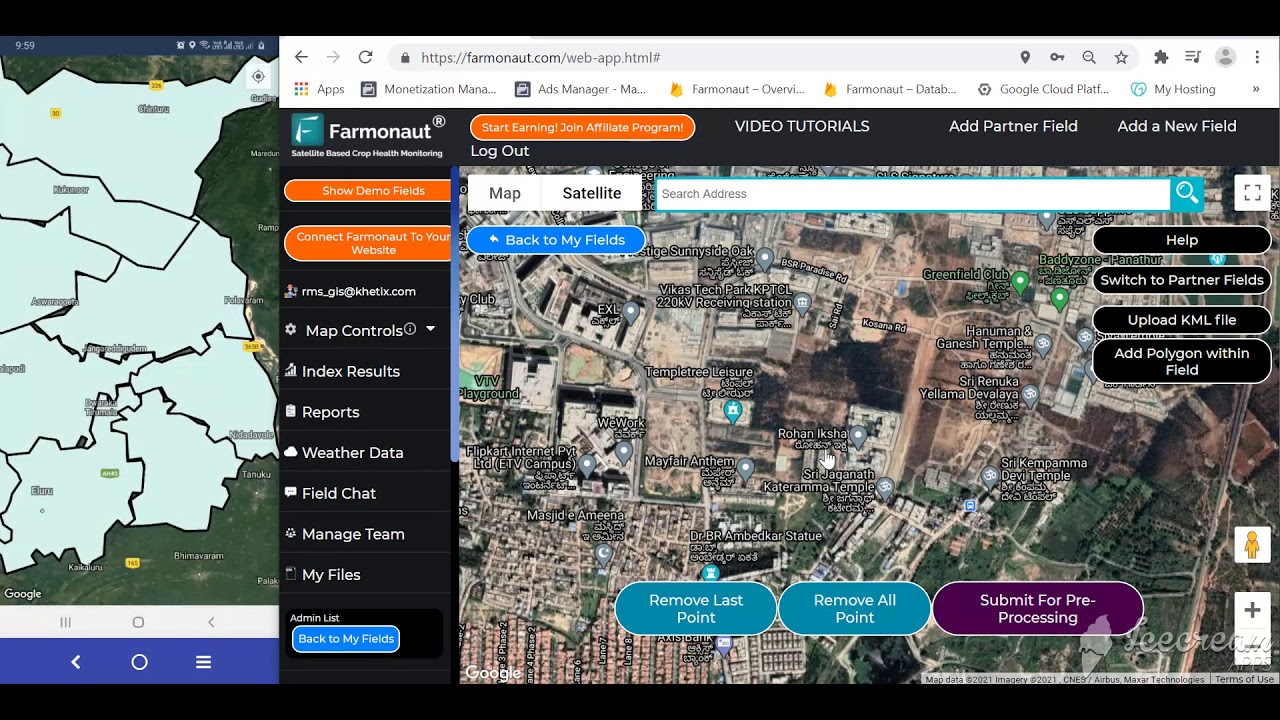
Baling timing is a weather-and-moisture problem before it's a machinery problem: cut hay that sits too long before baling loses quality, and hay baled too wet risks mold or heat damage in storage. Farmonaut's satellite monitoring platform gives operators NDVI vegetation health data, soil condition indicators, and weather forecasts to time cutting and baling windows against actual field conditions rather than a fixed calendar.
- AI-Powered Advisory: Farmonaut's Jeevn AI issues field-specific recommendations that factor into baling schedule decisions.
- Blockchain Traceability: supports documented chain-of-custody for baled material sold into regulated feed or bioenergy contracts.
- Fleet Management: tracks baler and tractor utilization across a season to plan maintenance windows before peak cutting.
- Carbon Footprint Tracking: supports emissions reporting for operations selling into sustainability-linked supply contracts.

Access Web App: Precision Insights for Smart Baling
Want to Integrate Satellite Insights in Your Own Platform?
- Farmonaut Agriculture API — plug real-time field data into your own farm management or precision baling software.
- Developer documentation for building against the API.
Baler Types at a Glance
- Round Balers: cylindrical bales; shed water outdoors; common on livestock operations.
- Square Balers: rectangular bales; stack and truck efficiently; common where hay is sold off-farm.
What Would Change This Market's Trajectory
The baler market's near-term direction is tied to three verifiable, trackable signals rather than a fixed prediction:
- US hay acreage. A material change from the 2025 baseline of 49.56 million acres (USDA NASS) up or down would shift baler demand directly — check the current-year Crop Production report at USDA NASS for the latest acreage.
- Tractor and equipment sales momentum. The 2024-to-2025 drop from 217,279 to 195,857 tractor units (farmdoc daily) signals a broader capital-equipment slowdown; farmdoc daily's monthly updates will show whether that trend continues, reverses, or stabilizes.
- Tariff and input-cost headwinds. farmdoc daily's February 2026 analysis flagged tariff exposure as a factor pressuring the $5.72 billion equipment inventory value; that is a policy variable, not a fixed forecast, and can shift with trade policy changes.
None of these three signals point to a single number this article can hand you for next year — the durable approach is to check USDA NASS Quick Stats for acreage and farmdoc daily for equipment sales each time you're planning a purchase, rather than relying on a figure that will age out of this page.

Empower Your Farm with the Latest iOS Smart Monitoring Tools
Explore Satellite-Powered Farm Management
Whether managing large-scale operations (see Farmonaut's Agro Admin platform) or planning around crop loans and insurance, satellite data adds context to baling and broader field-management decisions.
Farmonaut Flexible Subscriptions
Scalable access to real-time satellite crop monitoring, AI advisories, and blockchain-based traceability:
FAQ: Balers and the Agriculture Balers Market
What is a baler in agriculture?
A baler is a farm machine that compresses cut hay, straw, or silage into round or rectangular bales for storage, feeding, and transport.
What is the difference between a round baler and a square baler?
Round balers make cylindrical bales that shed rain in outdoor storage. Square balers make rectangular bales that stack more densely for barn storage and truck transport, and are common in commercial operations shipping hay off-farm. Buyers leaning toward round bales can compare round balers that offer good value model by model.
How big is the agriculture balers market?
No government source publishes a baler-specific unit-sales figure; balers are grouped under "haying and forage machinery" in USDA and Census of Agriculture data. The closest verifiable proxy is the broader US farm machinery and equipment inventory, valued at $5.72 billion as of December 2025 (farmdoc daily, University of Illinois), alongside US tractor sales of 195,857 units in 2025, down from 217,279 in 2024.
What makes a baler energy-efficient?
Typically a right-sized engine matched to the baler's actual PTO horsepower requirement, reduced-friction plunger and pickup mechanisms, and idle-management electronics. There is no public, standardized fuel-consumption benchmark comparing baler models; a manufacturer-specific dyno test or your own field trial is the only reliable comparison method.
How much hay acreage does a baler purchase decision typically need to account for?
US hay harvested acreage across all types was 49.56 million acres in 2025, per USDA NASS. Use your own farm's acreage and expected yield with the calculator above, and check USDA NASS Quick Stats for the current year's acreage data for your state.
What's shaping the baler machine agriculture segment going forward?
Automated tying/ejection systems, moisture sensors, telematics integration with farm management platforms, and expanding use on crop residues like corn stalks and wheat straw for bioenergy feedstock.


The Baler's Role in a Data-Driven Hay Operation
The baler itself hasn't changed its core job in decades — compress cut crop into a transportable, storable unit. What has changed is the data available to decide when to run it: acreage and yield benchmarks from USDA NASS, equipment market signals from sources like farmdoc daily, and field-level moisture and weather data from satellite platforms. Combining a correctly sized machine with that data is what turns a baling season from a guessing game into a scheduled operation.
Get started with real-time crop insights and supply chain traceability to inform your next baling season.

 Green Bite Farm
 FCF India
 Unifrutti Gulf
 Deluxe Conseil
 TVS Electronics
 BW Pipelines
 WICO
WICO Gen Chayat
 Chimera Innovation
 SkyHarvest
 Polaris Digitech
 Teledarbas
 Wild Oak Farm
 SFX
SFX Doodlakine
