

Farm machinery · Cost guide
Cost of a Combine: Per-Acre Cost Calculator and Charts
The cost of a combine depends most on acres harvested. Illinois economists put it at $43.40 per acre at 3,600 acres and $54.10 at 2,600 acres. Here are the parts of the bill, custom hire rates and a calculator for your own farm.
Key takeaways
- University of Illinois estimate (farmdoc daily, 2025): $43.40 per acre to own and run a new combine on corn at 3,600 acres a year, $54.10 at 2,600 acres.
- The combine list price in the Illinois model rose 26%, from $587,000 in 2021 to $741,000 in 2023.
- Manitoba’s 2026/2027 guide sets planning prices of C$600,000 (Class 6) to C$1,150,000 (Class 10+); ownership is more than half the hourly cost.
- Custom combining: C$31-40 per acre in Manitoba, without the header; $41-47 average reported per acre for wheat, soybeans and corn in a 2024 Mississippi survey.
- The Illinois authors suggest at least 3,000 acres per combine; smaller farms can share a machine or hire.
In this article
- The cost of a combine at a glance
- What a new combine costs to buy
- Where the money goes each hour
- How acres harvested change the cost per acre
- The 7 factors that set the cost of a combine
- Owning a combine vs hiring a custom operator
- Work out your own combine cost per acre
- Ways to lower the cost of a combine per acre
- Machinery prices: what the index says
- Where yield data and field maps fit in
- How we checked the numbers
- FAQ
The cost of a combine is best measured per acre, not by the sticker. University of Illinois farm economists put the 2025 cost of owning and running a new combine at $43.40 per acre of corn when one machine harvests 3,600 acres a year. The list price of the combine in their model rose from $587,000 in 2021 to $741,000 in 2023. Below that acreage, the cost per acre climbs fast.
This page breaks the total into its parts: buying, interest, depreciation, fuel, repairs, labour and the header. It uses published cost guides from Illinois, Manitoba and Mississippi, and every number has a date and a named source. You can also put your own numbers into the calculator further down and compare owning with hiring a custom operator.
The cost of a combine at a glance
The table sums up the main figures used on this page. They come from different places and years, so read each one with its basis in mind. Manitoba figures are in Canadian dollars. US figures are in US dollars.
| Measure | Figure | Basis and source |
|---|---|---|
| Purchase price, new rotary combine | C$600,000 (Class 6) to C$1,150,000 (Class 10+) | Planning values, not dealer quotes; Manitoba Agriculture 2026/2027 guide |
| List price of the combine in the Illinois cost model | $587,000 (2021), $741,000 (2023) | List price; farmdoc daily, October 2025 |
| Own-and-run cost, corn, 3,600 acres a year | $43.40 per acre | Estimate for new machines; farmdoc daily, 2025 |
| Own-and-run cost, corn, 2,600 acres a year | $54.10 per acre | Estimate for new machines; farmdoc daily |
| Custom combining, Manitoba | C$31 to C$40 per acre (without header) | Calculated custom rate; Manitoba Agriculture |
| Custom combining, Mississippi | Average $47 per acre (corn), $43 (soybeans), $41 (wheat) | Survey of reported charges, 2024; Mississippi State University Extension |
| US machinery prices paid index | 173.8 in August 2026 (2011 = 100), 2.1% above a year earlier | Index, not a price; USDA NASS |
What a new combine costs to buy
Combines are sold by class. The class roughly follows engine power and the amount of crop the machine can thresh per hour. A bigger class costs more to buy, but it also covers more acres in an hour. That second point matters as much as the first.
The Manitoba Agriculture Cost of Production guide for farm machinery lists planning prices for new self-propelled rotary combines. A Class 6 machine of 301 to 360 hp is set at C$600,000. A Class 8 machine of 421 to 500 hp is set at C$800,000. The largest group, Class 10+ above 626 hp, is set at C$1,150,000. These are round planning figures used to work out custom and rental rates. They are not dealer quotes, and they do not include a header.
Manufacturer pages show what the power range looks like in real machines. Case IH lists its Axial-Flow 160 Series at 348 to 375 hp with a grain tank of up to 350 bushels. Its AF Series, the largest in its line, runs from 634 to 775 hp with a grain tank of 455 to 567 bushels. Case IH asks buyers to build and price these machines with a dealer, so no public list price is given.
For a US example, the University of Illinois cost model used a combine list price of $741,000 in 2023. That was 26% more than the $587,000 used in 2021. The same team noted that new equipment prices in general rose by over 20% between 2021 and 2023.
Chart
Planning purchase price of a new rotary combine, by class
Canadian dollars, thousands; header not included
Where the money goes each hour
The purchase price is only the start. The Manitoba guide splits the hourly cost of each combine class into ownership and running costs. Ownership covers depreciation, interest on the money tied up, insurance and housing. Running costs cover repairs and maintenance, fuel and the operator’s time.
For a Class 8 rotary combine at C$800,000, the guide gives these hourly figures, based on 250 separator hours a year:
- Ownership cost: C$257.86 per hour
- Repair and maintenance: C$84.16 per hour
- Fuel: C$85.20 per hour, at 71 litres per hour and a 75% engine load
- Labour: C$28.00 per hour
Ownership is more than half of the total. That is why the number of hours and acres you put through the machine each year has such a big effect. The ownership bill arrives whether the combine runs 100 hours or 400 hours. Fuel, repairs and labour, by contrast, rise and fall with use.
Fuel is the most volatile part. The USDA NASS Agricultural Prices report for September 2026 shows the index of fuel prices paid by farmers at 116.7 in August 2026, 35% above August 2025. A change like that moves the running cost of a combine within one season, even when the machine price stays the same.
Chart
Hourly cost of a Class 8 rotary combine
Canadian dollars per separator hour, at 250 hours a year
How acres harvested change the cost per acre
The single biggest lever on the cost of a combine is how many acres it harvests each year. The University of Illinois team estimates combine costs for a range of farm sizes every other year. Their figures assume new machines and a crop mix of 60% corn and 40% soybeans.
In their farmdoc daily article of October 2025, the cost of combining corn was $43.40 per acre at 3,600 acres harvested. At 2,600 acres it was $54.10 per acre. So 1,000 more acres cut the cost by $10.70 per acre. In 2021 the same step saved only $7.10 per acre, from $38.20 to $31.10. Higher machine prices make the size effect stronger.
The authors suggest a benchmark of at least 3,000 acres per combine for economical operation. They also say that harvest costs often make up more than 50% of total machinery-related costs on grain farms. Farms below 3,000 acres, they note, face a clear cost disadvantage when they own a combine alone.
This does not mean every smaller farm should sell its combine. Timeliness, weather risk and the local supply of custom operators all count. But it does mean the decision should start with a per-acre number, not with the price on the dealer’s sheet.
Chart
Combine cost per acre of corn, by acres harvested
US dollars per acre, new machines, 60% corn and 40% soybeans
The 7 factors that set the cost of a combine
The original version of this guide listed seven factors. They still hold, and each one now comes with a number you can check.
1. Class and horsepower
Each step up in class adds about C$100,000 to the Manitoba planning price. But the work rate rises too, from 10 acres per hour for Class 6 to 24 acres per hour for Class 10+. A larger machine can have a lower cost per acre if it has enough acres to cover. On a small farm, the same machine sits idle for most of the year.
2. Hours and acres per year
As the Illinois figures show, spreading the fixed cost over more acres is the strongest way to cut the cost per acre. The Manitoba guide assumes 250 separator hours a year. If your combine runs only 120 hours, your ownership cost per hour is about twice the guide figure.
3. Interest and financing
Money tied up in a machine has a cost, whether you borrow it or use your own cash. In the Illinois model, the interest rate rose from 4.5% in 2021 to 5.5% in 2023. On a $741,000 machine, each extra point of interest adds thousands of dollars a year. Loan terms, dealer finance offers and leases all change this line, so get advice from your lender or accountant before you sign.
4. Fuel
The Manitoba guide puts fuel use at 51 litres per hour for Class 6 and 100 litres per hour for Class 10+. The Illinois model raised its diesel price from $2.75 to $3.50 per gallon between 2021 and 2023. Fuel prices paid by US farmers were 35% higher in August 2026 than a year before, so this line deserves a fresh check each season.
5. Repairs and maintenance
Repairs rise as a combine ages and as hours build up. The Manitoba guide gives C$63.12 per hour for Class 6 and C$120.98 per hour for Class 10+. A used machine may cost less to buy but more to keep running. Ask for service records and check wear parts such as rotors, concaves, chains and bearings before you buy.
6. Header choice
The header is a separate cost. The Manitoba guide lists header rental rates from C$14 to C$364 per hour, depending on type and width. Its worked example adds a C$34 per hour flex auger header to a Class 9 combine at C$587 per hour. With a work rate of 17 acres per hour, the custom rate comes to about C$37 per acre. Corn heads, draper heads and pick-up heads each change the total.
7. New or used, trade-in and dealer support
A used combine trades a lower price for higher repair risk and older technology. Auction sites such as Purple Wave’s John Deere 9600 price guide publish past sale results for older models, which helps you test a dealer’s asking price. Trade-in value, warranty terms and the distance to a dealer with parts in stock also shape the real cost. A machine that waits a week for a part during harvest can cost more than any price gap.
Owning a combine vs hiring a custom operator
Custom harvesting turns the cost of a combine into a simple per-acre bill. You give up control over timing, but you avoid the fixed cost. Two public guides give a sense of the rates.
The Manitoba guide calculates custom rates of C$31 to C$40 per acre for rotary combines, without the header. The larger classes reach the lower rate because they cover more ground per hour.
In the US South, the Mississippi State University Extension custom rates survey asked producers in spring and summer 2024 about the charges for custom work. Reported combining rates for corn ran from $40 to $55 per acre, with an average of $47. Soybeans ranged from $35 to $55, with an average of $43. Wheat ranged from $35 to $50, with an average of $41. Rice was higher, from $55 to $85, with an average of $70. These are reported charges from a small number of responses, not a price list.
Compare those rates with the Illinois own-and-run figure of $43.40 per acre at 3,600 acres. At that size, owning is in the same range as hiring. At 2,600 acres, owning costs about $54 per acre, so a custom operator may be cheaper, if one is free at the right time.
Custom rates vary by region, crop, yield, field size and distance. Ask two or three local operators for quotes before you decide, and check what each quote includes, such as hauling, the header and fuel.
Chart
Reported custom combining charges in Mississippi
US dollars per acre, lowest and highest reported, 2024 survey
Work out your own combine cost per acre
The calculator below uses a standard machinery cost method. It spreads the purchase price, minus the value left at the end, over the years you plan to keep the machine. It adds interest on the average value and 1% of the price a year for insurance and housing. Running costs come from your hourly figure and work rate.
The starting values are examples only, set close to break-even with a custom rate. Change every input to match your own farm. The result is a planning estimate, not a quote, and it leaves out taxes and depreciation rules.
Try the numbers for your own farm below.
Calculator
Combine cost per acre: own or hire?
Enter your own price, acres and running costs.
- Ownership cost per year: 56,000 $
- Ownership cost per acre: 25.45 $/acre
- Running cost per acre: 12.50 $/acre
- Custom rate minus own cost (positive = owning cheaper): 2.05 $/acre
- Break-even acres per year: 2,036 acres
Example values only, set near break-even with the custom rate; they are not a benchmark or a quote. Yearly ownership = (price minus end value) / years kept + interest on the average value + 1% of the price for insurance and housing. Running cost per hour should include fuel, repairs and the operator. Taxes and depreciation rules are left out. Get advice from your lender or accountant before buying.
Ways to lower the cost of a combine per acre
The Illinois authors’ main advice is to put more acres through each machine. The first idea below comes from their article; the others are common ways to lower the cost per acre.
- Share a combine. Two farms of 2,000 acres each could own one machine together and harvest 4,000 acres, which costs much less per acre than two machines. This needs a clear written agreement on timing, repairs and costs.
- Do custom work for neighbours. Extra acres spread your fixed cost, as long as your own harvest timing does not suffer.
- Keep the machine longer. Depreciation is steepest in the first years. A well-kept combine kept for more seasons can lower the yearly ownership cost.
- Match the class to your acres. A smaller class bought for fewer acres may cost less per acre than a large machine that runs only a few weeks.
- Plan harvest routes and timing. Fewer idle hours, less road travel and fewer unloading stops mean more acres per hour.
The Manitoba guide also shows how grain hauling adds to the bill. Hauling from one combine cost about C$0.29 to C$0.58 per bushel in its examples, depending on distance. A grain cart or second truck can keep the combine moving, but it is one more cost to count.

▶ Managing tasks and crop health across many fields on large farms. · 7:27
Machinery prices: what the index says
For a wider view, the US Department of Agriculture tracks the prices farmers pay for machinery as an index. In August 2026 the machinery index stood at 173.8, where 2011 equals 100. It was 0.4% above July and 2.1% above August 2025. The report noted that prices for self-propelled machinery, which includes combines, were unchanged from July.
The index is not a combine price. It shows the direction of costs. The Illinois authors wrote that supply chain effects, general inflation and labour limits suggest machinery prices and costs will not fall. If that holds, the gap between large and small farms in combine cost per acre is likely to stay.

▶ What bigger, smarter farm machines mean for farmers and rural towns. · 3:50
Where yield data and field maps fit in
Most new combines carry a yield monitor. The USDA Economic Research Service report on precision agriculture notes that yield monitors became standard equipment on new combines. Yield maps show which parts of each field pay for the harvest and which do not.
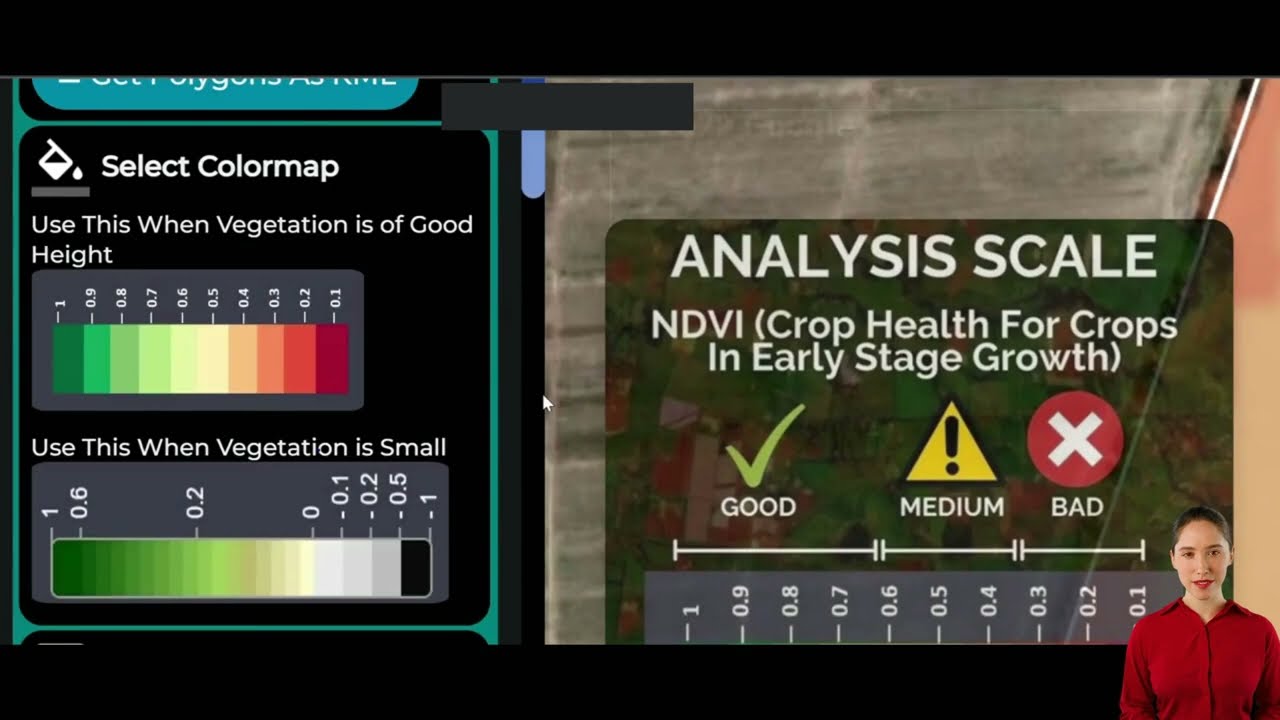
Satellite crop maps add a view of the season before harvest. They can show which fields are ready first and where crop growth is weak, which helps you plan harvest order and the hours you will need. Farmonaut Satellite + AI Farm Monitoring System gives vegetation maps of your own fields on web, Android and iOS, which you can set beside your yield maps.
A combine is a long-term choice that shapes your costs for a decade or more. Good records make it easier: acres harvested, separator hours, fuel used, repair bills and yield. With those numbers, you can check your real cost per acre each year and decide when it is time to trade, share or hire.
▶ How to read satellite crop maps of your own fields. · 10:16
How we checked the numbers
We used the latest public versions of each guide as of October 2026. The Illinois figures are estimates for new machines on a corn and soybean farm, and the authors give them as costs per acre, not as prices. The Manitoba figures are planning values in Canadian dollars for 2026/2027 and leave out the header unless stated. The Mississippi figures are average charges reported by a small group of survey respondents in 2024. The USDA figures are index values, not prices. We did not use dealer asking prices, because they change with options, region and season.
Figures for financing, tax and depreciation are for planning only. Get professional advice from your lender, accountant or local extension office before a large purchase.
For a closer look at a related question, see our guide: Wheat Combine Harvester: Vintage to Modern & Price Insights.
FAQ
How much does a combine cost per acre?
University of Illinois economists estimated $43.40 per acre to own and run a new combine on corn at 3,600 acres a year, and $54.10 per acre at 2,600 acres (farmdoc daily, 2025). Your figure depends on acres, price, interest and fuel.
How much does a new combine cost to buy?
The Manitoba Agriculture 2026/2027 guide uses planning prices of C$600,000 for a Class 6 rotary combine up to C$1,150,000 for Class 10+, without a header. The Illinois cost model used a list price of $741,000 in 2023. Dealer quotes vary with options and region.
How many acres do you need to justify owning a combine?
The Illinois authors suggest at least 3,000 acres per combine as a benchmark for economical operation. Below that, sharing a machine or hiring a custom operator may cost less per acre.
What does custom combining cost?
Manitoba’s guide calculates C$31 to C$40 per acre without the header. In a 2024 Mississippi survey with 5 to 8 responses per crop, reported average charges were $47 per acre for corn, $43 for soybeans and $41 for wheat.
Is a used combine cheaper to run?
It is cheaper to buy, so ownership cost is lower. Repair costs are usually higher, and older machines may lack newer technology. Check service records and wear parts, and compare the price with past auction results.
Related pages on our site: satellite-based mineral detection, mining query form and contact us.
Farmonaut crop monitoring
See your fields from space before harvest
Draw your fields once and Farmonaut shows satellite crop maps through the season, on web, Android or iOS, to help plan harvest order.




Sources
- farmdoc daily (University of Illinois), Large Increase in Machinery Costs Suggests Need to Reconsider Machinery Purchase Decisions (October 2025): farmdocdaily.illinois.edu
- Manitoba Agriculture, Cost of Production: Farm Machinery, custom and rental guide 2026/2027: manitoba.ca
- Mississippi State University Extension, Custom Rates for Mississippi Agricultural Practices (2024 survey): extension.msstate.edu
- USDA NASS, Agricultural Prices, September 2026 (prices paid indexes for August 2026): esmis.nal.usda.gov
- USDA ERS, Precision Agriculture in the Digital Era: Recent Adoption on U.S. Farms, EIB-248 (February 2023): ers.usda.gov
- Case IH, Axial-Flow 160 Series combine harvesters (product page): caseih.com
- Case IH, AF Series combine harvesters (product page): caseih.com
- Case IH, Axial-Flow 260 Series combine harvesters (product page): caseih.com
- Purple Wave, John Deere 9600 combine auction results and price guide: purplewave.com
- Mississippi State University Extension, Custom rates publication P4048: extension.msstate.edu
Discussion
Questions, corrections or field experience? Share them below. First-time comments are reviewed before they appear, and your email is never published.
No comments yet. Be the first to add a question or your experience.

 Clubhouse OS
 John Deere
 Progenseed
 SkyHarvest
 Polaris Digitech
 Teledarbas
 Wild Oak Farm
 SFX
 BACF Africa
 Doodlakine
 Exurbia Geospatial
 FieldZero
 Indico Company
 Kubota

 Licence holder · Niger · Gold










