

Harvest machinery · Buyer guide
Wheat Combine Harvester: History, Sizes and Costs
A wheat combine cuts, threshes and cleans grain in one pass. Manitoba’s 2026/2027 guide values new rotary combines at CAD 600,000 to 1,150,000, and a 2024 John Deere S780 sold for $414,000 at a June 2026 auction (AgWeb).
Key takeaways
- Manitoba’s 2026/2027 machinery guide values new rotary combines from CAD 600,000 (Class 6) to CAD 1,150,000 (Class 10+), header not included.
- The list price of the combine in University of Illinois cost estimates rose from $587,000 in 2021 to $741,000 in 2023 (farmdoc daily, 2025).
- Custom wheat combining averaged $31.30 per acre in Texas (2026 survey) and $41 in Mississippi (2024 survey); hauling is often extra.
- At a June 2026 auction a 2024 John Deere S780 with 476 hours sold for $414,000 (AgWeb).
- Hiram Moore’s 1830s combine needed about 20 horses; self-propelled machines followed from 1911.
In this article
- Wheat combine harvester sizes at a glance
- How a wheat combine harvester works
- From horse teams to self-propelled machines: a short history
- Vintage combine harvesters today
- What a wheat combine harvester costs to buy
- Why new combine prices rose
- Wheat combine models and recent prices
- Owning or hiring a custom harvester
- How to choose a wheat combine
- Modern technology on a combine
- Smaller combines and plot harvesters
- Using satellite crop maps before harvest
- How we checked the numbers
- FAQ
A wheat combine harvester cuts the crop, threshes the grain from the heads, cleans it and stores it in a tank, all in one pass. New large combines are expensive: the 2026/2027 Manitoba machinery guide uses purchase prices of CAD 600,000 for a Class 6 rotary combine up to CAD 1,150,000 for the largest class, and University of Illinois cost estimates used a $741,000 list price for a new combine in 2023.
This guide covers how the machine works, how it grew from a 20-horse prototype into today’s 700-plus horsepower models, which models sell for what at auction, and what custom hire charges. It includes dated price data from extension services and auctions, three charts and a calculator that gives a rough example estimate of a used combine’s value on your own numbers.
Wheat combine harvester sizes at a glance
Combines are grouped into classes by engine power. The table uses the classes and purchase prices from the Manitoba government’s farm machinery cost guide, plus its custom rate per acre. Prices are guide values in Canadian dollars for 2026/2027, not dealer quotes, and the guide prices exclude the header.
| Class | Engine power | Guide price (CAD) | Work rate | Custom rate |
|---|---|---|---|---|
| Class 6 rotary | 301-360 hp | 600,000 | 10 ac/hr | CAD 40/ac |
| Class 7 rotary | 361-420 hp | 700,000 | 12 ac/hr | CAD 38/ac |
| Class 8 rotary | 421-500 hp | 800,000 | 15 ac/hr | CAD 35/ac |
| Class 9 rotary | 501-560 hp | 900,000 | 17 ac/hr | CAD 35/ac |
| Class 10 rotary | 561-625 hp | 1,000,000 | 21 ac/hr | CAD 31/ac |
| Class 10+ rotary | 626+ hp | 1,150,000 | 24 ac/hr | CAD 31/ac |
Source: Manitoba Agriculture, Cost of Production: Farm Machinery 2026/2027. The guide assumes 250 separator hours a year.
Chart
Guide purchase price of new rotary combines by class
Canadian dollars, thousands, 2026/2027 guide values, header not included
How a wheat combine harvester works
The name comes from combining three jobs that once needed separate machines and crews: reaping, threshing and winnowing. A modern machine does them in this order.
- Header: a cutter bar and reel cut the standing wheat and feed it to the centre. Draper and flex headers are common in wheat.
- Feeder house: a chain conveyor carries the cut crop up into the machine.
- Threshing: a rotor or a drum rubs the grain out of the heads. Rotary machines use one or two long rotors; conventional machines use a cylinder and straw walkers.
- Cleaning: sieves and a fan blow chaff away and let clean grain fall through.
- Grain tank and unloading auger: clean grain goes to the tank and is unloaded into a grain cart or truck.
- Residue: straw and chaff are chopped and spread, or dropped in a row for baling.
Settings matter more in wheat than many growers expect. Rotor speed, concave clearance, fan speed and sieve openings all change how much grain is lost out the back and how much is cracked. Operators check losses behind the machine and adjust as moisture changes through the day.
From horse teams to self-propelled machines: a short history
The first combine harvester is credited to Hiram Moore in Michigan. He built and patented a machine in the 1830s that reaped, threshed and winnowed grain, and his full-scale version was pulled by about 20 horses, according to the history summary of the combine harvester.
By the early 1900s, horse-drawn combines worked the wheat plains of the American West, often with teams of 20 or more horses. Self-propelled machines followed: Holt Manufacturing in California built one in 1911, and in 1937 Thomas Carroll, working for Massey-Harris in Canada, perfected a self-propelled model that the company sold widely from 1940. In Europe, Claeys launched a self-propelled combine in 1952 and Claas followed in 1953.
Later decades brought rotary threshing, enclosed cabs, yield monitors and GPS steering. Engine power kept climbing. The Case IH AF11, for example, is listed at 775 horsepower with a 567-bushel grain tank on the Case IH AF11 product page (checked October 2026).
Vintage combine harvesters today
Old combines have a second life with collectors, museums and farm shows. Restored machines show visitors how harvest moved from crews of workers to one operator in a cab.
Vintage machines also sell at auction. In July 2026, Machinery Pete previewed an upcoming vintage tractor auction in Penfield, Illinois, featuring 1970s Massey Ferguson models; the auctioneer said he had never turned down so many pieces of equipment, as reported by AgWeb. Prices for vintage equipment depend on rarity, condition and paint, not on harvest output, so no single price range fits them. If you are buying one to work, check parts supply first.
What a wheat combine harvester costs to buy
Prices depend on size, age, hours and the header. Three kinds of price data are useful, and they measure different things.
- Guide or list prices for new machines. The Manitoba guide values new rotary combines from CAD 600,000 (Class 6) to CAD 1,150,000 (Class 10+) for 2026/2027, header not included. The University of Illinois used a list price of $741,000 for the combine in its 2023 estimate, up from $587,000 in 2021, a 26% rise, according to farmdoc daily (October 2025).
- Auction results for used machines. At a June 30, 2026 auction in Minnesota, a 2024 John Deere S780 with 476 hours sold for $414,000. At another auction the same day in Illinois, a 2013 John Deere S670 with 2,316 engine hours sold for $103,500; the average auction price for that model in 2026 to that date was about $75,125 (AgWeb, July 2026).
- Dealer asking prices. These are often above auction results and can include trade-ins, warranty and financing. Treat them as a starting point for talks.
Used prices move with supply. Machinery Pete said in 2022 that used combine prices had risen over the previous 18 months, as reported by AgWeb in September 2022, and in 2026 he pointed to a shortage of five- to 12-year-old machines pushing buyers toward newer used units.
▶ Wheat market price trends in the UK and Europe, useful context when weighing machine costs against crop value. · 1:46
Why new combine prices rose
New equipment prices rose by more than 20% between 2021 and 2023, the farmdoc daily analysts note. The list price of the combine in their cost model went from $587,000 in 2021 to $741,000 in 2023. Interest rates and diesel prices rose over the same years, which made each machine dearer to finance and run.
Higher new prices push buyers toward used machines. That is one reason late-model used combines have sold for record sums at auction, and why the supply of five- to 12-year-old machines matters so much to price.
Chart
List price of the combine in Illinois cost estimates
US dollars, thousands, new combine list price used in the model
Wheat combine models and recent prices
The table lists models with a dated, public price or specification. It mixes auction results and maker specifications, so read the basis column before comparing rows.
| Model | Detail | Price or spec | Basis and date |
|---|---|---|---|
| John Deere S780 (2024) | 476 hours | $414,000 | Auction result, Minnesota, June 2026 |
| John Deere S670 (2013) | 2,316 engine hours | $103,500 | Auction result, Illinois, June 2026 |
| John Deere S670 | All sales to date | about $75,125 | Average auction price, 2026 to July |
| Case IH AF11 | Class 10+ | 775 hp, 567 bu tank | Maker specification, checked October 2026 |
| Generic Class 8 rotary | 421-500 hp | CAD 800,000 | Manitoba guide price, 2026/2027 |
Auction sources: AgWeb, July 2026. For full cost per acre and the factors behind combine prices, see our separate guide to the cost of a combine.
What to check on a used wheat combine
Hours alone do not set the price. Buyers look at separator hours, the condition of the rotor, concaves and feeder chain, the header type and width, and whether the yield monitor and guidance are included or need a new subscription. A machine set up for corn may need a new header and concave changes for wheat, which adds to the real price.
The Manitoba guide assumes a combine keeps about one third of its purchase price after a 12-year service life, losing value evenly after the first year, at about 250 separator hours a year. The calculator below uses that rule for a rough first estimate before you compare real auction results.
Try the numbers for your own farm below.
Calculator
What might a used combine be worth?
Enter the new list price, age and hours of the machine you are looking at.
- Share of list price kept: 66.5 %
- Yearly loss in value: $33,500
- Use-adjusted age: 6.0 years
Rough example estimate only, not a valuation or a market price; the default list price is the Manitoba guide’s Class 6 price (CAD 600,000) used as an example, so enter your own price in your own currency; check recent auction results and get a dealer or appraiser opinion. Defaults follow the Manitoba Agriculture Cost of Production: Farm Machinery guide (2026/2027): value falls in a straight line to one third (33%) of purchase price over a 12-year service life, with 250 separator hours a year as normal use (about 5.6% of the price per year). Averaging age with hours divided by normal hours a year is our simplification to account for heavy or light use.
Owning or hiring a custom harvester
Owning is not the only way to get a wheat crop cut. Custom harvesters bring their own machine, operator and fuel and charge per acre, often with extra per-bushel charges. Survey results from extension services give a sense of the rates for wheat and small grains.
- Texas (2026 survey): the per-acre part of combining and hauling wheat averaged $31.30 across 34 responses, from $20 to $45, plus about $0.28 per bushel for hauling, according to the Texas A&M AgriLife Extension custom rates survey. Some operators add an overage charge on yields above a set level.
- Wisconsin (2025): straight combining of small grains averaged $37.12 per acre, from $25 to $50, and wheat with grain cart and local hauling averaged $48.18, from the University of Wisconsin custom rates report.
- Mississippi (2024 survey): combining wheat averaged $41 per acre across five responses, from $35 to $50, according to Mississippi State University Extension.
- Manitoba (2026/2027 guide): custom rates of CAD 31 to 40 per acre, falling as combine size rises.
Rates vary by region, yield, field size and distance. Survey numbers are averages of reported rates, not quotes. Get written prices from local operators before you decide, and get professional advice on financing and tax before a large purchase.
To put the rate in context, US farmers received $6.23 per bushel for all wheat in August 2026, according to USDA’s Agricultural Prices report (September 2026). At that price, a $35 per acre harvest bill equals about 5.6 bushels of wheat per acre.
Chart
Reported custom combining rates for wheat and small grains
Lowest and highest reported rate, US dollars per acre, selected surveys
How to choose a wheat combine
- Count your acres. Add wheat to other crops the same machine will harvest. Fewer acres point toward a used machine, shared ownership or custom hire.
- Check your harvest window. Divide acres by the days you can safely harvest. The Manitoba guide’s work rates (10 to 24 acres an hour by class) help you size the machine.
- Match the header. Wheat growers often choose a draper header. Header width should suit the combine’s power and your field size and terrain.
- Compare total cost per acre. Include depreciation, interest, insurance, repairs, fuel and labour, not just the price. Our guide to the cost of a combine covers cost per acre.
- Inspect used machines. Look at separator hours as well as engine hours, rotor and concave wear, the feeder chain, bearings and service records.
- Check dealer support. Parts and service close to your farm reduce downtime during a short harvest.
Modern technology on a combine
Most new large combines come with tools that were rare 20 years ago. Common features include GPS auto-steering, yield monitors that record yield and moisture as you drive, automatic header height control, camera or sensor checks on grain quality, and telematics that send machine data to the office. Brands such as John Deere, Case IH, New Holland and Claas each sell their own versions.
Yield maps are useful after harvest. Comparing them with in-season crop maps shows which parts of a field were weak all year and which lost yield late. Some features carry subscription fees, so ask the dealer what is included and for how long.

▶ Six plain steps to start with precision agriculture, from field maps to yield data. · 4:18
Smaller combines and plot harvesters
Not every farm needs a Class 8 machine. Smaller and older combines, including Class 5 and below, are common on mixed farms, research plots and hilly ground. They cost less to buy and fit narrow gates and small fields, but they cover fewer acres an hour.
For small acreages, a used mid-size combine or custom hire is often cheaper per acre than a new machine. Our guide to small-scale farming tools covers other equipment for smaller farms.
Using satellite crop maps before harvest
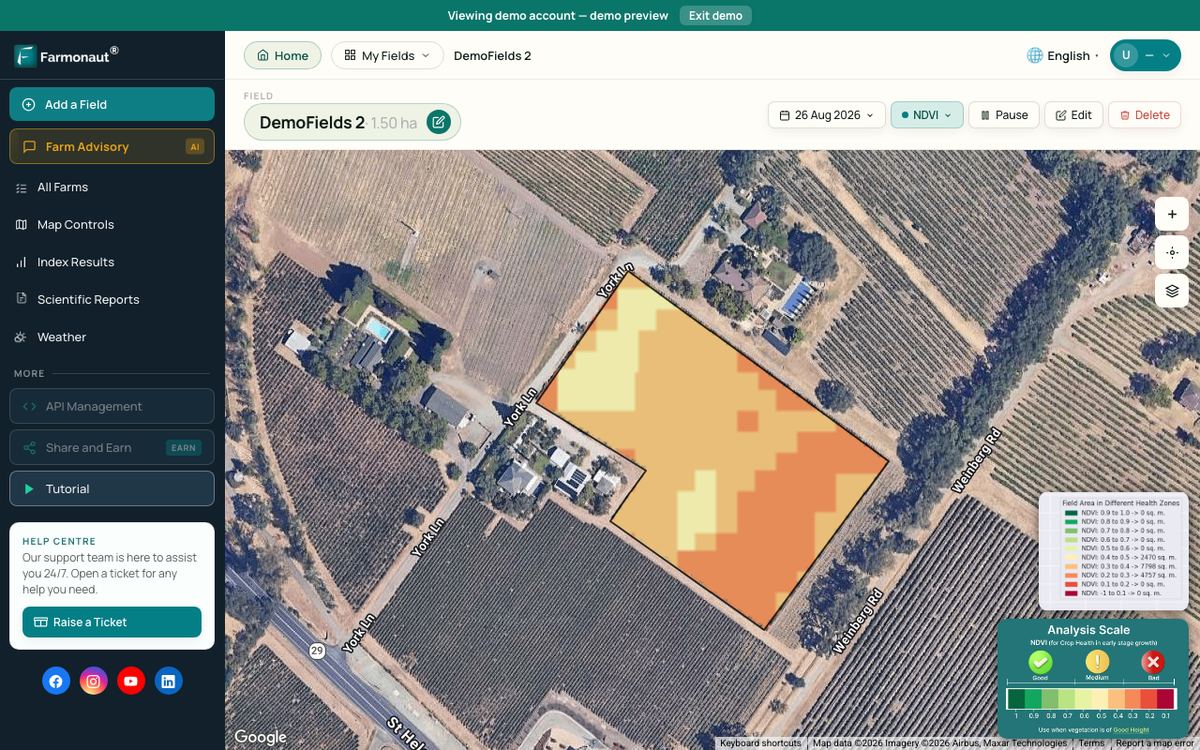
Crop condition maps help plan harvest order. Fields or zones that matured early, or that lodged or ripened unevenly, show up in vegetation index maps in the weeks before harvest. Farmonaut Satellite + AI Farm Monitoring System provides these maps for fields you draw on the web or in the mobile app, and developers can pull the same data through the Farmonaut API and its developer documentation. Satellite maps show crop change, not its cause, so check fields on foot before acting.

▶ How satellite crop health maps show weak and strong parts of a field across a large farm. · 4:09
How we checked the numbers
We used extension service surveys and cost studies from Illinois, Texas, Wisconsin, Mississippi and Manitoba, USDA price data and auction results reported by AgWeb. Each price is labelled as a guide price, a cost estimate, a survey average or an auction result, with its date. Costs from Illinois are for corn and soybeans, and we say so where we use them. Prices in Canadian dollars are not converted.
Related pages on our site: fleet management, product traceability, carbon footprinting and crop loan and insurance.
FAQ
What does a wheat combine harvester do?
It cuts the wheat, threshes the grain out of the heads, separates it from the straw, cleans it and holds it in a tank, all in one pass. Straw and chaff are spread behind the machine or left in rows for baling.
How much does a new combine cost?
The Manitoba 2026/2027 guide values new rotary combines at CAD 600,000 to CAD 1,150,000 depending on class, without a header. The University of Illinois used a $741,000 list price in its 2023 cost estimate. Dealer prices vary by options and region.
How much does it cost to rent or hire a combine for wheat?
Custom combining surveys show wheat averages of $31.30 per acre in Texas (2026, with hauling charged extra per bushel), $41 per acre in Mississippi (2024) and $37.12 per acre for straight small grains in Wisconsin (2025). Get local quotes, as rates depend on yield, field size and distance.
Who invented the combine harvester?
Hiram Moore built and patented an early combine in Michigan in the 1830s. Self-propelled designs followed in the 20th century, including Holt in 1911 and the Massey-Harris model that Thomas Carroll developed in Canada in 1937.
What does a used John Deere S780 sell for?
A 2024 S780 with 476 hours sold for $414,000 at a Minnesota auction on June 30, 2026, reported by AgWeb as a high price for that model. Prices depend on hours, header, options and region, so compare several recent sales.
Farmonaut crop monitoring
See your wheat fields from space
Draw your fields once and Farmonaut shows satellite crop maps for them through the season, on web, Android or iOS.



Keep reading
Sources
- Manitoba Agriculture, Cost of Production: Farm Machinery 2026/2027: manitoba.ca
- farmdoc daily (University of Illinois), Large increase in machinery costs (October 2025): farmdocdaily.illinois.edu
- University of Illinois, Machinery Cost Estimates: Harvesting (September 2023): farmdoc.illinois.edu
- Texas A&M AgriLife Extension, 2026 Texas Agricultural Custom Rates: agecoext.tamu.edu
- University of Wisconsin, Custom Rates for 2025 Wisconsin Farm Operations: farms.extension.wisc.edu
- Mississippi State University Extension, Custom Rates for Mississippi Agricultural Practices (2024 survey): extension.msstate.edu
- USDA NASS, Agricultural Prices (September 2026): esmis.nal.usda.gov
- AgWeb, Pete’s Pick: John Deere S780 and S670 lead June auctions (July 2026): agweb.com
- AgWeb, Machinery Pete: Used combine prices showing strength (September 2022): agweb.com
- Case IH, AF11 combine product page (checked October 2026): caseih.com
- Wikipedia, Combine harvester (history section): en.wikipedia.org
Discussion
Questions, corrections or field experience? Share them below. First-time comments are reviewed before they appear, and your email is never published.
No comments yet. Be the first to add a question or your experience.

 Dextrago
 Kubota
 FFBS
FFBS Jontra
 Kalustyan
 Tucor
Tucor Geno
Geno Hayleys Agriculture
 Linx Agritech
 Adinet
 Save Your Soils
 Grandstream Algérie
 XOS Realty
 Geospatial Lab Africa
 Licence holder · Niger · Gold










