

Diamond supply · Buyer guide
Diavik Diamonds for Sale: What Is Left After Closure
Rio Tinto announced the end of production at Diavik on 26 March 2026. Only stock already cut or in the pipeline remains. See what was produced, how the rough was sold and how to check a stone.
Key takeaways
- Rio Tinto announced the end of production at Diavik on 26 March 2026, after 23 years and more than 150 million carats (Rio Tinto release, March 2026).
- Output was 2.76 million carats in 2024 and 4.43 million in 2025; the third quarter of 2026 shows zero (Rio Tinto operations reviews).
- Rio Tinto sold the rough to contract customers called Select Diamantaires, so no public Diavik outlet exists; ask for origin papers and a lab report.
- Diavik’s 2025 output was roughly 6% of the 69 million carats of world gem-quality natural diamond output that USGS estimates for 2025.
- Value follows the four Cs of each stone, not the mine name. This page makes no price forecast.
In this article
- Can you still buy Diavik diamonds after the mine closed
- Diavik mine facts and closure timeline
- Diamond terms in plain words
- How many carats did Diavik produce each quarter
- What kind of diamonds came out of Diavik
- From discovery to closure: how the Diavik mine developed
- How Diavik rough reached buyers
- How to check a diamond sold as Diavik: 6 steps
- Check the price per carat of a stone you are offered
- Diavik compared with other Canadian diamond mines
- Where Diavik sat in world diamond supply
- What US import data show about the diamond market
- What the closure means for supply and collectors
- Closure, rehabilitation and monitoring
You can no longer buy newly mined stones from the Diavik mine, because Rio Tinto announced the end of production on 26 March 2026. Rio Tinto said the mine had used up its economic reserves after 23 years and more than 150 million carats of rough diamonds (Rio Tinto media release, filed with the US SEC). Diamonds cut from Diavik rough are still in the trade. This page explains where they came from, how the rough was sold, how to check a stone that is marketed as Diavik, and what the closure means for supply.
Can you still buy Diavik diamonds after the mine closed
Yes, but only from stock that already exists. Rio Tinto said the final rough production will be polished and sold through 2026 and beyond by its international customers, including its long-standing Select Diamantaires. A Select Diamantaire is a diamond manufacturer that holds a supply contract with Rio Tinto. Rio Tinto sold rough diamonds to these firms, not polished stones to the public.
That has two practical effects for a buyer. First, there is no single “Diavik shop.” A stone reaches a ring or a collector through a chain of cutters, dealers and retailers, and each link can describe the origin differently. Second, a claim of Diavik origin is only as good as the paperwork behind it. The sections below show what to ask for.
The number of new stones is now fixed. Rio Tinto’s own production table shows no ore processed and no diamonds recovered at Diavik in the third quarter of 2026 (Rio Tinto third quarter operations review, 14 October 2026).
Diavik mine facts and closure timeline
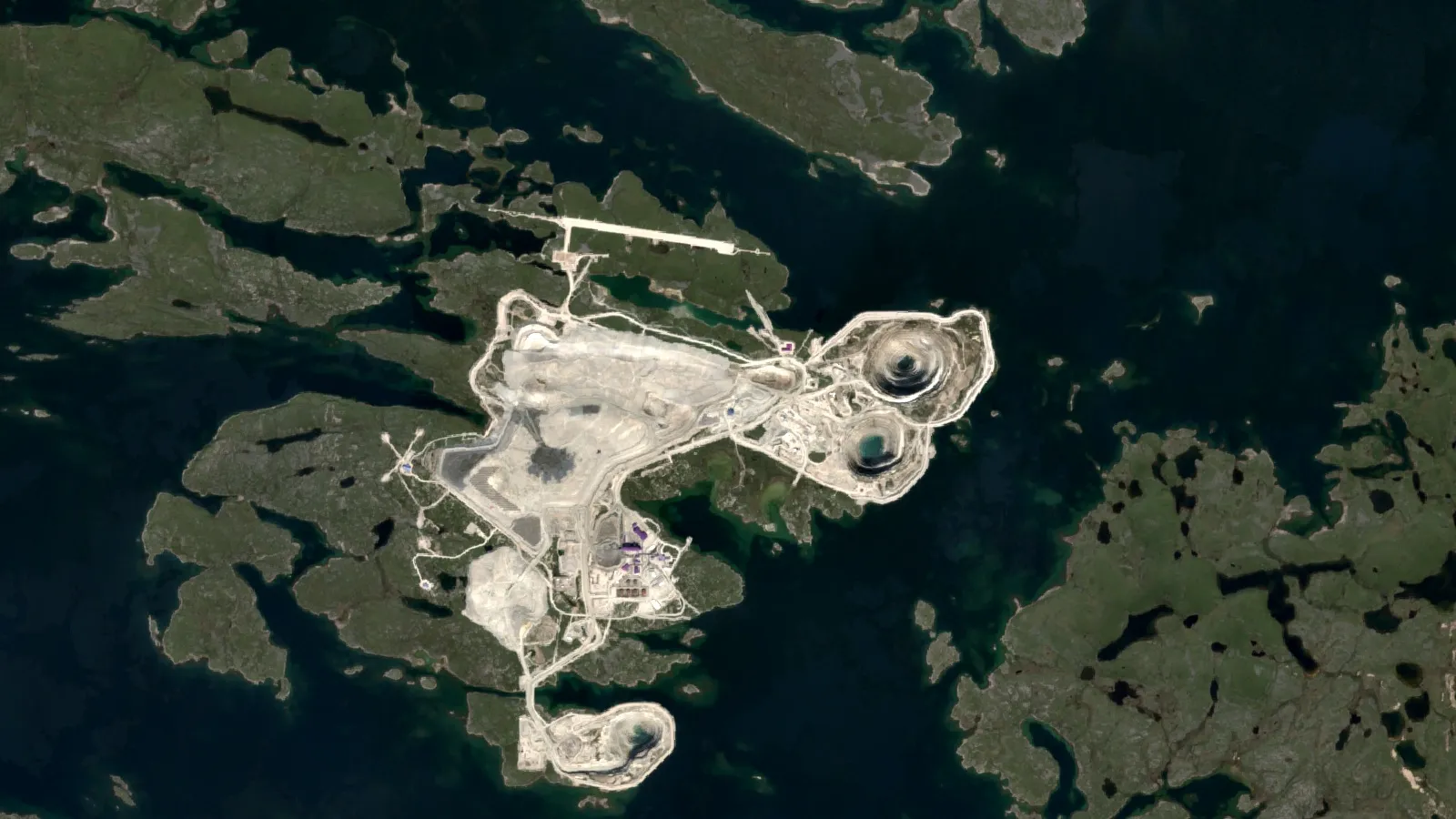
The mine sits on an island in Lac de Gras in the Northwest Territories, about 300 km northeast of Yellowknife and about 220 km south of the Arctic Circle. Ore came from four kimberlite pipes. Kimberlite is the volcanic rock that carries diamonds up from the mantle, and a pipe is the vertical, carrot-shaped body it forms. The pipes are A154 North, A154 South, A418 and A21, and they lie under the shallow water of the lake, so the mine had to build rock dikes to drain the areas it mined (Wikipedia, Diavik Diamond Mine).
| Item | Fact | Source |
|---|---|---|
| Owner | Rio Tinto, 100% interest | Rio Tinto half-year results, 2026 |
| Location | Lac de Gras, Northwest Territories, Canada | Rio Tinto release |
| Pipes | A154 North, A154 South, A418, A21 | Wikipedia |
| Mining started | 2003; underground mining began in 2010 and replaced the open pits by 2012 | Rio Tinto release; Wikipedia |
| End of production announced | 26 March 2026 | Rio Tinto release |
| Lifetime output | More than 150 million carats of rough | Rio Tinto release |
| Closure work | Runs to 2029, then post-closure monitoring | Rio Tinto release |
Rio Tinto’s 2026 half-year results describe the mine as a wind-down and list it among the legacy sites in its closure programme, along with Argyle in Australia (Rio Tinto half-year results, 2026).
One correction to older web pages: Dominion Diamond Mines is not the operator. Dominion once held a 40% share of the joint venture, and Rio Tinto, which ran the mine, later became the sole owner.
Diamond terms in plain words
- Carat: the unit of diamond weight, equal to 0.2 grams. A million carats is 200 kilograms of diamonds.
- Rough: diamond as it leaves the mine, before cutting.
- Polished: a cut and finished stone, the product a jeweller sells.
- Kimberlite: the igneous rock that carries diamonds from deep in the Earth to the surface. Most mined diamonds come from it.
- Pipe: the near-vertical, carrot-shaped body of kimberlite that a diamond mine digs out.
- HPHT: high pressure, high temperature, a laboratory process used to change a diamond’s colour or to grow synthetic stones.
- Select Diamantaire: Rio Tinto’s term for a long-standing contract buyer of its rough.
How many carats did Diavik produce each quarter
Rio Tinto reports Diavik output on a 100% basis every quarter. Production was 2.76 million carats in 2024 and 4.43 million carats in 2025, a rise of about 61% (Rio Tinto fourth quarter 2025 operations review). The 2025 jump came with more ore through the plant: about 1.9 million tonnes in 2025, against about 1.3 million tonnes in 2024.
Chart
Diavik diamonds recovered by quarter
Thousand carats, 100% basis
The chart shows the last five quarters. Output stayed near 1.1 million carats a quarter until the first quarter of 2026, then collapsed once mining ended. The second quarter of 2026 shows only 33,000 carats, and the third quarter shows zero.
What kind of diamonds came out of Diavik
Diavik was a high-volume mine, not a mine known for a few record stones. The 4.43 million carats of 2025 equal roughly 6% of the 69 million carats of world gem-quality natural diamond output that the US Geological Survey estimates for 2025 (our calculation from the two figures; USGS Mineral Commodity Summaries 2026, gemstones). Rough diamonds are sorted by size, shape, colour and clarity, and the output of a mine like this covers every grade from small industrial-quality pieces to cut-quality stones.
For that reason, treat any listing that says “all Diavik diamonds are top colour” or “many over 100 carats” with caution. Rio Tinto reports carats recovered but does not publish a quality breakdown of the output. A stone’s value comes from its own grades, not from the mine it came from. GIA, the lab that created the standard grading system, ranks value by the four Cs: clarity, colour, cut and carat weight (GIA, Diamond Quality Factors).
From discovery to closure: how the Diavik mine developed
Rio Tinto dates the discovery to 1991 and the start of mining to 2003. Mining began in the open pits, and in March 2010 underground mining started, with the move from open pit to underground completed in September 2012 (Wikipedia, Diavik Diamond Mine). The A21 pipe was the last to come into production and was reached by building a rockfill dike around part of the lake, .
The site is remote. It has an airstrip that can take Boeing 737 aircraft and is linked to the south by a winter ice road. In 2006 the ice road froze late and thawed early, and part of that year’s supplies had to be flown in.
How Diavik rough reached buyers
The rough went from the mine to Rio Tinto’s diamond marketing operations, which sold it to contracted customers such as the Select Diamantaires. Those customers cut and polished the stones and sold them on to dealers and jewellers.
Three points matter for a buyer:
- Records decide traceability. A polished stone can be linked to Diavik only if each seller in the chain kept the records.
- Stock is finite. With the mine closed, the remaining supply is the final rough, plus polished stock already in the pipeline.
- Retail claims are the seller’s own. If a jeweller advertises an official Diavik collection, ask for the supplier’s name and the origin documents in writing.
How to check a diamond sold as Diavik: 6 steps
- Ask for the origin paperwork. A real chain of custody names the cutter and the supplier and links the polished stone back to rough. A verbal “it’s Canadian” is not evidence.
- Get a grading report. A report from an independent lab such as GIA lists the four Cs and, for most stones, the inscription number. The report describes the stone; it does not on its own prove the mine.
- Read the report for treatments. Some brown diamonds are heated under high pressure and temperature (HPHT) to remove colour, and GIA notes that this treatment can be hard to detect even for experienced gemologists, so a laboratory report is the only way to confirm it (GIA, An Introduction to Gem Treatments).
- Confirm natural or laboratory-grown. USGS reports that cheaper synthetic stones have taken part of the market, so ask for the word “natural” on the report (see the USGS summary linked above).
- Compare price per carat, not total price. Use the calculator below, and compare stones of the same colour, clarity, cut and size.
- Get the return terms in writing. Look for a refund window, the right to have the stone re-checked by a lab, and a clear statement of what “Diavik” means in the listing.
Red flags in a Diavik listing
- The seller cannot name the cutter or the supplier.
- The listing promises that the stone will rise in value.
- The only proof is a photo of a mine or a certificate of origin with no stone identifier.
- The seller will not allow an independent lab check.
- The price per carat is far below the quotes you have from other dealers for the same grades.
Check the price per carat of a stone you are offered
The calculator in the next block turns a listing price and a weight into price per carat, then compares it with a quote you have for a similar stone. All values are examples that you replace.
Calculator
What is the price per carat of the stone you are offered
Enter the listing details and a quote you hold for a stone of the same grades.
- Difference to your comparison quote, per carat: $500
- Total difference for this stone: $500
- Price including report cost, per carat: $5,000
Example values only, not a market benchmark. Replace each number with your own quotes. Compare stones with the same colour, clarity, cut and size.
Diavik compared with other Canadian diamond mines
Canada is one of the four largest gem-diamond producers in the USGS table, at an estimated 13 million carats in 2025, level with Botswana and Angola and behind Russia at 21 million carats. Diavik’s 2025 output of 4.4 million carats was a little over a third of that Canadian total, on the same estimates.
Chart
Diavik and Gahcho Kue, 2025 output
Million carats, full year 2025, 100% basis
| Mine | Location | Owner | Status | Latest output we checked |
|---|---|---|---|---|
| Diavik | Lac de Gras, Northwest Territories | Rio Tinto (100%) | End of production announced 26 March 2026; closure work to 2029 | 4.43 million carats in 2025 |
| Gahcho Kué | Northwest Territories | De Beers (51%) and Mountain Province Diamonds (49%) | Operating | 4.33 million carats in 2025; 2026 guidance 6.6 to 7.2 million (100% basis) |
The Gahcho Kué numbers come from Mountain Province’s release of 9 March 2026, which gives 4,333,792 carats for 2025 and a 2026 range of 6.6 to 7.2 million carats on a 100% basis (Mountain Province Diamonds release via Stockwatch). The chart compares the two mines for 2025, the last full year of Diavik production.
For a much older example of a kimberlite mine, read our account of the Kimberley “Big Hole” in South Africa, a kimberlite mining operation. For the drilling side of Canadian diamond and mineral exploration, see our guide to diamond drilling companies in Canada, and for the wider spending picture, mineral exploration spending in Canada.
Where Diavik sat in world diamond supply
USGS estimates world gem-quality natural diamond production at 69 million carats in 2025, about the same as in 2024 (68.6 million). Russia produced about 21 million carats, around 30% by volume, and sanctions by the United States, the European Union and the G7 kept Russian rough and finished stones out of those markets. The chart ranks the leading producing countries.
Chart
Gem-quality natural diamond output by country
Million carats, 2025 estimate, selected leading countries
USGS also notes that the world’s largest diamond mines have matured and are past peak output, and that several of the largest are expected to close in the near future (USGS Mineral Commodity Summaries 2026, diamond). Rio Tinto says Diavik exhausted its economic reserves.
What US import data show about the diamond market
The US is one of the largest markets for polished diamonds. According to USGS, US gemstone imports were worth about US$11 billion in 2025, a fall of 44% from US$19.6 billion in 2024. US apparent consumption of gemstones fell 47%, to US$9.4 billion. USGS also reports that US output of laboratory-created gemstones fell by 35% after a leading synthetic producer in Oregon stopped operations in July 2025 (USGS Mineral Commodity Summaries 2026, gemstones).
These figures cover all gemstones, not only diamonds, but diamond made up an average of 79% of the value of US gem imports. Treat a deep discount as a reason to ask for more proof, not as a bargain.
What the closure means for supply and collectors
The natural diamond market has been weak since early 2023, according to USGS, with the lower end (one carat or less) hit hardest. Fewer jewellery sales led to a buildup of inventory, lower rough sales and lower prices, and USGS names inflation, excess stock and cheaper synthetic stones as causes. Rio Tinto gave a different reason for Diavik: its economic reserves were used up.
What this does and does not tell a buyer:
- A closed mine shrinks future supply of one origin. It does not by itself raise the price of any particular stone. Price still follows the four Cs and the state of the market.
- Any seller who says a Diavik stone “will rise in value” is making a forecast. Rio Tinto and USGS give no price outlook, and this page makes no price prediction.
- Provenance is worth paying for only if it is documented. Without paperwork it is a story, not a feature.
Diavik stones have no separate price list, so use dated written quotes from the dealers you are comparing. Use quotes from the dealers you are comparing, dated and in writing.
Closure, rehabilitation and monitoring
Rio Tinto says closure activities will run to 2029, followed by post-closure monitoring. Its half-year results include Diavik in a group closure programme that is expected to cost about US$1 billion a year over the coming years, shared with sites such as Argyle in Australia. The work is carried out with the Government of the Northwest Territories and Indigenous partners.
The land impact of any mine is easier to follow with a plain explanation of the main effects: land disturbance, water, waste rock, energy and closure. The short video below covers the seven main environmental impacts of mining in plain words.

▶ The seven main environmental impacts of mining, explained as a short clay animation · 2:31
Watching a closed mine site from space
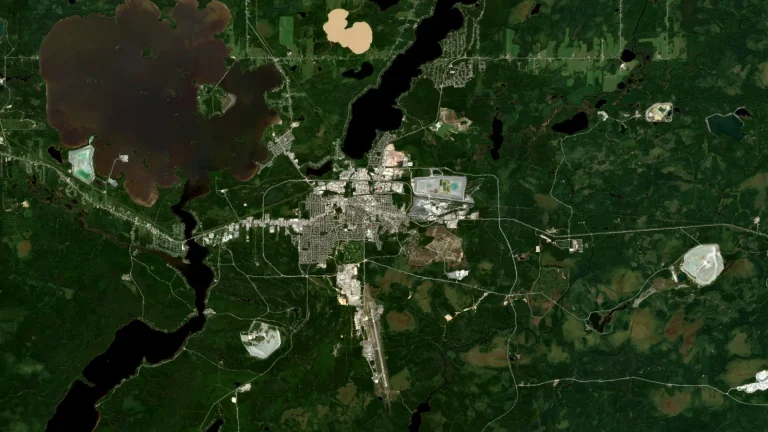
A mine this remote can be followed through public satellite images and commercial image archives. Sentinel-2, the European Space Agency satellite pair, images the same ground every few days at 10 m detail, which shows pits filling with water, waste rock piles, roads and vegetation recovery. The picture at the top of this page is a Sentinel-2 summer composite of the Lac de Gras area.
Farmonaut is a US-based company that maps mining sites from satellite data; licence owners and consultants can submit a boundary and receive a map-based report.
▶ Remote sensing for mining in three minutes: what satellites can and cannot measure · 2:01
We cover a connected topic in Gold Mine Water Treatment in Canada: 6 Projects Compared.
Frequently asked questions
Is the Diavik mine still open?
No. Rio Tinto announced the end of production on 26 March 2026. Closure work is planned to run to 2029, followed by monitoring.
Where is the Diavik mine?
It is on an island in Lac de Gras in the Northwest Territories of Canada, about 300 km northeast of Yellowknife and about 220 km south of the Arctic Circle.
Who owns the Diavik mine?
Rio Tinto reports a 100% interest. It earlier held 60% in a joint venture with Dominion Diamond, which held the other 40%.
How many diamonds did Diavik produce?
Rio Tinto says more than 150 million carats of rough over 23 years. Production was 2.76 million carats in 2024 and 4.43 million carats in 2025, on a 100% basis.
Where can I buy a Diavik diamond?
There is no official public outlet. Rio Tinto sold rough to contracted customers, and cutters and jewellers sold the stones on. Ask any seller for written origin documents and a lab report.
What is a Select Diamantaire?
It is the term Rio Tinto uses for its long-standing contract customers, who buy rough diamonds and manufacture them.
Are Diavik diamonds worth more than other diamonds?
Value is set by the four Cs of each stone. Origin alone does not set the price; stones are priced on their own grades.
How can I tell if a stone is natural?
Only a gemological laboratory report can confirm it. Ask for the word “natural” on the report and check the inscription number against the lab.
How many kimberlite pipes did Diavik mine?
Four: A154 North, A154 South, A418 and A21. All four lie under Lac de Gras.
Which Canadian diamond mines are still operating?
Gahcho Kué, owned by De Beers and Mountain Province Diamonds, produced 4.33 million carats in 2025.
Will the closure raise diamond prices?
USGS describes a market weakened by high inventory and lower demand since early 2023. A single mine closing is one factor among several, and neither USGS nor Rio Tinto forecasts a price change.
What happens to the Diavik site now?
Rio Tinto plans closure activities to 2029 with Indigenous partners and the Government of the Northwest Territories, then post-closure monitoring.
This page is for information only. It is not investment advice. Check the origin and grading of any diamond with an independent laboratory before you buy.
Farmonaut mining
Map your own mining site from space
Submit a site boundary and receive a satellite-based map of the ground and its changes.

Mining Pro sample view, synthetic data
Keep reading
Sources
- Rio Tinto, Diavik end of production media release (March 2026), filed with the US SEC: sec.gov
- Rio Tinto, Third Quarter 2026 Operations Review (14 October 2026): sec.gov
- Rio Tinto, Fourth Quarter 2025 Operations Review (ASX, 21 January 2026): announcements.asx.com.au
- Rio Tinto, 2026 half-year results: riotinto.com
- USGS, Mineral Commodity Summaries 2026: Gemstones: pubs.usgs.gov
- USGS, Mineral Commodity Summaries 2026: Diamond (industrial): pubs.usgs.gov
- GIA, Diamond Quality Factors: gia.edu
- GIA, An Introduction to Gem Treatments: gia.edu
- Mountain Province Diamonds, 2025 production and 2026 guidance release (9 March 2026), via Stockwatch: stockwatch.com
- Wikipedia, Diavik Diamond Mine: en.wikipedia.org
Discussion
Questions, corrections or field experience? Share them below. First-time comments are reviewed before they appear, and your email is never published.
No comments yet. Be the first to add a question or your experience.

 Mwerezi Minerals Company Limited
 Congo Mining Solutions
 Mining SARL
 SenGold Invest SAS
 Sania Corporation
 Sean Mining Limited
 NTS Group (Pty) Ltd
 Mine4Africa
 Lithspo Minerals Limited
 Tintina Mining Group
 Dalgety Minerals Pty Ltd
 Vortex Minerals Pty Ltd
 Faith At Work (Pty) Ltd
 Geotech Mining Solutions plc
 Vulcan International Limited
 Kidepo Associates
 GKY Mining
 Alkimy SARL
 Double A Trading

 Licence holder · Nigeria · Gold + lithium










