

Biological control · How-to guide
Ladybug Pest Control: What They Eat and How to Release
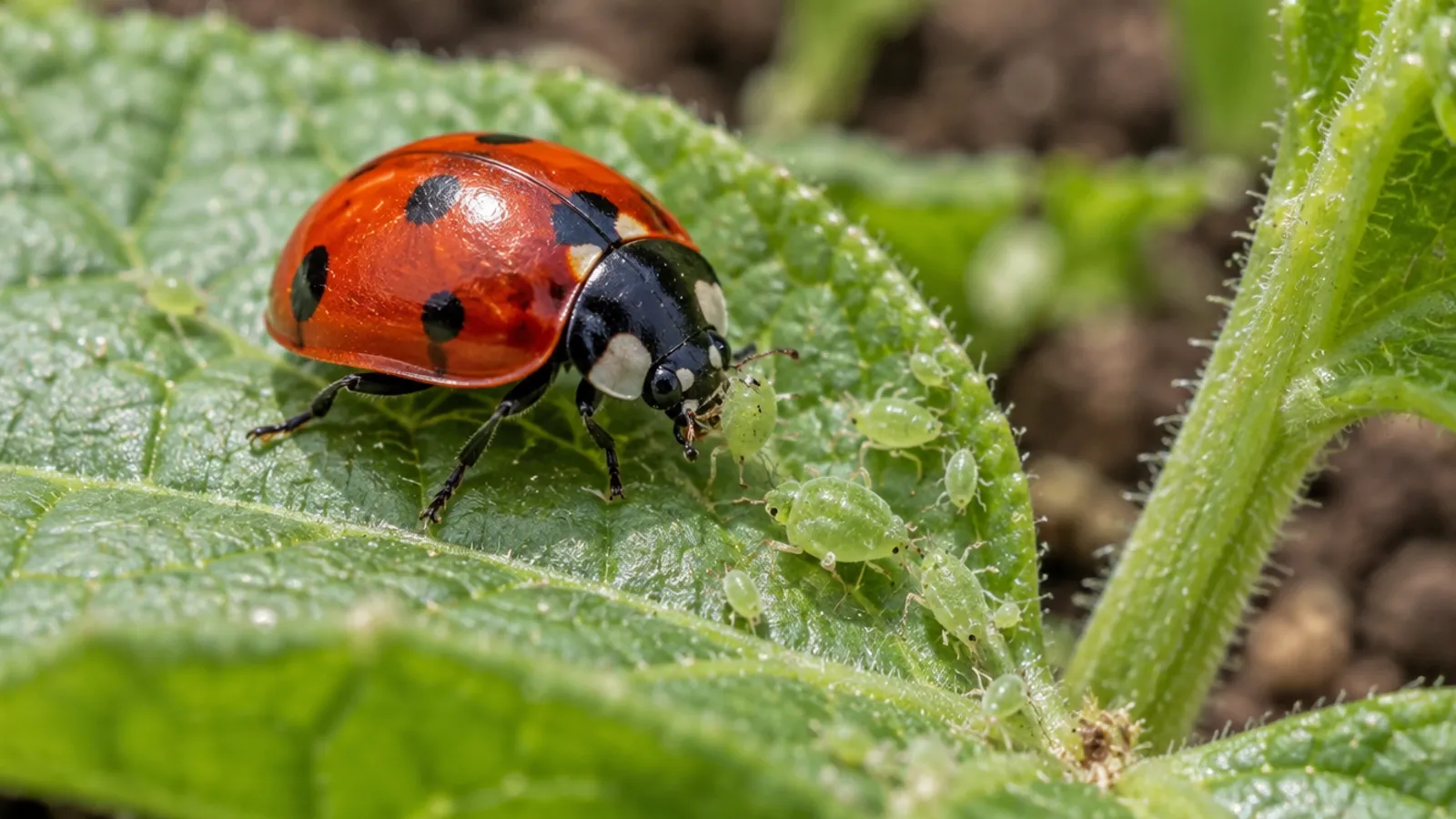
Lady beetles mainly eat aphids, and some species eat scales, mealybugs or mites. Bought ladybugs give short-term control at best: each adult eats about 100 aphids a day, but most leave within one or two days (UC IPM).
Key takeaways
- Each adult convergent lady beetle can eat about 100 aphids a day, but most bought beetles fly away within 1 to 2 days of release (UC IPM).
- Nearly all ladybugs sold are convergent lady beetles collected from wild winter clusters in the western US, and many do not lay eggs for several weeks (CSU Extension).
- One heavily infested rose bush needed two releases of about 1,500 beetles each, a week apart (UC IPM Aphids Pest Note).
- The mealybug destroyer is a reared lady beetle; about 500 per acre is recommended in spring in California citrus where mealybugs were a problem (UC IPM).
- Release at dusk onto watered plants, control ants and avoid broad-spectrum sprays such as pyrethroids, which are very toxic to predatory beetles (UC IPM).
In this article
- Ladybug pest control in short
- What ladybugs control
- Which ladybugs you can buy
- How many ladybugs to release
- How to release ladybugs so fewer fly away
- Ladybugs and insecticide sprays
- Life cycle: why larvae matter
- When buying ladybugs makes sense
- Ladybug pest control cost: release vs spray
- How Farmonaut fits into scouting
- How we checked the facts
- FAQ
Ladybugs (lady beetles) mainly eat aphids, and the adults sold for release can each eat about 100 aphids a day, according to UC IPM’s convergent lady beetle page. The catch is that most bought beetles fly away within one or two days, so ladybug pest control works best as a short, heavy release on a small, well-watered patch, backed by steps that keep wild lady beetles on your farm.
This guide covers what ladybugs control, which species you can buy, how many to release and how to release them so fewer fly off. It also has charts on species and life stages and a calculator that compares the cost of a release with the cost of a spray program on your own numbers.
Ladybug pest control in short
| Question | Short answer | Source |
|---|---|---|
| Main prey | Aphids; some species eat scales, mealybugs, mites or whiteflies | Colorado State University Extension |
| Species sold | Mostly the convergent lady beetle, Hippodamia convergens | CSU Extension; UC IPM |
| Where they come from | Collected in the wild at winter sites in western US mountains | UC IPM |
| Aphids eaten | About 100 a day per adult | UC IPM |
| How long they stay | Most leave within 1 to 2 days | UC IPM |
| Rate on one rose bush | About 1,500 beetles, two releases a week apart | UC IPM Aphids Pest Note |
| Mealybug destroyer | About 500 per acre in spring in California citrus | UC IPM |
What ladybugs control
Lady beetles are a large family of beetles, the Coccinellidae. Adults and larvae both hunt. Each species has its own favourite food, but most eat almost any small insect, mite or insect egg they can catch, says Colorado State University Extension. The common spotted species in fields and gardens feed mainly on aphids.
Aphids
Aphids are the main target. Convergent, seven-spot, two-spot and multicolored Asian lady beetles all eat them. The larvae, which look like tiny grey alligators with orange marks, eat many aphids too. Ladybugs work best on aphid colonies that are easy to reach, such as on shoots and the tops of leaves. Aphids in tightly curled leaves are harder for them to find.
Scale insects
Some small, dark lady beetles specialise in scale insects. The genera Chilocorus, Exochomus and Coccidophilus feed on scales, according to CSU Extension. The twicestabbed lady beetle, Chilocorus orbus, is shiny black with two red spots. These beetles are easy to miss because many are tiny or shaped like the scales they eat, notes the UC IPM Pest Note on scales. The best-known case of all is the vedalia beetle, which controls cottony cushion scale in citrus. Public agencies still run this kind of work: the California Department of Food and Agriculture has a Biological Control Program that brings in and tests natural enemies of invasive pests.
Mealybugs
The mealybug destroyer, Cryptolaemus montrouzieri, is a lady beetle from Australia. Its larvae are covered in white wax and look like the mealybugs they eat. It is reared and sold for release. For organic options on this pest, see our guide to organic mealybug control.
Spider mites, whiteflies and insect eggs
Very small lady beetles in the genus Stethorus eat spider mites. Several small species, plus the multicolored Asian lady beetle, feed on whiteflies, according to the UC IPM Pest Note on whiteflies. The pink lady beetle, Coleomegilla maculata, is an important predator of insect eggs and is common in gardens and crops.
Not all ladybirds eat pests
A few lady beetles eat plants or fungi. In Britain, the RHS lists more than 40 resident species, and some, such as the 22-spot ladybird, feed on powdery mildew rather than insects (RHS ladybirds advice). In North America, the Mexican bean beetle feeds only on plants and is an important pest of beans, says CSU Extension.
Chart
Lady beetle species recorded by region
Approximate number of species, as given by each source
Which ladybugs you can buy
Most shops and catalogs sell one species. Nearly all ladybugs sold in garden catalogs are convergent lady beetles, says CSU Extension. They are not reared in a lab. They are vacuumed up from large winter clusters in the foothills and mountains of the US West, mainly in California.
| Species | Main prey | How it is sold | Best for |
|---|---|---|---|
| Convergent | Aphids | Field-collected adults | Short aphid knock-down on a small area |
| Mealybug destroyer | Mealybugs | Reared adults or larvae | Citrus, greenhouses, interiorscapes |
| Multicolored Asian | Aphids, eggs, whiteflies | Not usually sold; now wild across North America | Already present; conserve, do not buy |
| Scale specialists | Scale insects | Rarely sold | Conserve in orchards and landscapes |
Two points matter when you buy field-collected beetles. First, CSU Extension says they are often in a resting state called reproductive diapause, so they do not lay eggs until they have fed for several weeks. Second, some carry a small parasitic wasp, Perilitus coccinellae, which develops inside the beetle.
The multicolored Asian lady beetle
The multicolored Asian lady beetle, Harmonia axyridis, was released in North America for decades, starting in California in 1916. Those releases did not seem to take. The first lasting populations were found in Louisiana in 1988, probably from an accidental arrival by cargo, says Penn State Extension. It is a strong aphid predator in crops, but it also competes with native lady beetles, can taint grapes during wine-making and invades homes in autumn. In Britain it is called the harlequin ladybird and became established in 2004.
Chart
Adult size of common lady beetles
Largest adult length in mm, as given by each source
How many ladybugs to release
High numbers are needed. University of California research found that one large, heavily infested rose bush needed two releases, a week apart, of about 1,500 lady beetles each, according to the UC IPM Pest Note on aphids. UC IPM’s convergent lady beetle page says aphids on roses can need about 1,500 beetles per shrub at 1- to 2-week intervals while conditions suit aphids.
For the mealybug destroyer, the rate is per area. In California citrus, a spring release of 500 beetles per acre is recommended where mealybugs have been a problem, according to UC IPM’s mealybug destroyer page. In greenhouses, several beetles per square foot or per plant are released where egg masses are present.
Field-scale rates for aphids in open crops are not well supported by research, because the beetles leave so quickly. On a farm, a release is most useful on a small block, a high-value bed, a greenhouse or a tunnel, not across a whole field.
How to release ladybugs so fewer fly away
Each step below comes from UC IPM’s guidance. None of them stop all beetles leaving, but together they keep more of them on your plants for longer.
- Check that you have a pest to feed them. Look for live aphid colonies, and check for wild lady beetles, lacewings, syrphid fly larvae and parasitised aphid mummies first. If many are present, the aphids may fall without any purchase.
- Order for the date you need. Large numbers may need to be ordered ahead through a shipping service.
- Keep them cool. Store the beetles in the refrigerator until release. Do not freeze them.
- Feed stored beetles. If you keep some for later releases, warm them to room temperature once a week and mist them with very dilute sugar water. Do not refrigerate them with food.
- Water first. Mist the plants, and mist the beetles just before release.
- Release at dusk. Beetles let go in full daylight fly off at once. Late evening, when it is cooler, slows dispersal.
- Place them low. Put them at the base of infested plants or in the crotches of low branches. They crawl upward to look for aphids.
- Repeat. Plan for a second release about a week later.
Help resident lady beetles do the work
CSU Extension says the record for bought lady beetles in a garden is “typically poor”, and that conserving wild ones works far better. These steps help both bought and wild beetles:
- Control ants. Ants tend aphids for honeydew and drive off lady beetles and other predators.
- Plant flowers. Nectar and pollen plants help adult lady beetles, lacewings and parasitic wasps live longer and lay more eggs.
- Keep dust down. Dust interferes with natural enemies.
- Leave some prey. Lady beetles need aphids or other prey to stay and breed.
- Choose sprays with care. See the next section.

▶ Practical aphid control on farms, from natural enemies to targeted treatments. · 12:44
Ladybugs and insecticide sprays
Broad-spectrum insecticides kill lady beetles along with pests. UC IPM’s citrus guide on selectivity of insecticides and miticides names most organophosphates, carbamates, pyrethroids and neonicotinoids as broad-spectrum. It notes that predatory beetles are very sensitive to pyrethroids, and that some insect growth regulators, such as pyriproxyfen and buprofezin, are very toxic to the vedalia beetle. Residues of some products can harm predatory beetles for two to three months or more.
If you must spray, UC IPM suggests using broad-spectrum products in a selective way: baits, spot treatments, or timing when natural enemies are not active. Low-residue options such as insecticidal soap or horticultural oil kill only the insects they touch while wet, so a release a few days later is less at risk. Always check the product label, local rules and your extension office before you spray, and do not release beetles onto freshly treated plants.

▶ Integrated pest management for aphids in organic alfalfa. · 15:22
Life cycle: why larvae matter
Lady beetles go through egg, larva, pupa and adult. For the multicolored Asian lady beetle, Penn State Extension gives 3 to 5 days as an egg, 12 to 14 days as a larva and 4 to 5 days as a pupa. The full cycle takes three to six weeks, depending on temperature and food, with four to six generations a year. Convergent lady beetle females can lay several hundred eggs in a growing-season life of about two months, according to UC IPM.
Chart
Multicolored Asian lady beetle: days in each stage
Days per life stage, range given by the source
Larvae eat aphids for about two weeks before they pupate, so eggs and larvae on your plants are a good sign. Learn to recognise them so you do not mistake them for pests. Eggs are yellow to orange, spindle-shaped and laid upright in clusters near aphids. CSU Extension says the egg stage usually lasts five to seven days. Lady beetles that eat mealybugs often have waxy larvae that look like mealybugs themselves.
When buying ladybugs makes sense
A release can make sense in these cases:
- Greenhouses and tunnels. The beetles cannot leave as easily, and conditions stay warm.
- Small, high-value plantings. A few rose bushes, a herb bed or nursery stock, where 1,500 beetles per plant is affordable.
- Mealybug problems in citrus or under glass. The mealybug destroyer is reared for this job, though UC IPM notes supplies can be limited.
- Organic or low-residue programs. Where you want to avoid broad-spectrum sprays and accept slower control.
A release is less likely to pay in open field crops, when no aphids are present yet, when ants are abundant, or right after a broad-spectrum spray. In those cases, money is often better spent on scouting, ant control and flowering borders.
Ladybug pest control cost: release vs spray
Prices for ladybugs vary by supplier, season and quantity, and many sellers price by the pint or by the thousand. Get current quotes from suppliers and compare them with the cost of the spray program you would use instead. The calculator below does this on your own numbers. It does not include labour, which is often similar for both.
Try the numbers for your own farm below.
Calculator
Ladybug release or spray: which costs less for you?
Enter your own plant count, release rate and quotes.
- Beetles needed in total: 30,000 beetles
- Cost of beetle releases: 300 $
- Cost of spray program: 300 $
Example values only, not a benchmark, a price quote or a forecast; every number is your input. The default of 1,500 beetles per plant and two releases is the rose-bush example in the UC IPM Aphids Pest Note; other crops differ. Enter current supplier prices per 1,000 beetles and your own spray cost per application. Labour, shipping and losses to dispersal are not included. Check product labels and local rules before any spray.
How Farmonaut fits into scouting
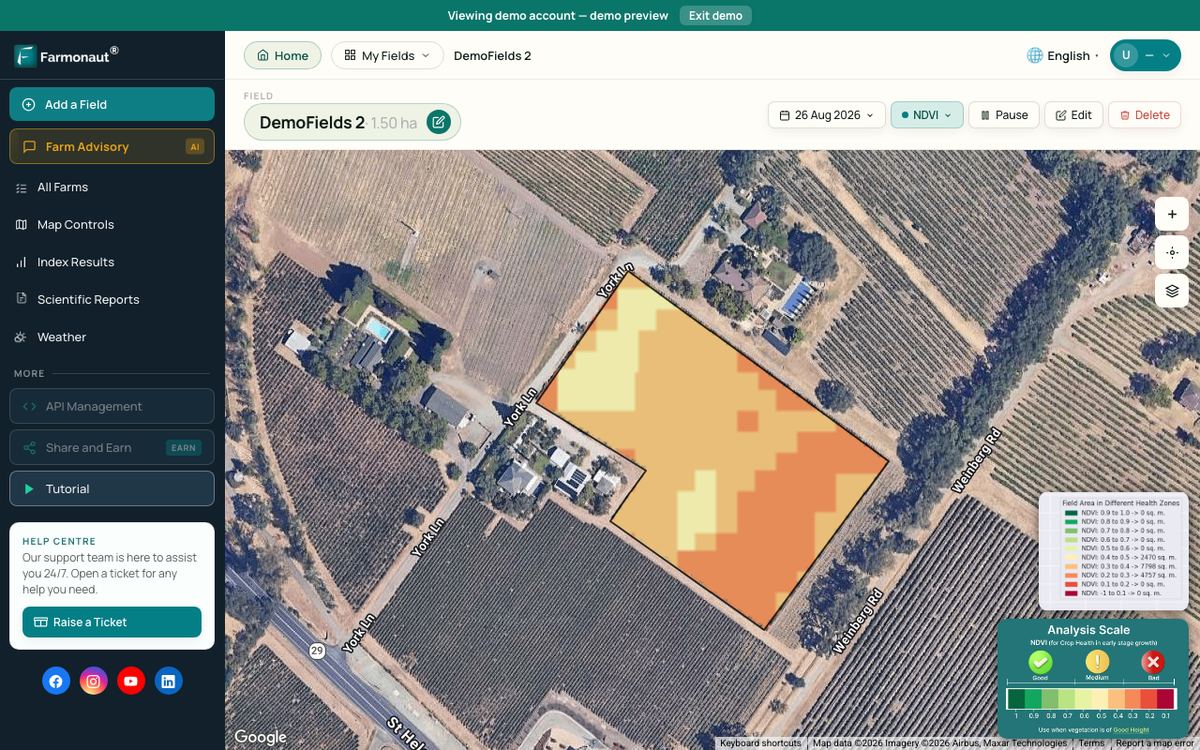
A release only works if you catch aphids early and in the right place. Aphids are often worst along the upwind edge of a field and close to other infested plants, notes UC IPM. The Farmonaut Satellite + AI Farm Monitoring System maps crop vigour from satellite images through the season, which helps you find stressed patches to scout on foot. Satellites cannot see the insects themselves, so a field check is still needed before you buy or spray. Our satellite and weather API lets advisers add the same data to their own tools.

▶ Organic pest control supported by Farmonaut’s precision farming tools. · 12:30
How we checked the facts
We used university extension guides from the University of California IPM Program, Colorado State University and Penn State, plus RHS advice for UK readers. Release rates are the ones these sources give for specific cases, such as one rose bush or California citrus; they are not general field rates. We did not use supplier claims for prey eaten or beetles per acre. Prices are not quoted, because supplier list prices change often; use the calculator with your own quotes.
FAQ
Do ladybugs really work for pest control?
Wild lady beetles are important aphid predators. Bought ones give, at best, short-term control, because most fly away within one or two days. UC IPM found one heavily infested rose bush needed two releases of about 1,500 beetles.
How many aphids does a ladybug eat?
UC IPM says each adult convergent lady beetle can eat about 100 aphids a day before it disperses. Larvae also eat aphids; for the multicolored Asian lady beetle the larval stage lasts 12 to 14 days (Penn State Extension).
When is the best time to release ladybugs?
At dusk, after watering, when aphids are present on the plants. Releases in full daylight fly off at once. Keep the beetles refrigerated until release.
Are multicolored Asian lady beetles good or bad?
Both. Penn State Extension says they eat aphids and insect eggs in crops, but they displace native lady beetles, can taint wine grapes and gather in homes in autumn.
Can I use ladybugs with insecticides?
Only with care. Broad-spectrum products such as pyrethroids, organophosphates, carbamates and neonicotinoids kill lady beetles, and some residues last for months. Use selective or short-residue products, check the label and local rules, and wait before releasing.
What do ladybug larvae look like?
They are long, with legs sticking out, and look like tiny alligators. Most are grey or black with orange, yellow or white spots. Keep them; they are eating your pests.
Related pages on our site: farm management for agribusinesses, satellite data API, our apps, crop loan and insurance tools, carbon footprinting, product traceability and fleet management.
Farmonaut crop monitoring
Know where to scout first
Draw your fields once and Farmonaut shows satellite crop-vigour maps through the season on web, Android or iOS, so you can check weak patches for pests sooner.



Keep reading


Sources
- UC Statewide IPM Program, Convergent Lady Beetle, Natural Enemies Gallery: ipm.ucanr.edu
- UC Statewide IPM Program, Aphids Pest Note 7404: ipm.ucanr.edu
- UC Statewide IPM Program, Mealybug Destroyer, Natural Enemies Gallery: ipm.ucanr.edu
- UC Statewide IPM Program, Scales Pest Note 7408: ipm.ucanr.edu
- UC Statewide IPM Program, Whiteflies Pest Note 7401: ipm.ucanr.edu
- UC Statewide IPM Program, Selectivity of Insecticides and Miticides, Citrus Pest Management Guidelines: ipm.ucanr.edu
- Colorado State University Extension, Lady Beetles, fact sheet 5.594: extension.colostate.edu
- Penn State Extension, Multicolored Asian Lady Beetle: extension.psu.edu
- Royal Horticultural Society, Ladybirds (RHS advice): rhs.org.uk
- California Department of Food and Agriculture, Biological Control Program: cdfa.ca.gov
- UC Statewide IPM Program, Mealybugs Pest Note 74174: ipm.ucanr.edu
Discussion
Questions, corrections or field experience? Share them below. First-time comments are reviewed before they appear, and your email is never published.
No comments yet. Be the first to add a question or your experience.

 Agritein
 Delicio
 Payagri
 WB Dev
 Sama Premium
 Prochecker
 Tres Valles
 LACOS Geoinformation
 Pulsar Supernova
 Magrifly
 LatConnect 60
 WebsEdge
 Blickwinkel
 Agricultural Credit Policy Council
 Marei Nursery
 eKGIS
eKGIS Mostas Tech
 Andex
Andex FCF India
 Unifrutti Gulf
 Licence holder · Niger · Gold
 Licence holder · Nigeria · Gold + lithium










