

Customer case study · Lucerne and beans
Alfalfa Irrigation Scheduling: A Namibia Pivot Case Study
Satellite advisories set 35% of planned days on Yolande van Niekerk’s lucerne pivot to zero water, mostly around each cutting, and offered an organic fertilizer option in 97% of nutrient recommendations across her two pivots.
Key takeaways
- Yolande van Niekerk’s four fields at Middelplaas Farming, Namibia, about 131 acres, received 564 satellite advisories from November 2024 to October 2026.
- On the lucerne pivot, 216 of 610 planned days (35.4%) were zero-water days, and 117 of them fell around cutting and regrowth.
- The planned water on the lucerne pivot was about 35% below a same-dose daily routine, and about 23% below it on the bean pivot.
- 1,480 of 1,520 nutrient recommendations on the two pivots came with an organic option, led by compost, bone meal and wood ash.
- 63% of lucerne nutrient recommendations said no application was needed, in line with guidance that established alfalfa fixes its own nitrogen.
In this article
- Middelplaas Farming at a glance
- What Yolande says about the advisories
- How alfalfa irrigation scheduling works on her pivots
- Alfalfa irrigation scheduling around each cutting
- The bean pivot: water that follows each planting
- Organic fertilizer management, nutrient by nutrient
- Reading crop health from space
- Pest and weed watch by growth stage
- What other alfalfa growers can take from this
- FAQ
Alfalfa irrigation scheduling means matching each watering to what the crop is using, and stopping water at the right moments, such as the days around each cutting. This case study follows Yolande van Niekerk of Middelplaas Farming, whose centre pivots of lucerne (alfalfa) and French beans sit in the dry Stampriet area of Namibia’s Hardap Region. Since November 2024 her fields have received 564 satellite advisories. On the lucerne pivot, 35% of the planned days were zero-water days, and almost every fertilizer recommendation came with an organic option.
Yolande follows her farm with the Farmonaut Satellite + AI Farm Monitoring System and gave the service a five-star client review. Below we go through her advisory records to show what the system told her to do, week by week, and why.
Middelplaas Farming at a glance
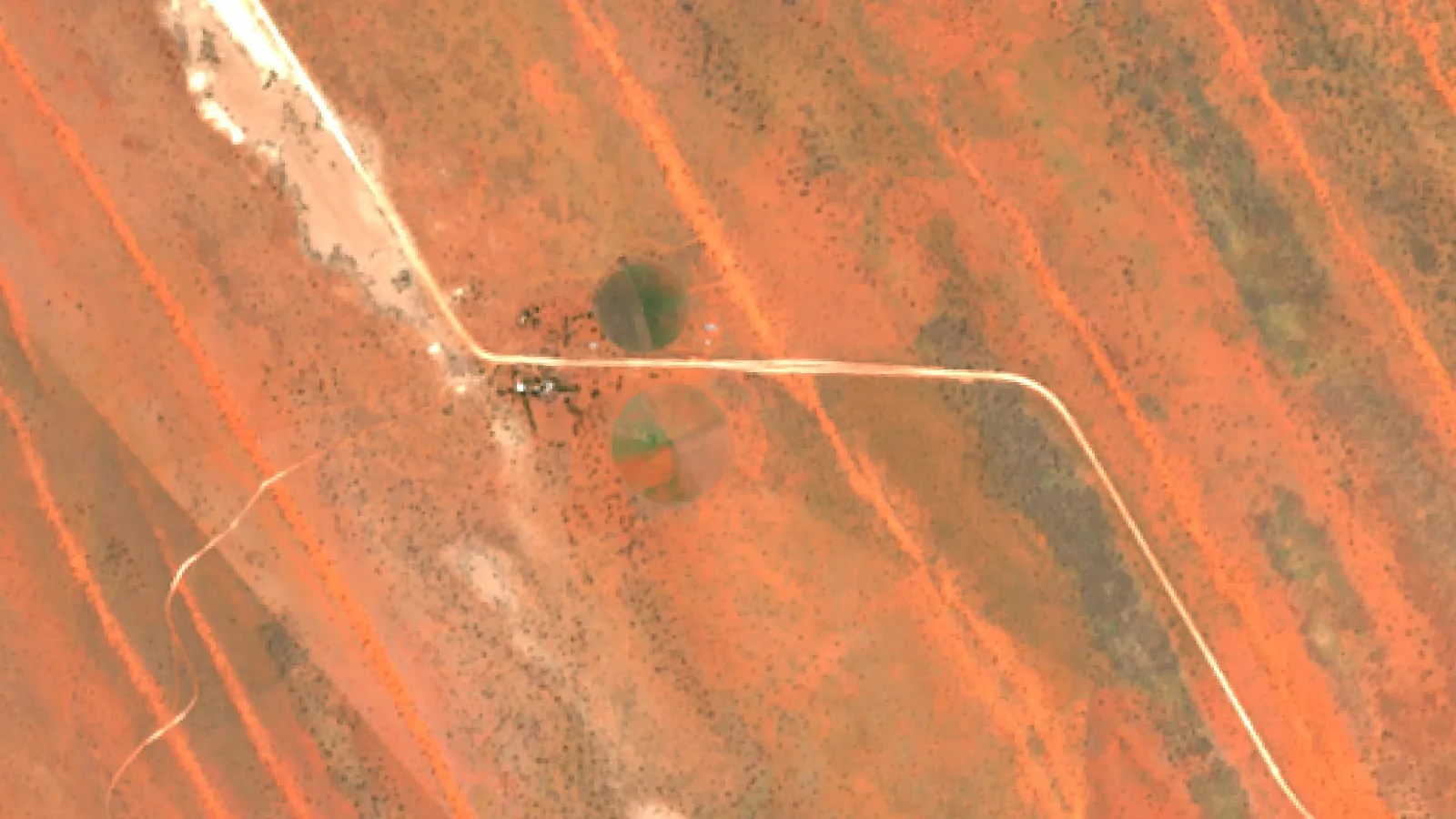
Yolande added her first field on 30 November 2024: the lucerne pivot. The bean pivot followed two days later, and two larger farm sections were added in April 2025. The four fields she monitors today cover about 131 acres (53 hectares).
| Field | Area | Crop | Monitored since | Advisories |
|---|---|---|---|---|
| Lucerne pivot | 53.5 acres | Lucerne (alfalfa) | Nov 2024 | 146 |
| Large Pivot | 35.2 acres | French beans | Nov 2024 | 158 |
| Section Bettie | 25.5 acres | Farm section | Apr 2025 | 130 |
| Section Pieriette R | 17.3 acres | Farm section | Apr 2025 | 130 |
The two pivots carry the full crop advisory, with irrigation, fertilizer, soil, pest and weed sections. The two farm sections are tracked with satellite crop-health maps. The lucerne pivot was redrawn in November 2025 to its current 53.5-acre outline, so the earliest lucerne advisories describe a smaller area.
The latest advisories describe an alkaline soil, with a pH of 7.4 to 7.8, moderate salinity and soil organic carbon of 0.17–0.22%, which the advisory rates as low. That soil profile shapes much of the fertilizer advice later in this story.
What Yolande says about the advisories
In her client review, Yolande rated Farmonaut five stars and wrote:
“I check my crop’s general health and irrigation status with the reports. The Farm Advisory’s Organic Fertilizer Management has helped me a lot – I’ve seen improvement since using Farmonaut!” – Yolande van Niekerk, Middelplaas Farming
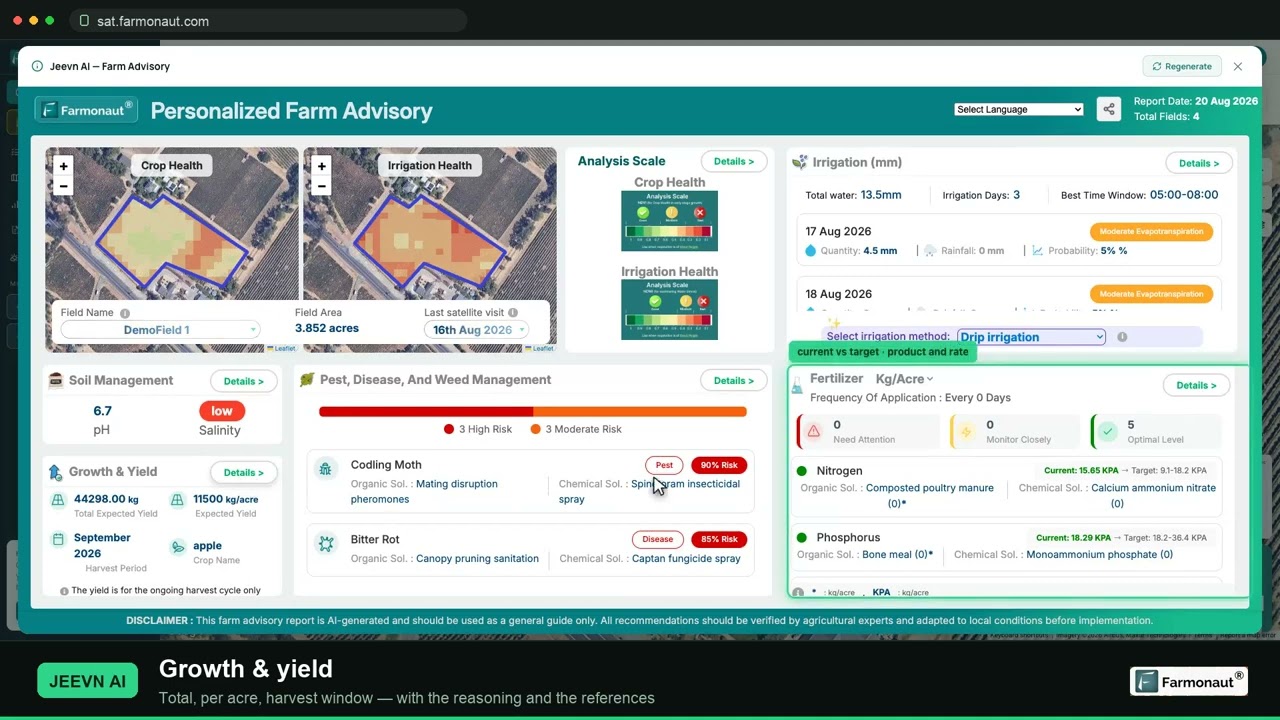
Her review names the three things this case study looks at: crop health, irrigation status and organic fertilizer management. Each of them is a section of the advisory she receives for every pivot, every few days.

How alfalfa irrigation scheduling works on her pivots
Each advisory starts with a fresh satellite pass. Sentinel-2 has a revisit time of five days with its two satellites, and it measures the crop in visible, near-infrared and shortwave-infrared light. Sentinel-1 adds radar, which can image the field by day or night, whatever the weather. From these passes the system reads canopy greenness (NDVI), leaf water (NDWI) and a radar soil-moisture index (RSM) for each pivot.
Infographic
How each pivot plan is built in 4 steps
- 1Satellite passSentinel-2 and Sentinel-1 image each pivot every few days.
- 2Read the fieldNDVI, NDWI and radar soil moisture show canopy, leaf water and soil wetness.
- 3Crop water useReference evaporation times the crop coefficient for the current stage.
- 4Daily planDry days set to 0 mm; other days get an amount and a morning window.
Next, the system estimates how much water the crop is using. It multiplies a reference evaporation rate (ET0) by a crop coefficient (Kc) for the current growth stage. FAO’s irrigation guide gives alfalfa hay an initial Kc of 0.40 and a Kc of 1.20 during the peak of an individual cutting period, so water need climbs steeply as the stand regrows and drops after each cut. Where full weather data is missing, the advisories fall back on the Hargreaves temperature-based ET0 equation, the alternative FAO gives when radiation, humidity or wind data are not available.
Finally, the plan applies skip rules. A day gets 0 mm when the soil and canopy are already wet, when rain is expected, or when the crop stage calls for a dry field. Every other day gets an amount in millimetres and an early-morning time window, with the recommended method (drip, sprinkler or centre pivot) shown beside the alternatives.
The same method drives the plans in our sugarcane irrigation scheduling case study and in our satellite irrigation advisory case study from the Algerian steppe.
Alfalfa irrigation scheduling around each cutting
On the lucerne pivot, the advisories planned water for 610 days between November 2024 and October 2026. On 216 of those days, 35.4%, the plan said 0 mm. More than half of the zero days (117) fell at harvest or regrowth stages, the days around each cutting. Only 14 zero days were caused by rain, which is rare on the edge of the Kalahari.
Chart
Planned water: same dose every day vs the advisory
mm per pivot, November 2024 to October 2026
That pattern matches extension advice for irrigated hay. A 2024 forage irrigation workshop in Siskiyou County, California, notes that irrigations must be cut back a few days prior to cutting, and during hay curing on the ground. Water at that stage cannot help a crop that is about to be mowed, and a wet field slows drying and baling.
The water difference adds up. A routine that gave the average planned dose every single day would have put about 5,250 mm on the lucerne pivot over the two seasons. The advisory planned about 3,390 mm, roughly 35% less. In 2026 the share of zero-water days on this pivot ran between 36% and 53% in every month except January, when the stand was growing fastest.
Holding water back at the right time is a well-studied lever in alfalfa. In a University of California trial in the Klamath Basin, stopping irrigation after the first cutting saved 21 inches of water on a silt loam and 11 inches on a sandy loam. Yolande’s plan does not stop irrigation for the season. It removes water on the specific days when the crop cannot use it.
Chart
Share of zero-water days on the lucerne pivot
% of planned days set to 0 mm, by month, 2026 (October to the 16th)
The bean pivot: water that follows each planting
The 35.2-acre Large Pivot grows French beans, a short crop that is sown several times a year. The advisories re-estimate the sowing date from the satellite record whenever the canopy pattern changes, for example when NDVI falls to bare-soil levels after a harvest and then climbs again as a new crop emerges.
FAO gives green beans a Kc of 0.5 at the start, 1.05 at mid-season and 0.90 at the end, so the bean pivot needs a very different schedule from the lucerne next to it. Across 641 planned days, 22.6% were zero-water days, and nearly half of those fell around harvest. The plan came to about 3,280 mm, against about 4,240 mm for the same dose every day, a difference of roughly 23%.
The most recent bean advisory, on 16 October 2026, shows how specific the plan is. It placed the crop at the first-to-third trifoliate leaf stage, noted that NDVI had risen from 0.21–0.33 to 0.45 since sowing, and set 4.0 mm of drip water between 05:30 and 07:00 on watering days, with sprinkler and centre-pivot amounts shown for comparison.

▶ How to read a Farmonaut satellite farm advisory, section by section · 9:13
Organic fertilizer management, nutrient by nutrient
Yolande singled out the advisory’s organic fertilizer management. Each fertilizer section lists the soil’s current level of nitrogen, phosphorus, potassium, sulphur and zinc, the ideal range for the crop, a mineral fertilizer with its rate, and an organic source with its own rate. Across the two pivots, 1,480 of 1,520 nutrient recommendations (97%) included an organic option.
| Organic source | Times suggested | Main nutrient |
|---|---|---|
| Compost | 654 | Nitrogen and organic matter |
| Bone meal | 235 | Phosphorus |
| Wood ash | 231 | Potassium |
| Manures (poultry, kraal, farmyard) | 95 | Nitrogen, zinc |
| Gypsum | 52 | Sulphur and calcium |
The rates are specific. In the October 2026 bean advisory, for example, the organic plan suggested poultry manure compost at 175 kg per acre for nitrogen, bone meal at 61.5 kg per acre for phosphorus and wood ash for potassium, each with a maximum single dose and a split where needed.
When the right amount is nothing
Just as important, many recommendations were zero. On the lucerne pivot, 63% of nutrient recommendations (461 of 730) said no application was needed, including 62% of nitrogen recommendations. That fits the crop: lucerne is a legume that fixes its own nitrogen. Manitoba’s agriculture department says a well-nodulated stand that fixes nitrogen efficiently removes the need for nitrogen fertilizer, and Alberta’s guidance warns that nitrogen fertilizer favours the growth of grasses, which can come to dominate an alfalfa stand. On the bean pivot, 39% of recommendations were zero.
Building soil, not just applying fertilizer
Low soil organic carbon is the main reason compost appears so often in Yolande’s plans. FAO’s soils bulletin on organic matter calls it a key to drought-resistant soil and sustained food production, which matters on sandy, alkaline Kalahari soils. Manure research on alfalfa points the same way: University of Wisconsin trials found that manure applied before seeding raised alfalfa yields beyond what its nutrients alone explained. The same extension article advises spreading right after harvest to limit salt burn and wheel damage, and the advisories give a maximum single dose for every organic source for the same reason.
Chart
Lucerne nutrient recommendations that said apply nothing
% of 146 advisories per nutrient, November 2024 to October 2026
Reading crop health from space
Yolande says she uses the reports to check her crop’s general health. Every pass adds a new value to each field’s index record: NDVI for greenness, plus water, soil and stress indices. For the lucerne pivot in its current outline, monthly average NDVI rose from 0.39 in November 2025 to 0.71 in May 2026, and stood at 0.61 in October 2026 as the stand came out of winter.
Chart
Monthly average NDVI on the two pivots
Sentinel-2 NDVI, November 2025 to October 2026 (cloud-free passes)
The colour map that comes with each pass splits the pivot into zones, so a weak sector stands out before it shows from the farmhouse. On the bean pivot, the same record shows each crop cycle as a rise in NDVI from bare soil to full canopy and a drop at harvest, which is how the system keeps the bean sowing dates current.
▶ Satellite crop monitoring tutorial: spotting crop stress from the index maps · 19:36
Pest and weed watch by growth stage
Each advisory also lists the pests, diseases and weeds most likely at the current stage, with a probability and both an organic and a chemical option. On the lucerne pivot, aphids were the most frequent alert, followed by alfalfa weevil and the lucerne caterpillar. On the bean pivot, aphids, bean fly, thrips and spider mites were the main alerts, and the list changed as each crop moved from emergence to pods. These are modelled risks, not confirmed outbreaks, so they work as a scouting list. Always follow the product label and local rules for any treatment.

▶ Organic pest management for aphids in alfalfa · 15:22
What other alfalfa growers can take from this
- Plan the dry days. In Yolande’s records, the biggest water difference came from days set to 0 mm around each cutting, not from smaller doses.
- Let each crop keep its own schedule. The lucerne and bean pivots sit side by side, yet their zero-water share differed by 13 percentage points because their growth cycles differ.
- Check before you feed a legume nitrogen. Most nitrogen recommendations for the lucerne pivot were zero, in line with provincial guidance for established alfalfa.
- Use organic sources with a rate and a cap. Compost, bone meal and wood ash came with a rate and a maximum single dose, which keeps salt and ammonia risk down.
- Watch the whole pivot, not one spot. A satellite map shows every sector of a pivot on each pass.
Try the numbers for your own farm below.
Calculator
How much water could planned dry days save on your pivot?
Enter your own pivot size, watering amount and the share of days you leave dry.
- Water held back per hectare: 72.0 mm
- Cost of that water: $7,200
Example values only, not a benchmark or forecast. 1 mm of water over 1 hectare is 10 cubic metres. The water cost is your own figure for pumping or buying 1 cubic metre.
FAQ
Where is Middelplaas Farming?
The monitored fields are in the Stampriet area of the Hardap Region in southern Namibia, an arid area where crops depend on irrigation.
How often does Yolande get an advisory?
About every five days per field, after each usable satellite pass. Her four fields have received 564 advisories between November 2024 and October 2026.
Why does the plan skip irrigation before cutting lucerne?
The crop is about to be mowed, so water at that stage adds little yield, and a dry field lets the hay cure faster. Extension guidance for irrigated hay advises cutting irrigation back a few days before each cutting.
Does the advisory only suggest organic fertilizer?
No. Every nutrient line shows a mineral fertilizer and, in 97% of cases on these pivots, an organic option, each with its own rate. The grower chooses.
How were the water figures in this case study worked out?
From the daily amounts in Yolande’s advisories. We compared the planned total with a simple routine that gives the average planned dose every day. They are planned amounts, not meter readings.
Farmonaut crop monitoring
Get a pivot-by-pivot irrigation and fertilizer plan
Draw your fields once, and Farmonaut sends a satellite-based irrigation, fertilizer and crop-health plan for each one every few days on web, Android or iOS.




Keep reading

Sources
- Farmonaut advisory and index records for Middelplaas Farming (2024–2026): sat.farmonaut.com
- ESA, Sentinel-2 facts and figures: esa.int
- Copernicus SentiWiki, Sentinel-1 mission: sentiwiki.copernicus.eu
- FAO Irrigation and Drainage Paper 56, crop coefficients (1998): fao.org
- FAO Irrigation and Drainage Paper 56, meteorological data and Hargreaves ET0 (1998): fao.org
- Siskiyou County, Efficient irrigation scheduling for forages, Tulelake workshop (2024): co.siskiyou.ca.us
- University of California ANR, alfalfa irrigation cut-off trials in the Klamath Basin: ucanr.edu
- Manitoba Agriculture, Fertilizing alfalfa forage: gov.mb.ca
- Alberta Agriculture, Fertilizing alfalfa (Agdex 561-18): www1.agriculture.alberta.ca
- FAO Soils Bulletin 80, The importance of soil organic matter (2005): fao.org
- University of Wisconsin–Madison Extension, Applying manure to alfalfa: cropsandsoils.extension.wisc.edu
Discussion
Questions, corrections or field experience? Share them below. First-time comments are reviewed before they appear, and your email is never published.
No comments yet. Be the first to add a question or your experience.

 Save Your Soils
 YelloSkye
 GalaxEye Space
 Grandstream Algérie
 XOS Realty
 Geospatial Lab Africa
 Agro La Gándara
 HIPSAC
 ZOL Zimbabwe
 Juligerm
 AdBio
 MISE Maroc
 NWNS
 Red August Group
 Farm Inc
 WeMe Global
 Agrotoken
 Blue BearX
 Insignito

 Licence holder · Niger · Gold
 Licence holder · Nigeria · Gold + lithium










