

Copper mining · Case study comparison
Copper Mining Case Studies: 5 Major Mines Compared
Escondida made 1,261 kt of copper in the year to June 2026. Kamoa-Kakula’s mill feed ran at 2.39% copper. This page compares five mines on output, grade, cost and power or water, from 2025 and 2026 filings.
Key takeaways
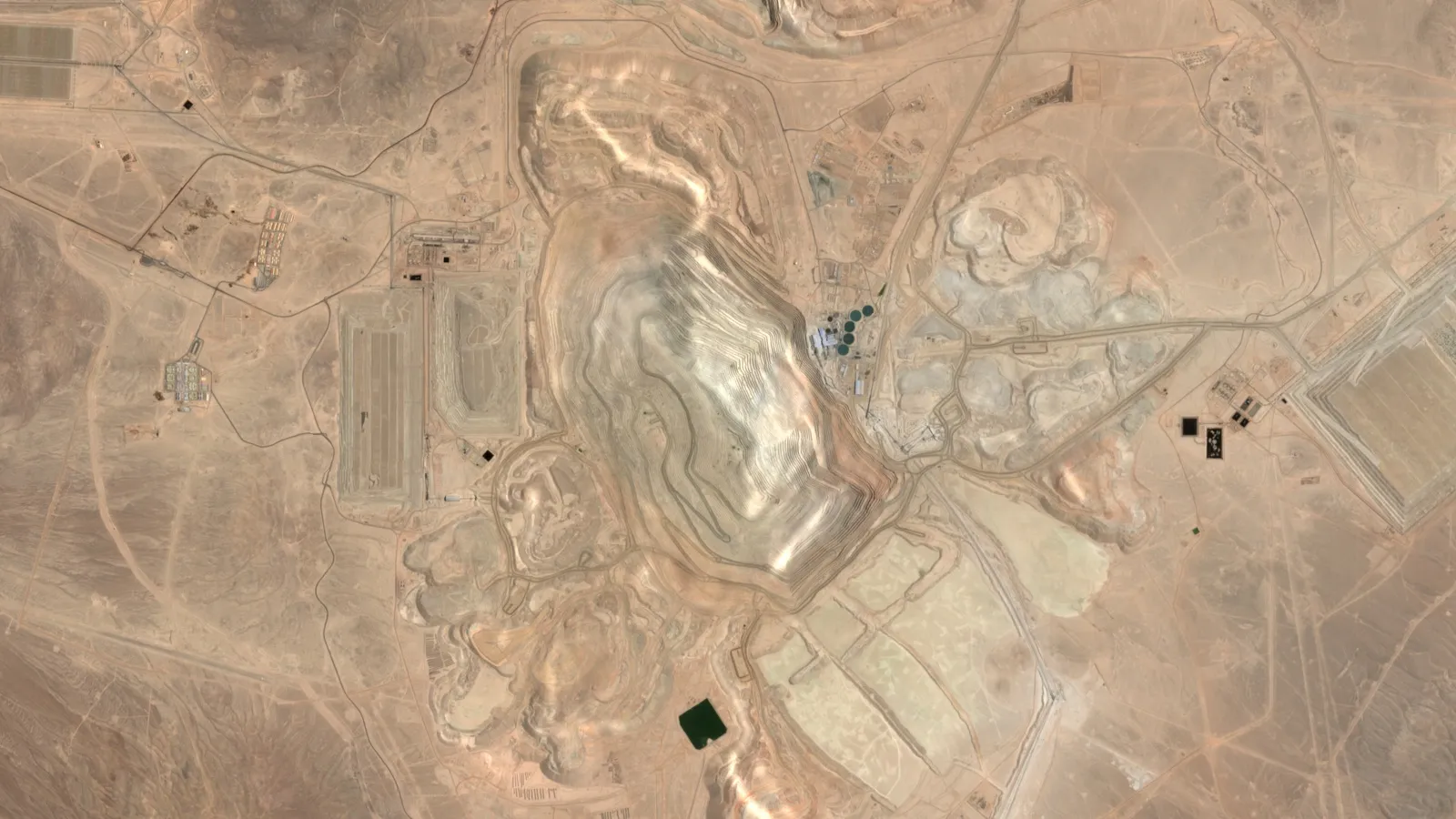
- Escondida (Chile) produced 1,261.2 kt of copper in the year to 30 June 2026 on a 100% basis, down 3%; BHP guides 1,000 to 1,100 kt for the next year (BHP, July 2026).
- Kamoa-Kakula (DR Congo) made 388,838 t of copper in concentrate in 2025; Q2 2026 mill feed was 2.39% Cu at 87.4% recovery (Ivanhoe Mines, July 2026).
- Morenci (Arizona) mills ore at 0.31% Cu and leaches ore down to 0.18% Cu in reserve; output was about 0.7 billion lb in 2025 (Freeport-McMoRan 10-K, 2026).
- Oyu Tolgoi (Mongolia) made 345 kt in 2025, up 61%, and ran at about 450 kt a year in Q3 2026 against a 500 kt target (Rio Tinto, 2026).
- Chile mined about 5.3 Mt and the DR Congo 3.2 Mt of the world’s roughly 23 Mt of copper in 2025 (USGS, 2026 estimates).
In this article
- Which copper mines make the best case studies
- Five copper mines compared at a glance
- Where these mines sit in world copper supply
- Escondida, Chile: scale, seawater and a new concentrator
- Kamoa-Kakula, DR Congo: high grade, an on-site smelter and solar power
- Morenci, Arizona: low-grade ore, a huge fleet and leaching gains
- Oyu Tolgoi, Mongolia: an underground mine ramping up
- Kansanshi, Zambia: adding a third processing line to an old mine
- What the five mines teach about copper project success
- Check a copper mine's output and margin yourself
- Using satellite images to study a copper project
- Frequently asked questions
Five copper mines make clear case studies: Escondida in Chile, Kamoa-Kakula in the DR Congo, Morenci in Arizona, Oyu Tolgoi in Mongolia and Kansanshi in Zambia. Between them they cover the main ways a mine can succeed: sheer scale, very high grade, low-grade ore recovered by leaching, a rapid underground ramp-up, and a new processing line added to an old mine. Chile, the DR Congo and the United States, home to the first three, mined about 9.5 million tonnes of copper in 2025 out of a world total of roughly 23 million tonnes, according to the U.S. Geological Survey (USGS, 2026 estimates).
This page uses company filings and results from 2025 and 2026, not press summaries. Each section gives the latest dated output, what the mine did differently, and what a reader can copy or check. A worked calculator near the end lets you test the same arithmetic on your own project. These are third-party mines. None of them is a Farmonaut project.
Which copper mines make the best case studies
We picked mines that report their numbers every quarter, so each claim below can be checked against a filing. Together they span five countries and five operators (BHP, Ivanhoe and Zijin, Freeport-McMoRan, Rio Tinto and First Quantum), with open-pit and underground mines and both concentrate and leach-cathode routes. We left out mines that have been shut for long periods, because a case study of success needs a mine that is producing.
We judged each mine on four measures: tonnes of copper produced, ore grade, unit cost, and how it handles its biggest constraint (water, power, depth or ore hardness). Some terms you will see:
- Grade is the share of copper in the rock, written as a percentage. A grade of 1% means 10 kilograms of copper in every tonne of ore.
- Concentrate is the copper-rich powder made by crushing, grinding and floating the ore. It is sold to a smelter. Cathode is nearly pure copper sheet made by leaching and electrowinning, or by refining.
- Heap or run-of-mine (ROM) leaching sprays weak acid on piles of broken rock to dissolve copper, which suits low-grade ore.
- C1 cash cost is the direct cost of mining, processing and shipping a pound of copper, after by-product credits such as gold or acid. It excludes most capital spending, so compare it only with the same definition.
Five copper mines compared at a glance
The figures use different reporting periods and bases, so read each row on its own. “100% basis” means the whole mine, not only one owner’s share.
Chart
Annual copper output, earlier year to latest year
Thousand tonnes. Escondida: years to June 2025 and 2026 (100% basis). Oyu Tolgoi: 2024 and 2025. Kansanshi: 2024 and 2025
| Mine | Country | Latest output | Grade or ore note | What to study |
|---|---|---|---|---|
| Escondida | Chile | 1,261 kt copper, year to June 2026 (100% basis) | Lower grade expected in the next year | Seawater supply, leaching, new concentrator |
| Kamoa-Kakula | DR Congo | 388,838 t copper in concentrate, 2025 | 2.39% Cu mill feed, Q2 2026 | On-site smelter, solar power, ramp-up plan |
| Morenci | USA (Arizona) | About 0.7 billion lb (roughly 320 kt), 2025, 100% basis | 0.18% to 0.45% Cu in reserves | Mill plus leach, huge fleet, leaching gains |
| Oyu Tolgoi | Mongolia | 345 kt copper in concentrate, 2025 | Underground ore, higher grades in 2026 | Underground ramp-up toward 500 kt a year |
| Kansanshi | Zambia | 181 kt copper, 2025 | S3 line fed by stockpiles and fresh ore | Adding a line to an old mine |
Where these mines sit in world copper supply
Chile alone mined about 5.3 million tonnes in 2025, close to a quarter of the world total, and the DR Congo mined about 3.2 million tonnes, both USGS estimates. The United States mined about 1.0 million tonnes, and USGS reports that Arizona, home of Morenci, produced about 70% of it. Zambia produced about 0.94 million tonnes. Oyu Tolgoi’s country, Mongolia, is not listed separately by USGS and falls inside “other countries”.
Chart
Copper mine production by country, 2025 estimate
Thousand tonnes of contained copper; selected countries
Supply growth is modest. The International Copper Study Group (ICSG) expects world mine output to grow 1.6% in 2026 and 2.3% in 2027, and lists the ramp-up of Oyu Tolgoi among the main sources of that growth. It also notes that output at Kamoa and Grasberg is still held back by major incidents in 2025. That is why the case studies below focus on what each operator did to keep output growing.
Escondida, Chile: scale, seawater and a new concentrator
Escondida, in the Atacama Desert, is described by BHP as the world’s largest copper asset. It produced 1,261.2 kt of copper on a 100% basis in the year to 30 June 2026, down 3% from 1,304.9 kt a year earlier, in BHP’s operational review. On the USGS world total that is roughly 5% of global mine output, though the periods differ (BHP’s financial year against USGS’s calendar 2025).
Water. The mine sits in one of the driest places on Earth. Its supply comes from seawater desalination plus a long pumping system. The engineering firm CDM Smith, which supported the owner’s team on the expansion, says the project added 833 litres per second, bringing production to 3,333 litres per second, and upgraded four pumping stations. The aim is less reliance on aquifers.
Ore and leaching. BHP guides Escondida to 1,000 to 1,100 kt in the year to June 2027, against a guided range of 1,200 to 1,275 kt for the year just ended. In its 2026 results, BHP says the full “SaL” leaching technology, which BHP describes as its own proprietary leaching technology, is deployed at Escondida. In its half-year results, Rio Tinto, which also reports Escondida output, says lower concentrate output from the expected grade decline was partly offset by higher refined copper from better leaching.
What it shows. A big mine plans for falling grade years ahead. BHP’s presentation puts a new concentrator on track for first production in calendar 2031 to 2032, with a final investment decision targeted for 2027 to 2028 and about US$0.5 billion of pre-commitment funding approved. The same slides put Escondida’s unit cost (C1 plus sustaining capital) at about US$1.65 per lb against about US$3.03 for a marginal (90th percentile) producer, using Wood Mackenzie’s 2026 nominal-basis estimates shown in the slides. Low cost is what lets scale pay. For more on this operation, see our earlier look at Escondida’s technology and water choices.
▶ Explains why electric vehicles need so much copper and follows it back to the Atacama pits, including Escondida. · 6:03
Kamoa-Kakula, DR Congo: high grade, an on-site smelter and solar power
Kamoa-Kakula is an underground copper complex on the DRC Copperbelt. Ivanhoe Mines and Zijin Mining each hold an indirect 39.6%, a small holder has 0.8%, and the DRC government holds 20%. Ivanhoe reports a full-time workforce of 7,481, of whom over 90% are Congolese.
Output and grade. The complex produced 388,838 tonnes of copper in concentrate in 2025. In the second quarter of 2026 its three concentrators milled 2.97 million tonnes of ore at a feed grade of 2.39% copper and 87.4% recovery, making 61,134 tonnes of copper in concentrate, according to Ivanhoe’s quarterly release. Ivanhoe’s 2026 guidance is 290,000 to 310,000 tonnes of copper in anode, blister or slag concentrate (a different basis from the 2025 concentrate figure), 380,000 to 420,000 tonnes for 2027, and about 500,000 tonnes a year from 2028. The mining rate at the Kamoa mines is planned to rise 30% to about 8.5 million tonnes a year in the second half of 2026.
Smelter and power. An on-site smelter with a design capacity of 500,000 tonnes of copper a year ran at about 60% of design in 2026, limited by concentrate feed, and made 112,307 tonnes of sulphuric acid in the quarter that is sold to nearby mines. A 60-megawatt solar plant with battery storage was being commissioned in mid-2026, and Ivanhoe plans to double on-site solar capacity to 120 MW by the end of 2027. C1 cash cost was US$2.84 per lb in the second quarter and US$2.70 for the half-year.
What it shows. High grade helps a mine’s cost per pound, and a smelter on site keeps more of the value in the country, but output depends on steady underground development. Ivanhoe reports development rates at Kamoa and Kakula each quarter, and the 2028 target rests on them.
Morenci, Arizona: low-grade ore, a huge fleet and leaching gains
Morenci, in Greenlee County, has been in continuous operation since 1939. Freeport-McMoRan (FCX) holds 72% and Sumitomo companies hold 28%, and each partner takes its share of the output in kind, according to FCX’s annual report for 2025. The report puts 2025 output at about 0.7 billion pounds of copper and 7 million pounds of molybdenum, counting the partners’ share.
Chart
Ore grades at Kamoa-Kakula and Morenci
Percent copper. Kamoa-Kakula: mill feed, Q2 2026. Morenci: proven and probable reserve average, end of 2025
The deposit is a porphyry copper system (large, low-grade copper in rock around an intrusion) with oxide, secondary sulphide and primary sulphide ore. The site runs two concentrators with a design capacity of 132,000 tonnes of ore a day, a crushed-ore leach pad that handles 72,500 tonnes a day, run-of-mine leaching, and three electrowinning tank houses with a capacity of about 900 million lb of cathode a year. The fleet counts 141 trucks of 235 tonnes, three of 372 tonnes and 13 electric shovels, and can move about 803,000 tonnes of material a day.
The grades explain the design. At the end of 2025 the reserve was 969 million tonnes of mill ore at 0.31% copper with 82.8% recovery, 112 million tonnes of crushed-leach ore at 0.45% (82.9% recovery) and 2,497 million tonnes of run-of-mine leach ore at 0.18% with 51.6% recovery. Compare that with Kamoa-Kakula’s 2.39% mill feed in the chart below. The grades are reserve averages for Morenci and a quarterly mill-feed figure for Kamoa, so the chart shows the order of magnitude, not an exact like-for-like.
What it shows. Low-grade ore can still pay when it is leached cheaply. FCX says leaching and technology initiatives across its U.S. and South American mines added 47 million lb of copper in the second quarter of 2026 and 101 million lb in the first half, and it targets an annual run rate of 300 million lb by the end of 2026. It is testing an internally developed additive at Morenci at large scale. One risk the filing flags is water: FCX is party to litigation that could affect its water rights at the site. Our post on Freeport-McMoRan’s copper operations covers the wider company.
Oyu Tolgoi, Mongolia: an underground mine ramping up
Oyu Tolgoi is run by Rio Tinto, which holds 66% of the project. Rio Tinto reported its underground development project complete by the end of 2025, and output has risen sharply since: 345,000 tonnes of copper in concentrate in 2025, up 61% on 2024 (Rio Tinto, fourth-quarter 2025 production report). In the third quarter of 2026 Rio Tinto said production rose 29% in the year to date, with the mine running at about 450 kt a year.
Rio’s half-year report ties the gain to the ramp-up of underground operations, higher grades and better recoveries, and says a productivity programme raised drawbell development rates (the openings from which caved ore is drawn) by 15%. The long-term target is an average of 500 kt a year from 2028 to 2036. Mine development is moving through Panels 0, 2 North and 2 South, and Panel 1 is expected to be last, after the Government of Mongolia agreed to start work on the Entrée licence transfer. During the first half Oyu Tolgoi also paid US$443 million after a Mongolian tax assessment for 2021 and 2022, reserving its right to dispute it. A trial of eight 91-tonne battery-swappable haul trucks with a Chinese partner, begun in October 2025, had reached its half-way point.
What it shows. Large underground mines take years to reach their nameplate rate, and the final steps depend on licences and tax terms as much as on engineering.
Kansanshi, Zambia: adding a third processing line to an old mine
Kansanshi, operated by First Quantum Minerals, produced 181 kt of copper in 2025, 10 kt more than in 2024. The new S3 circuit, a large SAG-mill (semi-autogenous grinding) processing line, made first concentrate in August 2025 and contributed 25 kt that year. First Quantum declared commercial production on 1 December 2025, with milling rates and operating time above 80% of design and recovery above 80%. It expects S3 to contribute over 84 kt of copper in 2026.
In the second quarter of 2026, Kansanshi produced 43,997 tonnes at a C1 cash cost of US$2.16 per lb, and S3 ran above design capacity, with its highest monthly rate in May, First Quantum reports. Feed comes largely from lower-grade stockpiles, with harder, higher-grade ore from the South East Dome being introduced gradually. The 2026 guidance for Kansanshi is 175,000 to 205,000 tonnes of copper and 110,000 to 120,000 oz of gold.
Power is a constraint. In the second quarter of 2026 about 80% of First Quantum’s Zambian power came from imports and independent power producers, and about 20% from the state utility ZESCO. In mid-2026 the company reported progress on a wind and solar project it intends to buy power from, and on a grid-stability installation at Kansanshi that starts on site in early 2027. What it shows: a new line on an old mine can be completed under budget, and stockpiles already on site can become its feed.
What the five mines teach about copper project success
- Plan for falling grade. Escondida’s guidance drops to 1,000 to 1,100 kt for the year to June 2027 while the new concentrator is prepared. Kamoa-Kakula’s feed grade is well above Morenci’s reserve averages, but each project plans around the grade it has.
- Secure the scarce input. Water at Escondida, power at Kansanshi and Kamoa-Kakula, and water rights at Morenci each decide whether the mine can run at full rate.
- Ramp-ups take years. Oyu Tolgoi is still moving from 345 kt toward 500 kt a year. Kansanshi S3 went from first concentrate to commercial production in about four months.
- Squeeze more from ore already mined. Leaching initiatives at FCX and Escondida add copper without new pits.
- Count the full chain. Kamoa-Kakula’s smelter and acid sales show that by-products and downstream steps change both revenue and cost.
- Check the terms. Licence transfers, taxes and ownership shares (Mongolia, the DRC, Zambia) shape returns as much as grade does.
▶ Walks through the seven environmental impacts of mining in plain words. · 2:31
Check a copper mine’s output and margin yourself
You can test a company’s numbers with ore milled, grade and recovery. For Kamoa-Kakula in the second quarter of 2026: 2,968 thousand tonnes of ore multiplied by 2.39% grade and 87.4% recovery gives about 62,000 tonnes of copper, close to the 61,134 tonnes Ivanhoe reported (the small gap comes from rounding and from averaging grade and recovery across the three concentrators). The calculator below does the same sum for your own ore, adds a payable share, a price and a C1 cost, and shows the cash margin before sustaining capital, royalties and tax.
Calculator
How much copper does your mill make, and what is the cash margin?
Enter your own ore, grade, recovery, price and cost. Results update as you type.
- Payable copper (million lb): 436.8
- Revenue per year: $2,184,161,126
- C1 cash cost per year: $1,092,080,563
- Cash margin per year: $1,092,080,563.20
- Cash margin per lb: $2.50
Example values only, not benchmarks or forecasts. The copper price is an input: use today’s price. Payable share is the part of the contained copper a smelter pays for, set by your sales contract. Cash margin = payable pounds x (price – C1 cost); it excludes sustaining capital, royalties and tax. One tonne = 2,204.62 lb. Money in US$.
Using satellite images to study a copper project
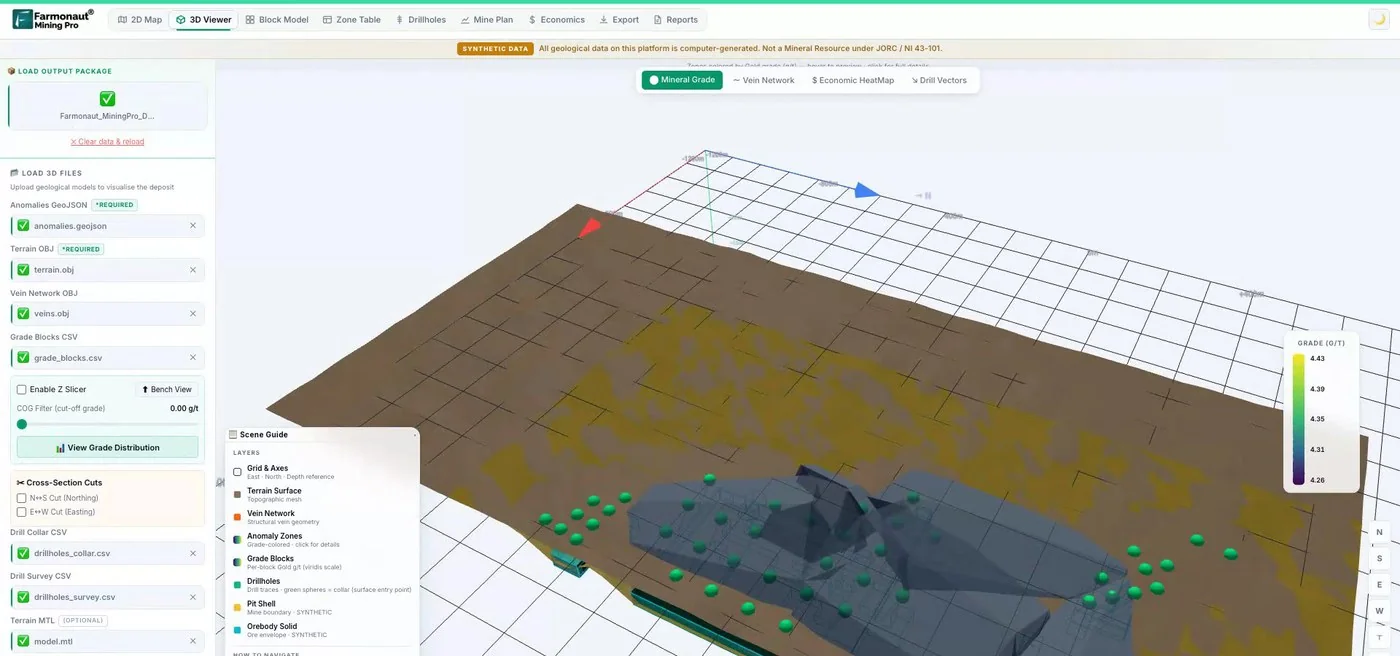
Before drilling or site visits, satellite images can show alteration zones, faults and iron-stained rock, which exploration geologists use as clues. Farmonaut screens an area from a KML, KMZ or polygon, and copper is on its list of detectable minerals. Delivery takes 5 to 20 business days depending on size, and the output is an exploration target, not a resource estimate.
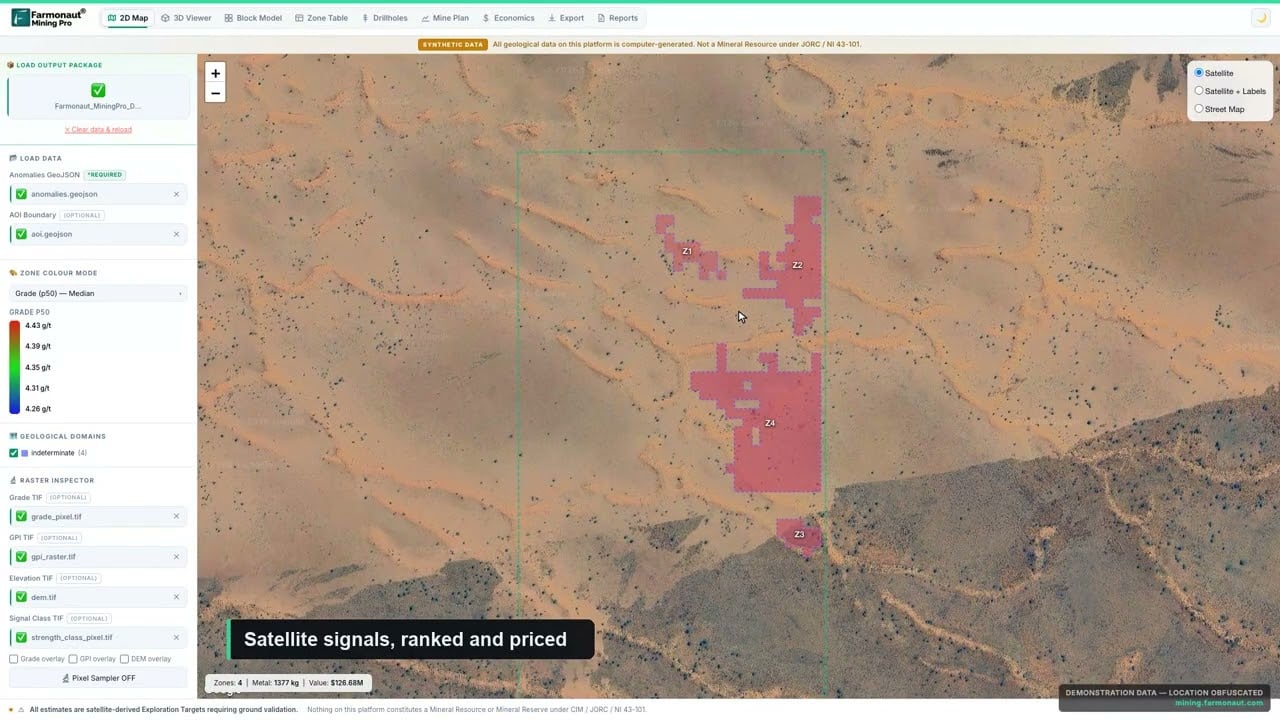
▶ A short look at Farmonaut Mining Pro, which turns a licence boundary into a geological and economic picture. · 4:56
Frequently asked questions
What is the largest copper mine in the world?
BHP calls Escondida in Chile the world’s largest copper asset. It produced 1,261.2 kt of copper in the year to June 2026 on a 100% basis.
Which country produces the most copper?
Chile, at about 5.3 million tonnes of mine output in 2025, followed by the DR Congo at about 3.2 million and Peru at about 2.7 million (USGS, 2026 estimates).
What makes a copper mining project successful?
The case studies above point to four tests: steady output against guidance, a unit cost below the marginal producer, a secure supply of water and power, and a plan for falling grade. Social licence and fair terms with the host government matter too, because they decide whether the mine can keep operating.
What is a good copper ore grade?
There is no single answer. Kamoa-Kakula’s mill feed was 2.39% in the second quarter of 2026, while Morenci’s reserve grades run from 0.18% to 0.45%. Low-grade ore works at Morenci because the pit is huge, the ore is leached cheaply and the infrastructure is already in place.
How much copper does Kamoa-Kakula produce?
It produced 388,838 tonnes of copper in concentrate in 2025. Ivanhoe’s 2026 guidance is 290,000 to 310,000 tonnes of copper in anode or blister, rising to 380,000 to 420,000 tonnes in 2027.
Who owns Morenci?
Freeport-McMoRan owns 72% as an undivided joint-venture interest. Sumitomo Metal Mining Arizona holds 15% and SMM Morenci holds 13%.
How long does a new copper mine take to reach full output?
It varies. Kansanshi’s S3 line took about four months from first concentrate in August 2025 to commercial production on 1 December 2025. Oyu Tolgoi’s underground, complete by the end of 2025, is still ramping toward its 500 kt a year target.
What is the difference between copper concentrate and cathode?
Concentrate is a copper-rich powder that must still be smelted and refined. Cathode is nearly pure copper made by leaching and electrowinning or by refining, and can be sold to wire and tube makers directly. Morenci makes both.
What does C1 cash cost mean?
It is the direct cost of producing a pound of payable copper after by-product credits. Kamoa-Kakula reported US$2.84 per lb in the second quarter of 2026 and Kansanshi US$2.16 per lb, each on the company’s own definition.
Where can I find real data for a mining case study?
Start with the operator’s quarterly results and annual report, which are filed on ASX, SEDAR+ or SEC EDGAR. U.S. companies also publish technical report summaries for their largest mines, and Canadian companies file NI 43-101 technical reports. USGS publishes country totals every February.
Are these Farmonaut case studies?
No. They are public mines run by other companies, and Farmonaut did not work on them. Farmonaut’s own work starts earlier, at the exploration stage.
This page is for information only. It is not investment advice. Production figures are company-reported for the periods shown, and operating results change each quarter.
Farmonaut mining
Map your mining site from space
Send a KML, KMZ or polygon and Farmonaut screens the area from satellite images before field crews go in.
Mining Pro sample view, synthetic data
Keep reading
Sources
- USGS, Mineral Commodity Summaries 2026: Copper (February 2026): pubs.usgs.gov
- ICSG, Copper Market Forecast 2026/2027 (23 April 2026): icsg.org
- BHP, FY2026 Results Presentation (18 August 2026): announcements.asx.com.au
- BHP, Operational review for the year ended 30 June 2026 (16 July 2026): announcements.asx.com.au
- BHP, Operational review for the year ended 30 June 2025 (18 July 2025): announcements.asx.com.au
- CDM Smith, Escondida desalination expansion project: cdmsmith.com
- Rio Tinto, 2026 half-year results: riotinto.com
- Rio Tinto, third quarter 2026 production results (14 October 2026): riotinto.com
- Rio Tinto, fourth quarter 2025 production results (21 January 2026): announcements.asx.com.au
- Ivanhoe Mines, 2025 production results and 2026 guidance (15 January 2026): newsfilecorp.com
- Ivanhoe Mines, Q2 2026 Kamoa-Kakula production (8 July 2026): newsfilecorp.com
- Ivanhoe Mines, 2026 second-quarter financial results (29 July 2026): tradingview.com
- Freeport-McMoRan, Form 10-K for 2025: s22.q4cdn.com
- Freeport-McMoRan, second-quarter 2026 results (23 July 2026): s22.q4cdn.com
- First Quantum Minerals, 2025 preliminary production and 2026-2028 guidance: first-quantum.com
- First Quantum Minerals, fourth quarter 2025 results: first-quantum.com
- First Quantum Minerals, second quarter 2026 results: first-quantum.com
Discussion
Questions, corrections or field experience? Share them below. First-time comments are reviewed before they appear, and your email is never published.
No comments yet. Be the first to add a question or your experience.

 Qader Group
 Ileys General Trading
 SG Gold Mining LLC
 VRV Global Pte Ltd
 Omsri International FZE
 G.I.T.T.
 Jaunita Erss Ltd
 Almosi SARL
 SRK Consulting
 Berks Gold Limited
 Mwerezi Minerals Company Limited
 Mining SARL
 SenGold Invest SAS
 Sean Mining Limited
 NTS Group (Pty) Ltd
 Mine4Africa
 Lithspo Minerals Limited
 Tintina Mining Group
 Licence holder · Nigeria · Gold + lithium










